|
recaplica
Trigonometry: Sine, Cosine, Tangent and the Basic Formulas | ||||||||||||||||||||||||||||
| © 2026 Recaplica · recaplica.com — All rights reserved | ||||||||||||||||||||||||||||
Trigonometry: Sine, Cosine, Tangent and the Basic FormulasWhat to print Page numbers appear when printing with default margins. SlidesChoose a cut Flash10 slidesThe essential thread, to present in classFull14 slidesEvery chapter and the deeper detailBoth come with speaker notes. In 30 seconds quick readTrigonometry is the branch of math that connects the angles of a triangle to the lengths of its sides. In a right triangle, three basic ratios, sine, cosine and tangent, let you go from a known angle to a measurement you'd otherwise need a tape measure on site to get. The formulas come from the Pythagorean theorem and a handful of special triangles, whose values you can work out without a calculator. It isn't a classroom invention: ancient navigators used it to find their way at sea, draw maps and measure the stars, and today it underpins everything from surveying to astronomy. Key Points
Key figures
Deep DiveWhat is trigonometryTrigonometry is the branch of math that studies the relationship between a triangle’s angles and the length of its sides. The name comes from Greek, “trigonon” (triangle) and “metron” (measure): literally, measuring triangles. According to Encyclopaedia Britannica, the field emerged in the Hellenistic world in the 3rd century BC, when early geometers applied the tools of geometry to problems in astronomy. In algebra you work with letters instead of numbers; here a Greek letter like θ (theta) stands for an angle, and the formulas linking it to the sides work the same way for any right triangle, small or enormous. Until roughly the 16th century, Britannica notes, trigonometry had one central problem: given some parts of a triangle, work out all the others. It’s the same practical goal behind anyone today who surveys a plot of land, plots a course, or observes a star. Right triangle trigonometry: sine, cosine and tangent (SOHCAHTOA)In a right triangle, every acute angle θ has three reference sides: the hypotenuse (the longest side, opposite the right angle), the leg opposite θ, and the leg adjacent to θ. These three sides give the three basic ratios, confirmed in identical terms by Wolfram MathWorld and the OpenStax university textbook:
The initials of the three lines spell SOHCAHTOA, the mnemonic generations of students have used to learn the three definitions. No other numbers are needed to get started: three ratios and one angle are enough. From the Pythagorean theorem to the basic identitiesThe three definitions aren’t independent of each other. Draw a right triangle with a hypotenuse of exactly 1, and the Pythagorean theorem says the sum of the squares of the two legs equals the square of the hypotenuse. Since in that triangle the opposite leg measures sin θ and the adjacent leg measures cos θ, the same equality reads: sin²θ + cos²θ = 1 That’s the Pythagorean identity, the fundamental relationship in trigonometry. Two more identities follow from it: tan²θ + 1 = sec²θ and 1 + cot²θ = csc²θ, where sec, csc and cot are the reciprocals of cosine, sine and tangent. Anyone who has already studied Euclidean geometry will recognize the same Pythagorean theorem here, just applied differently. The special values: 30°, 45°, 60°A handful of angles come up so often that they have exact values, worked out without a calculator. OpenStax derives them from two special triangles: the isosceles 45-45-90, and the 30-60-90, obtained by cutting an equilateral triangle in half.
These are fixed geometric properties, not figures that change over time: you can always redraw the two triangles and check them row by row.
Trigonometry beyond the triangle: stellar parallaxThe same principle works on a cosmic scale. To measure the distance to a nearby star, astronomers observe it twice, six months apart, from opposite sides of Earth’s orbit: the baseline of this enormous triangle is the diameter of that orbit, about 2 astronomical units. Against the backdrop of much more distant stars, the nearby star appears to shift by a tiny angle, stellar parallax, and that angle, through the tangent, gives the distance: d = 1 AU / tan(p), according to Encyclopaedia Britannica. When the parallax angle measures exactly one arcsecond, the corresponding distance is 206,265 astronomical units. That distance has its own name, the parsec, and it’s still the unit astronomers use for stars within our galaxy. Navigation, surveying, and a common mix-up: GPSFor centuries, trigonometry guided anyone who had to find their way without fixed landmarks: triangulation, measuring angles from two known points to work out the position of a third, underlies mapmaking and both sea and air navigation, as well as land surveying. It’s the same principle at work when solving equations for a triangle where only some parts are known. GPS, though, doesn’t work that way. According to GPS.gov, the official U.S. government site for the system, each receiver measures how long a radio signal takes to arrive from at least three satellites, a signal traveling at the speed of light, 299,792,458 meters per second, and turns that time into a distance (Distance = Rate × Time). With distances from three satellites, it pins down a point in space: that’s trilateration, not triangulation, because the calculation starts from distances rather than angles. The same distinction matters for orbits and measurements in the solar system. Slide deckSlides ready to download and make your own in PowerPoint or Google Slides, with speaker notes. Pick the Flash cut or the Full one.     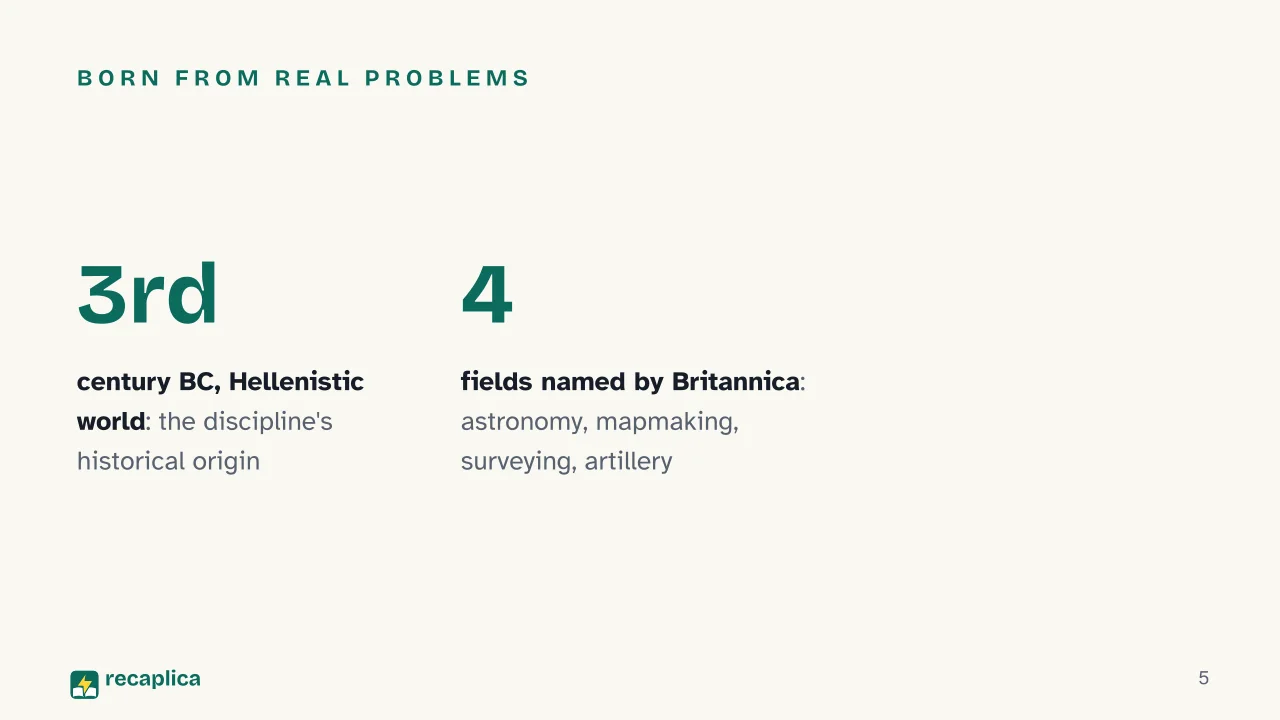 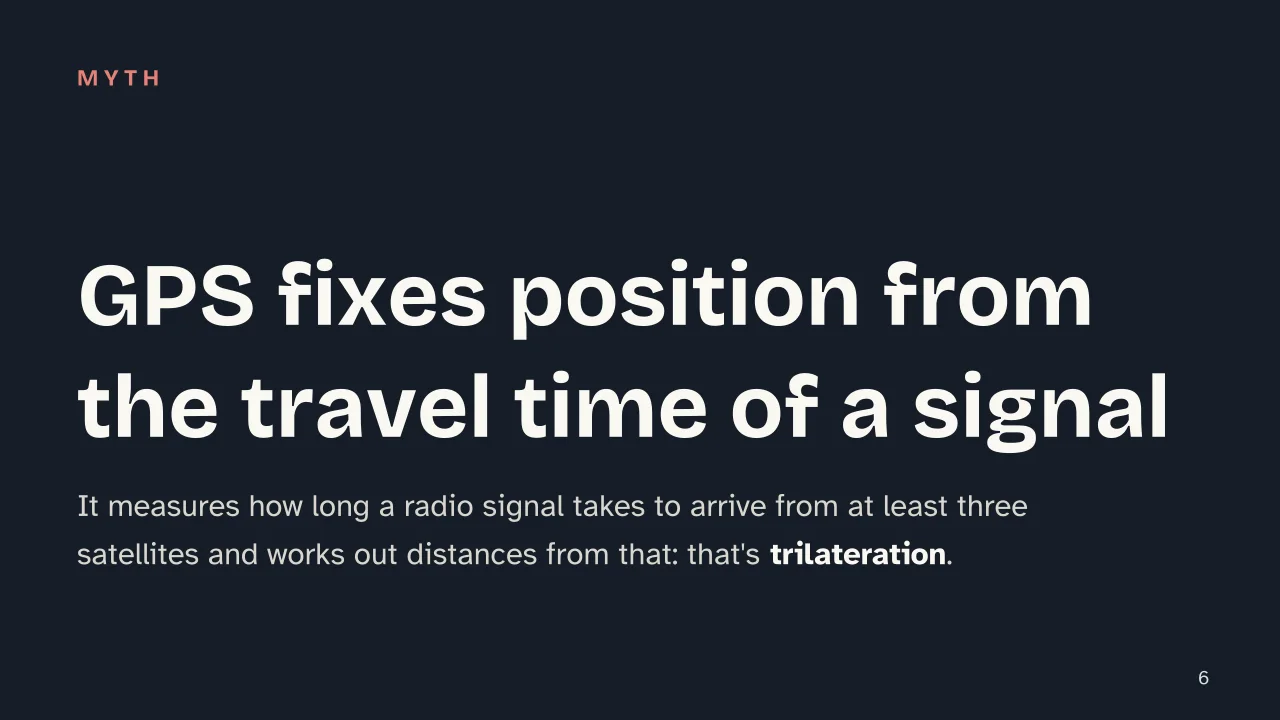  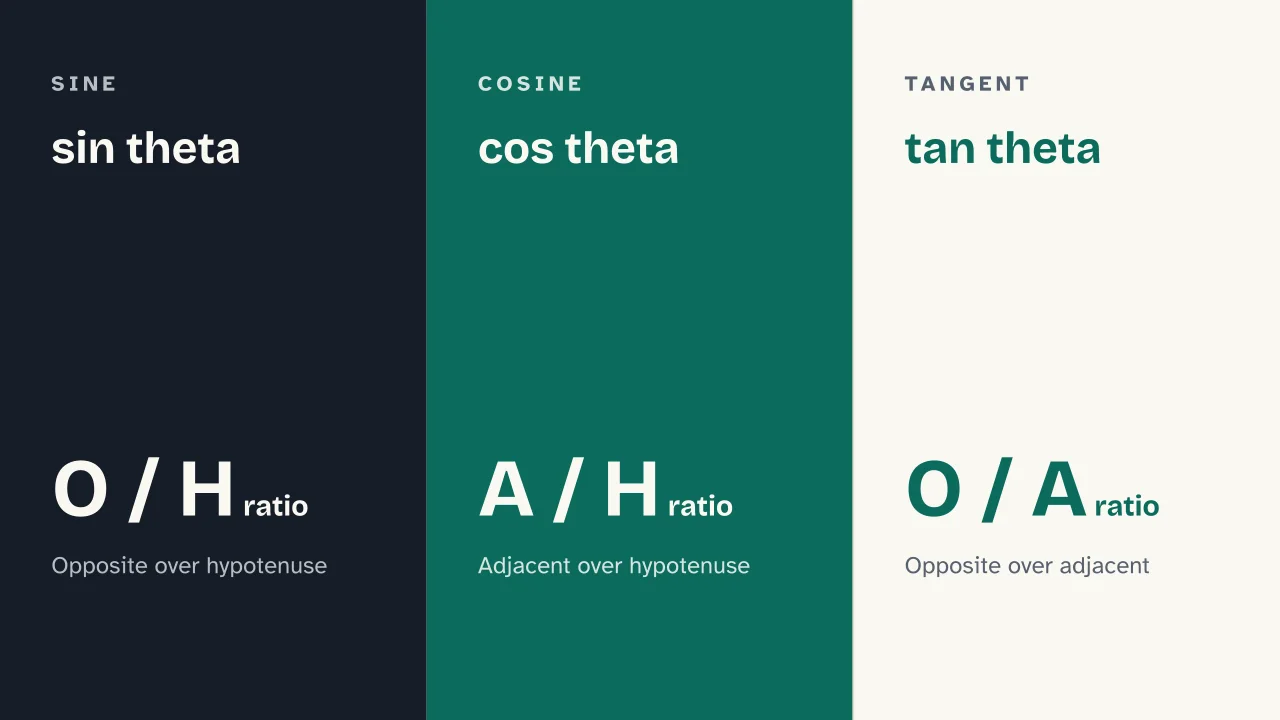  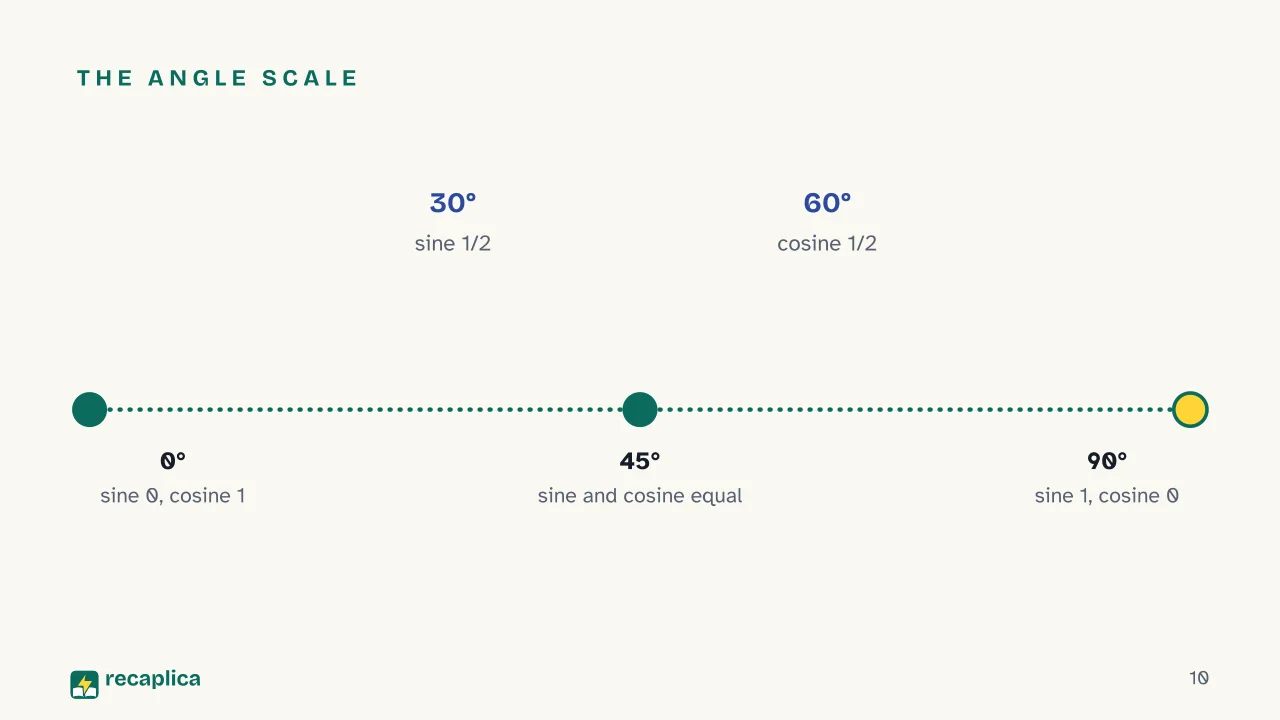  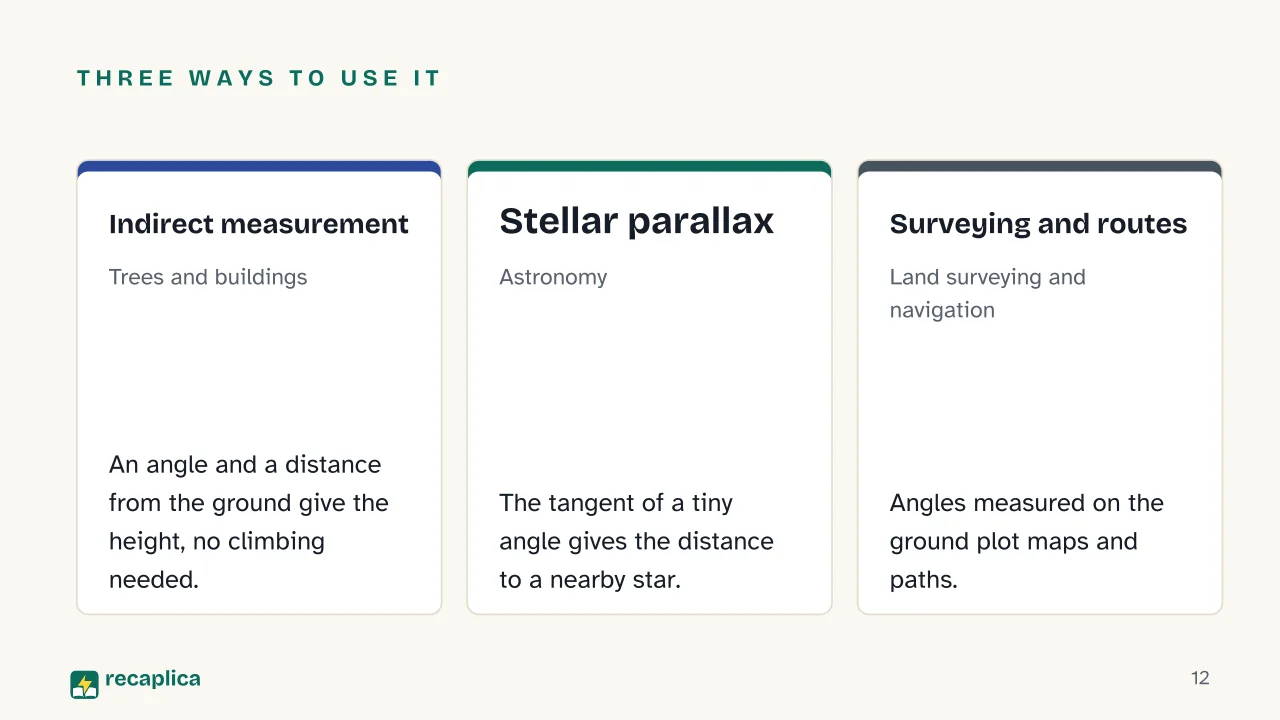 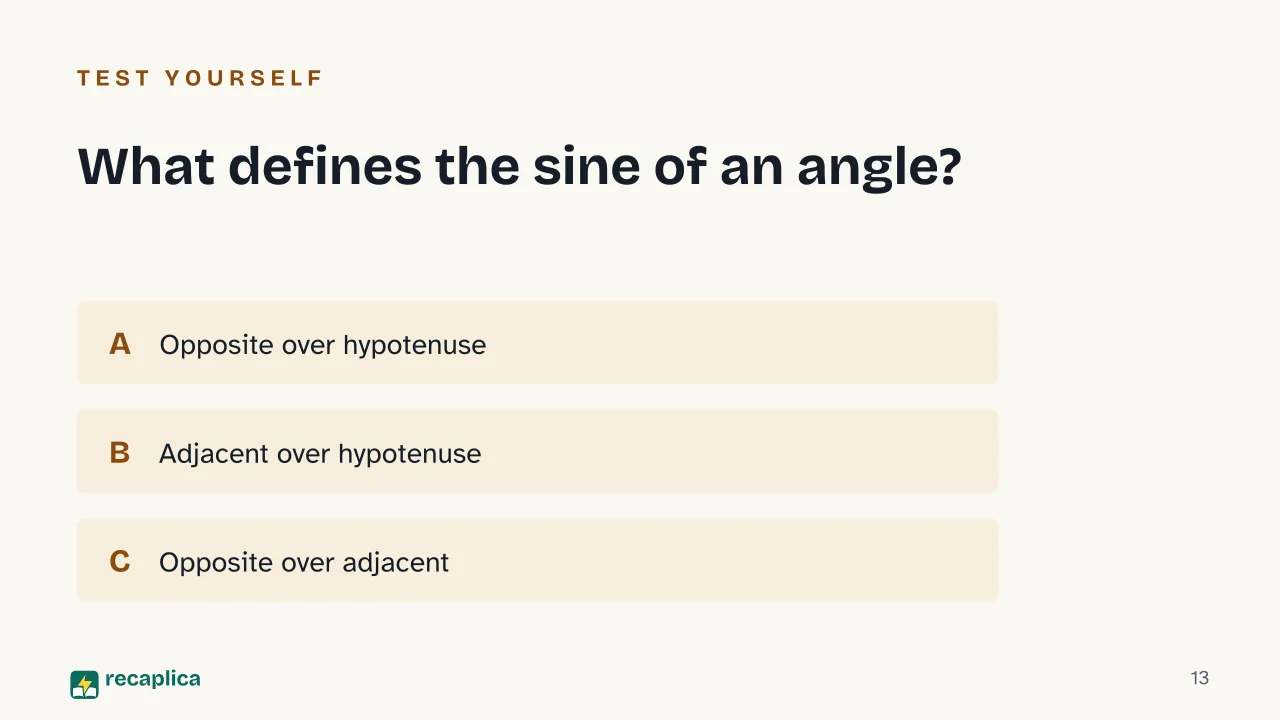  Common myths
Mind mapDrag the background to move around and the nodes to reposition them; use − and + to collapse and expand branches. 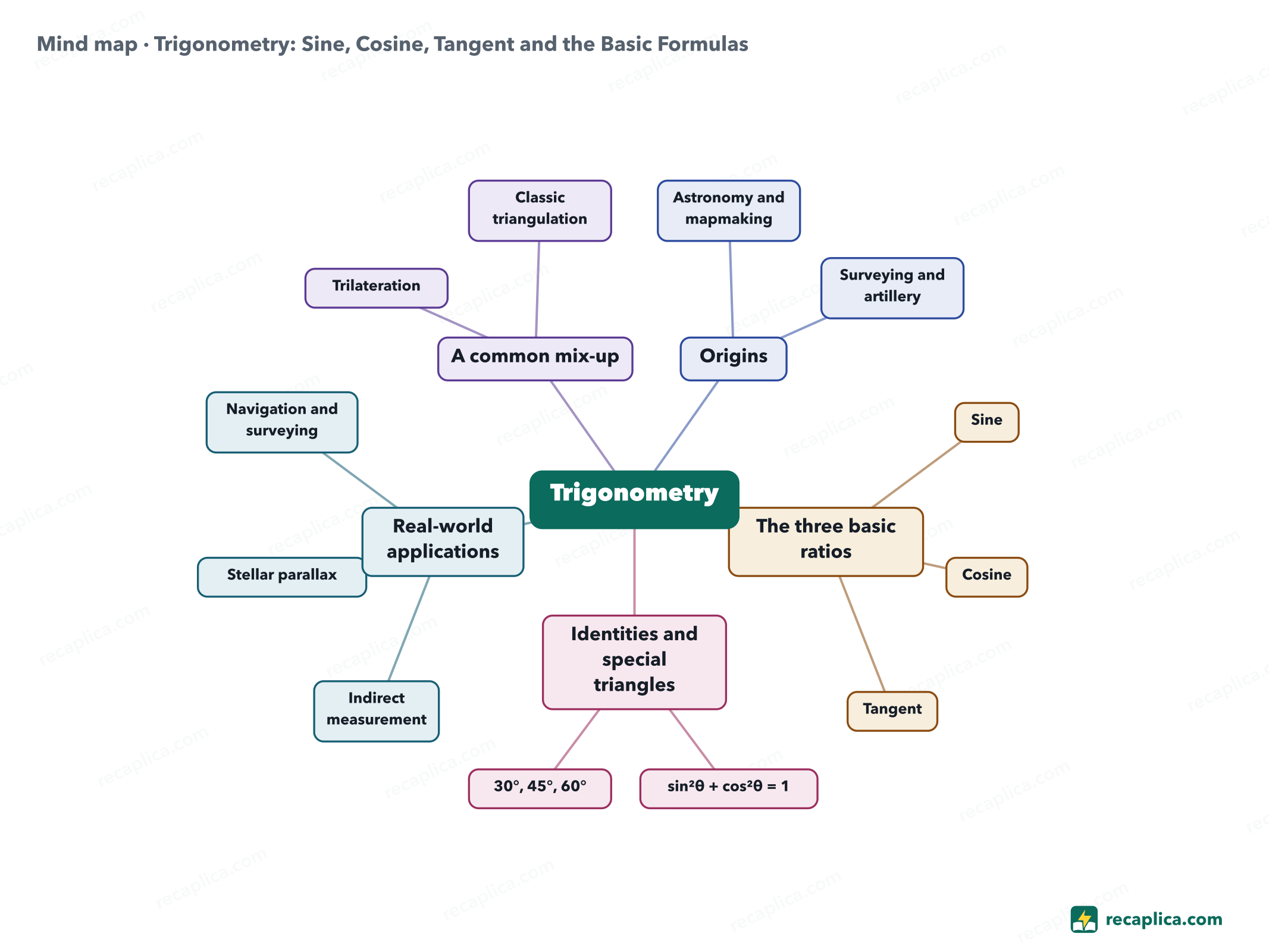
Quiz: test yourselfAnswer the questions to check what you have learned: you get instant feedback and a short explanation. Grade 0/10 0/5
FlashcardsTap the card to flip it and check whether you remember the answer, then move to the next one. 1 / 8 Explain it in your own wordsThe ultimate test: if you can explain it in simple words, you've truly understood it. Write your explanation, then compare it with the Recap. Your explanation is saved only on this device.
Frequently asked questionsWhat is trigonometry, in simple terms?It's the branch of math that connects a triangle's angles to the length of its sides, through the three ratios sine, cosine and tangent. What is trigonometry used for in real life?It measures distances and heights you can't reach directly: the height of a building from the ground, the distance to a nearby star, or, in surveying, the size of a plot of land. What's the difference between sine, cosine and tangent?They're three different ratios between the sides of the same right triangle: sine relates the side opposite the angle to the hypotenuse, cosine relates the adjacent side to the hypotenuse, and tangent relates the opposite side to the adjacent one. How do you calculate the angles of a right triangle?If you know the ratio of two sides, the missing angle comes from the inverse of sine, cosine or tangent (arcsin, arccos, arctan). If you already know one acute angle, the other follows by subtraction, since the three angles of any triangle add up to 180° and one of them is already 90°. Does GPS work through trigonometry?Not in the classic sense. According to GPS.gov it calculates position by trilateration, from measured distances to satellites; traditional triangulation in surveying works from angles instead. Every Recap goes through an independent review before publication. |