Skip to content
recaplica

    One moment: security check

    Cloudflare wants to make sure you're not a robot. Tick the box below and your search will continue on its own.

    IT
    recaplica Light Refraction: What It Is, the Laws Behind It, and Examples
    © 2026 Recaplica · recaplica.com — All rights reserved
    Home › Science

    Light Refraction: What It Is, the Laws Behind It, and Examples

    By Recaplica Newsroom · Updated on October 16, 2026

    What to print

    Page numbers appear when printing with default margins.

    Slides

    Choose a cut

    Flash10 slidesThe essential thread, to present in classFull16 slidesEvery chapter and the deeper detail

    Both come with speaker notes.

    Telegram channel
    recaplica Clear in 30 seconds, yours in 10 minutes.
    In 30 seconds Key points Figures Deep dive Slides Myths Mind map Quiz Flashcards FAQ

    In 30 seconds quick read

    A surface that separates two transparent materials sends some light back, reflecting it, and lets the rest through while bending it toward a new direction. The law of reflection keeps the incoming and outgoing angles equal, both measured from the normal to the surface. Snell's law governs refraction instead, linking the index of each material to how much the ray tilts before and after it crosses over. These two laws alone explain mirrors, lenses, prisms and everyday sights such as a pencil that appears to snap inside a glass of water.

    Key Points

    • The law of reflection keeps the angle of incidence and the angle of reflection, both measured from the normal, equal to each other.
    • Snell's law links the refractive index of two materials to how the ray tilts before and after it enters the new medium.
    • The refractive index compares the speed of light in a vacuum with its speed inside a material: the slower light travels, the higher the index.
    • Past the critical angle, a ray traveling inside a denser material stays trapped inside it: that is total internal reflection, the principle behind fiber optics.
    • A prism splits colors because every wavelength refracts at a slightly different angle: red bends least, blue bends most.
    • Curved mirrors and lenses gather or spread rays toward a single point, the focus, using the same two laws on curved surfaces.

    Key figures

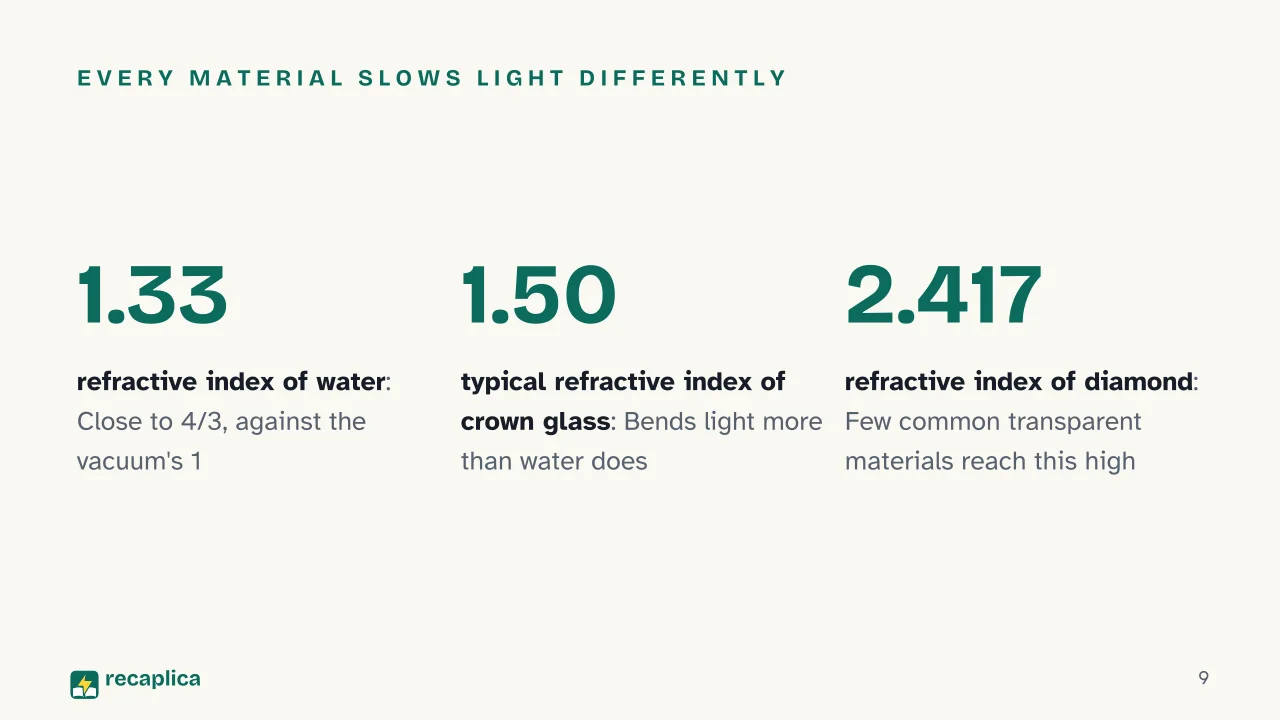
    • 2.417 Refractive index of diamond, among the highest of any common transparent material: it explains why light stays trapped inside the gem for longer before it finally gets out. Source: HyperPhysics, Georgia State University (page consulted in October 2026)
    • 24.4° Critical angle of diamond against air: below this value, a well-cut facet almost never lets light out before it has bounced inside the gem several times. Source: OpenStax University Physics, via Physics LibreTexts, CC BY (page consulted in October 2026)
    • 1.33 Refractive index of water, close to 4/3: it is the value that makes a pencil look broken when half of it sits inside a glass of water. Source: HyperPhysics, Georgia State University (page consulted in October 2026)

    Deep Dive

    Two fates for the same ray

    When a ray of light reaches a surface separating two transparent materials, it does not generally pick just one path. Part of it bounces back into the material it came from: that is reflection. Another part enters the second material, but changes direction on the way in: that is refraction. It happens every time light meets a pane of glass, the water in a pool, or even just the warmer air sitting above a sidewalk.

    These two laws, applied to flat or curved surfaces, explain mirrors and lenses. They also explain prisms, and even a mirage over hot asphalt.

    The law of reflection

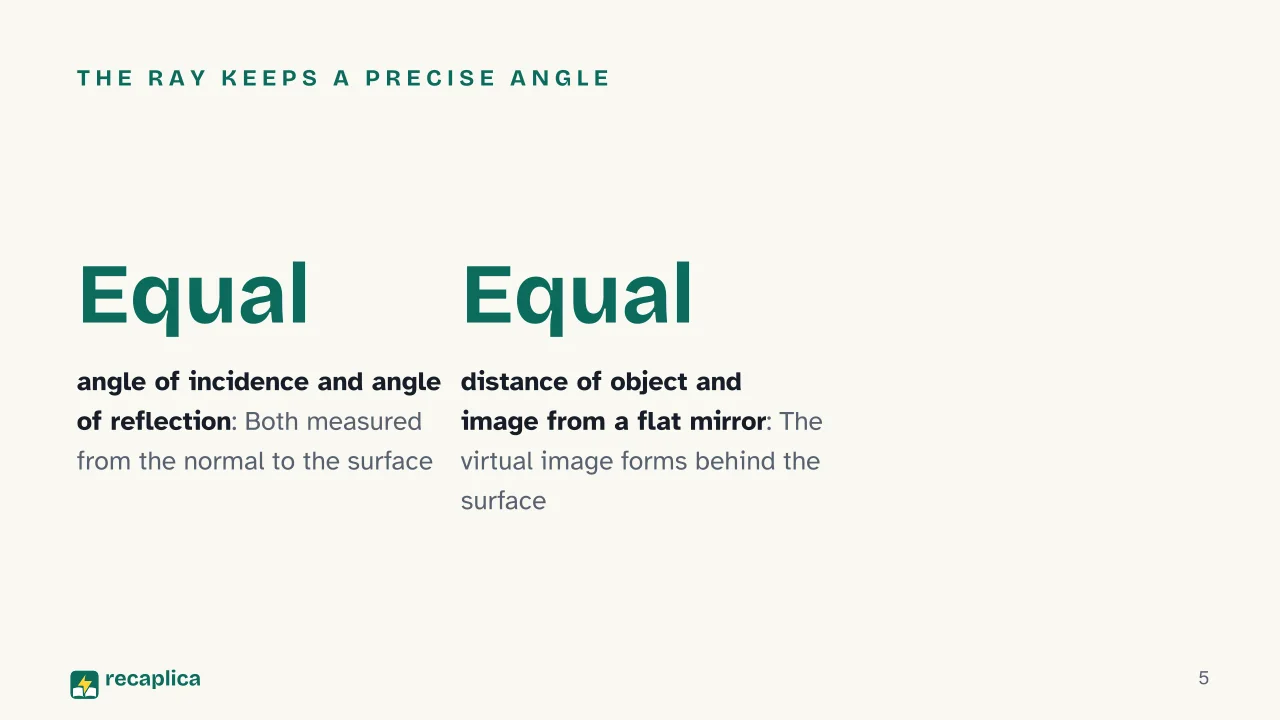
    Reflection is the easier half to measure. The angle of incidence, the angle at which the ray reaches the surface measured from the normal (the perpendicular to the surface at that point), always equals the angle of reflection, the angle at which the ray leaves. This holds on any smooth surface: a mirror, the still water of a lake, a polished floor. On a rough surface, by contrast, light bounces off in many directions at once, an effect called scattering: a sheet of white paper reflects plenty of light, yet it does not work as a mirror, because that light leaves in every direction instead of just one.

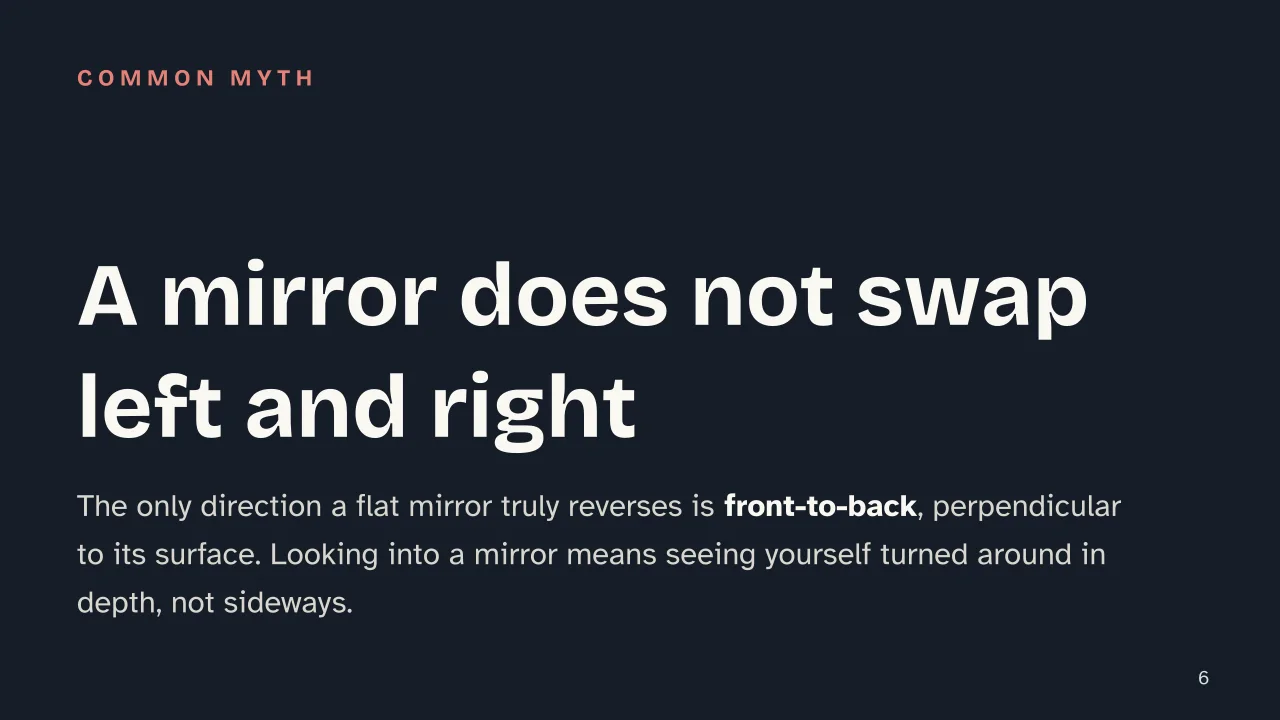
    A flat mirror produces a virtual image that forms at exactly the same distance behind the reflecting surface as the object sits in front of it. It counts as a real image in the sense that it can be photographed and measured, even though it appears at a physical point where the object could never actually be, behind the solid glass of the mirror. Many people believe a mirror swaps left and right: in fact, the only direction a reflecting surface can tell apart geometrically is the one perpendicular to itself, front and back. Looking into a mirror, the image you see is turned around in depth, and the idea of a left-right swap only arises when you picture having to turn around to stand in your reflection’s place.

    Snell’s law and the refractive index

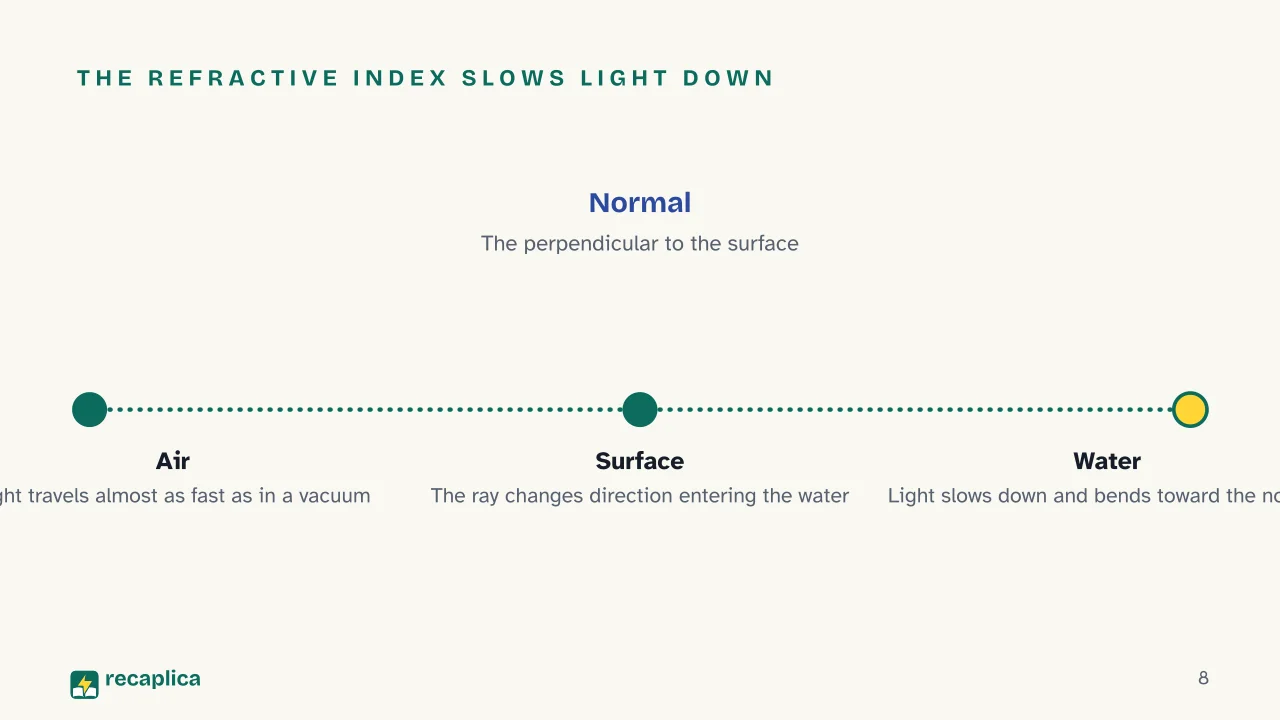
    Refraction is the change in direction of a wave, here light, when it crosses into a material where it travels at a different speed. Snell’s law links the refractive indices of the two materials to the angles the ray makes with the normal, before and after it crosses over: the index of the first material times the sine of the angle of incidence equals the index of the second material times the sine of the angle of refraction. The refractive index of a material, written n, is simply the ratio between the speed of light in a vacuum and its speed inside that material: n = c/v. The more a material slows light down, the higher its index.

    A vacuum has an index of 1.000 by definition, and air sits very close to it, at 1.000277, since it barely slows light at all. Water, around 1.33, slows it down visibly, and crown glass, between 1.50 and 1.62 depending on the type, even more. Diamond reaches 2.417, among the highest values of any common transparent material — a fact that matters again when we come back to its critical angle.

    MaterialRefractive index
    Vacuum1.000
    Air1.000277
    Waterabout 1.33
    Crown glass1.50-1.62
    Diamond2.417

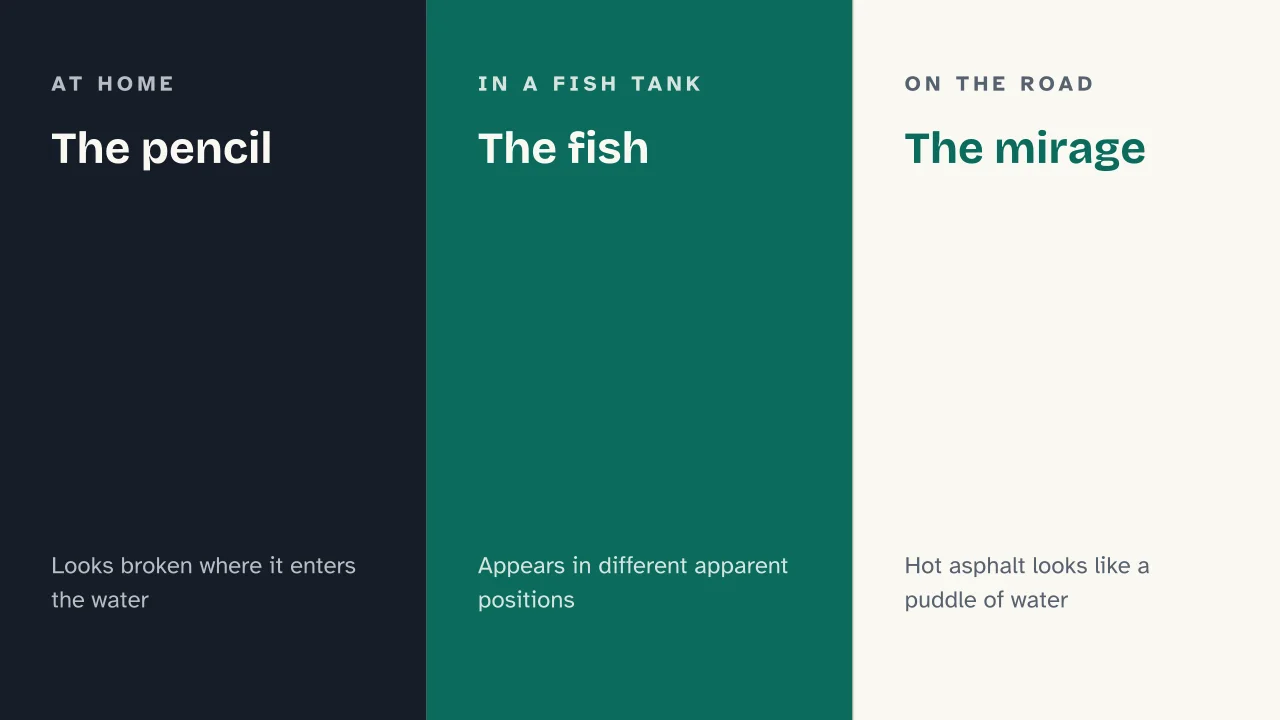
    Real-world example: dip a pencil halfway into a glass of water. Right where the pencil enters the water, it suddenly looks broken or shifted, because the rays of light reaching your eye have changed direction crossing from water into air. The pencil, of course, is straight: it is the path of the light that has bent.

    Real-world example: the same principle explains why a fish in a tank can seem to be in two different spots depending on where you look from. The rays leaving the fish refract right where they leave the water, and the eye traces those rays back in a straight line, with no way of “knowing” they changed direction along the way.

    Checking how a measured angle changes crossing from one material into another is also a small exercise in Thales’ theorem: the triangles formed by the ray, the normal and the surface stay in proportion, and those same proportions show up in the formula behind Snell’s law.

    The critical angle and total internal reflection

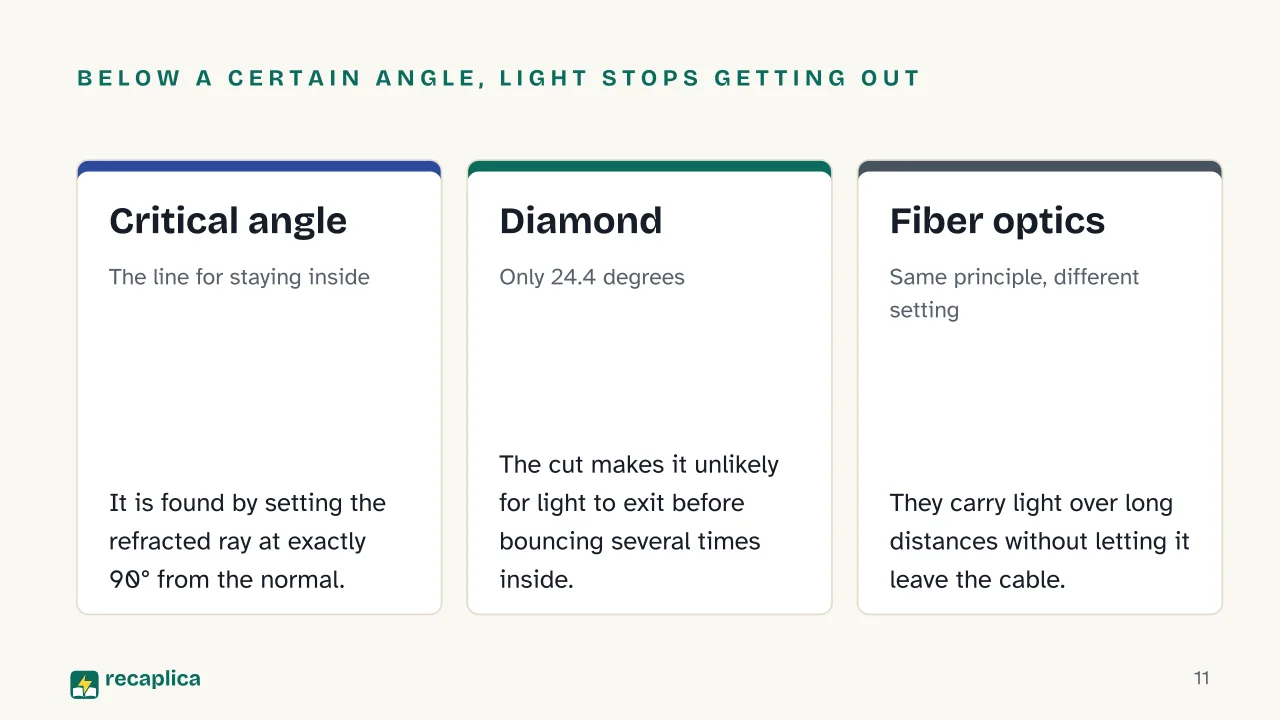
    When light passes from a material with a higher refractive index into one with a lower index, say from water into air, the ray bends away from the normal: it exits more tilted than it was going in. Raising the angle of incidence far enough, a point comes where the refracted ray skims the surface, leaving at 90° from the normal. That angle of incidence is called the critical angle, and it is found by imposing exactly this condition on Snell’s law. Below the critical angle, light never reflects completely: part of it exits refracted, part of it reflects anyway. Only past the critical angle does light stop leaving at all, staying entirely inside the original material: that is total internal reflection, the physical principle behind fiber optics and polarizing prisms (it has its own Recap).

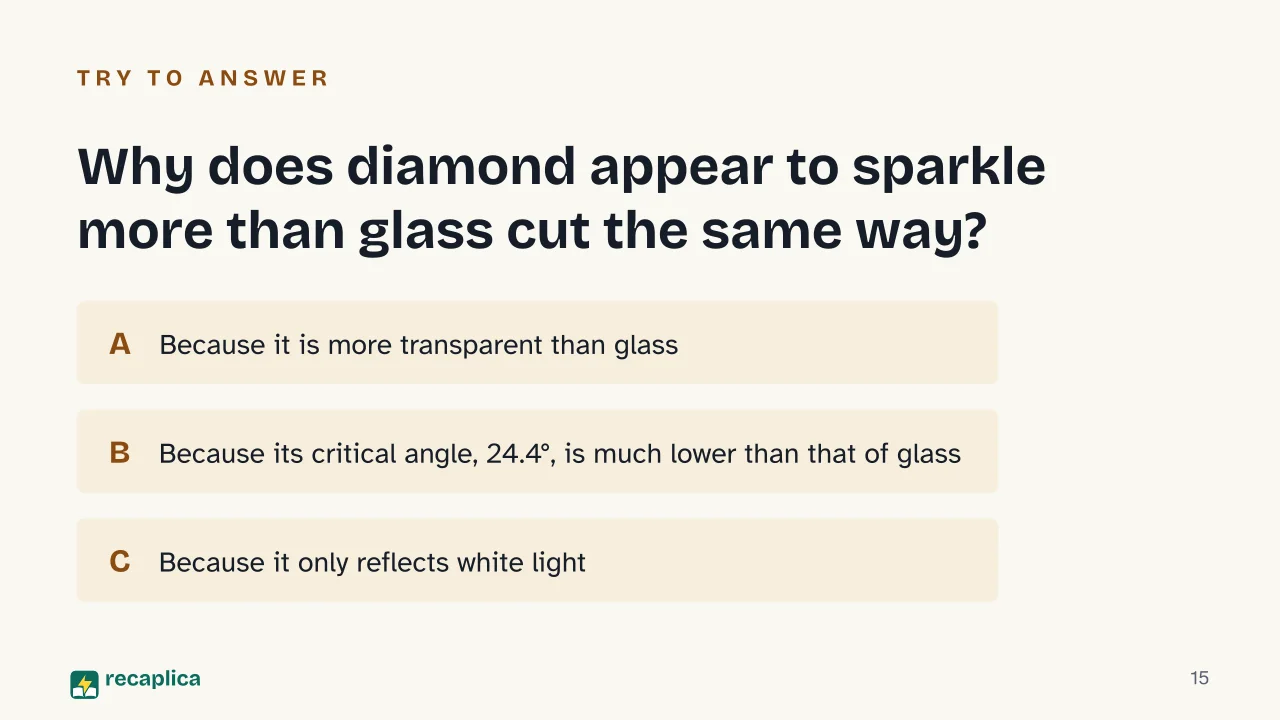
    Diamond takes this effect to the extreme. Because of its very high refractive index, the critical angle for light going from diamond into air is only 24.4°, far lower than that of ordinary glass. The facets of a cut diamond are shaped on purpose to make it unlikely for light to exit at an angle below the critical one: the light stays “trapped” for longer, bounces many times inside the stone, and concentrates before it finally leaves. That is the physical effect behind diamond’s characteristic sparkle, not some magical property of the stone.

    Dispersion, curved mirrors and lenses

    A prism splits white light into the colors of the rainbow for a precise reason: a material’s refractive index changes with the wavelength of light, an effect called chromatic dispersion. The index generally drops as wavelength grows, so red light refracts less than blue light, which also travels a touch slower inside transparent materials. Isaac Newton was among the first to show with a prism that white light is not a single, simple color but a sum of colors that separate once they refract at different angles.

    Curved mirrors follow the same law of reflection, applied point by point to a spherical surface rather than a flat one. For a concave or convex mirror, the focal length is always half the radius of curvature of the spherical cap. In a concave mirror, rays arriving parallel to the optical axis converge at a real focus; in a convex mirror, they appear instead to diverge from a virtual focus behind the surface. The equation describing where the image forms, for rays close to the axis, takes the same mathematical shape found in the equation for thin lenses: the same similar triangles come in handy to derive it, the same reasoning used in the triangle similarity theorems studied in geometry.

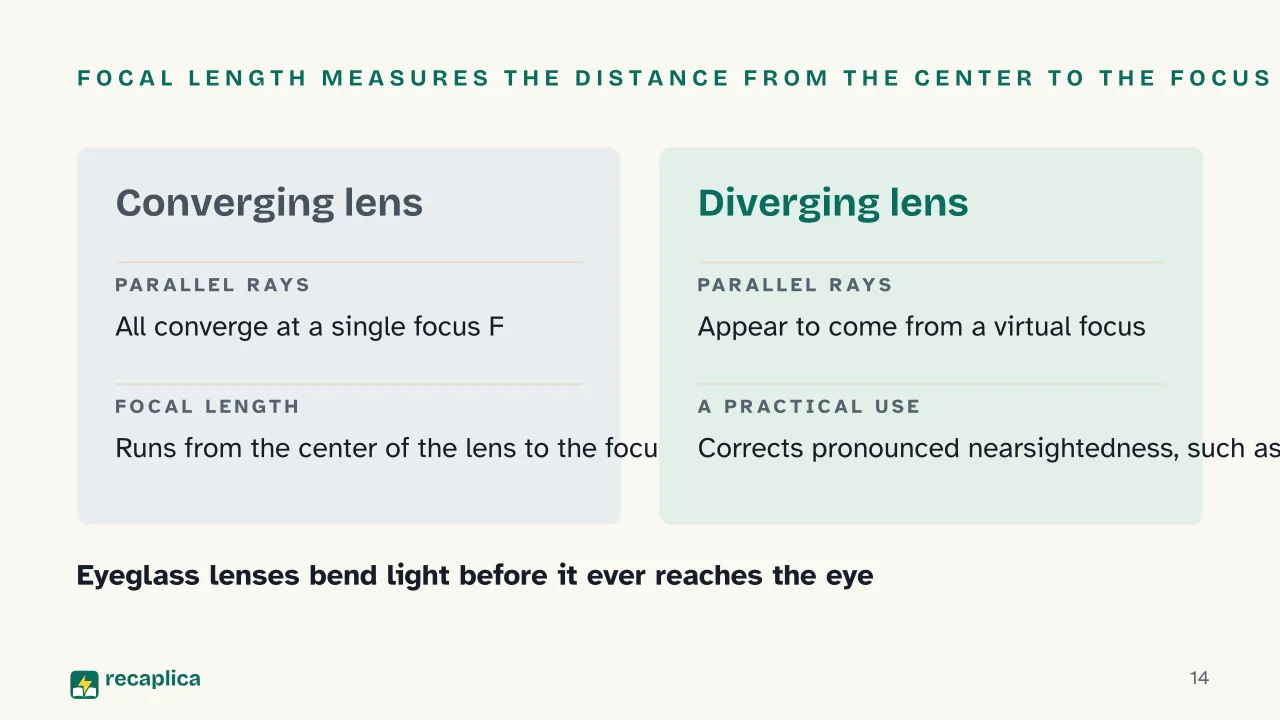
    In lenses the principle stays the same, but the curvature works through refraction instead of reflection. In a converging lens, rays entering parallel to the optical axis are bent until they all meet at a single point, the focus. In a diverging lens, parallel rays spread apart instead, and traced backward they appear to come from a single virtual focus. The focal length of a lens is the distance between its center and that point. A diverging lens, for example, can correct nearsightedness in eyeglasses, bending light before it ever reaches the eye.

    An invisible gradient, over the asphalt

    Air looks like a uniform material, but it never quite is. At standard temperature and pressure its refractive index is 1.00029, a tiny difference from a vacuum that still starts to matter over long distances. Close to the ground, air at different heights sits at different temperatures, so its refractive index varies slightly from layer to layer: rays of light curve toward the cooler side of this thermal gradient. Over a very hot road or stretch of asphalt, the air right above the surface is warmer, and therefore slightly less refractive, than the air higher up. Light from the sky arriving at a shallow angle gets bent upward before it reaches the eye, and the effect mimics the shiny surface of a puddle: it is a mirage, not an actual reflection off water.

    Pinning down these laws with pencil and paper takes the same scientific method used for any measurable phenomenon: a hypothesis about an angle, a measurement with a protractor, a comparison against what Snell’s law predicts. It is from measurements of exactly this kind, repeated across different materials, that the refractive index tables used in optics today come from.

    Slide deck

    Slides ready to download and make your own in PowerPoint or Google Slides, with speaker notes. Pick the Flash cut or the Full one.
    Slide 1 of the presentation on Light Refraction: Light RefractionSlide 2 of the presentation on Light Refraction: Why does a pencil look broken inside a glass of water?Slide 3 of the presentation on Light Refraction: Light follows two lawsSlide 4 of the presentation on Light Refraction: Chapter 01: ReflectionSlide 5 of the presentation on Light Refraction: The ray keeps a precise angleSlide 6 of the presentation on Light Refraction: A mirror does not swap left and rightSlide 7 of the presentation on Light Refraction: Chapter 02: RefractionSlide 8 of the presentation on Light Refraction: The refractive index slows light downSlide 9 of the presentation on Light Refraction: Every material slows light differentlySlide 10 of the presentation on Light Refraction: Chapter 03: Critical angleSlide 11 of the presentation on Light Refraction: Below a certain angle, light stops getting out: Critical angle, Diamond, Fiber opticsSlide 12 of the presentation on Light Refraction: Chapter 04: In everyday lifeSlide 13 of the presentation on Light Refraction: The pencil · The fish · The mirageSlide 14 of the presentation on Light Refraction: Focal length measures the distance from the center to the focusSlide 15 of the presentation on Light Refraction: Why does diamond appear to sparkle more than glass cut the same way?Slide 16 of the presentation on Light Refraction: Now you can read a ray of light
    Flash10 slidesThe essential thread, to present in classFull16 slidesEvery chapter and the deeper detail

    Common myths

    • ✗ Myth A flat mirror swaps left and right.

      ✓ Reality A mirror only reverses the direction perpendicular to its surface, front to back, because that is the only direction a reflecting surface can geometrically tell apart. The feeling of a left-right swap comes from a mental step the viewer makes, imagining turning around to stand where the reflection stands: it is not a physical property of the mirror itself.

    • ✗ Myth Diamond sparkles because of some near-magical property of the stone.

      ✓ Reality Diamond sparkles for a measurable geometric reason: its very high refractive index pushes the critical angle down to just 24.4 degrees, and a cutter angles the facets so that a ray rarely finds a way out right away. Bouncing inside the stone several times, the light concentrates before it finally leaves.

    • ✗ Myth A mirage on hot asphalt is the reflection of a real puddle of water.

      ✓ Reality There is no water anywhere: the road surface heats the air just above it, and that thin layer refracts light slightly differently from the cooler air above, enough to bend upward the rays that arrive almost horizontal. The effect mimics the shiny surface of water, but it is refraction in the air, nothing more.

    Mind map

    Drag the background to move around and the nodes to reposition them; use − and + to collapse and expand branches.
    Customize
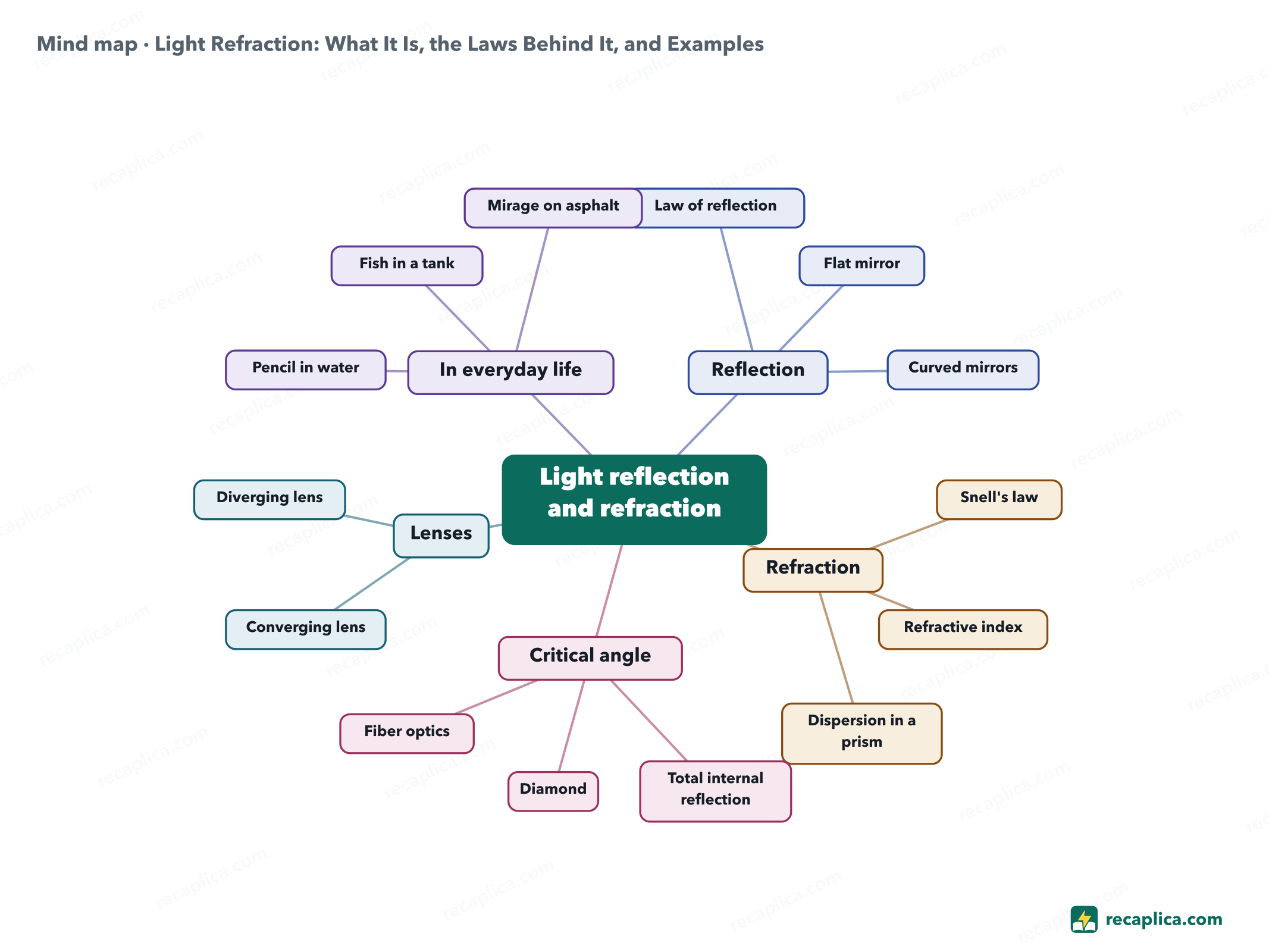
    Mind map: Light Refraction: What It Is, the Laws Behind It, and Examples
    • Light reflection and refraction
      • Reflection
        • Law of reflection Angle of incidence equal to angle of reflection
        • Flat mirror Virtual image at the same distance as the object
        • Curved mirrors Focal length equal to half the radius of curvature
      • Refraction
        • Snell's law Links the indices and angles in both materials
        • Refractive index Ratio between the speed in a vacuum and in the material
        • Dispersion in a prism Each color refracts at a slightly different angle
      • Critical angle
        • Total internal reflection Past the critical angle, light stays inside
        • Diamond Critical angle of only 24.4 degrees
        • Fiber optics Use the same principle over long distances
      • Lenses
        • Converging lens Parallel rays meet at the focus
        • Diverging lens Parallel rays appear to come from a virtual focus
      • In everyday life
        • Pencil in water Looks broken right at the surface
        • Fish in a tank Appears in different apparent positions
        • Mirage on asphalt Hot air bends light near the ground

    Quiz: test yourself

    Answer the questions to check what you have learned: you get instant feedback and a short explanation.

    Grade 0/10 0/5
    1 A beam of light hits a mirror at 30° from the normal. At what angle does it bounce back?

    Yes: both angles share the same normal as their reference, and here the value stays the same between the ray's arrival and its departure, so 30° in stays 30° out.

    2 A ray passes from water into air, that is, from a material with a higher refractive index to one with a lower index. What happens to its direction?

    Moving into a less refractive material, Snell's law requires the angle from the normal to grow larger: the ray exits more tilted than it was when it entered.

    3 How is the refractive index of a material defined?

    n = c/v, where c is the speed of light in a vacuum and v is its speed inside the material: a high index means light slows down a lot when it enters that material.

    4 Why does a diamond appear to sparkle more than a piece of glass cut the same way?

    A low critical angle makes total internal reflection easier to trigger: light stays inside the gem longer, bounces more times and concentrates before it exits.

    5 True or false: a mirage on hot asphalt is caused by the same physics as rays bending through a temperature gradient in the air.

    True: the warmed air just above the road does not slow light down by quite the same amount as the cooler air sitting higher up, and that small mismatch is enough to bend the rays into mimicking a water surface.

    Answers: 1-B · 2-B · 3-A · 4-B · 5-A

    Flashcards

    Tap the card to flip it and check whether you remember the answer, then move to the next one.

    1 / 8

    Explain it in your own words

    The ultimate test: if you can explain it in simple words, you've truly understood it. Write your explanation, then compare it with the Recap.

    Your explanation is saved only on this device.

    A surface that separates two transparent materials sends some light back, reflecting it, and lets the rest through while bending it toward a new direction. The law of reflection keeps the incoming and outgoing angles equal, both measured from the normal to the surface. Snell's law governs refraction instead, linking the index of each material to how much the ray tilts before and after it crosses over. These two laws alone explain mirrors, lenses, prisms and everyday sights such as a pencil that appears to snap inside a glass of water.

    Frequently asked questions

    Why does a pencil in a glass of water look broken?

    Because the rays of light change direction right at the point where they pass from water into air, through refraction. The eye traces those rays back in a straight line to work out the pencil's position, and the result is an apparent bend exactly at the water's surface.

    Why does a fish in a tank seem to be in a different spot than where it really is?

    Because the light leaving the fish also refracts as it crosses from water into air. Looking at the tank from different angles sends those rays to the eye along different paths, so the same fish can appear in two different apparent positions compared to where it actually is.

    What is the critical angle, and why does diamond sparkle so much?

    The critical angle is the angle of incidence, inside a denser material, beyond which light can no longer get out and reflects entirely back inside instead. In diamond it is only 24.4°, a very low value caused by its high refractive index: cutting exploits this fact to bounce light around several times before letting it leave, concentrated and bright.

    Why does hot asphalt seem to have a puddle of water in the distance?

    It is a mirage: the heat from the road surface warms the air just above it, which slows light down a touch less than the cooler air sitting higher up. A ray arriving almost horizontal ends up bent toward the eye before it reaches the ground, and the result mimics the shiny surface of water even though no puddle is actually there.

    Is this the same as the 'Light – Reflection and Refraction' class 10 chapter?

    Yes, the physics is exactly the same ground covered in that chapter: the law of reflection, Snell's law, the refractive index, the critical angle and total internal reflection, plus everyday cases such as mirrors, lenses and prisms. This Recap works as a plain-language summary and revision aid alongside the textbook, not a replacement for it.

    What is the difference between reflection and refraction of light?

    In reflection the ray bounces back into the same material, leaving at the same angle it arrived. In refraction the ray enters a different material, where light travels at another speed, and changes direction according to Snell's law. Most of the time both happen together at the same surface: part of the light reflects, part of it refracts.

    Sources

    • HyperPhysics — Law of Reflection (Georgia State University)
    • HyperPhysics — Snell's Law and Index of Refraction (Georgia State University)
    • HyperPhysics — Total Internal Reflection and Critical Angle (Georgia State University)
    • HyperPhysics — Dispersion of Light (Georgia State University)
    • HyperPhysics — Spherical Mirrors (Georgia State University)
    • HyperPhysics — Mirages (Georgia State University)
    • OpenStax College Physics — The Law of Reflection (via Physics LibreTexts, CC BY)
    • OpenStax College Physics — The Law of Refraction (via Physics LibreTexts, CC BY)
    • OpenStax College Physics — Image Formation by Lenses (via Physics LibreTexts, CC BY)
    • OpenStax University Physics — Total Internal Reflection (via Physics LibreTexts, CC BY)
    • John Baez (UC Riverside) — Do Mirrors Reverse Left and Right?

    Every Recap goes through an independent review before publication.

    Every evening, the day's new Recaps on our Telegram channel. Join the channel →

    Keep learning

    • Science Correlation: What It Means and How to Read the Coefficient Correlation measures how closely two variables move together, and the most common way to put a number on it is the correlation coefficient, which runs from -1 to +1. A value near +1 means the two variables rise together, near -1 means one rises while the other falls, and near 0 means no linear relationship stands out. The coefficient only captures the strength of a straight-line relationship, and a single unusual data point can push it up or down by a lot. Even when it's strong, a correlation between two variables never shows that one causes the other. Read the Recap →
    • Science Total Internal Reflection and the Critical Angle: Definition and Formula Total internal reflection is what happens when a light ray stops being able to leave a transparent medium and gets sent back inside it completely. It takes place past a specific angle of incidence, called the critical angle, calculated with Snell's law by comparing the refractive indices of the two materials involved. It only happens under one precise condition: the ray must be traveling from an optically denser medium into a less dense one, such as from water into air or from glass into air. Optical fibers and, in part, the sparkle of diamonds rely on this same principle. Read the Recap →
    • Science Bayes Theorem Formula: What It Is and How It Works Bayes theorem connects two opposite conditional probabilities: the chance of observing some evidence if a hypothesis were true, and the chance of that hypothesis being true given the evidence actually observed. It starts from conditional probability, the ratio between the chance that two events happen together and the chance of the second one on its own, and turns it around. It matters whenever you know P(evidence|cause) and want P(cause|evidence), which is exactly the case with diagnostic tests, where a positive result does not automatically mean being sick. The formula is P(A|B) = P(B|A)·P(A)/P(B). Read the Recap →

    recaplica

    Clear in 30 seconds, yours in 10 minutes.

    Recaps Mind maps Request a Recap Telegram channel Mind map maker Our method About Privacy & cookies Legal notes & terms of use

    © 2026 Recaplica · A project by Curi S.r.l. — VAT IT05472000750

    Statistics, only if you say so

    To learn which Recaps help most we would use Google Analytics, with aggregate, anonymous data. It starts only with your OK, and you can change your mind anytime. Privacy policy