Skip to content
recaplica

    One moment: security check

    Cloudflare wants to make sure you're not a robot. Tick the box below and your search will continue on its own.

    IT
    recaplica Pythagorean Theorem: What It Says and the Formula
    © 2026 Recaplica · recaplica.com — All rights reserved
    Home › Science

    Pythagorean Theorem: What It Says and the Formula

    By Recaplica Newsroom · Updated on October 7, 2026

    What to print

    Page numbers appear when printing with default margins.

    Slides

    Choose a cut

    Flash10 slidesThe essential thread, to present in classFull15 slidesEvery chapter and the deeper detail

    Both come with speaker notes.

    Telegram channel
    recaplica Clear in 30 seconds, yours in 10 minutes.
    In 30 seconds Key points Figures Deep dive Slides Myths Mind map Quiz Flashcards FAQ

    In 30 seconds quick read

    The Pythagorean theorem ties together the three sides of a right triangle through a single equation, a²+b²=c², once the longest side is called the hypotenuse and the two shorter ones the legs. Knowing any two sides always gives the third, which is why the formula is used to measure distances a tape measure cannot reach directly. Babylonian tablets record the same relationship roughly a thousand years before Pythagoras was born, so crediting him with the first proof is a tradition handed down through history rather than a documented fact. A handful of whole-number triples, such as 3-4-5, satisfy the equation and let anyone confirm a right angle without any instrument.

    Key Points

    • The theorem only applies to right triangles: it links the hypotenuse and the two legs through a²+b²=c².
    • Knowing any two sides of a right triangle always gives the third through the formula.
    • The relationship was already known to the Babylonians: tablets dated to roughly 1900-1600 BCE show it.
    • Crediting Pythagoras with the first proof is a tradition, not a documented certainty.
    • Pythagorean triples, such as 3-4-5 and 5-12-13, are sets of three whole numbers that satisfy the equation.
    • Pythagoras founded a philosophical and religious school at Croton with two circles of followers, one inner and one outer.

    Key figures

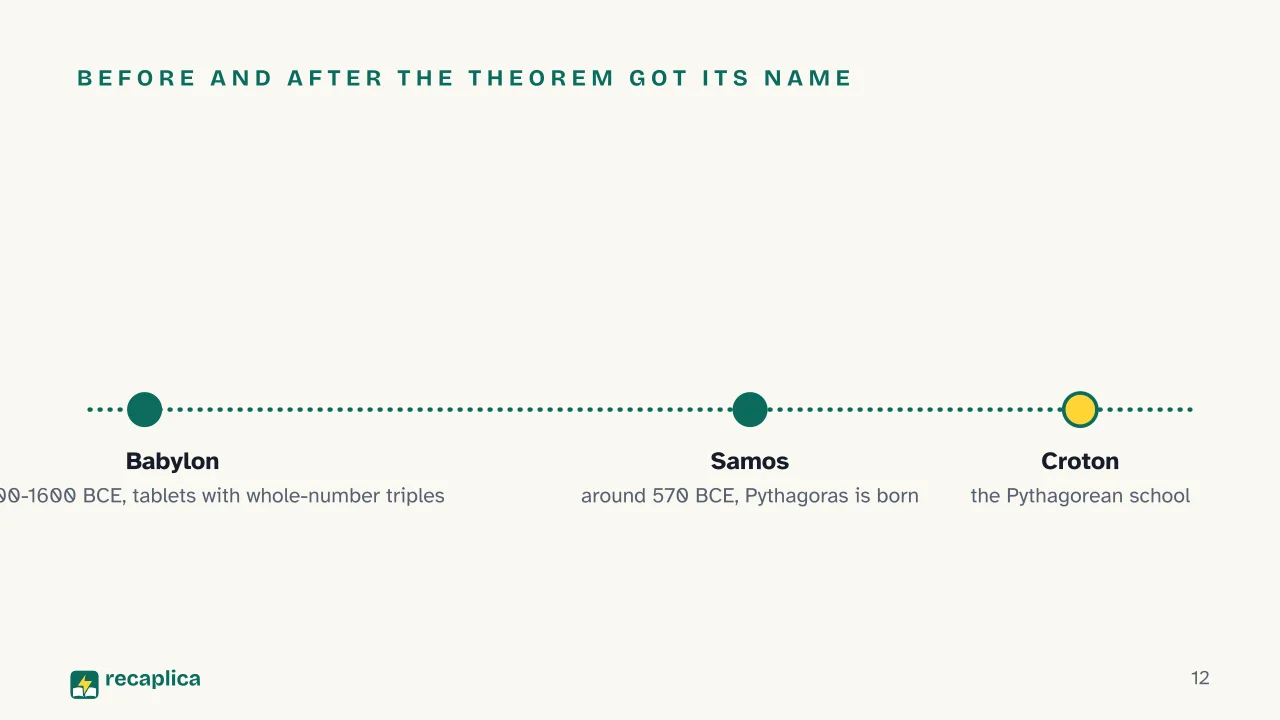
    • around 570 BCE Pythagoras is born on Samos, in Ionia, the son of Mnesarchus. Source: MacTutor History of Mathematics
    • around 1900-1600 BCE Period of the Old Babylonian Empire the tablets recording the same mathematical result date back to, centuries before Pythagoras. Source: MacTutor History of Mathematics, Babylonian Pythagoras's theorem
    • 3:4:5 The side ratio of a right triangle already found in a problem on the Berlin Papyrus 6619, an ancient Egyptian mathematical text. Source: Wolfram MathWorld

    Deep Dive

    What the theorem says

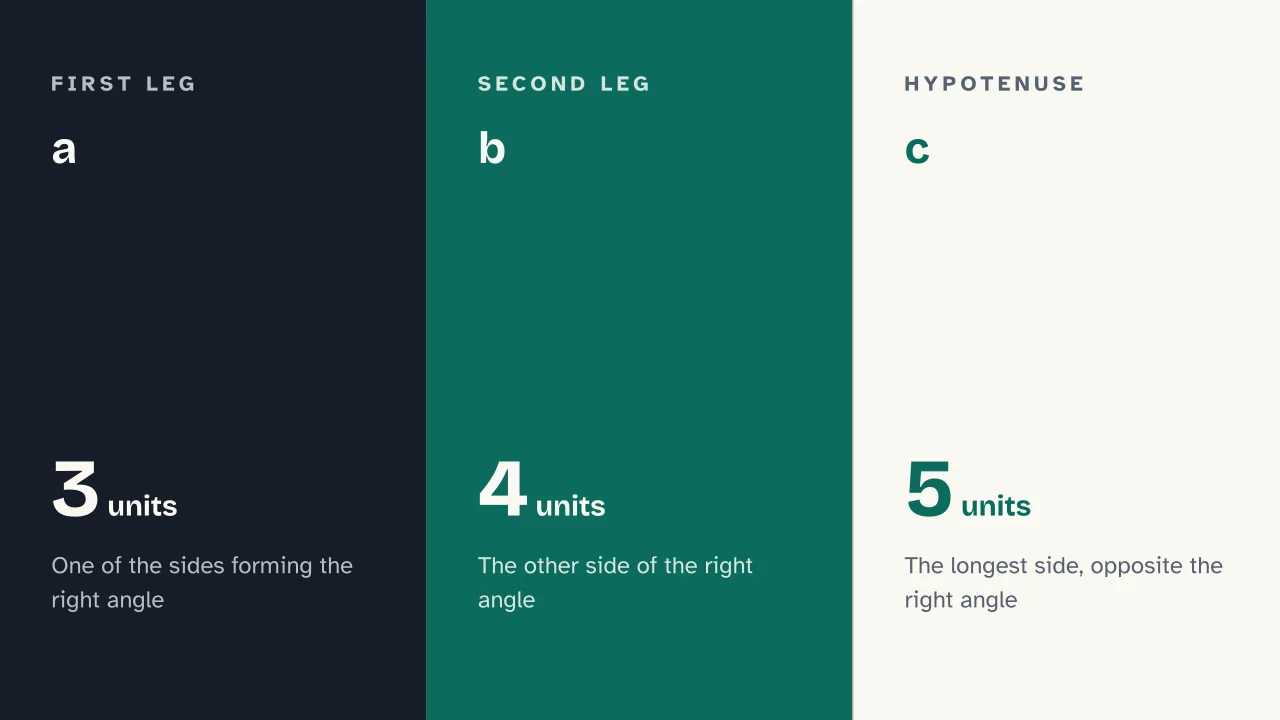
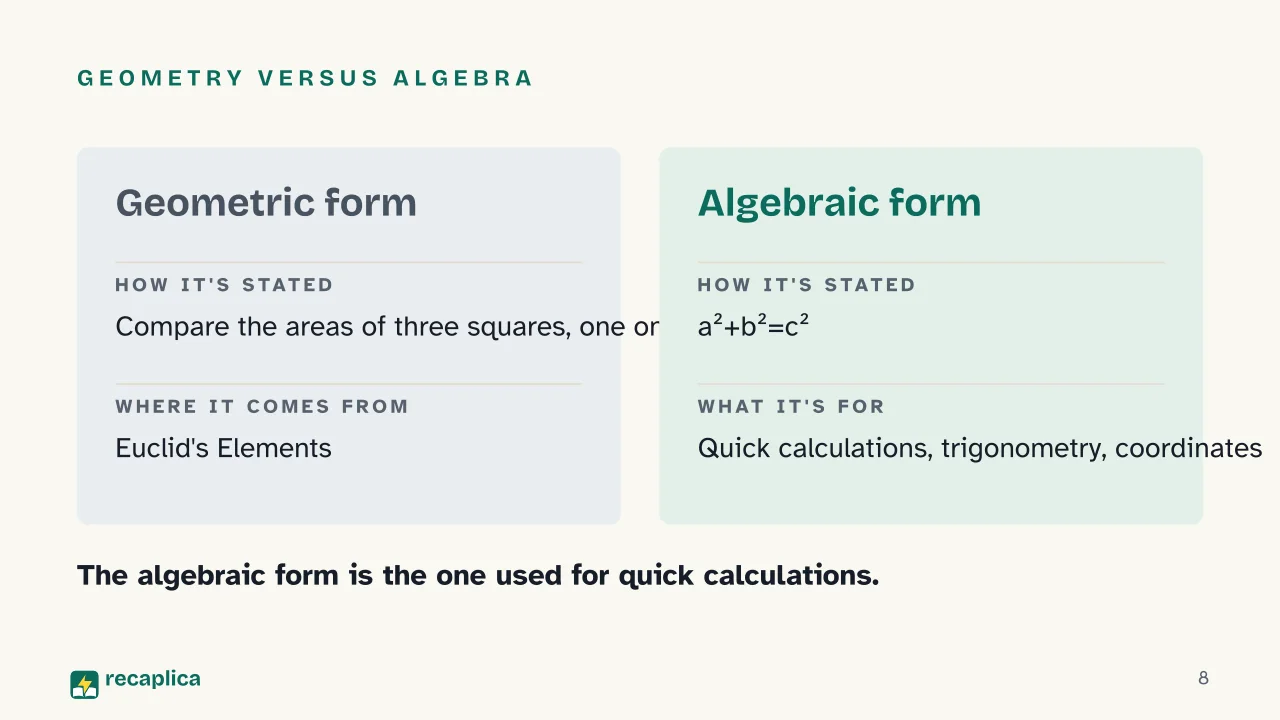
    The Pythagorean theorem applies to right triangles, the ones with a 90° angle. In its classic geometric form, the square built on the hypotenuse matches the sum of the squares built on the two legs. The same relationship, in standard algebraic notation, is written a²+b²=c². The legs are the two sides that form the right angle; the hypotenuse is the side opposite that angle, always the longest of the three. The geometric and algebraic forms say the same thing in different languages. The statement belongs to the framework of postulates and theorems described in the entry on Euclidean geometry.

    Why it holds: the idea behind the proof

    Wolfram MathWorld calls the Pythagorean theorem one of the most fundamental in geometry and notes that many different proofs exist, without giving an exact count. One direct way to see why the relationship holds starts from the squares in the geometric form itself: the one built on the hypotenuse has an area that can be cut into pieces and rearranged to match exactly the combined area of the two squares built on the legs, with no overlaps and no gaps left over. It is just one of the many routes to the same conclusion.

    The same idea carries over outside the flat plane. Extend the reasoning to three dimensions and the space diagonal of a rectangular box can be found by applying the theorem twice: once on the base, to get the diagonal of the base rectangle, then again on a second right triangle built from that diagonal and the height. It is the same relationship, simply applied back to back — a construction that comes in handy for the shapes covered in the entry on solid geometry.

    Solving for a missing side

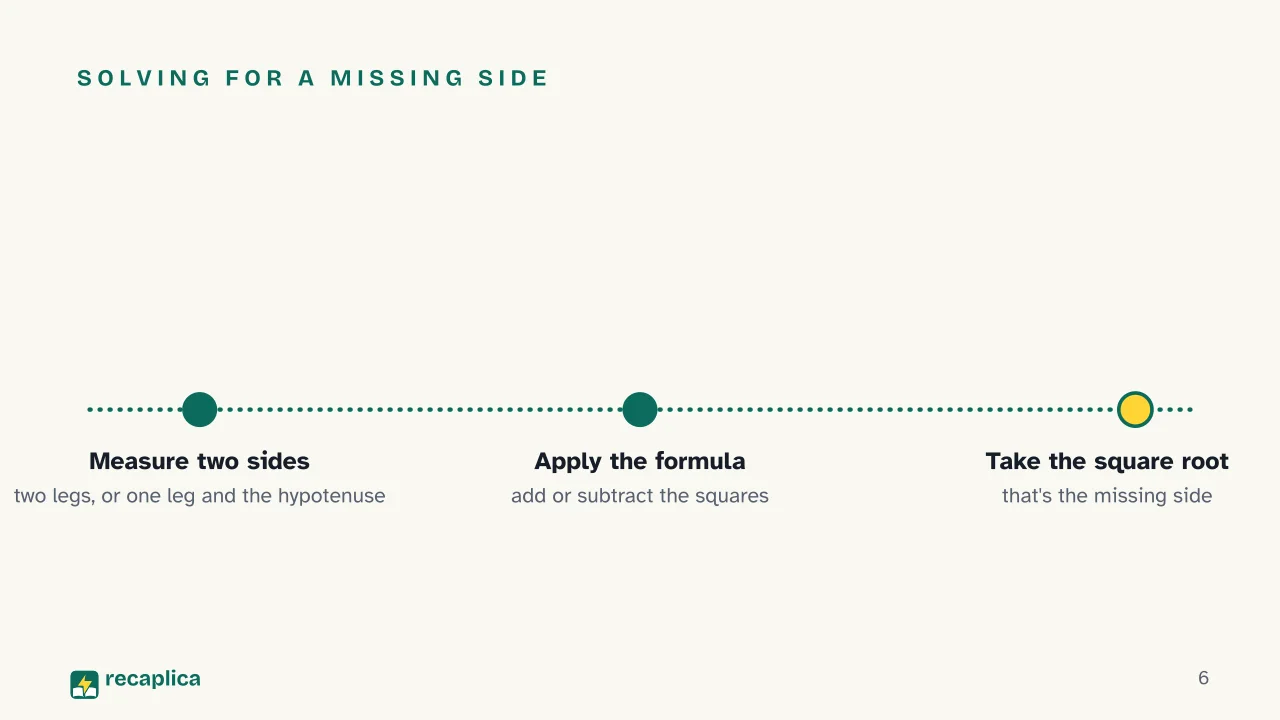
    Knowing any two sides of a right triangle, the third can always be found with the formula. For the hypotenuse, square each leg, add the results, then take the square root of the sum: c = square root of (a²+b²). For a leg, square the hypotenuse, subtract the square of the leg already known, then take the square root of what remains: a = square root of (c²-b²).

    Worked example: a right triangle has legs measuring 3 and 4 meters. Squaring each one: 3²=9 and 4²=16. Adding them: 9+16=25. The square root of 25 is 5, so the hypotenuse measures 5 meters. It also works in reverse: if the hypotenuse is 5 and one leg is 3, the second leg comes from the square root of (25-9), which is 4.

    The same calculation, applied to coordinates on a Cartesian plane, becomes the distance formula between two points: the difference between the x-coordinates and the difference between the y-coordinates act as the two legs, and the distance itself is the hypotenuse. That connection is described in the entry on analytic geometry, and the same right triangle is also the starting point for sine, cosine and tangent, covered in the entry on trigonometry.

    The most common Pythagorean triples

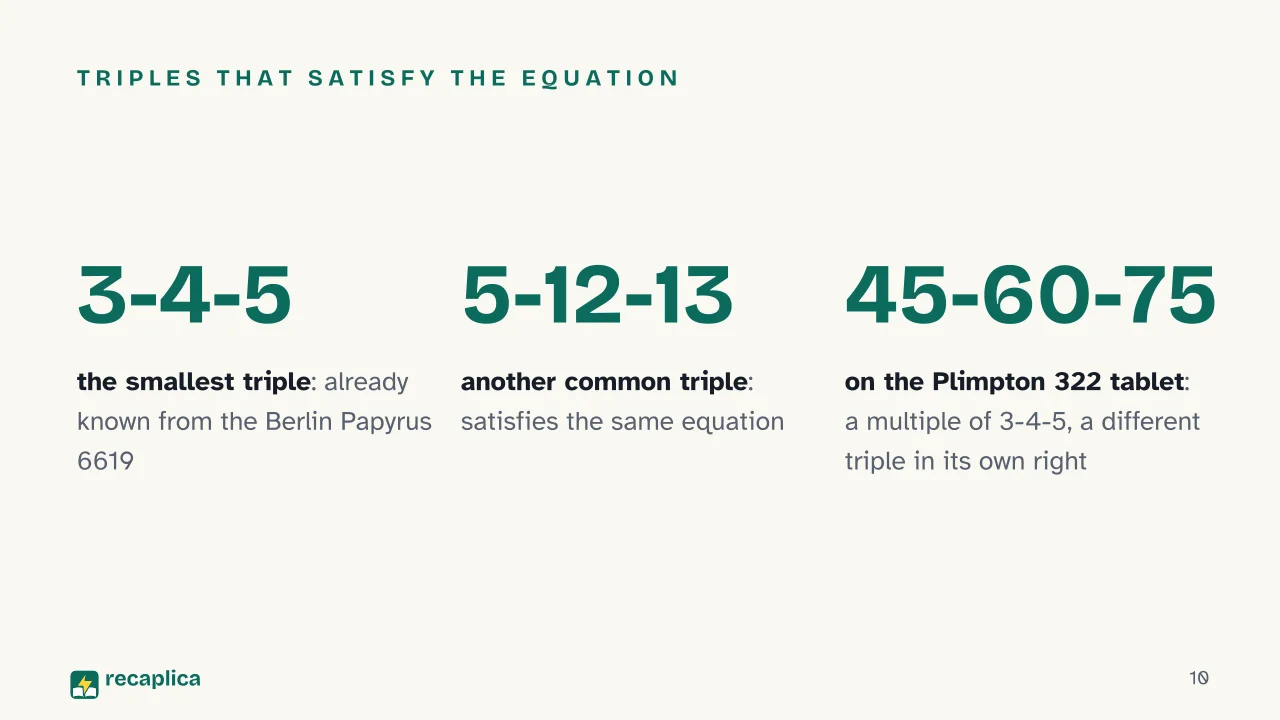
    Certain sets of three whole numbers satisfy a²+b²=c² without needing any square roots with decimals: these are called Pythagorean triples, and a triangle with sides in that ratio is a right triangle by construction, with no need to measure the angle.

    TripleCheckNote
    3-4-59+16=25already found in a problem on the Berlin Papyrus 6619, an ancient Egyptian mathematical text
    5-12-1325+144=169a whole-number triple independent of 3-4-5
    45-60-752,025+3,600=5,625a multiple of 3-4-5 (×15), found on the Babylonian Plimpton 322 tablet

    The Plimpton 322 tablet, per the analysis by Neugebauer and Sachs cited by MacTutor History of Mathematics, is a list of whole-number Pythagorean triples. Neither 3-4-5 nor 5-12-13, the two most familiar triples, appears on it: the smallest one present is 45-60-75, a multiple of 3-4-5.

    Content older than the name attached to it

    The theorem carries Pythagoras’s name, but its content was known long before him. The Babylonian tablets analyzed by MacTutor History of Mathematics date to the Old Babylonian Empire, which flourished in Mesopotamia roughly between 1900 and 1600 BCE: according to this source, the Babylonians already knew the content of the theorem about a thousand years before Pythagoras.

    Pythagoras was born on Samos, in Ionia, the son of Mnesarchus, in the first half of the 6th century BCE according to Treccani, a period MacTutor places more precisely around 570 BCE. He later moved to southern Italy, to Croton, perhaps around 529 BCE (Treccani uses “perhaps”: the date isn’t certain), and there founded a philosophical school that also became a religious community, aimed at the moral and political regeneration of its members. Within the school, the inner circle, the “mathematikoi,” lived permanently in the community: no personal possessions, a vegetarian diet. A second, outer circle, the “akousmatics,” lived in their own homes and joined the community only during the day.

    On the question of who first proved it, sources stay cautious: MacTutor History of Mathematics writes that Pythagoras “may have been” the first to prove the theorem, a conditional that signals a guess rather than an established fact. It remains a traditional attribution, more than a documented one.

    Slide deck

    Slides ready to download and make your own in PowerPoint or Google Slides, with speaker notes. Pick the Flash cut or the Full one.

    Slide 1 of the presentation on Pythagorean Theorem: The Pythagorean TheoremSlide 2 of the presentation on Pythagorean Theorem: The theorem carries Pythagoras's name, but does it predate him?Slide 3 of the presentation on Pythagorean Theorem: What's aheadSlide 4 of the presentation on Pythagorean Theorem: Chapter 01: The statement and the formulaSlide 5 of the presentation on Pythagorean Theorem: a · b · cSlide 6 of the presentation on Pythagorean Theorem: Solving for a missing sideSlide 7 of the presentation on Pythagorean Theorem: Chapter 02: Why it holdsSlide 8 of the presentation on Pythagorean Theorem: Geometry versus algebraSlide 9 of the presentation on Pythagorean Theorem: Chapter 03: Pythagorean triplesSlide 10 of the presentation on Pythagorean Theorem: Triples that satisfy the equationSlide 11 of the presentation on Pythagorean Theorem: Chapter 04: History, from Babylon to CrotonSlide 12 of the presentation on Pythagorean Theorem: Before and after the theorem got its nameSlide 13 of the presentation on Pythagorean Theorem: Pythagoras did not invent the theorem that bears his name.Slide 14 of the presentation on Pythagorean Theorem: In a²+b²=c², what does c represent?Slide 15 of the presentation on Pythagorean Theorem: Now for the review
    Flash10 slidesThe essential thread, to present in classFull15 slidesEvery chapter and the deeper detail

    Common myths

    • ✗ Myth Pythagoras invented the theorem that bears his name.

      ✓ Reality Old Babylonian tablets, dated to roughly 1900-1600 BCE according to MacTutor History of Mathematics, show the relationship was already known about a thousand years before Pythagoras was born, around 570 BCE. The same source hedges on whether Pythagoras actually proved it, closer to a guess than a settled claim.

    • ✗ Myth 3-4-5 and 5-12-13 are the only Pythagorean triples the ancients knew.

      ✓ Reality The Plimpton 322 tablet, per the analysis by Neugebauer and Sachs cited by MacTutor, lists other whole-number Pythagorean triples. Neither 3-4-5 nor 5-12-13 appears on it: the smallest triple present is 45-60-75, a multiple of 3-4-5.

    • ✗ Myth The Pythagorean theorem applies to any triangle.

      ✓ Reality It only holds for right triangles, the ones with a 90° angle: in a²+b²=c² the hypotenuse c is by definition the side opposite that angle.

    Mind map

    Drag the background to move around and the nodes to reposition them; use − and + to collapse and expand branches.
    Customize
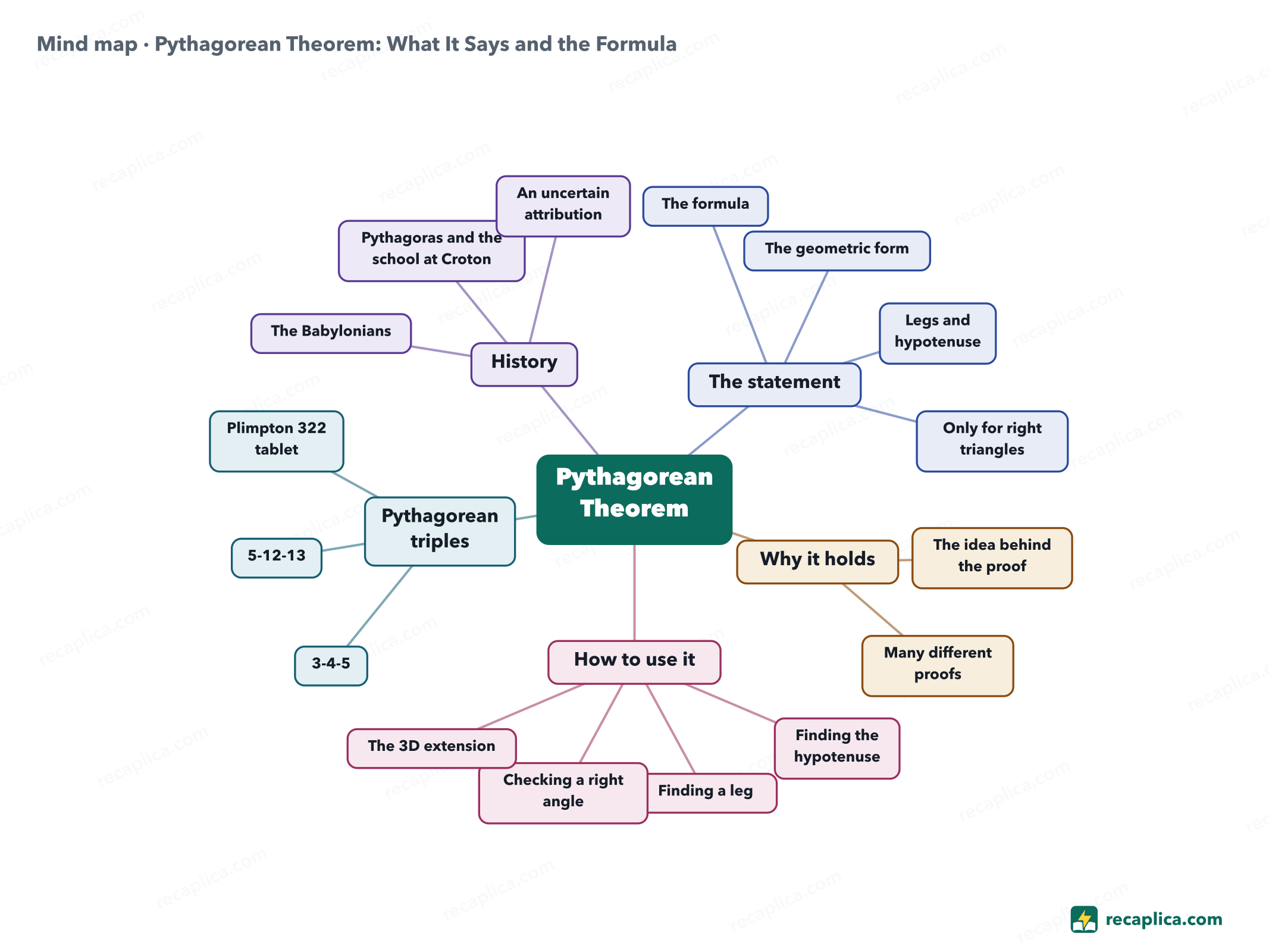
    Mind map: Pythagorean Theorem: What It Says and the Formula
    • Pythagorean Theorem
      • The statement
        • The formula a²+b²=c², algebraic notation
        • The geometric form areas of squares built on each side, compared directly
        • Legs and hypotenuse the hypotenuse is the side opposite the right angle
        • Only for right triangles
      • Why it holds
        • The idea behind the proof comparing the areas of the squares on the three sides
        • Many different proofs per Wolfram MathWorld; exact count not stated
      • How to use it
        • Finding the hypotenuse
        • Finding a leg
        • Checking a right angle
        • The 3D extension the space diagonal of a box
      • Pythagorean triples
        • 3-4-5 on the Berlin Papyrus 6619
        • 5-12-13
        • Plimpton 322 tablet list of whole-number triples, analysis by Neugebauer and Sachs
      • History
        • The Babylonians around 1900-1600 BCE, before Pythagoras
        • Pythagoras and the school at Croton mathematikoi and akousmatics
        • An uncertain attribution sources hedge with conditional language

    Quiz: test yourself

    Answer the questions to check what you have learned: you get instant feedback and a short explanation.

    Grade 0/10 0/5
    1 What does the Pythagorean theorem state?

    It is the classic relationship between the three sides of a right triangle, also written as a²+b²=c².

    2 For which kind of triangle does the Pythagorean theorem hold?

    The theorem links the hypotenuse and the legs, two terms that only exist in a right triangle, the one with a 90° angle.

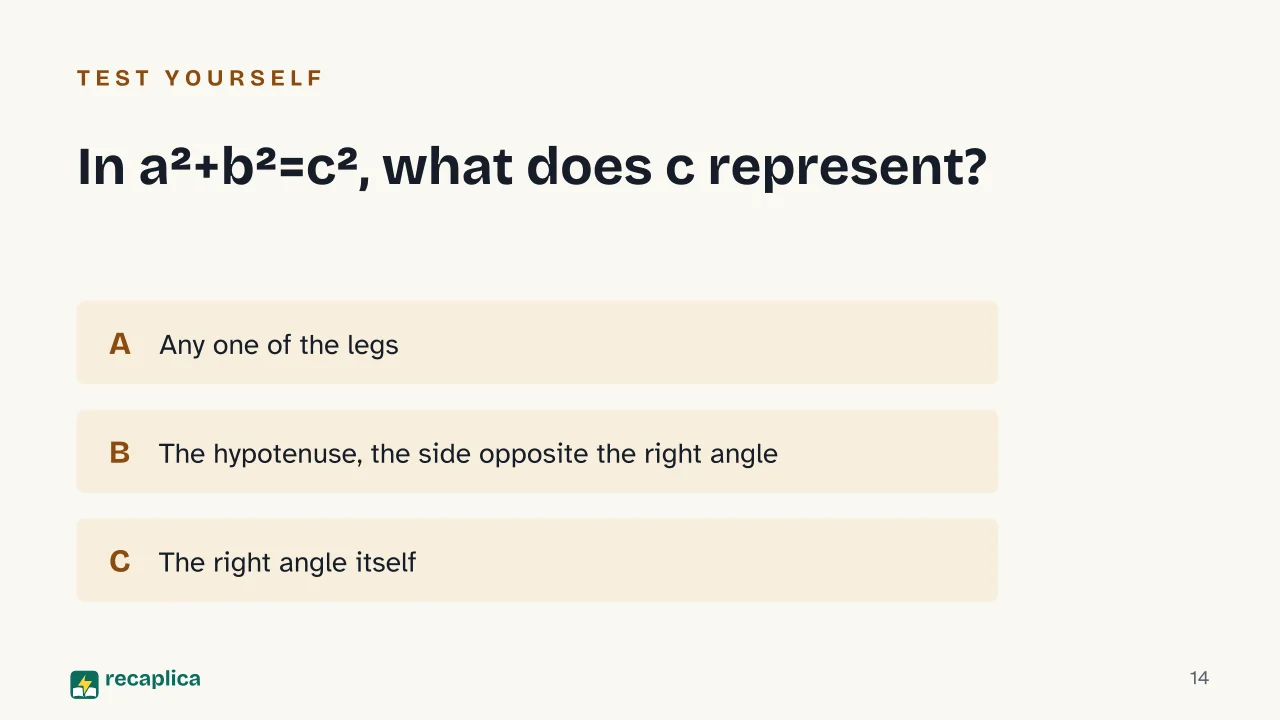
    3 In the formula a²+b²=c², what does c represent?

    C is always the hypotenuse, the longest side of the right triangle, opposite the 90° angle.

    4 True or false: 3-4-5 is the only Pythagorean triple known in antiquity.

    False: the Plimpton 322 tablet lists other whole-number Pythagorean triples, and the smallest one it contains, 45-60-75, is itself a multiple of 3-4-5.

    5 According to historical sources, who already knew the content of the theorem before Pythagoras?

    Tablets from the Old Babylonian Empire, dated to roughly 1900-1600 BCE, already contained the content of the theorem; crediting Pythagoras with the first proof remains an attribution to treat with caution.

    Answers: 1-B · 2-C · 3-B · 4-B · 5-B

    Flashcards

    Tap the card to flip it and check whether you remember the answer, then move to the next one.

    1 / 8

    Explain it in your own words

    The ultimate test: if you can explain it in simple words, you've truly understood it. Write your explanation, then compare it with the Recap.

    Your explanation is saved only on this device.

    The Pythagorean theorem ties together the three sides of a right triangle through a single equation, a²+b²=c², once the longest side is called the hypotenuse and the two shorter ones the legs. Knowing any two sides always gives the third, which is why the formula is used to measure distances a tape measure cannot reach directly. Babylonian tablets record the same relationship roughly a thousand years before Pythagoras was born, so crediting him with the first proof is a tradition handed down through history rather than a documented fact. A handful of whole-number triples, such as 3-4-5, satisfy the equation and let anyone confirm a right angle without any instrument.

    Frequently asked questions

    What is the Pythagorean theorem, in simple terms?

    It's a rule linking the three sides of a right triangle: if you know two sides, you can always find the third. The square of the longest side, the hypotenuse, equals the sum of the squares of the other two, the legs.

    What is the formula for the Pythagorean theorem's hypotenuse?

    Square each leg, add the two results, then take the square root of that sum: that's the hypotenuse, c = square root of (a²+b²).

    How do you find a leg when you know the hypotenuse and the other leg?

    Work backward from the same equation: the missing leg is a = square root of (c²-b²), so the known leg's square gets removed from the hypotenuse's square before the root is taken.

    What are Pythagorean triples?

    Sets of three whole numbers that satisfy a²+b²=c², such as 3-4-5 or 5-12-13: with sides in that ratio the triangle is a right triangle by construction, no angle measurement needed.

    Did Pythagoras really discover the theorem?

    The content of the theorem was already known to the Babylonians centuries earlier, according to tablets from the Old Babylonian Empire. Whether Pythagoras was the first to prove it is a traditional attribution that historical sources treat with caution.

    Sources

    • MacTutor History of Mathematics — Pythagoras
    • MacTutor History of Mathematics — Babylonian Pythagoras's theorem
    • Treccani — Pitagora
    • Wolfram MathWorld — Pythagorean Theorem

    Every Recap goes through an independent review before publication.

    Every evening, the day's new Recaps on our Telegram channel. Join the channel →

    Keep learning

    • Science Correlation: What It Means and How to Read the Coefficient Correlation measures how closely two variables move together, and the most common way to put a number on it is the correlation coefficient, which runs from -1 to +1. A value near +1 means the two variables rise together, near -1 means one rises while the other falls, and near 0 means no linear relationship stands out. The coefficient only captures the strength of a straight-line relationship, and a single unusual data point can push it up or down by a lot. Even when it's strong, a correlation between two variables never shows that one causes the other. Read the Recap →
    • Science Light Refraction: What It Is, the Laws Behind It, and Examples A surface that separates two transparent materials sends some light back, reflecting it, and lets the rest through while bending it toward a new direction. The law of reflection keeps the incoming and outgoing angles equal, both measured from the normal to the surface. Snell's law governs refraction instead, linking the index of each material to how much the ray tilts before and after it crosses over. These two laws alone explain mirrors, lenses, prisms and everyday sights such as a pencil that appears to snap inside a glass of water. Read the Recap →
    • Science Total Internal Reflection and the Critical Angle: Definition and Formula Total internal reflection is what happens when a light ray stops being able to leave a transparent medium and gets sent back inside it completely. It takes place past a specific angle of incidence, called the critical angle, calculated with Snell's law by comparing the refractive indices of the two materials involved. It only happens under one precise condition: the ray must be traveling from an optically denser medium into a less dense one, such as from water into air or from glass into air. Optical fibers and, in part, the sparkle of diamonds rely on this same principle. Read the Recap →

    recaplica

    Clear in 30 seconds, yours in 10 minutes.

    Recaps Mind maps Request a Recap Telegram channel Mind map maker Our method About Privacy & cookies Legal notes & terms of use

    © 2026 Recaplica · A project by Curi S.r.l. — VAT IT05472000750

    Statistics, only if you say so

    To learn which Recaps help most we would use Google Analytics, with aggregate, anonymous data. It starts only with your OK, and you can change your mind anytime. Privacy policy