recaplica
Clear in 30 seconds, yours in 10 minutes.
In 30 seconds quick read
Total internal reflection is what happens when a light ray stops being able to leave a transparent medium and gets sent back inside it completely. It takes place past a specific angle of incidence, called the critical angle, calculated with Snell's law by comparing the refractive indices of the two materials involved. It only happens under one precise condition: the ray must be traveling from an optically denser medium into a less dense one, such as from water into air or from glass into air. Optical fibers and, in part, the sparkle of diamonds rely on this same principle.
Key Points
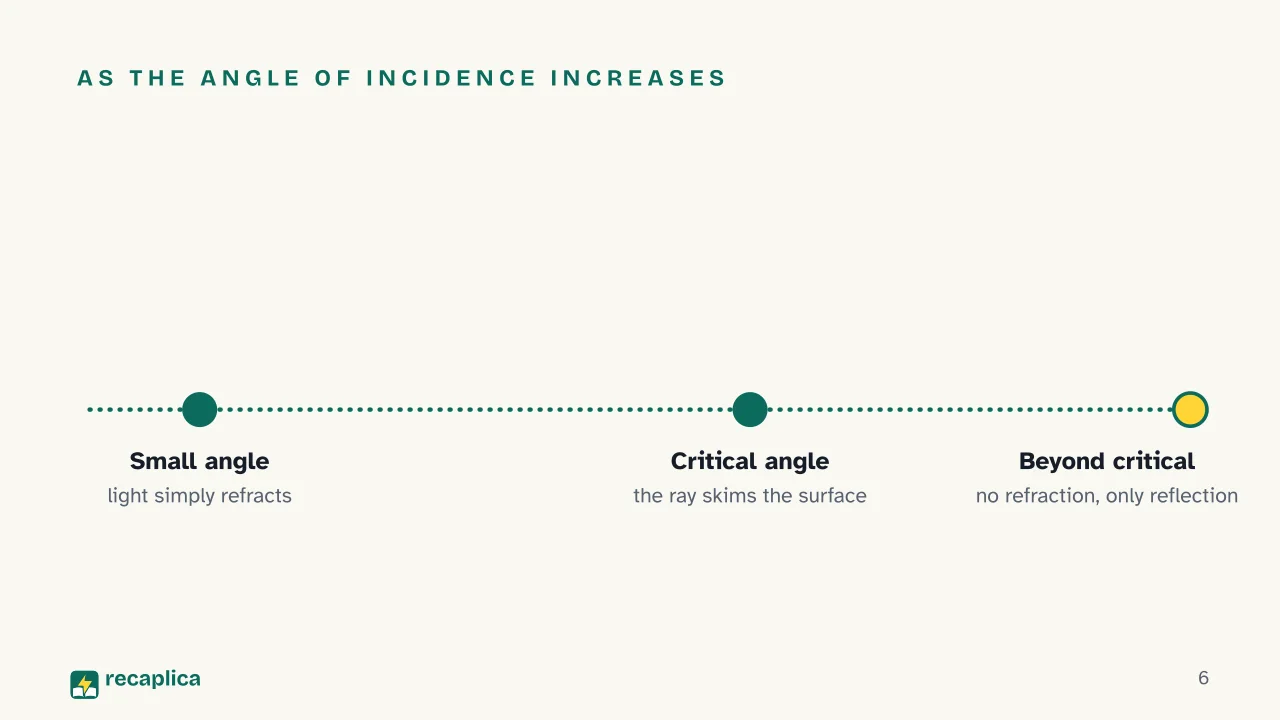
Past a certain angle of incidence, a light ray stops refracting outward: that point is the critical angle, also called the limiting angle.
Beyond that angle, light has no way out: it stays reflected inside the medium it started in.
Total internal reflection only happens when light moves from an optically denser medium into a less dense one.
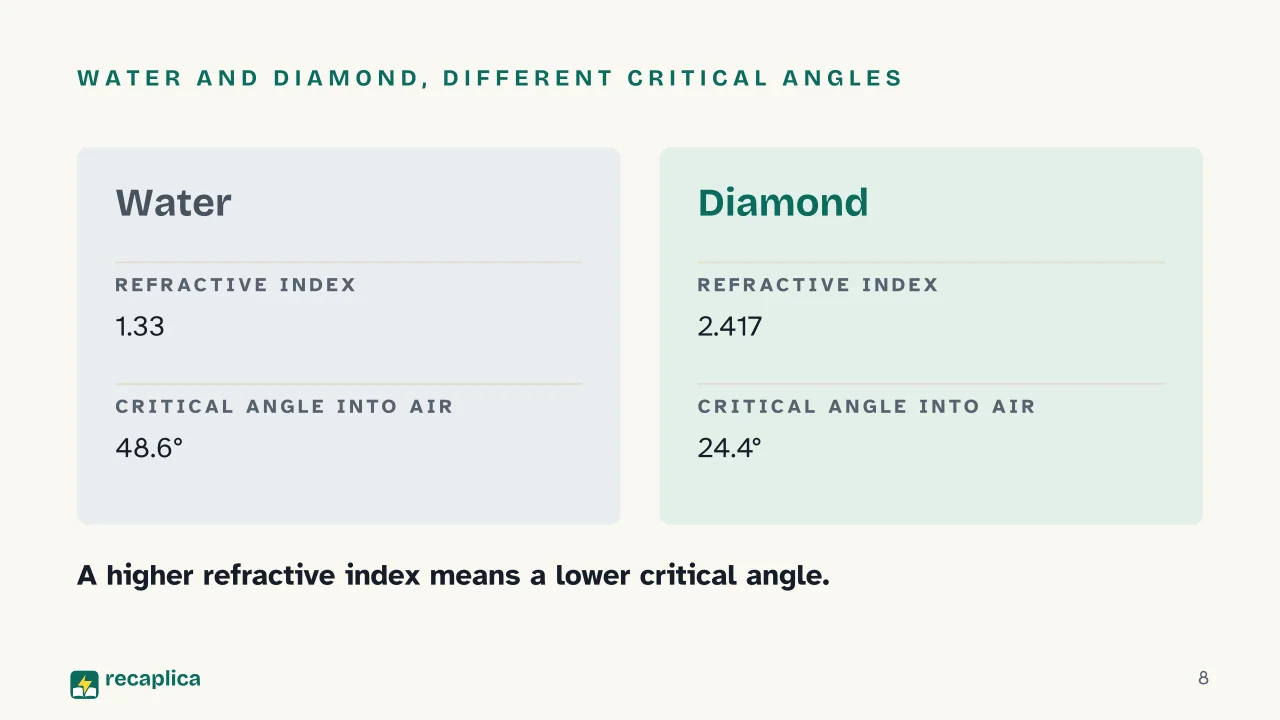
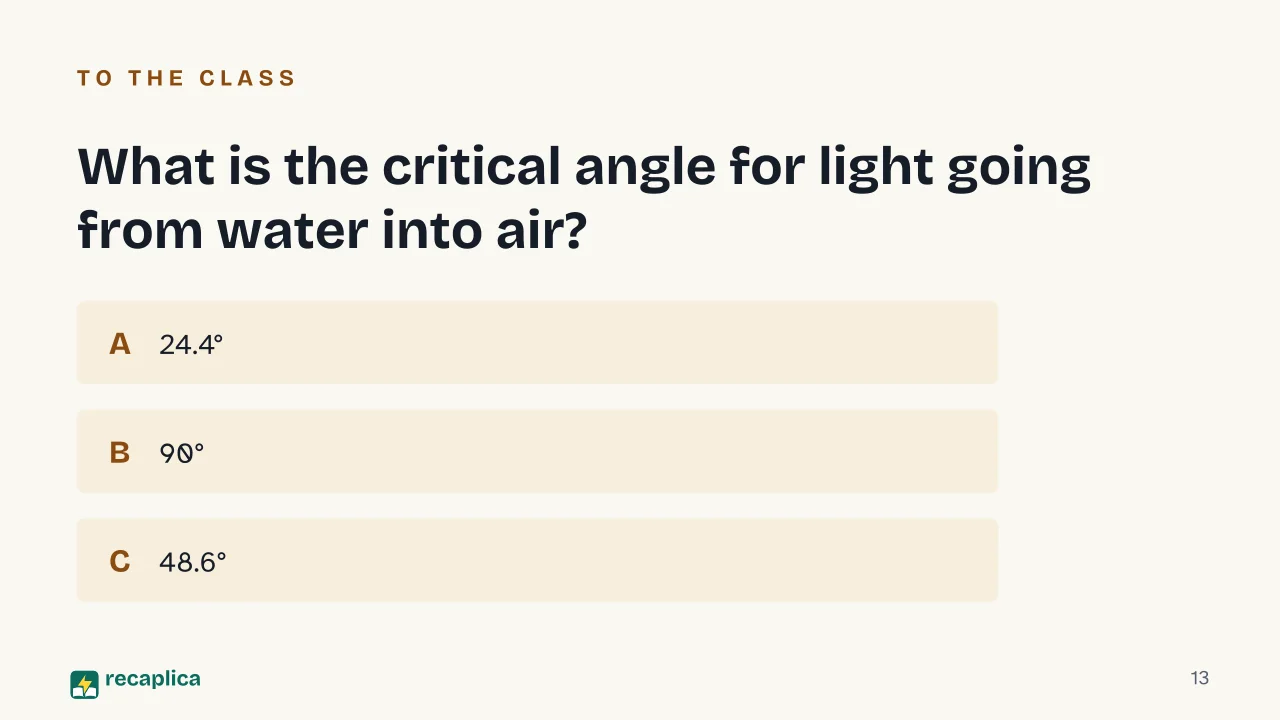
For light going from water into air, the critical angle is 48.6°; for diamond, only 24.4°.
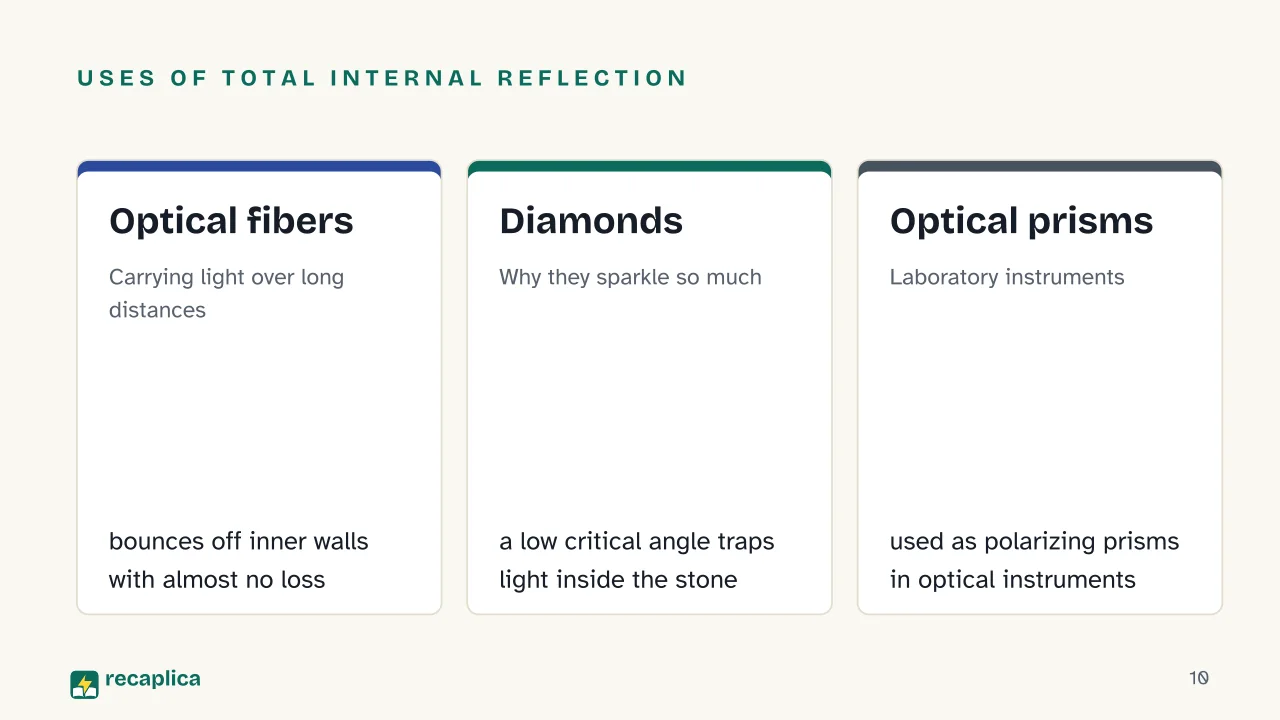
Optical fibers rely on the same mechanism to carry light over long distances with minimal loss.
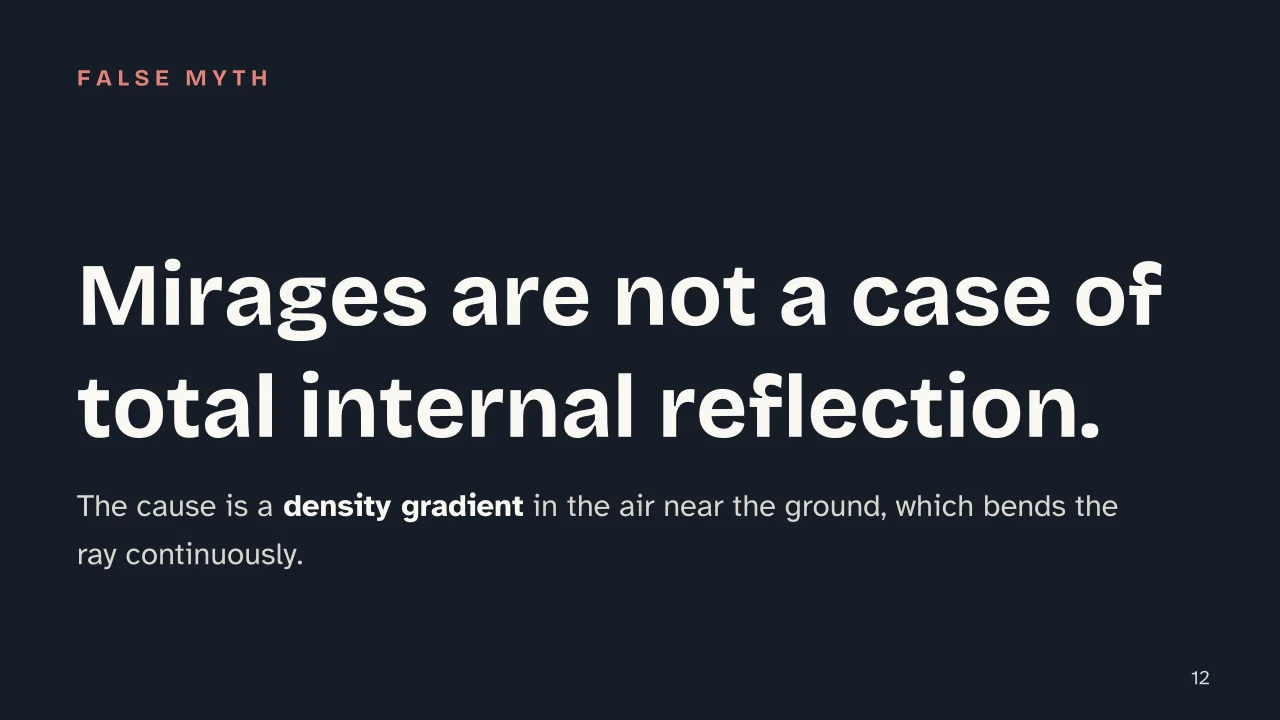
Mirages have a different explanation behind them: no total internal reflection, just air layers of varying density.
Deep Dive
Light moving from one material into another usually refracts: it changes direction, but still makes it into the new medium. Past a certain point, though, that stops happening.
The exact point where that limit is reached is called the critical angle, or limiting angle: it’s the angle of incidence that makes the refracted ray exit at 90° from the normal, meaning it skims along the boundary between the two media, according to HyperPhysics. Once that value is exceeded, outward refraction stops completely: all the light stays inside the original medium, reflected as if by a mirror. This is total internal reflection. The value is calculated with Snell’s law, applied to the limiting case of a ray exiting at 90°: what matters is the ratio between the refractive index of the less dense medium and that of the denser one, as College Physics (OpenStax) explains.
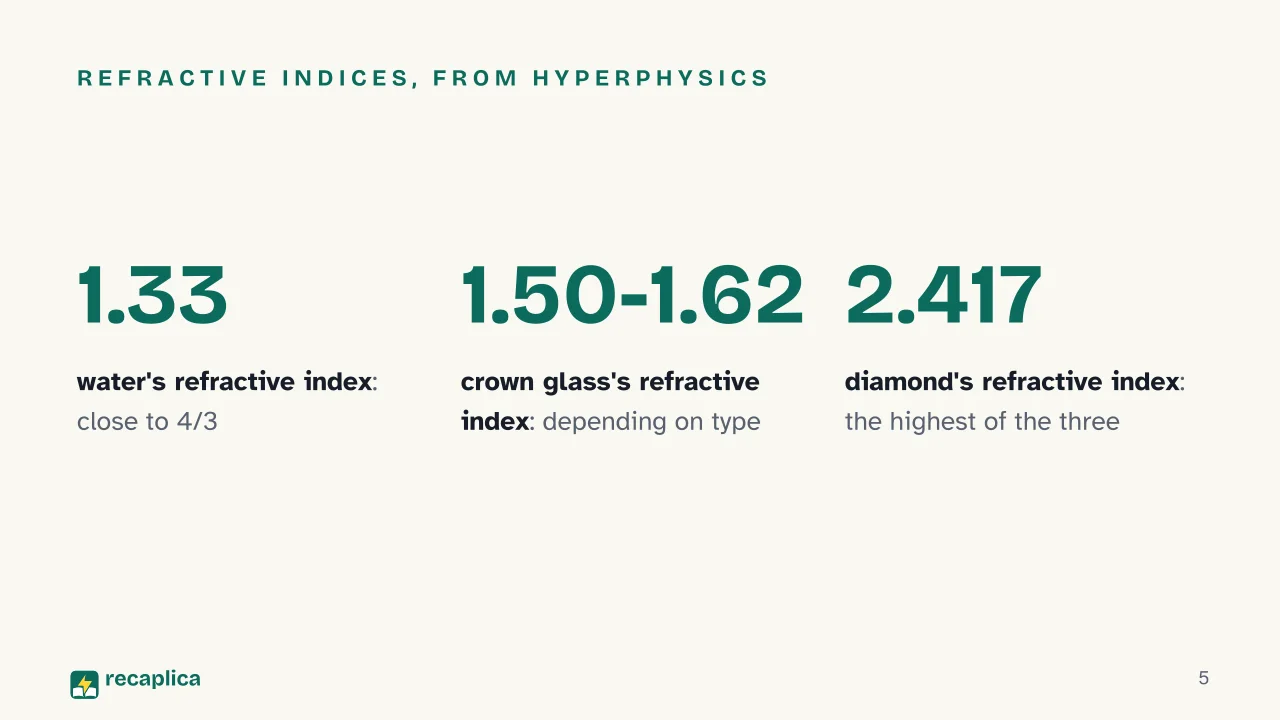
The two known values show how much the phenomenon depends on the material. Light crossing from water into air hits its critical angle at 48.6°. For diamond, with a much higher refractive index (2.417, according to HyperPhysics), it drops to just 24.4°: the window of angles at which light can still get out is far narrower.
Material
Refractive Index
Critical Angle into Air
Vacuum
1.000
—
Air
1.000277
—
Water
1.33
48.6°
Crown glass
1.50-1.62
—
Flint glass
1.57-1.75
—
Diamond
2.417
24.4°
The refractive index values are approximate and don’t account for dispersion, meaning the small variation that depends on the wavelength of light, HyperPhysics notes. For glass, the sources used here don’t report a critical angle: only the water and diamond values remain.
Practical example: a cut diamond relies exactly on this difference. With a critical angle of only 24.4°, most of the light that enters the stone hits its inner faces at an angle above the critical one and gets sent back inside instead of passing through: according to College Physics (OpenStax), it’s the combination of this very low critical angle and the very high refractive index that explains why diamonds sparkle more than other transparent materials.
The same physics, put to a different use, is behind optical fibers. Their operation relies on the total internal reflection of the rays traveling inside them, HyperPhysics explains: a ray that enters at the right angle keeps reflecting off the fiber’s inner walls with almost no loss, covering long distances this way. Bundles of optical fibers make it possible to get images from otherwise inaccessible places, as in endoscopes: each individual fiber works as a light conduit, carrying the light that corresponds to a single point of the image along its own path. The same principle shows up in the polarizing prisms inside optical instruments too, again according to HyperPhysics.
There’s a mistaken use of this principle that’s just as common as the correct one: explaining mirages, such as the puddle that seems to appear on hot asphalt, as a case of total internal reflection. According to the Department of Astronomy at San Diego State University, that idea is wrong: light bends gradually as it passes through layers of air that get less dense going upward, not through a single bounce off a surface.
The Recap on light refraction covers the general case of this same phenomenon. Here, past that same critical angle, the ray simply has nowhere left to go, so it keeps bouncing inside the medium it started in.
Slide deck
Slides ready to download and make your own in PowerPoint or Google Slides, with speaker notes. Pick the Flash cut or the Full one.
✗ Myth Many believe mirages, such as the puddle that seems to appear on hot asphalt, are a case of total internal reflection.
✓ Reality According to the Department of Astronomy at San Diego State University, mirages actually come from air layers of decreasing density that bend the ray continuously: a constant temperature gradient in the air produces a density gradient that's nearly linear with height.
✗ Myth Many think that simply moving from one material into another is enough to get total internal reflection.
✓ Reality Snell's law sets a precise condition instead: the refractive index of the medium the light enters must be lower than that of the medium it leaves, and the angle of incidence must exceed the critical angle.
✗ Myth Many believe diamonds sparkle just because they're highly transparent.
✓ Reality It actually comes down to the combination of a very low critical angle (24.4°) and a very high refractive index, explains College Physics (OpenStax): light stays trapped inside the stone instead of passing through it, through total internal reflection.
Mind map
Drag the background to move around and the nodes to reposition them; use − and + to collapse and expand branches.
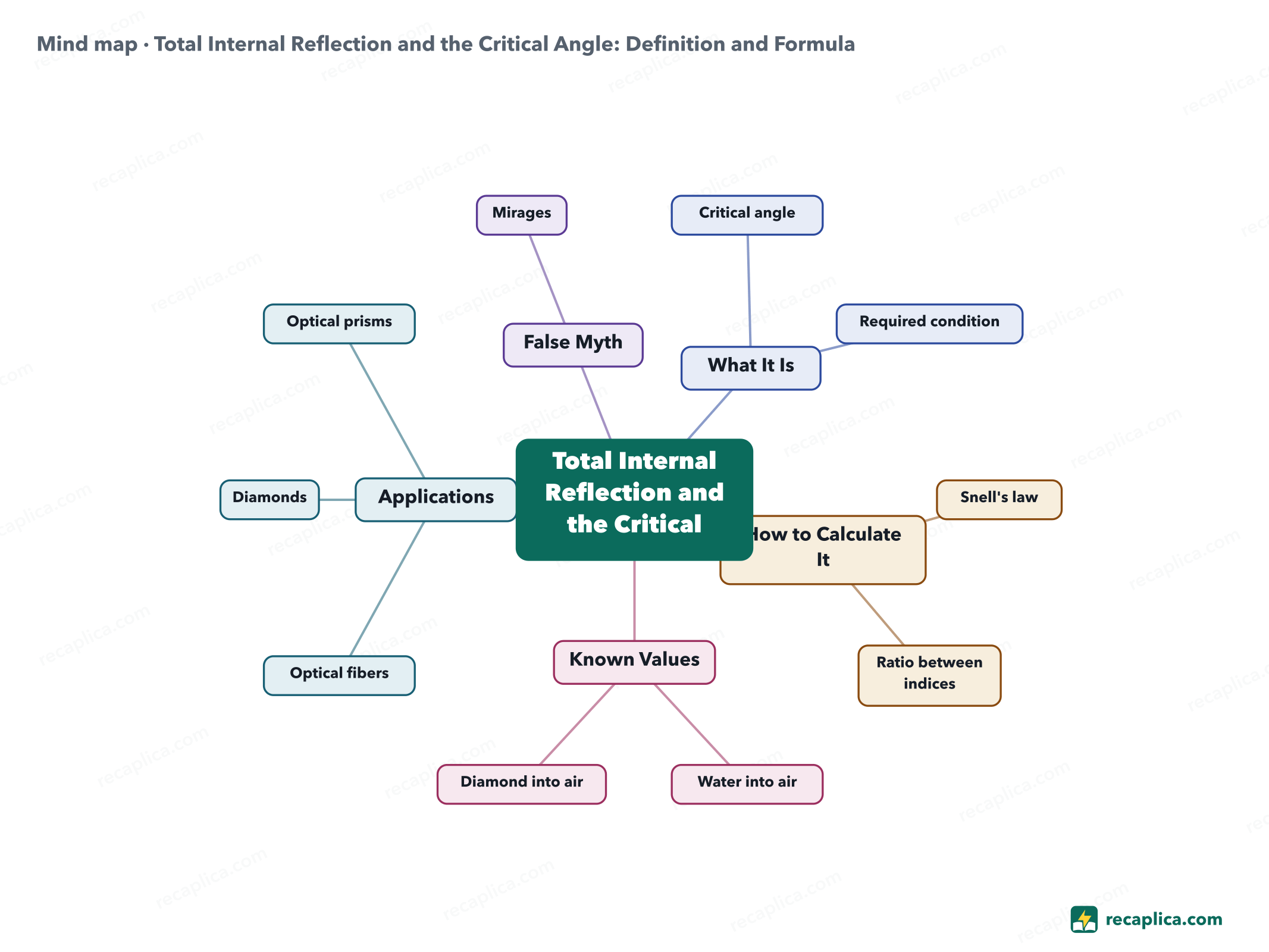
Required conditionhigher refractive index moving toward a lower one
How to Calculate It
Snell's lawlinks refractive index and angle of incidence
Ratio between indicesratio between the two media's indices
Known Values
Water into air48.6°
Diamond into air24.4°
Applications
Optical fiberssend light long distances, losing almost none of it
Diamondslight stays trapped inside the stone
Optical prismsused in polarizing optical instruments
False Myth
Miragesgradual refraction, not total internal reflection
Quiz: test yourself
Answer the questions to check what you have learned: you get instant feedback and a short explanation.
Grade0/100/5
Answers: 1-A · 2-B · 3-C · 4-B · 5-B
Flashcards
Tap the card to flip it and check whether you remember the answer, then move to the next one.
1 / 7
Explain it in your own words
The ultimate test: if you can explain it in simple words, you've truly understood it. Write your explanation, then compare it with the Recap.
Your explanation is saved only on this device.
Total internal reflection is what happens when a light ray stops being able to leave a transparent medium and gets sent back inside it completely. It takes place past a specific angle of incidence, called the critical angle, calculated with Snell's law by comparing the refractive indices of the two materials involved. It only happens under one precise condition: the ray must be traveling from an optically denser medium into a less dense one, such as from water into air or from glass into air. Optical fibers and, in part, the sparkle of diamonds rely on this same principle.
Frequently asked questions
What is total internal reflection?
It's what happens when light traveling inside a denser medium hits the boundary with a less dense one at an angle steeper than the critical angle: instead of refracting outward, it stays completely reflected inside, as HyperPhysics explains. It only occurs when light moves from a denser medium into one with a lower refractive index.
What is the critical angle?
It's the incidence angle where the refracted ray exits at 90° from the normal to the surface, skimming along it. For angles beyond that, outward refraction no longer exists, according to HyperPhysics.
How do you calculate the critical angle?
With Snell's law applied to the limiting case where the refracted ray exits at 90°: the calculation compares the refractive index of the less dense medium with that of the denser one, as College Physics (OpenStax) explains. For light going from water into air the result is 48.6°, and for diamond it's 24.4°.
What is total internal reflection used for?
It's the principle behind optical fibers, which carry light over long distances with almost no loss; it's also used in the polarizing prisms found in optical instruments, and, combined with diamond's high refractive index, it contributes to the sparkle of cut stones.
Are mirages an example of total internal reflection?
No, even though that's a common explanation: according to San Diego State University, mirages come from a density gradient in the air near hot ground, which bends the ray continuously.
Every Recap goes through an independent review before publication.
Statistics, only if you say so
To learn which Recaps help most we would use Google Analytics, with aggregate, anonymous data. It starts only with your OK, and you can change your mind anytime. Privacy policy