|
recaplica
Vectors: What They Are, Magnitude and Direction, and How to Add Them | ||||||||
| © 2026 Recaplica · recaplica.com — All rights reserved | ||||||||
Vectors: What They Are, Magnitude and Direction, and How to Add ThemWhat to print Page numbers appear when printing with default margins. SlidesChoose a cut Flash10 slidesThe essential thread, to present in classFull15 slidesEvery chapter and the deeper detailBoth come with speaker notes. In 30 seconds quick readA vector carries two pieces of information at once: how much, its magnitude, and in which direction. A scalar quantity, on the other hand, needs only a single number, like temperature or mass. Drawn on paper, a vector is an arrow running from a tail to a tip. Two vectors can be added by drawing them tail-to-tip, by completing a parallelogram, or by splitting each one into components and adding those components one by one. Key Points
Deep DiveVectors describe quantities whose behavior depends on direction. Push a crate to the right and it ends up somewhere different than if you pushed it with the same force upward, even though the “how much” stays identical. The NASA Glenn Research Center’s teaching page Scalars and Vectors calls a quantity vector when it depends on direction, and scalar when it doesn’t. A vector needs two pieces of information held together, magnitude and direction; a scalar needs only one, the magnitude. Vector and Scalar Quantities: What Sets Them ApartNASA’s own aviation examples make the distinction concrete. An aircraft’s weight is a vector quantity, and so are its engine thrust and the aerodynamic forces acting on it: each one carries a precise size and a precise direction, and changing the direction changes the outcome. The aircraft’s motion works the same way: its displacement counts as a vector quantity, and so do its velocity and acceleration. Fuel density, pressure and temperature sit on the other side, as scalar quantities, where numbers are enough and direction plays no part. OpenStax’s University Physics Volume 1 draws the same line formally: a scalar quantity is fully specified by a single number together with its unit, while a vector quantity is fully specified by a number of units, the magnitude, plus a direction. A vector’s magnitude is its length, and it’s always a positive scalar quantity: even a vector pointing downward or backward has a magnitude with no sign attached.
How a Vector Is RepresentedOn paper, a vector is an arrow. OpenStax describes it this way: drawn from a starting point, the tail, to an ending point, the head, marked by an arrowhead. A second NASA page, Vector Components, backs up the same definition and adds the visual detail: the arrow’s length shows the magnitude, its tip shows the direction. Both pieces of information a vector carries sit right there in that one drawing. There’s also a way to write a vector without drawing it: components. According to NASA, components turn a vector into two or more scalar quantities that are easier to handle mathematically, typically the projections along the x and y axes of a coordinate plane. In aerospace work, forces are vectors, and splitting them into components is what makes the resulting motion easier to study. Anyone who has already met sine and cosine in trigonometry will recognize the same tool here: a vector’s components are calculated with those same functions, and the magnitude of a vector rebuilt from its components comes out of a process that echoes the Pythagorean theorem. The Head-to-Tail MethodTo add two vectors graphically, OpenStax walks through the head-to-tail method: the second vector slides over until its tail lands on the tip of the first. The sum vector is then drawn from the tail of the first to the tip of the second, without changing the length or direction of either original vector during the move.
The Parallelogram RuleOpenStax lays out a second graphical method, equivalent to the first but built differently: the parallelogram rule. The two vectors are moved until they share the same starting point, then the parallelogram they form as sides is completed. The diagonal leaving that shared point is the sum vector. The same logic shows up whenever two quantities are combined coordinate by coordinate, one pair of axes at a time.
Addition by ComponentsThe third method, the one that works best for calculation, starts from components. According to NASA, adding two vectors means first splitting each one into its components, say along the x and y axes. The sum vector’s x-component comes from adding the x-components of the two starting vectors; its y-component comes from adding their y-components. The magnitude and direction of the resulting vector are then worked out from those summed components. Calculation replaces drawing, and that’s why, in problems with more than two vectors acting on the same point, where the head-to-tail method would need one slide after another, addition by components stays the most practical way to work on paper. This method underlies much of linear algebra, and in physics it’s the standard way to combine several forces acting on the same body, as in Newton’s laws of motion. Vectors support other operations besides addition, such as the dot product and the cross product. Slide deckSlides ready to download and make your own in PowerPoint or Google Slides, with speaker notes. Pick the Flash cut or the Full one.     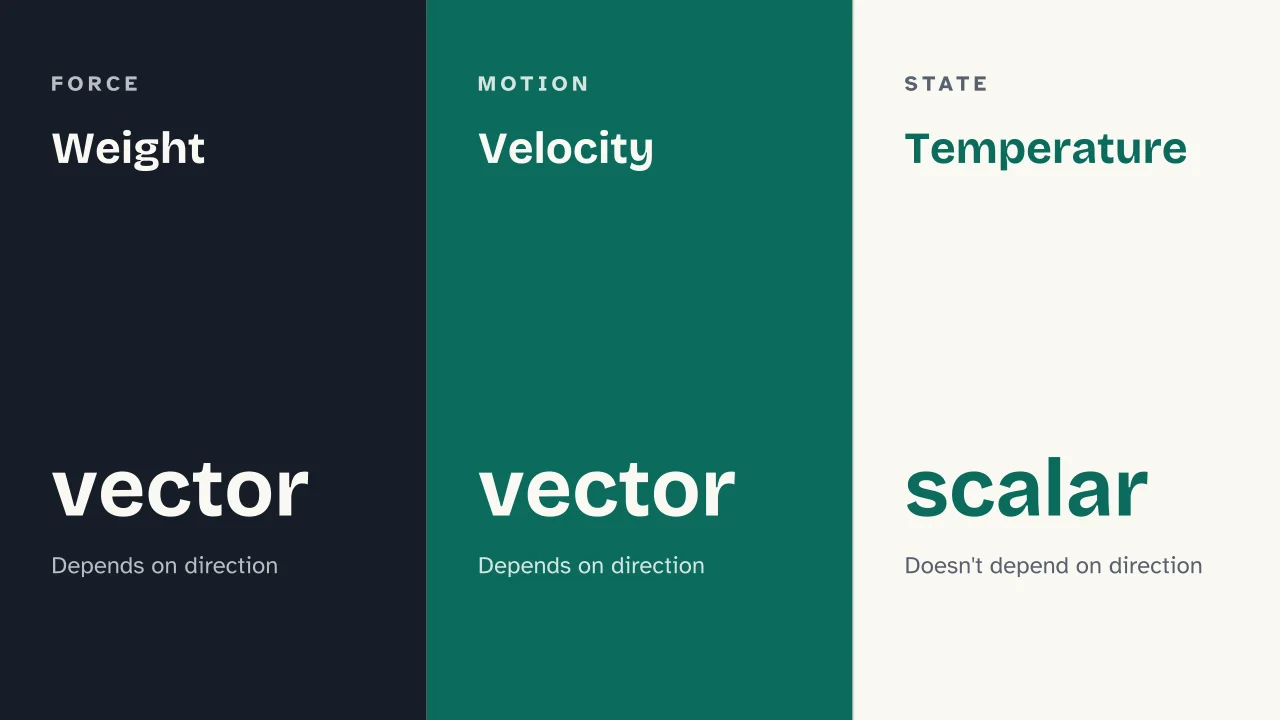  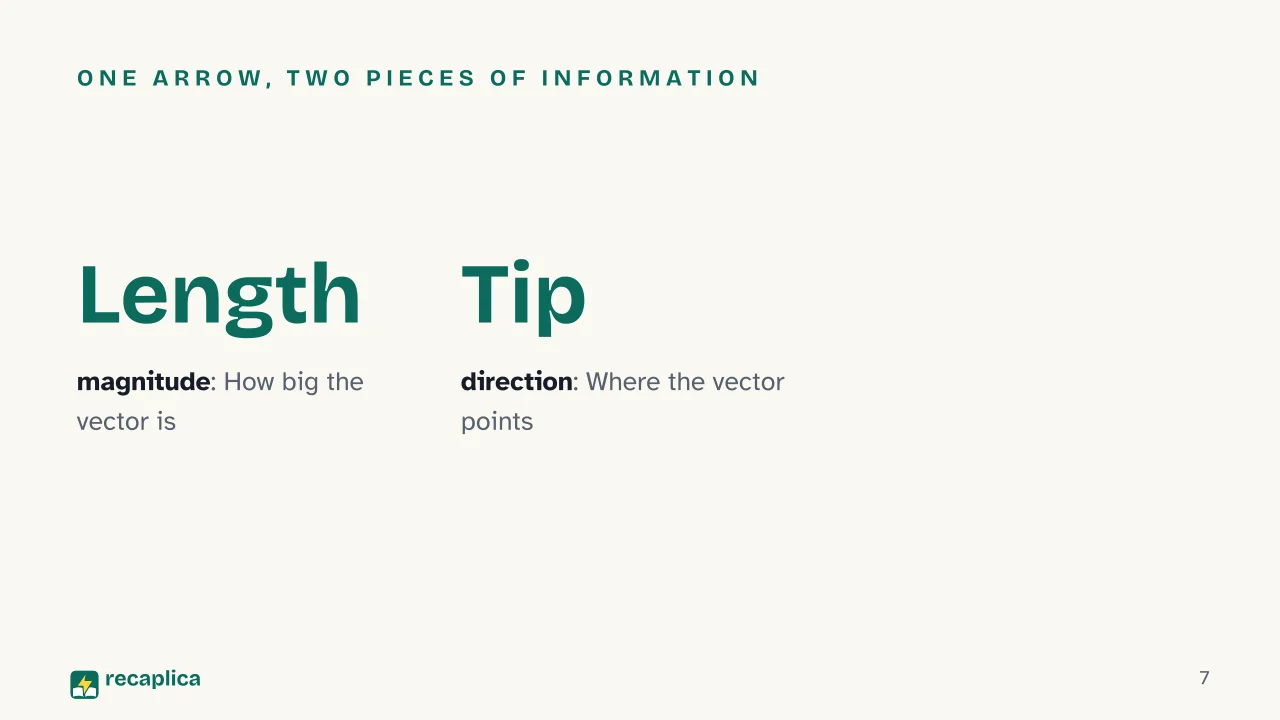 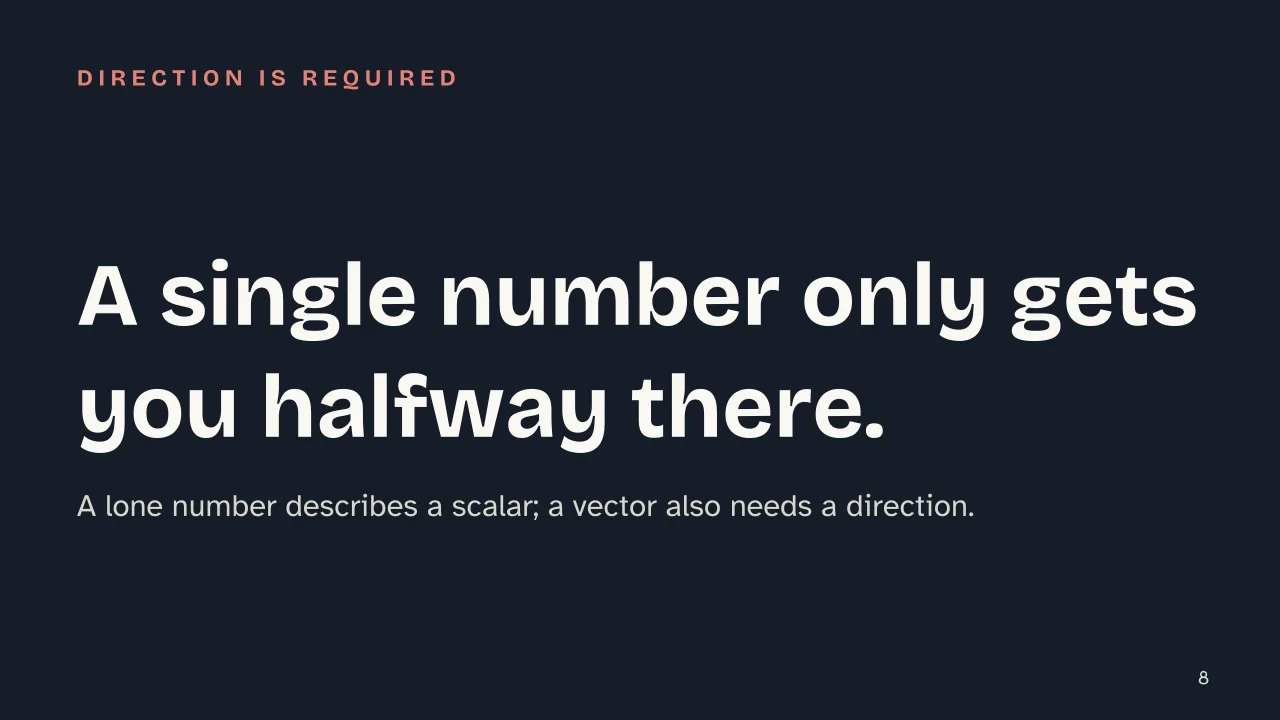  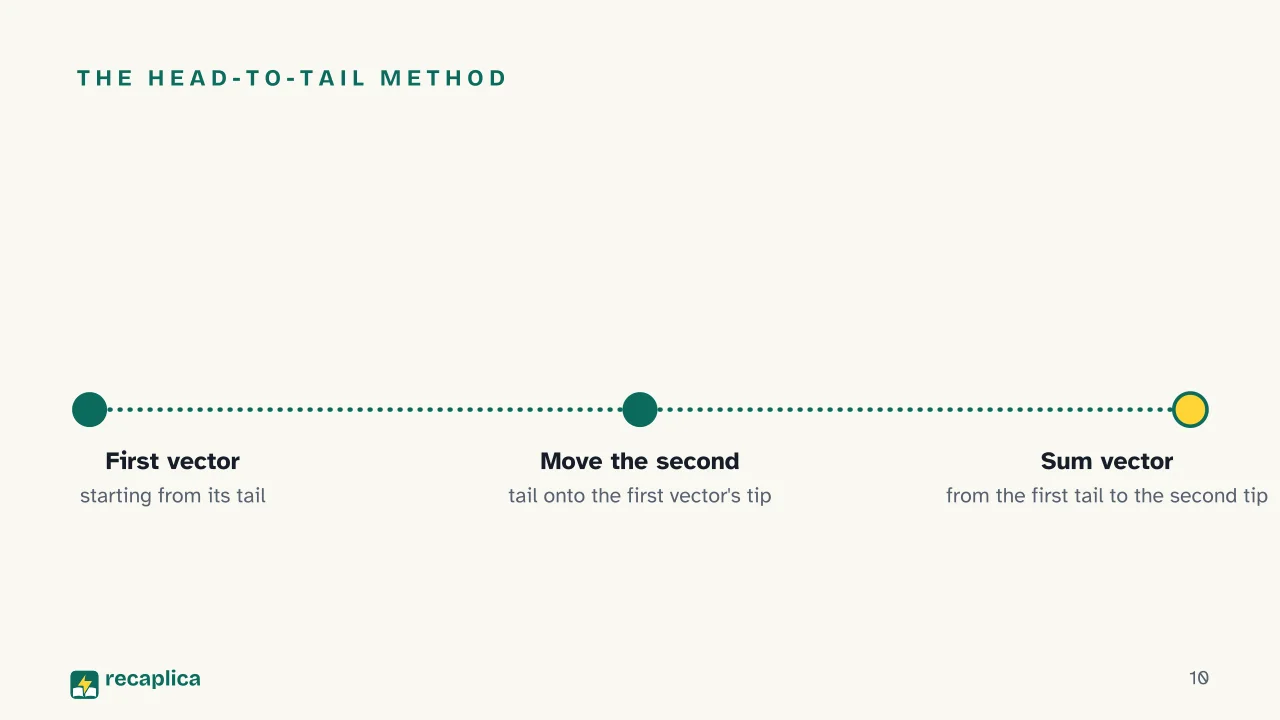 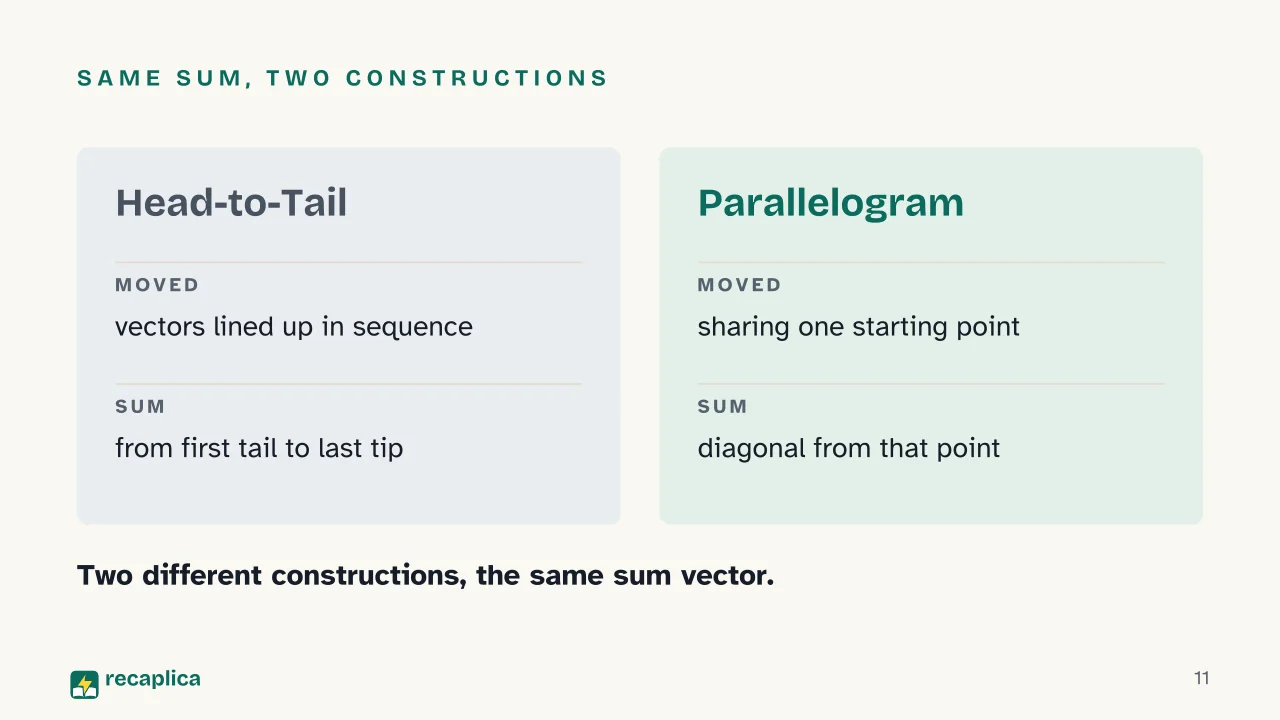  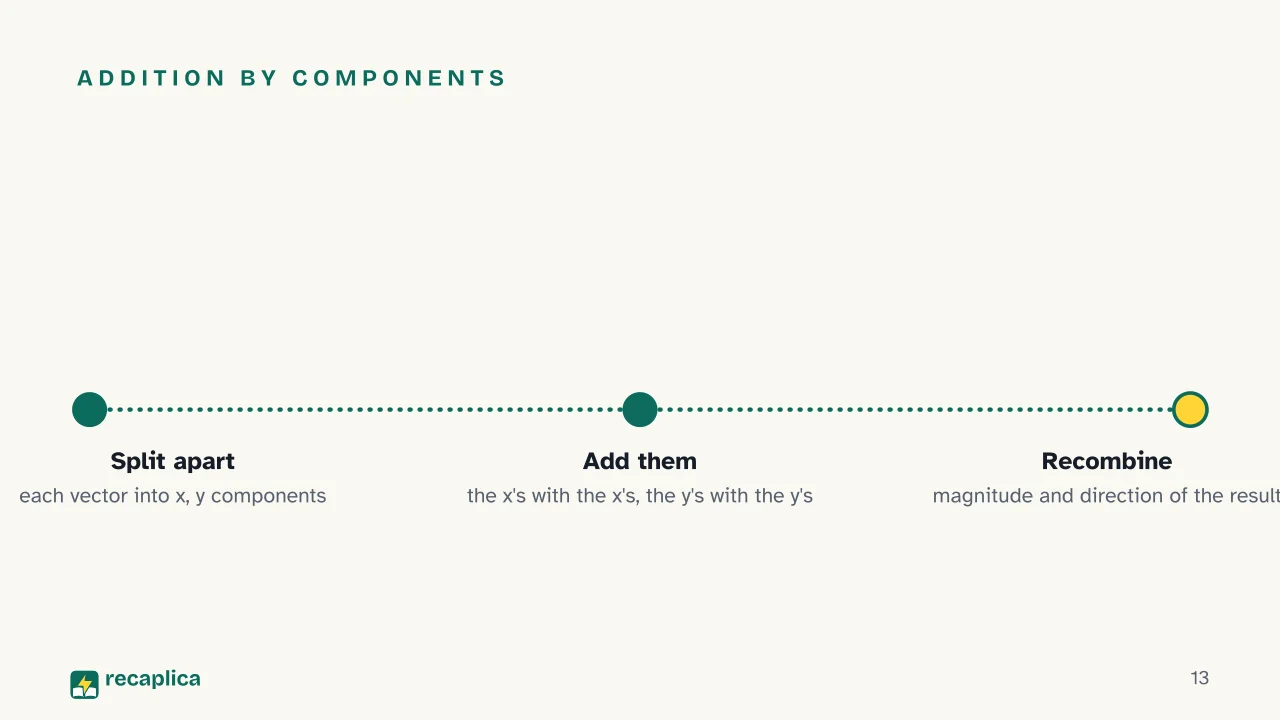   Common myths
Mind mapDrag the background to move around and the nodes to reposition them; use − and + to collapse and expand branches. 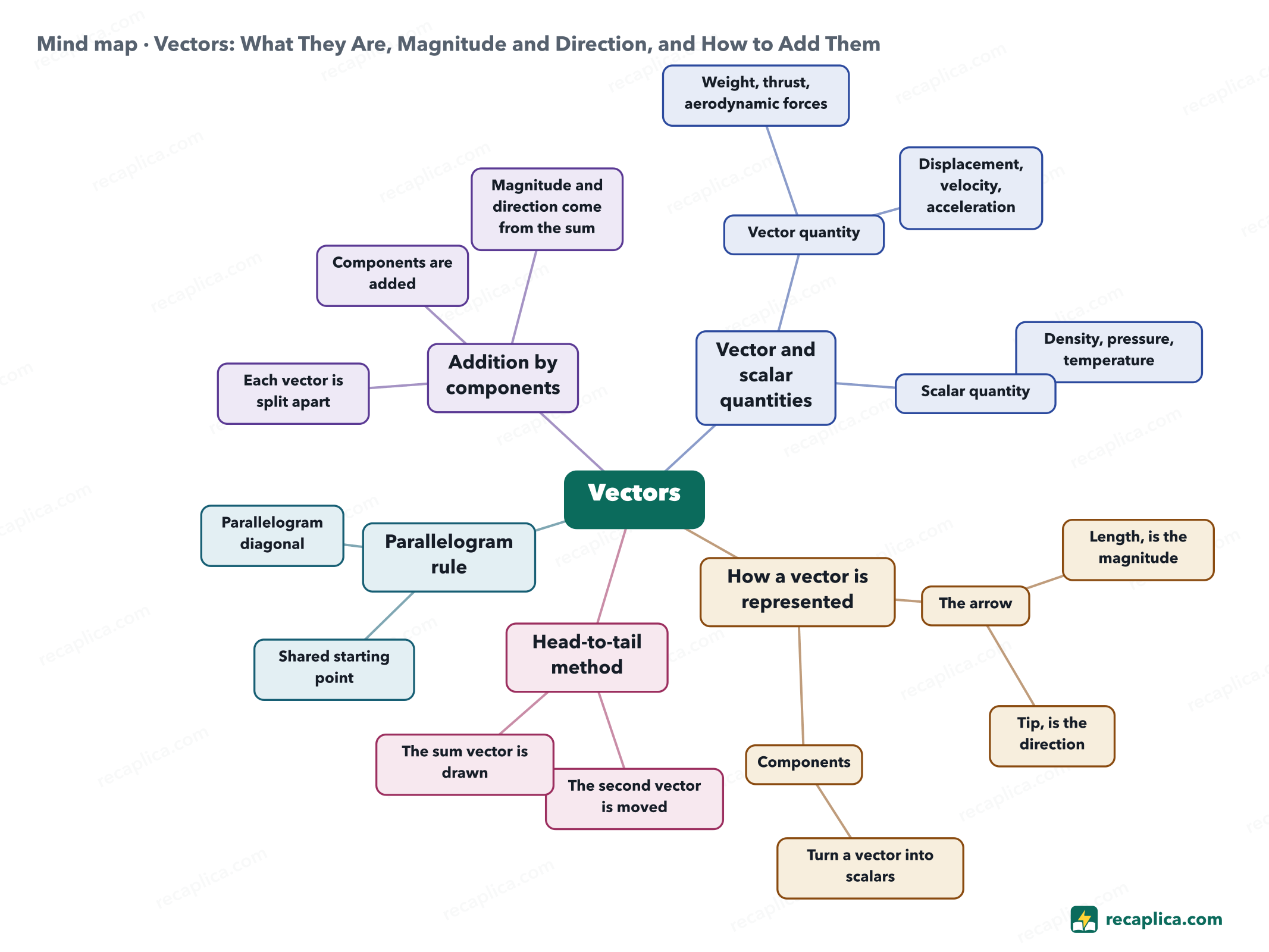
Quiz: test yourselfAnswer the questions to check what you have learned: you get instant feedback and a short explanation. Grade 0/10 0/5
FlashcardsTap the card to flip it and check whether you remember the answer, then move to the next one. 1 / 7 Explain it in your own wordsThe ultimate test: if you can explain it in simple words, you've truly understood it. Write your explanation, then compare it with the Recap. Your explanation is saved only on this device.
Frequently asked questionsWhat's the definition of a vector?A vector is a quantity defined by two pieces of information held together: magnitude (how much) and direction. It's drawn as an arrow and used to describe forces, displacements, velocities and accelerations. What's the difference between a vector and a scalar quantity?A vector depends on direction and always carries magnitude and direction together; a scalar doesn't depend on direction, and a single number describes it fully, like pressure or temperature. How do you add two vectors?With the head-to-tail method (the second vector slides onto the tip of the first), with the parallelogram rule (the shared diagonal is the sum), or by splitting the vectors into components and adding the components one by one. Why is a vector drawn as an arrow?Because an arrow carries both pieces of information that define a vector at once: how long it runs and where it points, magnitude and direction in a single stroke. What are the components of a vector, and what are they for?They're the vector's projections along reference directions, such as the x and y axes. They let you handle a vector as two separate numbers, useful for instance to add it to another vector or to work out the magnitude and direction of the result. Every Recap goes through an independent review before publication. |