Skip to content
recaplica

    One moment: security check

    Cloudflare wants to make sure you're not a robot. Tick the box below and your search will continue on its own.

    IT
    recaplica Coordinate Plane: What It Is and How It Works
    © 2026 Recaplica · recaplica.com — All rights reserved
    Home › Science

    Coordinate Plane: What It Is and How It Works

    By Recaplica Newsroom · Updated on October 8, 2026

    What to print

    Page numbers appear when printing with default margins.

    Slides

    Choose a cut

    Flash10 slidesThe essential thread, to present in classFull14 slidesEvery chapter and the deeper detail

    Both come with speaker notes.

    Telegram channel
    recaplica Clear in 30 seconds, yours in 10 minutes.
    In 30 seconds Key points Figures Deep dive Slides Myths Mind map Quiz Flashcards FAQ

    In 30 seconds quick read

    The coordinate plane is a grid made of two perpendicular number lines, the x-axis and the y-axis, meeting at a point called the origin. According to Treccani, the first number of a coordinate pair is called the abscissa and the second the ordinate; together they pinpoint a point's position with just two numbers. Math.net divides the plane into four quadrants, numbered I through IV counterclockwise starting from the top-right one, each with its own combination of signs. The name traces back to René Descartes, who according to MacTutor published La Géométrie in 1637, the treatise that gave rise to Cartesian geometry. Reading and plotting a point's coordinates is the first step before using the plane for lines and curves.

    Key Points

    • The coordinate plane is formed by two perpendicular axes, the x-axis and the y-axis.
    • The origin is the point (0,0) where the axes meet, and it belongs to none of the four quadrants.
    • The plane splits into four quadrants: the numbering runs from I to IV, counterclockwise, starting from the top-right one.
    • The signs of the coordinates change in each quadrant: (+,+), (−,+), (−,−), (+,−).
    • Every point is given by an ordered pair (x, y): x marks how far the point sits from the y-axis, y marks how far it sits from the x-axis.
    • The word «Cartesian» comes from Cartesius, the Latin form of Descartes' name.

    Key figures

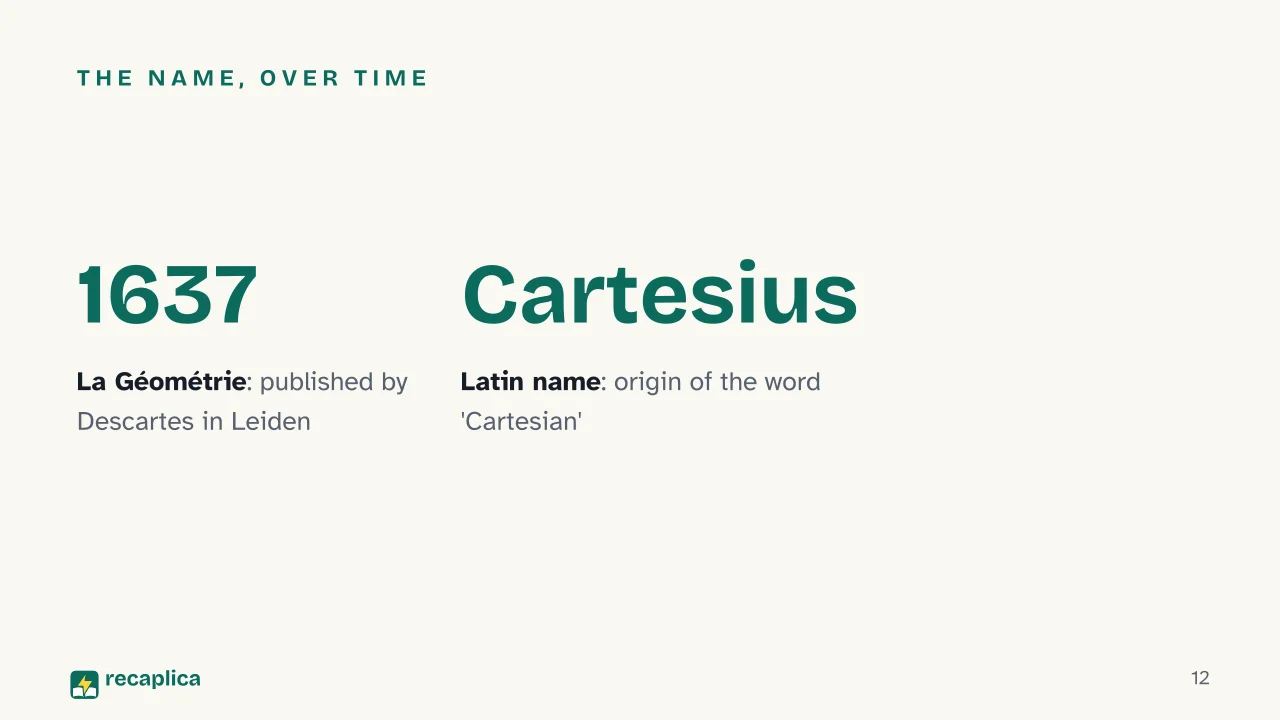
    • 1637 Year La Géométrie was published, the treatise by Descartes that gave rise to Cartesian geometry. Source: MacTutor History of Mathematics

    Deep Dive

    Two Lines That Meet

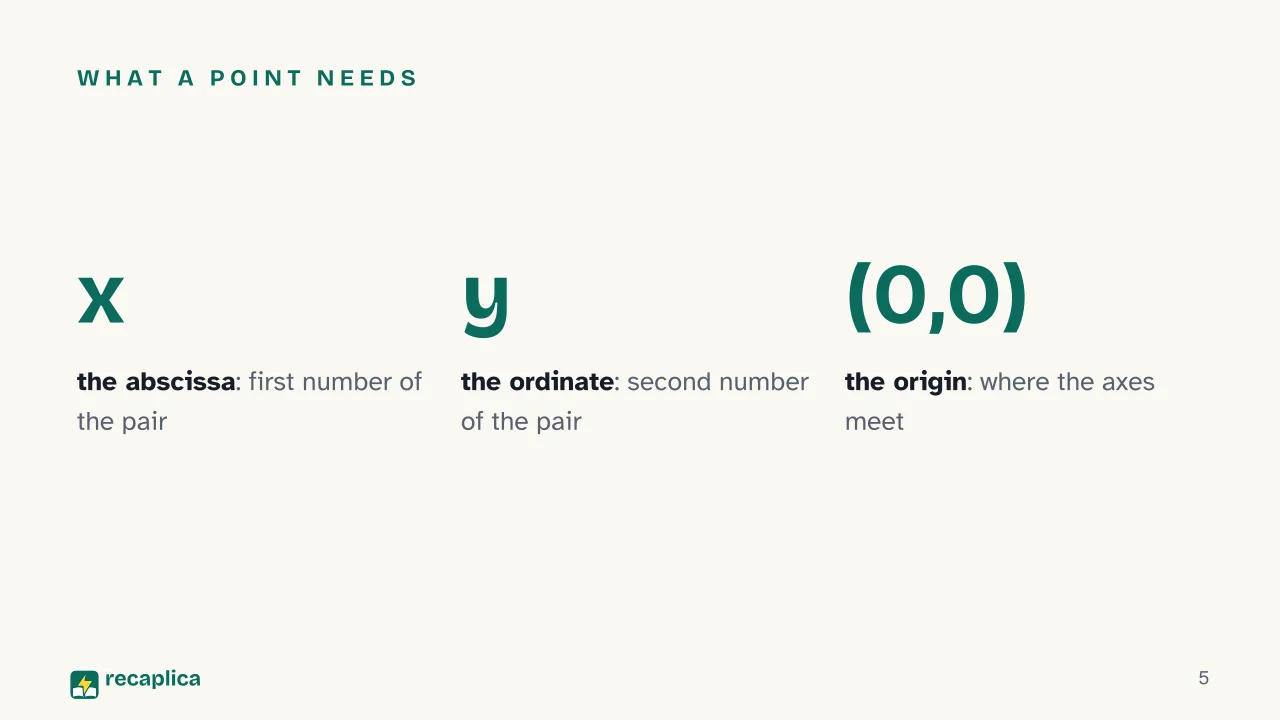
    The coordinate plane is the plane formed by two coordinate axes perpendicular to each other, as Cuemath puts it. The horizontal axis is called the x-axis, the vertical one the y-axis; the point where the two axes meet is the origin, with coordinates (0, 0).

    According to Treccani, to find the coordinates of a point P you draw lines parallel to the axes: the lengths of the two segments that form, measured from the origin, are the point’s two coordinates. This creates a correspondence between every point in the plane and every pair of real numbers.

    Abscissa and Ordinate

    Treccani calls the first number of a coordinate pair the abscissa and the second the ordinate: in practice, x is always the abscissa and y is always the ordinate. The line along which the abscissa is measured is the x-axis; the other is the y-axis. Cuemath defines the distance symmetrically: x is the point’s distance from the y-axis, y is its distance from the x-axis.

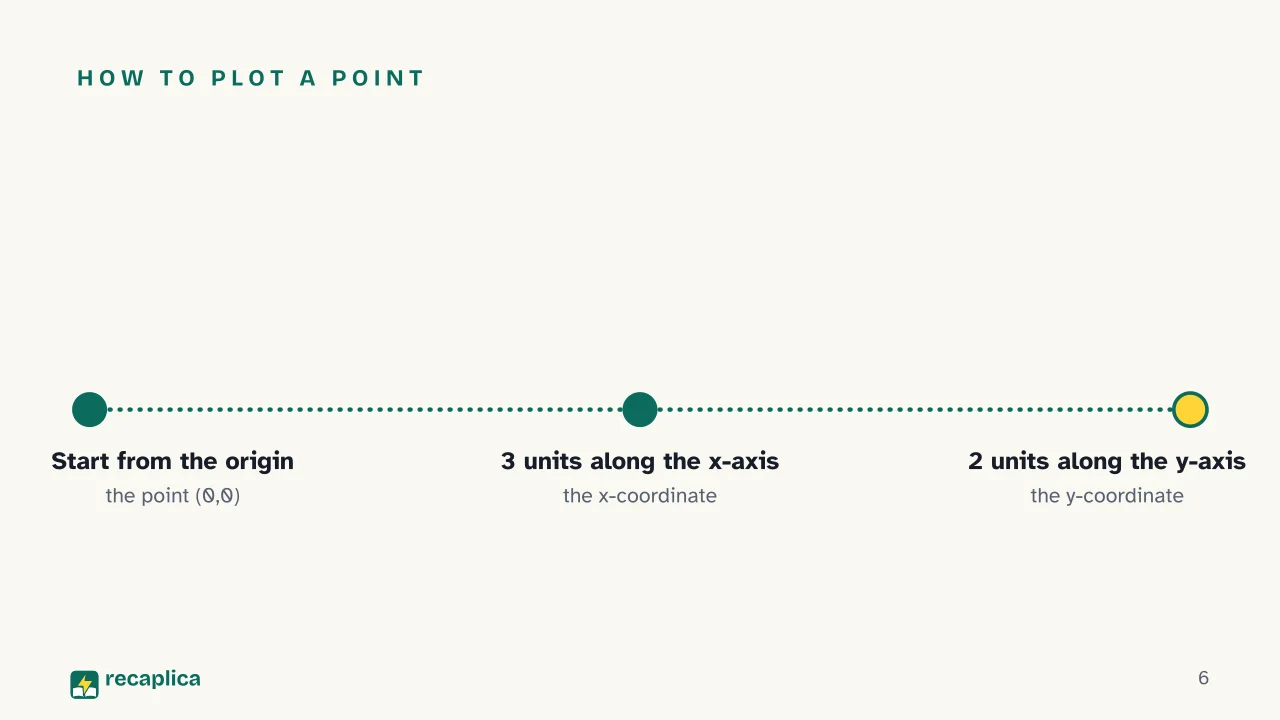
    Practical example: to plot the point (3, 2), start from the origin, move 3 units along the x-axis, then 2 units upward, parallel to the y-axis. The point you land on has an x-coordinate of 3 and a y-coordinate of 2.

    The Four Quadrants

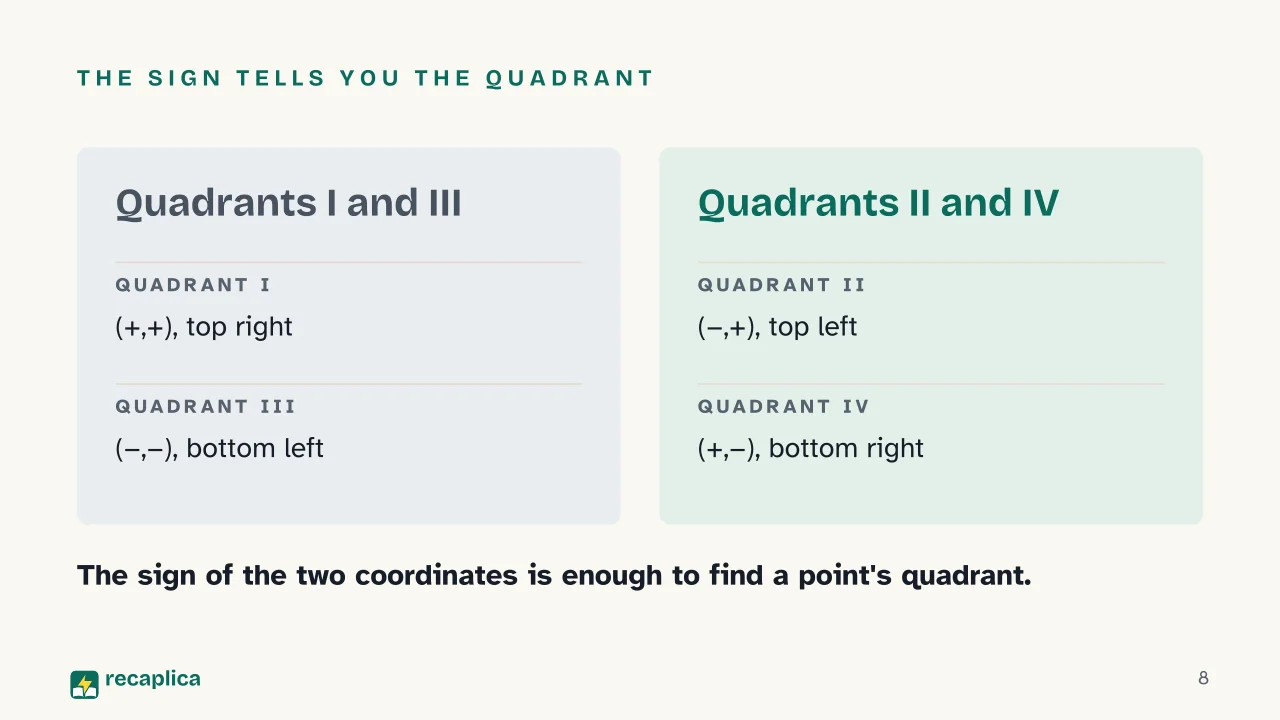
    The axes divide the plane into four infinite regions, the quadrants, numbered I through IV starting from the top-right one and moving counterclockwise, according to Math.net. The origin belongs to none of the four. Each quadrant has a fixed combination of signs:

    QuadrantPositionSign of xSign of y
    Itop right++
    IItop left−+
    IIIbottom left−−
    IVbottom right+−

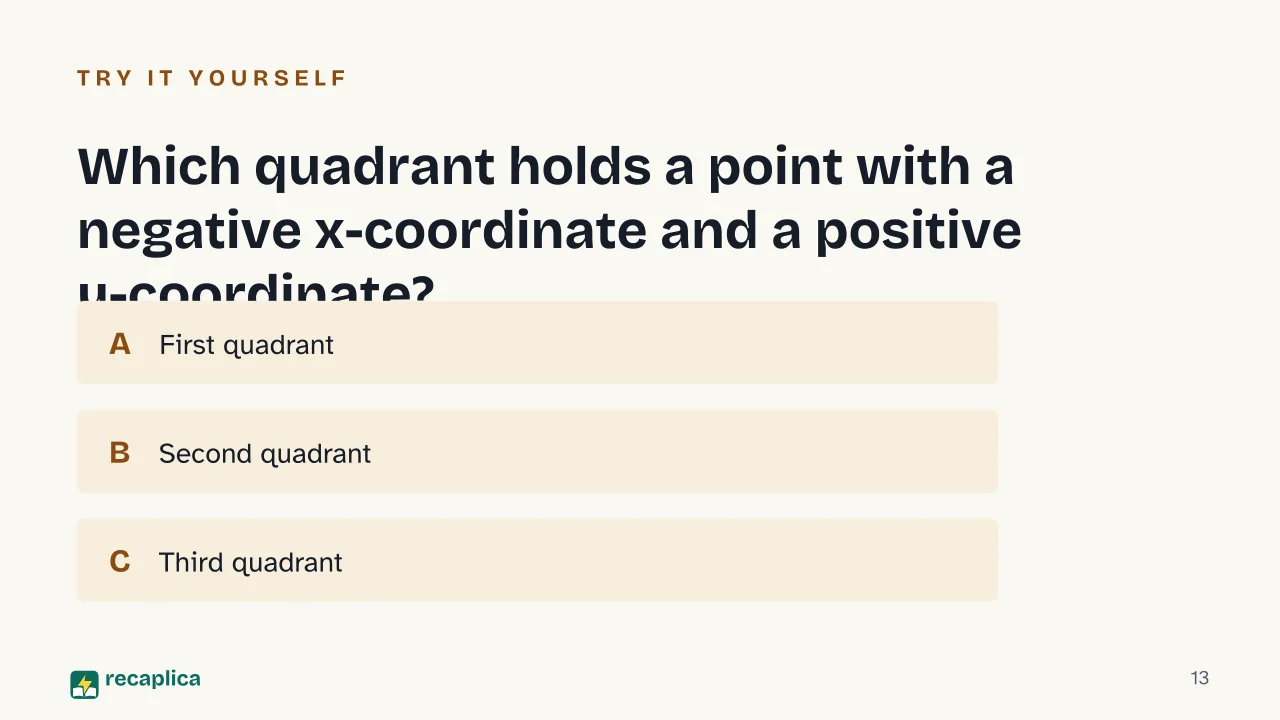
    For example, whenever x is negative and y is positive, the point always sits in the second quadrant: the signs alone tell you which of the four zones to look in.

    Where the Name “Cartesian” Comes From

    The name traces back to René Descartes, who according to MacTutor published La Géométrie in Leiden in 1637, the work that gave rise to what is now called Cartesian geometry. The term traces back to the Latinized form of Descartes’ name, “Cartesius.” MacTutor notes, however, that some of the treatise’s ideas may derive from earlier work by the medieval mathematician Nicole Oresme, even though that work shows no sign of linking algebra and geometry; and that the English mathematician John Wallis argued forcefully that those ideas belonged to Thomas Harriot, a historical dispute that MacTutor reports without endorsing. The method’s attribution to Descartes stands, alongside the debts to earlier work that MacTutor itself points out.

    What It’s Used for, Beyond Plotting Points

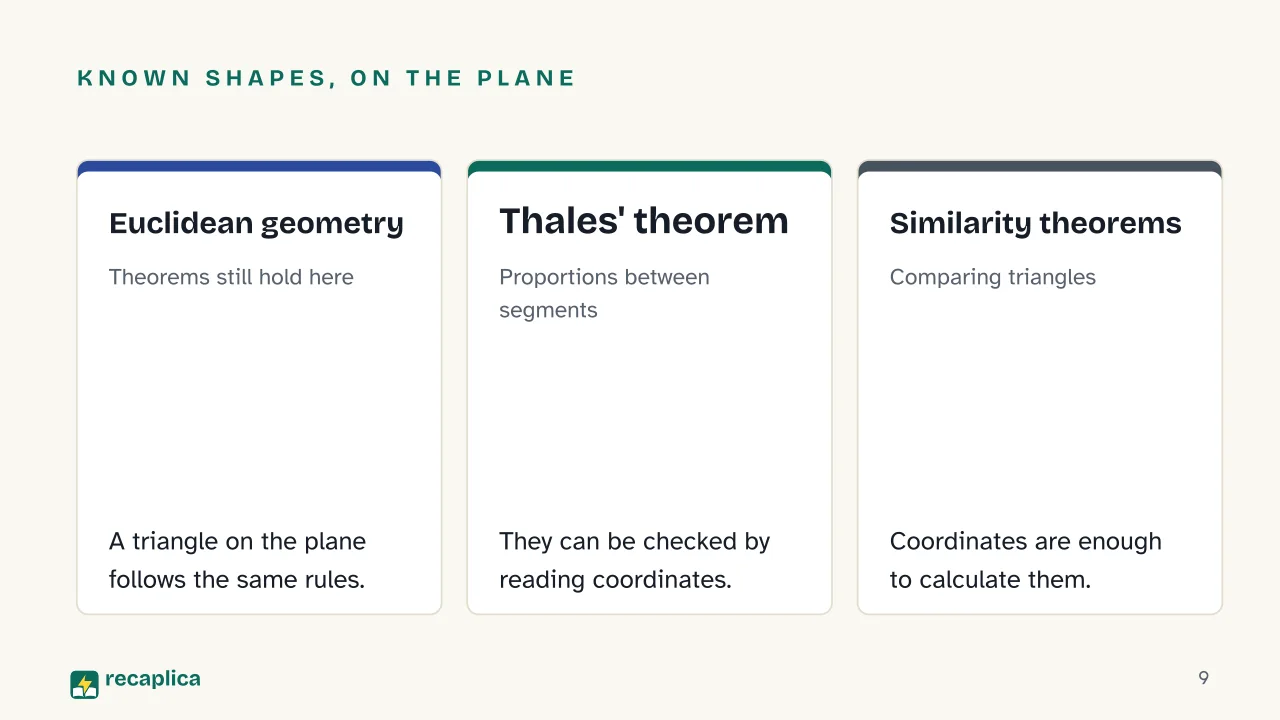
    The coordinate plane alone already makes it possible to place known geometric shapes and describe their properties with numbers: the theorems and postulates of Euclidean geometry, for instance, still hold for triangles drawn on the plane, and the proportions from Thales’ theorem can be checked by reading the coordinates of the points involved. Once the coordinate plane is used to describe lines and curves with equations, it becomes analytic geometry, a step beyond simply reading a point.

    Two triangles drawn on the plane, with vertices at different points, can be compared using the triangle similarity theorems: coordinates make it possible to calculate exactly the measurements those theorems require, without having to draw everything by hand.

    Slide deck

    Slides ready to download and make your own in PowerPoint or Google Slides, with speaker notes. Pick the Flash cut or the Full one.
    Slide 1 of the presentation on Coordinate Plane: Coordinate PlaneSlide 2 of the presentation on Coordinate Plane: How do you describe the exact position of a point in the plane?Slide 3 of the presentation on Coordinate Plane: From the axes to the nameSlide 4 of the presentation on Coordinate Plane: Chapter 01: The axes and the coordinatesSlide 5 of the presentation on Coordinate Plane: What a point needsSlide 6 of the presentation on Coordinate Plane: How to plot a pointSlide 7 of the presentation on Coordinate Plane: Chapter 02: The four quadrantsSlide 8 of the presentation on Coordinate Plane: The sign tells you the quadrantSlide 9 of the presentation on Coordinate Plane: Known shapes, on the plane: Euclidean geometry, Thales' theorem, Similarity theoremsSlide 10 of the presentation on Coordinate Plane: No fly invented the coordinate plane.Slide 11 of the presentation on Coordinate Plane: Chapter 03: Where the name comes fromSlide 12 of the presentation on Coordinate Plane: The name, over timeSlide 13 of the presentation on Coordinate Plane: Which quadrant holds a point with a negative x-coordinate and a positive y-coordinate?Slide 14 of the presentation on Coordinate Plane: Now, time to review
    Flash10 slidesThe essential thread, to present in classFull14 slidesEvery chapter and the deeper detail

    Common myths

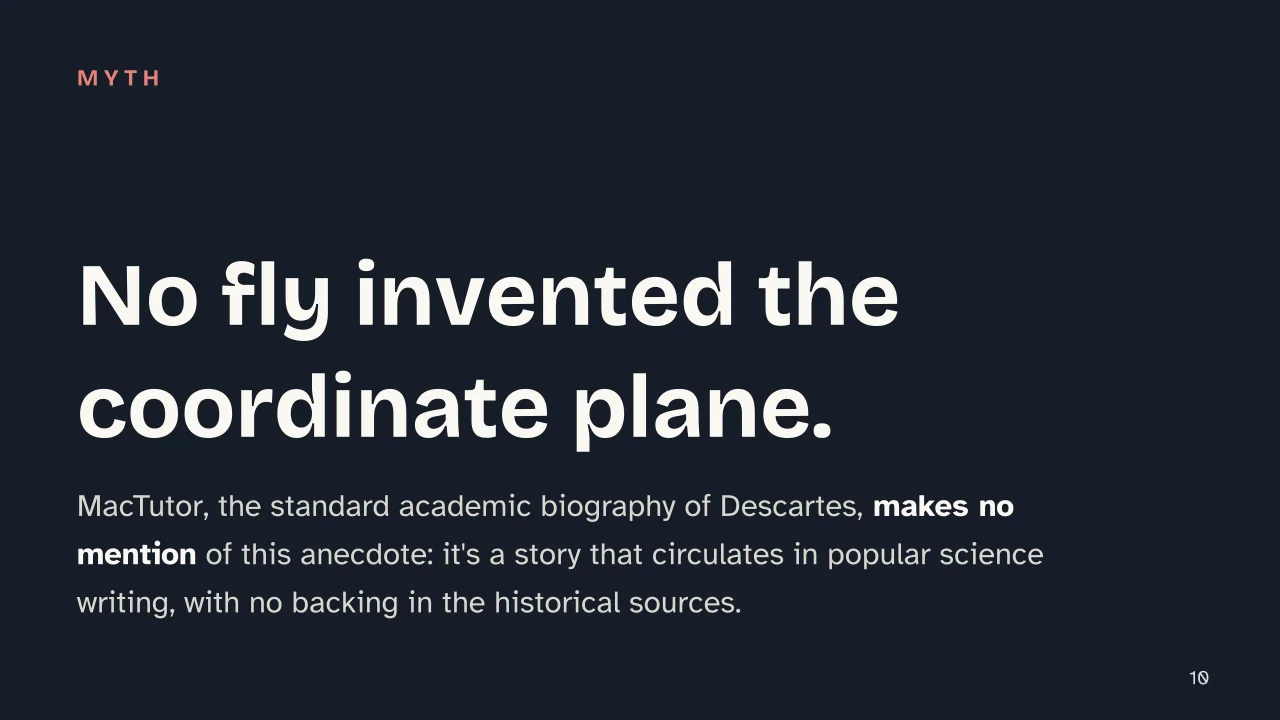
    • ✗ Myth Descartes came up with the coordinate plane while watching a fly crawl across his bedroom ceiling.

      ✓ Reality It's a popular anecdote in science writing, but the standard historical source, MacTutor, doesn't mention it at all: it remains a popular legend, not a documented fact about the origin of Cartesian geometry.

    • ✗ Myth The coordinate method was a sudden, isolated invention of Descartes, with no debt to earlier work.

      ✓ Reality MacTutor notes that some of the ideas may trace back to the medieval mathematician Nicole Oresme, and that the English mathematician John Wallis went so far as to accuse Descartes of borrowing from Thomas Harriot. The attribution of the name stays correct, but the ground wasn't entirely untouched.

    • ✗ Myth The coordinate plane is only good for plotting scattered points, with no other use.

      ✓ Reality It's the basic tool used to place already-known geometric shapes, such as triangles and polygons, so they can be studied with numbers instead of just drawings; it's also the starting point for describing lines and curves with equations.

    Mind map

    Drag the background to move around and the nodes to reposition them; use − and + to collapse and expand branches.
    Customize
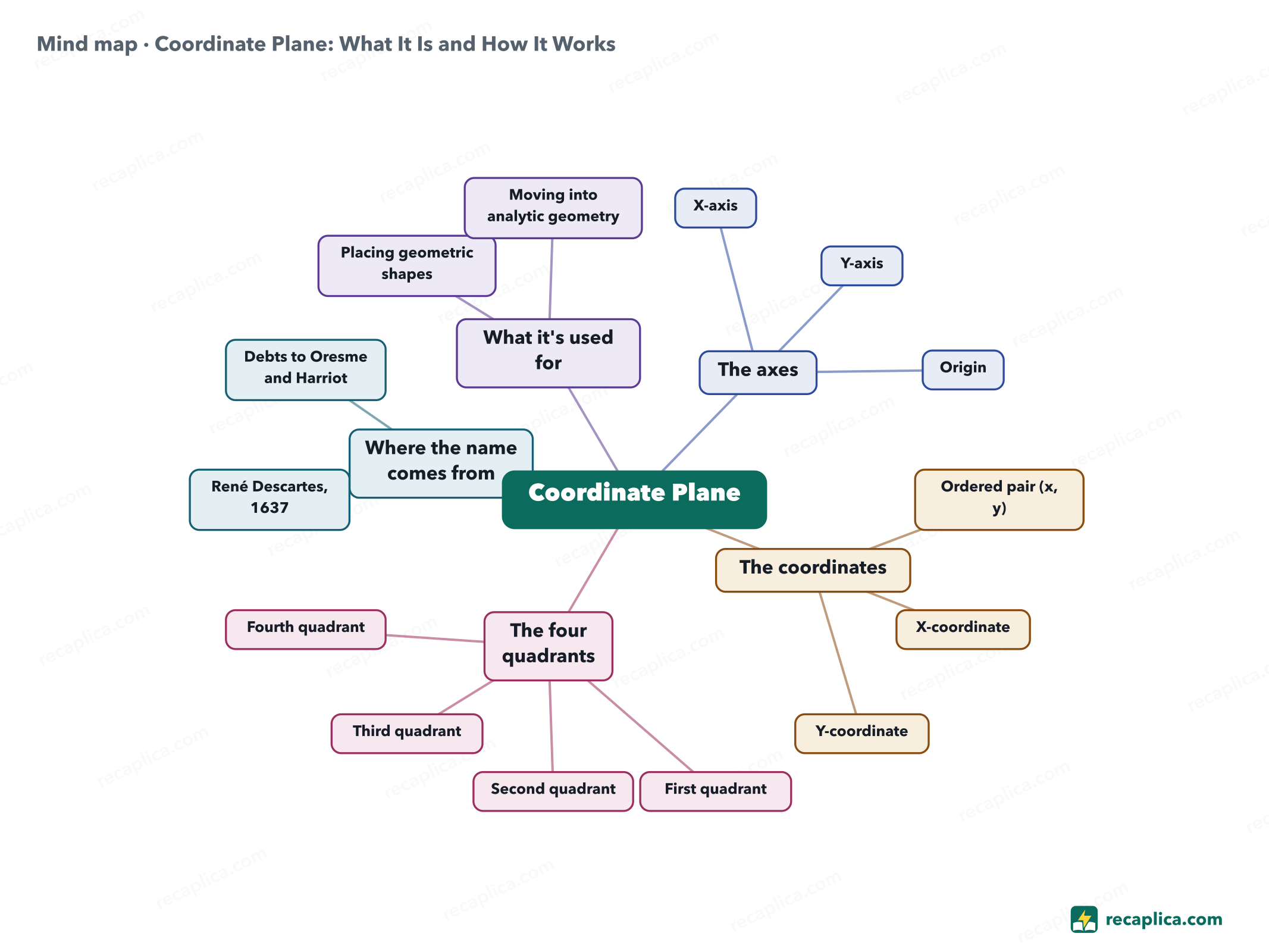
    Mind map: Coordinate Plane: What It Is and How It Works
    • Coordinate Plane
      • The axes
        • X-axis the horizontal axis
        • Y-axis the vertical axis
        • Origin the point (0, 0)
      • The coordinates
        • Ordered pair (x, y)
        • X-coordinate the first number
        • Y-coordinate the second number
      • The four quadrants
        • First quadrant (+, +)
        • Second quadrant (−, +)
        • Third quadrant (−, −)
        • Fourth quadrant (+, −)
      • Where the name comes from
        • René Descartes, 1637 La Géométrie, according to MacTutor
        • Debts to Oresme and Harriot noted by MacTutor
      • What it's used for
        • Placing geometric shapes
        • Moving into analytic geometry

    Quiz: test yourself

    Answer the questions to check what you have learned: you get instant feedback and a short explanation.

    Grade 0/10 0/5
    1 What are the two axes of the coordinate plane called?

    The axes of the coordinate plane are called the x-axis and the y-axis.

    2 What is the point where the x-axis and y-axis meet called?

    The point where the axes meet is called the origin, with coordinates (0, 0), as Cuemath notes.

    3 Which quadrant holds a point with a negative x-coordinate and a positive y-coordinate?

    According to Math.net, the second quadrant has the sign combination (−, +), meaning a negative x-coordinate and a positive y-coordinate.

    4 True or false: the origin of the coordinate plane belongs to the first quadrant.

    Math.net specifies that the origin, the point (0, 0), belongs to none of the four quadrants.

    5 According to Treccani, what is the first number of a coordinate pair called?

    Treccani calls the first number abscissa and the second ordinate; together they form the pair (x, y) that locates a point.

    Answers: 1-A · 2-A · 3-B · 4-B · 5-A

    Flashcards

    Tap the card to flip it and check whether you remember the answer, then move to the next one.

    1 / 8

    Explain it in your own words

    The ultimate test: if you can explain it in simple words, you've truly understood it. Write your explanation, then compare it with the Recap.

    Your explanation is saved only on this device.

    The coordinate plane is a grid made of two perpendicular number lines, the x-axis and the y-axis, meeting at a point called the origin. According to Treccani, the first number of a coordinate pair is called the abscissa and the second the ordinate; together they pinpoint a point's position with just two numbers. Math.net divides the plane into four quadrants, numbered I through IV counterclockwise starting from the top-right one, each with its own combination of signs. The name traces back to René Descartes, who according to MacTutor published La Géométrie in 1637, the treatise that gave rise to Cartesian geometry. Reading and plotting a point's coordinates is the first step before using the plane for lines and curves.

    Frequently asked questions

    What's the difference between the abscissa and the ordinate?

    The abscissa is the first number of a coordinate pair (usually x, on the horizontal axis), the ordinate is the second (usually y, on the vertical axis): together they locate a point, as Treccani defines it.

    Why is the coordinate plane called 'Cartesian'?

    After René Descartes, Latinized as Cartesius: according to MacTutor he published La Géométrie in 1637, the work that introduced the coordinate method, even though some of its ideas had debts to earlier work.

    Which quadrant does the origin belong to?

    None: according to Math.net the origin, the point (0, 0), is where the axes meet and belongs to none of the four quadrants.

    Is there an online coordinate plane tool to use?

    Yes, several online tools exist, such as graphing calculators, that let you plot points on a coordinate plane without paper and pencil. Recaplica doesn't recommend a specific tool: the right choice depends on the task, from school homework to more advanced projects.

    How do you find the coordinates of a point that's already plotted?

    According to Treccani, you draw lines parallel to the axes from the point: the two segments that form, compared to the origin, give you the pair of numbers you're after.

    Sources

    • MacTutor History of Mathematics, René Descartes
    • Math.net, Quadrant
    • Cuemath, Cartesian Plane
    • Treccani, Enciclopedia della Matematica, Coordinate cartesiane

    Every Recap goes through an independent review before publication.

    Every evening, the day's new Recaps on our Telegram channel. Join the channel →

    Keep learning

    • Science Correlation: What It Means and How to Read the Coefficient Correlation measures how closely two variables move together, and the most common way to put a number on it is the correlation coefficient, which runs from -1 to +1. A value near +1 means the two variables rise together, near -1 means one rises while the other falls, and near 0 means no linear relationship stands out. The coefficient only captures the strength of a straight-line relationship, and a single unusual data point can push it up or down by a lot. Even when it's strong, a correlation between two variables never shows that one causes the other. Read the Recap →
    • Science Light Refraction: What It Is, the Laws Behind It, and Examples A surface that separates two transparent materials sends some light back, reflecting it, and lets the rest through while bending it toward a new direction. The law of reflection keeps the incoming and outgoing angles equal, both measured from the normal to the surface. Snell's law governs refraction instead, linking the index of each material to how much the ray tilts before and after it crosses over. These two laws alone explain mirrors, lenses, prisms and everyday sights such as a pencil that appears to snap inside a glass of water. Read the Recap →
    • Science Total Internal Reflection and the Critical Angle: Definition and Formula Total internal reflection is what happens when a light ray stops being able to leave a transparent medium and gets sent back inside it completely. It takes place past a specific angle of incidence, called the critical angle, calculated with Snell's law by comparing the refractive indices of the two materials involved. It only happens under one precise condition: the ray must be traveling from an optically denser medium into a less dense one, such as from water into air or from glass into air. Optical fibers and, in part, the sparkle of diamonds rely on this same principle. Read the Recap →

    recaplica

    Clear in 30 seconds, yours in 10 minutes.

    Recaps Mind maps Request a Recap Telegram channel Mind map maker Our method About Privacy & cookies Legal notes & terms of use

    © 2026 Recaplica · A project by Curi S.r.l. — VAT IT05472000750

    Statistics, only if you say so

    To learn which Recaps help most we would use Google Analytics, with aggregate, anonymous data. It starts only with your OK, and you can change your mind anytime. Privacy policy