|
recaplica
Newton's Three Laws of Motion: What They Actually Say | ||||||||||||
| © 2026 Recaplica · recaplica.com — All rights reserved | ||||||||||||
Newton's Three Laws of Motion: What They Actually SayWhat to print Page numbers appear when printing with default margins. SlidesChoose a cut Flash10 slidesThe essential thread, to present in classFull17 slidesEvery chapter and the deeper detailBoth come with speaker notes. In 30 seconds quick readNewton's three laws of motion describe how forces change the way objects move, from a lawnmower in the yard to rockets leaving Earth. The first says a body keeps doing whatever it's already doing (staying still or moving in a straight line) until a force comes along to change that. The second links force to acceleration through mass. The third says every force always produces another, equal and opposite, acting on a different body. Isaac Newton published them in 1687, but the formula taught in school, F=ma, is a later rewrite of his original idea. Key Points
Key figures
Deep DiveWhat the first law actually saysA body at rest stays at rest. A body in motion keeps moving in a straight line, at the same speed, until something acts to change that. That’s the principle of inertia, and it’s subtler than it sounds: in everyday life we’re used to thinking things “stop on their own,” because in practice friction and air resistance are almost always at work. But that friction is itself an external force: take it away, as with a puck gliding across an air hockey table, and the motion continues for much longer — the same principle that lets a football keep rolling across a well-mowed pitch, where friction is minimal (see also the Recap on the history of football’s rules). Inertia is a body’s tendency to resist changes to its state of motion: a boulder has more of it than a basketball, meaning it resists harder when you try to speed it up or bring it to a stop. That idea leads straight to something more technical but important: the inertial reference frame, a frame in which the first law actually holds. A train moving at constant speed is (approximately) an inertial frame: a glass of water on its little table stays put relative to the train. A train braking hard is no longer one: the glass slides forward, not because some mysterious force pushes it, but because the train, the reference frame, is accelerating while the glass, by inertia, would otherwise keep going as before.
Even Earth, taken as the reference for everyday experiments, isn’t a perfectly inertial frame: it spins on its axis and orbits the Sun, so it accelerates slightly. That acceleration, though, is less than 3.4×10⁻² m/s², small enough to make labs on Earth “approximately inertial” for the vast majority of practical purposes, from school physics experiments to a game of football. The second law: force, mass, and accelerationIf the first law describes what happens without a net force, the second describes what happens when there is one. An object’s acceleration is proportional to the force it receives and inversely proportional to its mass: a stronger push accelerates it more, but the same push accelerates a heavier object less. In the form taught in school, with constant mass, this is written F = m · a. The unit of force, the newton, is defined directly from this law: one newton (1 N) is the force needed to accelerate a 1 kg object at 1 meter per second, per second. A small apple weighs about 1 N on Earth, a handy way to get a feel for just how small this unit is.
This brings up one of the most confused distinctions in school physics: mass and weight aren’t the same thing. Mass is an intrinsic property of an object, the amount of matter it’s made of, and it never changes, whether the object is on Earth, in orbit, or on the Moon. Weight, by contrast, is the force with which gravity pulls that mass downward: w = m · g, where g is the local gravitational acceleration. On Earth, g is about 9.80 m/s², so a 1 kg object weighs 9.80 N. On the Moon, where g is about 1.62 m/s², the same 1 kg mass weighs only 1.6 N: the matter is identical, but the force gravity exerts on it is much weaker. Everyday confusion is made worse by household scales, which display a value in “kg” but actually measure weight, calibrated to report mass under Earth’s gravity. A finer distinction still, found in more advanced physics texts, is the one between inertial mass and gravitational mass. Inertial mass is the one that shows up in the second law, F = m · a: it measures how much an object resists being accelerated. Gravitational mass, instead, measures how much an object generates or experiences gravitational attraction. In Newtonian mechanics the two turn out to be numerically equal, a fact that lets the mass cancel out when calculating gravitational acceleration (which is why a feather and a lead weight fall at the same rate, absent air resistance), but Newton simply took this for granted without explaining it; centuries later, Einstein would elevate it to a founding principle of general relativity. When a system’s mass isn’t constant, as with rockets burning fuel during flight, F = m · a is no longer enough: the more general form, tied to the rate of change of momentum, is needed instead.
The third law: action and reaction, but on different bodiesThe third law says that whenever one body exerts a force on a second body, the second exerts a force on the first that’s equal in strength and opposite in direction. It’s probably the most quoted in everyday language (“for every action there’s an equal and opposite reaction”) and also the most misunderstood, because the wording invites a specific mistake: thinking the two forces, being equal and opposite, cancel each other out. They never do, for a simple reason: they act on two different bodies, not the same one. When a swimmer pushes off the pool wall backward with her feet, the wall pushes her forward with an equal and opposite force, and it’s that second force, acting on the swimmer’s own body, that determines her motion. If both forces acted on the same object, they really would cancel out, and nobody would ever be able to push off from a stop, which isn’t what happens every day in a pool, on a bike, or just walking.
The most instructive example of the third law, though, is probably rockets. A common idea pictures a rocket moving by “pushing against” the air behind it, the way a swimmer pushes against water. That’s wrong: rockets work perfectly well in the vacuum of space, where there’s nothing to push against. Their thrust comes from expelling exhaust gases at high speed: the rocket pushes the gases backward, and the gases push the rocket forward, exactly as the third law predicts. Because a rocket carries both its fuel and the oxidizer needed to burn it, it doesn’t need an atmosphere to generate thrust; if anything, it works better without one, since the exhaust gases meet less resistance expanding outward. The same principle explains why a helicopter flies by pushing air downward and receives, in reaction, an upward push. Not exactly what Newton wroteThis Recap talks about what the three laws “actually” say because there’s a real difference, not just a stylistic one, between the version taught in school and what Isaac Newton put on paper in the 1600s. In the Philosophiae Naturalis Principia Mathematica, published in 1687, the second law isn’t stated as F = m · a, but as a proportionality between the force impressed on a body and the resulting “change of motion,” in modern terms, the rate of change of momentum. F = m · a is a later rewrite, valid when mass stays constant, and a special case (if the most common one in everyday life) of Newton’s more general law. Early versions of the three laws date back to 1666, when Newton, barely into his twenties, was at Cambridge during the university’s closure for a plague outbreak. It took years, though, plus a push from the astronomer Edmond Halley, for those ideas to become the work we know today. In August 1684, Halley asked Newton what orbit a body would follow under a force inversely proportional to the square of the distance; discovering that Newton had already solved the problem, he convinced him to write it up in full. From a short initial treatise titled De Motu (“On Motion”), the Principia grew over roughly two and a half years of work. Historians agree the final publication came in 1687, even though an earlier version of the text had already been presented to the Royal Society the year before. The title of the work itself is a clue to its place in the history of science. According to the Stanford Encyclopedia of Philosophy, Newton chose it in deliberate allusion to René Descartes’ Principia Philosophiae, to set his own physics, grounded in universal gravitation, against Cartesian physics, which explained planetary motion through vortices of fine matter supposedly sweeping the planets along. With Galileo Galilei, the relationship is one of continuity rather than contrast: Newton’s general laws of motion include, as special cases, Galileo’s findings on falling bodies (an object falls a distance proportional to the square of the time) and on the parabolic path of projectiles, both confirmed by experiment. Where Newton’s laws stopThe three laws describe, with enormous precision, the world we can touch and measure directly: from lawnmowers to rockets, from baseballs to cars. But they remain laws with a defined range of application, and in two extreme situations they stop being enough. When speeds approach that of light, the classical F = m · a relationship no longer holds, because an object’s mass no longer behaves as a fixed quantity. In a sense, this calls for returning to Newton’s original formulation: force needs to be defined more generally as the rate of change of momentum over time, an idea that relativity inherits and develops further. At the atomic and subatomic scale, meanwhile, Newton’s laws give way to quantum mechanics, which describes phenomena like interference that have no equivalent in classical physics. None of these limits takes anything away from the three laws within their own domain: from bridge design to satellite launches, Newtonian mechanics remains the reference toolkit for calculation, so much so that it only fully matured as an organized discipline in the second half of the 1700s, once its theoretical promises had finally been worked out in full. To see how these same forces hold together bodies far larger than a rocket, the Recap on the solar system is worth a look; for a historical application of the laws of motion beyond Earth’s atmosphere, there’s the one on the Apollo 11 Moon landing. Slide deckSlides ready to download and make your own in PowerPoint or Google Slides, with speaker notes. Pick the Flash cut or the Full one.     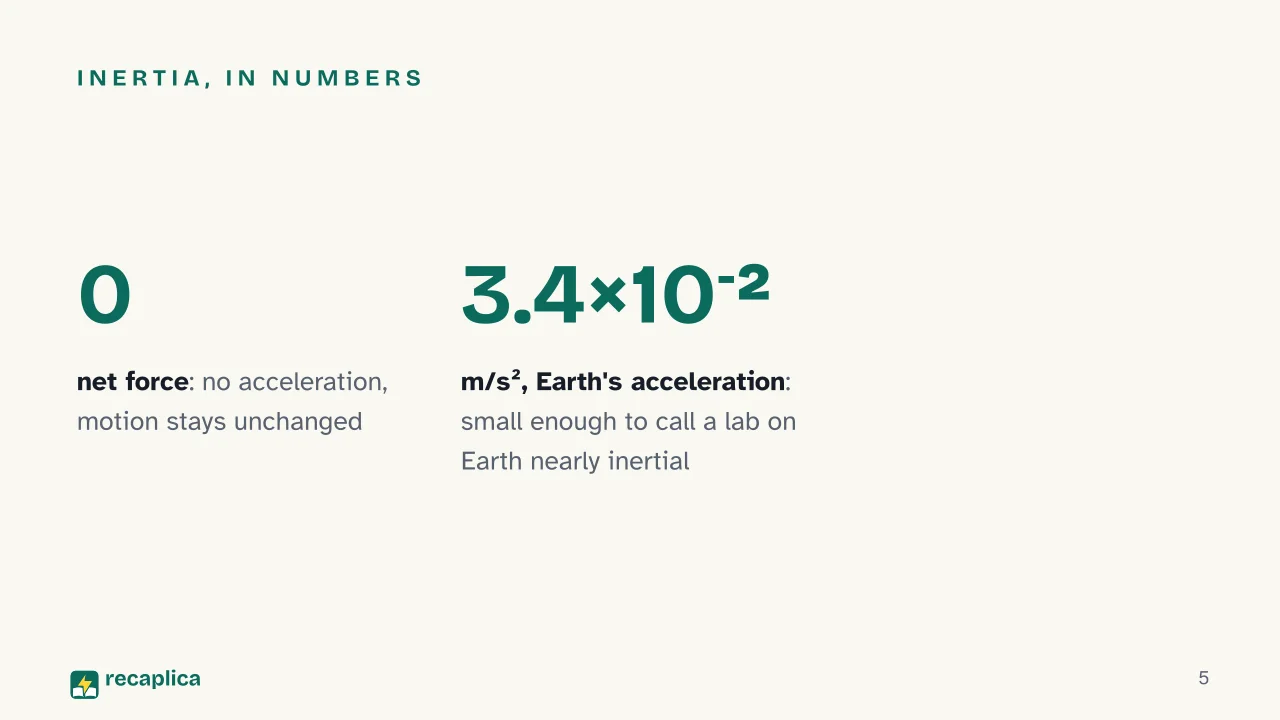 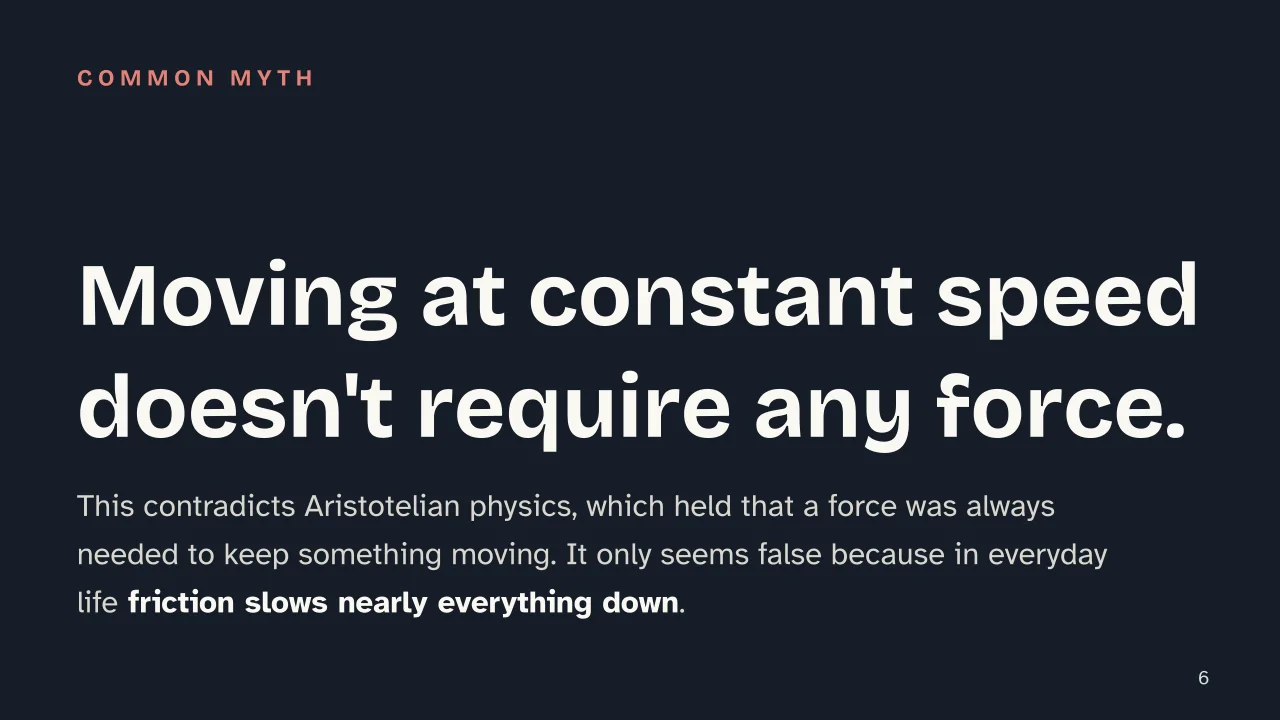  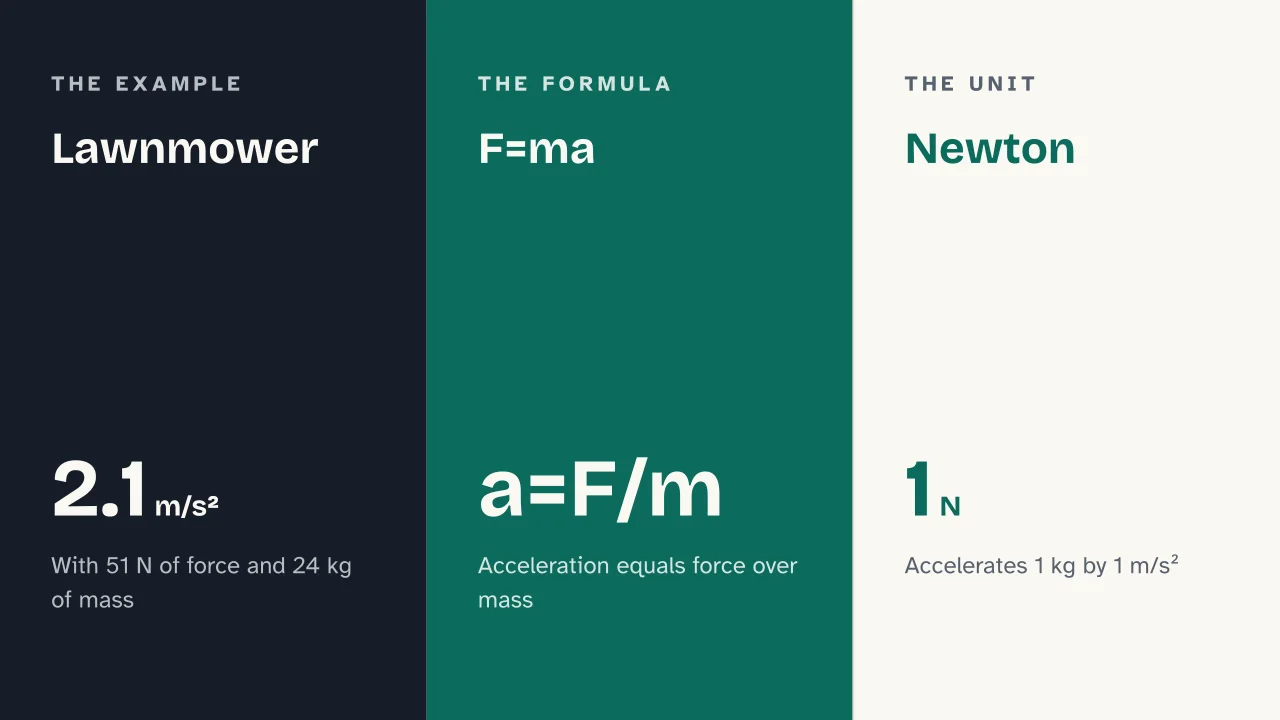 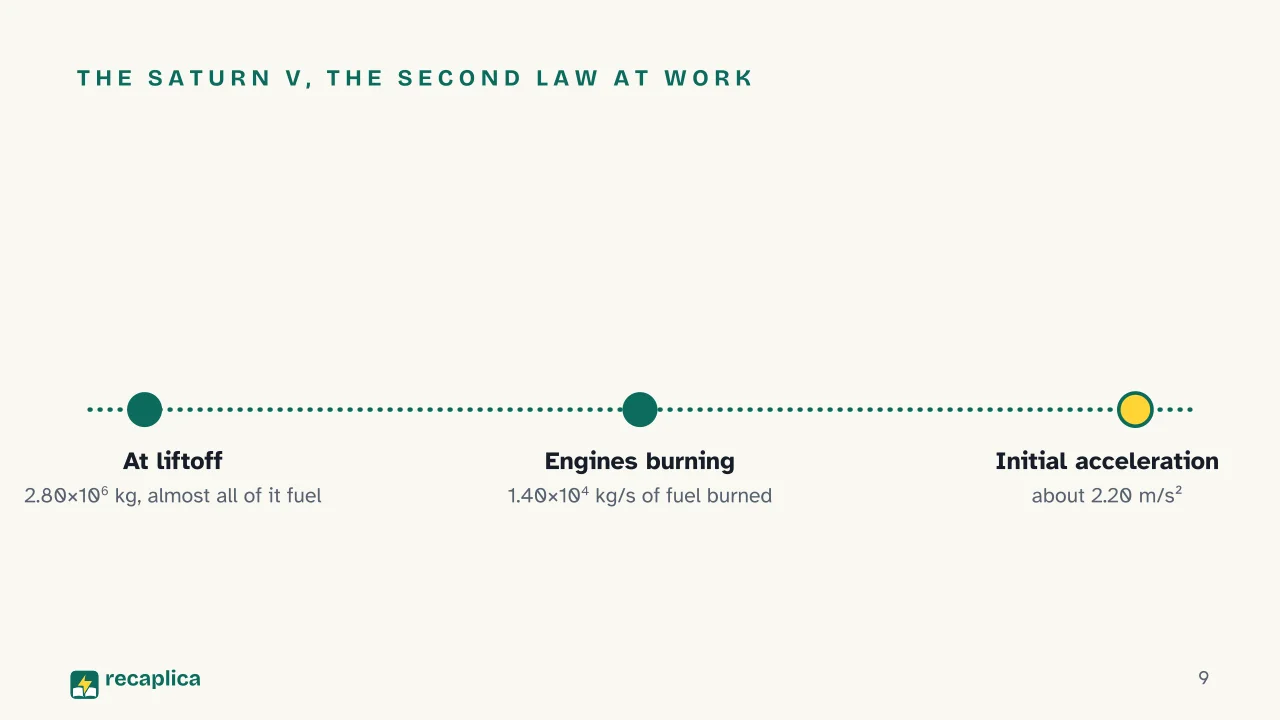  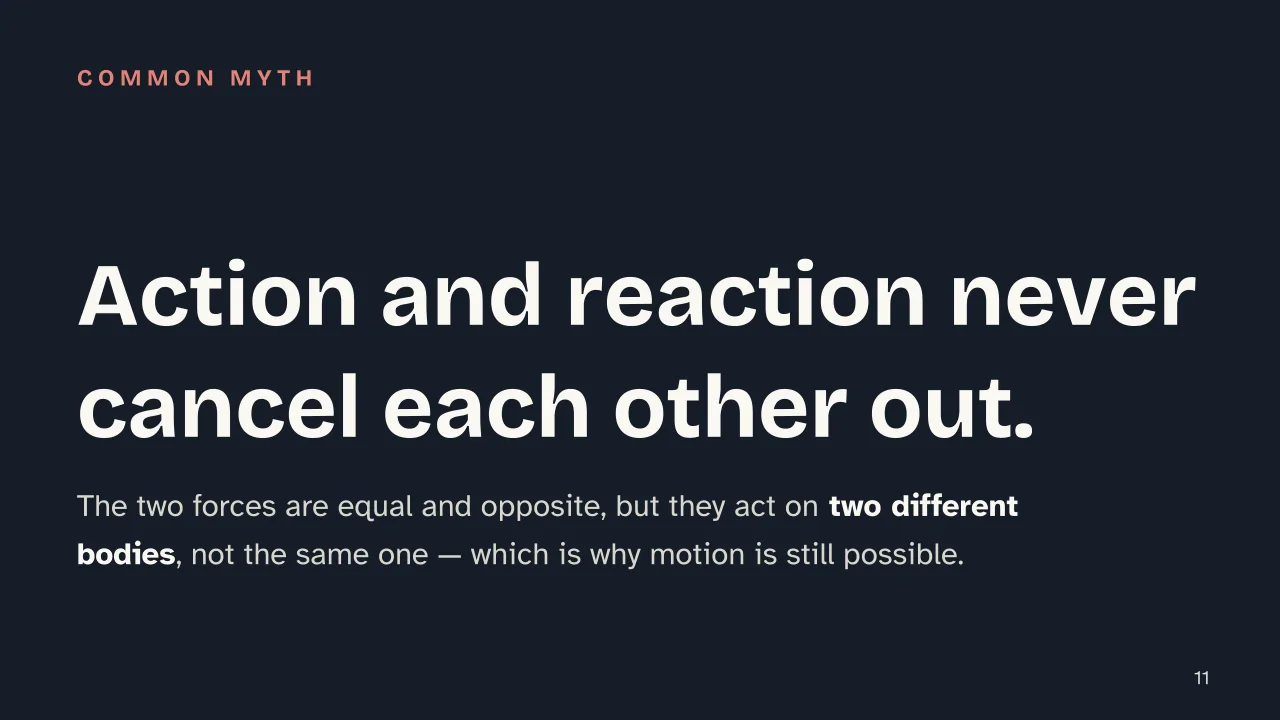 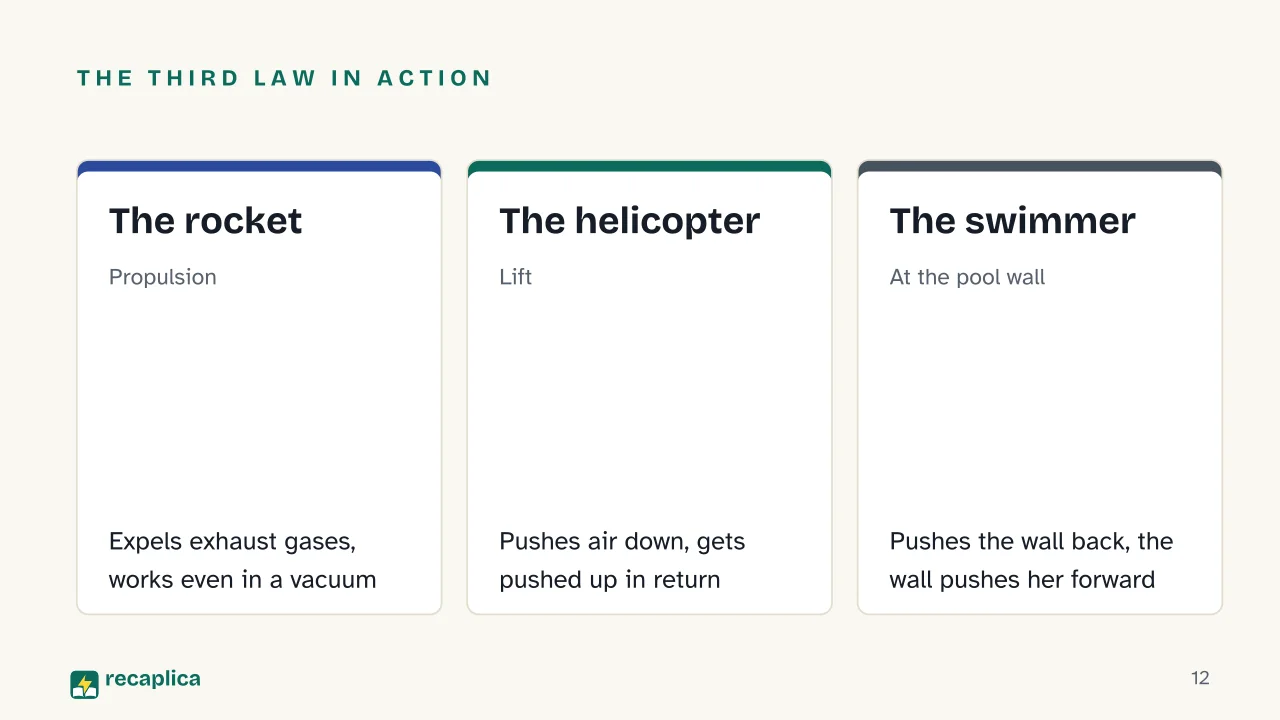  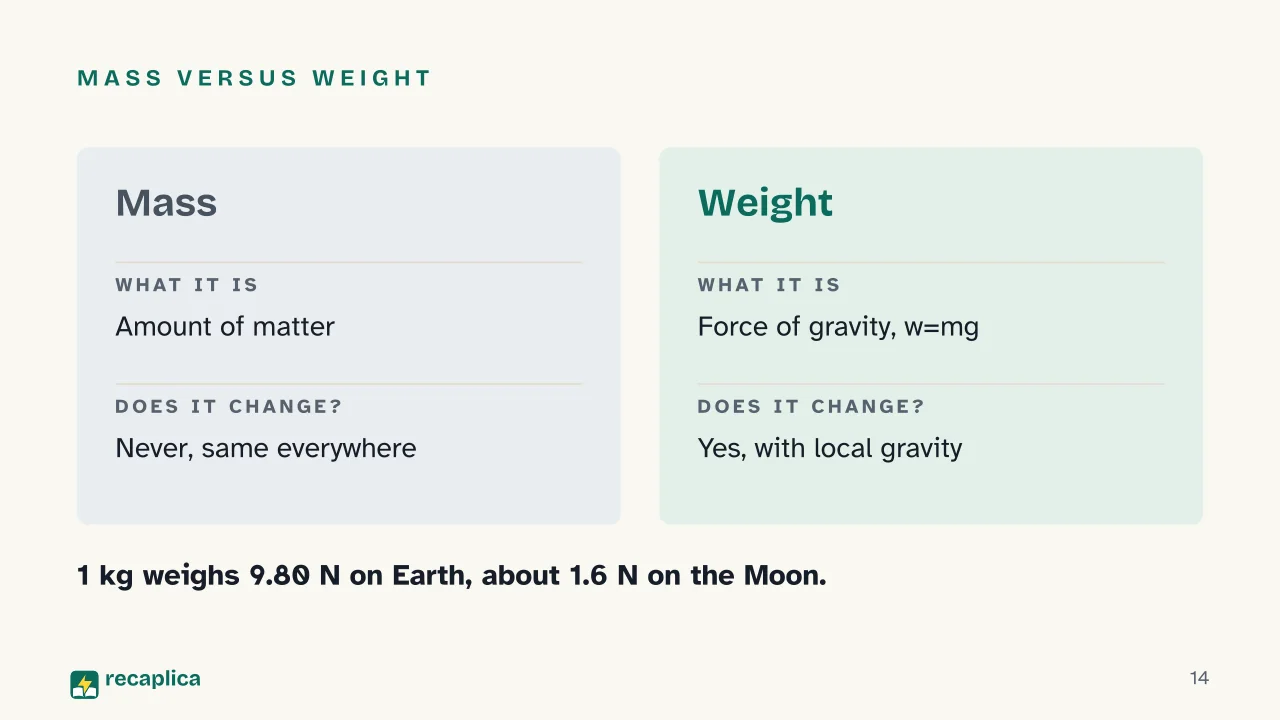 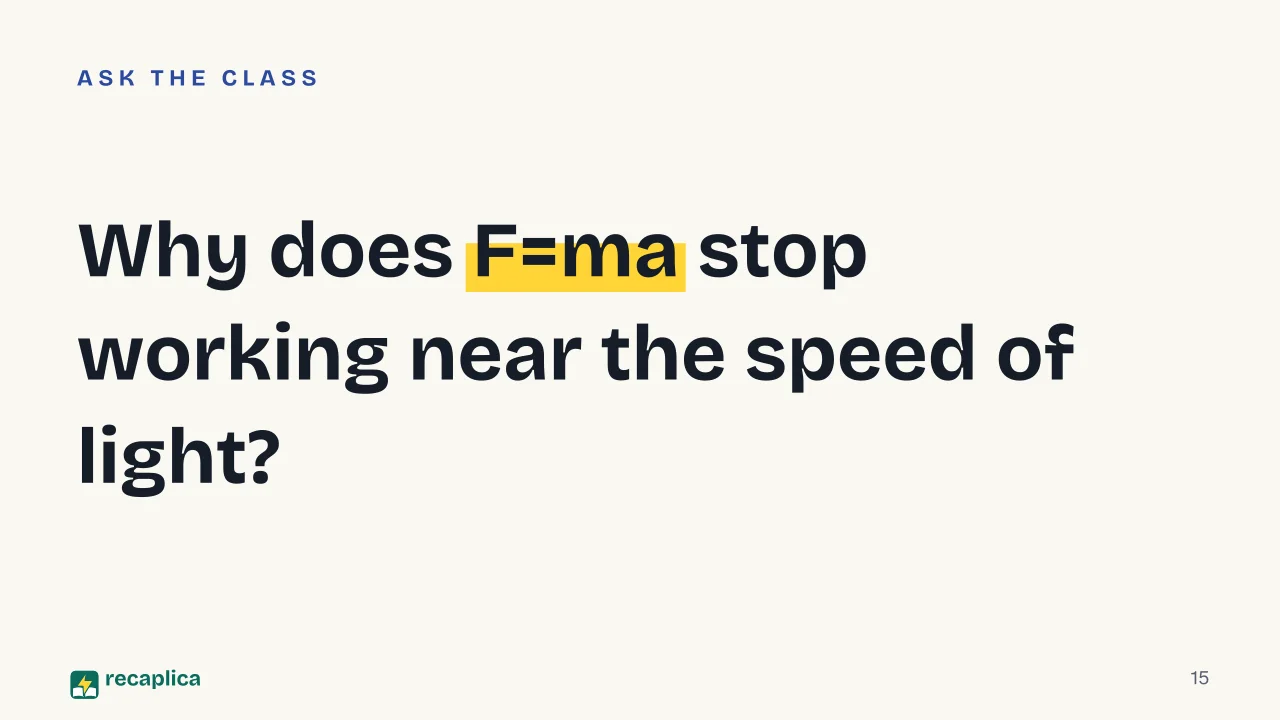 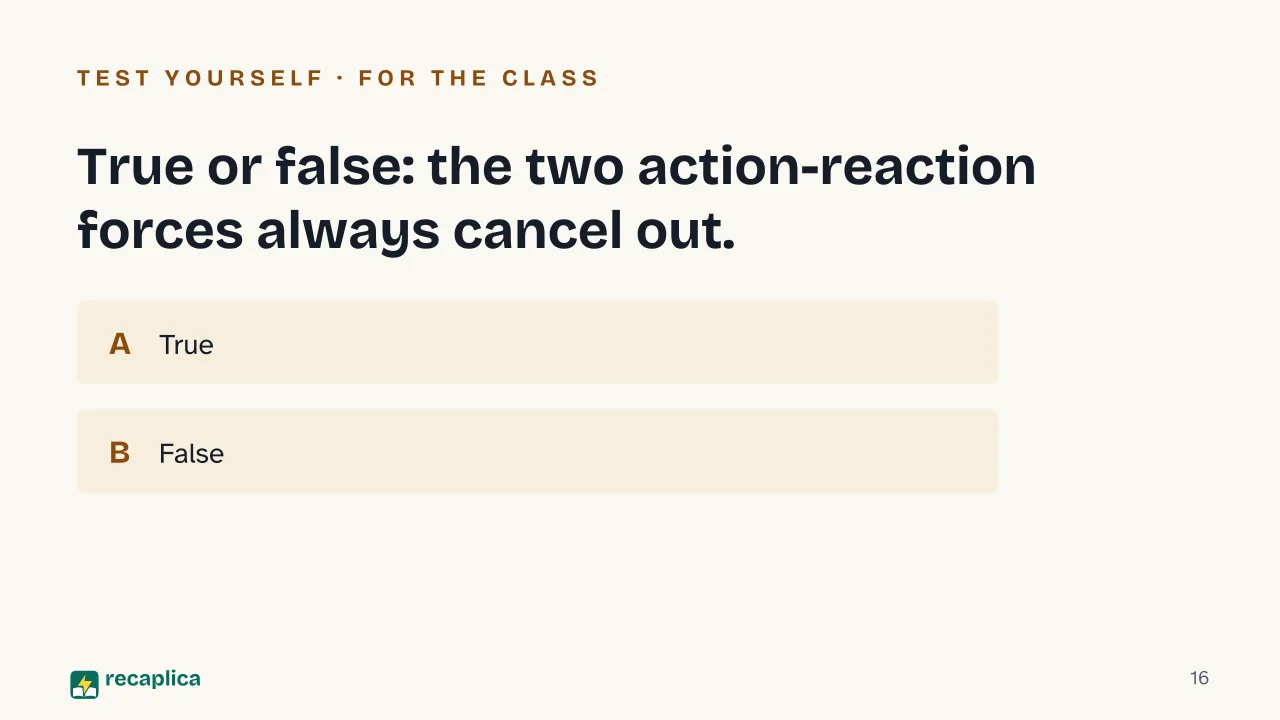  Common myths
Mind mapDrag the background to move around and the nodes to reposition them; use − and + to collapse and expand branches. 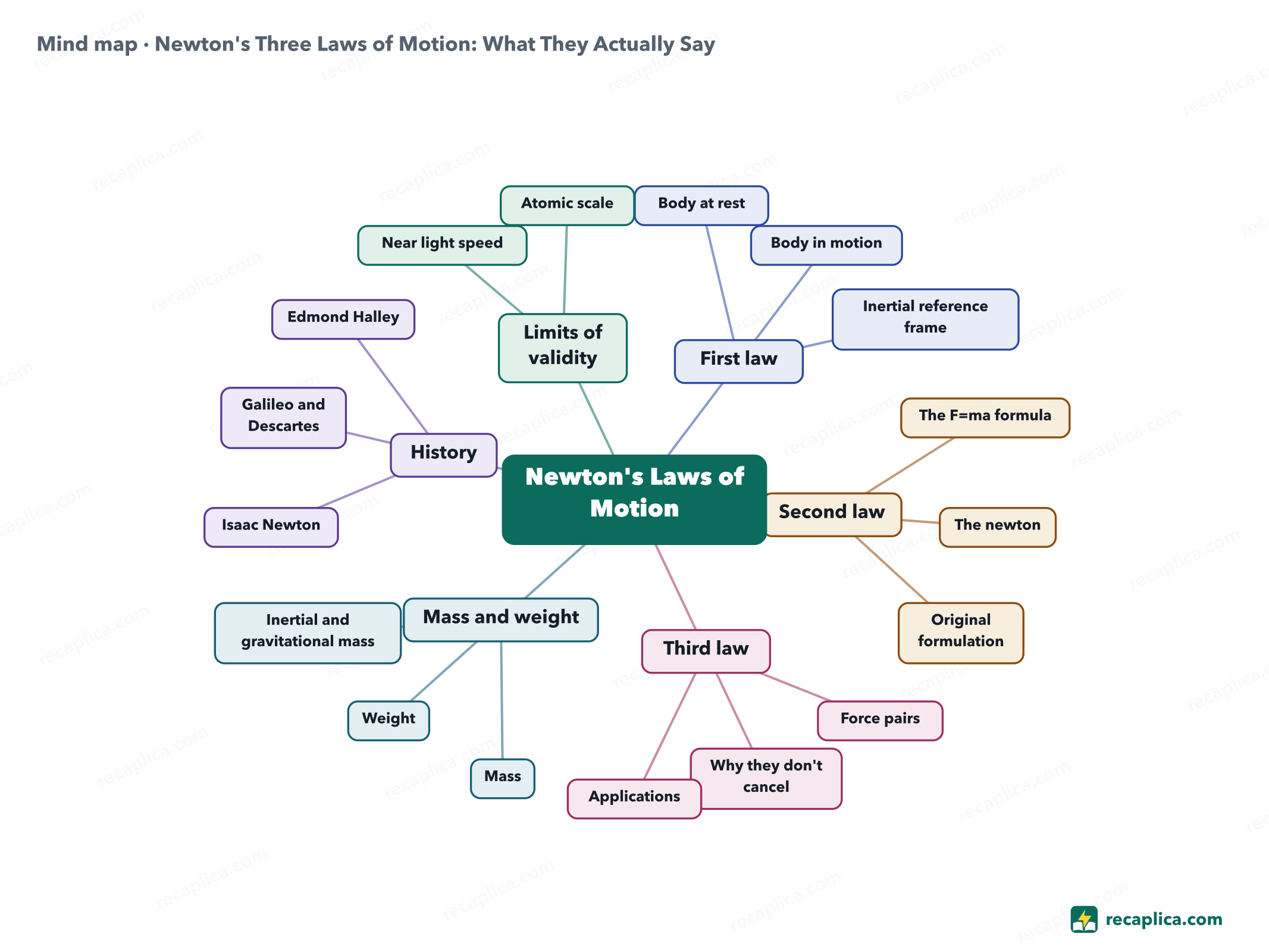
Quiz: test yourselfAnswer the questions to check what you have learned: you get instant feedback and a short explanation. Grade 0/10 0/5
FlashcardsTap the card to flip it and check whether you remember the answer, then move to the next one. 1 / 8 Explain it in your own wordsThe ultimate test: if you can explain it in simple words, you've truly understood it. Write your explanation, then compare it with the Recap. Your explanation is saved only on this device.
Frequently asked questionsWhat's the difference between Newton's three laws?The first describes what happens without a net force (a body keeps its state of motion); the second describes the effect of a net force (it produces an acceleration proportional to the force and inversely proportional to the mass); the third describes what happens when two bodies interact (they exchange equal and opposite forces). Why do people say F=ma isn't exactly what Newton wrote?Because in the Principia Mathematica of 1687, Newton stated the second law as a proportionality between the applied force and the resulting change in momentum, not as mass times acceleration. F=ma is the modern teaching shorthand, valid when mass stays constant; when mass changes, as with rockets burning fuel, the more general form is needed. Do Newton's laws always hold, in every situation?No. They describe everyday life extremely well, from lawnmowers to rockets, but lose their validity in two extreme cases. Near the speed of light, classical F=ma isn't enough anymore and relativity is needed, which redefines force more generally as a rate of change of momentum. At the atomic scale, Newton's laws give way to quantum mechanics. What role did Edmond Halley play in the origin of Newton's laws?In August 1684, Halley asked Newton what orbit a body would follow under a force inversely proportional to the square of the distance. Discovering that Newton had already solved the problem, he convinced him to write it up in full: that treatise, titled De Motu, grew over about two and a half years into the Philosophiae Naturalis Principia Mathematica. Why did Newton title his work similarly to Descartes'?According to the Stanford Encyclopedia of Philosophy, Newton chose the title Philosophiae Naturalis Principia Mathematica in deliberate allusion to Descartes' Principia Philosophiae, to set his own physics, grounded in universal gravitation, against Cartesian physics and its vortices of fine matter supposedly sweeping the planets along. Every Recap goes through an independent review before publication. |