Skip to content
recaplica

    One moment: security check

    Cloudflare wants to make sure you're not a robot. Tick the box below and your search will continue on its own.

    IT
    recaplica Triangle Similarity Theorems: SAS, AA, SSS and AAA
    © 2026 Recaplica · recaplica.com — All rights reserved
    Home › Science

    Triangle Similarity Theorems: SAS, AA, SSS and AAA

    By Recaplica Newsroom · Updated on October 8, 2026

    What to print

    Page numbers appear when printing with default margins.

    Slides

    Choose a cut

    Flash10 slidesThe essential thread, to present in classFull15 slidesEvery chapter and the deeper detail

    Both come with speaker notes.

    Telegram channel
    recaplica Clear in 30 seconds, yours in 10 minutes.
    In 30 seconds Key points Deep dive Slides Myths Mind map Quiz Flashcards FAQ

    In 30 seconds quick read

    Two triangles are similar when one has the shape of the other at a different size: matching angles are equal and matching sides share a single ratio. Nobody checks all six measurements, because three partial tests each settle the question on their own. AA looks only at angles, SAS and SSS start from the sides, with or without one angle to check. In an exercise you pick the test that asks for the data the figure already gives you, and once it is satisfied the triangles are similar.

    Key Points

    • Similar triangles have the same shape at different sizes, with angles equal in pairs and every pair of matching sides in one ratio.
    • AA - two pairs of equal angles are enough, because the 180-degree total fixes the third angle.
    • SAS - two pairs of sides in the same ratio, with equal angles where those two sides meet.
    • SSS - every side in proportion to its counterpart, with no angle measured at all.
    • In a right triangle the altitude to the hypotenuse makes two triangles similar to each other and to the original one.
    • That similarity gives the geometric mean relation - the altitude squared equals the product of the two hypotenuse segments.

    Deep Dive

    What makes two triangles similar

    Two polygons are similar when their matching angles are equal and their matching sides are all in the same ratio. For triangles that condition covers six measurements, three angles and three sides, but nobody checks six. A triangle is a rigid figure, and a handful of measurements already pins its shape down. The similarity theorems say which handful.

    In class the reasoning starts from the drawing. You look at what is marked on it — equal angles, known lengths, a shared side — and pick the test that asks for exactly those things. Once the test is satisfied, everything else comes along: the angles you never checked are equal too, and the sides you never measured sit in the same ratio. From there a single proportion gives you a missing length, and that is why these tests fill so many exercise sets.

    Similar is not the same as congruent. Two congruent triangles agree side by side and angle by angle, so one of them fits exactly over the other. Similar triangles may differ a lot in size, and congruence turns out to be the case where the ratio between matching sides happens to be 1. The ground rules underneath all of this, from the angle sum to the postulates the proofs rest on, sit in the Recap on Euclidean geometry.

    AA: two pairs of equal angles

    If two angles of one triangle are equal to two angles of another, in matching positions, the triangles are similar. This is the cheapest of the three tests and the one that comes up most, because equal angles are easy to spot in a figure: parallel lines cut by a transversal, vertical angles at a crossing, an angle shared by both triangles.

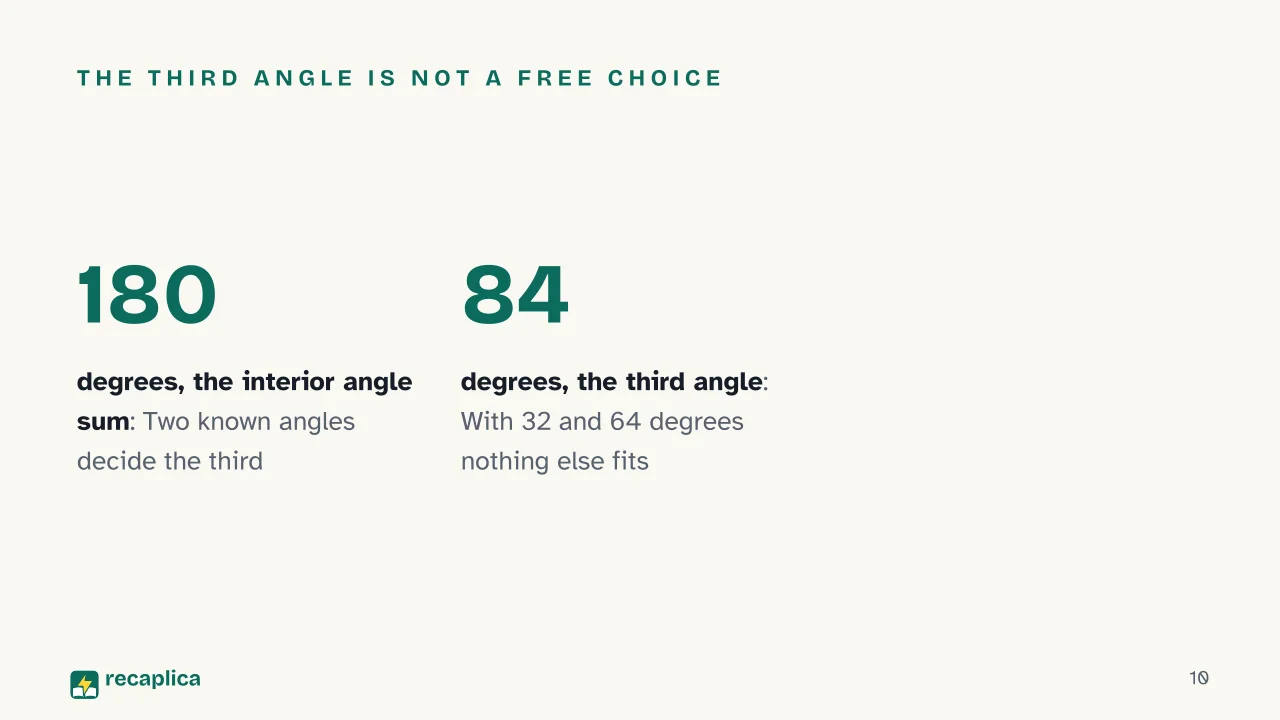
    The test stops at two angles because the third is not free. The interior angles of a triangle always add to a straight angle, 180 degrees, so as soon as two of them are known the third is whatever is left over. Angles of 32 and 64 degrees leave only 84. That is why the version written AAA, with three pairs of equal angles, is a true statement that says nothing AA has not said already; the third check is a formality. Some courses present AA as a postulate rather than a theorem, which is a choice about how the course builds its foundations and changes nothing about how the test is used.

    Practical example: in triangle ABC the angles at A and B measure 50 and 70 degrees. In triangle DEF the angles at D and E measure those same two values. Two pairs match, so the triangles are similar, and the remaining angle is 60 degrees in both. These numbers were picked to show the test at work, not taken from a measurement.

    SAS: two sides and the angle between them

    The SAS test asks for two things at once: two sides of one triangle in the same ratio as the matching sides of the other, and equal angles where those two sides meet.

    That last clause does the work. The angle has to be the included one, formed by the very sides you are comparing. Move the check to some other angle and the conclusion no longer holds. A useful habit in exercises is to mark the two sides first, then the angle wedged between them, and write the proportion last.

    Practical example: in triangle PQR the side PQ is 8 cm, PR is 6 cm and the angle at P is 40 degrees. In triangle LMN the side LM is 4 cm, LN is 3 cm and the angle at L is 40 degrees. The ratios 8/4 and 6/3 both come out as 2, and the included angles agree, so SAS is satisfied. The lengths were built to give a 2 to 1 ratio rather than measured.

    SSS: all three sides in proportion

    When all three sides of one triangle are in the same ratio as the three matching sides of the other, the triangles are similar. No angle enters the check, which makes SSS the test for figures where you have been given lengths and nothing else.

    You work out the three ratios of corresponding sides and see whether they agree. One ratio out of line rules similarity out.

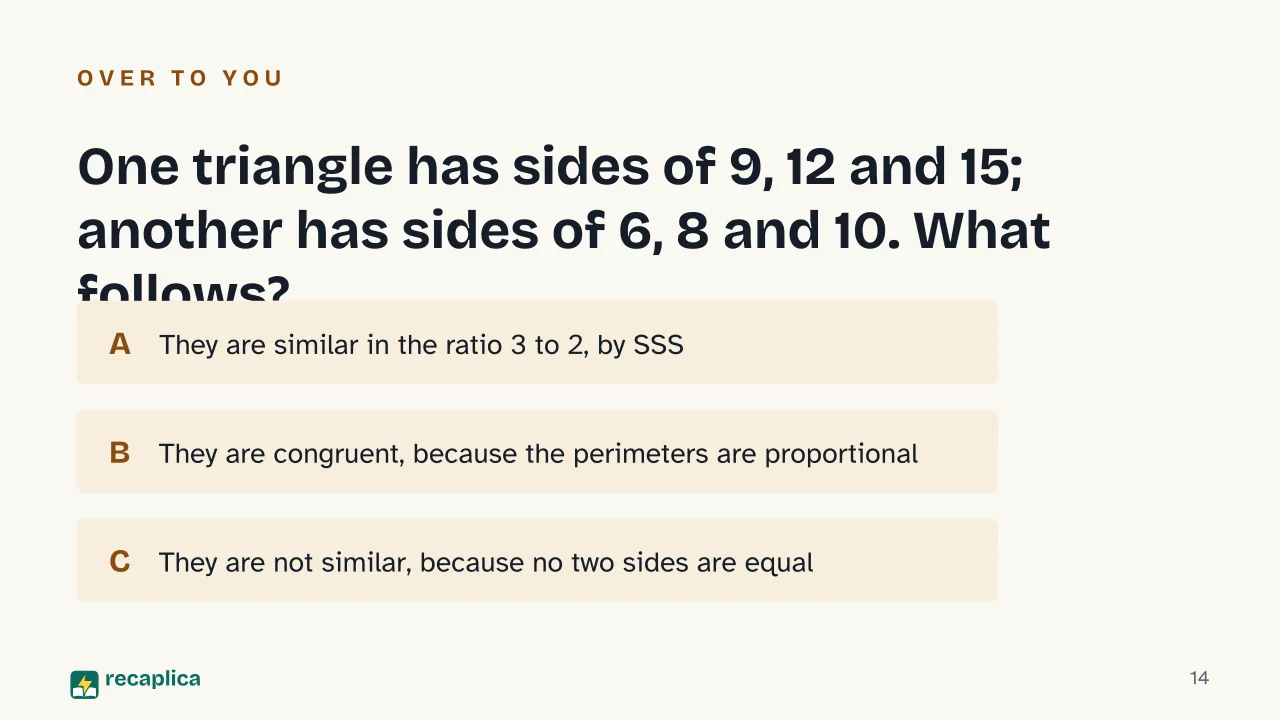
    Practical example: triangle ABC has sides of 9 cm, 12 cm and 15 cm; triangle DEF has sides of 6 cm, 8 cm and 10 cm. The ratios 9/6, 12/8 and 15/10 all equal 1.5, so SSS is satisfied and the triangles are similar in the ratio 3 to 2. Here too the measurements are there to show the arithmetic.

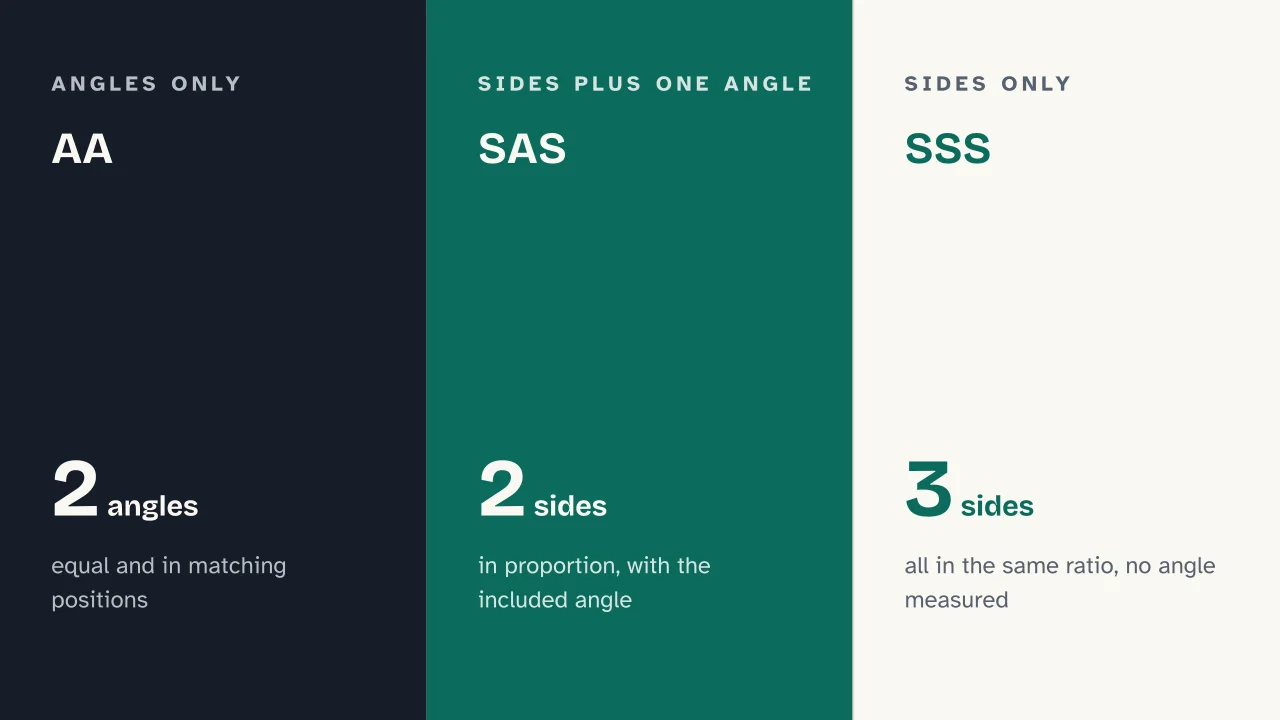
    TestWhat you checkAngles involvedSides involved
    AATwo pairs of equal corresponding angles2none
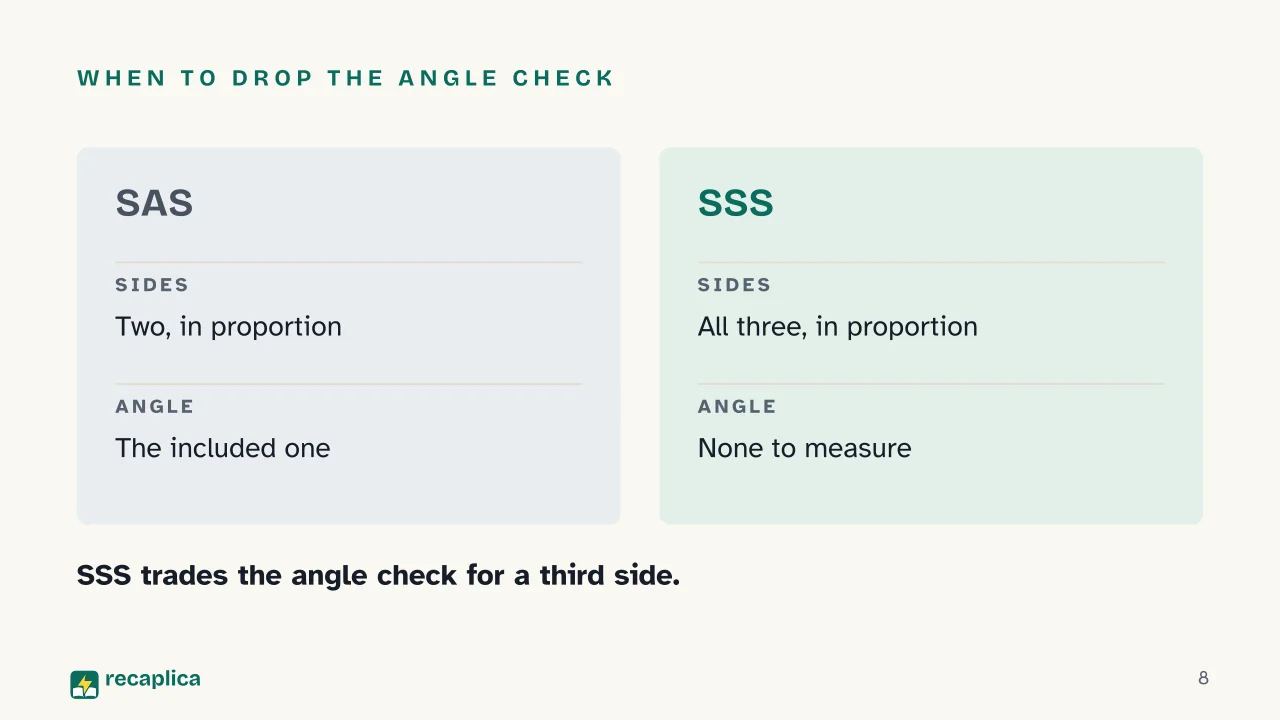
    SASTwo sides in proportion and equal included angles1, the included one2
    SSSAll three sides in proportion with their counterpartsnone3

    The right triangle similarity theorem

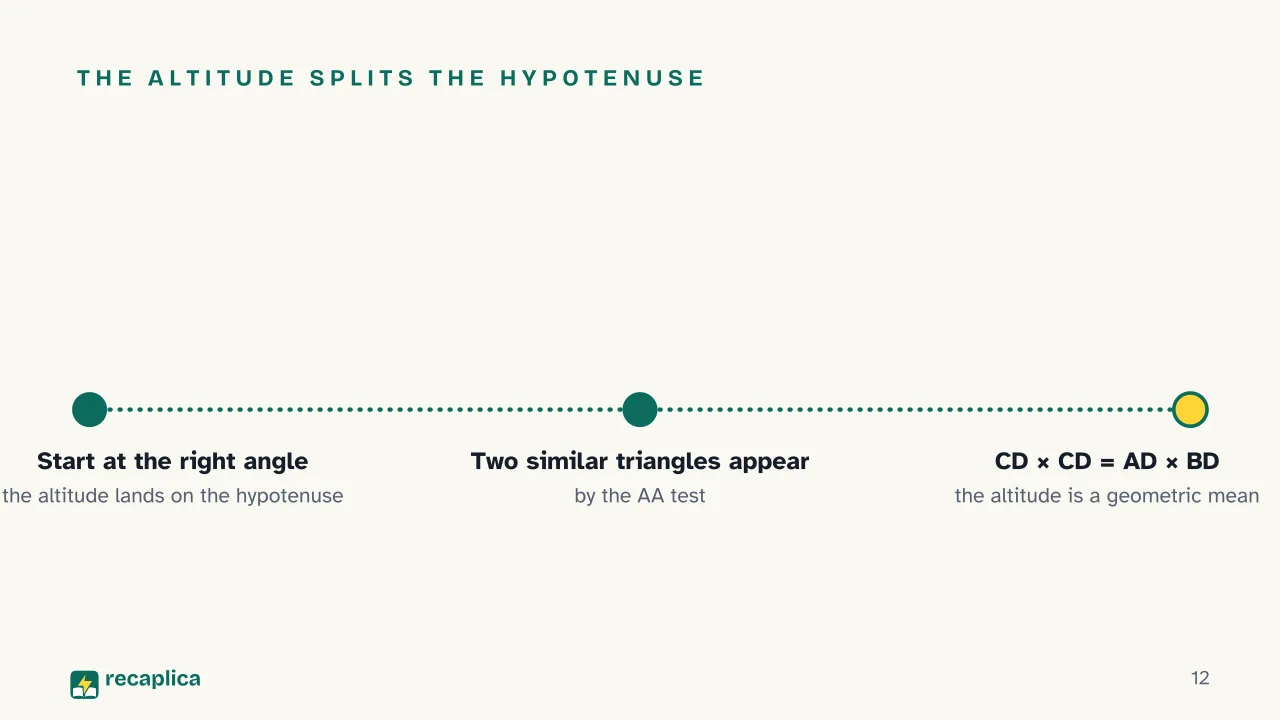
    Take a right triangle ABC with the right angle at C. The altitude drawn from C meets the hypotenuse AB at a point D and cuts the figure into two smaller triangles, both similar to each other and to the triangle they came out of. AA is the reason: each small triangle has a right angle and shares one of the acute angles with the big one, which supplies the two matching pairs.

    One consequence of that similarity turns up in exercise after exercise. Comparing the two small triangles gives the proportion AD to CD as CD to BD, and therefore CD² = AD · BD. In words: the altitude to the hypotenuse is the geometric mean of the two segments it divides the hypotenuse into.

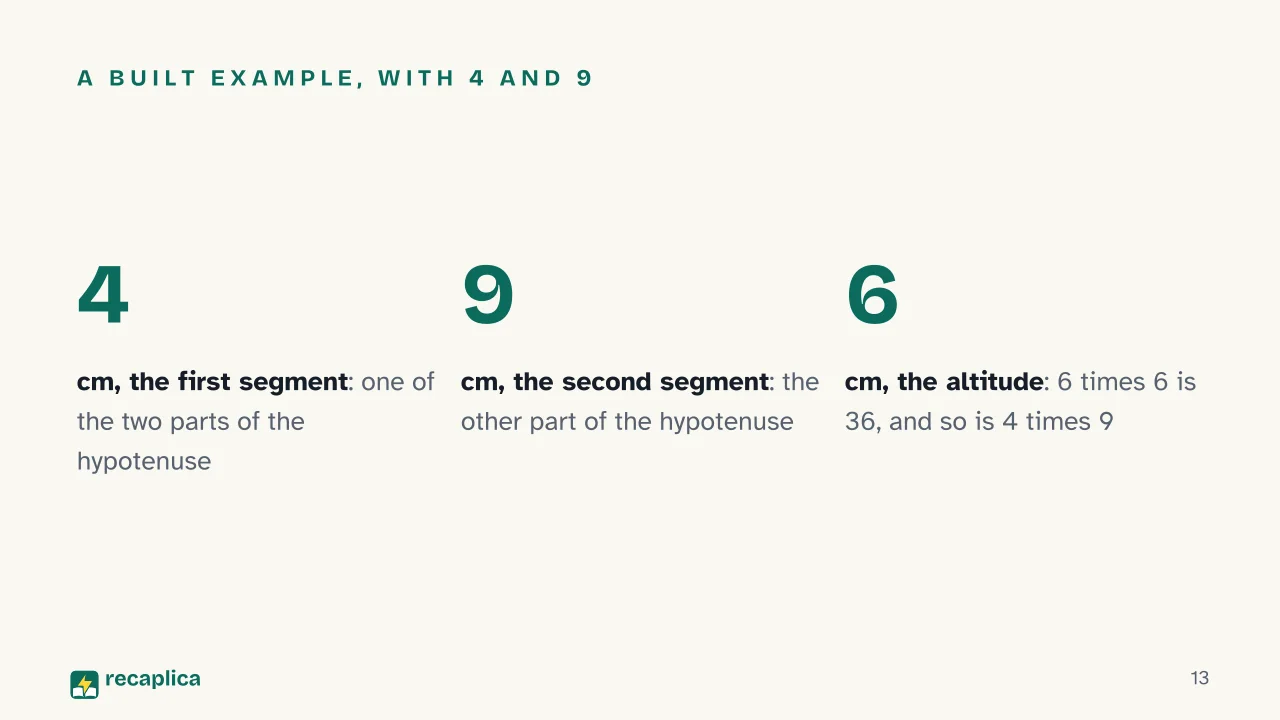
    Practical example: if the altitude splits the hypotenuse into pieces of 4 cm and 9 cm, its square is 4 × 9, so 36, and the altitude measures 6 cm. The numbers were chosen to come out whole. This same play of proportions, carried over from side lengths to the sine and cosine of an angle, is where trigonometry starts.

    Proofs for similar triangles

    The three tests are theorems, with proofs behind them. The classical route runs through the proportionality of segments cut off by parallel lines — Thales’ theorem, which in Euclid’s Elements corresponds to proposition VI.2 and carries the proofs of all three statements. Draw a parallel to any one of the sides and the other two come out cut into proportional parts; from that proportion each test is assembled step by step.

    The same link explains why similarity arrives early in a geometry course. It is the tool for comparing figures drawn at different scales, and the idea returns once you move into three dimensions and start comparing similar solids, as in the Recap on solid geometry.

    Slide deck

    Slides ready to download and make your own in PowerPoint or Google Slides, with speaker notes. Pick the Flash cut or the Full one.
    Slide 1 of the presentation on Triangle Similarity Theorems: Triangle similarity theoremsSlide 2 of the presentation on Triangle Similarity Theorems: How much do you need to know to call two triangles similar?Slide 3 of the presentation on Triangle Similarity Theorems: From the definition to the hypotenuseSlide 4 of the presentation on Triangle Similarity Theorems: Chapter 01: When two triangles are similarSlide 5 of the presentation on Triangle Similarity Theorems: One equal angle still allows countless shapesSlide 6 of the presentation on Triangle Similarity Theorems: Chapter 02: The three tests side by sideSlide 7 of the presentation on Triangle Similarity Theorems: AA · SAS · SSSSlide 8 of the presentation on Triangle Similarity Theorems: When to drop the angle checkSlide 9 of the presentation on Triangle Similarity Theorems: Chapter 03: Why two angles are enoughSlide 10 of the presentation on Triangle Similarity Theorems: The third angle is not a free choiceSlide 11 of the presentation on Triangle Similarity Theorems: Chapter 04: The altitude to the hypotenuseSlide 12 of the presentation on Triangle Similarity Theorems: The altitude splits the hypotenuseSlide 13 of the presentation on Triangle Similarity Theorems: A built example, with 4 and 9Slide 14 of the presentation on Triangle Similarity Theorems: One triangle has sides of 9, 12 and 15; another has sides of 6, 8 and 10. What follows?Slide 15 of the presentation on Triangle Similarity Theorems: Time to revise
    Flash10 slidesThe essential thread, to present in classFull15 slidesEvery chapter and the deeper detail

    Common myths

    • ✗ Myth One pair of equal angles already makes two triangles similar.

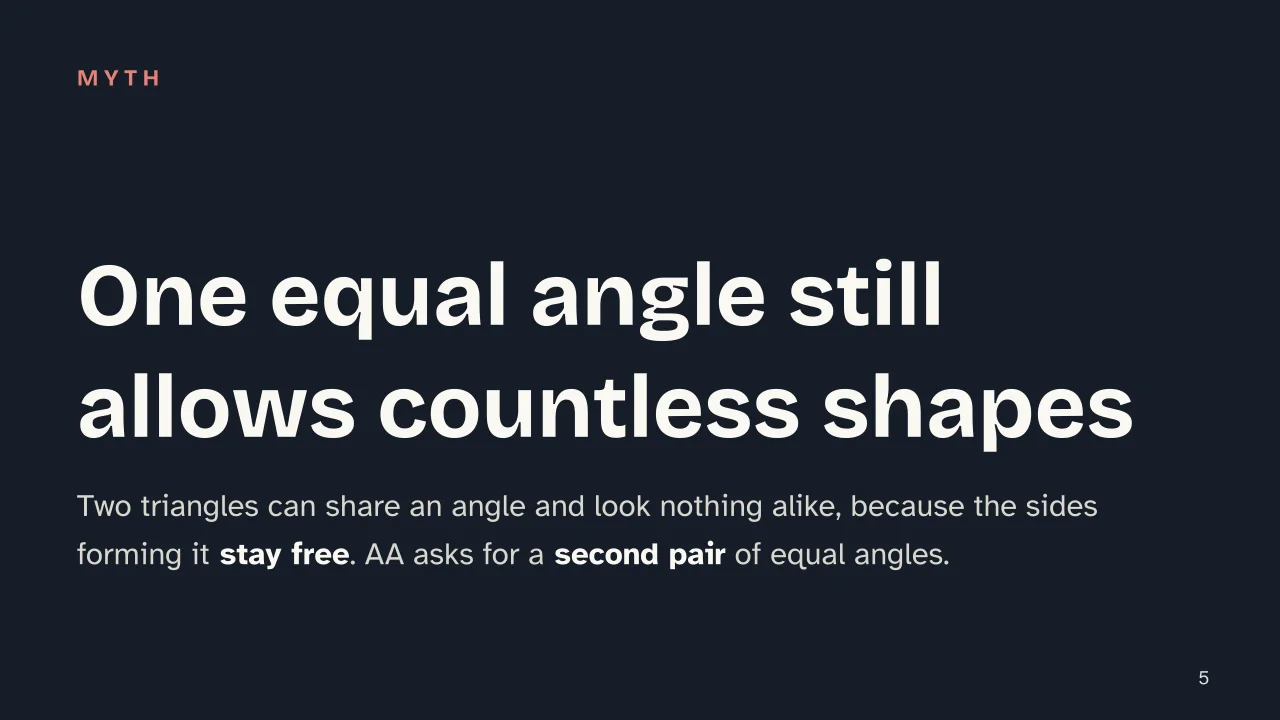
      ✓ Reality A single equal angle leaves every other measurement free, so two triangles can share that angle and still look nothing alike. AA asks for a second pair of equal angles; SAS stops at one angle, but only if the two sides forming it are in the same ratio as their counterparts.

    • ✗ Myth SSS similarity means the three sides have to be equal.

      ✓ Reality Equal sides give congruent triangles, the ones you can lay on top of each other. SSS similarity asks for a common ratio instead - each side twice its counterpart, say - which changes the size while the proportions stay put.

    • ✗ Myth Proving similarity means checking all three angles.

      ✓ Reality The three-angle version is true, just wasteful. The interior angles of any triangle add up to 180 degrees, so once two of them are known the third is already fixed, and measuring it adds nothing to the proof.

    Mind map

    Drag the background to move around and the nodes to reposition them; use − and + to collapse and expand branches.
    Customize
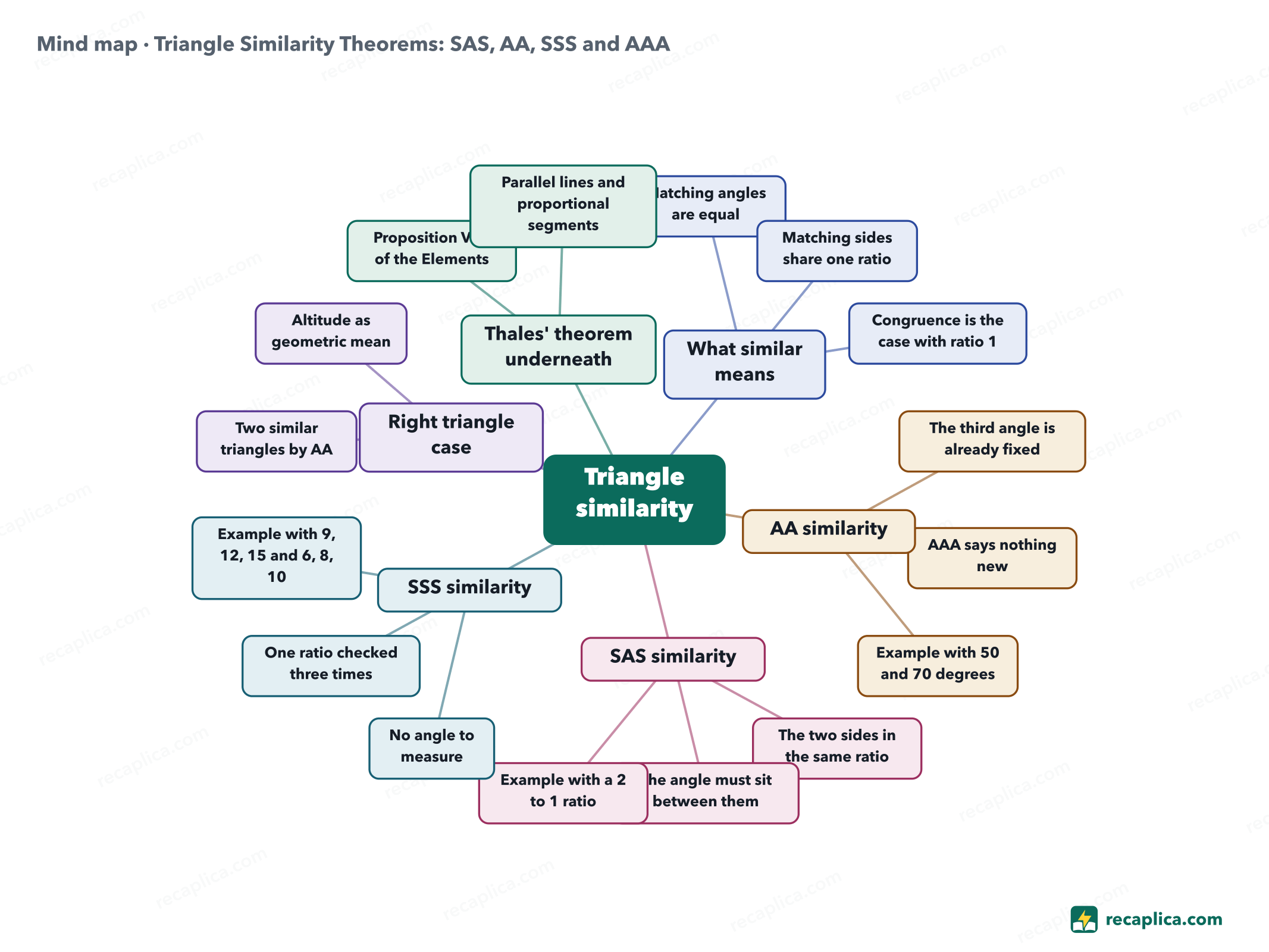
    Mind map: Triangle Similarity Theorems: SAS, AA, SSS and AAA
    • Triangle similarity
      • What similar means Same shape, different size
        • Matching angles are equal
        • Matching sides share one ratio
        • Congruence is the case with ratio 1
      • AA similarity Two pairs of equal angles
        • The third angle is already fixed Interior angles add up to 180 degrees
        • AAA says nothing new
        • Example with 50 and 70 degrees
      • SAS similarity Two sides and the included angle
        • The two sides in the same ratio
        • The angle must sit between them
        • Example with a 2 to 1 ratio
      • SSS similarity All three sides in proportion
        • No angle to measure
        • One ratio checked three times
        • Example with 9, 12, 15 and 6, 8, 10
      • Right triangle case Altitude to the hypotenuse
        • Two similar triangles by AA
        • Altitude as geometric mean The altitude squared matches the two segments multiplied
      • Thales' theorem underneath Where the proofs start
        • Proposition VI.2 of the Elements
        • Parallel lines and proportional segments

    Quiz: test yourself

    Answer the questions to check what you have learned: you get instant feedback and a short explanation.

    Grade 0/10 0/5
    1 What is the smallest number of equal angles you need to prove two triangles similar?

    With two pairs of matching angles equal, the third pair follows from the 180-degree total, so it is equal without being checked. That is why AA stops at two.

    2 SAS similarity asks for two sides in proportion and one pair of equal angles. Which angle?

    The angle has to be the one formed by the two proportional sides. Check a different angle and similarity is no longer guaranteed.

    3 One triangle has sides of 9, 12 and 15; another has sides of 6, 8 and 10. What follows?

    Each side of the first triangle is one and a half times its counterpart in the second, so all three pairs give the same ratio and SSS is satisfied.

    4 In a right triangle you draw the altitude to the hypotenuse. How do the two triangles it creates relate to each other?

    All three triangles have a right angle and share one of the acute angles, so AA makes them similar in pairs.

    5 Why is the version stated with three pairs of equal angles, AAA, considered redundant?

    Once two angles are known, the third is whatever completes 180 degrees. If two pairs match, the third pair matches with no check needed.

    Answers: 1-B · 2-A · 3-A · 4-A · 5-A

    Flashcards

    Tap the card to flip it and check whether you remember the answer, then move to the next one.

    1 / 8

    Explain it in your own words

    The ultimate test: if you can explain it in simple words, you've truly understood it. Write your explanation, then compare it with the Recap.

    Your explanation is saved only on this device.

    Two triangles are similar when one has the shape of the other at a different size: matching angles are equal and matching sides share a single ratio. Nobody checks all six measurements, because three partial tests each settle the question on their own. AA looks only at angles, SAS and SSS start from the sides, with or without one angle to check. In an exercise you pick the test that asks for the data the figure already gives you, and once it is satisfied the triangles are similar.

    Frequently asked questions

    What are the three triangle similarity theorems?

    AA asks for two pairs of equal corresponding angles. SAS asks for two pairs of sides in the same ratio together with equal angles where those sides meet. SSS asks for all three pairs of sides in the same ratio. Any one of the three closes the proof, and once a triangle pair is similar everything else holds as well: the angles you did not check and the ratios you did not compute.

    What do the proofs for similar triangles look like?

    The classical route runs through Thales' theorem, which establishes the proportionality of the segments cut off by a set of parallel lines. In the Euclidean tradition the support is proposition VI.2 of the Elements: it gives you the fact that a line parallel to one side of a triangle divides the other two sides proportionally, and each of the three tests is built up from that proportion.

    What is the difference between similar and congruent triangles?

    Congruent triangles can be placed one on top of the other, with sides and angles matching measurement for measurement. Similar triangles have equal angles and sides in proportion, while the size is free to change. When that ratio works out to 1 the two figures coincide, which is congruence again.

    Are two right triangles with one equal acute angle similar?

    Yes. The right angle is shared by both, and the equal acute angle is the second pair AA asks for, so the proof is done. This is also why the altitude to the hypotenuse produces two triangles similar to the one it was drawn in.

    What is the geometric mean relation for the altitude to the hypotenuse?

    The altitude from the right angle cuts the hypotenuse into two segments. The similarity of the two triangles it creates gives a proportion between those segments and the altitude, which says that the altitude squared equals their product. Writing CD for the altitude and AD and BD for the two segments, CD² = AD · BD.

    Sources

    • Math Open Reference, "Similar Triangles", "Similar Triangles AAA", "SAS Triangle similarity test", "SSS similarity test"
    • Wikipedia (EN), "AA postulate"
    • Wikipedia (EN), "Geometric mean theorem"
    • University of Georgia, EMAT 6680, "The altitude on the hypotenuse of a right triangle is the geometric mean of the segments of the hypotenuse"
    • Luciano Porta, "Dal teorema di Talete ai criteri di similitudine dei triangoli" (Liceo "E. De Castro")

    Every Recap goes through an independent review before publication.

    Every evening, the day's new Recaps on our Telegram channel. Join the channel →

    Keep learning

    • Science Correlation: What It Means and How to Read the Coefficient Correlation measures how closely two variables move together, and the most common way to put a number on it is the correlation coefficient, which runs from -1 to +1. A value near +1 means the two variables rise together, near -1 means one rises while the other falls, and near 0 means no linear relationship stands out. The coefficient only captures the strength of a straight-line relationship, and a single unusual data point can push it up or down by a lot. Even when it's strong, a correlation between two variables never shows that one causes the other. Read the Recap →
    • Science Light Refraction: What It Is, the Laws Behind It, and Examples A surface that separates two transparent materials sends some light back, reflecting it, and lets the rest through while bending it toward a new direction. The law of reflection keeps the incoming and outgoing angles equal, both measured from the normal to the surface. Snell's law governs refraction instead, linking the index of each material to how much the ray tilts before and after it crosses over. These two laws alone explain mirrors, lenses, prisms and everyday sights such as a pencil that appears to snap inside a glass of water. Read the Recap →
    • Science Total Internal Reflection and the Critical Angle: Definition and Formula Total internal reflection is what happens when a light ray stops being able to leave a transparent medium and gets sent back inside it completely. It takes place past a specific angle of incidence, called the critical angle, calculated with Snell's law by comparing the refractive indices of the two materials involved. It only happens under one precise condition: the ray must be traveling from an optically denser medium into a less dense one, such as from water into air or from glass into air. Optical fibers and, in part, the sparkle of diamonds rely on this same principle. Read the Recap →

    recaplica

    Clear in 30 seconds, yours in 10 minutes.

    Recaps Mind maps Request a Recap Telegram channel Mind map maker Our method About Privacy & cookies Legal notes & terms of use

    © 2026 Recaplica · A project by Curi S.r.l. — VAT IT05472000750

    Statistics, only if you say so

    To learn which Recaps help most we would use Google Analytics, with aggregate, anonymous data. It starts only with your OK, and you can change your mind anytime. Privacy policy