Skip to content
recaplica

    One moment: security check

    Cloudflare wants to make sure you're not a robot. Tick the box below and your search will continue on its own.

    IT
    recaplica What Is Thales' Theorem? Parallel Lines and Similar Triangles
    © 2026 Recaplica · recaplica.com — All rights reserved
    Home › Science

    What Is Thales' Theorem? Parallel Lines and Similar Triangles

    By Recaplica Newsroom · Updated on October 8, 2026

    What to print

    Page numbers appear when printing with default margins.

    Slides

    Choose a cut

    Flash10 slidesThe essential thread, to present in classFull15 slidesEvery chapter and the deeper detail

    Both come with speaker notes.

    Telegram channel
    recaplica Clear in 30 seconds, yours in 10 minutes.
    In 30 seconds Key points Deep dive Slides Myths Mind map Quiz Flashcards FAQ

    In 30 seconds quick read

    Thales' theorem describes a relationship between parallel lines and transversals: the parallel lines cut the transversals into segments that stand in the same proportion. A converse version also holds, deducing that two connecting lines are parallel once the segments they create are already proportional and two other connecting lines are already parallel. Read with triangles instead of lines, the same relationship is the principle behind similar triangles, one of the ways the theorem gets used in practice, alongside splitting a segment into equal parts. The theorem is named after Thales, a thinker from ancient Greece about whom few facts survive: the story of the pyramid measured through its shadow comes from ancient writers, set down centuries after his life.

    Key Points

    • Parallel lines cutting two transversals create segments on each one that stand in proportion to each other.
    • The converse also holds: once the segments are already proportional and two connecting lines turn out parallel, the remaining two end up parallel too.
    • The generalized form covers lines that meet at any point, not just the two rays of the basic case.
    • Expressed through triangles rather than lines, that same relationship underlies similar triangles.
    • The shadow-and-pyramid story comes from ancient writers such as Diogenes Laertius and Pliny, who lived centuries after Thales.
    • Thales' birth and death dates aren't settled: Treccani and the 1911 Encyclopædia Britannica give different years.

    Deep Dive

    The statement: parallel lines and proportional segments

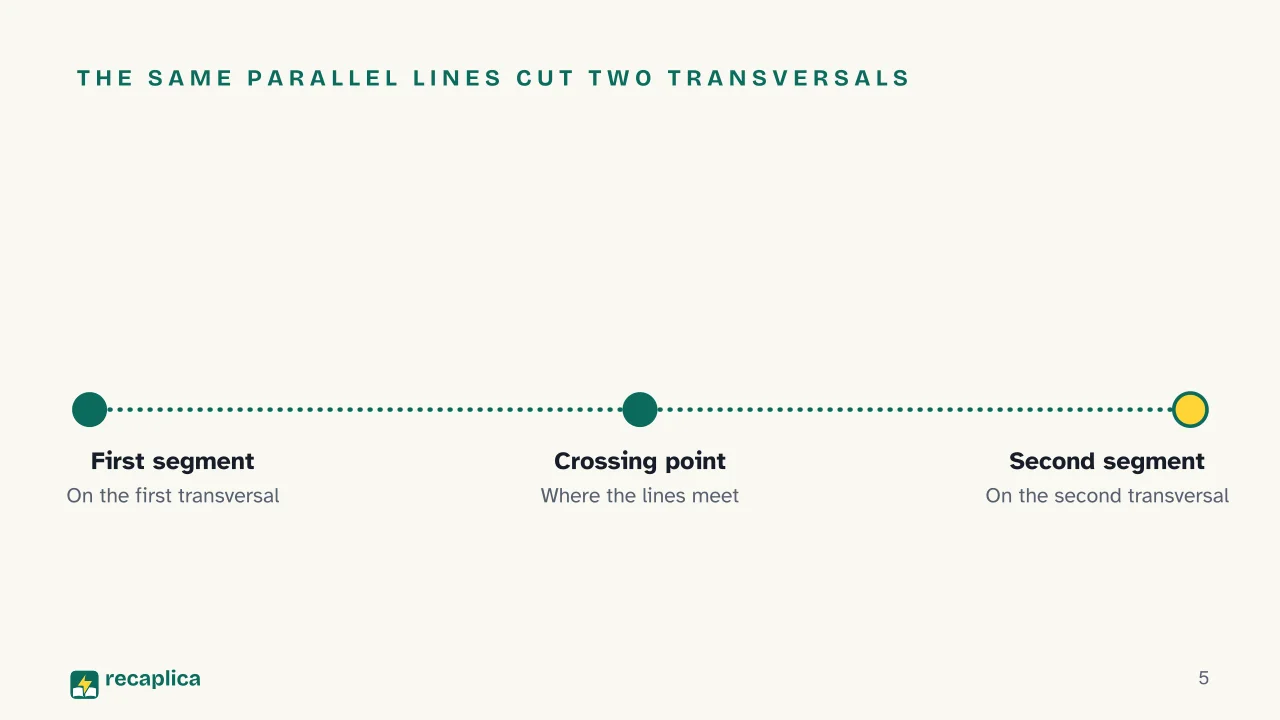
    Treccani explains that parallel lines cutting two transversal lines divide each transversal into segments, and the segments on one transversal stand in the same proportion as the matching segments on the other. That relationship is what gives Thales’ theorem its name.

    The converse theorem

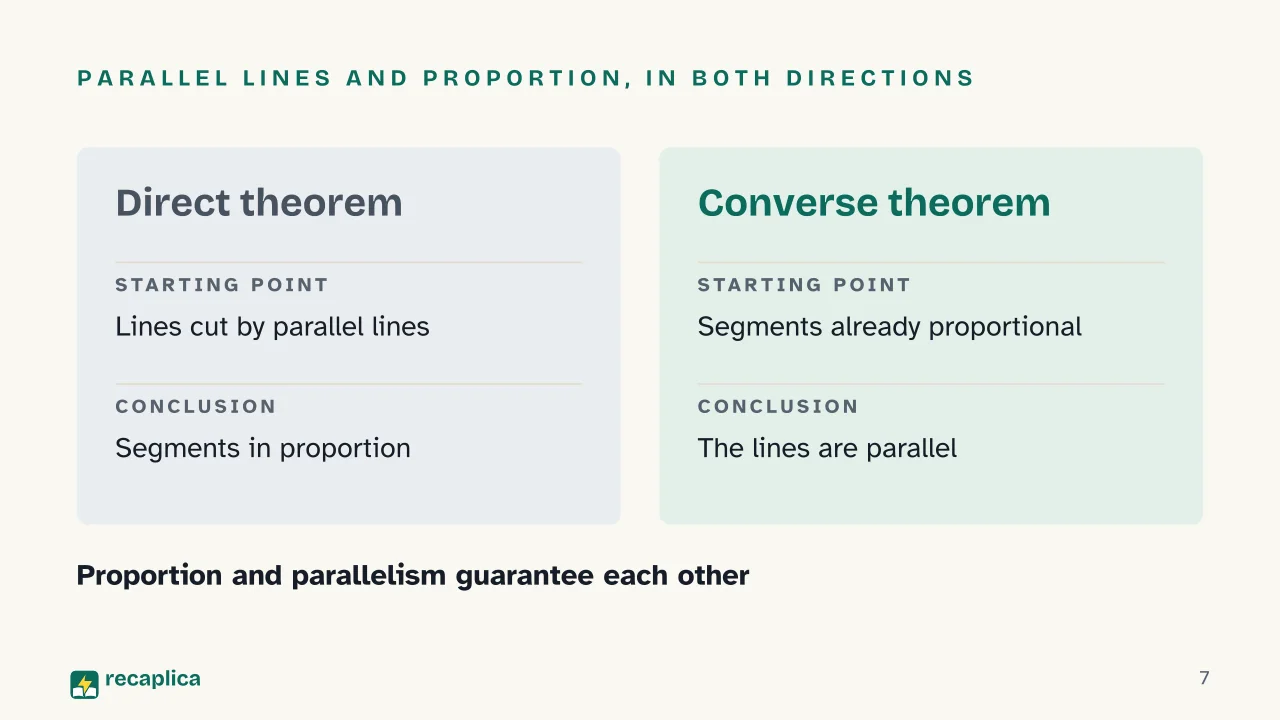
    The reasoning also works in reverse. According to Treccani, if the segments on two lines are already proportional and two of the lines connecting them are parallel, then the other two connecting lines are parallel as well. That makes it possible to prove parallelism from length measurements alone, without comparing any angles.

    The generalized form

    The Wikipedia EN entry on the Intercept theorem describes a broader version of the theorem that isn’t limited to two rays sharing the same starting point: it also holds when two lines cross at any point, as long as the same parallel lines cut both of them. This generalized form shows up in more advanced exercises, where the two transversals don’t start from a common origin but still cross somewhere.

    Thales’ theorem and similar triangles

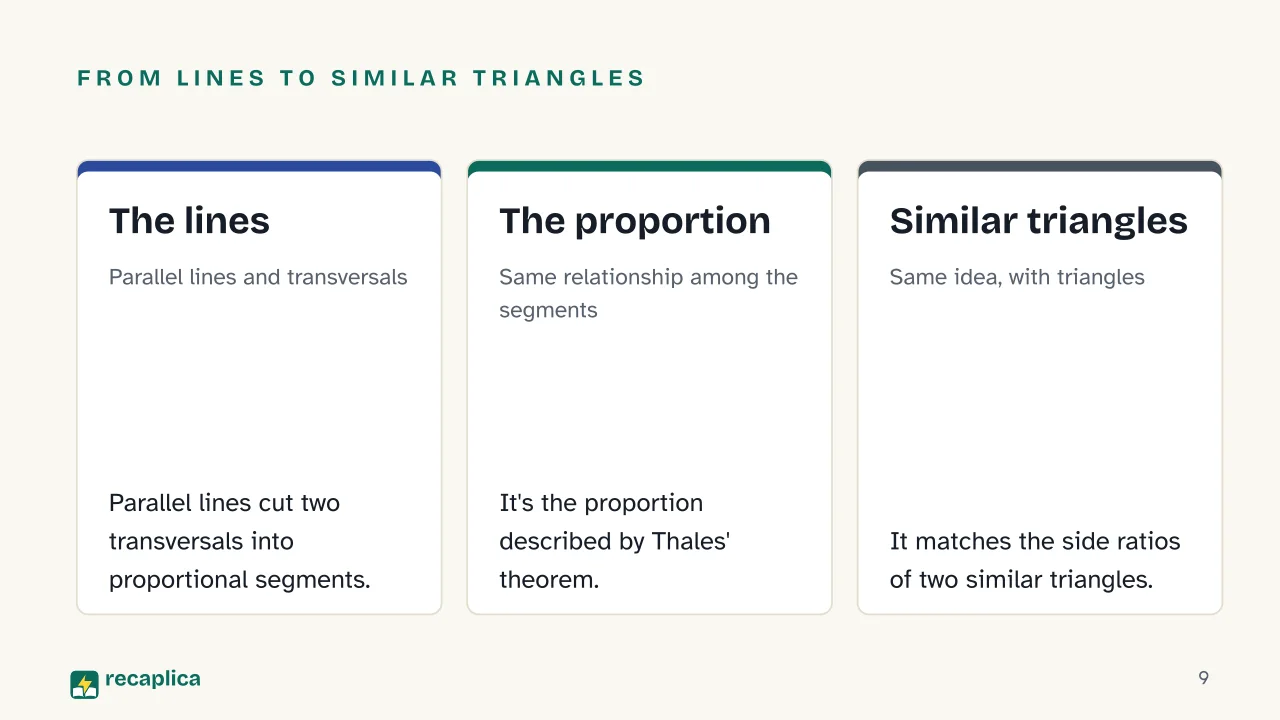
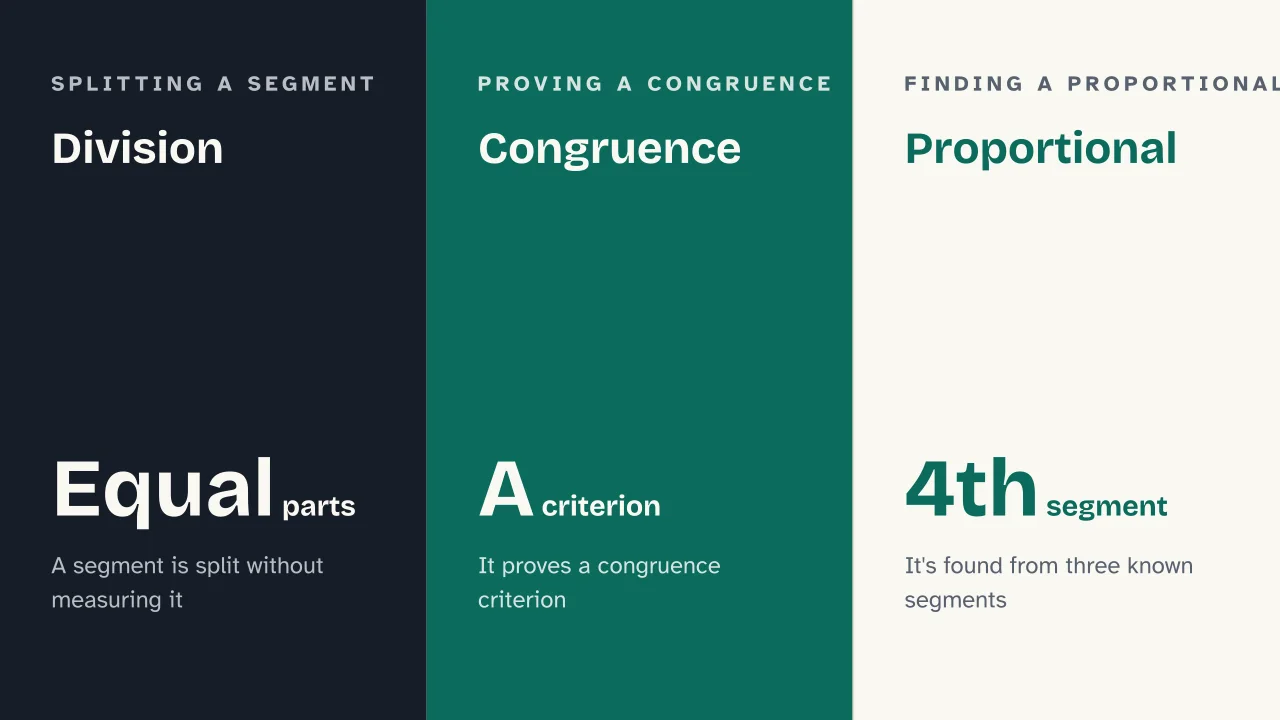
    Wikipedia EN describes Thales’ theorem as mathematically equivalent to the ratio between the sides of similar triangles: it’s the same idea behind similar triangles, stated with parallel lines and transversals instead of triangles themselves. Two triangles formed by cutting two lines with parallel lines have corresponding sides in proportion, which is why, according to Treccani, the theorem also serves to prove a triangle congruence criterion, besides splitting a segment into equal parts and finding a fourth segment proportional to three given ones. Anyone who wants to see this same relationship proved step by step in its classical form can read about the earliest written proof, in Euclid’s Elements.

    Plutarch, in the account reported by the 1911 Encyclopædia Britannica, also credits Thales with establishing that triangles with equal angles have proportional sides — the principle behind similar triangles — likely used as well to work out the distance of a ship at sea. The tests for checking when two triangles are actually similar — side-angle-side, angle-angle, side-side-side — are the subject of the triangle similarity theorems.

    A story handed down, not a documented fact

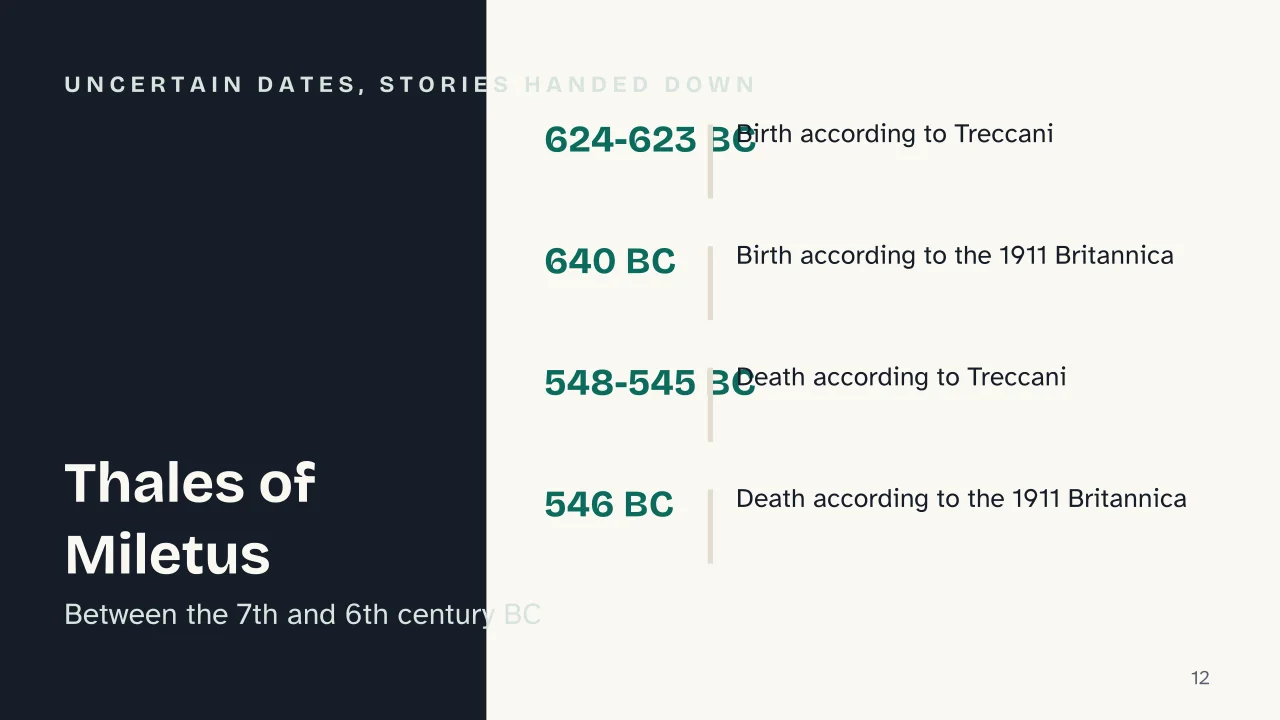
    What’s known about Thales’ life is scarce and uncertain: both Treccani and Wikipedia EN say so, describing dates and events that aren’t documented with certainty. The sources disagree even on the timeline: Treccani places Thales’ birth between 624 and 623 BC and his death between 548 and 545 BC, while the 1911 Encyclopædia Britannica gives 640-546 BC instead.

    The story handed down by Hieronymus of Rhodes, through Diogenes Laertius, and by Pliny, cited by the Encyclopædia Britannica, has Thales working out the height of an Egyptian pyramid by measuring its shadow at the moment his own shadow matched his height. It’s a tale passed down by ancient writers, not a fact documented at the time Thales lived. Plutarch tells a different version of the same episode, one that would already use the principle of triangle proportionality without the time-of-day condition: the ancient sources don’t describe the same procedure. Modern historians of mathematics, according to Wikipedia EN, remain doubtful that proofs with the rigor Greek mathematics would later reach were already being produced in Thales’ time.

    Practical example: in a modern reconstruction of the method, not Thales’ original procedure, which is lost, you measure the base of the pyramid and the height of a stick planted upright, and at the same moment of the day you measure the shadows of both. According to Wikipedia EN, the pyramid and the stick cast shadows proportional to their heights, so a single proportion is enough to work out the pyramid’s height without climbing it.

    Who was Thales

    Wikipedia EN notes that the theorem carries Thales’ name by tradition: the Babylonians and the Egyptians already knew it, and the earliest written proof we know of appears in Euclid’s Elements. The story told by Diogenes Laertius, through Apollodorus, has Thales dying while watching the 58th Olympic Games, from heatstroke and thirst: another episode that comes from antiquity, far from any independent confirmation.

    Anyone who wants to place Thales in his own time can read about ancient Greece; anyone who wants to move on to other tools for working with triangles can find trigonometry and analytic geometry.

    Slide deck

    Slides ready to download and make your own in PowerPoint or Google Slides, with speaker notes. Pick the Flash cut or the Full one.
    Slide 1 of the presentation on What Is Thales' Theorem? Parallel Lines and Similar Triangles: Thales' theoremSlide 2 of the presentation on What Is Thales' Theorem? Parallel Lines and Similar Triangles: How tall is a pyramid you can't climb?Slide 3 of the presentation on What Is Thales' Theorem? Parallel Lines and Similar Triangles: The lines come first, the pyramid comes laterSlide 4 of the presentation on What Is Thales' Theorem? Parallel Lines and Similar Triangles: Chapter 01: The statementSlide 5 of the presentation on What Is Thales' Theorem? Parallel Lines and Similar Triangles: The same parallel lines cut two transversalsSlide 6 of the presentation on What Is Thales' Theorem? Parallel Lines and Similar Triangles: Chapter 02: Direct and converseSlide 7 of the presentation on What Is Thales' Theorem? Parallel Lines and Similar Triangles: Parallel lines and proportion, in both directionsSlide 8 of the presentation on What Is Thales' Theorem? Parallel Lines and Similar Triangles: Chapter 03: Similar trianglesSlide 9 of the presentation on What Is Thales' Theorem? Parallel Lines and Similar Triangles: From lines to similar triangles: The lines, The proportion, Similar trianglesSlide 10 of the presentation on What Is Thales' Theorem? Parallel Lines and Similar Triangles: Division · Congruence · ProportionalSlide 11 of the presentation on What Is Thales' Theorem? Parallel Lines and Similar Triangles: Chapter 04: Thales and the pyramidSlide 12 of the presentation on What Is Thales' Theorem? Parallel Lines and Similar Triangles: Uncertain dates, stories handed downSlide 13 of the presentation on What Is Thales' Theorem? Parallel Lines and Similar Triangles: Thales didn't write the first proofSlide 14 of the presentation on What Is Thales' Theorem? Parallel Lines and Similar Triangles: What does Thales' theorem say about parallel lines cutting two transversals?Slide 15 of the presentation on What Is Thales' Theorem? Parallel Lines and Similar Triangles: Time to review
    Flash10 slidesThe essential thread, to present in classFull15 slidesEvery chapter and the deeper detail

    Common myths

    • ✗ Myth Many assume Thales invented the theorem out of nothing.

      ✓ Reality According to Wikipedia EN, the principle was already known to the Babylonians and the Egyptians before him; the earliest known written proof appears in Euclid's Elements.

    • ✗ Myth Many assume the shadow-and-pyramid measurement is a documented fact, told exactly as it circulates.

      ✓ Reality It's actually a story handed down by ancient writers such as Diogenes Laertius and Pliny, and Plutarch tells a different version of it: the ancient sources don't agree on the exact method, so it isn't a verifiable fact.

    • ✗ Myth Many assume Thales' birth and death dates are known with certainty.

      ✓ Reality The sources disagree: Treccani gives 624-623 BC to 548-545 BC, the 1911 Encyclopædia Britannica gives 640-546 BC, and what's known about Thales' life overall remains scarce and uncertain.

    Mind map

    Drag the background to move around and the nodes to reposition them; use − and + to collapse and expand branches.
    Customize
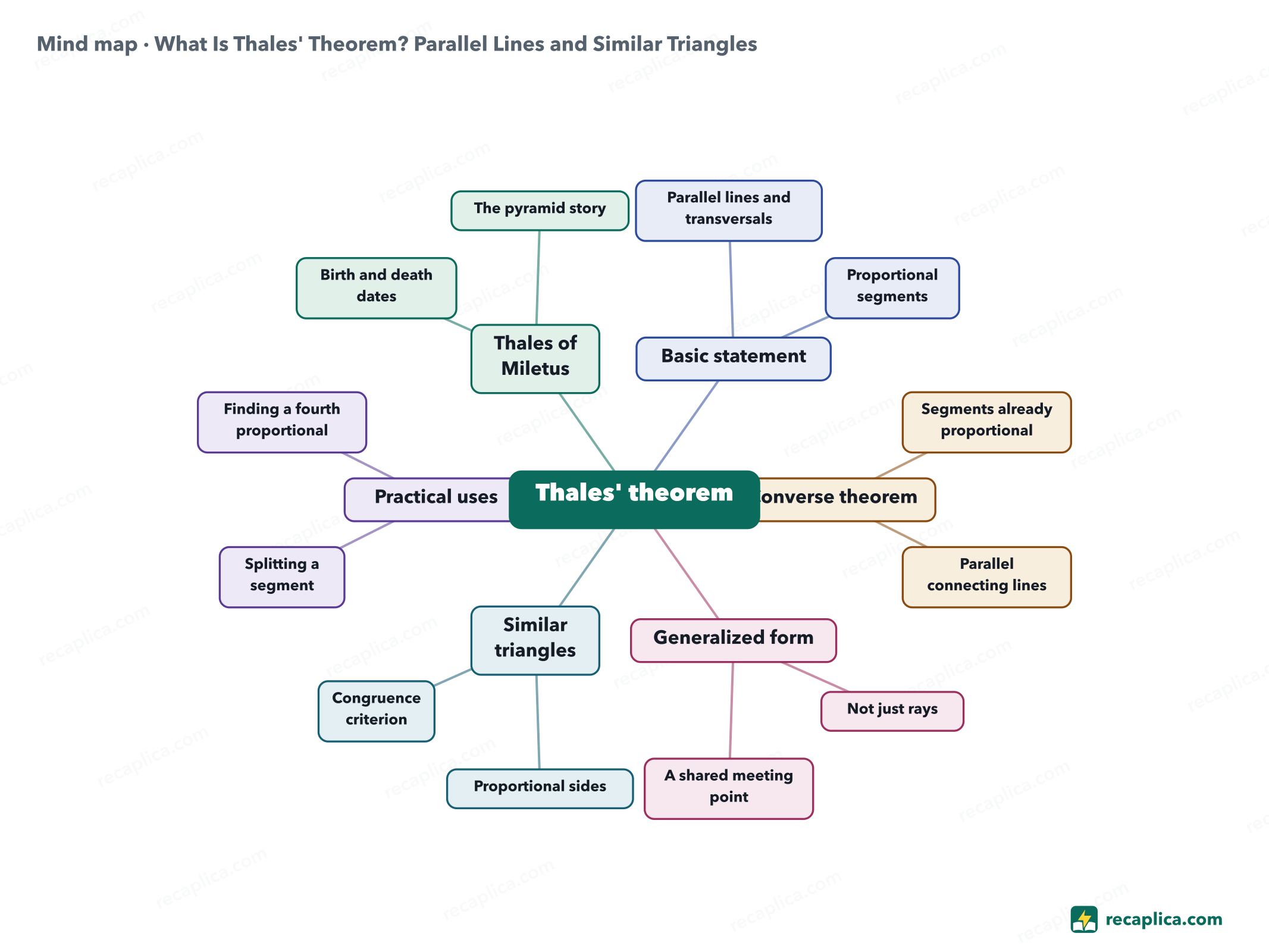
    Mind map: What Is Thales' Theorem? Parallel Lines and Similar Triangles
    • Thales' theorem
      • Basic statement parallel lines and transversals in proportion
        • Parallel lines and transversals the parallel lines cut the transversals
        • Proportional segments same proportion on both transversals
      • Converse theorem from proportion to parallelism
        • Segments already proportional
        • Parallel connecting lines
      • Generalized form any two lines, same parallel lines
        • Not just rays
        • A shared meeting point
      • Similar triangles same idea, with triangles
        • Proportional sides
        • Congruence criterion
      • Practical uses
        • Splitting a segment
        • Finding a fourth proportional
      • Thales of Miletus uncertain life, conflicting dates
        • Birth and death dates Treccani and Britannica disagree
        • The pyramid story a tale written down centuries later

    Quiz: test yourself

    Answer the questions to check what you have learned: you get instant feedback and a short explanation.

    Grade 0/10 0/5
    1 According to Thales' theorem, what happens to the segments that parallel lines create on two transversals?

    That's exactly what Thales' theorem says, according to Treccani: parallel lines cut by two transversals create segments in direct proportion.

    2 What does the converse of Thales' theorem state?

    This is the converse described by Treccani: proportional segments plus two parallel connecting lines lead to the parallelism of the other two.

    3 What does the generalized form of Thales' theorem cover?

    Wikipedia EN describes the extension from the two original rays to lines that meet at any point.

    4 What is the link between Thales' theorem and similar triangles?

    According to Wikipedia EN, Thales' theorem is equivalent to the theorem on the side ratios of similar triangles.

    5 The story of the pyramid measured through its shadow is a fact documented with certainty from Thales' own lifetime. True or false?

    It's a story that comes from ancient writers such as Diogenes Laertius, Pliny and Plutarch, written centuries after Thales' life, and the versions themselves disagree with each other.

    Answers: 1-A · 2-A · 3-A · 4-A · 5-B

    Flashcards

    Tap the card to flip it and check whether you remember the answer, then move to the next one.

    1 / 7

    Explain it in your own words

    The ultimate test: if you can explain it in simple words, you've truly understood it. Write your explanation, then compare it with the Recap.

    Your explanation is saved only on this device.

    Thales' theorem describes a relationship between parallel lines and transversals: the parallel lines cut the transversals into segments that stand in the same proportion. A converse version also holds, deducing that two connecting lines are parallel once the segments they create are already proportional and two other connecting lines are already parallel. Read with triangles instead of lines, the same relationship is the principle behind similar triangles, one of the ways the theorem gets used in practice, alongside splitting a segment into equal parts. The theorem is named after Thales, a thinker from ancient Greece about whom few facts survive: the story of the pyramid measured through its shadow comes from ancient writers, set down centuries after his life.

    Frequently asked questions

    What is Thales' theorem?

    It's the principle that parallel lines, when they cut two transversals, leave matching segments on each one in the same ratio, as Treccani explains.

    What is Thales' theorem used for?

    Treccani describes three practical uses: splitting a segment into equal parts, proving a congruence criterion between triangles, and finding a fourth length proportional to three already known.

    What's the difference between Thales' theorem and its converse?

    The direct theorem starts from parallel lines and arrives at a proportion between segments; the converse starts from a proportion already given between segments, together with two parallel connecting lines, and concludes that the other connecting lines are parallel too.

    Who was Thales?

    A thinker from ancient Greece credited by tradition with the theorem that bears his name. Little is known about his life with certainty, and the sources even disagree on his birth and death dates.

    Is Thales' theorem connected to similar triangles?

    Yes: Wikipedia EN describes Thales' theorem as equivalent to the principle behind similar triangles, just expressed through lines and parallels instead of the sides of a triangle.

    Sources

    • Treccani, Talete, teorema di
    • Treccani, Talete di Mileto
    • Encyclopædia Britannica, 1911, Thales (via Wikisource)
    • Wikipedia EN, Intercept theorem
    • Wikipedia EN, Thales of Miletus

    Every Recap goes through an independent review before publication.

    Every evening, the day's new Recaps on our Telegram channel. Join the channel →

    Keep learning

    • Science Correlation: What It Means and How to Read the Coefficient Correlation measures how closely two variables move together, and the most common way to put a number on it is the correlation coefficient, which runs from -1 to +1. A value near +1 means the two variables rise together, near -1 means one rises while the other falls, and near 0 means no linear relationship stands out. The coefficient only captures the strength of a straight-line relationship, and a single unusual data point can push it up or down by a lot. Even when it's strong, a correlation between two variables never shows that one causes the other. Read the Recap →
    • Science Light Refraction: What It Is, the Laws Behind It, and Examples A surface that separates two transparent materials sends some light back, reflecting it, and lets the rest through while bending it toward a new direction. The law of reflection keeps the incoming and outgoing angles equal, both measured from the normal to the surface. Snell's law governs refraction instead, linking the index of each material to how much the ray tilts before and after it crosses over. These two laws alone explain mirrors, lenses, prisms and everyday sights such as a pencil that appears to snap inside a glass of water. Read the Recap →
    • Science Total Internal Reflection and the Critical Angle: Definition and Formula Total internal reflection is what happens when a light ray stops being able to leave a transparent medium and gets sent back inside it completely. It takes place past a specific angle of incidence, called the critical angle, calculated with Snell's law by comparing the refractive indices of the two materials involved. It only happens under one precise condition: the ray must be traveling from an optically denser medium into a less dense one, such as from water into air or from glass into air. Optical fibers and, in part, the sparkle of diamonds rely on this same principle. Read the Recap →

    recaplica

    Clear in 30 seconds, yours in 10 minutes.

    Recaps Mind maps Request a Recap Telegram channel Mind map maker Our method About Privacy & cookies Legal notes & terms of use

    © 2026 Recaplica · A project by Curi S.r.l. — VAT IT05472000750

    Statistics, only if you say so

    To learn which Recaps help most we would use Google Analytics, with aggregate, anonymous data. It starts only with your OK, and you can change your mind anytime. Privacy policy