Skip to content
recaplica

    One moment: security check

    Cloudflare wants to make sure you're not a robot. Tick the box below and your search will continue on its own.

    IT
    recaplica Qualitative and Quantitative Research: Differences, Validity and Reliability
    © 2026 Recaplica · recaplica.com — All rights reserved
    Home › Science

    Qualitative and Quantitative Research: Differences, Validity and Reliability

    By Recaplica Newsroom · Updated on October 6, 2026

    What to print

    Page numbers appear when printing with default margins.

    Slides

    Choose a cut

    Flash10 slidesThe essential thread, to present in classFull15 slidesEvery chapter and the deeper detail

    Both come with speaker notes.

    Telegram channel
    recaplica Clear in 30 seconds, yours in 10 minutes.
    In 30 seconds Key points Deep dive Slides Myths Mind map Quiz Flashcards FAQ

    In 30 seconds quick read

    Qualitative and quantitative research are two different ways of studying something, and the difference starts with the goal. Quantitative researchers work with numbers, looking for patterns, testing them, and tracing how variables relate to each other. Qualitative researchers work with words, images and observations, aiming to get inside the meaning of an experience. Reliability is a measurement's ability to give the same result every time it is repeated — a separate check from validity, which asks instead whether that result actually measures what it is supposed to measure. Qualitative research uses its own criteria — credibility, transferability, dependability and confirmability — built for its own assumptions. Mixed methods combines both approaches in a single study, to gain breadth and depth at once.

    Key Points

    • Quantitative research measures with numbers to find patterns and relationships between variables; qualitative research uses words, images and observations to understand experiences and meaning.
    • Reliability is a measurement's ability to produce a stable result every time it is repeated.
    • A measurement can repeat itself perfectly and still be wrong: validity and reliability are independent checks on the same measurement.
    • In qualitative research, credibility and transferability are the equivalents of internal and external validity; dependability and confirmability are distinct criteria, built for its own assumptions.
    • Large samples give quantitative research conclusions that generalize to wider populations; the small, in-depth samples of qualitative research do not offer the same generalizability.
    • Mixed methods combines qualitative and quantitative elements within one research design, in data collection, analysis or conclusions; it differs from multimethod, which combines several approaches of the same type.

    Deep Dive

    Two Ways of Looking at the Same Phenomenon

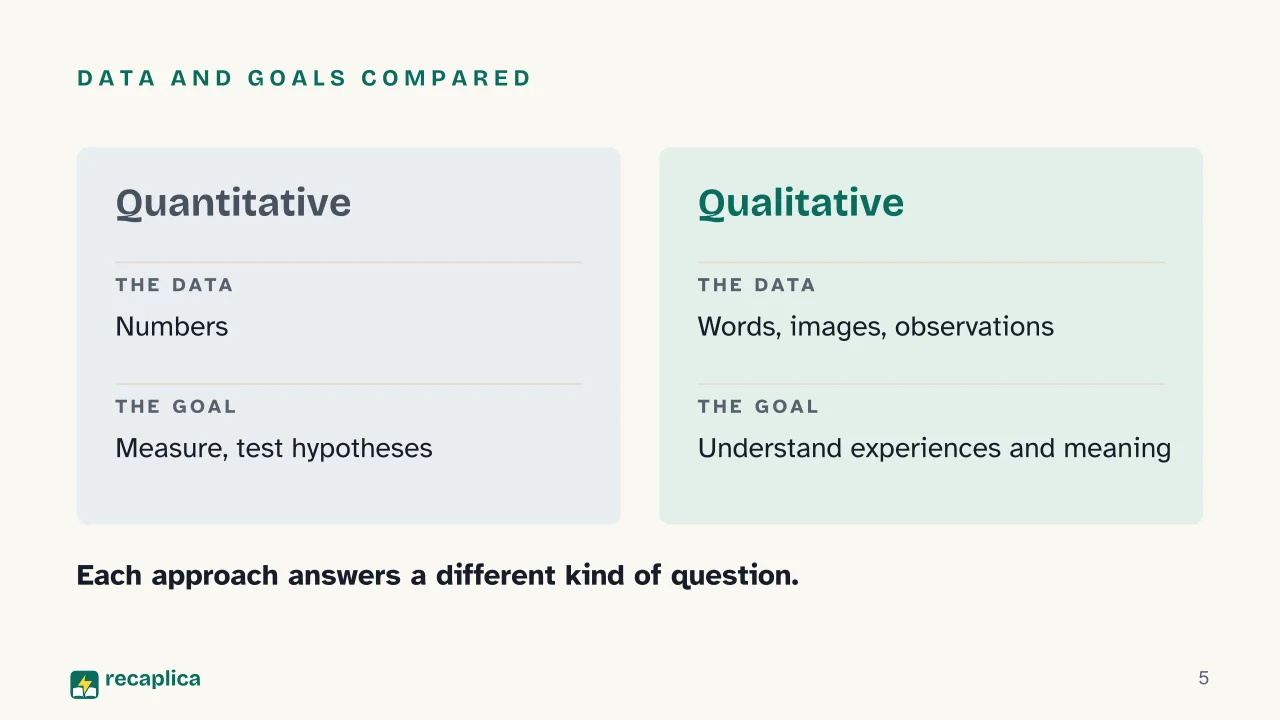
    Quantitative research collects numerical data to spot recurring patterns and measure how variables relate to each other. Qualitative research collects non-numerical data instead — words, images, observations — to get at the substance of experiences and meanings.

    These are not two versions of the same question. They are two different questions, asked with different tools.

    The quantitative approach relies on measurement and statistical analysis, and produces results that count as objective; anyone who wants to reason about how numbers are distributed and connected can find the groundwork in the article on probability and statistics. The qualitative approach relies instead on interpretation and context, and produces a deep understanding rather than an objective measurement.

    Practical example: a researcher studying cognitive load while students study could proceed in two ways. On the quantitative side, she gives a standardized questionnaire to two hundred students and calculates an average score — the same kind of measurement that drives Sweller’s cognitive load theory. On the qualitative side, she interviews ten students and asks them to describe, in their own words, what happens when a task gets too complicated. The first study produces a comparable number; the second produces an account that resists being summed up in a single figure, but carries details the questionnaire never picks up.

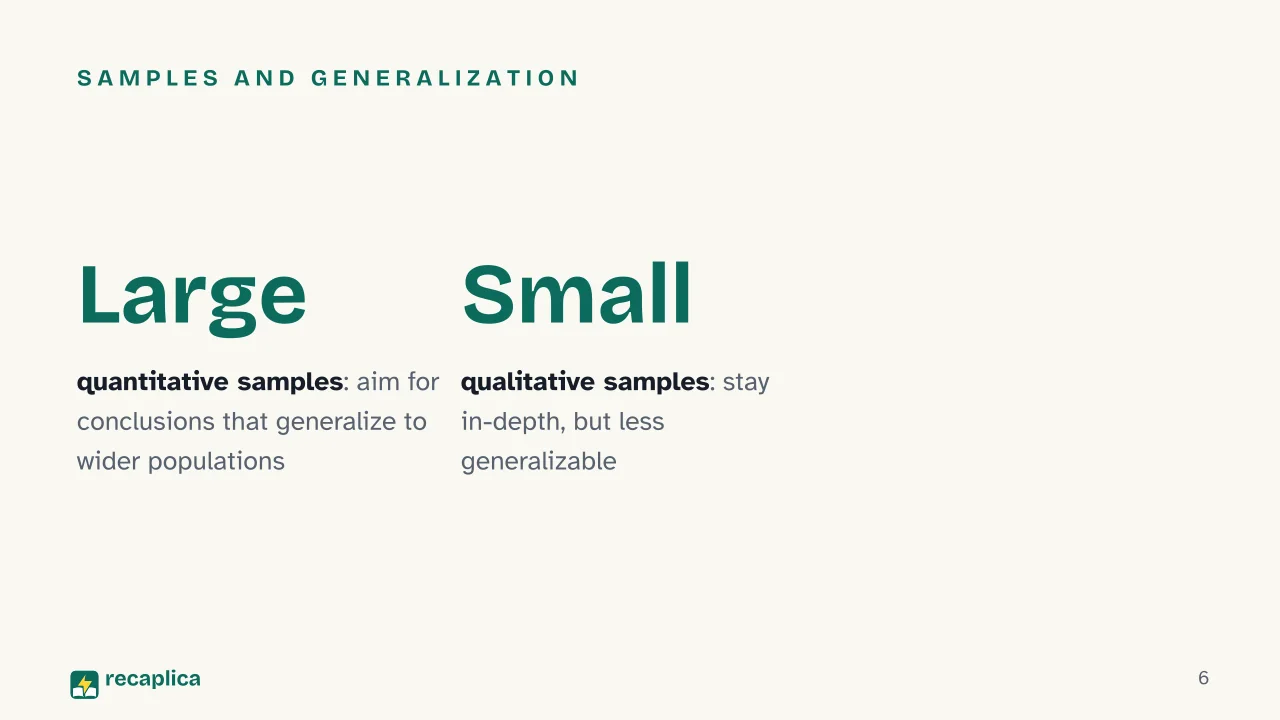
    Thanks to large samples, quantitative research can reach conclusions that generalize to wider populations. Qualitative research works with small, in-depth samples, and does not offer that same generalizability — in exchange, it reaches places a large sample never gets to, inside the detail of a single case.

    Quantitative researchQualitative research
    GoalMeasure, test hypothesesUnderstand experiences and meaning
    Type of dataNumbersWords, images, observations
    MethodStatistical analysisInterpretation in context
    Rigor criteriaValidity and reliabilityCredibility, transferability, dependability, confirmability
    GeneralizabilityHigh, with large samplesLimited, with small samples

    Reliability: How Consistent a Measurement Is

    The reliability of a research measurement is about how consistently it gives the same result when repeated. It says nothing about whether that result is the right one: it only says that, repeating the same measurement under the same conditions, the number or rating that comes out stays stable.

    In scientific method terms, reliability is about the quality of the measuring instrument itself: its ability to produce coherent, repeatable results. It cannot be calculated exactly, because no measurement is entirely free of error; it can only be estimated, using techniques that compare repeated measurements or different parts of the same instrument.

    Validity: Measuring What Actually Matters

    Validity is about whether a measurement actually gets at the concept it is supposed to track, not just whether it does so consistently. A bathroom scale that is off and always reads three kilos heavier than someone’s real weight is reliable, because it gives the same number every time, but it is not valid, because that number does not match the real weight. Reliability and validity stay separate checks, then. Anyone building a questionnaire for psychological science has to check both, because an instrument that swings wildly from one use to the next is just as useless as a stable instrument measuring the wrong concept.

    The Criteria of Qualitative Research

    The qualitative approach starts from different philosophical assumptions, and the criteria built for quantitative research do not simply carry over: Guba and Lincoln proposed four criteria designed specifically for this kind of study — credibility, transferability, dependability and confirmability.

    Credibility is the criterion equivalent to internal validity, and it measures how true and recognizable the findings are to the people who were studied, rather than to an outside observer. Transferability corresponds to external validity and asks how far the conclusions of a qualitative study might hold in other, similar settings. Confirmability is the qualitative equivalent of objectivity: the possibility that other researchers, examining the same data, would reach compatible conclusions.

    A study trying to understand how a group of students experiences exam anxiety, for instance, does not look for a statistically representative sample of the whole student population: it looks for accounts that the people who lived through it recognize as true, and checks whether other researchers reading the same interviews would read them in a similar way. Research into how students reflect on their own learning — metacognition — often relies on interviews of exactly this kind.

    Mixed Methods, a Third Approach

    Mixed methods combines qualitative and quantitative elements — in data collection, analysis or conclusions — to gain breadth and depth of understanding together. A study might, for example, start with a large-scale questionnaire and then dig deeper into some of the answers through interviews with a small group of participants.

    Mixed methods is different from multimethod research. Multimethod combines several approaches of the same type, for instance two different quantitative tools or two different qualitative techniques; mixed methods always brings together one qualitative element and one quantitative element within the same research design.

    Slide deck

    Slides ready to download and make your own in PowerPoint or Google Slides, with speaker notes. Pick the Flash cut or the Full one.

    Slide 1 of the presentation on Qualitative and Quantitative Research: Qualitative and Quantitative ResearchSlide 2 of the presentation on Qualitative and Quantitative Research: Is a reliable measurement automatically valid?Slide 3 of the presentation on Qualitative and Quantitative Research: What this coversSlide 4 of the presentation on Qualitative and Quantitative Research: Chapter 01: Two Ways to Do ResearchSlide 5 of the presentation on Qualitative and Quantitative Research: Data and goals comparedSlide 6 of the presentation on Qualitative and Quantitative Research: Samples and generalizationSlide 7 of the presentation on Qualitative and Quantitative Research: Chapter 02: Reliability and ValiditySlide 8 of the presentation on Qualitative and Quantitative Research: A number alone does not settle itSlide 9 of the presentation on Qualitative and Quantitative Research: Chapter 03: The Qualitative CriteriaSlide 10 of the presentation on Qualitative and Quantitative Research: Criteria built for the qualitative world: Credibility, Transferability, ConfirmabilitySlide 11 of the presentation on Qualitative and Quantitative Research: Qualitative research is not scientific.Slide 12 of the presentation on Qualitative and Quantitative Research: Chapter 04: Mixed MethodsSlide 13 of the presentation on Qualitative and Quantitative Research: Mixed or multimethodSlide 14 of the presentation on Qualitative and Quantitative Research: What is the main difference between quantitative and qualitative research?Slide 15 of the presentation on Qualitative and Quantitative Research: Time to review
    Flash10 slidesThe essential thread, to present in classFull15 slidesEvery chapter and the deeper detail

    Common myths

    • ✗ Myth Qualitative research is not real science because it does not use numbers.

      ✓ Reality It has its own rigor criteria, credibility, transferability, dependability and confirmability, proposed by Guba and Lincoln specifically for this kind of study, because qualitative research starts from different philosophical assumptions than quantitative research. The absence of numbers does not mean the absence of quality checks.

    • ✗ Myth If a measurement is reliable, it must also be valid.

      ✓ Reality These are two separate judgments about the same measurement, because a result can stay identical every time without being the right one: consistency does not guarantee correctness, which is why the two checks are kept apart.

    • ✗ Myth Mixed methods just means using any two techniques in the same study.

      ✓ Reality Mixed methods always combines one qualitative element and one quantitative element in the same piece of research. When the combined elements are of the same type instead, two quantitative techniques or two qualitative ones, that is called multimethod, not mixed methods.

    Mind map

    Drag the background to move around and the nodes to reposition them; use − and + to collapse and expand branches.
    Customize
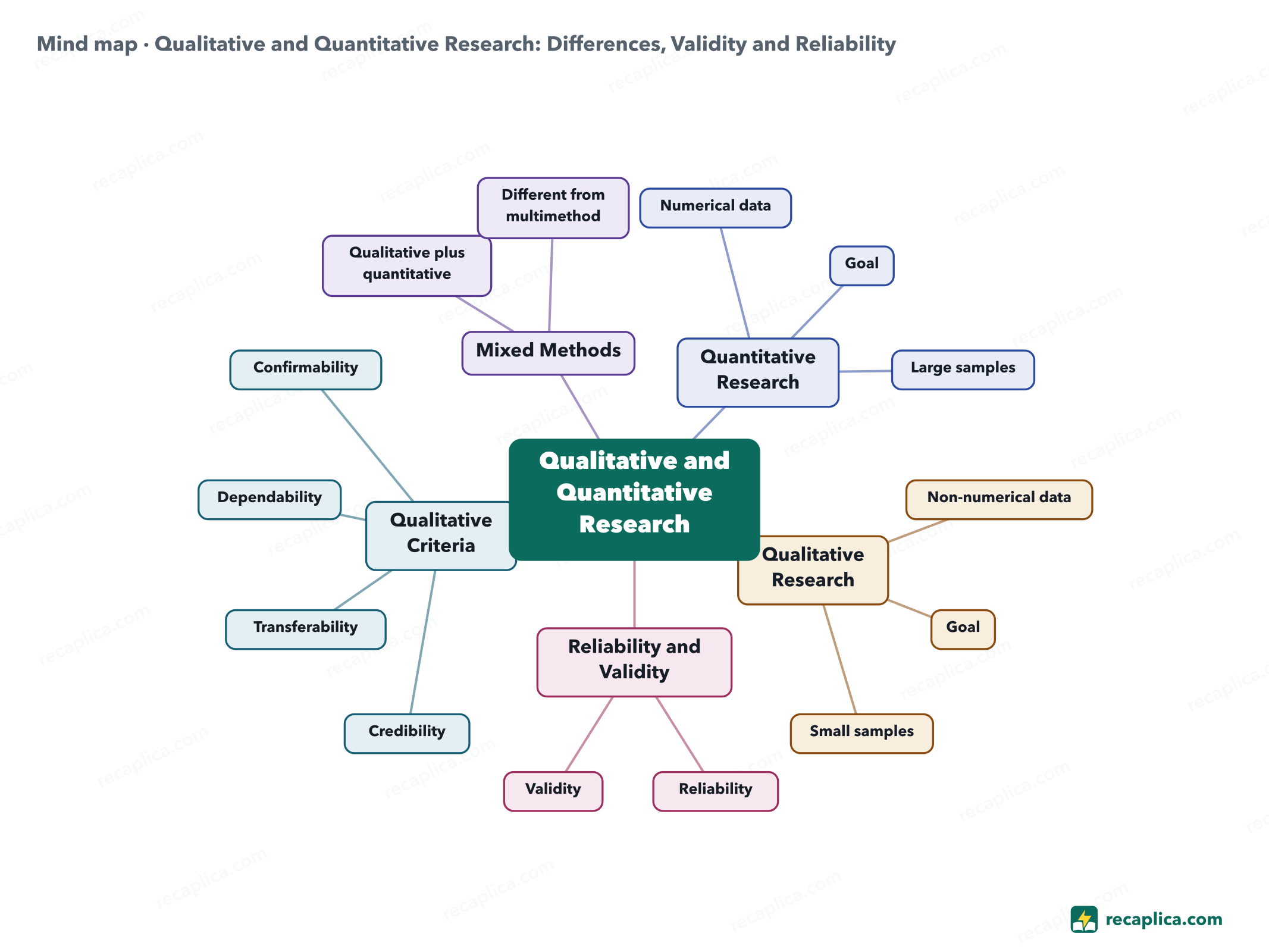
    Mind map: Qualitative and Quantitative Research: Differences, Validity and Reliability
    • Qualitative and Quantitative Research
      • Quantitative Research
        • Numerical data
        • Goal Measure, test hypotheses
        • Large samples Generalizable conclusions
      • Qualitative Research
        • Non-numerical data Words, images, observations
        • Goal Understand experiences and meaning
        • Small samples In-depth, less generalizable
      • Reliability and Validity
        • Reliability Consistency of a repeated result
        • Validity Measures the right concept
      • Qualitative Criteria
        • Credibility
        • Transferability
        • Dependability
        • Confirmability
      • Mixed Methods
        • Qualitative plus quantitative
        • Different from multimethod

    Quiz: test yourself

    Answer the questions to check what you have learned: you get instant feedback and a short explanation.

    Grade 0/10 0/5
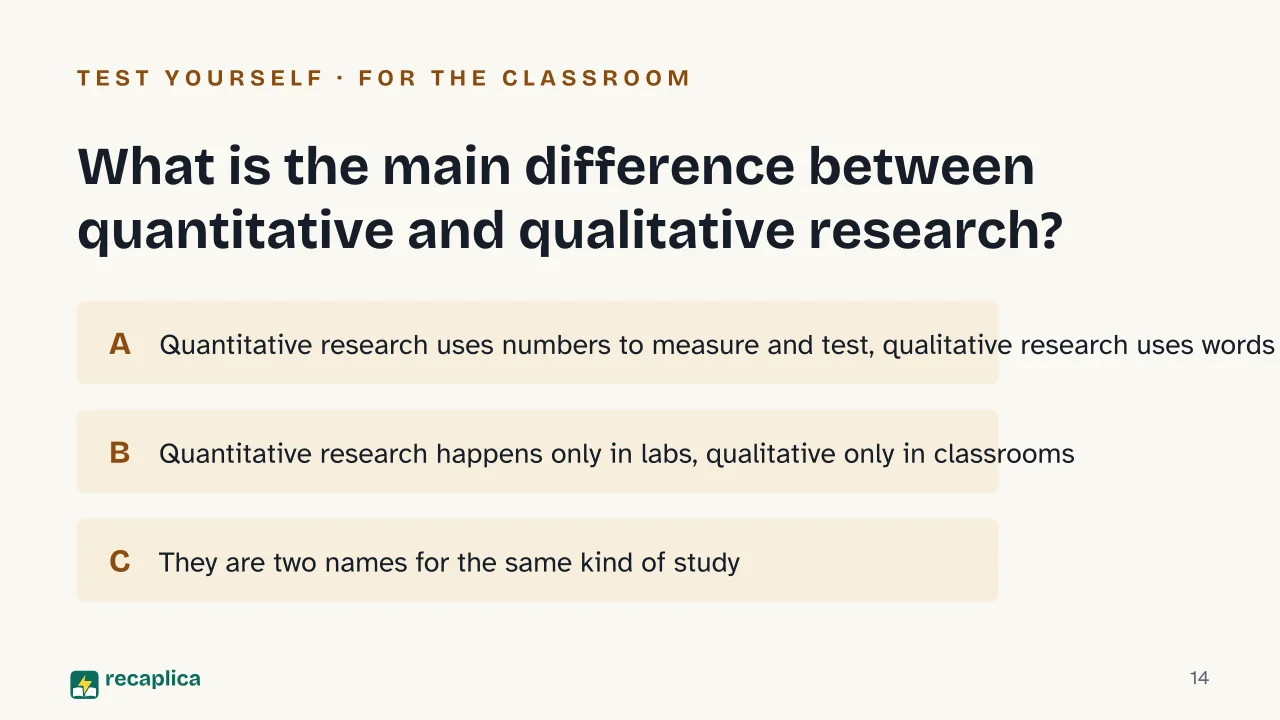
    1 What is the main difference between quantitative and qualitative research?

    Quantitative research relies on numbers, to spot recurring patterns and put them in relation to each other; qualitative research relies on words and observation, to understand the meaning of an experience. Where the work happens is beside the point, and the two names do not label the same thing.

    2 What does the reliability of a research measurement assess?

    Reliability measures the stability of an instrument: its ability to give the same result every time the measurement is repeated.

    3 True or false: a reliable measurement is automatically also valid.

    False. A measurement can repeat itself perfectly and still miss the concept it was meant to capture: consistency and correctness are two different questions, checked separately.

    4 What is the qualitative equivalent of external validity?

    Transferability plays, in the qualitative world, the same role external validity plays in the quantitative one, and asks whether what was observed in one setting also holds elsewhere. Credibility and confirmability answer other questions, about truth as perceived by the people studied and agreement across different researchers; dependability stands as a fourth criterion named alongside the other three.

    5 What distinguishes mixed methods from multimethod research?

    Mixed methods brings together, inside one piece of research, a qualitative technique and a quantitative technique, to gain both breadth and depth; multimethod instead adds up several tools from the same family, such as two quantitative questionnaires built in different ways.

    Answers: 1-A · 2-A · 3-B · 4-A · 5-A

    Flashcards

    Tap the card to flip it and check whether you remember the answer, then move to the next one.

    1 / 8

    Explain it in your own words

    The ultimate test: if you can explain it in simple words, you've truly understood it. Write your explanation, then compare it with the Recap.

    Your explanation is saved only on this device.

    Qualitative and quantitative research are two different ways of studying something, and the difference starts with the goal. Quantitative researchers work with numbers, looking for patterns, testing them, and tracing how variables relate to each other. Qualitative researchers work with words, images and observations, aiming to get inside the meaning of an experience. Reliability is a measurement's ability to give the same result every time it is repeated — a separate check from validity, which asks instead whether that result actually measures what it is supposed to measure. Qualitative research uses its own criteria — credibility, transferability, dependability and confirmability — built for its own assumptions. Mixed methods combines both approaches in a single study, to gain breadth and depth at once.

    Frequently asked questions

    What is the difference between qualitative and quantitative research?

    Quantitative research works with numbers, used to find recurring patterns, test hypotheses and see how variables relate to each other; with large samples it reaches conclusions that generalize. Qualitative research instead works with words, images and observations, aiming to capture lived experience from the inside; its samples are smaller and more in-depth.

    Is a reliable measurement also a valid one?

    No. The same number can come out every time without being the right one: the stability of a result and whether it matches the concept it is meant to capture are two independent checks.

    What are credibility and transferability in qualitative research?

    They are two of the criteria Guba and Lincoln proposed for judging the rigor of qualitative research, in place of the criteria designed for quantitative research. Credibility measures how true the findings feel to the people who were studied; transferability measures how far the conclusions might hold in other, similar settings.

    What is mixed methods research?

    It is a third way of doing research, combining a qualitative part and a quantitative part in one project — this can happen during data collection, analysis or when drawing conclusions — to gain breadth and depth together. It differs from multimethod, which instead combines several techniques of the same type.

    Why does not qualitative research use the same validity criteria as quantitative research?

    Because it starts from different philosophical assumptions. The criteria of credibility, transferability, dependability and confirmability were developed as an alternative to the validity and reliability criteria built for quantitative research, to fit how qualitative research looks at the reality it studies.

    Sources

    • Reliability & Validity — Research Methods Knowledge Base (Conjointly)
    • Reliability — Research Methods Knowledge Base (Conjointly)
    • Qualitative Validity — Research Methods Knowledge Base (Conjointly)
    • Quantitative vs. Qualitative Research — LibGuide, Illinois Institute of Technology
    • Schoonenboom J., Johnson R.B. (2017), How to Construct a Mixed Methods Research Design — Europe PMC

    Every Recap goes through an independent review before publication.

    Every evening, the day's new Recaps on our Telegram channel. Join the channel →

    Keep learning

    • Science Correlation: What It Means and How to Read the Coefficient Correlation measures how closely two variables move together, and the most common way to put a number on it is the correlation coefficient, which runs from -1 to +1. A value near +1 means the two variables rise together, near -1 means one rises while the other falls, and near 0 means no linear relationship stands out. The coefficient only captures the strength of a straight-line relationship, and a single unusual data point can push it up or down by a lot. Even when it's strong, a correlation between two variables never shows that one causes the other. Read the Recap →
    • Science Light Refraction: What It Is, the Laws Behind It, and Examples A surface that separates two transparent materials sends some light back, reflecting it, and lets the rest through while bending it toward a new direction. The law of reflection keeps the incoming and outgoing angles equal, both measured from the normal to the surface. Snell's law governs refraction instead, linking the index of each material to how much the ray tilts before and after it crosses over. These two laws alone explain mirrors, lenses, prisms and everyday sights such as a pencil that appears to snap inside a glass of water. Read the Recap →
    • Science Total Internal Reflection and the Critical Angle: Definition and Formula Total internal reflection is what happens when a light ray stops being able to leave a transparent medium and gets sent back inside it completely. It takes place past a specific angle of incidence, called the critical angle, calculated with Snell's law by comparing the refractive indices of the two materials involved. It only happens under one precise condition: the ray must be traveling from an optically denser medium into a less dense one, such as from water into air or from glass into air. Optical fibers and, in part, the sparkle of diamonds rely on this same principle. Read the Recap →

    recaplica

    Clear in 30 seconds, yours in 10 minutes.

    Recaps Mind maps Request a Recap Telegram channel Mind map maker Our method About Privacy & cookies Legal notes & terms of use

    © 2026 Recaplica · A project by Curi S.r.l. — VAT IT05472000750

    Statistics, only if you say so

    To learn which Recaps help most we would use Google Analytics, with aggregate, anonymous data. It starts only with your OK, and you can change your mind anytime. Privacy policy