Skip to content
recaplica

    One moment: security check

    Cloudflare wants to make sure you're not a robot. Tick the box below and your search will continue on its own.

    IT
    recaplica Metacognition: What It Means and Why It Helps You Learn
    © 2026 Recaplica · recaplica.com — All rights reserved
    Home › Science

    Metacognition: What It Means and Why It Helps You Learn

    By Recaplica Newsroom · Updated on October 1, 2026

    What to print

    Page numbers appear when printing with default margins.

    Slides

    Choose a cut

    Flash10 slidesThe essential thread, to present in classFull15 slidesEvery chapter and the deeper detail

    Both come with speaker notes.

    Telegram channel
    recaplica Clear in 30 seconds, yours in 10 minutes.
    In 30 seconds Key points Deep dive Slides Myths Mind map Quiz Flashcards FAQ

    In 30 seconds quick read

    Metacognition is the ability to think about your own thinking and to control it while you learn: according to Livingston (2003), it is a "higher order" form of thinking that lets you actively direct your own mental strategies. The term was coined in 1979 by psychologist John Flavell, who split it into two parts: knowing how you learn (metacognitive knowledge) and using that knowledge to plan, monitor and evaluate a task (metacognitive regulation). It isn't limited to adults: research cited by the Education Endowment Foundation finds that children as young as three already set themselves goals and check whether they've understood something. The same organisation rates it as a high-impact, very low-cost intervention for school learning.

    Key Points

    • Metacognition is awareness and control of your own thought processes while you learn, according to Livingston (2003).
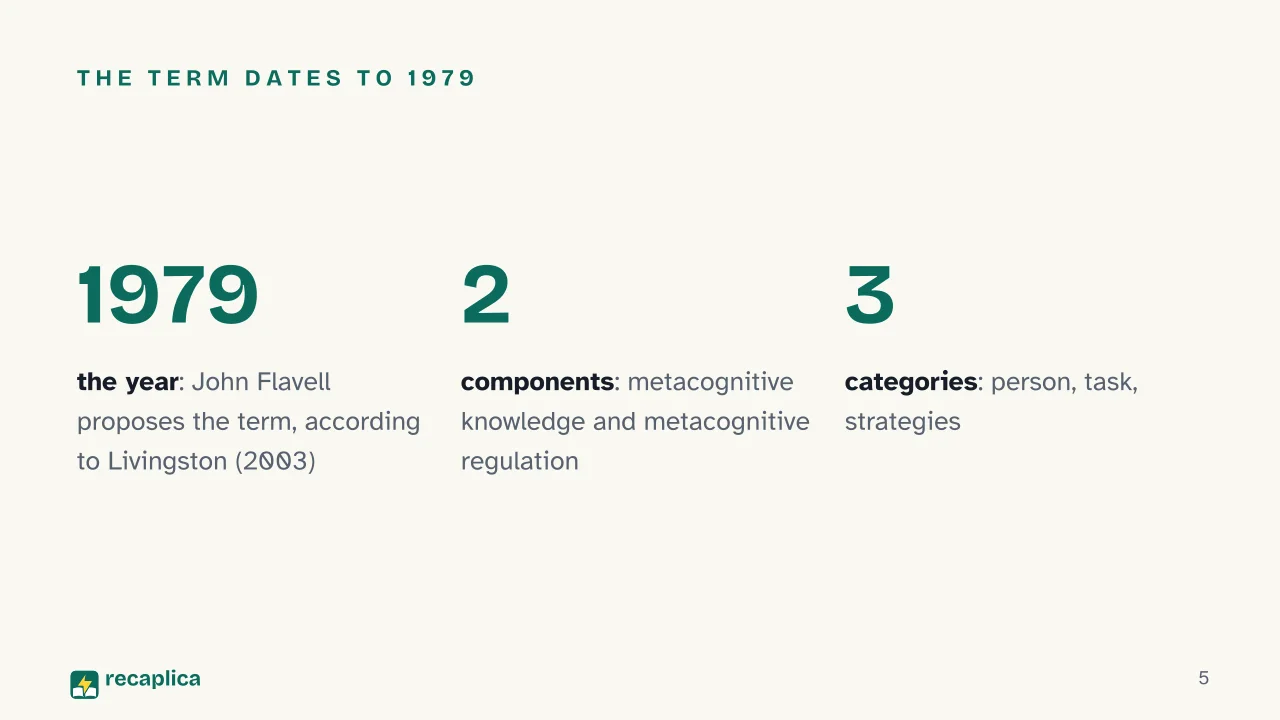
    • The term is credited to psychologist John Flavell, who proposed it in 1979.
    • It has two parts - metacognitive knowledge (of yourself, the task, and the strategies available) and metacognitive regulation (planning, monitoring, evaluating).
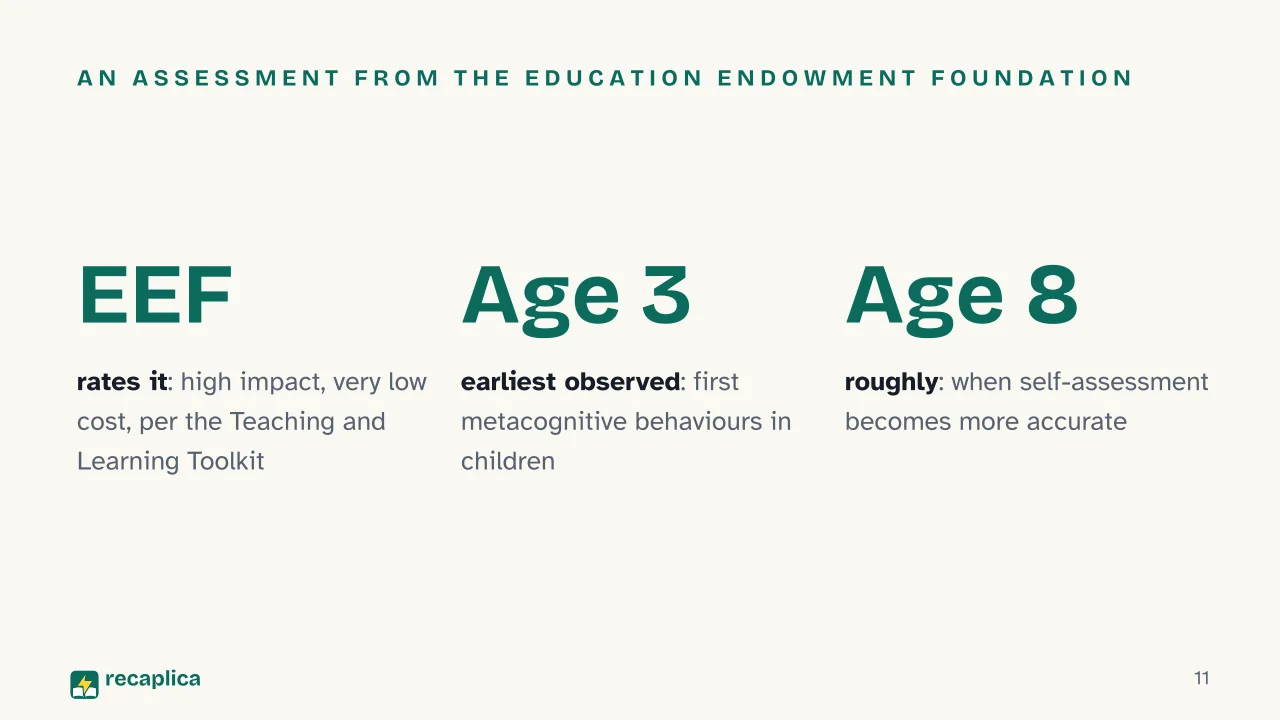
    • Children show metacognitive behaviour from age three, though self-assessment only becomes accurate around age eight, according to research cited by the Education Endowment Foundation.
    • The Education Endowment Foundation rates metacognition and self-regulation interventions as high impact for very low cost.
    • It's a different concept from self-regulated learning, which according to Panadero (2017) is broader and also covers motivation and emotion.

    Deep Dive

    Putting a name to a specific skill

    According to Livingston (2003), metacognition is a “higher order” form of thinking that means actively controlling your own cognitive processes while you learn: planning how to approach a task, monitoring your own understanding, evaluating the progress you’ve made. The concept sits inside psychological science, the discipline that studies mental processes using the experimental method, and got a precise name in 1979 from psychologist John Flavell.

    Almost everyone with average intelligence uses some form of metacognitive regulation when facing a demanding task, but some do it more than others. According to Livingston (2003), people with stronger metacognitive skills tend to do better at cognitive tasks, and the ability to regulate your own thinking can be learned.

    Flavell’s two components

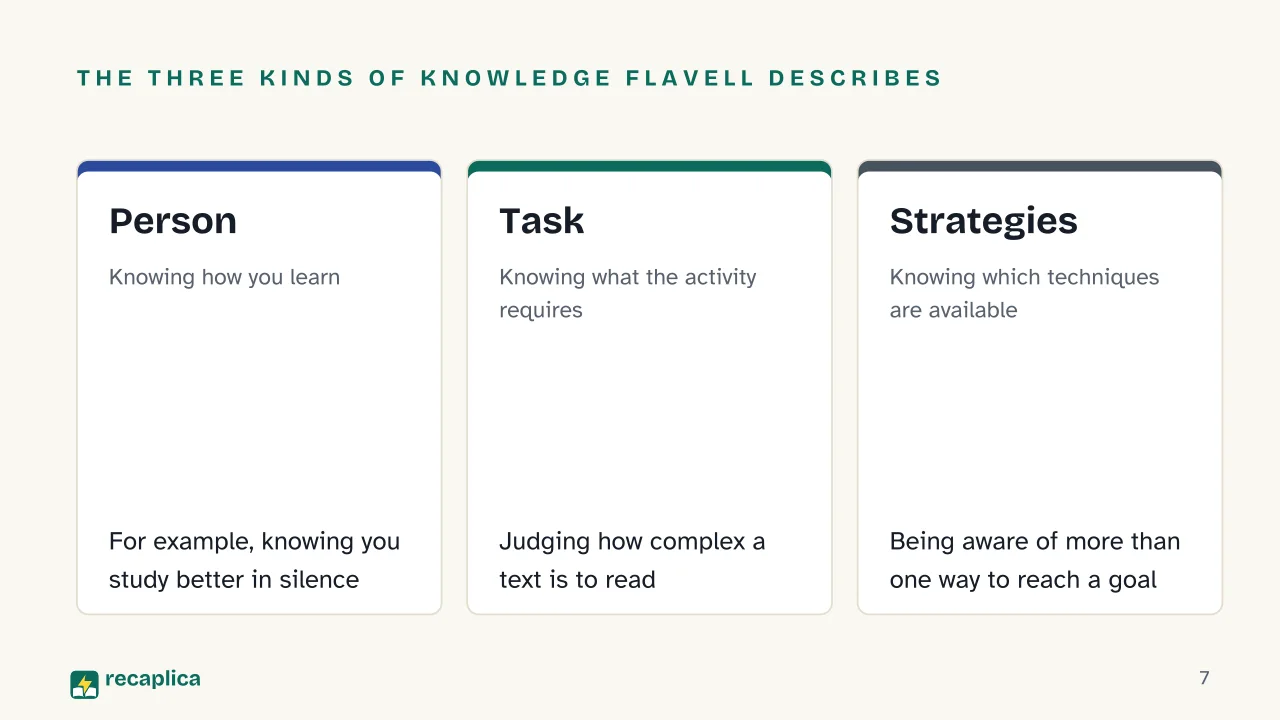
    Flavell splits metacognition into two parts. The first is metacognitive knowledge, meaning what you know about your own way of learning: it breaks down into three categories, knowledge of yourself as a learner, knowledge of the task at hand, and knowledge of the strategies available. One example of knowledge about the “person” is knowing that you study better in a library, in silence, rather than at home with distractions.

    The second part is metacognitive regulation, the practical use of that knowledge: the strategies a person deploys to control their own thinking and check whether a goal has been reached, such as understanding a text. Flavell also points out that, in practice, this knowledge can look much like ordinary cognitive knowledge - what changes is how it gets applied, either to reach a goal or to check whether it has been reached.

    What it looks like while you study

    One of the most cited examples of metacognitive regulation involves reading. Pausing to ask yourself questions about a paragraph you’ve just read, to check you really understood it, is, according to Livingston (2003), one of the most common comprehension-monitoring strategies.

    Practical example: after reading a paragraph from a textbook, try closing the book and explaining it out loud, as if you were describing it to a classmate who hasn’t read it. If you get stuck on one specific point, that’s the part you haven’t understood - not the whole paragraph, just an isolated piece to go back to. It’s the same monitoring mechanism Livingston describes, applied to any chapter.

    For a toolkit of concrete techniques to use while studying - how to pace your time, which diagrams to use, how to review material - the Recap on how to study effectively collects the ones backed by research. Here, the goal is understanding the mechanism that makes them work.

    The regulation cycle: plan, monitor, evaluate

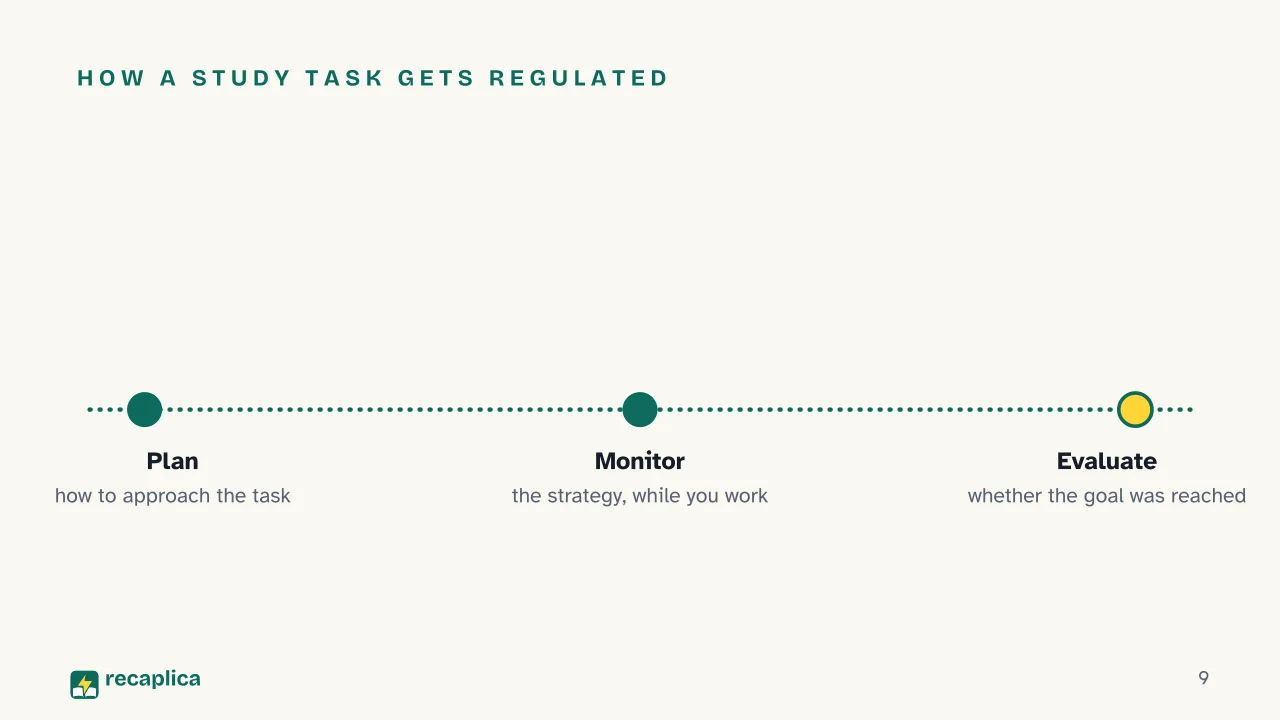
    Metacognitive regulation follows a three-stage cycle, according to the Education Endowment Foundation (EEF): plan how to approach a task, monitor the strategy while you work, and evaluate its success at the end. Metacognition can’t work on its own, though - it needs cognitive strategies already in place, and the motivation to apply them.

    StageWhat happensExample while studying
    PlanDecide how to approach the taskChoose where to start studying a chapter
    MonitorCheck your understanding while you workPause to explain a paragraph to yourself
    EvaluateVerify whether the goal was reachedRedraw a diagram and compare it with the text

    At what age it develops

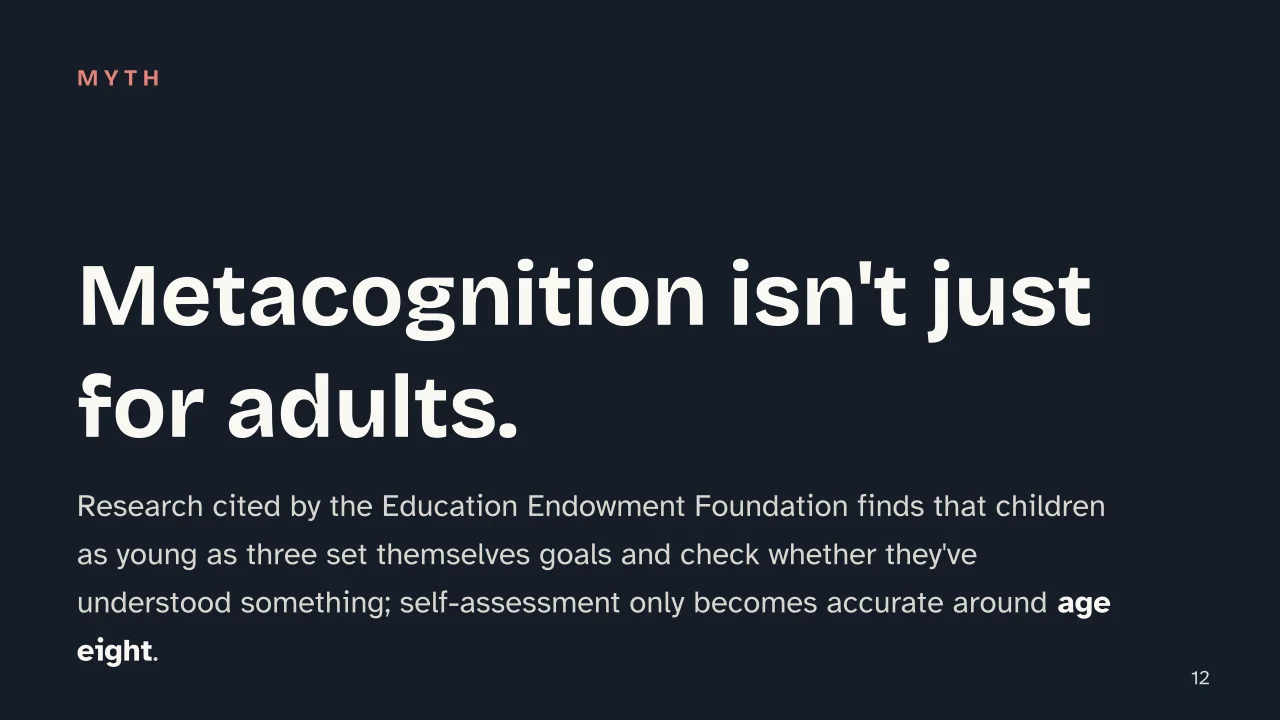
    It’s a common assumption that metacognition only concerns adults. Research cited by the EEF shows the opposite: children as young as three already do metacognitive things, like deciding on a goal for themselves and checking whether an idea has actually sunk in. Until about age eight, though, they tend to overestimate what they actually know - their self-assessment stays fairly inaccurate before gradually becoming more precise.

    Theories that explain how children’s thinking changes with age, starting with Piaget and Vygotsky’s constructivism, offer the framework for placing this evidence on metacognitive development.

    Why it matters for learning

    The EEF’s Teaching and Learning Toolkit puts metacognition and self-regulation approaches among its highest-impact, lowest-cost strategies, drawing on a wide body of international evidence. Several studies cited by the EEF find that self-regulated learning, and metacognition specifically, affects students’ school outcomes independently of what they already knew beforehand.

    Some evidence suggests disadvantaged students use metacognitive strategies less often, which is why they may be the ones who benefit most from being taught these skills explicitly - not an innate ability, but something built through targeted support, as explored in the Recap on Jerome Bruner and teaching.

    Not the same as self-regulated learning

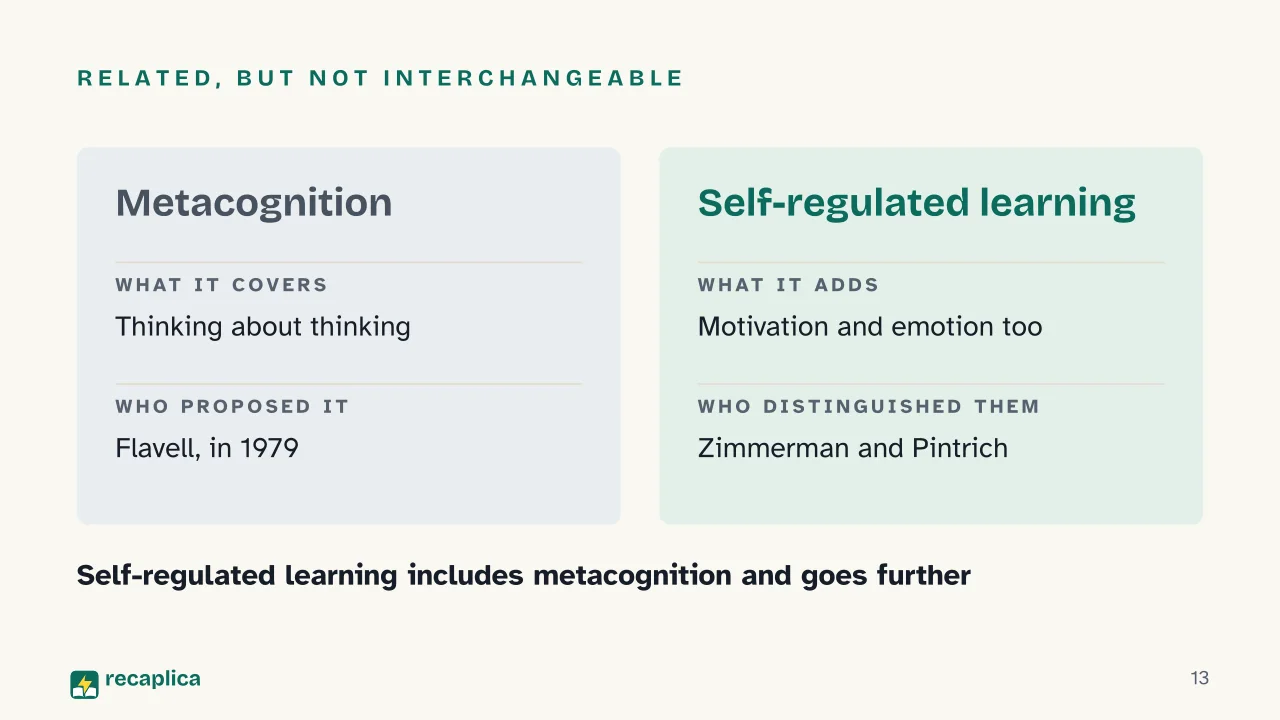
    Self-regulated learning is a broader concept than metacognition alone: it also covers behavioural, motivational and emotional aspects, beyond the cognitive and metacognitive ones, according to Panadero’s (2017) review. The distinction between the two fields, related as they are, traces back to the work of Zimmerman and Pintrich between the 1980s and 1990s.

    Drawing on four meta-analyses on the topic, Panadero concludes that self-regulated learning interventions do improve student learning when well designed, but their effect varies by school level: according to the meta-analysis by Dignath and colleagues cited in the review, interventions grounded in social-cognitive theory - the same theory behind Albert Bandura’s work on social learning, with its emphasis on observation and self-efficacy - have a bigger impact in primary school, especially when teachers and students are given a structured framework to follow. Another meta-analysis by the same research group found that group work makes these interventions less effective in primary school, while it improves them in secondary school.

    Slide deck

    Slides ready to download and make your own in PowerPoint or Google Slides, with speaker notes. Pick the Flash cut or the Full one.
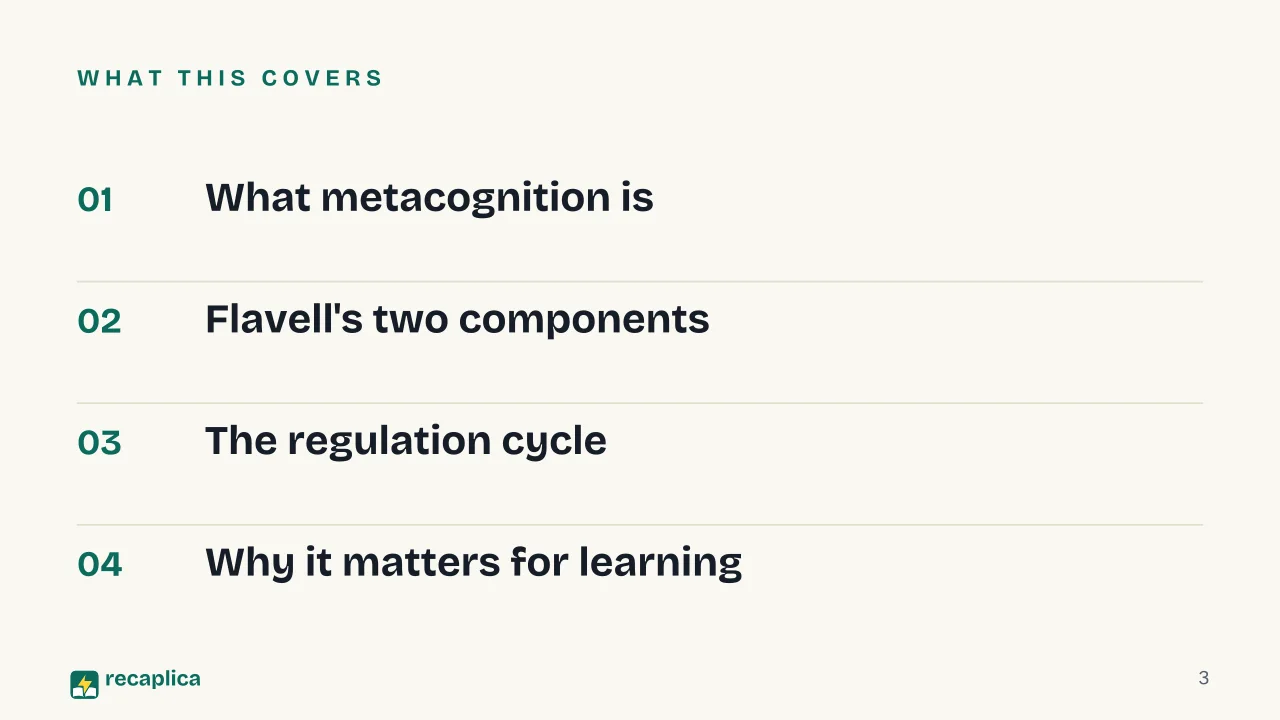
    Slide 1 of the presentation on Metacognition: MetacognitionSlide 2 of the presentation on Metacognition: Do you know which environment helps you study best?Slide 3 of the presentation on Metacognition: What this coversSlide 4 of the presentation on Metacognition: Chapter 01: What metacognition isSlide 5 of the presentation on Metacognition: The term dates to 1979Slide 6 of the presentation on Metacognition: Chapter 02: Flavell's two componentsSlide 7 of the presentation on Metacognition: The three kinds of knowledge Flavell describes: Person, Task, StrategiesSlide 8 of the presentation on Metacognition: Chapter 03: The regulation cycleSlide 9 of the presentation on Metacognition: How a study task gets regulatedSlide 10 of the presentation on Metacognition: Chapter 04: Why it matters for learningSlide 11 of the presentation on Metacognition: An assessment from the Education Endowment FoundationSlide 12 of the presentation on Metacognition: Metacognition isn't just for adults.Slide 13 of the presentation on Metacognition: Related, but not interchangeableSlide 14 of the presentation on Metacognition: What are the two components of metacognition according to Flavell?Slide 15 of the presentation on Metacognition: Now for the review
    Flash10 slidesThe essential thread, to present in classFull15 slidesEvery chapter and the deeper detail

    Common myths

    • ✗ Myth Metacognition is a skill that only concerns adults.

      ✓ Reality According to research cited by the Education Endowment Foundation, children as young as three already set their own goals and check whether an idea has actually landed. What changes is accuracy - until about age eight, children tend to overestimate what they actually know, before gradually becoming more accurate at judging themselves.

    • ✗ Myth Metacognition and self-regulated learning are the same thing under two different names.

      ✓ Reality For Panadero (2017), self-regulated learning is a wider concept - it takes in how you behave, what motivates you and how you feel, not just how you think about thinking. Researchers Zimmerman and Pintrich first drew that line between the two fields in the 1980s and 1990s, even though the two remain closely linked.

    Mind map

    Drag the background to move around and the nodes to reposition them; use − and + to collapse and expand branches.
    Customize
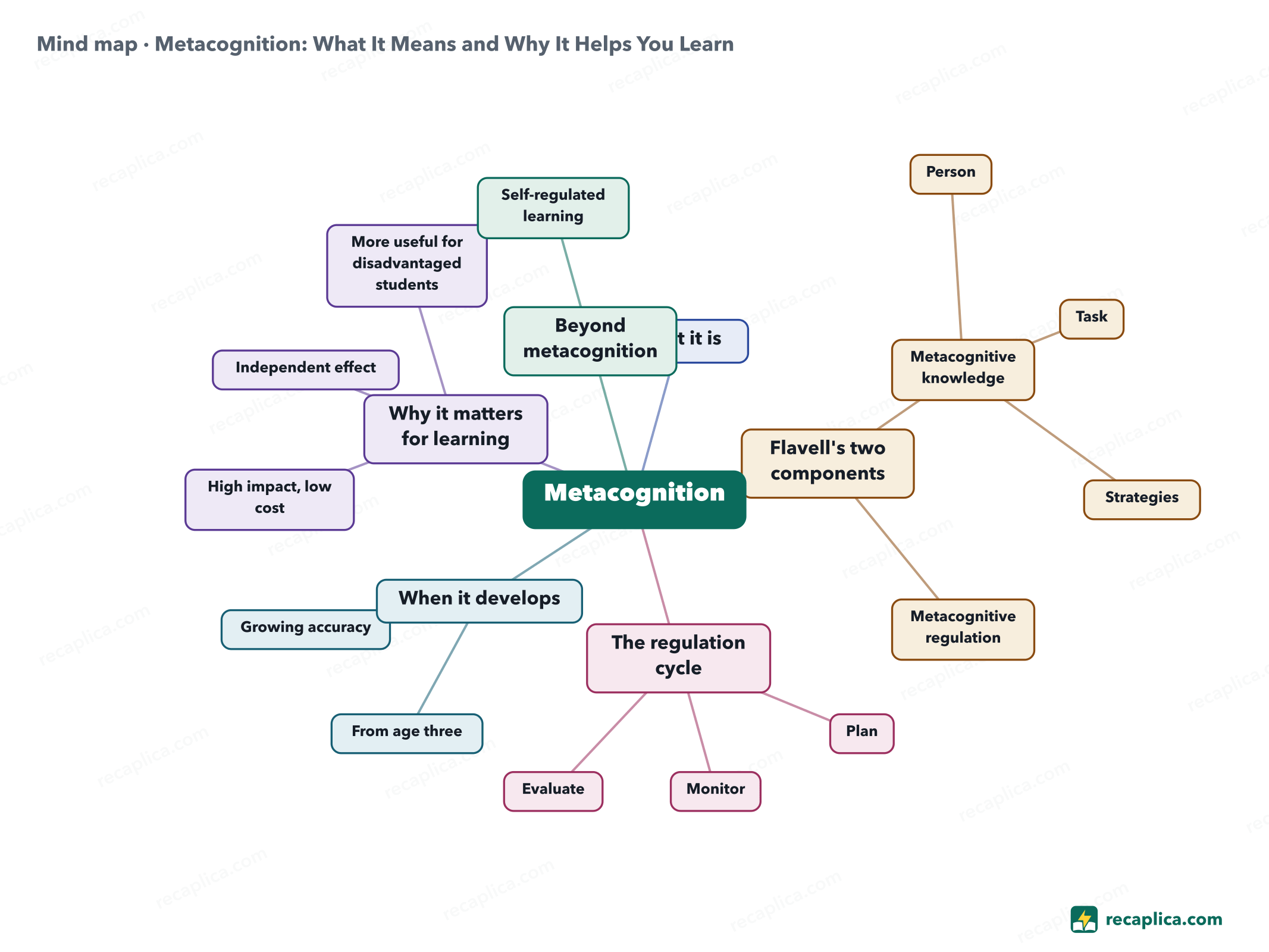
    Mind map: Metacognition: What It Means and Why It Helps You Learn
    • Metacognition
      • What it is Planning, monitoring and checking how you think, a "higher order" skill per Livingston (2003)
      • Flavell's two components
        • Metacognitive knowledge Knowing how you learn
          • Person How you learn best
          • Task What the activity requires
          • Strategies Which techniques are available
        • Metacognitive regulation Using that knowledge and checking the outcome
      • The regulation cycle
        • Plan How to approach the task
        • Monitor The strategy, while you work
        • Evaluate Whether the goal was reached
      • When it develops
        • From age three First metacognitive behaviours, per research cited by the EEF
        • Growing accuracy Until about age eight children overestimate what they know
      • Why it matters for learning
        • High impact, low cost Rating from the EEF's Teaching and Learning Toolkit
        • Independent effect Affects outcomes even at the same starting knowledge level
        • More useful for disadvantaged students They use metacognitive strategies less often, according to the EEF
      • Beyond metacognition
        • Self-regulated learning Broader concept, per Panadero (2017) - also covers motivation and emotion

    Quiz: test yourself

    Answer the questions to check what you have learned: you get instant feedback and a short explanation.

    Grade 0/10 0/5
    1 Who first proposed the term "metacognition"?

    According to Livingston (2003), the term is credited mainly to John Flavell, who proposed it in 1979.

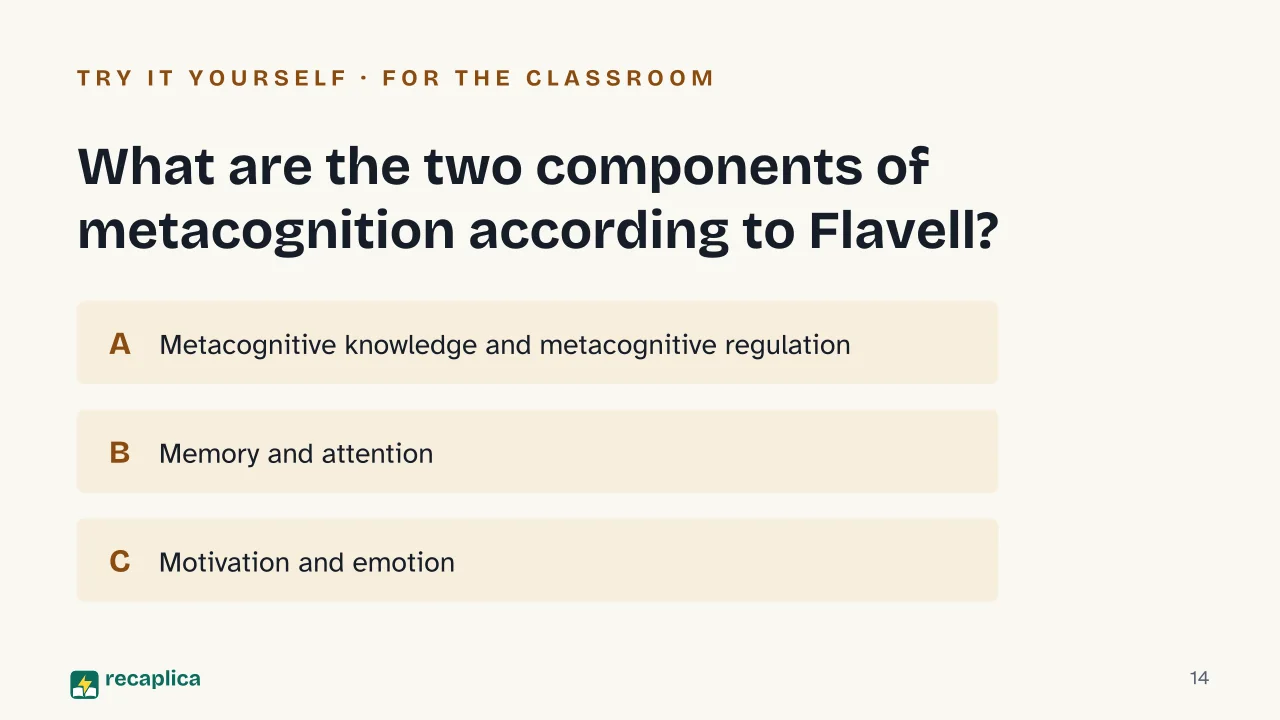
    2 What are the two components of metacognition according to Flavell?

    Flavell separates a "knowing" part (metacognitive knowledge, itself split into person, task and strategies) from a "doing" part (metacognitive regulation, meaning planning, monitoring and evaluating).

    3 True or false: metacognition only develops in adults.

    False: according to research cited by the Education Endowment Foundation, children as young as three already show metacognitive behaviour, such as setting goals and checking their own understanding, even though self-assessment stays inaccurate until around age eight.

    4 In the metacognitive regulation cycle described by the Education Endowment Foundation, what's the correct sequence?

    The cycle has three stages in this order - first you plan how to approach the task, then you monitor the strategy while you work, and finally you evaluate whether it succeeded.

    5 According to Panadero (2017), what sets self-regulated learning apart from metacognition?

    For Panadero, self-regulated learning includes metacognition but goes further, also covering the motivation, emotions and behaviour of the learner.

    Answers: 1-A · 2-A · 3-B · 4-A · 5-A

    Flashcards

    Tap the card to flip it and check whether you remember the answer, then move to the next one.

    1 / 8

    Explain it in your own words

    The ultimate test: if you can explain it in simple words, you've truly understood it. Write your explanation, then compare it with the Recap.

    Your explanation is saved only on this device.

    Metacognition is the ability to think about your own thinking and to control it while you learn: according to Livingston (2003), it is a "higher order" form of thinking that lets you actively direct your own mental strategies. The term was coined in 1979 by psychologist John Flavell, who split it into two parts: knowing how you learn (metacognitive knowledge) and using that knowledge to plan, monitor and evaluate a task (metacognitive regulation). It isn't limited to adults: research cited by the Education Endowment Foundation finds that children as young as three already set themselves goals and check whether they've understood something. The same organisation rates it as a high-impact, very low-cost intervention for school learning.

    Frequently asked questions

    What does metacognition mean?

    It means thinking about your own thinking, specifically in the sense of controlling it while you learn. According to Livingston (2003), it means actively directing your own cognitive processes - for example, deciding how to approach a task or checking that you've actually understood it.

    What are examples of metacognition?

    Knowing that you study better in silence than with music playing is an example of knowledge about the "person"; quizzing yourself on a paragraph right after reading it, to check it actually sank in, is, according to Livingston (2003), one of the most common monitoring strategies. Deciding where to start studying a chapter, or redrawing a diagram to check nothing is missing, also count as metacognitive behaviour.

    What's the difference between metacognition and self-regulated learning?

    Metacognition is about thinking regarding how you learn. For Panadero (2017), self-regulated learning is a broader concept that also includes the behavioural, motivational and emotional sides of studying, not just the cognitive and metacognitive ones.

    At what age does metacognition develop?

    Earlier than most people assume. According to research cited by the Education Endowment Foundation, children as young as three already show signs of metacognitive behaviour, such as setting themselves a goal or checking they've understood something; self-assessment, though, stays fairly inaccurate until around age eight, when it gradually becomes more precise.

    Why does metacognition matter for learning?

    Because, per Livingston (2003), a sharper grip on your own thinking tends to translate into better results on cognitive tasks, and the Education Endowment Foundation rates metacognition interventions as high impact for very low cost. Disadvantaged students, in particular, appear to benefit more from being taught these skills explicitly.

    Sources

    • Livingston, J. A. (2003). Metacognition: An Overview
    • Education Endowment Foundation (2018). Metacognition and Self-Regulated Learning - Guidance Report
    • Panadero, E. (2017). A Review of Self-regulated Learning: Six Models and Four Directions for Research, Frontiers in Psychology

    Every Recap goes through an independent review before publication.

    Every evening, the day's new Recaps on our Telegram channel. Join the channel →

    Keep learning

    • Science Correlation: What It Means and How to Read the Coefficient Correlation measures how closely two variables move together, and the most common way to put a number on it is the correlation coefficient, which runs from -1 to +1. A value near +1 means the two variables rise together, near -1 means one rises while the other falls, and near 0 means no linear relationship stands out. The coefficient only captures the strength of a straight-line relationship, and a single unusual data point can push it up or down by a lot. Even when it's strong, a correlation between two variables never shows that one causes the other. Read the Recap →
    • Science Light Refraction: What It Is, the Laws Behind It, and Examples A surface that separates two transparent materials sends some light back, reflecting it, and lets the rest through while bending it toward a new direction. The law of reflection keeps the incoming and outgoing angles equal, both measured from the normal to the surface. Snell's law governs refraction instead, linking the index of each material to how much the ray tilts before and after it crosses over. These two laws alone explain mirrors, lenses, prisms and everyday sights such as a pencil that appears to snap inside a glass of water. Read the Recap →
    • Science Total Internal Reflection and the Critical Angle: Definition and Formula Total internal reflection is what happens when a light ray stops being able to leave a transparent medium and gets sent back inside it completely. It takes place past a specific angle of incidence, called the critical angle, calculated with Snell's law by comparing the refractive indices of the two materials involved. It only happens under one precise condition: the ray must be traveling from an optically denser medium into a less dense one, such as from water into air or from glass into air. Optical fibers and, in part, the sparkle of diamonds rely on this same principle. Read the Recap →

    recaplica

    Clear in 30 seconds, yours in 10 minutes.

    Recaps Mind maps Request a Recap Telegram channel Mind map maker Our method About Privacy & cookies Legal notes & terms of use

    © 2026 Recaplica · A project by Curi S.r.l. — VAT IT05472000750

    Statistics, only if you say so

    To learn which Recaps help most we would use Google Analytics, with aggregate, anonymous data. It starts only with your OK, and you can change your mind anytime. Privacy policy