Skip to content
recaplica

    One moment: security check

    Cloudflare wants to make sure you're not a robot. Tick the box below and your search will continue on its own.

    IT
    recaplica Prejudice: Definition and How It Forms in the Mind and in Groups
    © 2026 Recaplica · recaplica.com — All rights reserved
    Home › Science

    Prejudice: Definition and How It Forms in the Mind and in Groups

    By Recaplica Newsroom · Updated on October 5, 2026

    What to print

    Page numbers appear when printing with default margins.

    Slides

    Choose a cut

    Flash10 slidesThe essential thread, to present in classFull16 slidesEvery chapter and the deeper detail

    Both come with speaker notes.

    Telegram channel
    recaplica Clear in 30 seconds, yours in 10 minutes.
    In 30 seconds Key points Figures Deep dive Slides Myths Mind map Quiz Flashcards FAQ

    In 30 seconds quick read

    Psychologists draw a line between two related ideas: a shared belief about what a group is like, called a stereotype, and the unfavorable feeling someone may hold toward that group, called prejudice. Both grow out of a mechanism the brain uses from infancy, social categorization, which simplifies a complex social world and can, at the same time, produce favoritism toward one's own group within the first years of life. A 2019 developmental psychology review found that random assignment to a group is enough to build a preference for its members. The way adults talk, even without any explicit lesson, teaches children that a category holds deep similarities among its members. Simply putting two different groups together can leave mutual prejudice unchanged on its own: a 2026 experiment in Bangladesh, with children from a refugee community and children from the host community, shows it.

    Key Points

    • The APA keeps the two terms apart: a stereotype is what people believe about a group, prejudice is how they feel about it.
    • Social categorization, the mechanism that simplifies understanding of the social world, underlies both stereotypes and prejudice.
    • Tajfel's minimal group paradigm shows that mere group membership, even arbitrary, is enough on its own to tilt people toward favoring their own group.
    • How adults talk about a category teaches children that the category holds deep similarities among its members.
    • According to psychologist Gordon Allport, contact between groups reduces prejudice only under specific conditions.
    • A 2026 experiment in Bangladesh, pairing children from the Rohingya community with children from the local host community, found that a single joint session lacking those conditions left mutual prejudice unchanged.

    Key figures

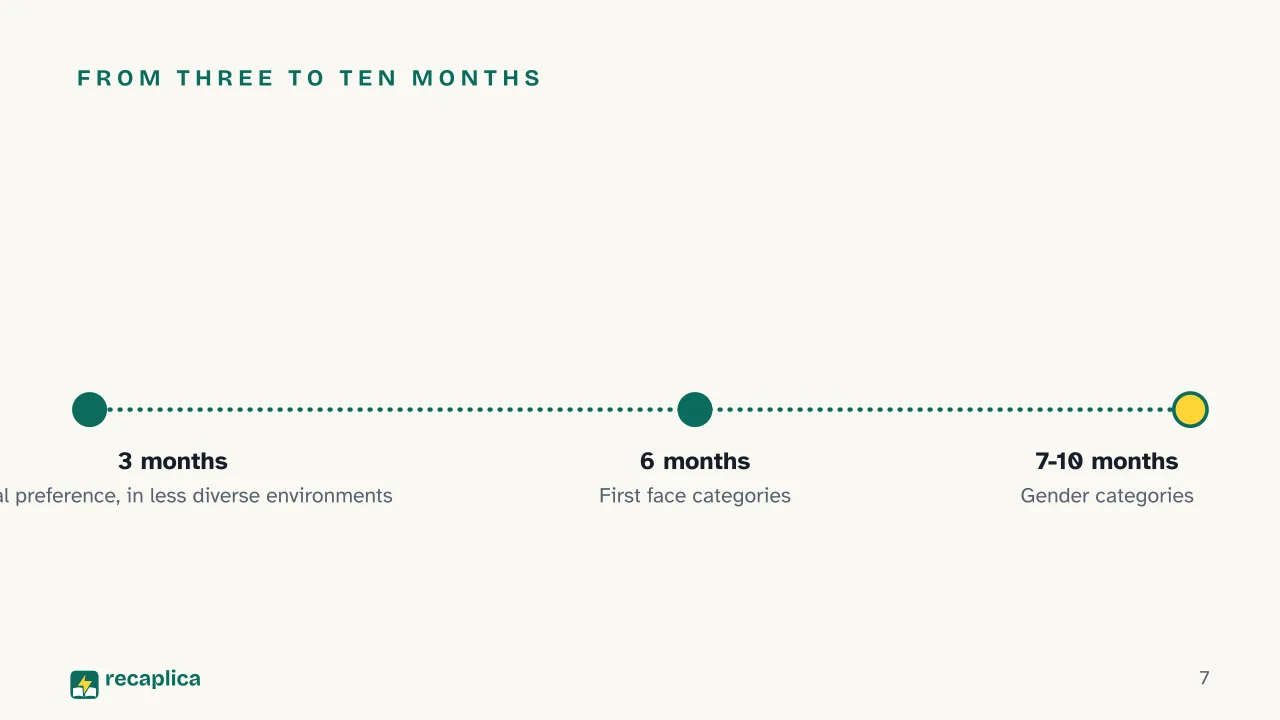
    • 3 months Age at which, in the 2006 study of infants in Israel and Ethiopia cited by Rhodes and Baron's review, infants observed looked longer at faces from their own ethnic group, in visually homogeneous environments Source: Bar-Haim et al., 2006, cited in Rhodes & Baron, Annual Review of Developmental Psychology, 2019
    • 6 months Age at which, according to Rhodes and Baron's 2019 review, infants observed begin sorting faces into distinct categories Source: Rhodes & Baron, Annual Review of Developmental Psychology, 2019
    • 481 children Participants aged 5-10 in the 2026 study comparing a Rohingya refugee community with the Bangladeshi host community, in which a single virtual collaboration session did not change prejudice toward the other group Source: Corbit, MacIntosh & Muhammad, Developmental Science, 2026

    Deep Dive

    Prejudice and Stereotypes: Definition and a Few Examples

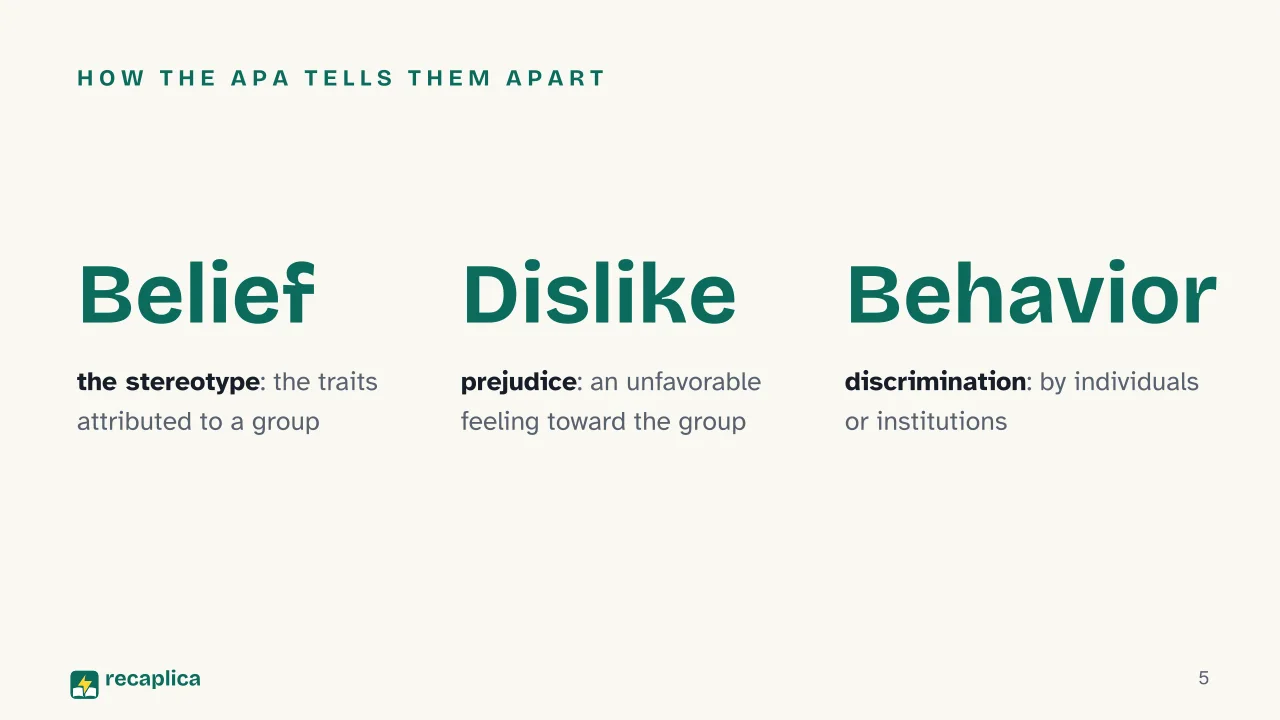
    A policy resolution from the American Psychological Association draws a clear line between the two terms. A stereotype is a generalized belief about the traits of a group; prejudice is an unfavorable emotional reaction toward that group. Discrimination is about behavior: differential treatment carried out by individuals, or policies and institutional settings that keep an inequality going over time.

    The APA notes that the shape these take shifts with the historical and social moment. Open, hostile forms of prejudice exist alongside more modern, automatic ones that are hard to spot in any single instance; some blend positive and negative feelings, such as a patronizing attitude or envy toward a group. They fall most often on groups with less social power, for instance by ethnicity or economic standing, and research cited by the APA measures a real cost in lower psychological wellbeing and changed behavior among the children who are their target.

    How They Form: Social Categorization

    A 2019 developmental psychology review by Marjorie Rhodes and Andrew Baron, published in Annual Review of Developmental Psychology, points to social categorization as the shared mechanism behind both stereotypes and prejudice, a topic close to psychological science more broadly. It is a universal process: it helps children, and later adults, make sense of an otherwise overwhelming social world by grouping people according to shared traits. In adults this sorting happens on its own and shapes how we think and act. Rhodes and Baron argue that the very ability that lets people navigate the social world is also the ground on which stereotypes, prejudice and discrimination can grow.

    Infants start sorting faces into distinct categories around six months of age, according to the same review. Categorizing by gender comes a little later, between seven and ten months.

    The ability to tell apart faces of different races also depends on the environment a child grows up in. A 2006 study of three-month-old infants in Israel and Ethiopia, cited by Rhodes and Baron, found that babies raised in a visually homogeneous racial environment looked longer at faces from their own ethnic background, while infants exposed to both white and Black faces showed no such preference. The belief that race is an objective way to divide people develops later, between seven and ten years of age, and its strength varies with the diversity of the community a child grows up in and with their parents’ political views.

    The Minimal Group and the Weight of Belonging

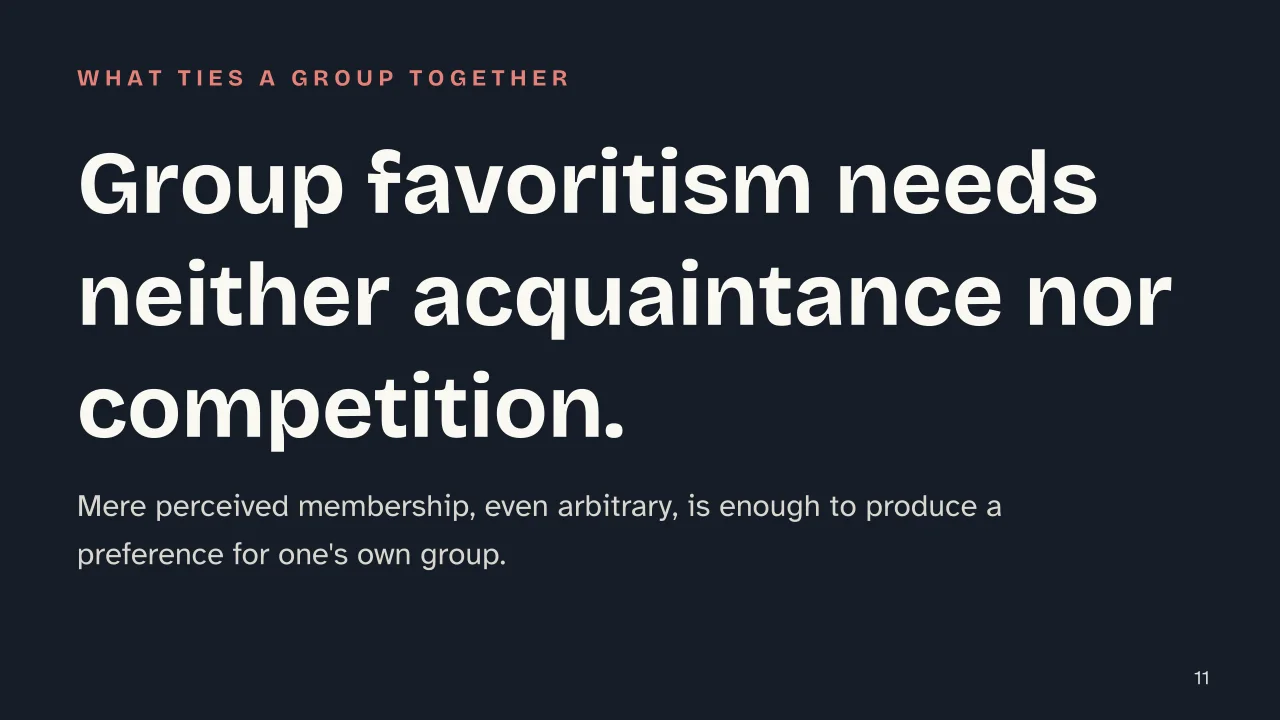
    In the 1970s, psychologist Henri Tajfel and his colleagues proposed social identity theory: people identify with members of their own group, and that self-identification feeds back into social categorization. One of the most cited findings from the research tradition that followed, the minimal group paradigm, is that favoritism toward one’s own group appears even when the similarity between people is minimal and entirely arbitrary, with no competition or cooperation involved. Simply perceiving oneself as a member is enough; there is no need to know anything about the other members or ever expect to meet them.

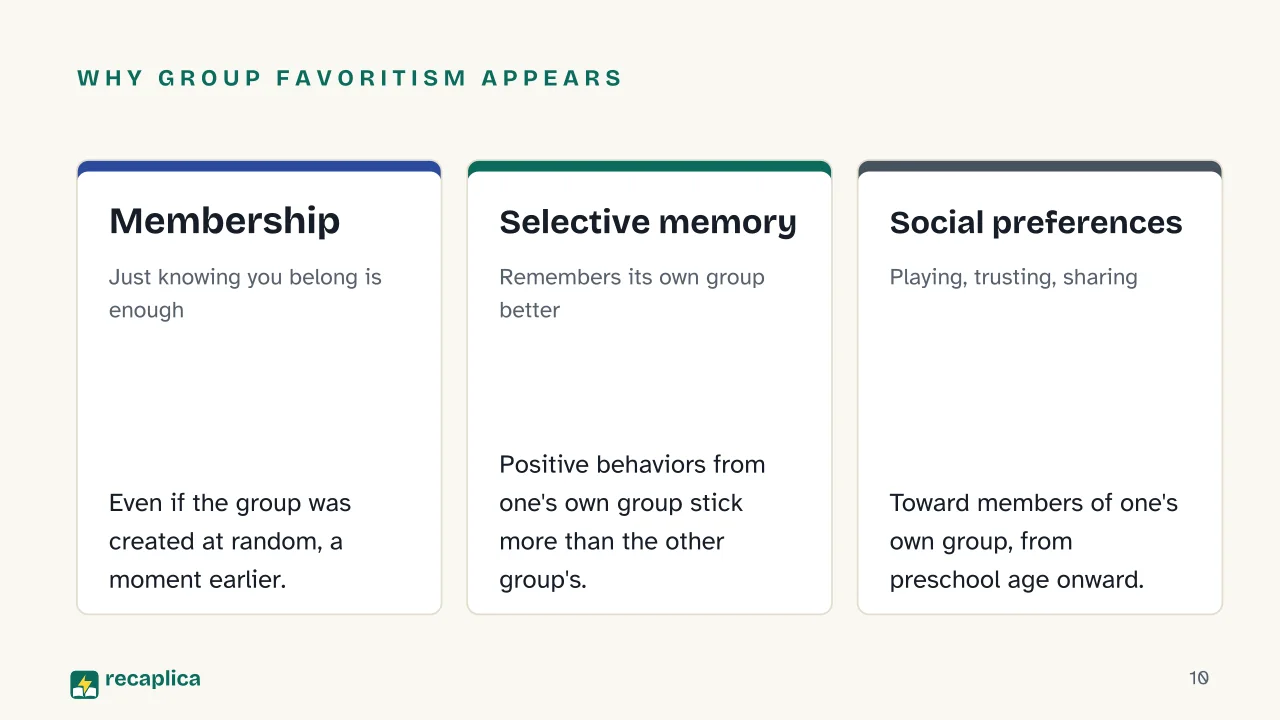
    This favoritism shows up readily in preschool and early school-age children: being randomly assigned to a group is enough to make a child want to play with its members and trust them more. The same preference also leads to sharing more with them and, overall, rating them more favorably. Identifying with one’s own group also leads children to remember its positive behaviors and the other group’s negative ones more selectively, reinforcing over time a more favorable view of whoever counts as part of the same group. Kurt Lewin’s work on group dynamics starts from a related question, what holds the members of a group together. With stereotypes, the bond comes from perceived belonging itself, even when there is no real similarity behind it.

    How They Spread: The Language Adults Use

    Stereotypes pass from one generation to the next even without a single explicit lesson.

    Practical example: an adult might simply say, in a neutral tone, “girls do this”: a generic sentence, said with no teaching intent at all, that is still enough to plant in a child’s mind the idea that the category holds deep similarities among its members.

    It is the same principle behind Albert Bandura’s social learning theory: people pick up behaviors and ideas by watching others, not only by being taught directly. Sorting people into categories, for that matter, is one of the processes that cognitivism treats as active information processing.

    Intergroup Contact Reduces Prejudice, Under Certain Conditions

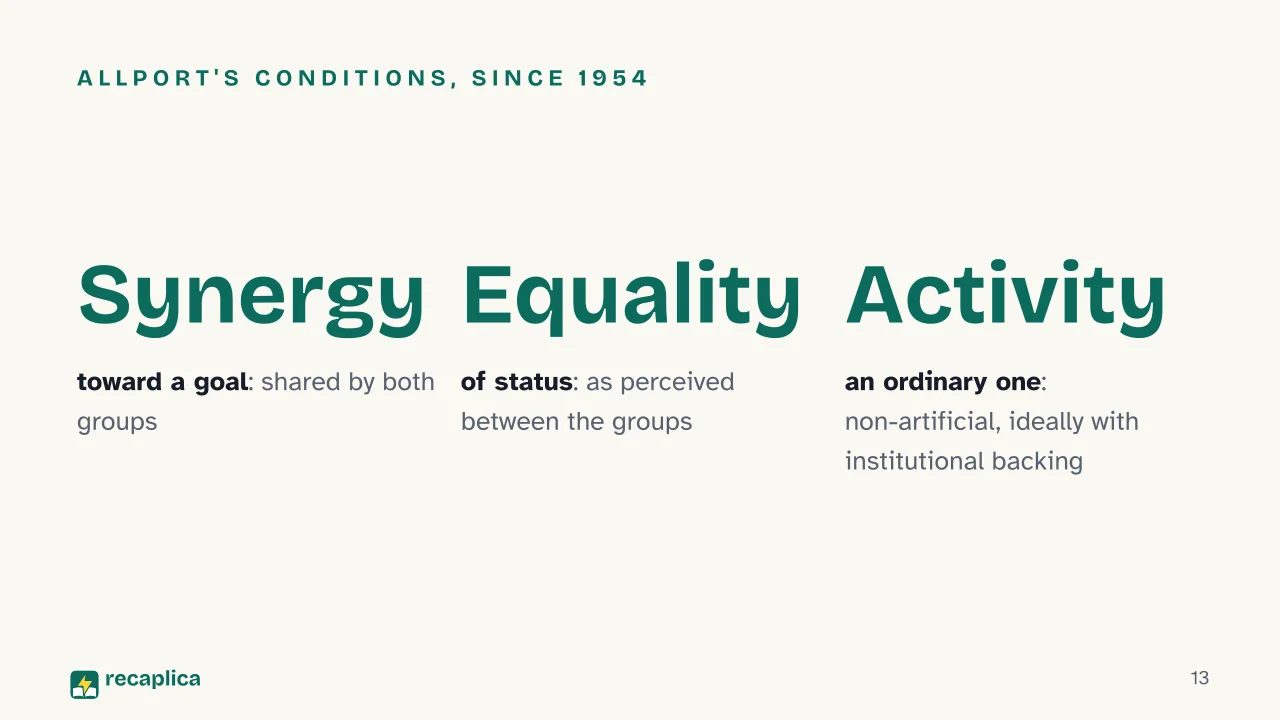
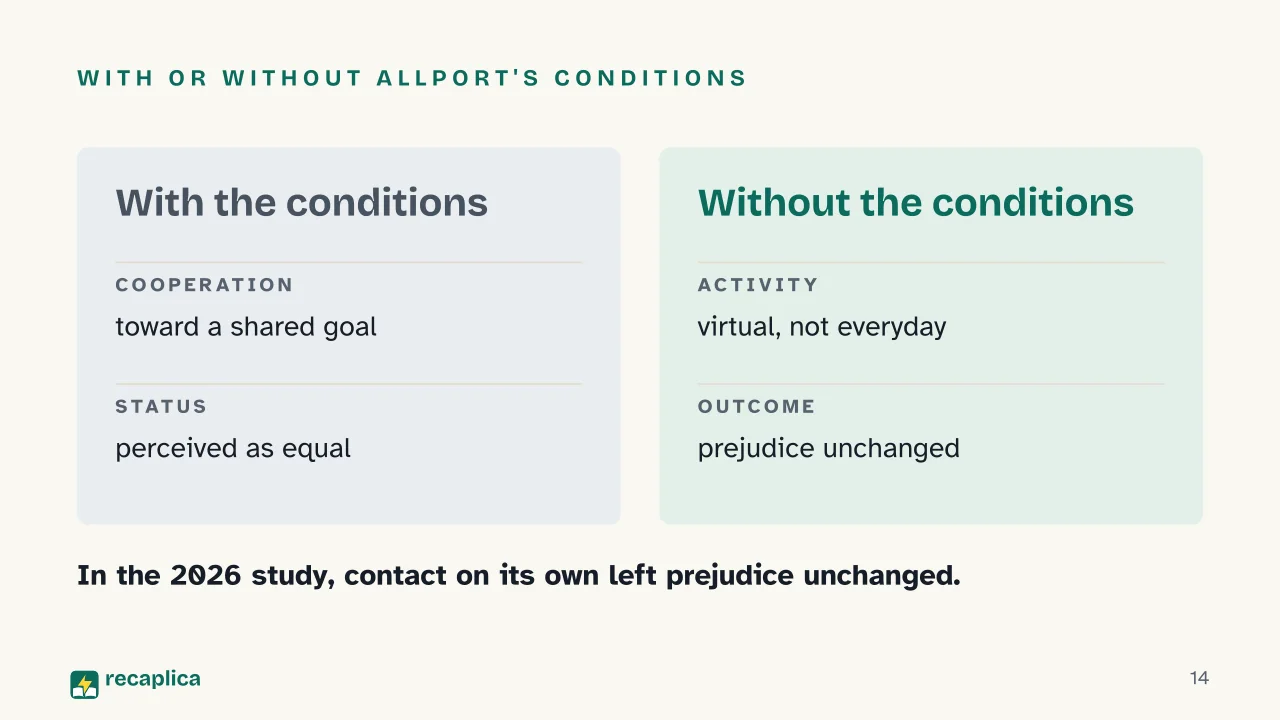
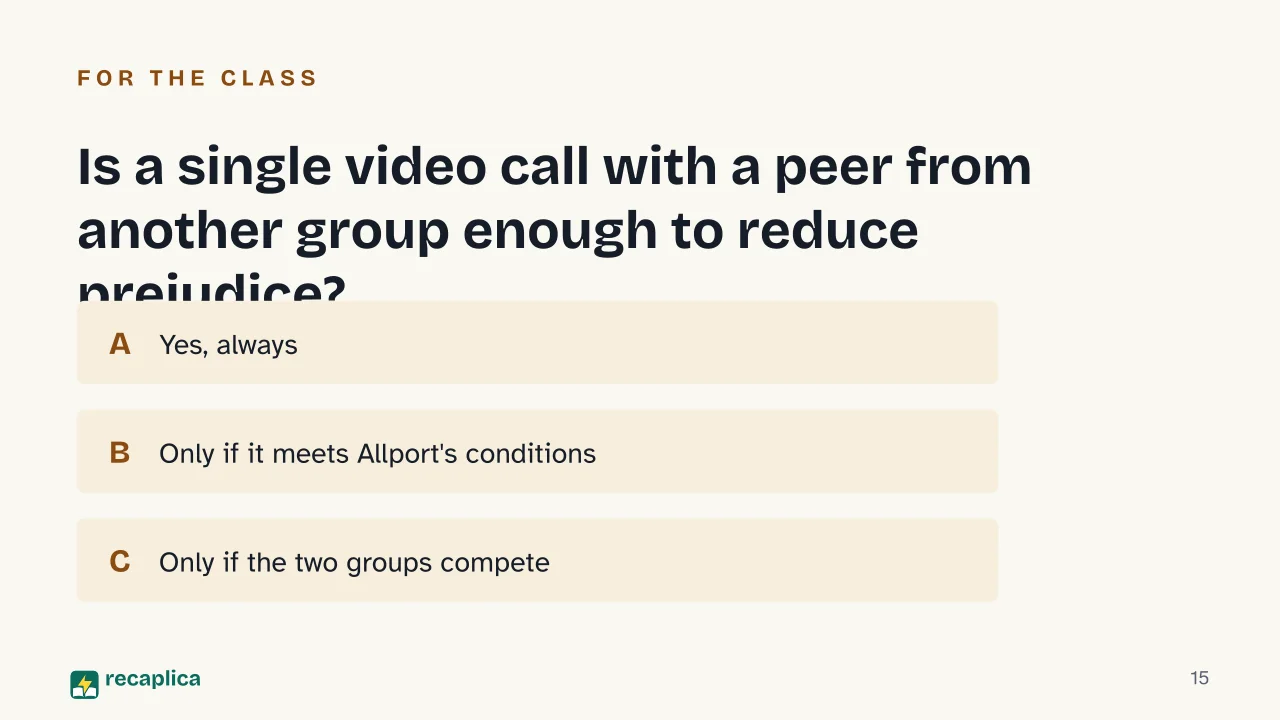
    Psychologist Gordon Allport proposed in 1954 that contact between different groups can reduce prejudice when it meets specific conditions: cooperation toward a shared goal, a perceived equality of status between the groups, an ordinary and non-artificial setting, and ideally the backing of the community’s institutions. The APA reports that taking part in demographically mixed settings has the potential to lower prejudice toward members of an outgroup.

    A 2026 study in Developmental Science shows that bringing two groups together, on its own, can leave mutual prejudice unchanged. The researchers worked with 481 children aged 5 to 10, from Rohingya refugee communities and from the Bangladeshi community hosting them: both groups showed strong favoritism toward their own group, more pronounced among the host-community children and increasing with age within this range. A single virtual collaboration session with a peer from the other group left this prejudice unchanged across every measure used. The authors themselves link the result to two of Allport’s conditions their experiment did not meet, including an ordinary, non-artificial setting, one possible reason why contact on its own fell short here.

    Slide deck

    Slides ready to download and make your own in PowerPoint or Google Slides, with speaker notes. Pick the Flash cut or the Full one.
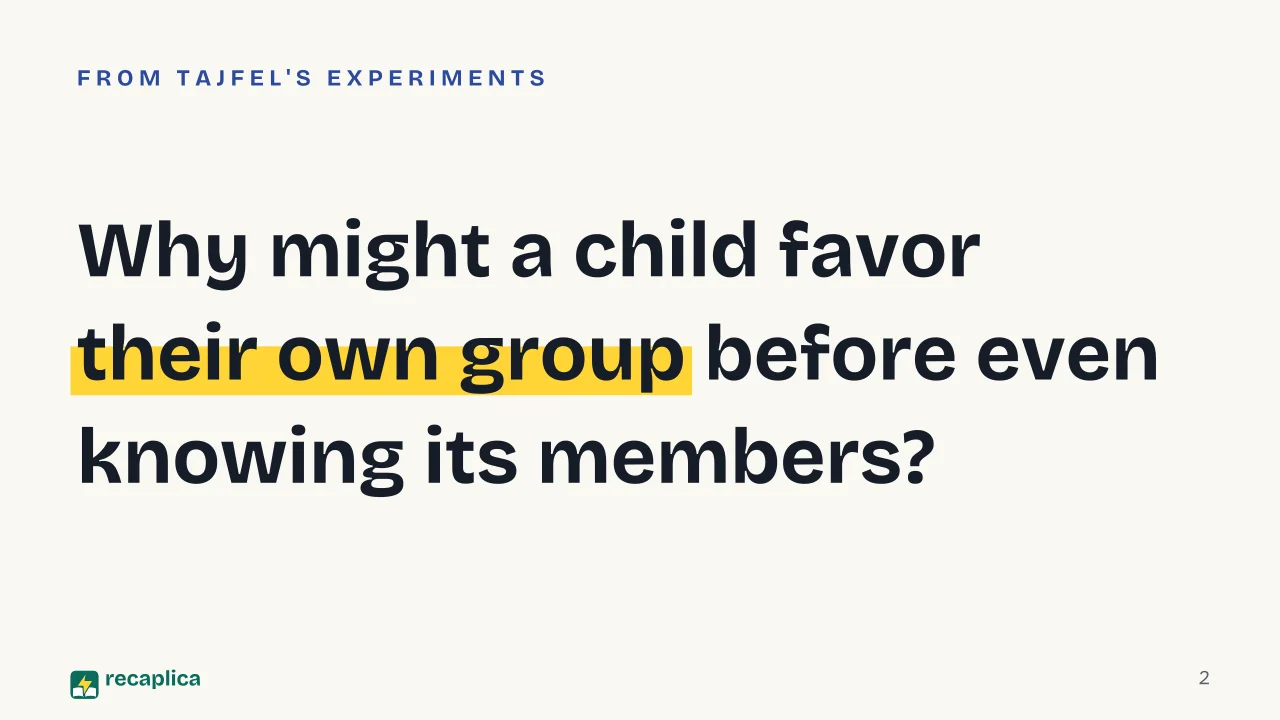
    Slide 1 of the presentation on Prejudice: Prejudice and StereotypesSlide 2 of the presentation on Prejudice: Why might a child favor their own group before even knowing its members?Slide 3 of the presentation on Prejudice: In this RecapSlide 4 of the presentation on Prejudice: Chapter 01: Stereotype and PrejudiceSlide 5 of the presentation on Prejudice: How the APA tells them apartSlide 6 of the presentation on Prejudice: Chapter 02: How They Form in ChildhoodSlide 7 of the presentation on Prejudice: From three to ten monthsSlide 8 of the presentation on Prejudice: Does a child need to be taught to pick up a stereotype?Slide 9 of the presentation on Prejudice: Chapter 03: The Weight of BelongingSlide 10 of the presentation on Prejudice: Why group favoritism appears: Membership, Selective memory, Social preferencesSlide 11 of the presentation on Prejudice: Group favoritism needs neither acquaintance nor competition.Slide 12 of the presentation on Prejudice: Chapter 04: Contact Between GroupsSlide 13 of the presentation on Prejudice: Allport's conditions, since 1954Slide 14 of the presentation on Prejudice: With or without Allport's conditionsSlide 15 of the presentation on Prejudice: Is a single video call with a peer from another group enough to reduce prejudice?Slide 16 of the presentation on Prejudice: Learn more
    Flash10 slidesThe essential thread, to present in classFull16 slidesEvery chapter and the deeper detail

    Common myths

    • ✗ Myth Many people think that simply bringing two different groups together is enough to lower mutual prejudice.

      ✓ Reality Contact reduces prejudice only under specific conditions, according to Gordon Allport: cooperation, equal status, ordinary activities and institutional backing. A 2026 study confirms this: when children fleeing as Rohingya refugees met children from the Bangladeshi community hosting them, one virtual session without those conditions left their mutual prejudice exactly where it started.

    • ✗ Myth There is a common belief that children only learn prejudice if an adult explicitly teaches it to them.

      ✓ Reality A 2019 developmental psychology review found that even a generic sentence an adult says about a category, far from any explicit lesson, strengthens in children who hear it the idea that the category reflects deep similarities among its members.

    • ✗ Myth Favoring one's own group is often assumed to require first knowing its members or competing with the other group.

      ✓ Reality Experiments on Tajfel's minimal group paradigm show that mere perceived membership is enough, even when arbitrary: favoritism appears regardless of any competition, cooperation or mutual acquaintance between the two groups' members.

    Mind map

    Drag the background to move around and the nodes to reposition them; use − and + to collapse and expand branches.
    Customize
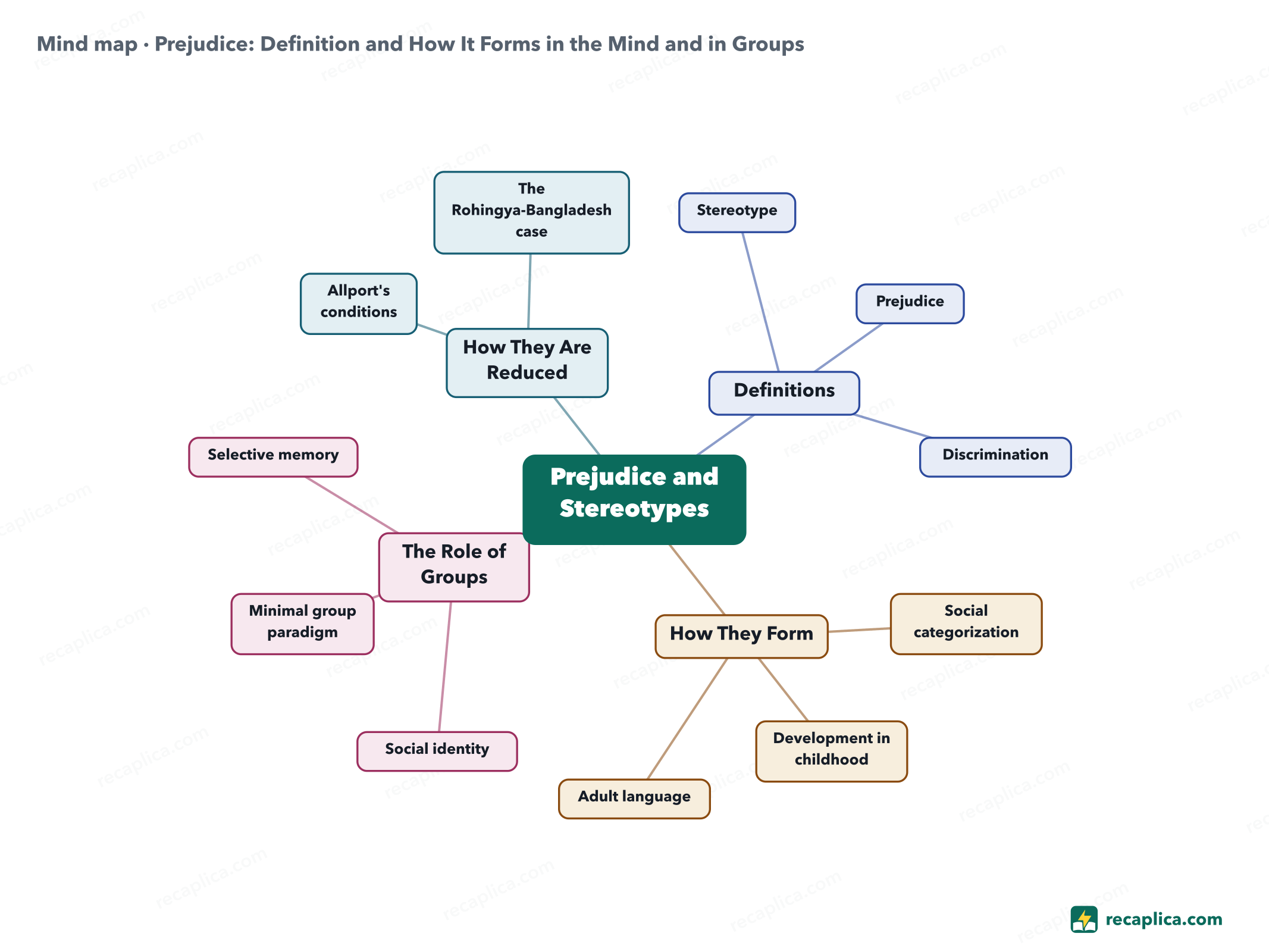
    Mind map: Prejudice: Definition and How It Forms in the Mind and in Groups
    • Prejudice and Stereotypes
      • Definitions
        • Stereotype A generalized belief about a group's traits
        • Prejudice An unfavorable emotional reaction toward a group
        • Discrimination Differential treatment, by individuals or institutions
      • How They Form
        • Social categorization Mechanism that simplifies the social world
        • Development in childhood From three months onward, according to the 2019 review
        • Adult language A channel of transmission even without explicit teaching
      • The Role of Groups
        • Social identity Identifying with one's own group feeds categorization
        • Minimal group paradigm Favoritism arises even from arbitrary memberships
        • Selective memory Favoring one's own group, against the outgroup
      • How They Are Reduced
        • Allport's conditions Cooperation, equal status, non-artificial activities
        • The Rohingya-Bangladesh case 2026 study on contact without those conditions

    Quiz: test yourself

    Answer the questions to check what you have learned: you get instant feedback and a short explanation.

    Grade 0/10 0/5
    1 How does the APA distinguish stereotype from prejudice?

    For the APA, a stereotype is a shared belief about a group, prejudice is the unfavorable feeling that can go with it; discrimination is the behavior that may follow.

    2 According to the Rhodes and Baron review, around what age do infants start sorting faces into distinct categories?

    The 2019 review places this shift around six months of age; categorizing by gender arrives between seven and ten months.

    3 What does Tajfel's minimal group paradigm show?

    In minimal group paradigm experiments, favoritism appears with a purely arbitrary group assignment, with no competition or cooperation involved.

    4 True or false: according to the 2019 review, children only learn stereotypes if an adult explicitly teaches them.

    According to this 2019 review, even generic language an adult uses to describe a category can be enough to pass on a stereotype.

    5 According to psychologist Gordon Allport, when does contact between groups reduce prejudice?

    Allport proposed in 1954 that contact works only when it meets specific conditions; a 2026 study shows what happens when they are missing.

    Answers: 1-A · 2-A · 3-A · 4-B · 5-A

    Flashcards

    Tap the card to flip it and check whether you remember the answer, then move to the next one.

    1 / 7

    Explain it in your own words

    The ultimate test: if you can explain it in simple words, you've truly understood it. Write your explanation, then compare it with the Recap.

    Your explanation is saved only on this device.

    Psychologists draw a line between two related ideas: a shared belief about what a group is like, called a stereotype, and the unfavorable feeling someone may hold toward that group, called prejudice. Both grow out of a mechanism the brain uses from infancy, social categorization, which simplifies a complex social world and can, at the same time, produce favoritism toward one's own group within the first years of life. A 2019 developmental psychology review found that random assignment to a group is enough to build a preference for its members. The way adults talk, even without any explicit lesson, teaches children that a category holds deep similarities among its members. Simply putting two different groups together can leave mutual prejudice unchanged on its own: a 2026 experiment in Bangladesh, with children from a refugee community and children from the host community, shows it.

    Frequently asked questions

    What is the definition of prejudice, and how does it differ from a stereotype?

    Prejudice is an unfavorable emotional reaction toward a group; a stereotype is a generalized belief about that group's traits. It is the distinction the American Psychological Association proposes: discrimination covers the behavior that may follow from either.

    What are some examples of stereotypes?

    One example studied in child development research is the idea that a category such as gender holds deep similarities among its members: hearing an adult make generic statements about that category is enough to strengthen this belief in children. The APA documents prejudice and discrimination most often toward groups defined by ethnicity, race, age, disability, sexual orientation, religion or migration status.

    At what age do stereotypes start to form?

    Within the first months of life. A 2006 study found a visual preference for faces from one's own ethnic background starting around three months in children raised in visually homogeneous environments. By six months infants already group faces into categories, and between seven and ten months they categorize people by gender.

    Is it enough to bring people from different groups together to reduce prejudice?

    Contact reduces prejudice only when it meets specific conditions, according to psychologist Gordon Allport: cooperation toward a shared goal, perceived equal status, and ordinary non-artificial activities. A 2026 experiment put Rohingya refugee children together, online, with peers from the Bangladeshi community that hosts them: without those conditions, a single session produced no change in either side's prejudice.

    What is Tajfel's minimal group paradigm?

    A research tradition showing that belonging to a group, even one created on the spot and with no real meaning, is enough on its own to produce favoritism toward its members.

    Sources

    • APA, Resolution on Prejudice, Stereotypes, and Discrimination
    • Rhodes & Baron, The Development of Social Categorization, Annual Review of Developmental Psychology, 2019
    • Corbit, MacIntosh & Muhammad, Intergroup collaboration and in-group bias in Rohingya refugee and Bangladeshi children, Developmental Science, 2026

    Every Recap goes through an independent review before publication.

    Every evening, the day's new Recaps on our Telegram channel. Join the channel →

    Keep learning

    • Science Correlation: What It Means and How to Read the Coefficient Correlation measures how closely two variables move together, and the most common way to put a number on it is the correlation coefficient, which runs from -1 to +1. A value near +1 means the two variables rise together, near -1 means one rises while the other falls, and near 0 means no linear relationship stands out. The coefficient only captures the strength of a straight-line relationship, and a single unusual data point can push it up or down by a lot. Even when it's strong, a correlation between two variables never shows that one causes the other. Read the Recap →
    • Science Light Refraction: What It Is, the Laws Behind It, and Examples A surface that separates two transparent materials sends some light back, reflecting it, and lets the rest through while bending it toward a new direction. The law of reflection keeps the incoming and outgoing angles equal, both measured from the normal to the surface. Snell's law governs refraction instead, linking the index of each material to how much the ray tilts before and after it crosses over. These two laws alone explain mirrors, lenses, prisms and everyday sights such as a pencil that appears to snap inside a glass of water. Read the Recap →
    • Science Total Internal Reflection and the Critical Angle: Definition and Formula Total internal reflection is what happens when a light ray stops being able to leave a transparent medium and gets sent back inside it completely. It takes place past a specific angle of incidence, called the critical angle, calculated with Snell's law by comparing the refractive indices of the two materials involved. It only happens under one precise condition: the ray must be traveling from an optically denser medium into a less dense one, such as from water into air or from glass into air. Optical fibers and, in part, the sparkle of diamonds rely on this same principle. Read the Recap →

    recaplica

    Clear in 30 seconds, yours in 10 minutes.

    Recaps Mind maps Request a Recap Telegram channel Mind map maker Our method About Privacy & cookies Legal notes & terms of use

    © 2026 Recaplica · A project by Curi S.r.l. — VAT IT05472000750

    Statistics, only if you say so

    To learn which Recaps help most we would use Google Analytics, with aggregate, anonymous data. It starts only with your OK, and you can change your mind anytime. Privacy policy