Skip to content
recaplica

    One moment: security check

    Cloudflare wants to make sure you're not a robot. Tick the box below and your search will continue on its own.

    IT
    recaplica Bandura's Social Learning Theory: Observation and Self-Efficacy
    © 2026 Recaplica · recaplica.com — All rights reserved
    Home › Science

    Bandura's Social Learning Theory: Observation and Self-Efficacy

    By Recaplica Newsroom · Updated on September 27, 2026

    What to print

    Page numbers appear when printing with default margins.

    Slides

    Choose a cut

    Flash10 slidesThe essential thread, to present in classFull16 slidesEvery chapter and the deeper detail

    Both come with speaker notes.

    Telegram channel
    recaplica Clear in 30 seconds, yours in 10 minutes.
    In 30 seconds Key points Figures Deep dive Slides Myths Mind map Quiz Flashcards FAQ

    In 30 seconds quick read

    Albert Bandura's social learning theory describes how people acquire behaviors, attitudes and emotional reactions by observing and imitating others in a social context, not only through direct reinforcement. Bandura set it out in a 1977 book, putting the observer's active role at the center of whether a behavior gets imitated. Modeling runs through four processes, attention, retention, motor reproduction and motivation, and the 1961 Bobo doll experiment showed that children imitate an observed adult's aggression. In 1986 Bandura renamed the theory "social cognitive theory", adding self-efficacy and reciprocal determinism between person, behavior and environment.

    Key Points

    • The theory separates learning by observation from the direct reinforcement at the center of Skinner's behaviorism.
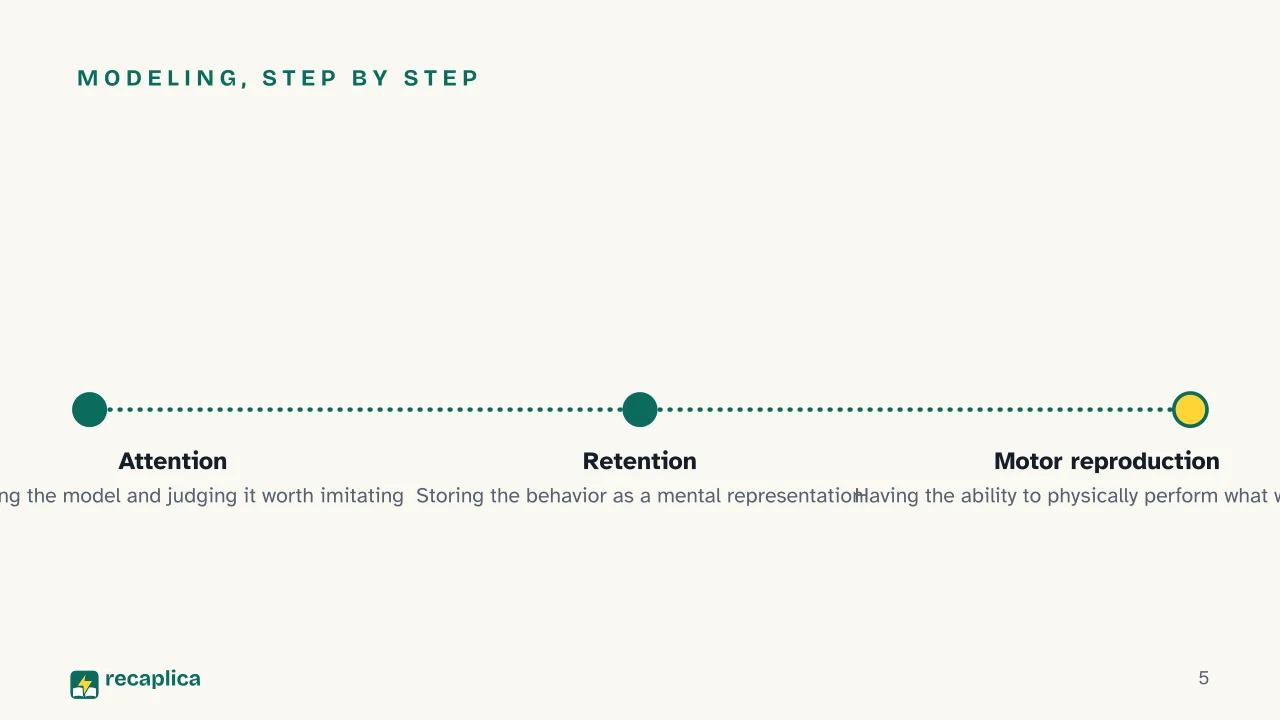
    • Modeling runs through four processes in sequence, attention, retention, motor reproduction, motivation.
    • In the Bobo doll experiment (1961), 72 children from the Stanford University Nursery School who watched an aggressive adult imitated more aggression than the other two groups.
    • Self-efficacy is confidence in succeeding at a specific task, not general self-esteem.
    • In 1986 Bandura renamed the theory social cognitive theory, adding self-efficacy and reciprocal determinism.
    • Constructivism, built by Piaget and Vygotsky, is another theory that moves away from classic behaviorism, starting from a different point than Bandura's.

    Key figures

    • 1961 Year of the Bobo doll experiment, run by Bandura on 72 children aged 3 to 6 at the Stanford University Nursery School. Source: Simply Psychology, Bandura's Bobo Doll Experiment
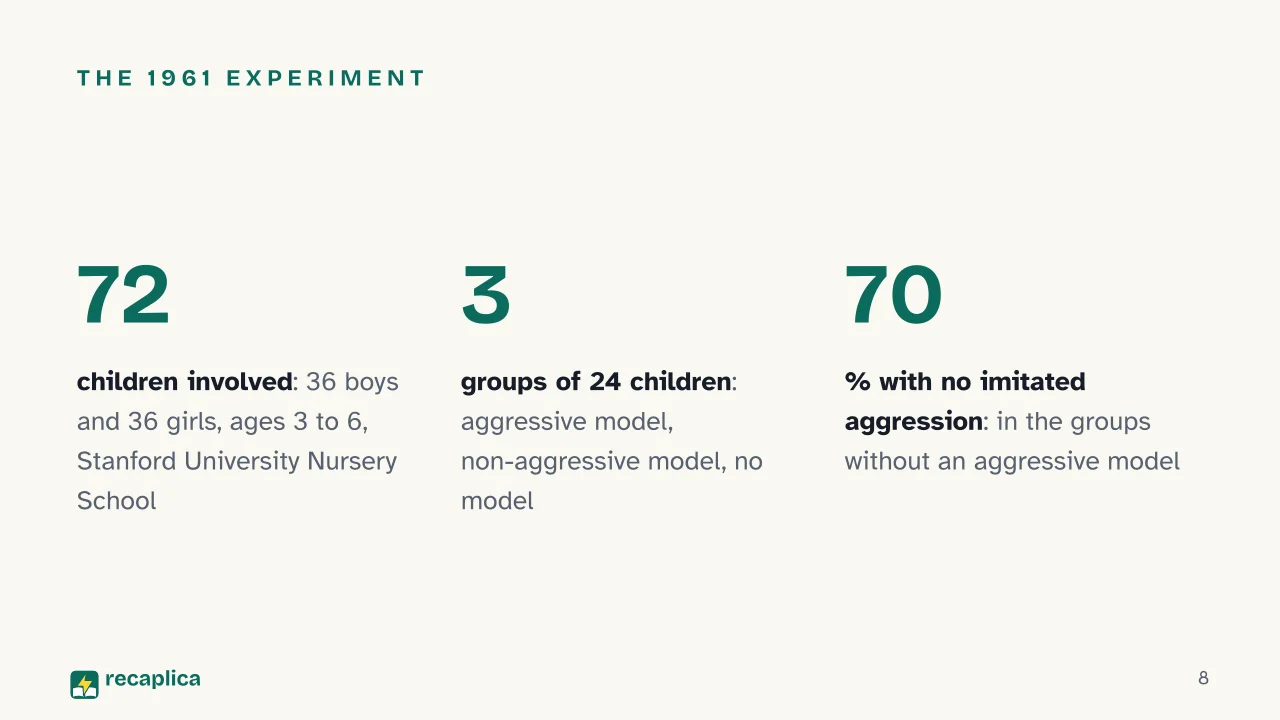
    • 72 Children in the experiment (36 boys and 36 girls), split into three groups of 24: aggressive model, non-aggressive model, no model. Source: Simply Psychology, Bandura's Bobo Doll Experiment
    • 1986 Year Bandura renamed the theory social cognitive theory, adding self-efficacy and reciprocal determinism. Source: Simply Psychology / Frontiers in Psychology

    Deep Dive

    What Bandura’s social learning theory is

    Albert Bandura published Social Learning Theory in 1977, arguing a different point than the behaviorism that had dominated the psychology of learning until then: people acquire new behaviors, attitudes and emotional reactions by observing and imitating others in a social context, not only through direct reinforcement of their own actions. A child can learn to brush their teeth by watching a parent do it, without ever having received a reward for that specific act.

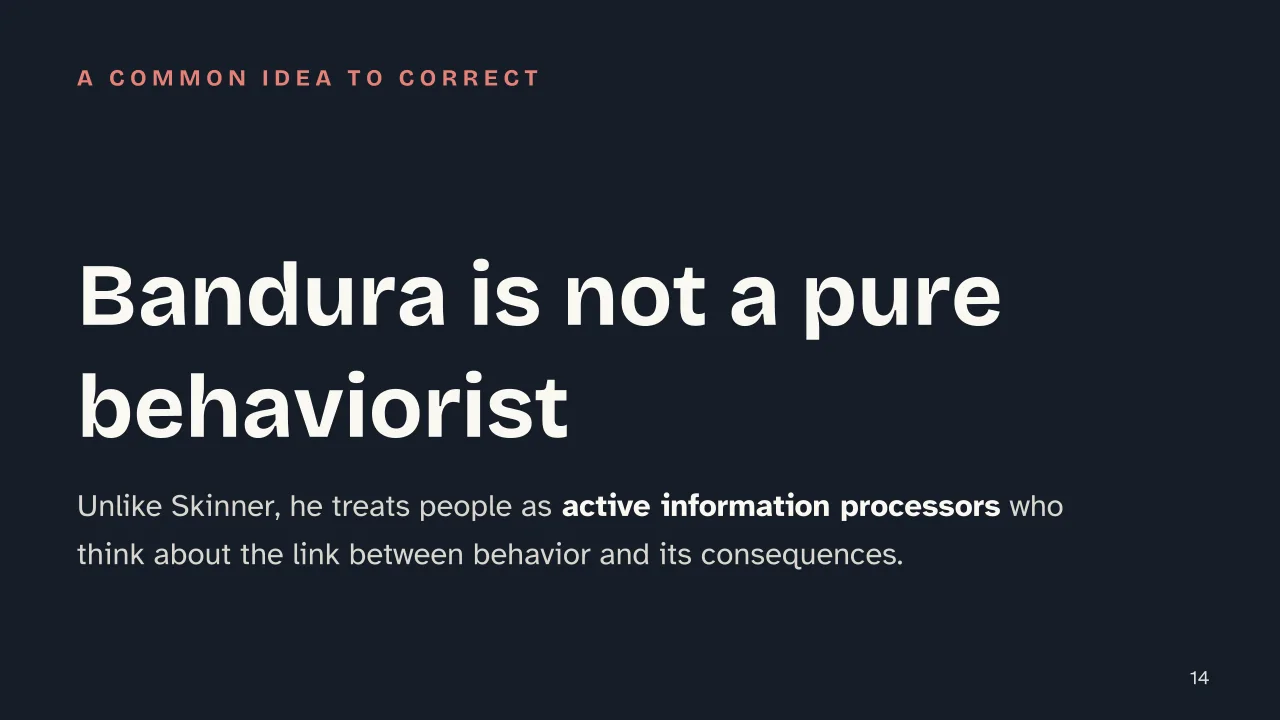
    Unlike pure behaviorism, which focuses only on the link between stimulus and response (see our Recap on behaviorism), Bandura introduces mediational processes that sit between seeing a behavior and deciding whether to reproduce it. He treats people as active information processors who think about the relationship between their own behavior and its consequences, an idea that brings his theory close to cognitivism, the school that views the mind as a system that processes information.

    The four processes of modeling

    Modeling, learning by imitating an observed model, runs through four processes. Each one is necessary for imitation to happen: according to Bandura, if even one is missing, the observer does not reproduce the observed behavior, even if it was clearly perceived.

    Attention is the first condition: simply being exposed to a model is not enough, the observer must notice it and judge its behavior worth imitating. Retention follows, the process by which the observer stores the behavior as a mental representation, organized into a form that is easy to recall later; it is memory work that draws on how much the mind can hold active at a given moment, the same territory covered by cognitive load applied to studying.

    The third process is motor reproduction, the physical and mental ability to actually perform the observed, stored behavior: someone can have noticed and remembered a double somersault without having the trained body to pull it off. The last process is motivation, the reason to act: the observer weighs the rewards and punishments seen happening to the model, and if the perceived benefits outweigh the costs, imitation becomes more likely.

    Practical example: a student sees a classmate praised by the teacher for asking a question during a lesson. She receives no direct reinforcement herself, but notices the episode (attention), remembers it (retention), already knows how to raise a hand and phrase a question (motor reproduction), and the following week, judging that the risk of getting it wrong is worth the possible praise, raises her hand too (motivation).

    The Bobo doll experiment

    In 1961 Bandura, together with D. Ross and S. A. Ross, ran the most cited study behind the theory: the Bobo doll experiment, conducted at the Stanford University Nursery School. It involved 72 children, 36 boys and 36 girls, aged 3 to 6, first assessed for their usual level of aggression by observing them at the nursery.

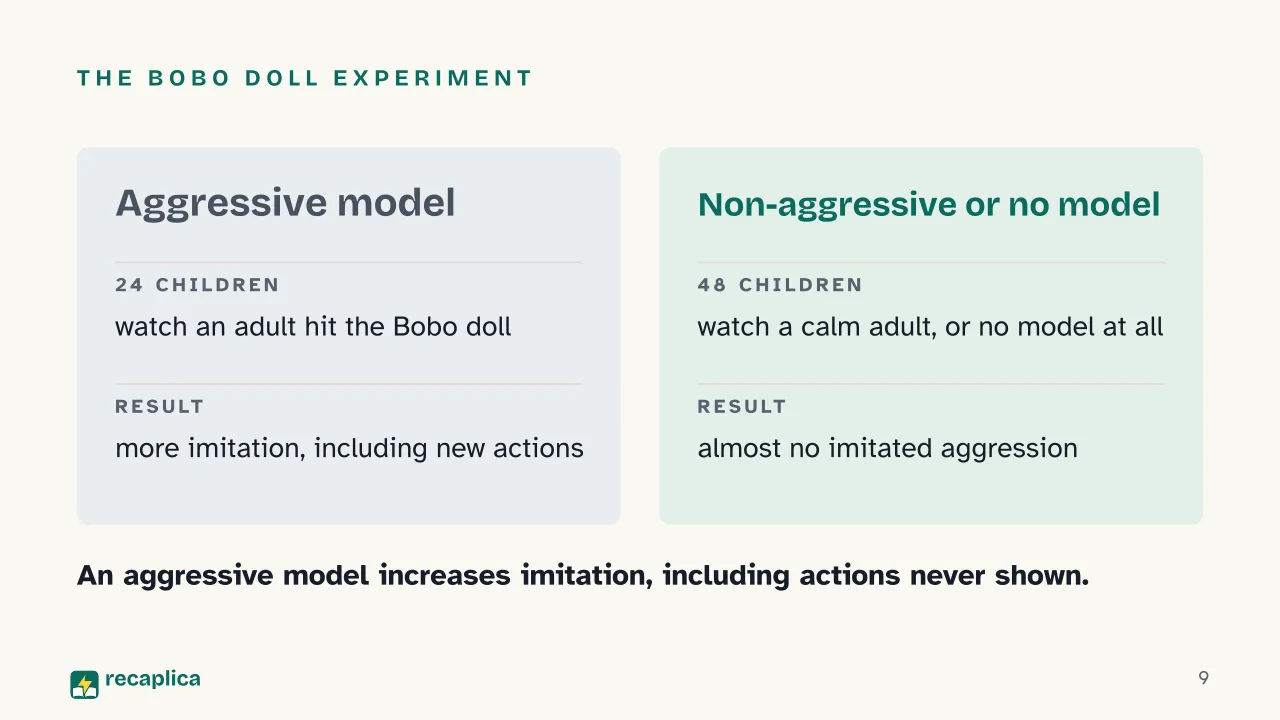
    The children were split into three groups of 24, in an independent-groups design: one group watched an adult behave aggressively toward a large inflatable doll, a second group watched a calm adult, a third group saw no model at all. After an observation session of about ten minutes, each child was left free to play for twenty minutes in a room with both aggressive and non-aggressive toys.

    Children who had watched the aggressive model imitated aggression, both physical and verbal, significantly more than the other two groups; exposure to the model did not just produce a copy of the gestures seen, it increased overall aggression, including new actions the model had never shown. In the non-aggressive and control groups, about 70% of children showed no imitative aggression at all. The source also flags the study’s limits: all 72 children came from a single Stanford nursery school, a mostly white and middle-class sample that limits how far the results generalize; and it notes that, conducted in 1961, the study predates modern ethics codes for research on minors.

    Self-efficacy

    At the center of Bandura’s theory is also self-efficacy, a person’s confidence in their own ability to organize and carry out the actions needed to succeed in a specific situation or complete a task. It is not a general judgment of oneself, like self-esteem, but an assessment tied to a precise area: the same person can have high self-efficacy in drawing and low self-efficacy in math.

    Bandura (1997) identifies four kinds of experience that build self-efficacy: successes already lived through in similar tasks, watching other people succeed at a task, encouragement and judgments received from those around us, and the physical and emotional state a person brings to a situation, for example the anxiety felt before an exam.

    From 1977 to 1986, from social learning theory to social cognitive theory

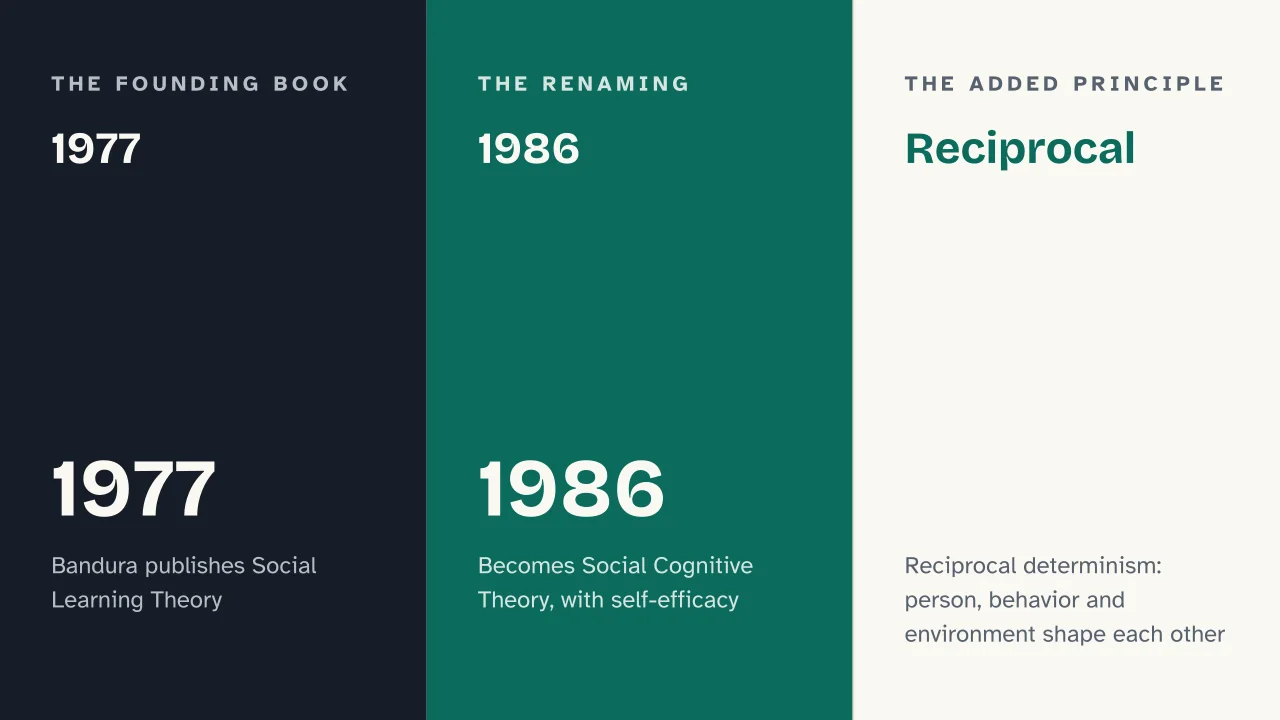
    In 1986 Bandura renamed his theory “social cognitive theory”: both Simply Psychology and an editorial in the peer-reviewed journal Frontiers in Psychology confirm it, describing how Bandura, with the Bobo doll experiment, defined the construct of self-efficacy and proposed an agentic theory of human behavior that challenges the central tenets of behaviorism.

    With the renaming, Bandura adds reciprocal determinism, the principle that personal factors (thoughts, emotions, motivations), an individual’s behavior, and the environment shape each other in a continuous, bidirectional cycle, instead of running in one direction from environment to person, as in classic behaviorism.

    What sets Bandura apart from behaviorism and constructivism

    The fixed point shared by the more specialized sources is this: while Skinner’s behaviorism looks only at the link between stimulus, response and reinforcement, Bandura’s theory introduces observation and mental processing as steps that sit in between, before a behavior is imitated or not.

    Social learning theory is not the only one to move away from classic behaviorism. Constructivism, with Piaget and Vygotsky, also describes learning as an active process, in which the learner builds their own knowledge starting from what they already know, instead of simply receiving a stimulus from outside. The sources consulted for this Recap do not directly compare Bandura and the constructivist theorists: they remain two distinct theories, each with its own starting point, united by stepping away from pure behaviorism.

    Slide deck

    Slides ready to download and make your own in PowerPoint or Google Slides, with speaker notes. Pick the Flash cut or the Full one.
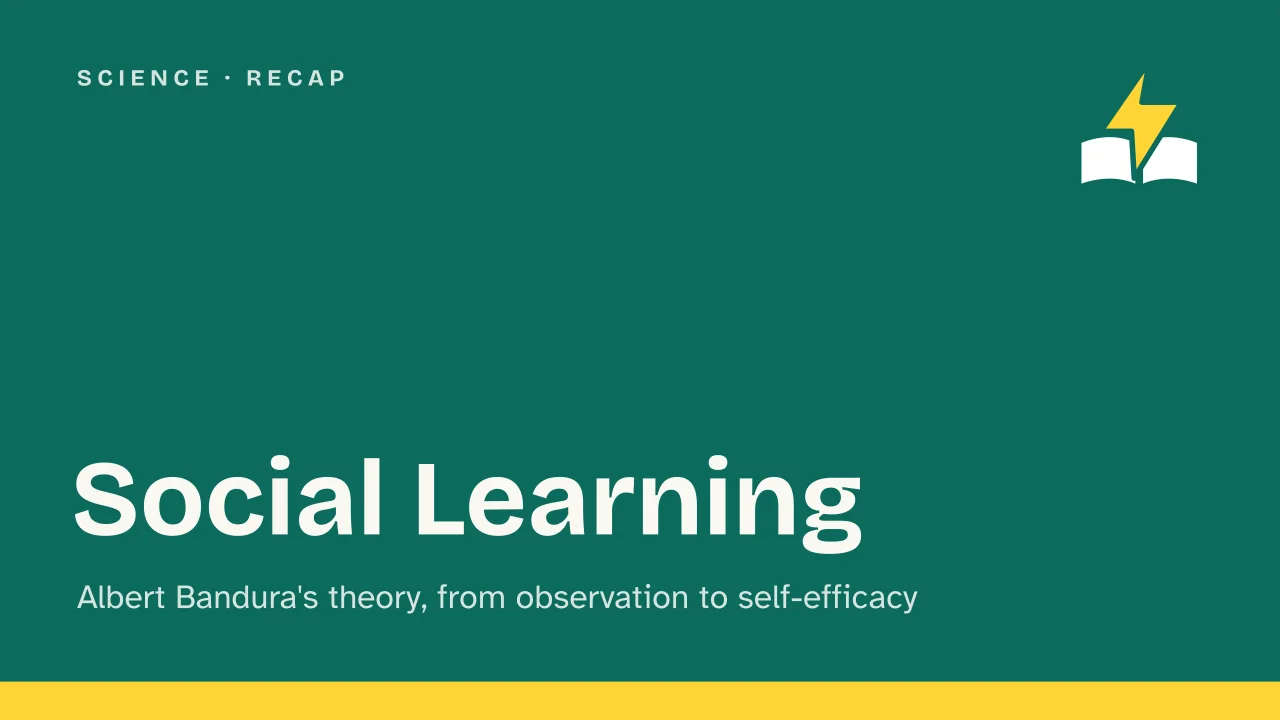
    Slide 1 of the presentation on Bandura's Social Learning Theory: Social LearningSlide 2 of the presentation on Bandura's Social Learning Theory: Why do we learn so much just by watching others?Slide 3 of the presentation on Bandura's Social Learning Theory: In this presentationSlide 4 of the presentation on Bandura's Social Learning Theory: Chapter 01: The four processesSlide 5 of the presentation on Bandura's Social Learning Theory: Modeling, step by stepSlide 6 of the presentation on Bandura's Social Learning Theory: Is noticing and remembering enough to decide to imitate?Slide 7 of the presentation on Bandura's Social Learning Theory: Chapter 02: The Bobo dollSlide 8 of the presentation on Bandura's Social Learning Theory: The 1961 experimentSlide 9 of the presentation on Bandura's Social Learning Theory: The Bobo doll experimentSlide 10 of the presentation on Bandura's Social Learning Theory: Chapter 03: Self-efficacySlide 11 of the presentation on Bandura's Social Learning Theory: How much does believing you can succeed at one task matter?Slide 12 of the presentation on Bandura's Social Learning Theory: Chapter 04: From 1977 to 1986Slide 13 of the presentation on Bandura's Social Learning Theory: 1977 · 1986 · ReciprocalSlide 14 of the presentation on Bandura's Social Learning Theory: Bandura is not a pure behavioristSlide 15 of the presentation on Bandura's Social Learning Theory: What are the four modeling processes, in order?Slide 16 of the presentation on Bandura's Social Learning Theory: To learn more
    Flash10 slidesThe essential thread, to present in classFull16 slidesEvery chapter and the deeper detail

    Common myths

    • ✗ Myth Just watching a behavior is enough, on its own, to learn it.

      ✓ Reality All four modeling processes are needed, attention, retention, motor reproduction and motivation: according to Bandura (1977), if even one is missing, imitation does not happen, even when the behavior was clearly seen.

    • ✗ Myth Bandura is a behaviorist like Skinner, just with a different word for imitation.

      ✓ Reality Source 1 and the journal Frontiers in Psychology both describe Bandura as a break from behaviorism: he adds the four mediational processes, attention, retention, motor reproduction and motivation, that Skinner's stimulus-response model does not include.

    • ✗ Myth Self-efficacy is just another name for self-esteem.

      ✓ Reality It is confidence specific to succeeding at a particular task or situation, not a general judgment of one's own worth: a person can have high self-efficacy in math and low self-efficacy in gym class, at the same time.

    Mind map

    Drag the background to move around and the nodes to reposition them; use − and + to collapse and expand branches.
    Customize
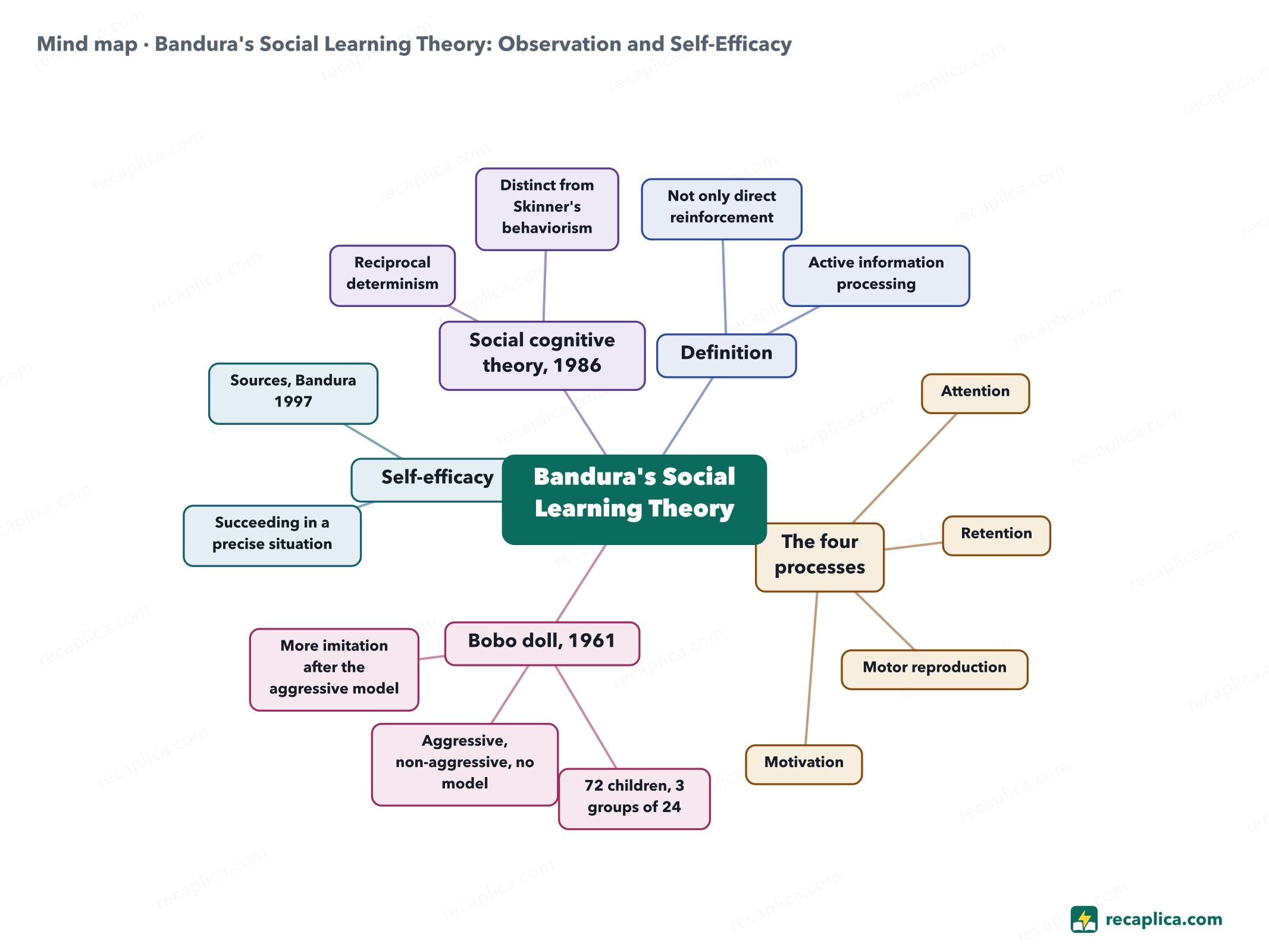
    Mind map: Bandura's Social Learning Theory: Observation and Self-Efficacy
    • Bandura's Social Learning Theory
      • Definition Observation and imitation in a social setting
        • Not only direct reinforcement Bandura, 1977
        • Active information processing The split from Skinner
      • The four processes Modeling, step by step
        • Attention Noticing and judging the model
        • Retention Storing the behavior in memory
        • Motor reproduction Being able to physically perform it
        • Motivation Weighing perceived rewards and punishments
      • Bobo doll, 1961 The experiment on imitated aggression
        • 72 children, 3 groups of 24
        • Aggressive, non-aggressive, no model
        • More imitation after the aggressive model
      • Self-efficacy Confidence in a specific task
        • Succeeding in a precise situation
        • Sources, Bandura 1997
      • Social cognitive theory, 1986 The theory's evolution
        • Reciprocal determinism Person, behavior, environment
        • Distinct from Skinner's behaviorism

    Quiz: test yourself

    Answer the questions to check what you have learned: you get instant feedback and a short explanation.

    Grade 0/10 0/5
    1 According to Bandura (1977), what sets his theory apart from Skinner's behaviorism?

    Source 1 states it explicitly: these are the four mediational processes, attention, retention, motor reproduction and motivation, that sit between observing a model and deciding whether to imitate it.

    2 In the order Bandura described, what are the four modeling processes?

    These are Bandura's four mediational processes (1977): without attention to the model, without storing the behavior in memory, without the ability to reproduce it, and without a reason to do so, imitation does not happen.

    3 How many children took part in the 1961 Bobo doll experiment, and how were they split?

    The experiment involved 72 children (36 boys and 36 girls) from the Stanford University Nursery School, split into three groups of 24 in an independent-groups design.

    4 What is self-efficacy, according to Bandura?

    Source 1 defines it as confidence in one's ability to organize and execute the actions needed to manage a situation; it is task-specific, not a general judgment of self-worth.

    5 What changes when Bandura renames the theory social cognitive theory in 1986?

    Source 1 and the journal Frontiers in Psychology both confirm that in 1986 Bandura renamed the theory, adding self-efficacy and reciprocal determinism, the principle that person, behavior and environment shape each other.

    Answers: 1-A · 2-A · 3-A · 4-A · 5-A

    Flashcards

    Tap the card to flip it and check whether you remember the answer, then move to the next one.

    1 / 8

    Explain it in your own words

    The ultimate test: if you can explain it in simple words, you've truly understood it. Write your explanation, then compare it with the Recap.

    Your explanation is saved only on this device.

    Albert Bandura's social learning theory describes how people acquire behaviors, attitudes and emotional reactions by observing and imitating others in a social context, not only through direct reinforcement. Bandura set it out in a 1977 book, putting the observer's active role at the center of whether a behavior gets imitated. Modeling runs through four processes, attention, retention, motor reproduction and motivation, and the 1961 Bobo doll experiment showed that children imitate an observed adult's aggression. In 1986 Bandura renamed the theory "social cognitive theory", adding self-efficacy and reciprocal determinism between person, behavior and environment.

    Frequently asked questions

    What is observational or vicarious learning?

    It is the core concept of Bandura's theory: learning by watching a model, instead of receiving direct reinforcement. Source 1 states that people acquire behaviors, attitudes and emotional reactions by observing and imitating others in a social context.

    How does Bandura's theory differ from pure behaviorism?

    Skinner's behaviorism focuses only on stimulus and response. Bandura, according to Source 1 and Frontiers in Psychology, introduces cognitive mediational processes: the four steps of attention, retention, motor reproduction and motivation that sit between observing and imitating.

    What did the Bobo doll experiment show?

    Out of 72 children split into three groups of 24, those who had watched an aggressive adult toward the Bobo doll imitated that aggression far more than the other two groups, and also showed new aggression not seen in the model. About 70% of children in the groups without an aggressive model showed no imitative aggression.

    What is the difference between social learning theory and social cognitive theory?

    Social learning theory is the name Bandura published in 1977. In 1986 he renamed it social cognitive theory, adding self-efficacy and reciprocal determinism, the principle that person, behavior and environment shape each other in a continuous cycle.

    What is self-efficacy, and what shapes it?

    It is a person's confidence in their own ability to succeed at a specific task. Bandura (1997) ties it to four kinds of experience: mastery experiences already lived, watching others succeed, encouragement received from other people, and one's physical and emotional state at the time.

    Sources

    • Simply Psychology, Albert Bandura's Social Learning Theory In Psychology
    • Simply Psychology, Bandura's Bobo Doll Experiment on Social Learning
    • Frontiers in Psychology, Past, present and future contributions from the social cognitive theory (Albert Bandura)
    • National University, Learning Theories, Five Theories of Learning in Education

    Every Recap goes through an independent review before publication.

    Every evening, the day's new Recaps on our Telegram channel. Join the channel →

    Keep learning

    • Science Kepler's Laws of Planetary Motion, Explained Kepler's laws are three rules that describe how the planets move around the sun. Johannes Kepler worked them out from Tycho Brahe's observations, publishing the first two in 1609 and the third in 1619. They say that orbits are ellipses with the sun at one of the two foci, that a planet speeds up when it's close to the sun and slows down when it's far away, and that the square of the orbital period is proportional to the cube of the average distance from the sun. Before Kepler, orbits were assumed to be perfect circles, as in Copernicus's model. Read the Recap →
    • Science Constructivism: What It Is in Learning, From Piaget to Vygotsky Constructivism holds that learners actively build their own knowledge instead of absorbing it ready-made. Jean Piaget looked at the individual child, who fits new information into existing mental schemas and reshapes those schemas when they no longer work. Lev Vygotsky shifted the focus to the social setting: for him, thinking first appears in exchanges with other people and only later becomes something a child can do alone. Jerome Bruner, working in the same tradition, proposed discovery learning backed by scaffolding from a more experienced adult. All three views show up in ordinary classrooms, from group work to teachers who ask guiding questions instead of handing over the answer. Read the Recap →
    • Science What Is Sociocultural Theory? Vygotsky's Explanation Sociocultural theory explains cognitive development as something that happens between people first, not inside a single child's head alone. The APA defines it as the view that a child's development is guided by interaction with adults, with the surrounding culture shaping how, where and when that interaction takes place. For Vygotsky, language is the main tool a child uses to build knowledge of the world: spoken aloud at first, then folded inward into thought. The theory runs counter to Piaget's, which treats development as an individual, biologically driven process that comes before learning. Read the Recap →

    recaplica

    Clear in 30 seconds, yours in 10 minutes.

    Recaps Mind maps Request a Recap Telegram channel Mind map maker Our method About Privacy & cookies Legal notes & terms of use

    © 2026 Recaplica · A project by Curi S.r.l. — VAT IT05472000750

    Statistics, only if you say so

    To learn which Recaps help most we would use Google Analytics, with aggregate, anonymous data. It starts only with your OK, and you can change your mind anytime. Privacy policy