|
recaplica
Equation: What It Is and How to Solve One | ||||||||||||
| © 2026 Recaplica · recaplica.com — All rights reserved | ||||||||||||
Equation: What It Is and How to Solve OneWhat to print Page numbers appear when printing with default margins. SlidesChoose a cut Flash10 slidesThe essential thread, to present in classFull17 slidesEvery chapter and the deeper detailBoth come with speaker notes. In 30 seconds quick readAn equation, as defined by the Treccani Encyclopedia of Mathematics, is an equality between two expressions containing one or more unknowns, that is, variables whose value we're looking for. Solving one relies on two equivalence principles: you can add or subtract the same quantity on both sides, or multiply or divide both sides by the same nonzero number, without changing the solutions. A first-degree equation has the form ax+b=0 and is solved by isolating the unknown one step at a time; a second-degree equation, ax²+bx+c=0, is solved with the quadratic formula, which uses the discriminant. Inequalities follow the same logic, with one difference: multiplying or dividing by a negative number flips the direction of the inequality. Key Points
Key figures
Deep DiveWhat an Equation IsAn equation, according to the entry “Equazione” in the Treccani Encyclopedia of Mathematics, is an equality between two expressions containing one or more variables, called unknowns. Solving it means finding the values of the unknown that make that equality true. Equations are one of the objects that algebra works with: literal calculation, meaning the use of letters in place of numbers, is the tool used to write and manipulate them. To move from one equation to another, simpler one with the same solutions, two rules are used. Treccani calls them equivalence principles. The first says that you can add (or subtract) the same expression on both sides of an equation, and the result is still an equivalent equation, meaning one with the same set of solutions. The second says that you can multiply (or divide) both sides by the same expression, as long as it’s never zero, again getting an equivalent equation. The idea of equivalence is broader than it looks at first glance. Treccani, in its entry “Equazioni equivalenti,” gives a useful example: the equations |x|-1=0 and x²-1=0 both have -1 and +1 as solutions, so they’re equivalent, even though they aren’t the same equation at all and one can’t be obtained from the other using the two principles above. First-Degree Equations, Step by StepA first-degree equation in one unknown has the form ax+b=0, where a and b are known numbers and x is the unknown, with a not equal to zero. Solving it means applying the two equivalence principles until x is isolated by itself on one side of the equals sign, using the same addition, subtraction, multiplication and division you already meet in arithmetic.
Equations with FractionsWhen the unknown appears inside fractions, as in x/2 + 1 = 5/3, the first step isn’t to calculate right away but to clear the denominators. You multiply both sides by the least common multiple of the denominators that appear in the equation: in this case, the least common multiple of 2 and 3 is 6. Multiplying every term by 6 makes the fractions disappear, leaving an ordinary first-degree equation, which is solved with the steps shown above. A common mistake is skipping this step and trying to add the fractions as they are: that also works, but the arithmetic gets much messier much faster once the denominators aren’t as simple as 2 and 3. Second-Degree Equations and the Quadratic FormulaA second-degree equation has the general form ax²+bx+c=0, with a not equal to zero: compared to a first-degree equation, it also has an x² term, meaning the unknown squared. Wolfram MathWorld gives the formula for its solutions: x = (-b ± √(b²-4ac)) / 2a. The expression under the square root, b²-4ac, is called the discriminant, and on its own it tells you how many real solutions exist before you even finish the calculation. If it’s positive, there are two distinct real solutions. If it’s zero, the formula produces a single solution, called a double root. If it’s negative, the square root of a negative number doesn’t exist among the real numbers, so the equation has no real solutions. The history of this formula is longer and less straightforward than a single name might suggest. According to MacTutor History of Mathematics, the Babylonians, around 1800 BC, already solved special cases of quadratic equations with an algorithmic approach based on completing the square, even without having the concept of an equation itself; Euclid, around 300 BC, reached equivalent results by geometric means. It was the Persian mathematician al-Khwarizmi, in a treatise from around 800 from which the terms “algebra” and “algorithm” derive, who systematically classified several types of second-degree equations and gave, for each one, a solving rule paired with a geometric proof: work that MacTutor describes as the first organized treatment of the subject, rather than an invention out of nowhere. Inequalities: Same Logic, a Sign That Can FlipAn inequality, according to Treccani, is a formula in which one of the inequality symbols appears — less than (<), less than or equal to (≤), greater than (>), greater than or equal to (≥) — in place of the equals sign. Otherwise, it’s solved by applying the same two equivalence principles used for equations, with one exception.
Treccani gives a direct example of this flip: from the inequality -2x > 3, multiplying both sides by -1/2 gives x < -3/2. The direction switched from greater-than to less-than exactly because the number used to multiply, -1/2, is negative. There’s also a small difference worth noting when the inequality is “wide,” meaning it uses ≤ or ≥ instead of < or >: in that case, as Treccani observes, the set of solutions of the inequality also includes any solutions of the associated equation, obtained by replacing the inequality symbol with an equals sign. When the unknown ends up under a square root, the method changes again: inequalities with square roots also require an existence condition on the radicand before the two sides can be compared. When the unknown appears in a denominator instead, rational inequalities call for studying the sign of the numerator and denominator separately with a sign chart. When there’s more than one unknown, a system of equations or inequalities to solve together enters the territory of linear algebra, which handles these systems with matrices and vectors. Those who continue their studies later meet equations involving continuous functions in calculus, where they’re also solved with the help of limits and derivatives. When the unknown sits in the exponent instead, the two equivalence principles seen here stop being enough: that’s the territory of exponential equations, which take a different method depending on whether the bases match or not. Slide deckSlides ready to download and make your own in PowerPoint or Google Slides, with speaker notes. Pick the Flash cut or the Full one.     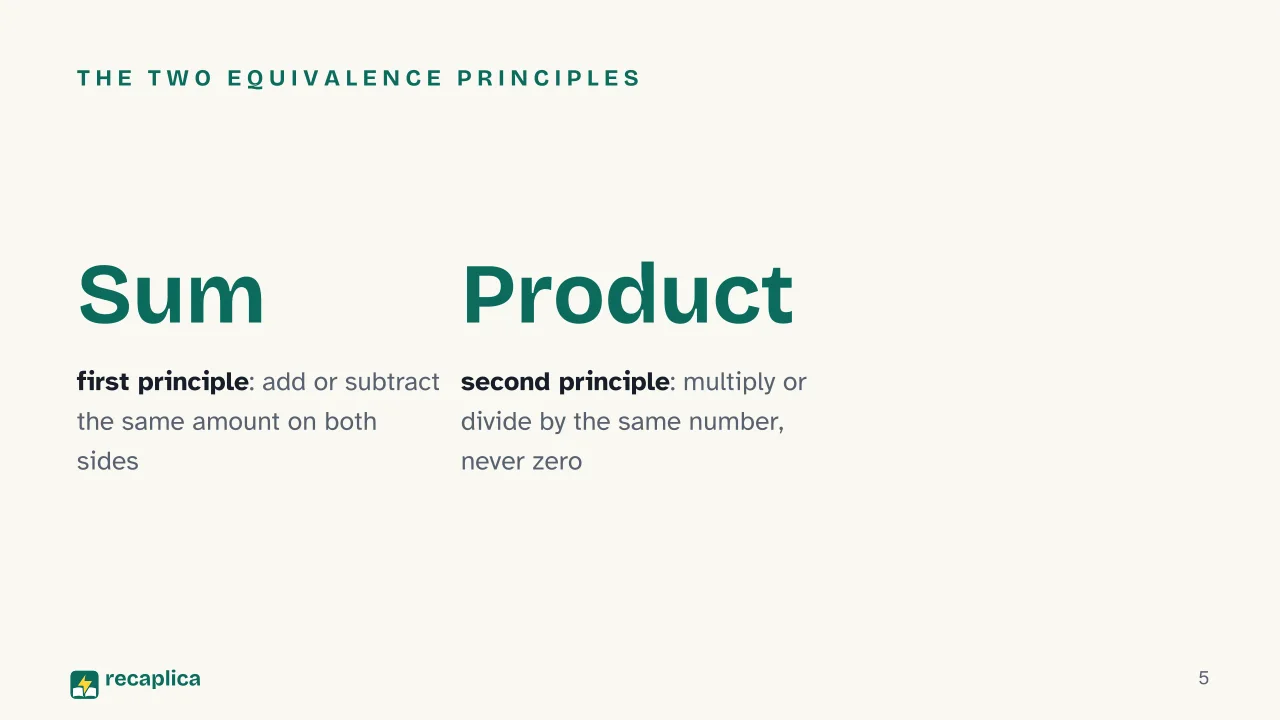  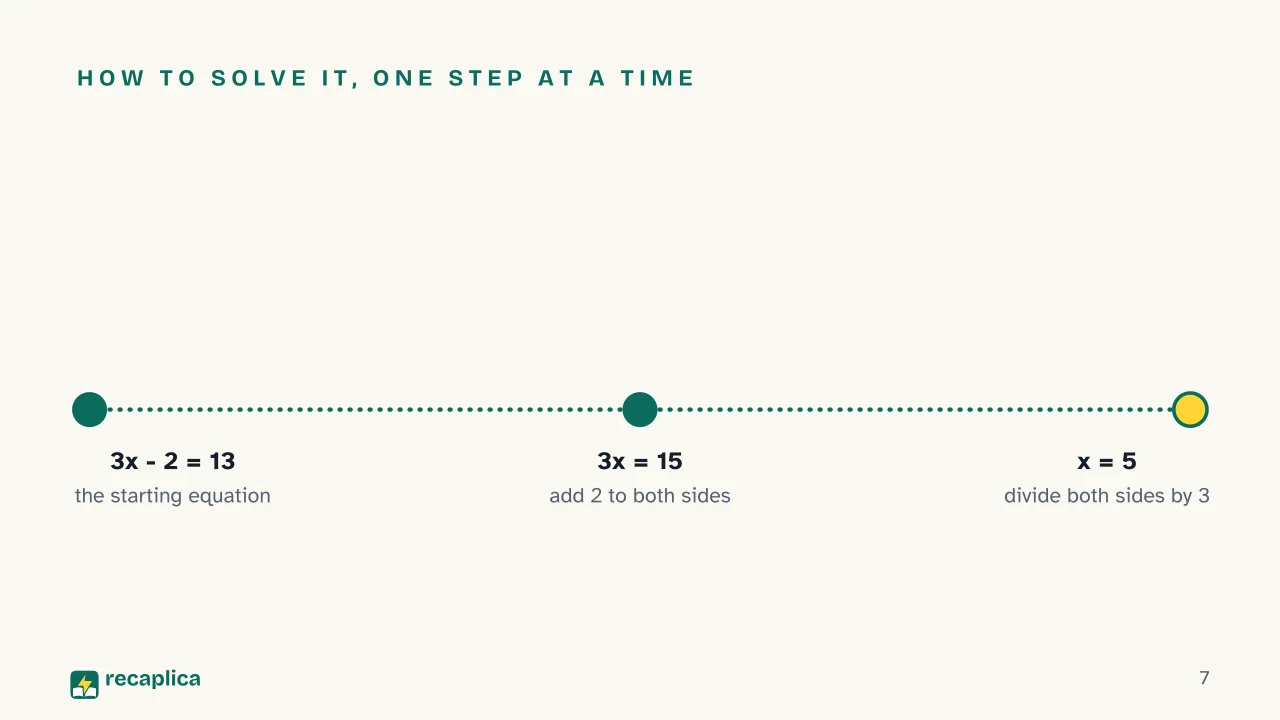 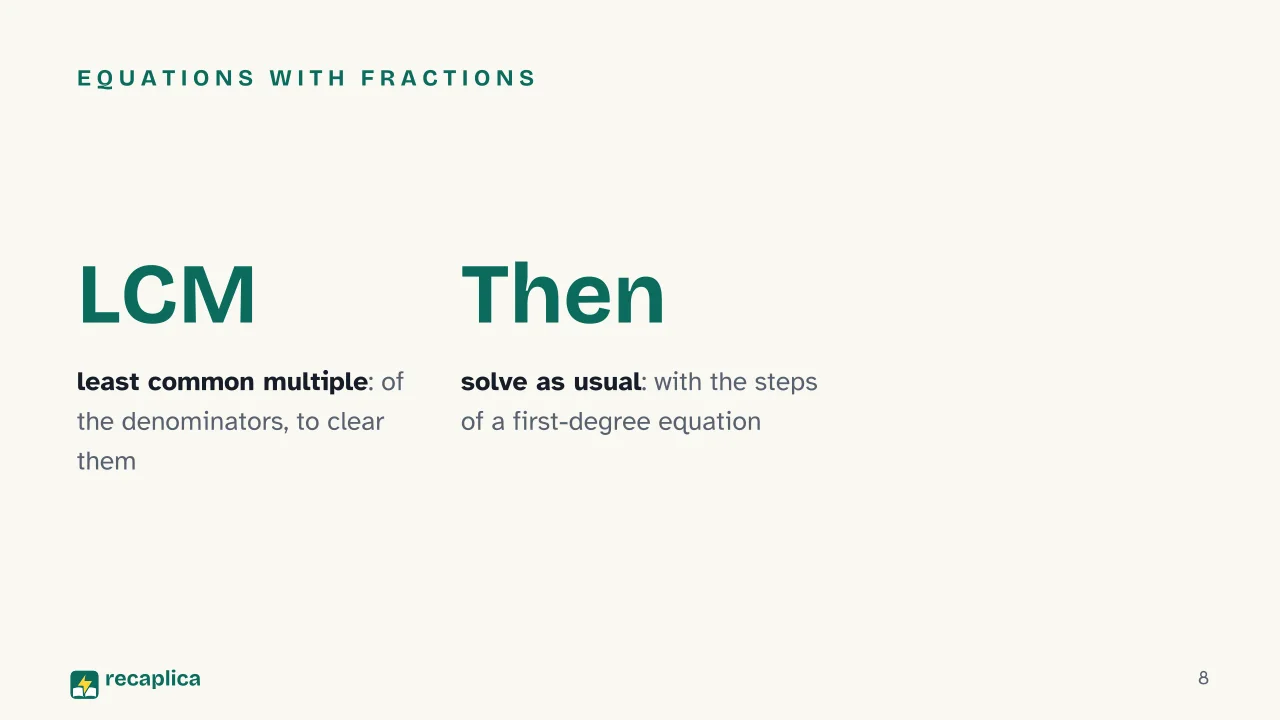  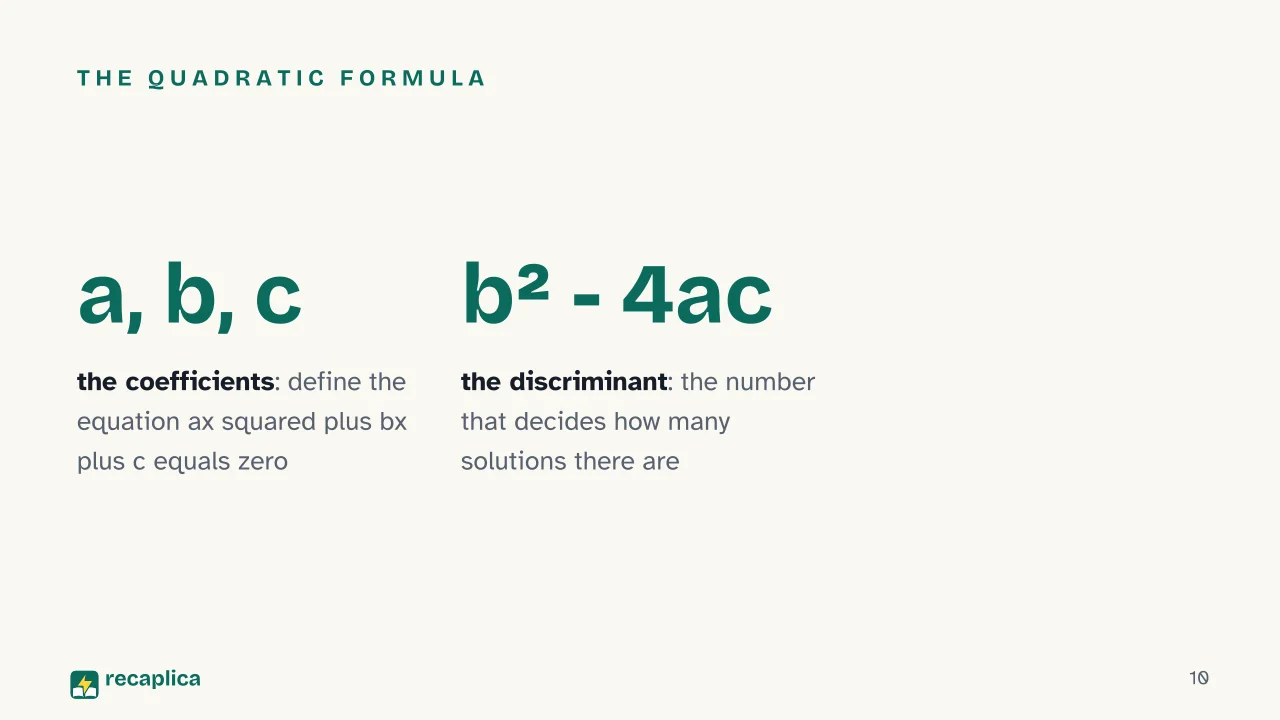 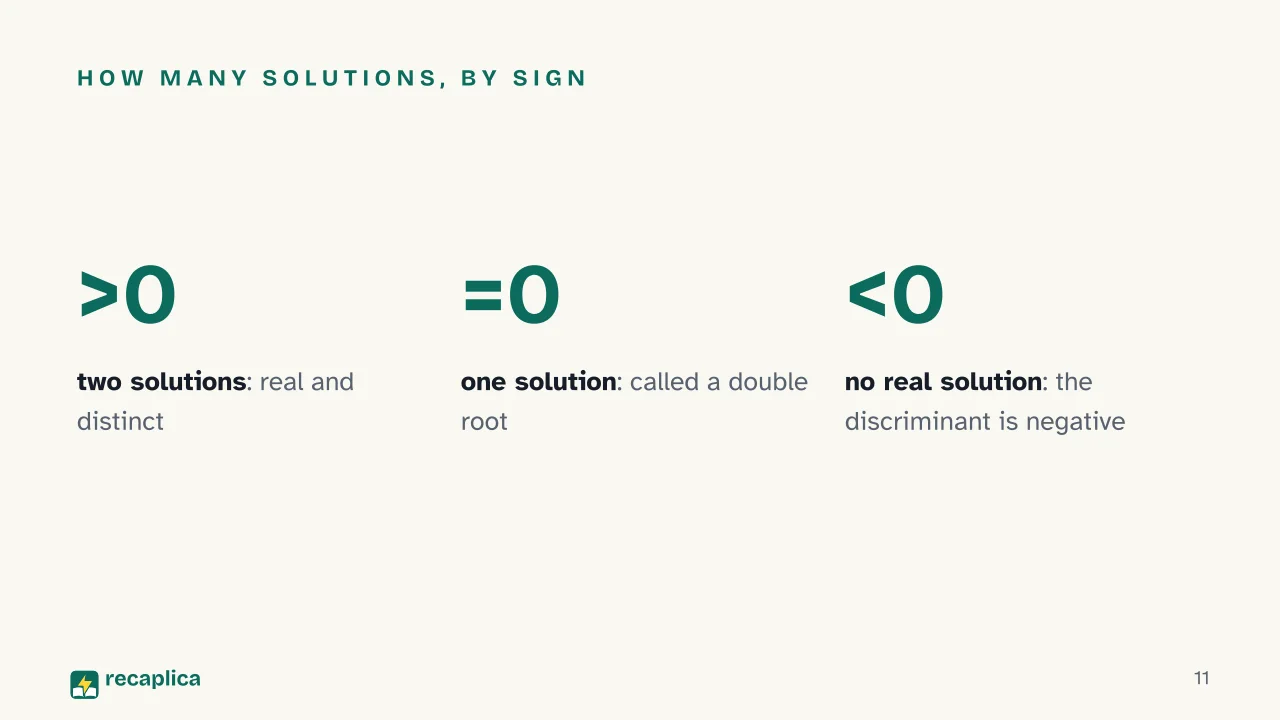 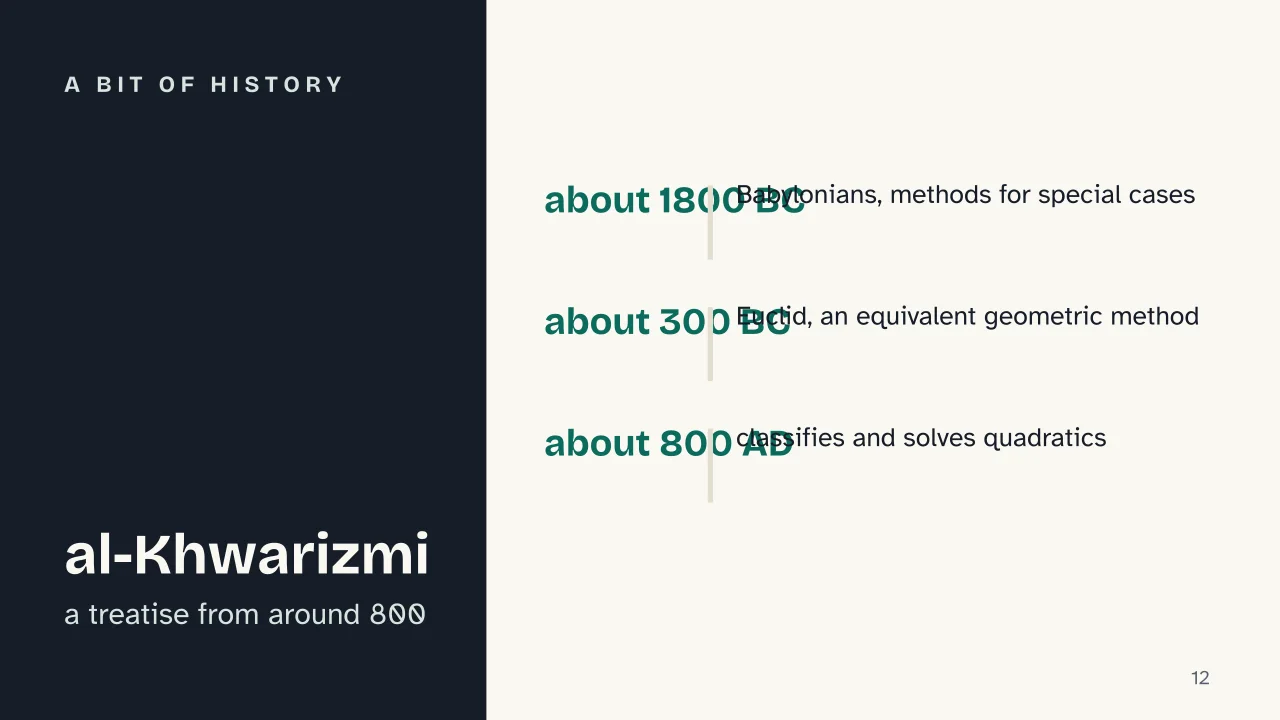  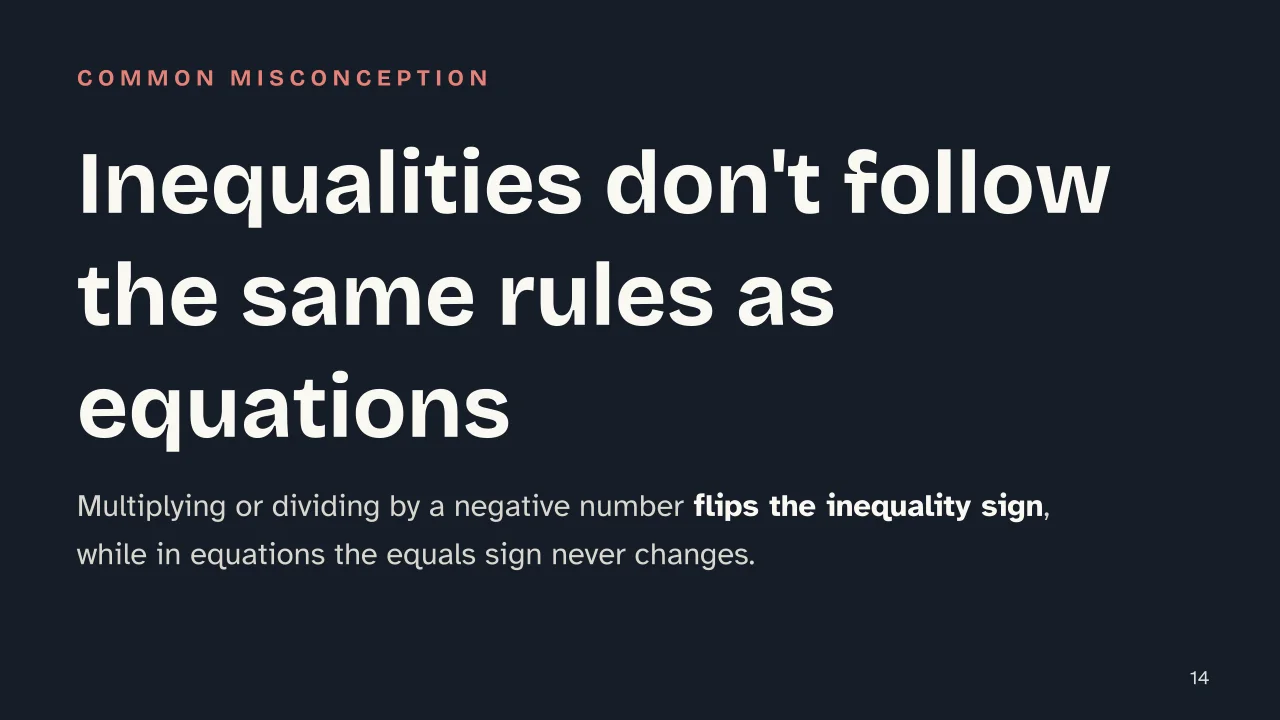 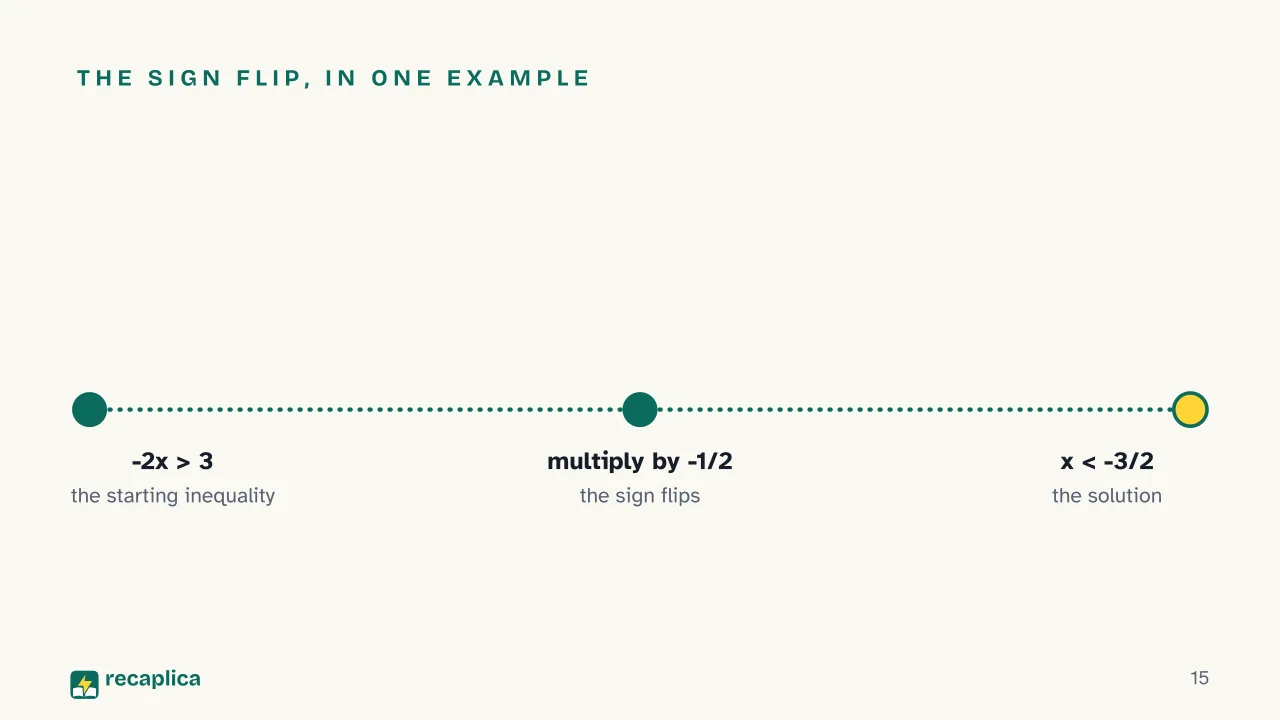 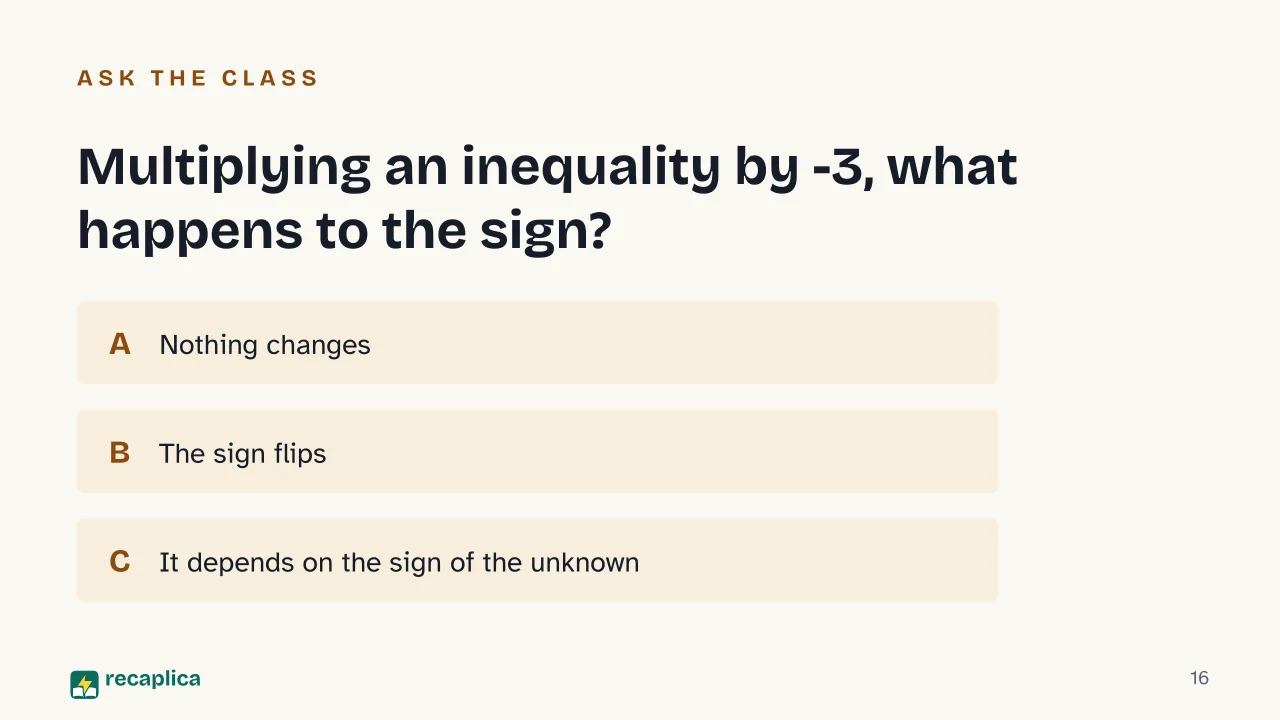  Common myths
Mind mapDrag the background to move around and the nodes to reposition them; use − and + to collapse and expand branches. 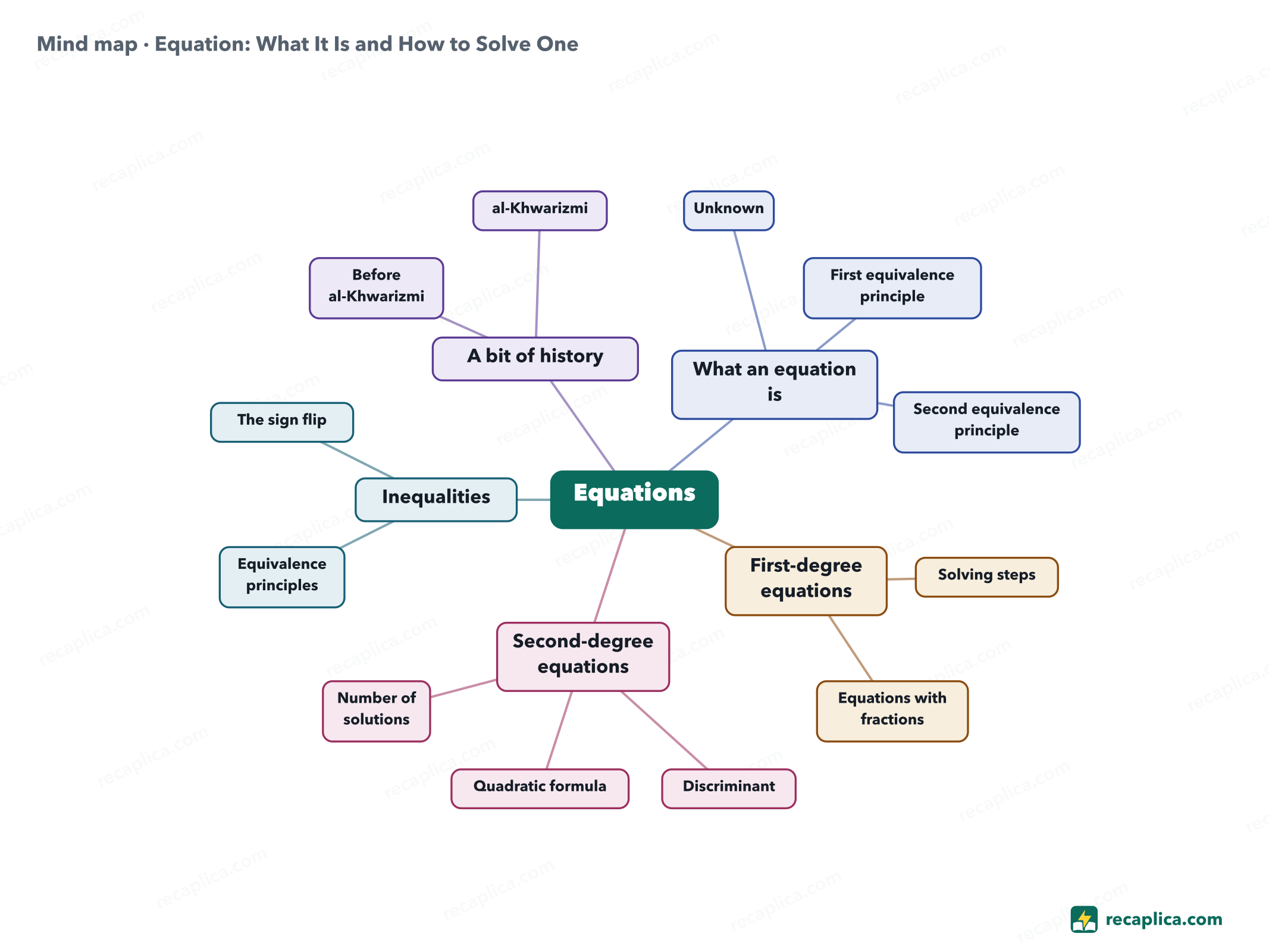
Quiz: test yourselfAnswer the questions to check what you have learned: you get instant feedback and a short explanation. Grade 0/10 0/5
FlashcardsTap the card to flip it and check whether you remember the answer, then move to the next one. 1 / 7 Explain it in your own wordsThe ultimate test: if you can explain it in simple words, you've truly understood it. Write your explanation, then compare it with the Recap. Your explanation is saved only on this device.
Frequently asked questionsAt what school level are equations usually taught?First-degree equations are typically introduced in middle school algebra classes; second-degree equations, more complex inequalities and systems of equations are usually covered in the early years of high school. What does it mean for two equations to be equivalent?Treccani defines two equations as equivalent when they have the same set of solutions, even if one can't be obtained from the other through the same algebraic steps: for example, |x|-1=0 and x²-1=0 both have -1 and +1 as solutions. How do you solve an equation with fractions?You multiply both sides by the least common multiple of the denominators, which clears the fractions; what's left is solved with the steps of a first-degree equation. Why does the inequality sign sometimes flip in inequalities?It happens when you multiply or divide both sides by a negative number: to stay equivalent to the original inequality, the direction of greater-than or less-than has to flip, as Treccani notes in its entry on equivalence principles. What is the discriminant of a second-degree equation?It's the expression b²-4ac that appears under the square root in the quadratic formula x = (-b ± √(b²-4ac)) / 2a; its sign tells you whether the equation has two real solutions, one, or none. Every Recap goes through an independent review before publication. |