Skip to content
recaplica

    One moment: security check

    Cloudflare wants to make sure you're not a robot. Tick the box below and your search will continue on its own.

    IT
    recaplica Rational Inequalities: The Sign Method and a Clear Definition
    © 2026 Recaplica · recaplica.com — All rights reserved
    Home › Science

    Rational Inequalities: The Sign Method and a Clear Definition

    By Recaplica Newsroom · Updated on September 20, 2026

    What to print

    Page numbers appear when printing with default margins.

    Slides

    Choose a cut

    Flash10 slidesThe essential thread, to present in classFull14 slidesEvery chapter and the deeper detail

    Both come with speaker notes.

    Telegram channel
    recaplica Clear in 30 seconds, yours in 10 minutes.
    In 30 seconds Key points Deep dive Slides Myths Mind map Quiz Flashcards FAQ

    In 30 seconds quick read

    A rational inequality is an inequality where the variable appears in the denominator of a fraction, not just the numerator. Studying its sign takes more than looking at a single polynomial the way an ordinary inequality does: the numerator and the denominator need to be examined on their own, and then compared to see where their signs agree or disagree. The denominator adds one more constraint before any of that starts, because it can never equal zero, so that value is ruled out of the solution from the very first line. The method itself follows four fixed steps: standard form, separate sign analysis, a sign chart, and a final check against the direction of the inequality.

    Key Points

    • The domain restriction rules out any value that makes the denominator zero, and it has to be written before any other step, staying in force until the end.
    • Every term moves to one side of the inequality until the expression takes the form N(x)/D(x) compared with zero.
    • The numerator and the denominator are studied separately, each with its own zeros and its own sign.
    • The sign chart lines up both sign studies and shows the sign of the whole fraction across every interval of the number line.
    • A fraction is positive when the numerator and denominator share the same sign, negative when their signs differ.
    • A zero of the numerator can belong to the solution when the inequality allows equality (≥ or ≤); a zero of the denominator never can, no matter the direction.

    Deep Dive

    A rational inequality gives itself away through one detail: the variable shows up in the denominator of a fraction. In (x-1)/2 > 0 the x sits only above the fraction line, and multiplying both sides by 2 handles it in one move — it’s really an ordinary inequality written in an unusual way. In (x-1)/(x+1) > 0, though, the x is also below the line: that fraction can flip sign as x changes, and it takes a method built specifically for that.

    The domain restriction

    Before any calculation, one condition has to be imposed: the denominator must be different from zero. It isn’t a technicality to tidy up at the end — it’s the first step, because a fraction with a zero denominator has no value at all: the expression stops meaning anything at that point. This condition stays valid through the very last line of the solution, even if the sign analysis later seems to include that value.

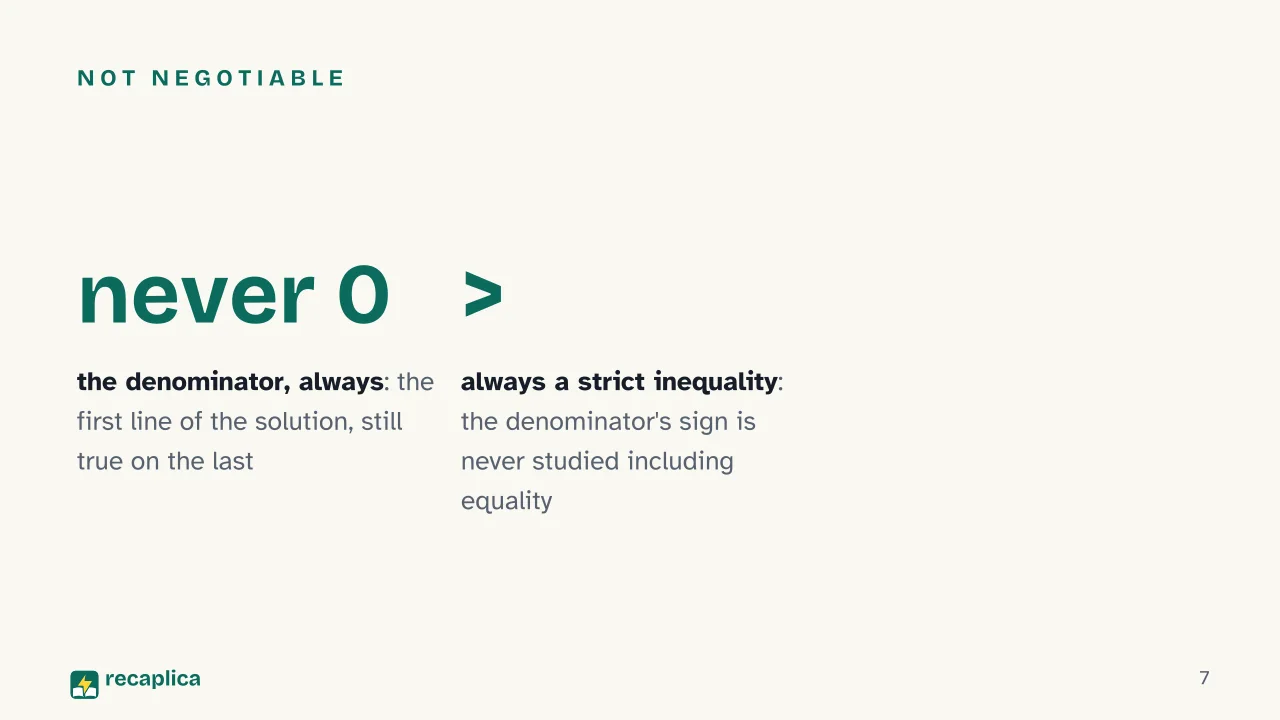
    For the same reason, when the denominator’s sign gets studied further on, it’s always with a strict inequality (D(x) > 0 or D(x) < 0), never with ≥ or ≤: the denominator can’t equal zero, so that equality is never an option worth keeping open.

    The method in four steps

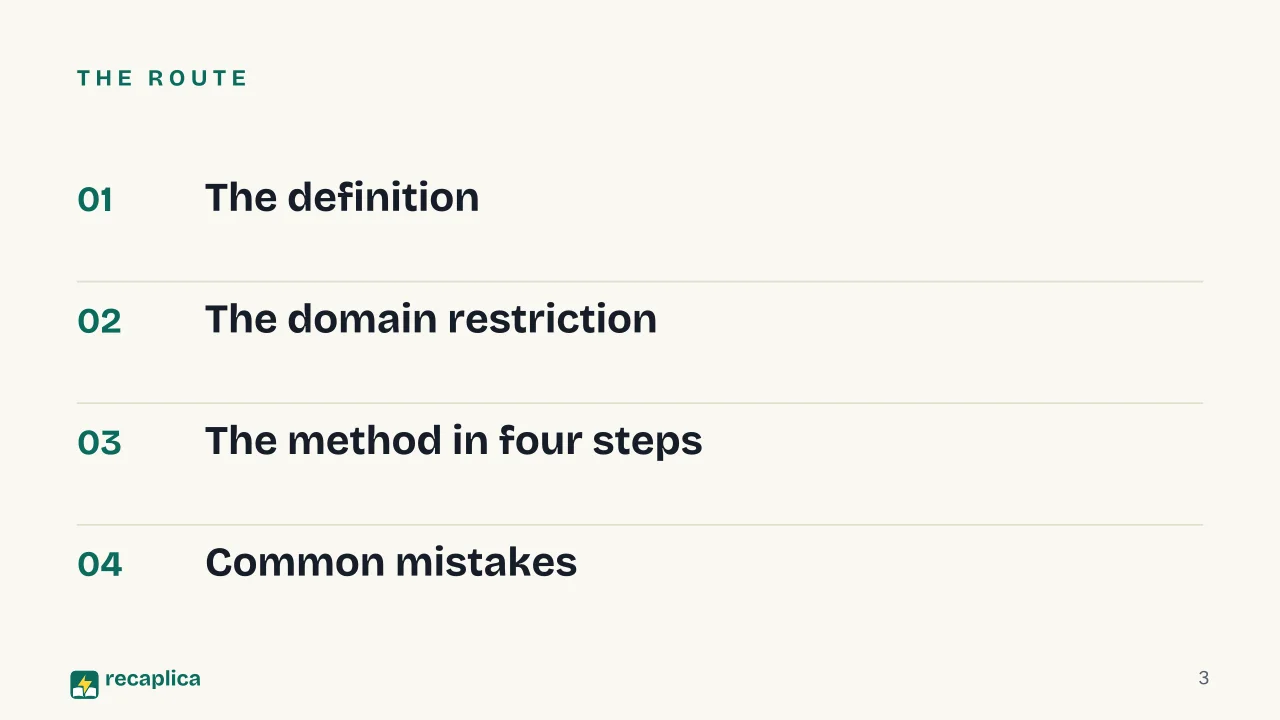
    Once the domain restriction is written down, the inequality gets handled in four fixed steps.

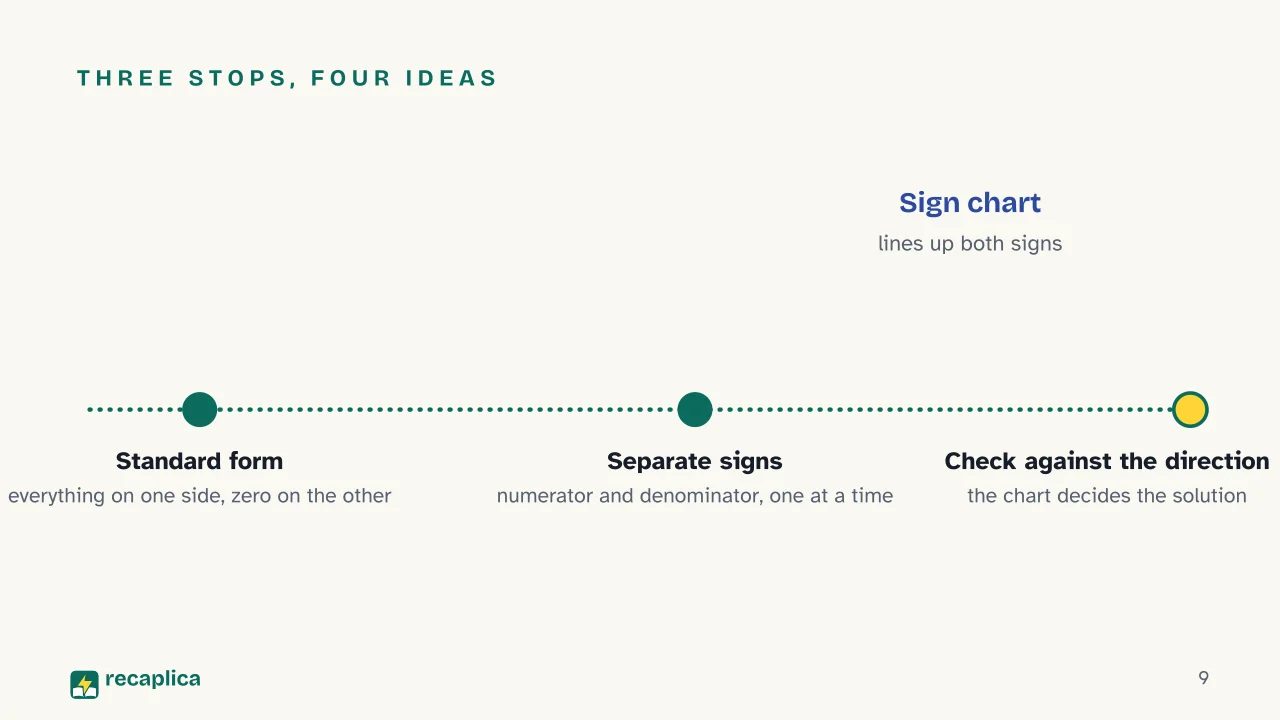
    The first is standard form: every term moves to one side of the inequality sign, leaving zero on the other, and the expression gets reduced to a single algebraic fraction N(x)/D(x). If several fractions need to be added or subtracted, this is the moment to find a common denominator — skipping this step and working directly on the separate terms is the most treacherous shortcut, because the sign of a sum of fractions isn’t the sum of the individual fractions’ signs.

    The second step is the separate sign study: the sign of N(x) gets analyzed on its own, then the sign of D(x) on its own, as if they were two independent inequalities (N(x) > 0 or ≥ 0 respectively, depending on the original direction, and D(x) always > 0, for the reason just seen). If the numerator or the denominator is itself made up of several factors, each factor gets studied individually.

    The third step is the sign chart (also called a sign line): the zeros of N(x) and D(x) get marked on the same number line, splitting it into intervals, and for each interval the sign of N(x), the sign of D(x), and the resulting sign of the fraction get recorded. The rule is the same one used for dividing numbers: a numerator and denominator that agree (same sign) give a positive fraction, and ones that disagree (opposite signs) give a negative one.

    The fourth step is the check against the direction of the original inequality: the chart shows which intervals have a fraction sign matching the required direction (positive for > or ≥, negative for < or ≤), keeping in mind that the denominator’s zeros always stay excluded, while the numerator’s zeros enter the solution only when the direction allows equality.

    Worked example: solve (x-3)/(x+4) > 0.

    The domain restriction is x ≠ -4. The expression is already in the form N(x)/D(x), with N(x) = x-3 and D(x) = x+4.

    Study N(x) > 0: x - 3 > 0 means x > 3. Study D(x) > 0: x + 4 > 0 means x > -4.

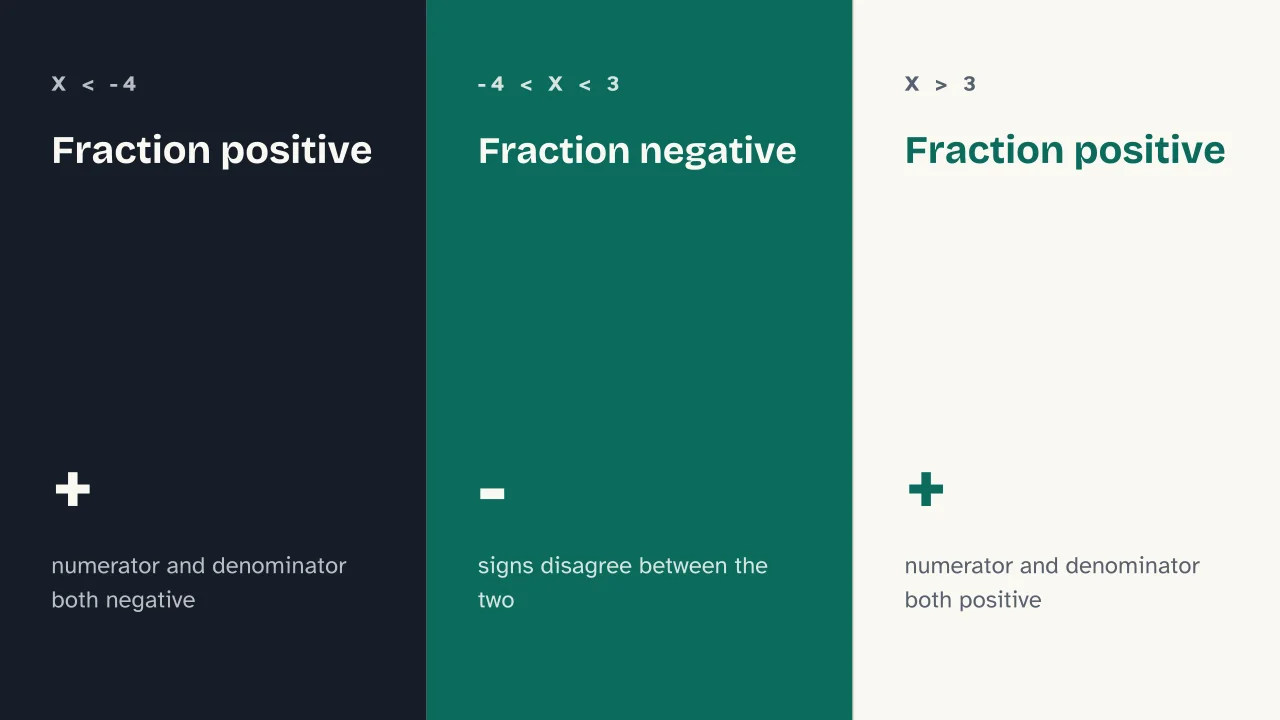
    On the sign chart: for x < -4, both N(x) and D(x) are negative, so the fraction is positive. For -4 < x < 3, N(x) is negative and D(x) is positive, so the fraction is negative. For x > 3, both are positive, so the fraction is positive again.

    The inequality’s direction is >, so the search is for where the fraction is positive: x < -4 or x > 3. x = -4 stays excluded no matter what, by the domain restriction; x = 3 isn’t included because the inequality is strictly greater than zero. If the original inequality had been (x-3)/(x+4) ≥ 0, the solution would only change at x = 3, which would then be included: x < -4 or x ≥ 3. x = -4 would still be excluded.

    Anyone who’s already reviewed equations recognizes the same standard form, with one crucial difference: in a rational equation the denominator just gets excluded, because the goal is a single value; in a rational inequality the denominator shapes the sign across entire intervals of the number line, and it has to be tracked step by step alongside the numerator.

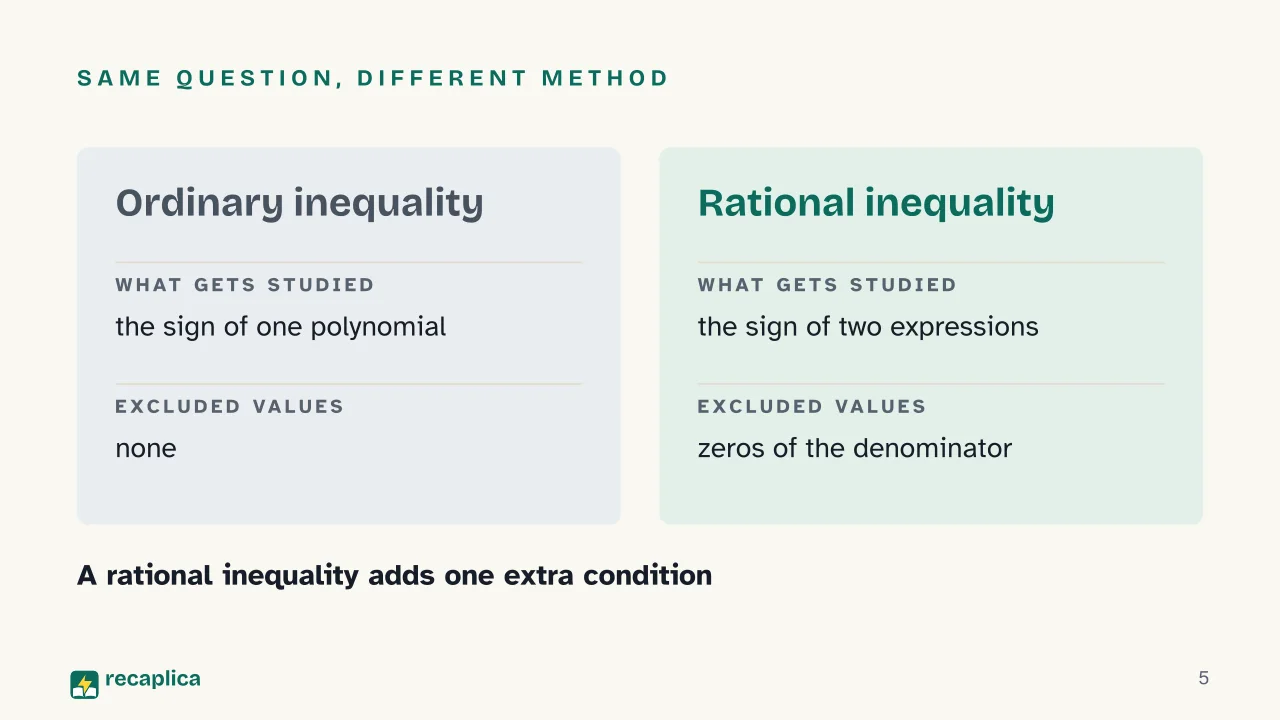
    AspectOrdinary inequalityRational inequality
    Domain restrictionnot neededdenominator different from zero
    What gets studiedthe sign of a single polynomialthe sign of N(x) and D(x), separately
    Inequality on the denominatordoesn’t applyalways strict, never ≥ or ≤
    Values excluded up frontnonethe zeros of the denominator

    The symbolic manipulation needed to reduce an expression to a single fraction and to factor N(x) and D(x) is the same skill taught in algebra: without knowing how to factor a polynomial, the sign chart can’t be built. And the final solution to a rational inequality is almost never a single number, but a set of intervals — the same interval idea between real numbers that comes up when studying number sets.

    A method with older roots

    Comparing fractions, and the idea that a fraction’s sign depends on the numerator and denominator together, traces back to arithmetic: that’s where positive and negative fractions get learned for the first time, long before a variable ever shows up in a denominator. Rational inequalities apply the same rule to an expression that changes with x, instead of to a fixed number.

    Getting it right

    The most common slip isn’t a calculation error, it’s a matter of order: solving the associated equation first, then trying to “patch” the sign by intuition. The four-step method exists precisely to head off that shortcut, which almost always misses an interval or lets the denominator’s zero slip into the solution by mistake.

    Slide deck

    Slides ready to download and make your own in PowerPoint or Google Slides, with speaker notes. Pick the Flash cut or the Full one.
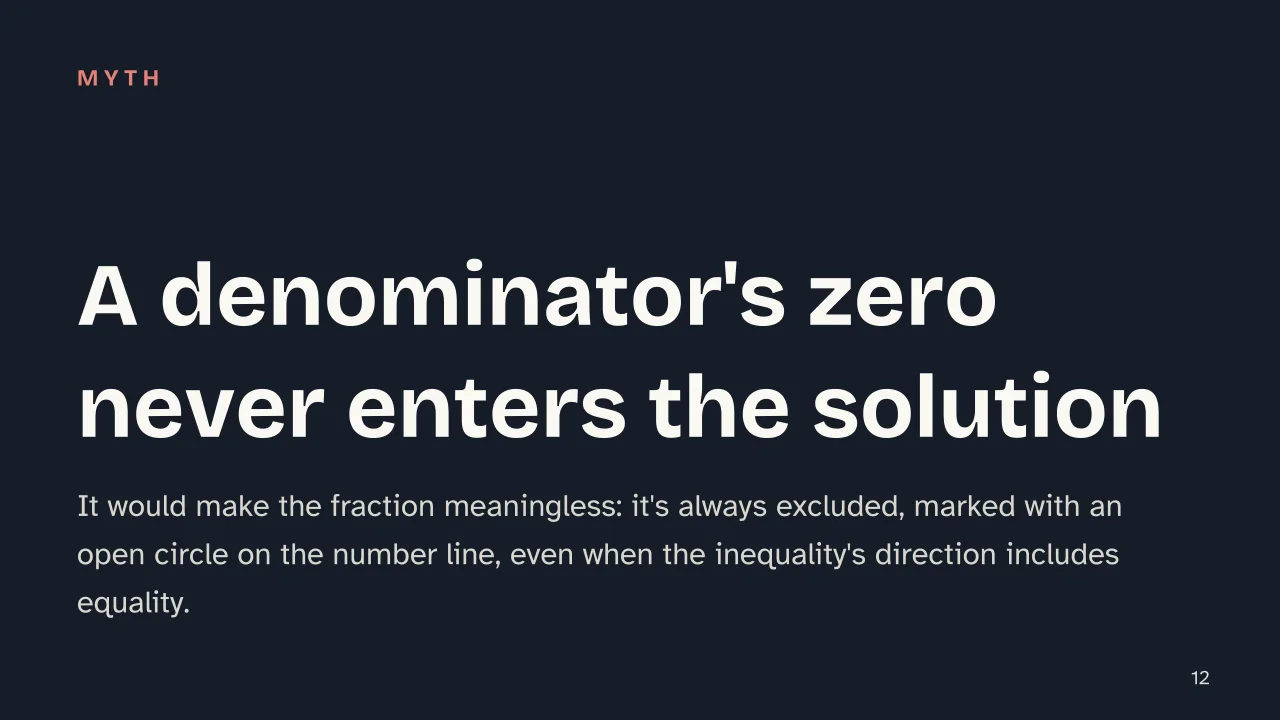
    Slide 1 of the presentation on Rational Inequalities: Rational InequalitiesSlide 2 of the presentation on Rational Inequalities: Why can't you just cross-multiply?Slide 3 of the presentation on Rational Inequalities: The routeSlide 4 of the presentation on Rational Inequalities: Chapter 01: The definitionSlide 5 of the presentation on Rational Inequalities: Same question, different methodSlide 6 of the presentation on Rational Inequalities: Chapter 02: The domain restrictionSlide 7 of the presentation on Rational Inequalities: Not negotiableSlide 8 of the presentation on Rational Inequalities: Chapter 03: The method in four stepsSlide 9 of the presentation on Rational Inequalities: Three stops, four ideasSlide 10 of the presentation on Rational Inequalities: Fraction positive · Fraction negative · Fraction positiveSlide 11 of the presentation on Rational Inequalities: Chapter 04: Common mistakesSlide 12 of the presentation on Rational Inequalities: A denominator's zero never enters the solutionSlide 13 of the presentation on Rational Inequalities: In a fraction, when is the result positive?Slide 14 of the presentation on Rational Inequalities: What's next
    Flash10 slidesThe essential thread, to present in classFull14 slidesEvery chapter and the deeper detail

    Common myths

    • ✗ Myth Any inequality that contains a fraction is a rational inequality.

      ✓ Reality What matters is where the variable sits. In (x-1)/2 > 0 there's a fraction, but the variable only appears in the numerator, so it behaves like an ordinary inequality once both sides are multiplied by 2. In (x-1)/(x+1) > 0 the variable is also in the denominator, and that's where the rational-inequality method, domain restriction included, actually applies.

    • ✗ Myth A rational inequality can be solved by cross-multiplying, the way a rational equation can.

      ✓ Reality An equation can shed its denominator because it's only looking for equality. An inequality can't: the denominator's sign changes from one interval of the number line to the next, and multiplying by a quantity that's sometimes positive and sometimes negative would flip the inequality sign only in some of those intervals, an easy trap once more than one fraction needs combining before reducing everything to a single N(x)/D(x). That's why every term moves to one side and the sign gets studied instead, never a cross-multiplication.

    • ✗ Myth The value that zeroes out the denominator can enter the solution too, just like a numerator zero, whenever the inequality allows equality.

      ✓ Reality The two zeros aren't equivalent. A numerator zero makes the fraction equal to zero, an acceptable value whenever the inequality allows equality. A denominator zero makes the fraction meaningless: no number exists that, divided by zero, gives a result, so that value stays excluded every single time, marked with an open circle on the number line, whatever the direction of the inequality.

    Mind map

    Drag the background to move around and the nodes to reposition them; use − and + to collapse and expand branches.
    Customize
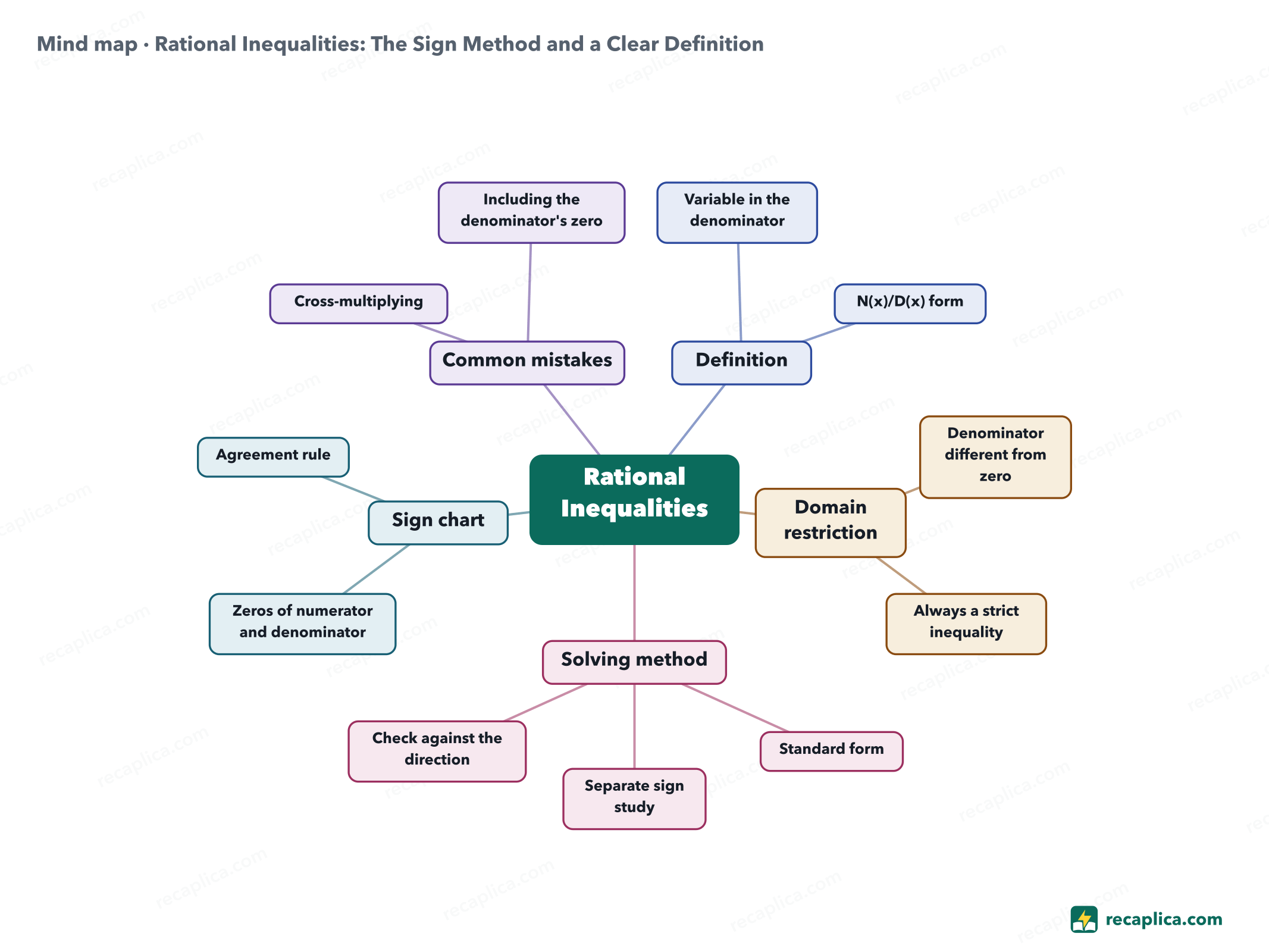
    Mind map: Rational Inequalities: The Sign Method and a Clear Definition
    • Rational Inequalities
      • Definition
        • Variable in the denominator the trait that sets a rational inequality apart from an ordinary one
        • N(x)/D(x) form the expression reduced to a single algebraic fraction
      • Domain restriction
        • Denominator different from zero
        • Always a strict inequality the denominator can never equal zero, even when the direction is ≥ or ≤
      • Solving method
        • Standard form everything on one side, zero on the other
        • Separate sign study N(x) first, then D(x), each on its own
        • Check against the direction the sign chart decides which intervals satisfy the inequality
      • Sign chart
        • Zeros of numerator and denominator
        • Agreement rule same signs give a positive fraction, opposite signs give a negative one
      • Common mistakes
        • Cross-multiplying
        • Including the denominator's zero

    Quiz: test yourself

    Answer the questions to check what you have learned: you get instant feedback and a short explanation.

    Grade 0/10 0/5
    1 Which of these is a rational inequality?

    It only counts as rational when the variable is also in the denominator: (x-1)/(x+3) > 0 has x above and below the line. The other three have the variable only in the numerator, or no denominator with a variable at all.

    2 What's the domain restriction to impose in a rational inequality?

    A fraction loses its meaning once the denominator equals zero, so that value is always excluded, regardless of the inequality's direction.

    3 True or false: the denominator's sign is always studied with a strict inequality, even when the original inequality uses ≥.

    The denominator can never equal zero, so its sign is always studied with > or <, never ≥ or ≤, whatever direction the original inequality uses.

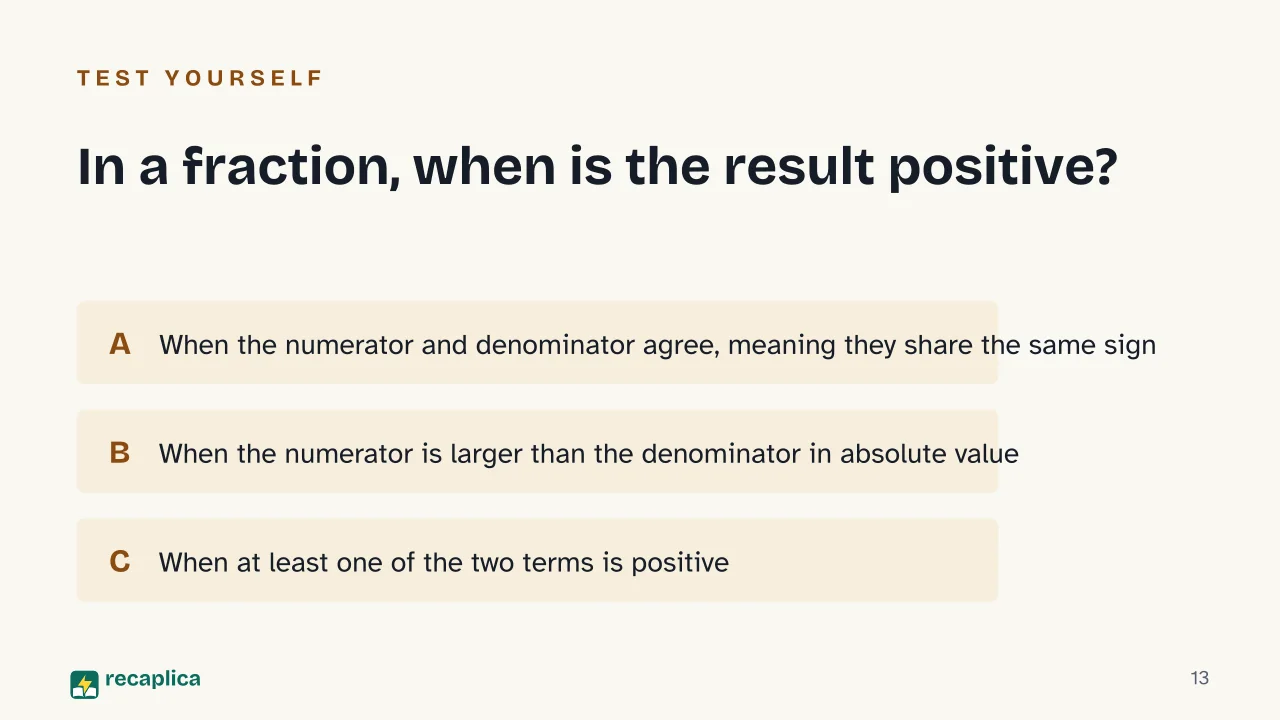
    4 In a fraction, when is the result positive?

    Division follows the same sign rule as multiplication: two terms with the same sign give a positive result, two terms with opposite signs give a negative one.

    5 In the inequality (x-3)/(x+4) > 0, which value is excluded from the solution no matter what the sign analysis shows?

    x = -4 makes the denominator (x+4) equal zero, so it's excluded from the domain before the signs are even studied: the domain restriction rules it out from the start.

    Answers: 1-A · 2-B · 3-A · 4-A · 5-B

    Flashcards

    Tap the card to flip it and check whether you remember the answer, then move to the next one.

    1 / 8

    Explain it in your own words

    The ultimate test: if you can explain it in simple words, you've truly understood it. Write your explanation, then compare it with the Recap.

    Your explanation is saved only on this device.

    A rational inequality is an inequality where the variable appears in the denominator of a fraction, not just the numerator. Studying its sign takes more than looking at a single polynomial the way an ordinary inequality does: the numerator and the denominator need to be examined on their own, and then compared to see where their signs agree or disagree. The denominator adds one more constraint before any of that starts, because it can never equal zero, so that value is ruled out of the solution from the very first line. The method itself follows four fixed steps: standard form, separate sign analysis, a sign chart, and a final check against the direction of the inequality.

    Frequently asked questions

    How do you solve a rational inequality step by step?

    Start with the domain restriction (denominator different from zero), then move everything to the form N(x)/D(x) compared with zero, study the sign of N(x) and D(x) separately, and finally read the solution off the sign chart, matching the intervals against the direction the inequality requires. This Recap walks through a full worked example that follows exactly these four steps.

    What's the difference between a polynomial inequality and a rational inequality?

    In a polynomial inequality the variable never sits in a denominator, so only one polynomial's sign needs studying and there's nothing to exclude for domain reasons. In a rational inequality the variable is also below the fraction line, so an extra domain restriction is needed and the sign has to be studied separately for the numerator and the denominator.

    Why can the denominator never show up in the solution?

    Because a fraction with a zero denominator has no numerical value at all: the expression stops meaning anything. That's why, unlike a numerator zero, a denominator zero is always excluded from the solution, no matter the inequality's direction.

    Can rational inequalities be solved online?

    Online tools exist that return the solution to a rational inequality, and some even show the intermediate steps. They're useful for checking a result already worked out by hand, but they don't replace understanding the method: without knowing why the denominator gets excluded or why the signs need separate treatment, a result copied from a tool doesn't transfer to the next problem, which will have different numbers.

    What happens if the domain restriction isn't imposed?

    The solution risks including a value that zeroes out the denominator, a point where the original expression doesn't even exist. The domain restriction has to be written first and kept in force to the very end: even if the sign analysis seems to include that point later, the domain restriction rules it out regardless.

    Sources

    • Le disequazioni fratte (WeSchool)
    • Disequazioni fratte — procedimento risolutivo ed esercizi (Skuola.net)
    • 3.8 Polynomial and Rational Inequalities (Mathematics LibreTexts, Monroe Community College)
    • Solve Rational Inequalities Using the Sign-Line Method (dummies.com)

    Every Recap goes through an independent review before publication.

    Every evening, the day's new Recaps on our Telegram channel. Join the channel →

    Keep learning

    • Science Cognitive Load Theory: The Definition Behind Sweller's Research Cognitive load is the amount of working memory a task uses up while you learn something new. Psychologist John Sweller first described it in 1988, starting from research on problem solving: a strategy that is too demanding leaves little room to build stable mental structures. Later research distinguishes three types of load, intrinsic, extraneous, and germane, though part of the field treats the third as indistinguishable from the first. Cutting extraneous load, with worked examples or less cluttered materials, frees up mental room for actual learning. Read the Recap →
    • Science Cognitivism: how the mind processes information Cognitivism is the psychological paradigm that treats the mind as a system for processing information, spanning perception, memory, reasoning and language. The shift began around 1956, while behaviorism, championed by Watson and Skinner, still ruled academic psychology and reduced the field to observable stimuli and responses. That same year, George Miller exposed the limits of short-term memory, and Chomsky joined McCarthy, Minsky, Newell and Simon in laying the groundwork for cognitive science. Donald Broadbent's attention model in 1958 and Ulric Neisser's 1967 book, which put the name cognitive psychology into common use, complete the roster of its founding figures. Read the Recap →
    • Science Behaviorism: What It Is and Where It Came From Behaviorism is the school of psychology that studies only observable behavior, leaving aside the thoughts and feelings that stay hidden inside the mind. It began in 1913, when the American psychologist John B. Watson published an essay calling for psychology to become an experimental science, without relying on introspection. After him, Ivan Pavlov studied conditioned reflexes and Edward Thorndike studied trial-and-error learning; Burrhus Skinner pushed the ideas to their most extreme form with radical behaviorism. The thread running through all of it is the stimulus-response model: a behavior is explained by what comes before it and what follows it, not by guessing what happens inside the head of the person doing it. Read the Recap →

    recaplica

    Clear in 30 seconds, yours in 10 minutes.

    Recaps Mind maps Request a Recap Telegram channel Mind map maker Our method About Privacy & cookies Legal notes & terms of use

    © 2026 Recaplica · A project by Curi S.r.l. — VAT IT05472000750

    Statistics, only if you say so

    To learn which Recaps help most we would use Google Analytics, with aggregate, anonymous data. It starts only with your OK, and you can change your mind anytime. Privacy policy