recaplica
Clear in 30 seconds, yours in 10 minutes.
In 30 seconds quick read
An exponential equation is an equation where the unknown sits in the exponent of a power, as in a raised to the x equals b, rather than in the base as in ordinary equations. The base a must be positive and different from 1, or the equation stops making sense. When both sides can be written as powers of the same base, the solution comes from comparing the exponents directly. When the bases stay different even after trying to rewrite them, a logarithm isolates the unknown instead. This Recap walks through both routes with worked examples.
Key Points
In an exponential equation the unknown sits in the exponent of a power, in the form a raised to the x equals b, not in the base.
The base a must be positive and different from 1, or the equation becomes undetermined or impossible.
When both sides can be written as powers of the same base, comparing the exponents gives the solution.
Different-looking numbers can hide the same base — 8 and 16 are both powers of 2 — and the power-of-a-power rule brings the equation back to the equal-base case.
When the bases cannot be reduced to one another, a logarithm is applied to both sides and its properties isolate the unknown.
Any solution found with the equal-base method can be checked by substituting it back into the original equation.
Deep Dive
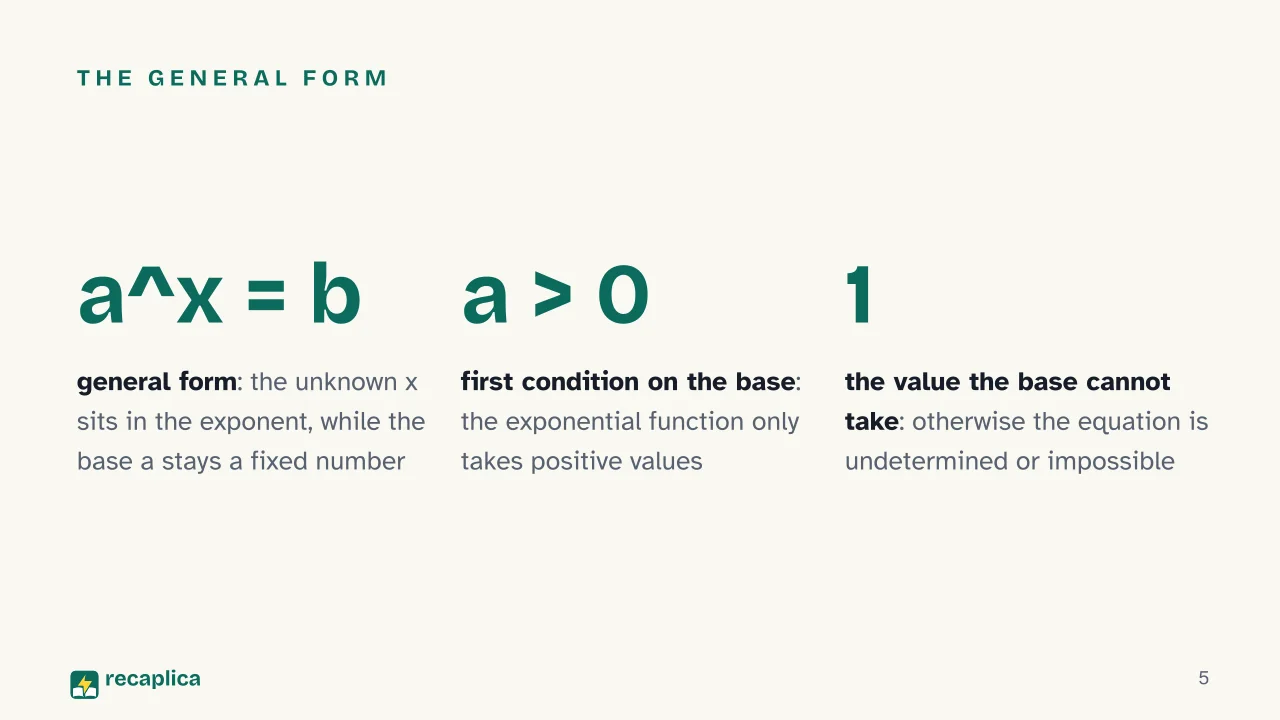
Exponential equations give themselves away through one detail: the letter we’re looking for no longer sits in the base of a power but in its exponent. In first- and second-degree equations, the unknown shows up as a base, a coefficient, or a term to add; here the power has a fixed base and the x climbs to the top instead, as in 2 raised to x equals 8. The general form is a raised to the x equals b, with a and b real numbers.
For the equation to make sense, the base a has to meet two conditions. It must be positive, because a power with a negative base and an arbitrary exponent isn’t consistently defined over the real numbers. And it must be different from 1, because 1 raised to any exponent always equals 1 — so the equation would become undetermined if the constant term is also 1, or impossible in every other case.
When the Two Bases Are Already Equal
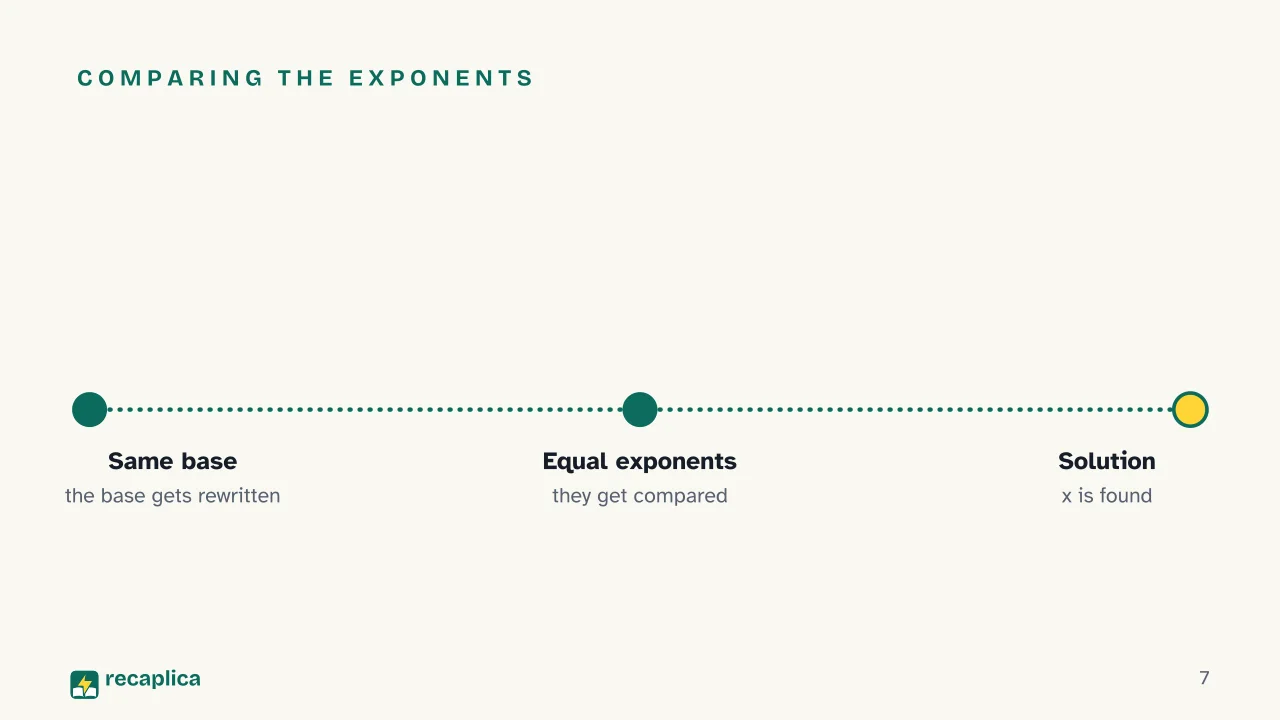
The simplest case shows up when the constant term and the starting base share the same root. If both sides can be written as powers of the same number, the exponential function treats them the same way: two powers with the same base are equal only if their exponents are equal too.
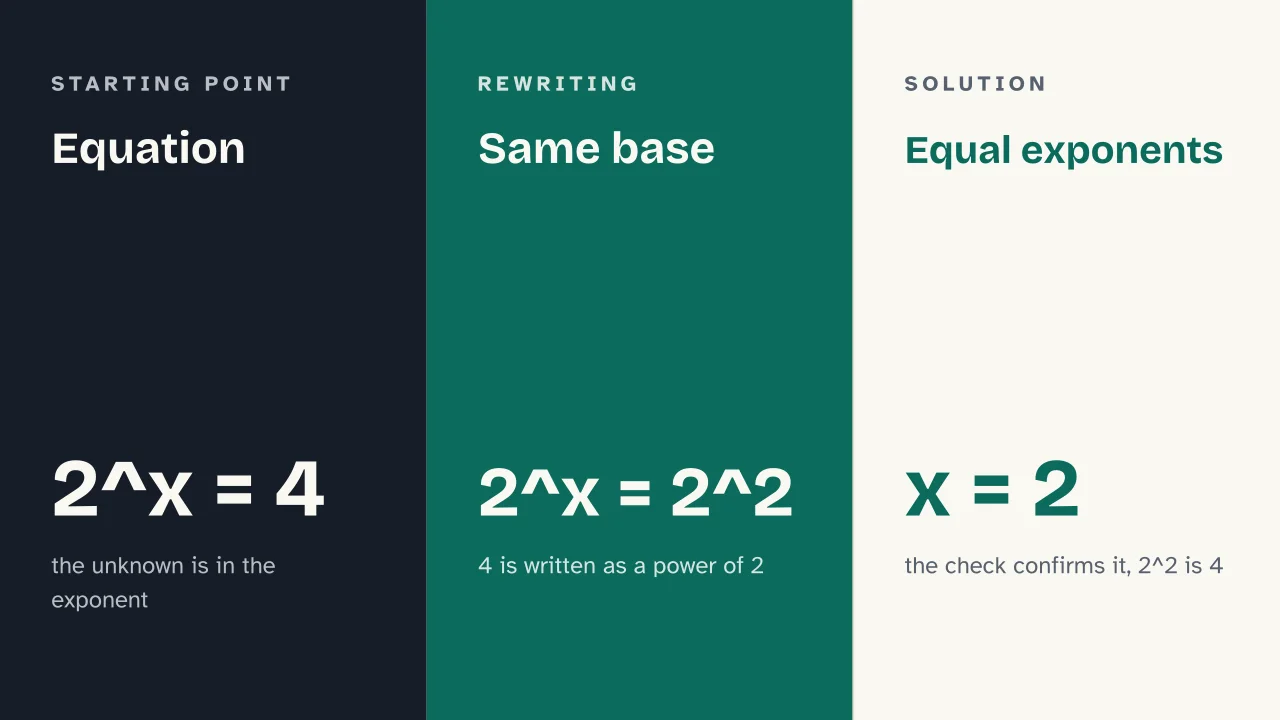
Practical example: solve 2 raised to x equals 4. The number 4 can be written as 2 squared, so the equation becomes 2 raised to x equals 2 squared. The bases match, so the exponents are compared: x equals 2. The check is immediate — 2 squared is exactly 4.
When the Same Base Is Hidden
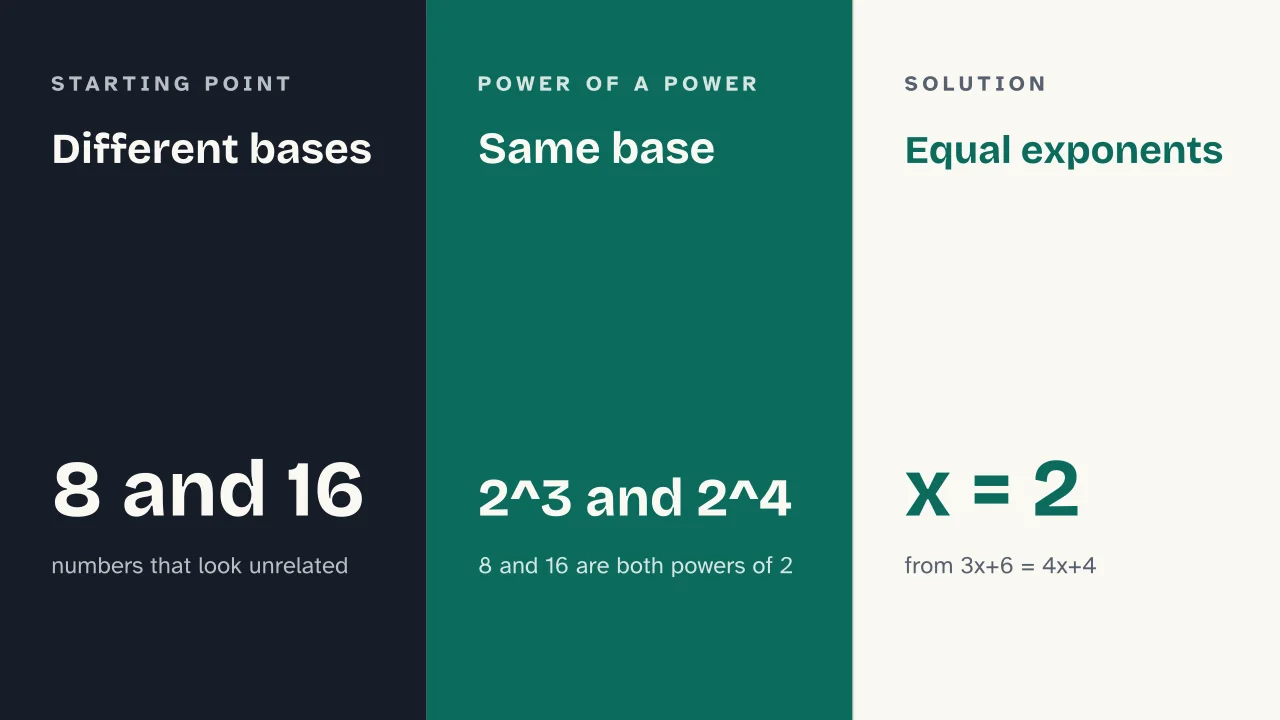
The two powers don’t always show the same base at first glance. Numbers such as 8 and 16 don’t look related, yet both are powers of 2 (2 cubed and 2 to the fourth, respectively). Rewriting them this way opens the door to the power-of-a-power rule, which multiplies the exponents together whenever a power is itself raised to another power.
Practical example: solve 8 raised to (x+2) equals 16 raised to (x+1). Both bases are rewritten as powers of 2, giving (2 cubed) raised to (x+2) equals (2 to the fourth) raised to (x+1). By the power-of-a-power rule, the equation becomes 2 raised to (3x+6) equals 2 raised to (4x+4). The bases now match, so the exponents are set equal: 3x plus 6 equals 4x plus 4, which gives x equals 2.
Case
What to do
Example
Bases already equal
Compare the exponents
2 raised to x equals 4, so x equals 2
Bases hidden behind different numbers
Rewrite both as powers of the same number, then compare the exponents
8 raised to (x+2) equals 16 raised to (x+1), so x equals 2
Bases that cannot be reduced to one another
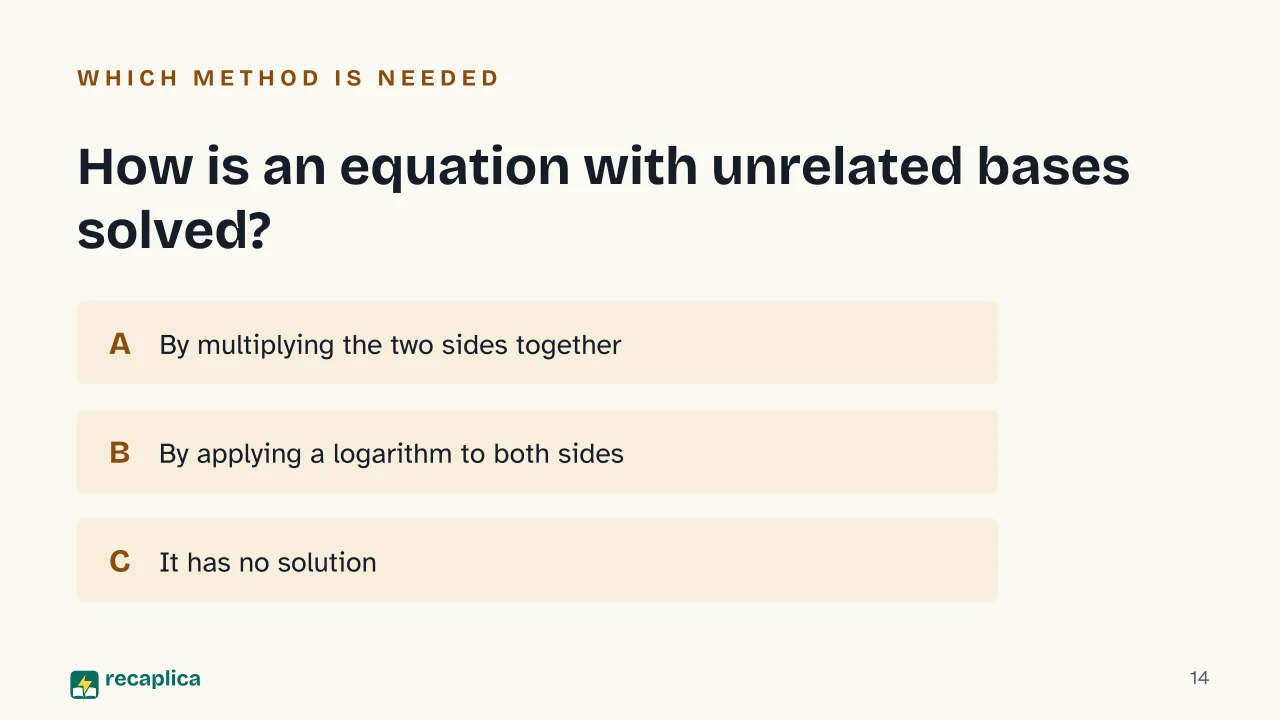
Apply a logarithm to both sides
3 raised to x equals 10
When the Bases Stay Different, Logarithms Step In
Some pairs of numbers share no common base that raises cleanly to a simple integer or rational exponent — 3 and 10 are one such pair. In these cases, a logarithm is applied to both sides of the equation. The equality holds no matter which base is chosen for the logarithm, and the logarithm-of-a-power property lets the exponent drop down in front of the logarithm, turning the equation into an ordinary first-degree equation in x.
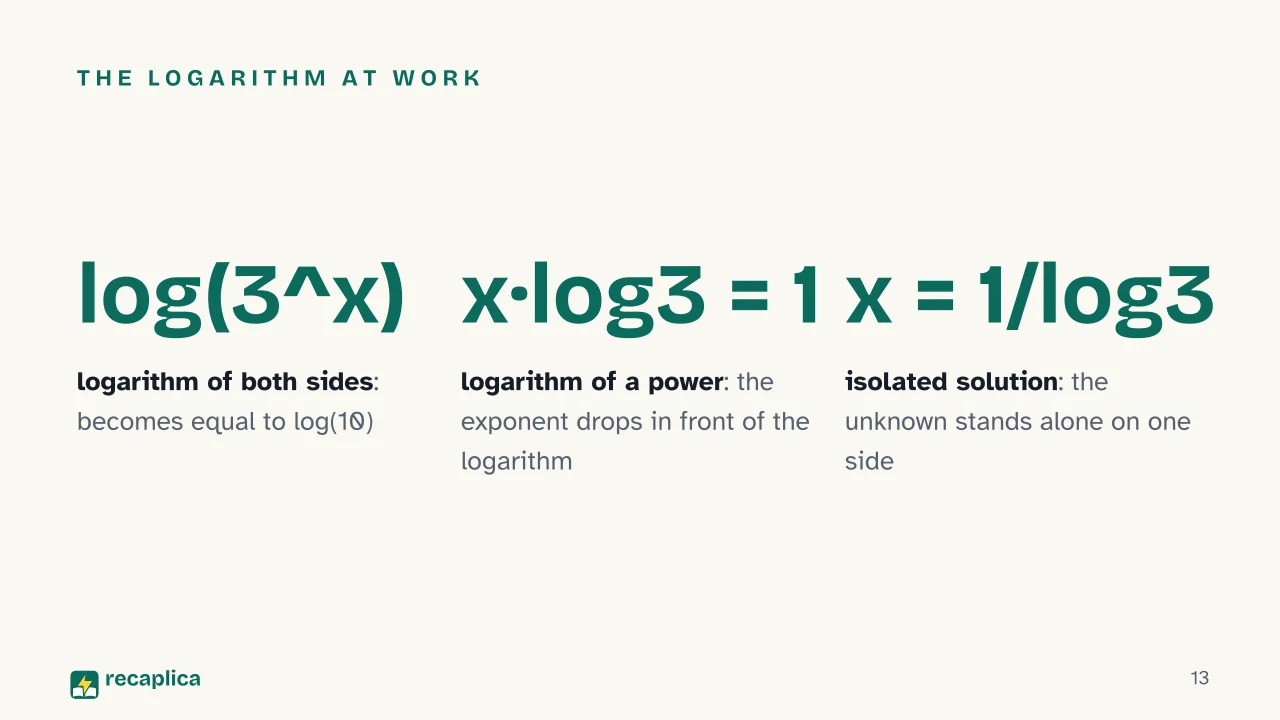
Practical example: solve 3 raised to x equals 10. A base-10 logarithm is applied to both sides: log(3 raised to x) equals log(10). By the logarithm-of-a-power property, x times log(3) equals 1, since the base-10 logarithm of 10 is 1. Isolating x gives x equals 1 divided by log(3).
Exponential Equations Inside Algebra
Exponential equations remain algebraic equations through and through: once rewritten with equal bases, or after switching to logarithms, they turn back into first-degree equations, solvable with the same rules of symbolic calculation covered in Algebra. The exponential function that governs them, together with its inverse the logarithm, is one of the topics explored in calculus.
Slide deck
Slides ready to download and make your own in PowerPoint or Google Slides, with speaker notes. Pick the Flash cut or the Full one.
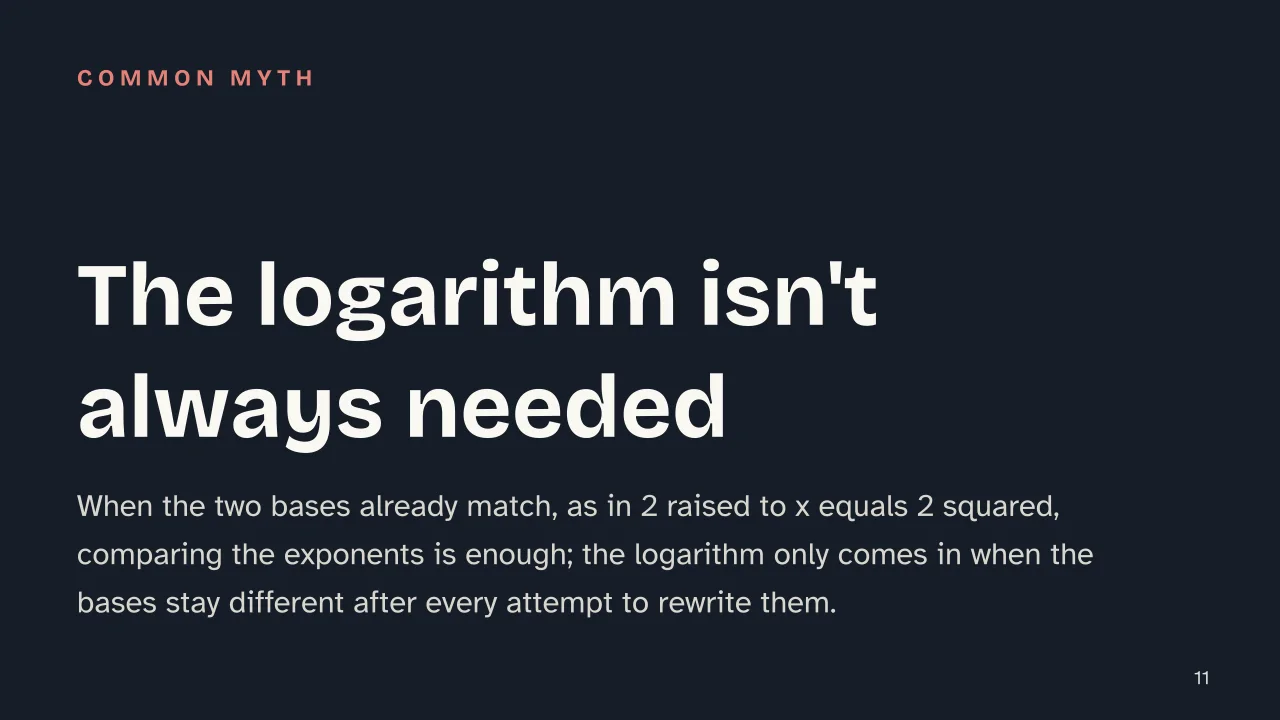
✗ Myth Many assume the logarithm has to come in every time, even when the two bases already match.
✓ Reality When both sides already share the same base, comparing the exponents is enough; bringing in a logarithm at that point is an extra step that only complicates the calculation.
✗ Myth Many treat a negative base, or a base equal to 1, as if it worked like any other number in the form a raised to the x equals b.
✓ Reality The base has to be positive and different from 1 — otherwise the equation loses its meaning, turning undetermined when the constant term is also 1, or impossible in every other case.
✗ Myth Many assume that two different numbers such as 8 and 16 can never share the same base.
✓ Reality Both are powers of the same number, 2 in this case, and recognizing that brings the equation back to the equal-base case through the power-of-a-power rule.
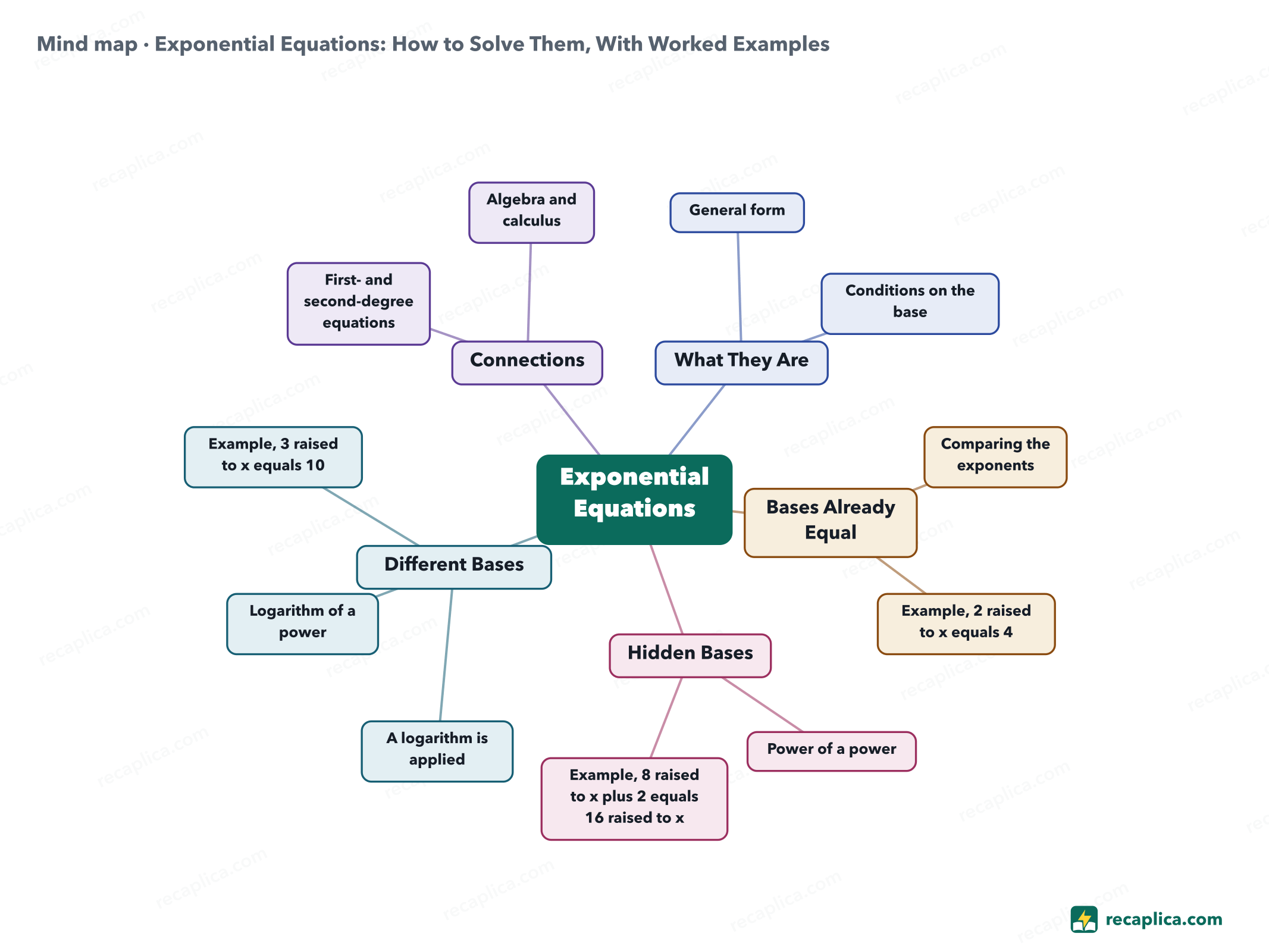
Mind map
Drag the background to move around and the nodes to reposition them; use − and + to collapse and expand branches.
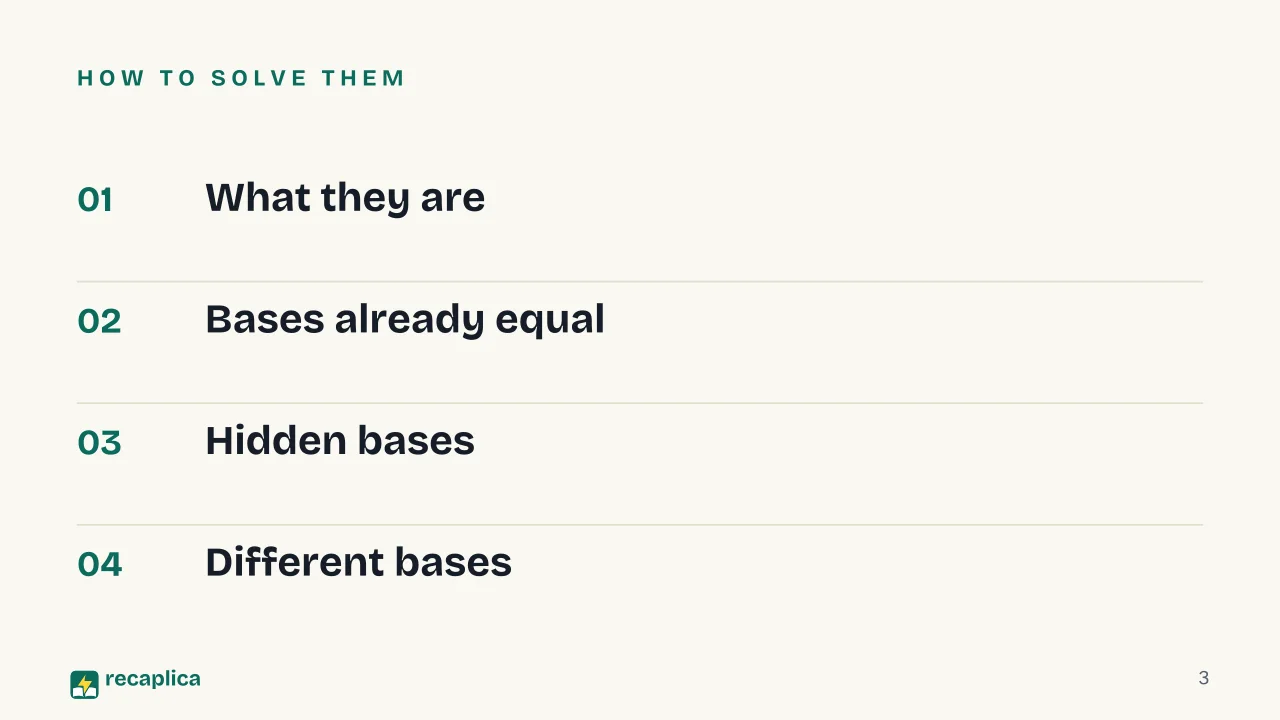
What They Arethe unknown sits in the exponent of a power
General forma raised to the x equals b
Conditions on the basepositive and different from 1
Bases Already Equal
Comparing the exponents
Example, 2 raised to x equals 4
Hidden Bases
Power of a powerthe exponents get multiplied
Example, 8 raised to x plus 2 equals 16 raised to x plus 1
Different Bases
A logarithm is applied
Logarithm of a powerthe exponent drops in front of the logarithm
Example, 3 raised to x equals 10
Connections
First- and second-degree equations
Algebra and calculus
Quiz: test yourself
Answer the questions to check what you have learned: you get instant feedback and a short explanation.
Grade0/100/5
Answers: 1-B · 2-B · 3-B · 4-B · 5-C
Flashcards
Tap the card to flip it and check whether you remember the answer, then move to the next one.
1 / 8
Explain it in your own words
The ultimate test: if you can explain it in simple words, you've truly understood it. Write your explanation, then compare it with the Recap.
Your explanation is saved only on this device.
An exponential equation is an equation where the unknown sits in the exponent of a power, as in a raised to the x equals b, rather than in the base as in ordinary equations. The base a must be positive and different from 1, or the equation stops making sense. When both sides can be written as powers of the same base, the solution comes from comparing the exponents directly. When the bases stay different even after trying to rewrite them, a logarithm isolates the unknown instead. This Recap walks through both routes with worked examples.
Frequently asked questions
What is a quick summary of exponential equations
They are equations with the unknown in the exponent of a power; they are solved by comparing exponents when the bases are equal, or by applying a logarithm when the bases stay different.
What is the difference between an exponential equation and an ordinary equation
In an ordinary equation, such as a first- or second-degree one, the unknown appears as a base, a coefficient, or a constant term; in an exponential equation, the unknown instead sits in the exponent of a power.
Why can't the base of an exponential equation be 1
Because 1 raised to any exponent always equals 1, so the equation would become undetermined if the constant term is also 1, or impossible in every other case.
When are logarithms used in an exponential equation
When the two sides of the equation cannot be written as powers of the same base, as in 3 raised to x equals 10; the logarithm still isolates the unknown.
Does a concept map help with studying exponential equations
It can help tell apart the two solving routes, equal bases or logarithms, and to keep the conditions on the base in mind before starting the calculations.
Every Recap goes through an independent review before publication.
Statistics, only if you say so
To learn which Recaps help most we would use Google Analytics, with aggregate, anonymous data. It starts only with your OK, and you can change your mind anytime. Privacy policy