recaplica
Clear in 30 seconds, yours in 10 minutes.
In 30 seconds quick read
A differential equation ties an unknown function to at least one of its own derivatives. Its order is set by whichever derivative in the equation is the highest one present: only a first derivative means a first-order equation. Solving one doesn't produce a single number but a whole family of functions, carrying an arbitrary constant that gets pinned down once some extra piece of information about the problem is known. Equations like this describe quantities that change over time: a falling object, a growing population, a decaying radioactive element, a balance that earns interest.
Key Points
An unknown function paired with one of its own derivatives is what makes an equation differential rather than algebraic.
The order comes from the highest derivative written in the equation, nothing else.
A general solution carries an arbitrary constant; it becomes a particular solution once that constant is fixed by a condition, such as a starting value.
A higher order brings more constants into the general solution, matching the number of independent solutions that order allows.
Separation of variables only works when the right-hand side splits into one factor depending on x and another depending on y.
A growing population and a decaying radioactive sample follow the same equation; only the sign of the constant tells them apart.
Key figures
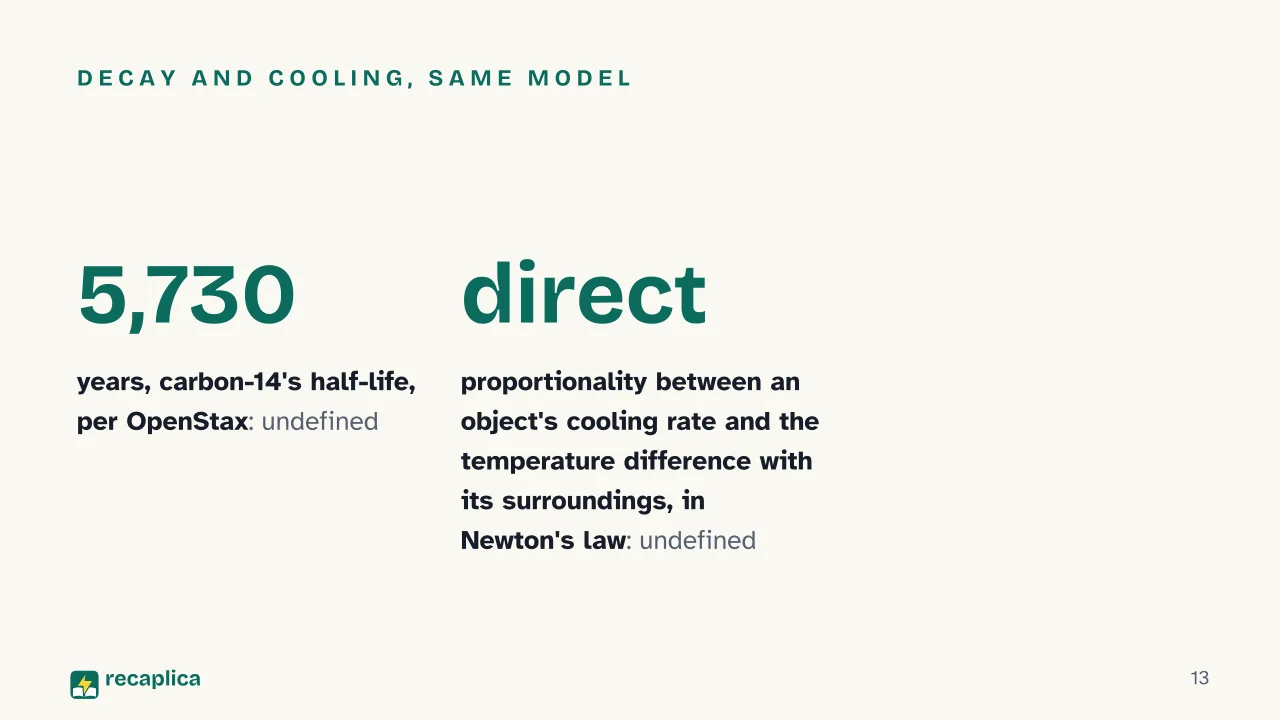
5,730 years The half-life of carbon-14, reported by OpenStax Calculus Volume 2. Source: OpenStax, Calculus Volume 2
Deep Dive
Unlike ordinary equations, the unknown here is a function, tied by the equation to one of its own derivatives. It belongs to the branch of mathematics known as calculus, and it describes phenomena that change over time.
Order and the general form
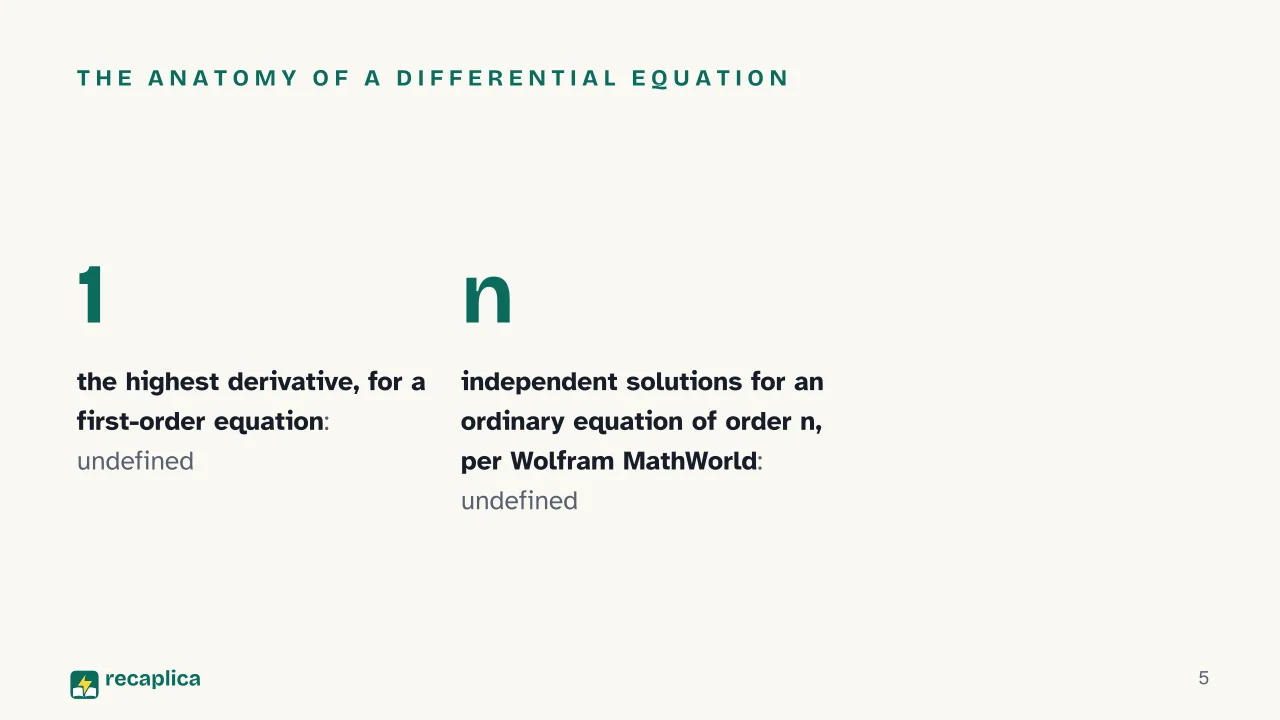
The order of a differential equation is set by the highest derivative that appears in it. An equation containing only a first derivative is first-order; one reaching a second derivative is second-order, and so on.
According to Wolfram MathWorld, the general form of an ordinary differential equation of order n is written F(x, y, y’, …, y^(n)) = 0, where the unknown function y and its derivatives up to order n appear together. “Ordinary” sets it apart from partial differential equations, which involve more than one independent variable and sit outside this Recap.
Solving a differential equation leads to the general solution: an entire family of functions carrying an arbitrary constant. An ordinary equation of order n has, in general, n solutions independent of each other, which is why it carries that many constants in its general solution. A particular solution comes from fixing that constant with extra information about the problem, such as a starting value.
How to solve them: separation of variables
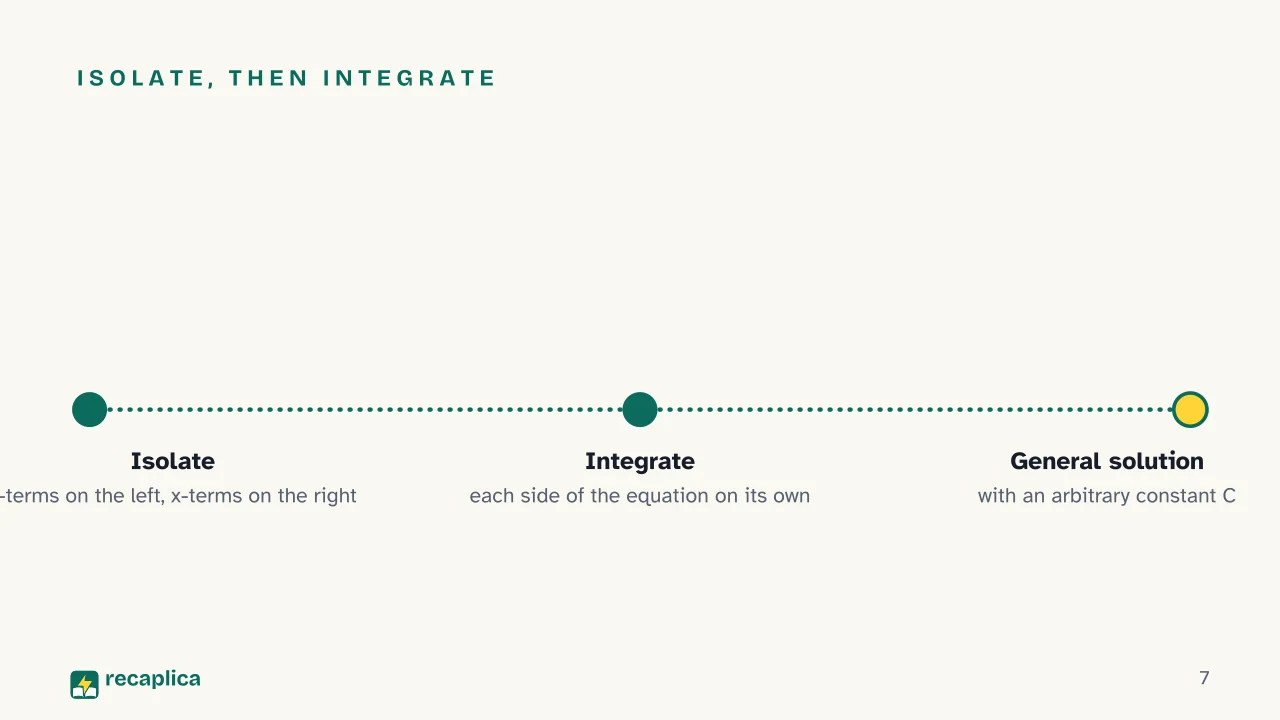
A differential equation is called separable when it can be written as a function of x alone multiplied by a function of y alone. In that case, separation of variables applies: every y-term moves to one side of the equation, every x-term to the other, and then both sides get integrated on their own.
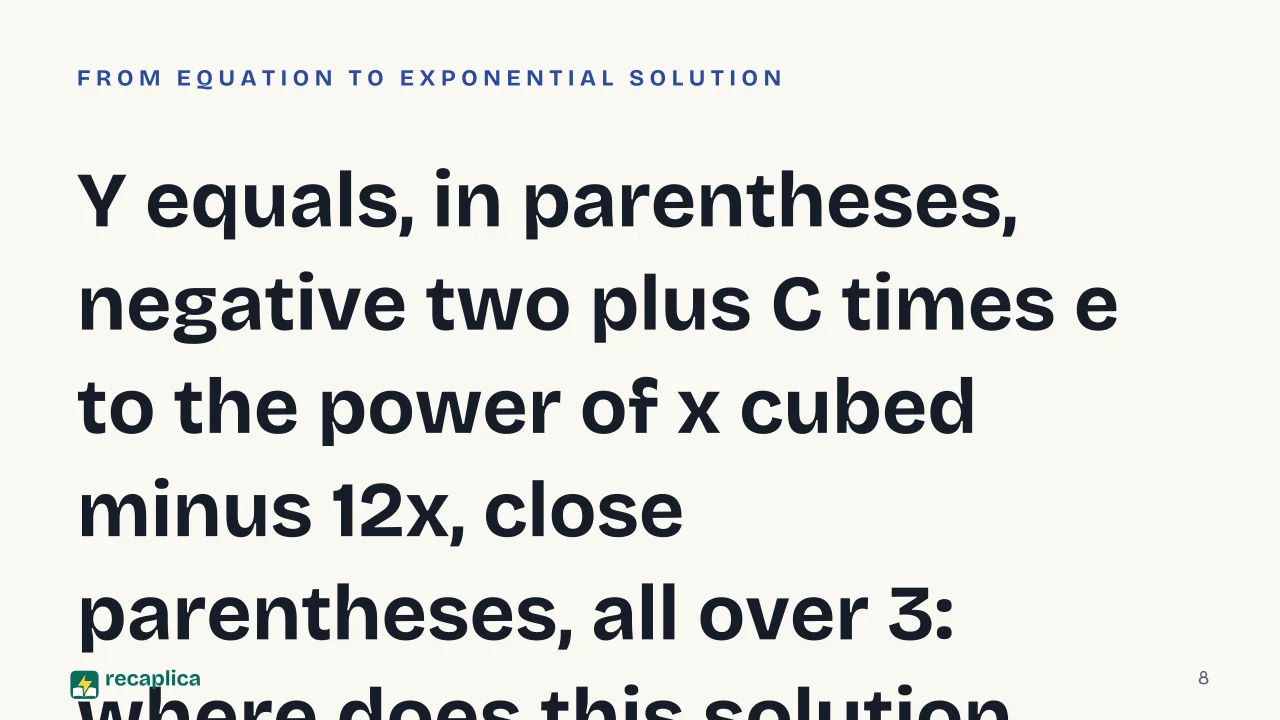
Worked example: take the equation y’ = (x²-4)(3y+2). The right-hand side is already a product of a function of x alone, (x²-4), and a function of y alone, (3y+2), so the equation is separable. Moving the y-terms to one side and the x-terms to the other, then integrating each side, produces the general solution y = (-2 + Ce^(x³-12x)) / 3, with C an arbitrary constant: changing C picks out a different function from within that same family of solutions.
Not every differential equation lends itself to this treatment: the method depends on that exact product structure, and equations without it call for other tools entirely. The Bernoulli differential equation, for instance, isn’t separable, but a specific substitution turns it into a solvable linear equation.
Where they show up: physics, biology, economics
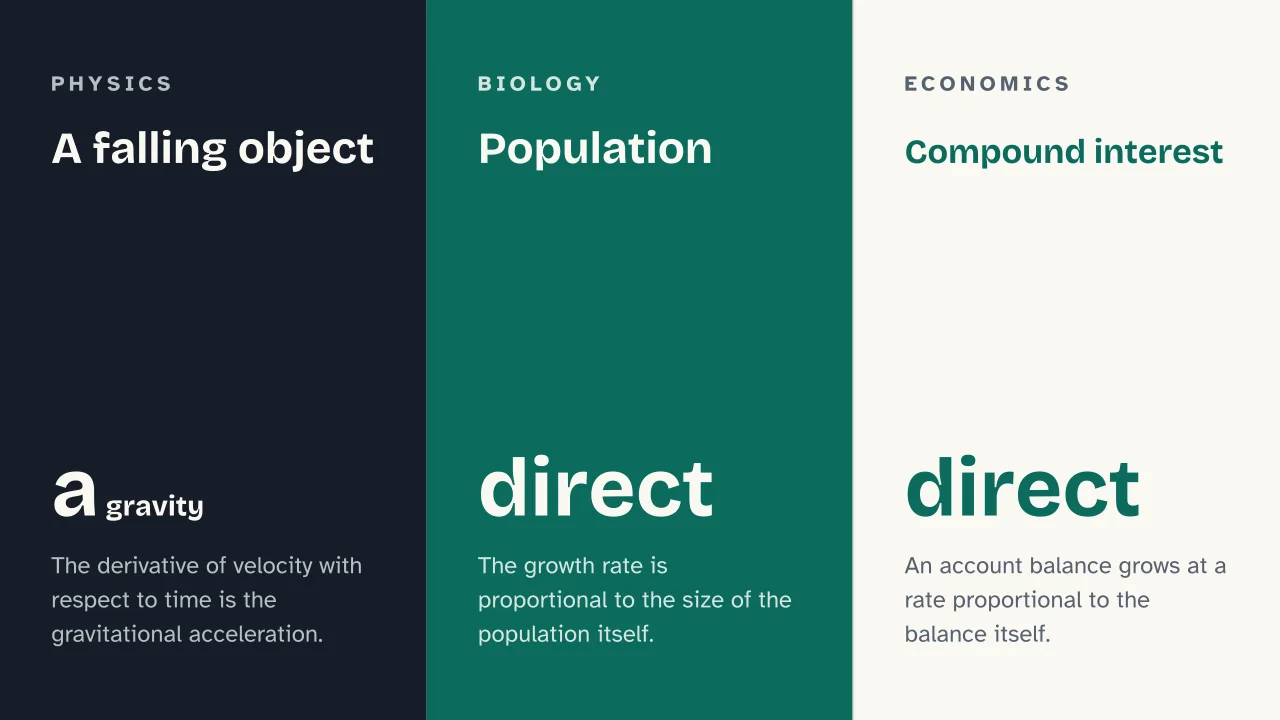
In physics, the motion of a falling object is written as a differential equation in which the derivative of velocity with respect to time equals gravitational acceleration. In biology, a basic population-growth model starts from the assumption that the growth rate is proportional to the population’s own size; that assumption leads straight to a first-order differential equation. Economics follows the same logic for continuous compound interest: an account balance grows at a rate proportional to the balance itself.
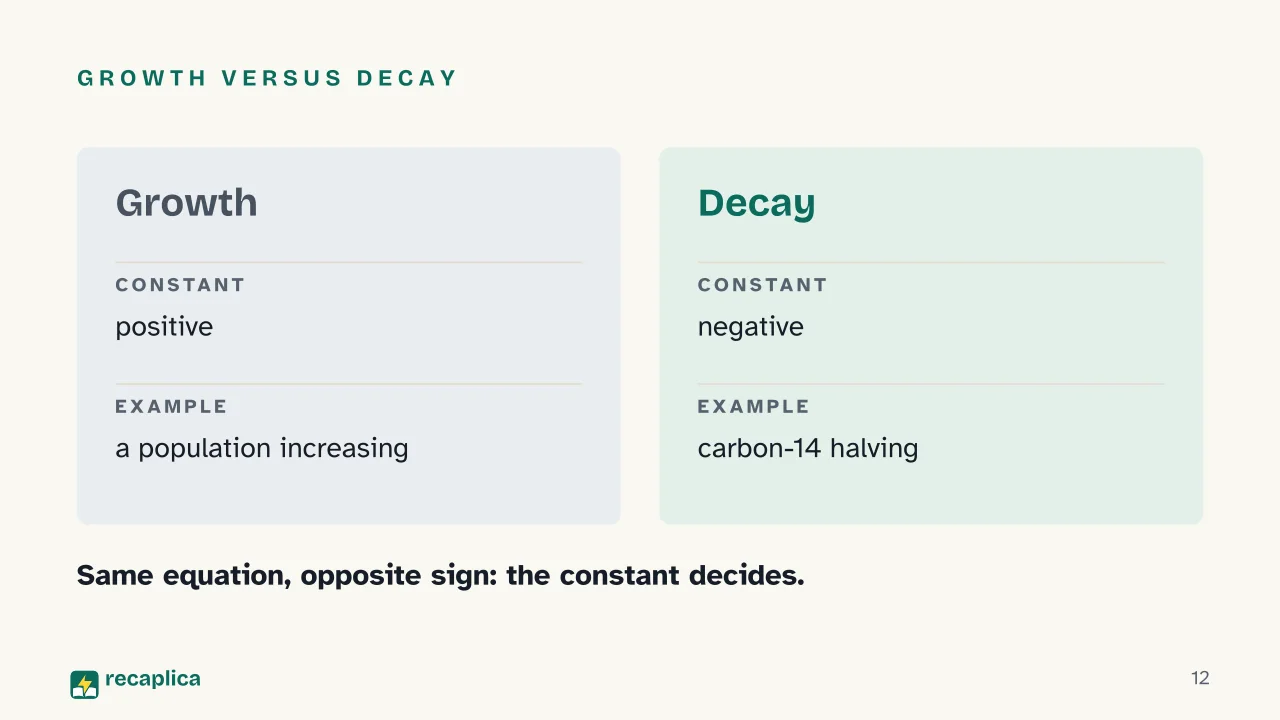
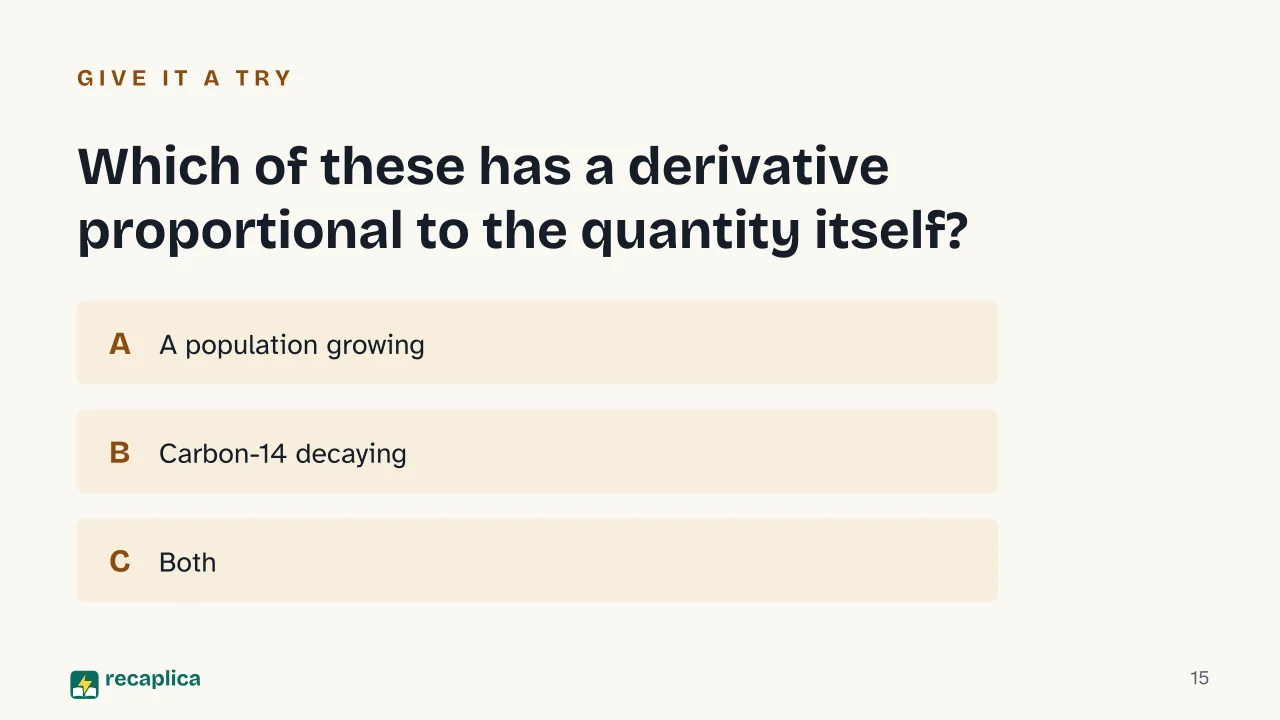
Exponential growth or decay is, in all three settings, a first-order differential equation where the derivative of a quantity is proportional to the quantity itself. Only the sign of the constant changes: positive for growth, negative for decay. Solving this kind of equation naturally produces an exponential function.
Radioactive decay and Newton’s law of cooling
For exponential decay, half-life is the time a quantity takes to drop by half. According to OpenStax, carbon-14 has a half-life of about 5,730 years — the textbook example of radioactive decay modeled with a differential equation, and the reason radiocarbon dating works at all.
Newton’s law of cooling models an object cooling down with a differential equation in which the cooling rate is proportional to the difference between the object’s temperature and that of its surroundings.
The four relationships covered so far, side by side:
Phenomenon
What the equation ties together
Sign of the constant
Population growth
derivative of the quantity, the quantity itself
positive
Radioactive decay (carbon-14)
derivative of the quantity, the quantity itself
negative
Newton’s cooling
cooling rate, temperature difference
negative
Continuous compound interest
derivative of the balance, the balance itself
positive
Slide deck
Slides ready to download and make your own in PowerPoint or Google Slides, with speaker notes. Pick the Flash cut or the Full one.
✗ Myth A common assumption is that every differential equation can be cracked with a formula, the way an algebraic equation can.
✓ Reality Separation of variables only works under one specific condition: the equation has to break down into a piece that depends solely on x and another that depends solely on y. Outside that case, the technique simply doesn't apply, and other tools are needed.
✗ Myth Differential equations can look like a closed chapter from a calculus textbook, with no real-world use.
✓ Reality OpenStax shows the same equation describing a falling object, a growing population, and a bank balance earning continuous interest — three unrelated settings, one shared structure.
✗ Myth Solving a differential equation is assumed to land on one exact answer, the way an algebraic equation does.
✓ Reality What comes out is a general solution with an open constant; it only narrows to one particular answer once an extra condition, such as a starting value, pins that constant down.
Mind map
Drag the background to move around and the nodes to reposition them; use − and + to collapse and expand branches.
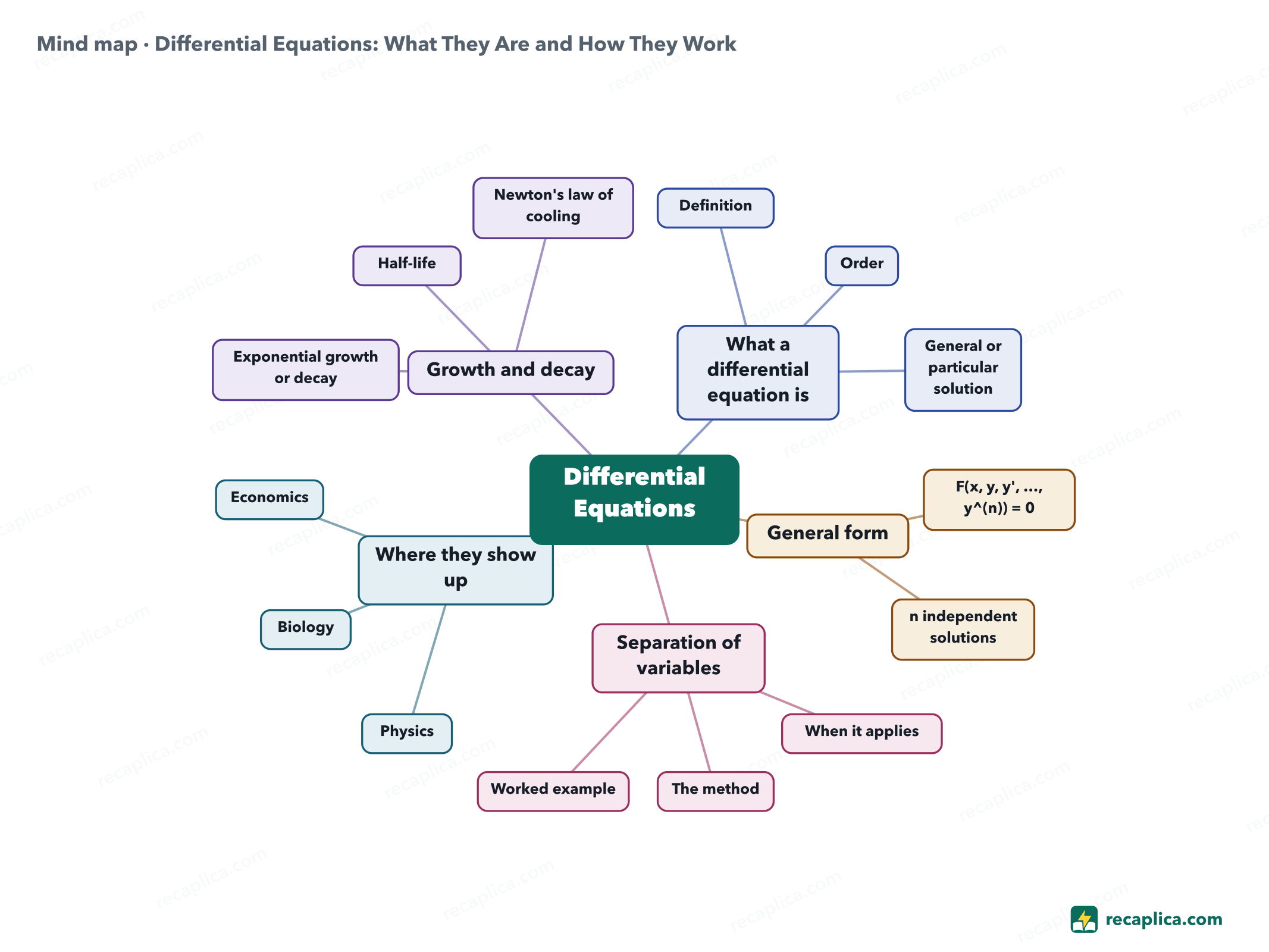
Definitionan unknown function plus at least one derivative
Orderthe order of the highest derivative present
General or particular solutionthe arbitrary constant, fixed or not
General form
F(x, y, y', …, y^(n)) = 0the unknown function and its derivatives up to order n
n independent solutionsfor an ordinary equation of order n
Separation of variables
When it appliesthe equation is a product of a function of x and a function of y
The methody terms on one side, x terms on the other, then integrate
Worked exampley' = (x²-4)(3y+2)
Where they show up
Physicsa falling object
Biologya growing population
Economicscontinuous compound interest
Growth and decay
Exponential growth or decayderivative proportional to the quantity itself
Half-lifecarbon-14, about 5,730 years
Newton's law of coolingproportional to the temperature difference with the surroundings
Quiz: test yourself
Answer the questions to check what you have learned: you get instant feedback and a short explanation.
Grade0/100/5
Answers: 1-A · 2-B · 3-C · 4-A · 5-B
Flashcards
Tap the card to flip it and check whether you remember the answer, then move to the next one.
1 / 7
Explain it in your own words
The ultimate test: if you can explain it in simple words, you've truly understood it. Write your explanation, then compare it with the Recap.
Your explanation is saved only on this device.
A differential equation ties an unknown function to at least one of its own derivatives. Its order is set by whichever derivative in the equation is the highest one present: only a first derivative means a first-order equation. Solving one doesn't produce a single number but a whole family of functions, carrying an arbitrary constant that gets pinned down once some extra piece of information about the problem is known. Equations like this describe quantities that change over time: a falling object, a growing population, a decaying radioactive element, a balance that earns interest.
Frequently asked questions
What's the difference between a regular equation and a differential equation?
A regular equation looks for a number that satisfies it; a differential equation looks for a function, and it includes at least one of that function's derivatives.
What is the order of a differential equation?
Check which derivative is the highest one written in the equation — that's its order.
When can separation of variables be used?
First check whether the equation splits into a piece involving only x and a piece involving only y. If it does, gather every y-term on one side and every x-term on the other, then integrate each side on its own.
What are differential equations actually used for?
They model a falling object in physics, a growing population in biology, the decay of carbon-14, an object cooling down, and a balance growing under continuous compound interest.
Every Recap goes through an independent review before publication.
Statistics, only if you say so
To learn which Recaps help most we would use Google Analytics, with aggregate, anonymous data. It starts only with your OK, and you can change your mind anytime. Privacy policy