recaplica
Clear in 30 seconds, yours in 10 minutes.
In 30 seconds quick read
The Bernoulli differential equation is a nonlinear differential equation that shows up in math courses, distinct from the Bernoulli principle studied in fluid physics. It takes the form y' + p(x)y = q(x)y^n, where n can be any real exponent. When n equals 0 or 1, the standard method for a linear equation already works. For every other value of n, the substitution v = y^(1-n) turns it into a first-order linear equation in v, solvable with the integrating factor; once v is found, substituting back v = y^(1-n) returns y. The final answer sometimes stays written as an integral, because it does not always reduce to a tidy formula.
Key Points
The exponent n in the Bernoulli equation can be any real number, whole or fractional; p(x) and q(x) must stay continuous across the interval being studied.
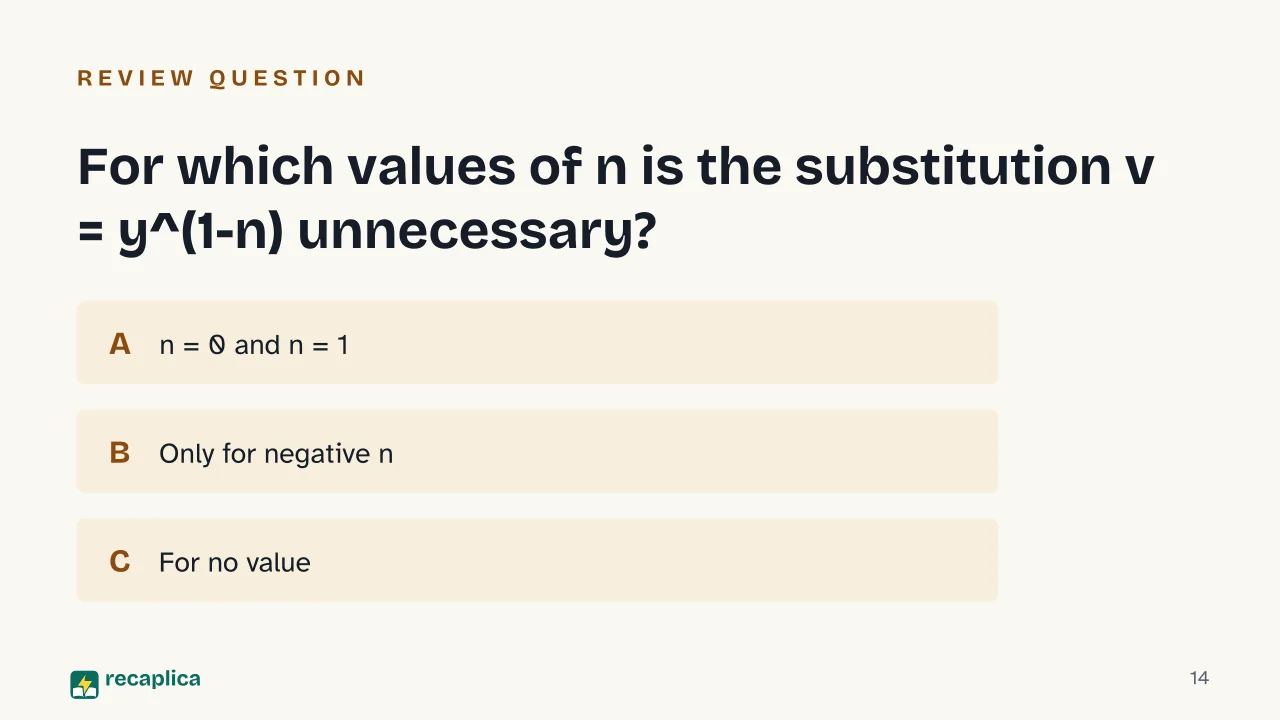
When n equals 0 or 1, the equation is already linear (for n = 1 it is also separable): no substitution is needed.
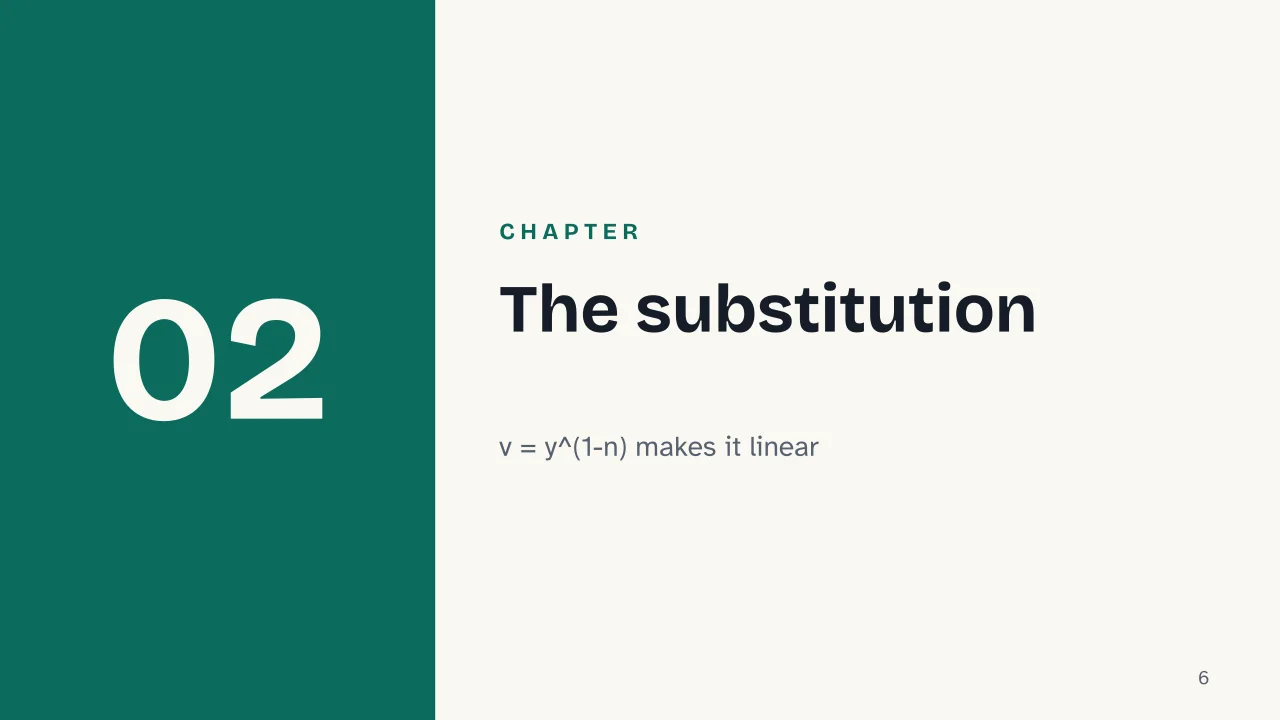
The substitution v = y^(1-n) replaces the exponent n with a new function v that follows a first-order linear equation.
That linear equation in v is solved with the integrating factor, the same tool used for any first-order linear equation.
Once v is found, the last step substitutes back v = y^(1-n) and solves for y, returning to the original function.
Not every Bernoulli equation ends in a tidy solution: in some cases the result stays tied to an integral with no elementary form.
Deep Dive
Jacob Bernoulli, not Daniel’s principle
The Bernoulli differential equation appears in courses on ordinary differential equations and carries the name of the Swiss mathematician Jacob Bernoulli (1654-1705). It is a topic in mathematics: the Bernoulli principle in fluid physics belongs to Daniel Bernoulli, a relative of Jacob, and shares only the surname with this equation. For the broader picture of this type of equation, before the specific case covered in this Recap, see differential equations.
The general form and the role of the exponent n
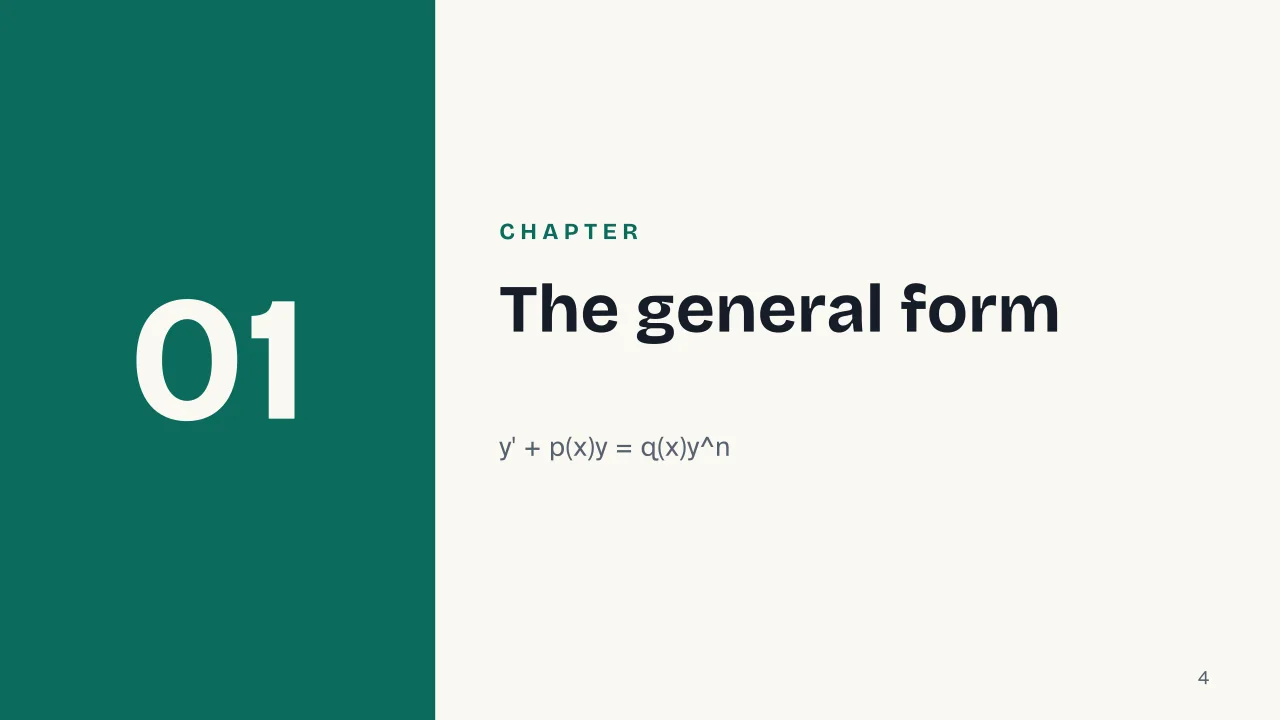
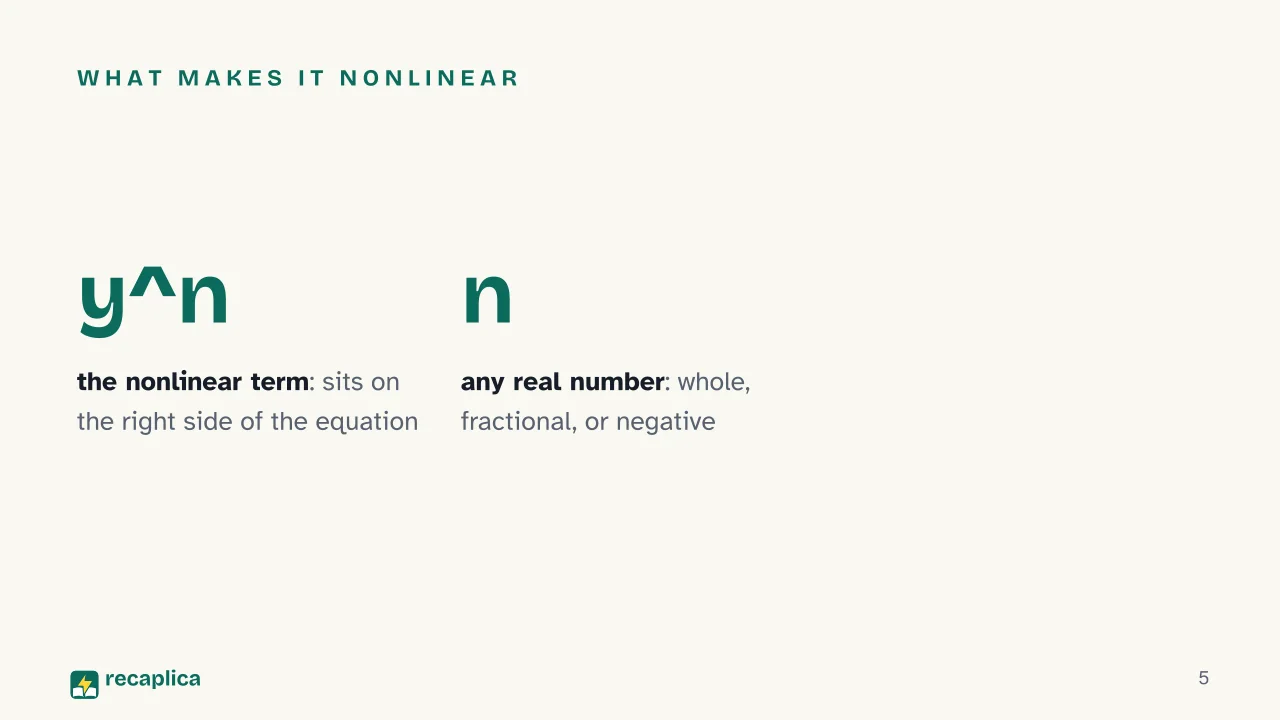
According to Paul’s Online Math Notes (Lamar University), Wolfram MathWorld, and Mathematics LibreTexts, the Bernoulli equation is written y’ + p(x)y = q(x)y^n, with p(x) and q(x) continuous functions on the interval considered and n any real number: whole, fractional, or negative. The exponent n determines whether the equation is already linear. When n equals 0 or 1, the equation is a special case of the first-order linear equation (and for n = 1 it is also separable), solvable with the standard methods of calculus: here the substitution is not needed. For any other value of n the equation is nonlinear, which is where the substitution technique described below comes in.
The method, step by step
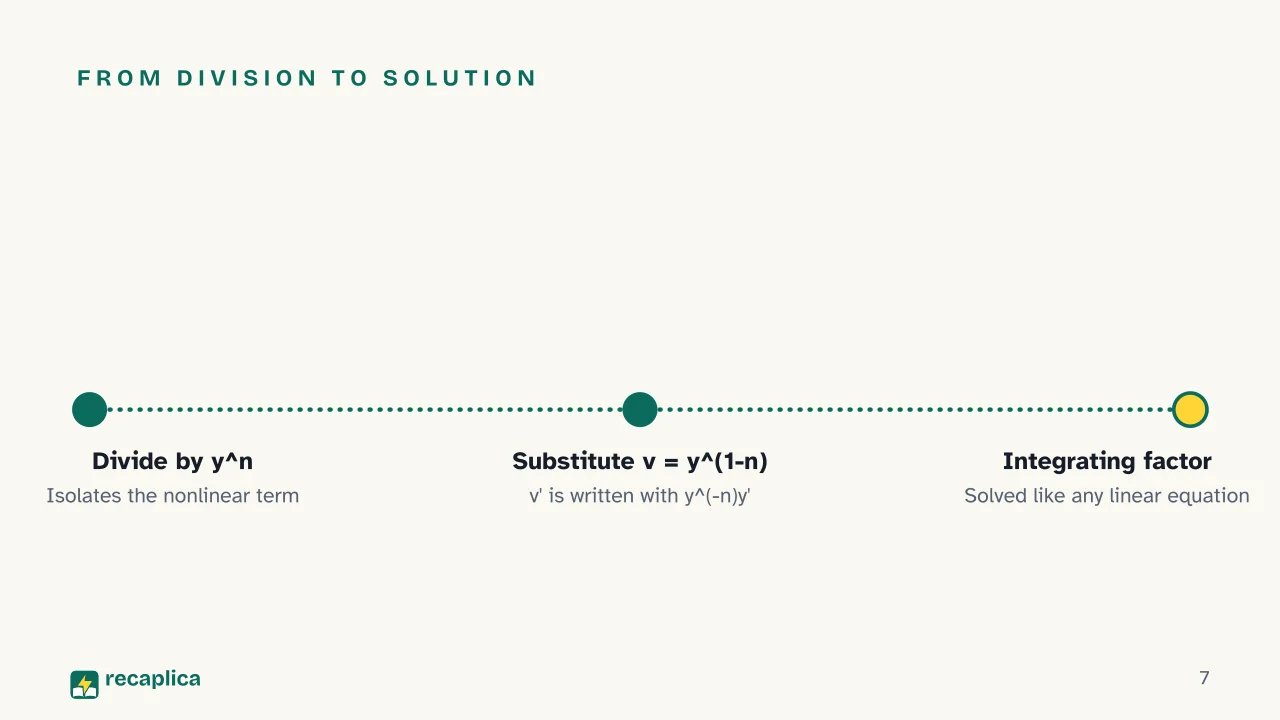
The procedure reduces the nonlinear equation to a linear equation in a different function. It starts by dividing the whole equation by y^n: the result is y^(-n)y’ + p(x)y^(1-n) = q(x), a step of pure symbolic manipulation similar to what is covered in algebra. At this point the substitution v = y^(1-n) is introduced. Differentiating v with respect to x gives v’ = (1-n)y^(-n)y’, a relation that lets the derivative term be replaced. The equation becomes a first-order linear equation in the function v, in the form v’ + (1-n)p(x)v = (1-n)q(x): the notion of linearity here is the same one studied in linear algebra, every term first-degree in the unknown and its derivative. From here it is solved like any linear equation, with the integrating factor. Once the linear equation is solved, substituting back v = y^(1-n) gives y, the function sought from the start.
An example with a closed-form solution
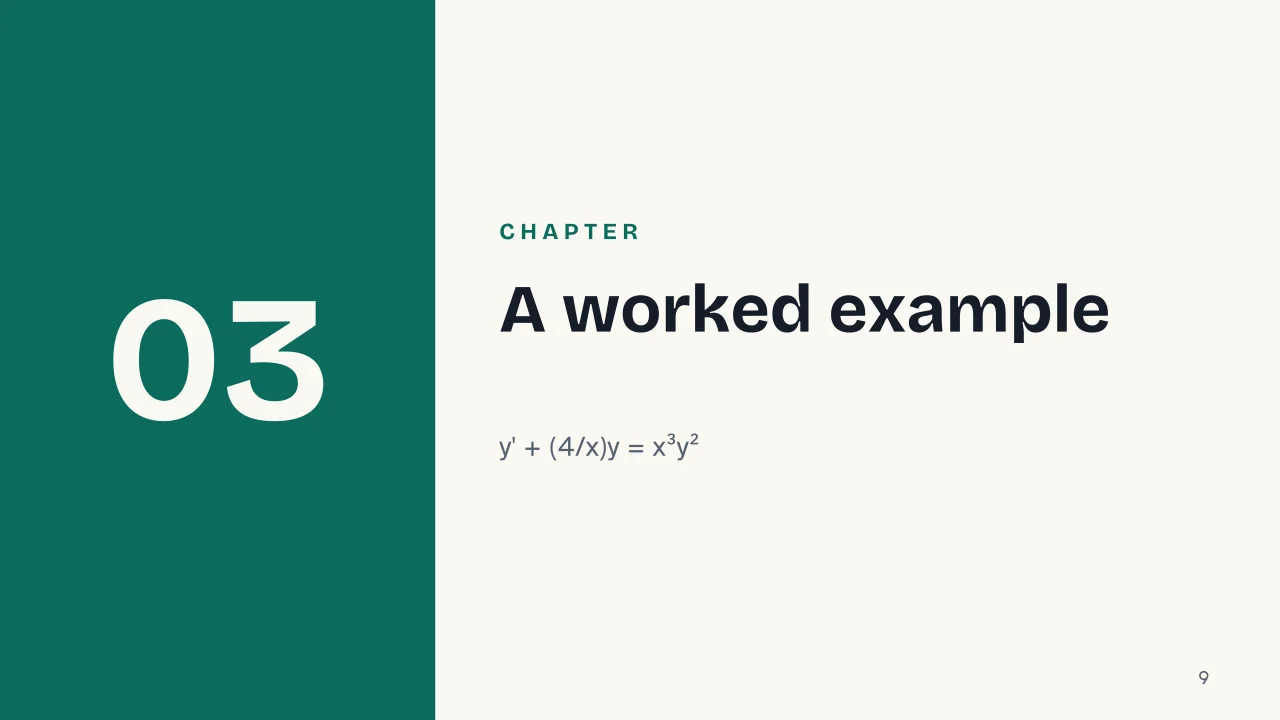
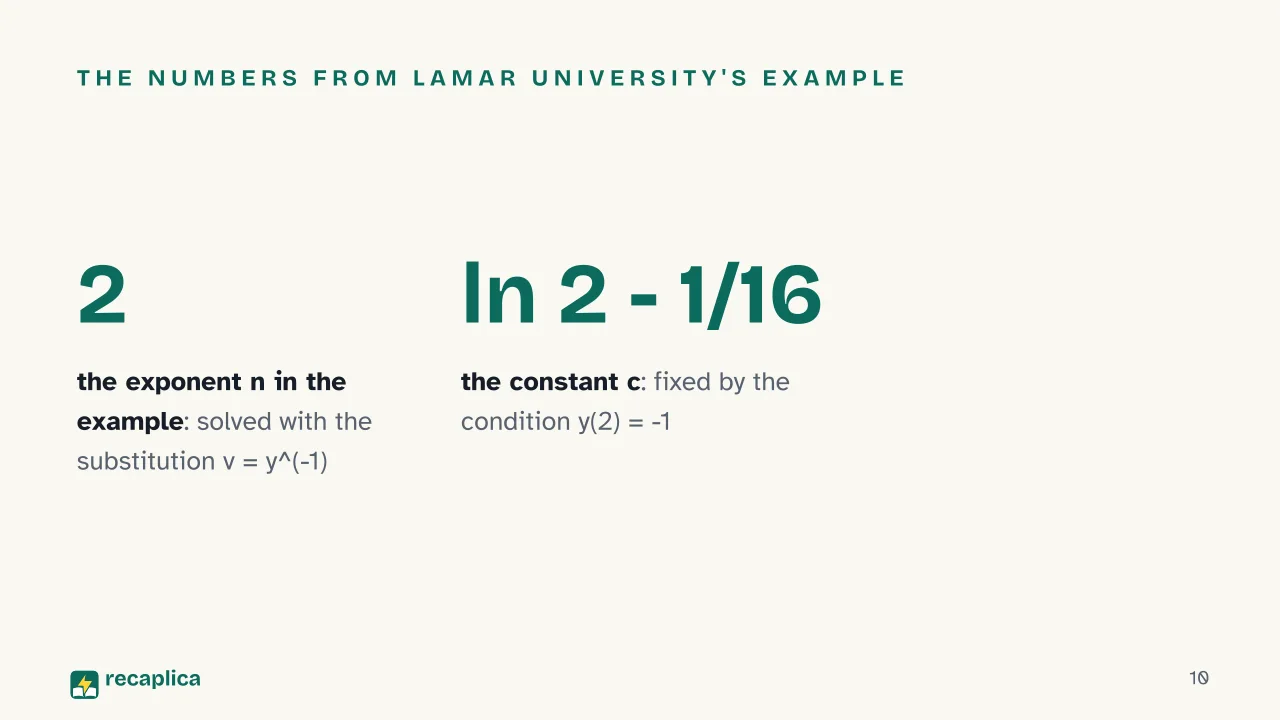
Worked example: Paul’s Online Math Notes solves y’ + (4/x)y = x³y², with the initial condition y(2) = -1 and x > 0. Here n = 2. Dividing by y² gives y^(-2)y’ + (4/x)y^(-1) = x³; with v = y^(-1) and v’ = -y^(-2)y’, the equation becomes v’ - (4/x)v = -x³, linear in v. The integrating factor is x^(-4), and the solution in v comes out as v(x) = cx⁴ - x⁴ ln x. Returning to y (v = y^(-1)) gives y^(-1) = x⁴(c - ln x). The initial condition y(2) = -1 fixes c = ln 2 - 1/16, and the final solution is y(x) = -16 / [x⁴(1 + 16 ln(x/2))].
The example shows the full sequence: divide, substitute, solve the linear equation with the integrating factor, return to y, and use the initial condition only at the end to fix the constant.
An example without a closed-form solution
Worked example: Mathematics LibreTexts solves xy’ + y(x+1) + xy⁵ = 0, with y(1) = 1. Here n = 5, and the substitution is v = y^(-4), with v’ = -4y^(-5)y’. After the substitution and rearranging terms, the equation becomes v’ - [4(x+1)/x]v = 4, still linear in v. The source notes that the integral needed to solve this linear equation has no elementary closed form, so the solution stays written with that integral.
The method works the same way every time, even when the final result stays awkward. The substitution always reduces the original equation to a linear one; whether that linear equation, once solved, turns back into a simple formula in y depends on the original equation itself.
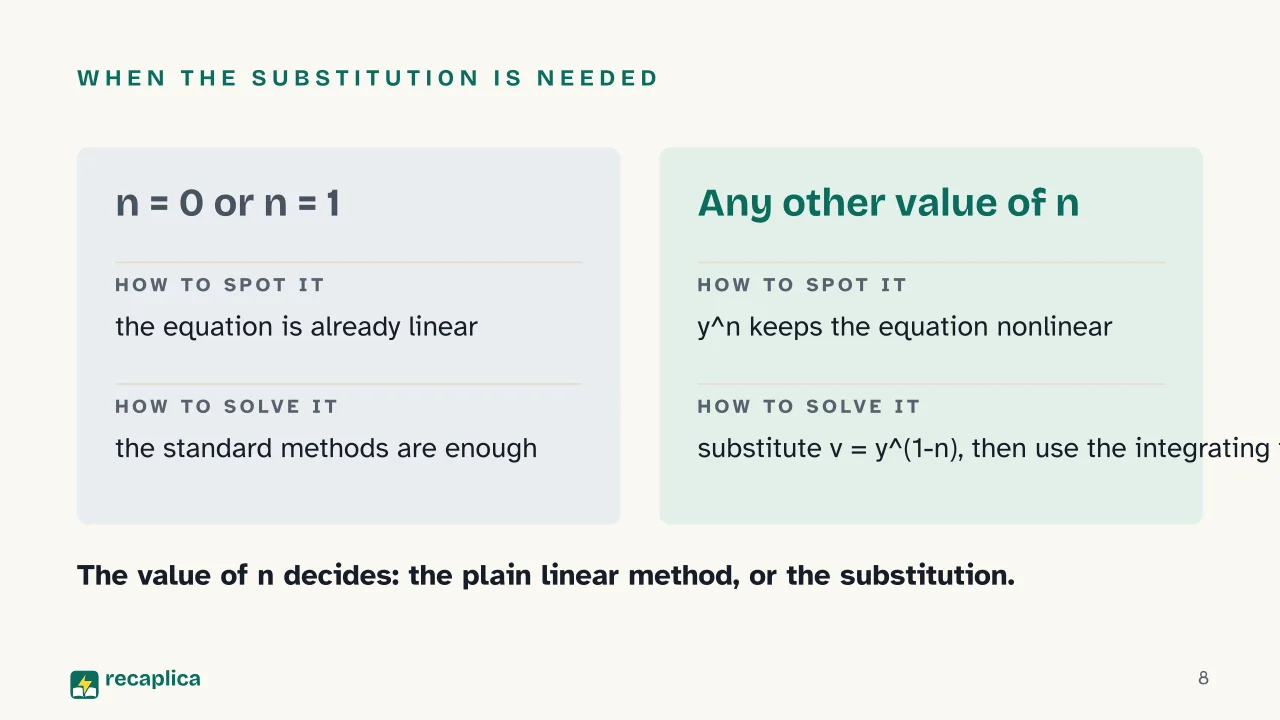
Case
How to spot it
Solving move
n = 0 or n = 1
the equation is already linear (and separable for n = 1)
the standard methods solve it on their own
n other than 0 and 1
y^n keeps the equation nonlinear
substitute v = y^(1-n), then use the integrating factor
Where the name comes from
Wolfram MathWorld places the Bernoulli equation among the standard reference texts on differential equations: a textbook topic, not an isolated result. Mathematics LibreTexts notes that the name “Bernoulli equation” has been used in the literature for more than one equation, part of why it gets confused with the fluid physics principle. That physics principle, due to Daniel Bernoulli, describes the behavior of a moving fluid and is not the differential equation covered here, which instead carries the name of Jacob Bernoulli, another member of the same family of Swiss mathematicians and physicists.
Slide deck
Slides ready to download and make your own in PowerPoint or Google Slides, with speaker notes. Pick the Flash cut or the Full one.
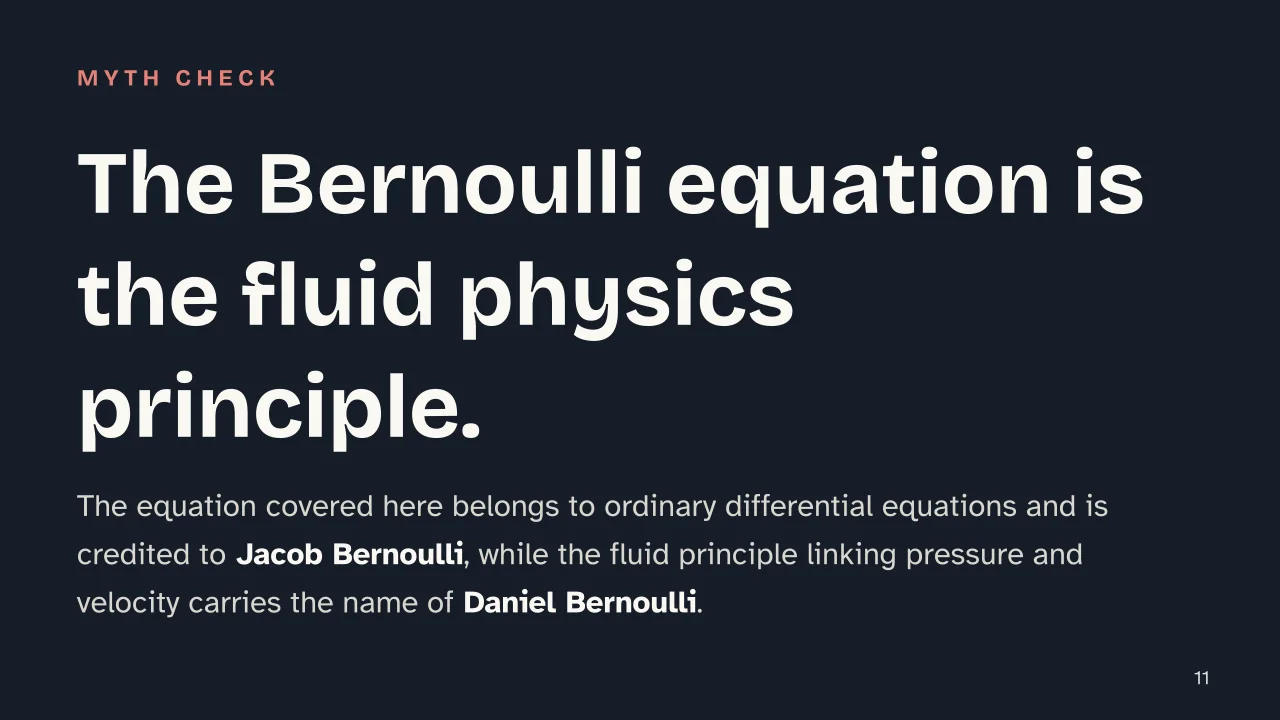
✗ Myth The Bernoulli differential equation is the same topic as the Bernoulli principle in physics.
✓ Reality The equation covered here belongs to ordinary differential equations and is named after the Swiss mathematician Jacob Bernoulli; the principle studied in fluid physics, which links pressure and velocity, is named after a different member of the same family, Daniel Bernoulli.
✗ Myth The substitution v = y^(1-n) is needed to solve every equation of the form y' + p(x)y = q(x)y^n.
✓ Reality That substitution only matters when n is different from 0 and from 1. In those two cases the equation is already linear, and for n = 1 it is also separable: the standard methods are enough on their own.
✗ Myth Once the linear equation in v is solved, the final answer for y is always a simple formula.
✓ Reality Mathematics LibreTexts shows a case where, after solving the linear equation in v, the result needs an integral with no elementary form: the final y stays tied to that integral instead of a compact formula.
Mind map
Drag the background to move around and the nodes to reposition them; use − and + to collapse and expand branches.
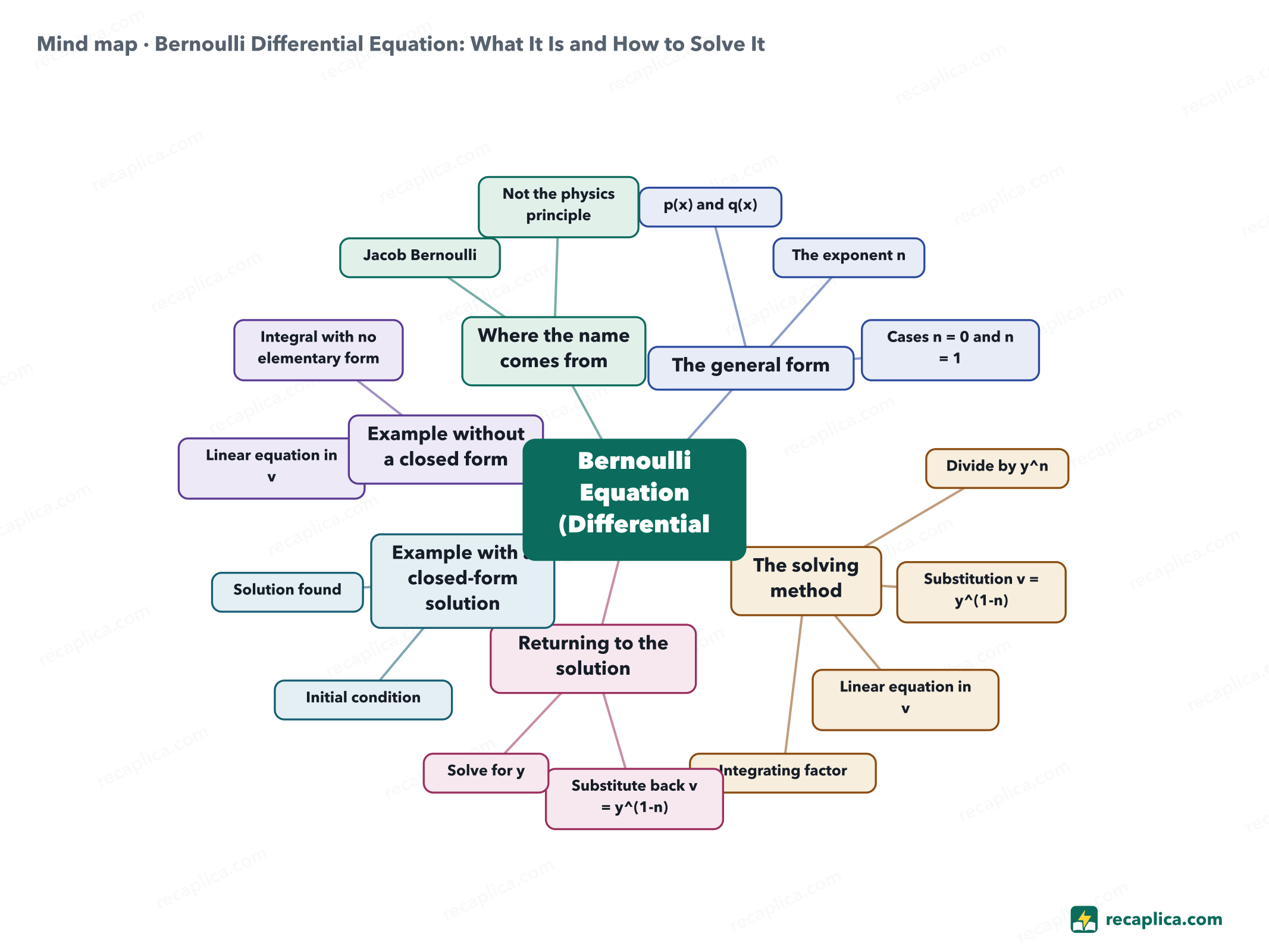
p(x) and q(x)Continuous functions on the interval considered
The exponent nAny real number, not necessarily an integer
Cases n = 0 and n = 1Already a linear equation, no substitution needed
The solving method
Divide by y^nIsolates the nonlinear term
Substitution v = y^(1-n)
Linear equation in v
Integrating factorSolved like any linear equation
Returning to the solution
Substitute back v = y^(1-n)
Solve for y
Example with a closed-form solutiony' + (4/x)y = x³y²
Initial conditiony(2) = -1
Solution foundy(x) = -16 / [x⁴(1 + 16 ln(x/2))]
Example without a closed formxy' + y(x+1) + xy⁵ = 0
Linear equation in vv = y^(-4)
Integral with no elementary form
Where the name comes from
Jacob BernoulliSwiss mathematician, 1654-1705
Not the physics principleThat one belongs to Daniel Bernoulli
Quiz: test yourself
Answer the questions to check what you have learned: you get instant feedback and a short explanation.
Grade0/100/5
Answers: 1-A · 2-A · 3-A · 4-A · 5-A
Flashcards
Tap the card to flip it and check whether you remember the answer, then move to the next one.
1 / 8
Explain it in your own words
The ultimate test: if you can explain it in simple words, you've truly understood it. Write your explanation, then compare it with the Recap.
Your explanation is saved only on this device.
The Bernoulli differential equation is a nonlinear differential equation that shows up in math courses, distinct from the Bernoulli principle studied in fluid physics. It takes the form y' + p(x)y = q(x)y^n, where n can be any real exponent. When n equals 0 or 1, the standard method for a linear equation already works. For every other value of n, the substitution v = y^(1-n) turns it into a first-order linear equation in v, solvable with the integrating factor; once v is found, substituting back v = y^(1-n) returns y. The final answer sometimes stays written as an integral, because it does not always reduce to a tidy formula.
Frequently asked questions
What is the difference between the Bernoulli differential equation and the Bernoulli principle in physics?
The fluid principle, due to Daniel Bernoulli, belongs to physics: it describes how pressure and velocity of a fluid change together along its motion. The differential equation covered here is named after the Swiss mathematician Jacob Bernoulli, a relative of Daniel, and belongs to a different subject altogether.
How do you recognize a Bernoulli equation?
It must match the pattern y' + p(x)y = q(x)y^n: p and q are continuous functions, and the exponent n can be any real number. If n equals 0 or 1 the equation is already linear; for any other value the substitution v = y^(1-n) is needed.
Why does the substitution v = y^(1-n) work?
Dividing the equation by y^n and introducing v = y^(1-n) makes the derivative v' take the place of y^(-n)y' in the original equation. The result is a first-order linear equation in the new function v, solvable with the integrating factor.
Does a Bernoulli equation always have a simple formula as its solution?
Not always: in an example from Mathematics LibreTexts, the linear equation found for v is solved only with an integral that has no elementary form, and the final solution is left written that way.
Who first studied the Bernoulli equation?
The name is credited to the Swiss mathematician Jacob Bernoulli (1654-1705). Wolfram MathWorld places its treatment among the standard reference texts on differential equations; Mathematics LibreTexts notes that more than one equation has carried the same name across different eras.
Every Recap goes through an independent review before publication.
Statistics, only if you say so
To learn which Recaps help most we would use Google Analytics, with aggregate, anonymous data. It starts only with your OK, and you can change your mind anytime. Privacy policy