|
recaplica
Conic Sections: What They Are and How to Tell Them Apart | |||||||||||||||
| © 2026 Recaplica · recaplica.com — All rights reserved | |||||||||||||||
Conic Sections: What They Are and How to Tell Them ApartWhat to print Page numbers appear when printing with default margins. SlidesChoose a cut Flash10 slidesThe essential thread, to present in classFull15 slidesEvery chapter and the deeper detailBoth come with speaker notes. In 30 seconds quick readConic sections are the curves you get by slicing a cone with a plane, and there are four of them: the circle, the ellipse, the parabola and the hyperbola. What changes from one to the next is the tilt of the cut and how many halves of the cone the plane goes through. The four can also be pinned down in one stroke, by a number called eccentricity: it is 0 for the circle, between 0 and 1 for the ellipse, exactly 1 for the parabola and above 1 for the hyperbola. Credit for finding these shapes generally goes to the Greek mathematician Menaechmus, who lived around 380-320 BC. Key Points
Deep DiveOne cone, one plane, four curvesA conic section is the curve left behind where a plane cuts through one or both nappes of a cone, which are the two halves meeting at its tip: the name describes the procedure. Hold the plane perpendicular to the axis of the cone and the intersection is a circle. Tilt it so that it stays inside a single nappe and what comes out is an ellipse or a parabola, depending on how steeply it leans. Push the tilt far enough that the plane goes through both nappes, and the curve drawn on it is a hyperbola. The same family of curves can be recognised from the algebra too, on the ground of analytic geometry: every conic section satisfies a general quadratic equation of the form ax² + 2bxy + cy² + dx + fy + g = 0, one of those second-degree equations in which the unknowns show up squared as well. According to MathWorld there is also a way to define all four curves at once, with a single parameter. Pick a point F, called the focus, and a line d, called the directrix: a conic section is then the set of points P for which the distance from P to F divided by the distance from P to d always comes out the same. That constant is the eccentricity, and its value separates the cases: 0 for the circle, between 0 and 1 for the ellipse, exactly 1 for the parabola, above 1 for the hyperbola. From Menaechmus to the rings of SaturnThe discovery of these shapes is generally credited to Menaechmus, a Greek mathematician who lived around 380-320 BC: by intersecting a plane with a right circular cone and changing the steepness of the plane, he obtained different figures, carrying an almost perfect symmetry. Aristotle may have had an intuitive grasp of them before him, since he had described the orbit of a planet as circular. The correction on that point arrived much later, with Kepler, who observed that planetary orbits do not in fact have a circular shape and established that planets travel an oval, that is elliptical, orbit around the Sun: the result studied alongside Kepler’s three laws of planetary motion. In the 1800s Maxwell and Kovalevskaya added a piece to the celestial chapter, showing that the rings of Saturn, compact as they look, are made of small particles rather than one solid continuous body. Side by side, the differences fit into two columns: the angle of the cut and the value of the eccentricity.
The three open curves, one by oneAn ellipse is the set of points of the plane for which the distances to two fixed points, the foci, add up to a constant total; centred at the origin and with the major axis horizontal it is written x²/a² + y²/b² = 1, with a greater than b. Among the real cases OpenStax lists the orbits of planets, moons, comets and satellites, and then shapes closer to the ground: the keels of certain boats, rudders, the wings of some aircraft.
A hyperbola collects every point whose two distances to the foci differ, in absolute value, by a positive constant; with its centre at the origin and the transverse axis horizontal its equation reads x²/a² - y²/b² = 1. The shape turns up in heavy engineering as well: hyperboloid cooling towers are designed this way because they hold against extreme winds while taking less construction material.
A parabola holds together the points that lie equally far from a fixed line, the directrix, and from a fixed point outside it, the focus. Its profile comes back in satellite dishes and telescopes, in microphones and spotlights, in car headlights and suspension bridges. Anyone who wants the school case worked through step by step will find the equation and the graph in the Recap on the parabola and the quadratic equation.
All this apparatus of foci, directrices and axes rests on an older frame, the Euclidean geometry of the Elements, where points and lines receive their first definitions. Slide deckSlides ready to download and make your own in PowerPoint or Google Slides, with speaker notes. Pick the Flash cut or the Full one.     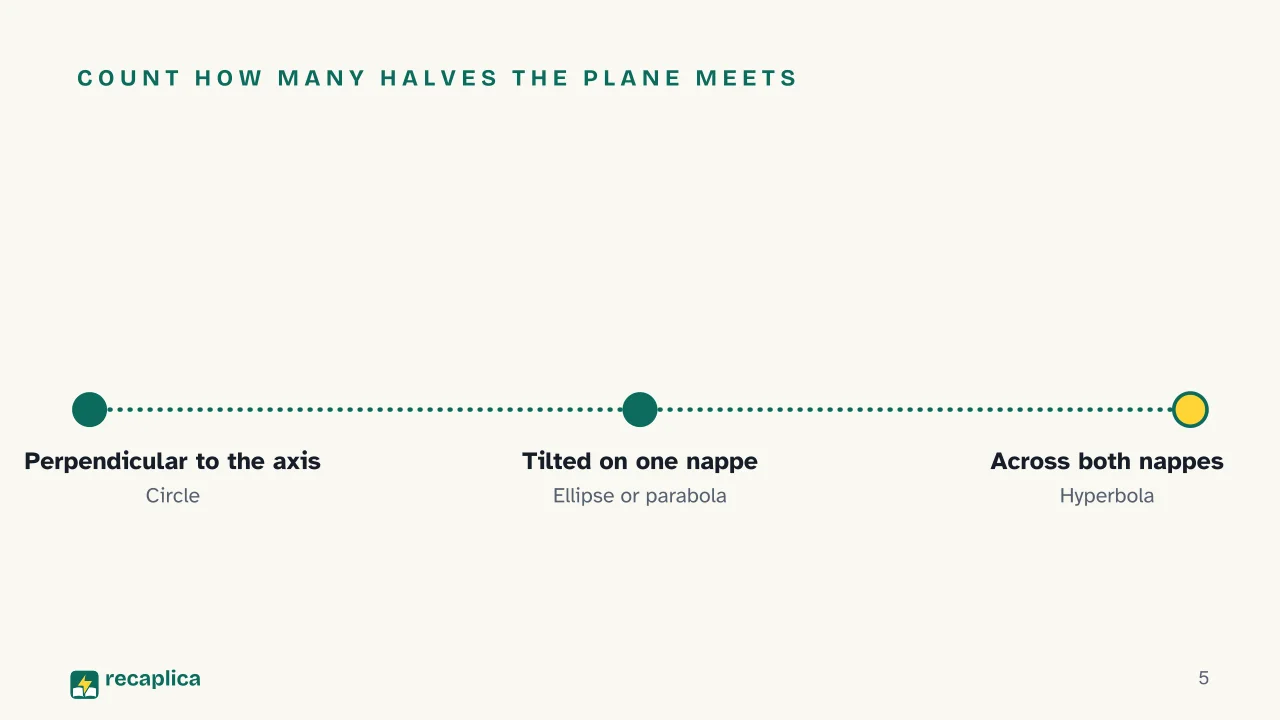  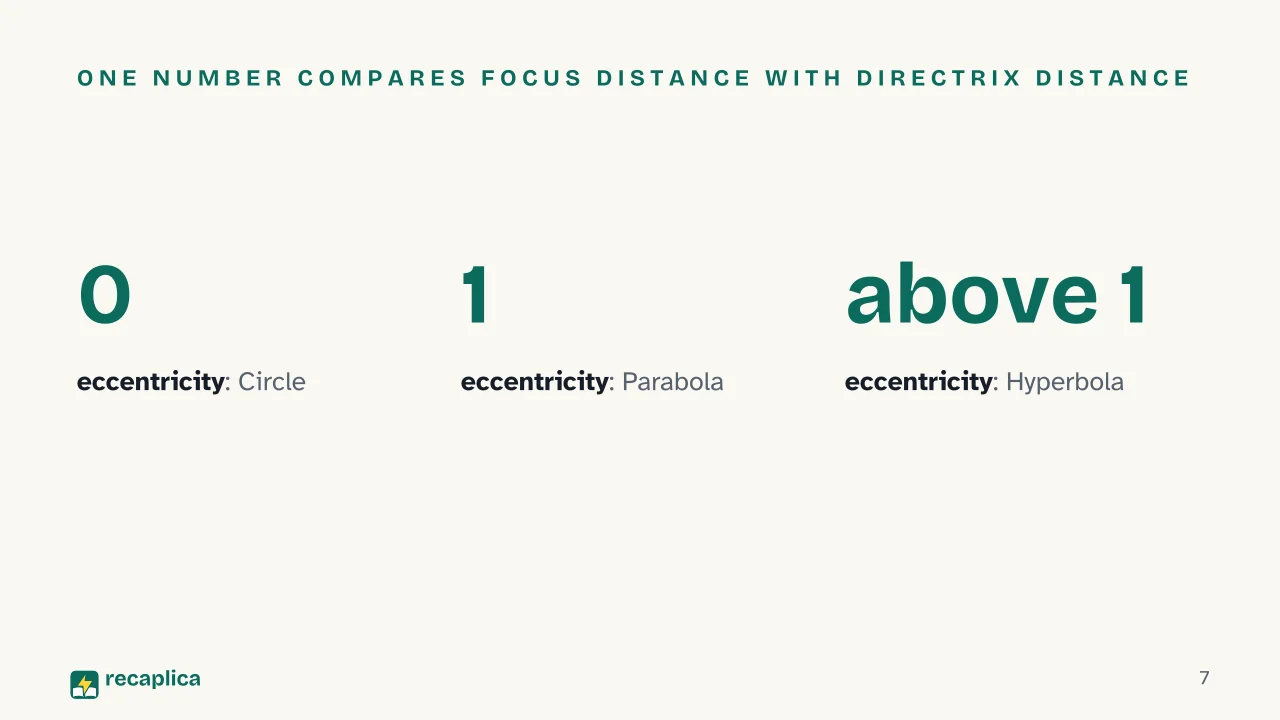  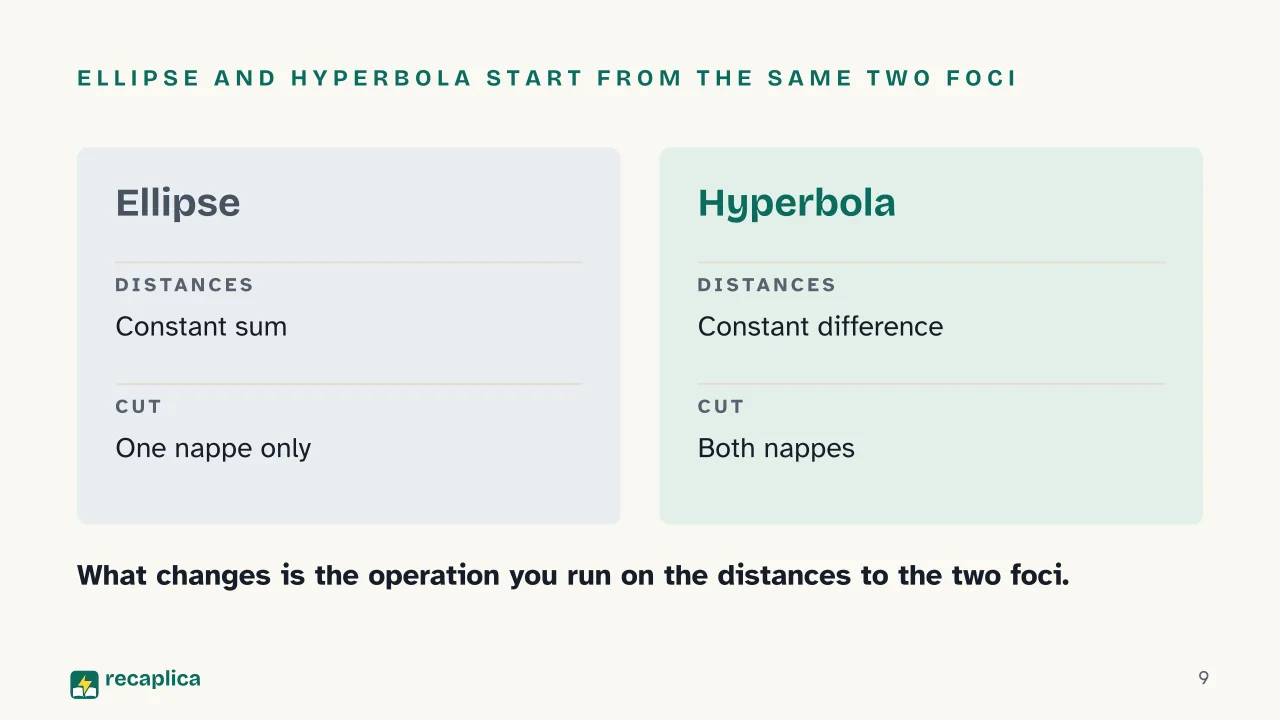 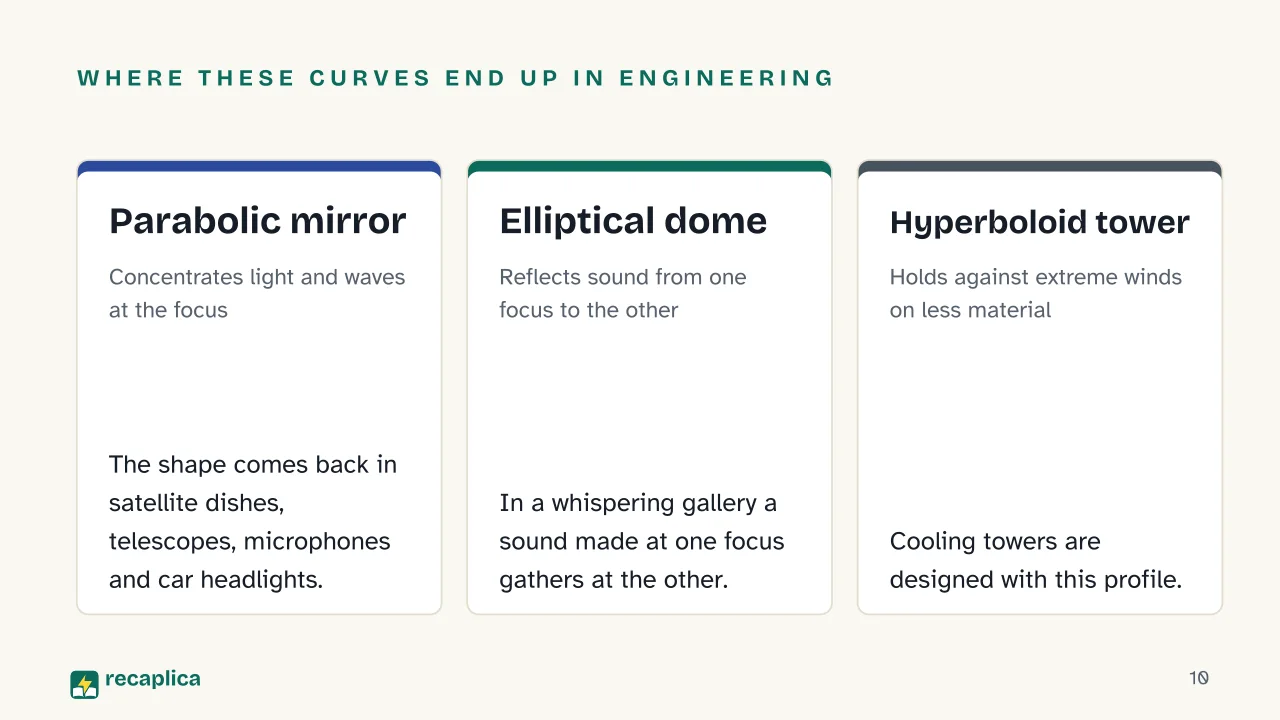 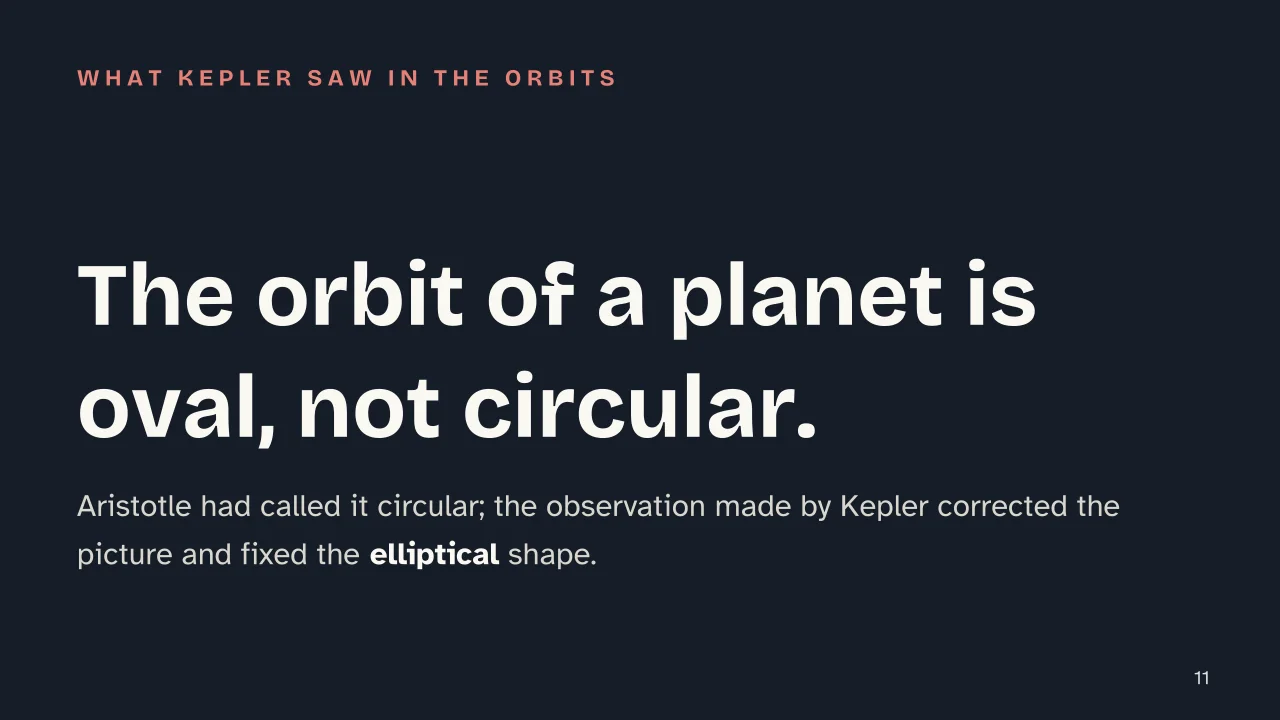  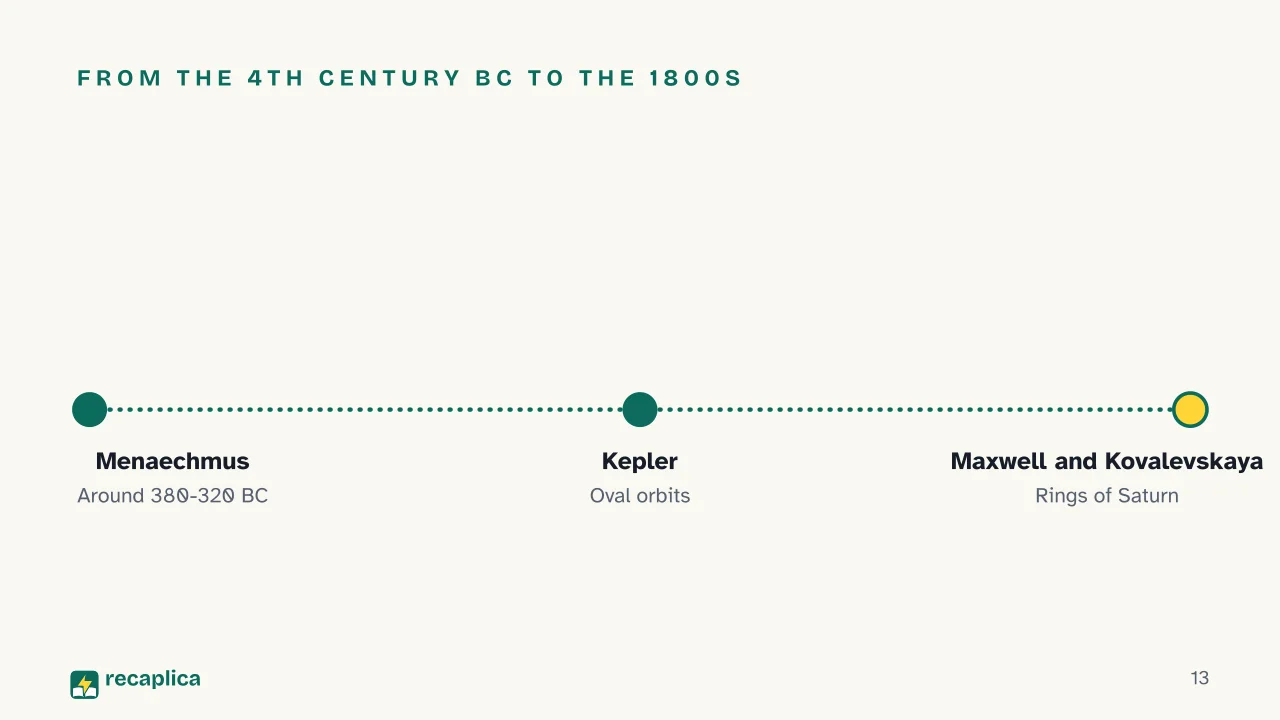 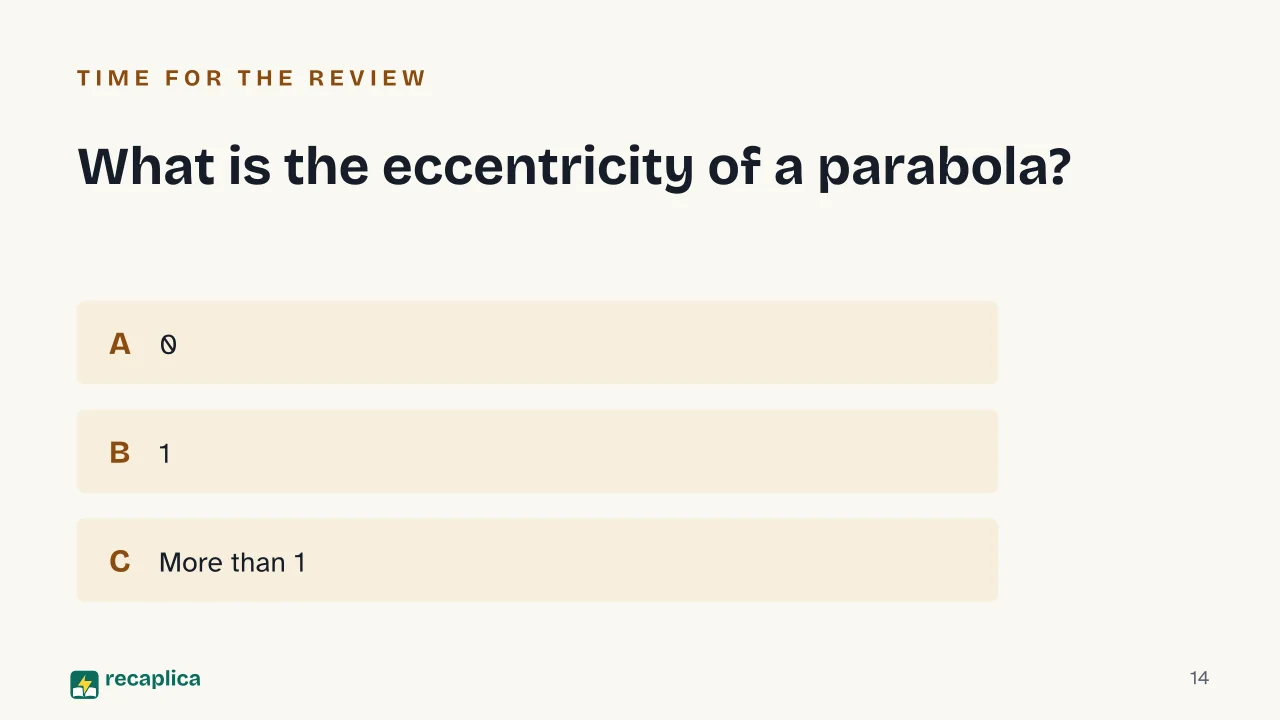  Common myths
Mind mapDrag the background to move around and the nodes to reposition them; use − and + to collapse and expand branches. 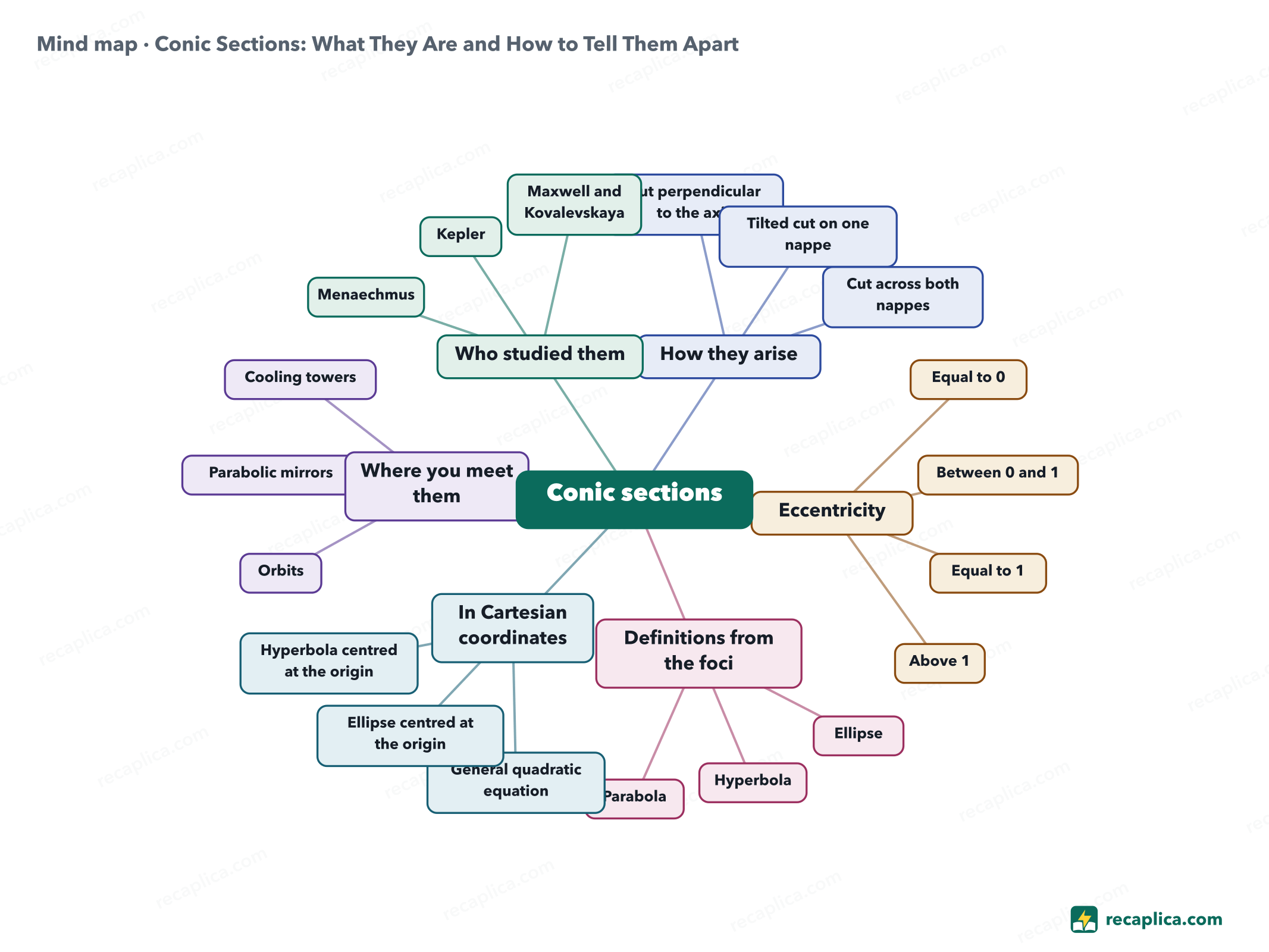
Quiz: test yourselfAnswer the questions to check what you have learned: you get instant feedback and a short explanation. Grade 0/10 0/5
FlashcardsTap the card to flip it and check whether you remember the answer, then move to the next one. 1 / 8 Explain it in your own wordsThe ultimate test: if you can explain it in simple words, you've truly understood it. Write your explanation, then compare it with the Recap. Your explanation is saved only on this device.
Frequently asked questionsWhat are conic sections, in plain words?They are the curves that appear when a plane slices a cone. The outcome depends on how the plane is oriented, and there are four possibilities: circle, ellipse, parabola, hyperbola. How many conic sections are there?Four of them are non-degenerate. A cut perpendicular to the axis gives the circle, a tilted cut inside a single nappe gives the ellipse or the parabola, and a cut that takes in both nappes gives the hyperbola. What is the difference between an ellipse, a hyperbola and a parabola?Ellipse and hyperbola are both built from two foci: the ellipse keeps the sum of the distances to those points constant, the hyperbola keeps the difference constant in absolute value. The parabola works from one focus and one line, the directrix, and takes the points equally far from both. In eccentricity the ellipse sits between 0 and 1, the parabola at exactly 1, the hyperbola above 1. When do you study conic sections at school?They normally arrive once quadratic equations and coordinates are already in hand, so they land in the later years of secondary school. The usual route starts from the circle and then takes in the ellipse, the parabola and the hyperbola, with the general quadratic equation ax² + 2bxy + cy² + dx + fy + g = 0 holding the four together. How do you build a schema or concept map of the conic sections?Four branches work well: how the plane slices the cone, the value of the eccentricity, the definition from focus and directrix, and the equation in Cartesian coordinates. Under each branch you hang the four curves. Every Recap goes through an independent review before publication. |