Skip to content
recaplica

    One moment: security check

    Cloudflare wants to make sure you're not a robot. Tick the box below and your search will continue on its own.

    IT
    recaplica Quadratic Equation: How to Solve It and Graph the Parabola
    © 2026 Recaplica · recaplica.com — All rights reserved
    Home › Science

    Quadratic Equation: How to Solve It and Graph the Parabola

    By Recaplica Newsroom · Updated on October 11, 2026

    What to print

    Page numbers appear when printing with default margins.

    Slides

    Choose a cut

    Flash10 slidesThe essential thread, to present in classFull15 slidesEvery chapter and the deeper detail

    Both come with speaker notes.

    Telegram channel
    recaplica Clear in 30 seconds, yours in 10 minutes.
    In 30 seconds Key points Deep dive Slides Myths Mind map Quiz Flashcards FAQ

    In 30 seconds quick read

    A quadratic equation has the form ax²+bx+c=0, with a not equal to zero, and it can be solved with the quadratic formula, by completing the square, or, when possible, by factoring. The discriminant Δ = b²-4ac tells you what to expect before you finish the calculation: positive for two distinct real solutions, zero for one repeated solution, negative for two complex conjugate solutions. The graph of this equation is a parabola, a curve with a vertex, an axis of symmetry, and a concavity that depends on the sign of a. Geometrically, the same curve comes from a focus and a directrix: it's the set of points equally distant from both.

    Key Points

    • A quadratic equation is written in the form ax²+bx+c=0, with a not equal to zero.
    • The quadratic formula x = (-b ± √(b²-4ac)) / 2a finds the solutions from the coefficients a, b, and c.
    • The discriminant Δ = b²-4ac tells you how many real solutions exist: two if it's positive, one repeated if it's zero, none if it's negative.
    • The parabola y = ax²+bx+c is the graph of the equation; its vertex has x-coordinate -b/(2a).
    • The sign of a decides the parabola's concavity and whether the vertex is a minimum or a maximum.
    • Geometrically, the parabola is the set of points equally distant from a focus F and a directrix d.

    Deep Dive

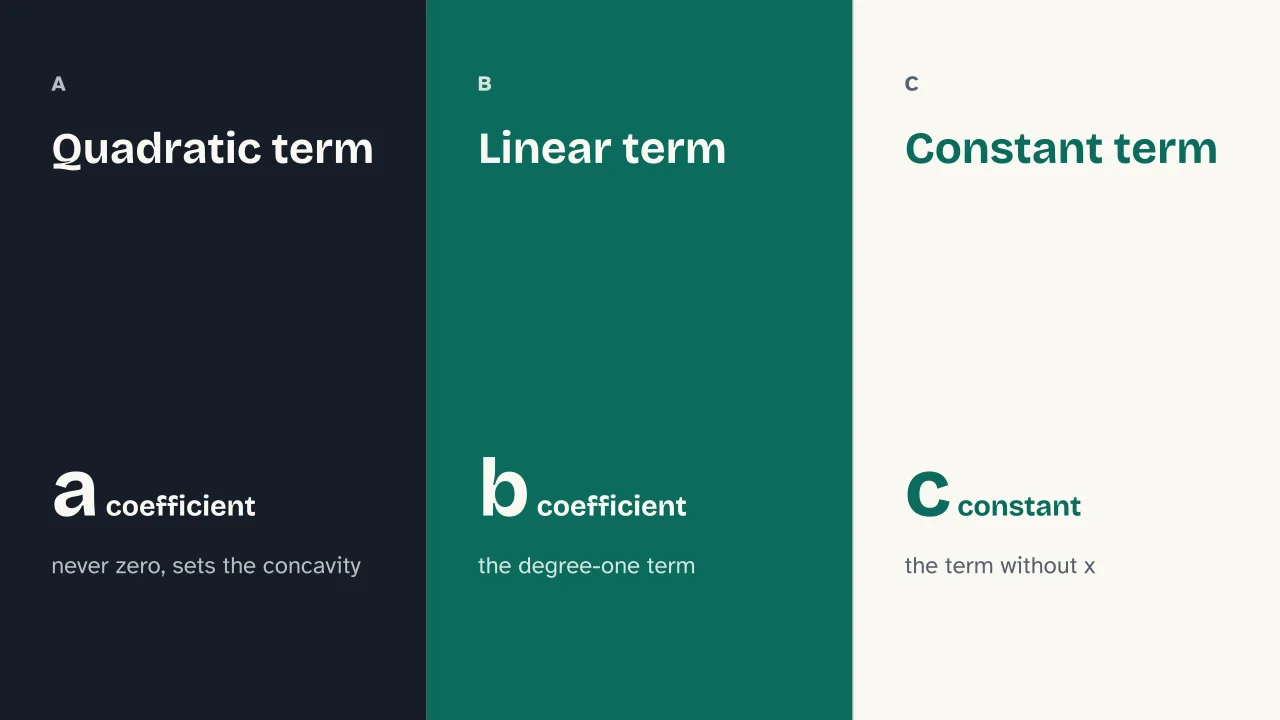
    A quadratic equation stands out by a term with x squared: in standard form it’s written ax² + bx + c = 0, with a, b, and c real numbers and a not equal to zero. If a were zero, the quadratic term would disappear and the equation would drop to a linear one. Anyone who has already met linear equations will recognize the same setup here — solving means finding the values of x that make the equality true — but the method differs because the degree is higher.

    Three methods for finding the solutions

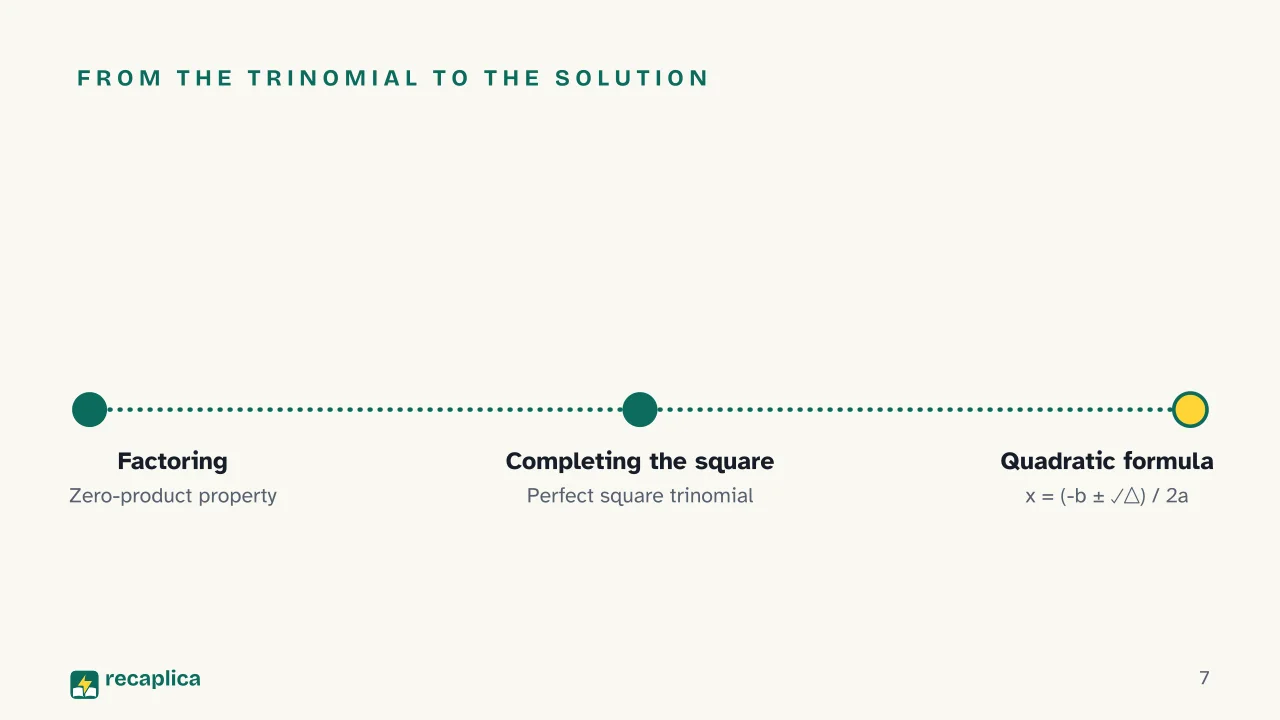
    Factoring breaks the trinomial ax² + bx + c into a product of two first-degree factors and applies the zero-product property: if a product of two factors is zero, at least one of them must be zero. Setting each factor equal to zero gives the solutions of the equation. This works when the trinomial factors easily; equations that don’t factor at a glance need one of the other two methods.

    Completing the square adds or subtracts terms on both sides of the equation until one side becomes a perfect square trinomial, a form that can be written as the square of a binomial. From there, the square root property applies and x can be isolated. The method works directly when the coefficient of the quadratic term is 1; otherwise the whole equation is divided by that coefficient first. Anyone already working with symbolic manipulation in algebra will recognize the same logic here, applied to an equation instead of an expression.

    The quadratic formula works for every quadratic equation, no exceptions:

    MethodWhen to use itHow it works
    FactoringThe trinomial factors easilyZero-product property: each factor set to zero gives one solution
    Completing the squareCoefficient of x² equal to 1 (or divided down to 1)One side becomes a perfect square, then x is isolated
    Quadratic formulaAlways, for any equationx = (-b ± √(b² - 4ac)) / 2a

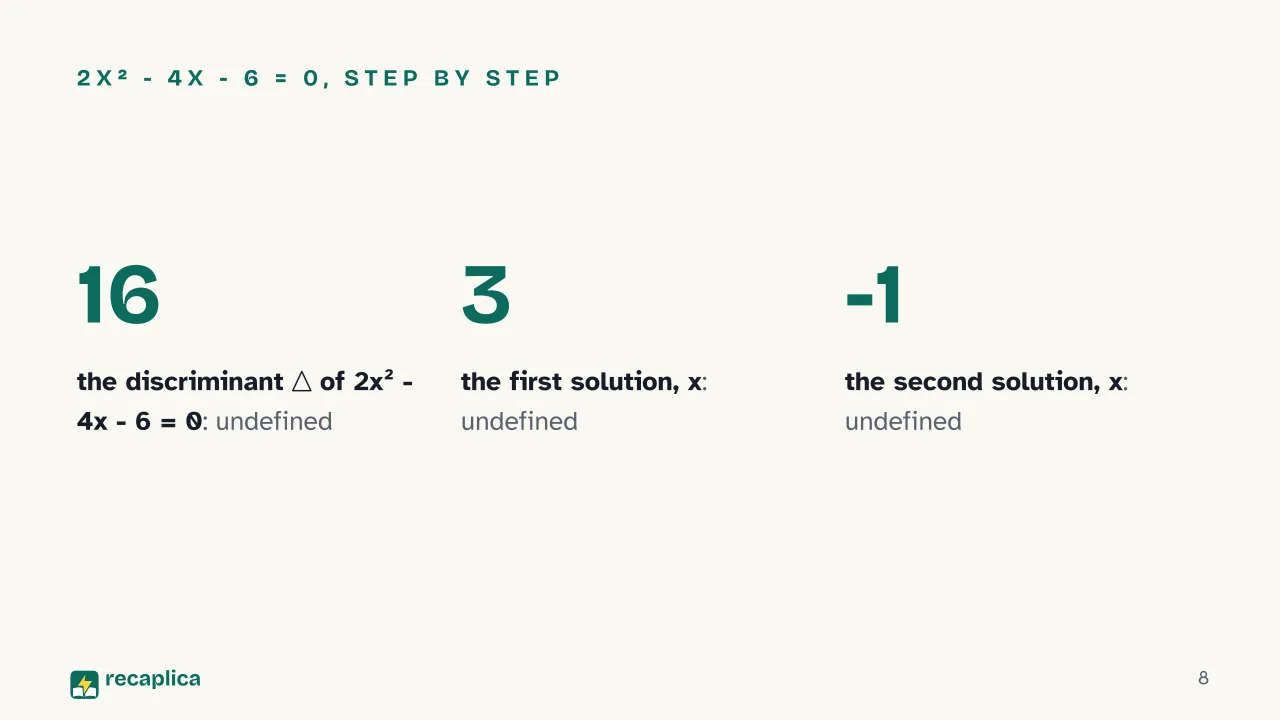
    Practical example: solve 2x² - 4x - 6 = 0. Dividing everything by 2 gives x² - 2x - 3 = 0, with a = 1, b = -2, c = -3. The discriminant is Δ = b² - 4ac = 4 - 4·1·(-3) = 4 + 12 = 16. The square root of 16 is 4, so x = (2 ± 4) / 2: the first solution is x = 3, the second is x = -1.

    The discriminant: what the sign tells you

    The discriminant Δ = b² - 4ac sits inside the square root of the quadratic formula, and its sign tells you in advance how many solutions to expect and of what kind, before the calculation is even finished.

    Sign of the discriminantSolutions of the equation
    PositiveTwo distinct real solutions (rational if Δ is a perfect square, irrational otherwise)
    ZeroOne real solution, counted twice
    NegativeTwo complex conjugate solutions

    Anyone who has already met complex numbers will recognize the point where the equation genuinely needs them: when the discriminant is negative, no real number squared gives a negative number, so the square root of the discriminant is written with the imaginary unit.

    The parabola: vertex, axis, and concavity

    The equation ax² + bx + c = 0 has a sibling equation, y = ax² + bx + c, which describes not just the points where y is zero but the entire curve on the coordinate plane: a parabola. Written in vertex form, f(x) = a(x - h)² + k, the pair (h, k) is the curve’s vertex, the point where the parabola changes direction. The vertex’s x-coordinate comes from h = -b/(2a), and its y-coordinate k is the value of the function at that point.

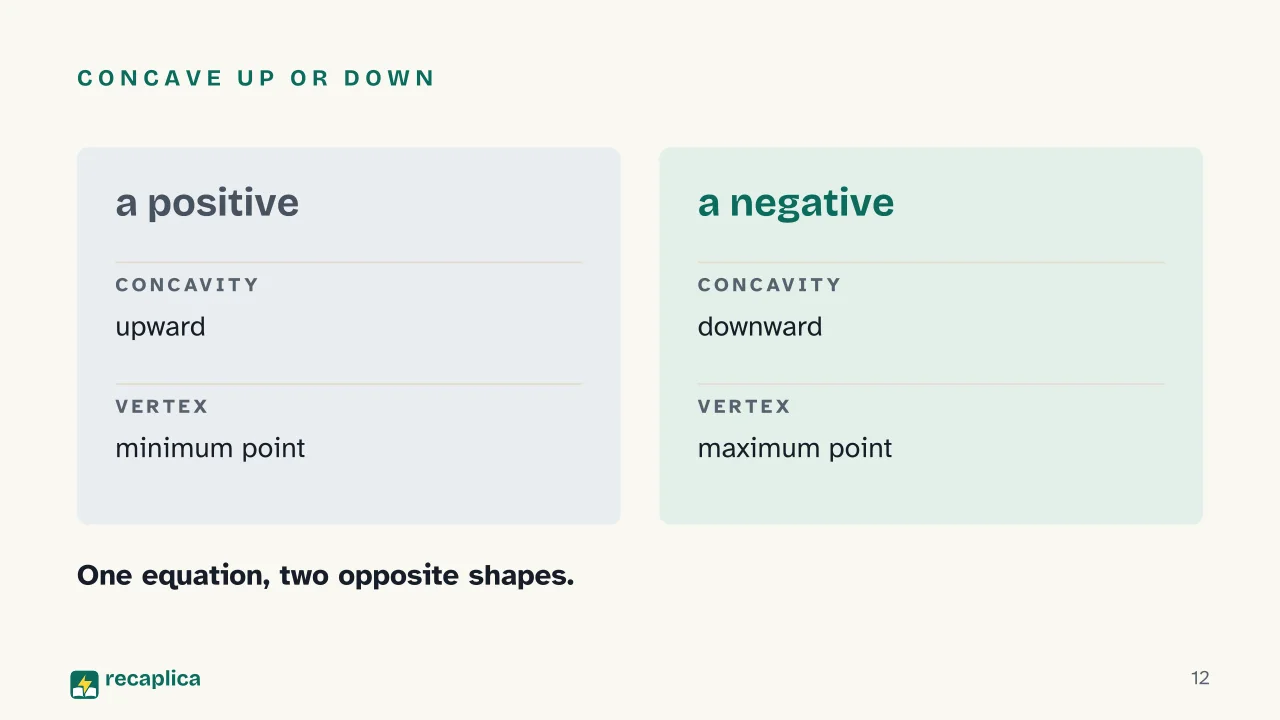
    Both the concavity and the type of vertex depend on the sign of a. Going back to the earlier example, y = 2x² - 4x - 6 has a = 2, so h = -(-4)/(2·2) = 1 and k = f(1) = 2 - 4 - 6 = -8: the vertex is (1, -8), and because a is positive, that point is a minimum, with both branches of the curve climbing away from it. With a negative coefficient the opposite happens: both branches drop away from the vertex, which becomes the highest point, a maximum.

    The axis of symmetry is the vertical line through the vertex that splits the parabola into two mirror halves: every point on the curve has a matching point at the same height on the other side of the axis. That’s why the two solutions of an equation with a positive discriminant always sit the same distance from the vertex’s x-coordinate, one to the left and one to the right.

    Focus and directrix: the geometric definition

    The parabola also comes from a purely geometric definition, independent of its coefficients. It’s one of the conic sections: it comes from cutting a circular cone with a plane parallel to one of its generating lines. The fuller study of this curve, alongside the other conics, belongs to analytic geometry.

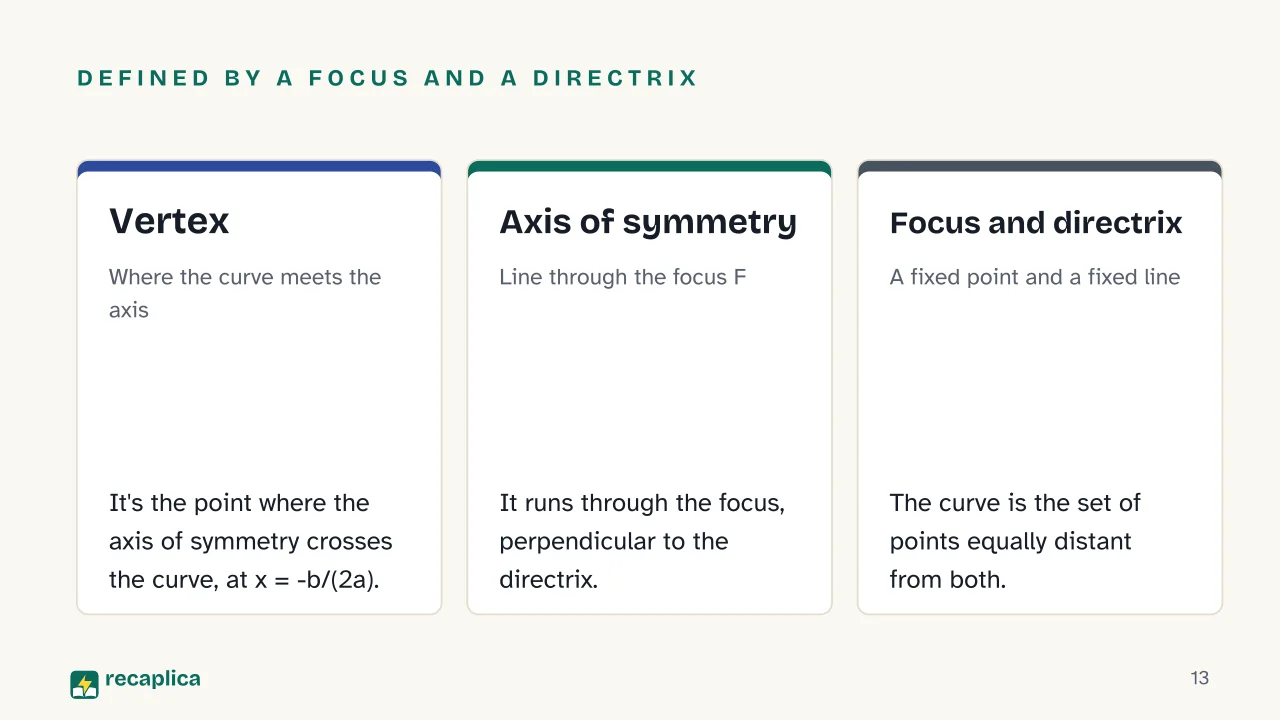
    Given a fixed point F, the focus, and a fixed line d, the directrix, every point on the parabola sits at exactly the same distance from F and from d. In this definition, the axis of symmetry connects the focus to the directrix while staying perpendicular to it; the vertex sits halfway along that path, where the axis touches the curve.

    The discriminant of the trinomial ax² + bx + c plays the same role when the parabola is read as a graph: its sign determines where the curve meets the x-axis. A positive discriminant means the parabola crosses the x-axis at two distinct points; a discriminant of zero means it just touches the axis at one point, tangent to it; a negative discriminant means it never touches the axis at all. The two readings — the algebraic one about the solutions and the geometric one about the x-axis intersection — describe the same fact from two angles.

    Slide deck

    Slides ready to download and make your own in PowerPoint or Google Slides, with speaker notes. Pick the Flash cut or the Full one.
    Slide 1 of the presentation on Quadratic Equation: Quadratic EquationsSlide 2 of the presentation on Quadratic Equation: What curve does a ball follow once it's in the air?Slide 3 of the presentation on Quadratic Equation: What's in this RecapSlide 4 of the presentation on Quadratic Equation: Chapter 01: The quadratic equationSlide 5 of the presentation on Quadratic Equation: Quadratic term · Linear term · Constant termSlide 6 of the presentation on Quadratic Equation: Chapter 02: How to solve itSlide 7 of the presentation on Quadratic Equation: From the trinomial to the solutionSlide 8 of the presentation on Quadratic Equation: 2x² - 4x - 6 = 0, step by stepSlide 9 of the presentation on Quadratic Equation: Chapter 03: The discriminantSlide 10 of the presentation on Quadratic Equation: A negative discriminant doesn't make the equation unsolvableSlide 11 of the presentation on Quadratic Equation: Chapter 04: The parabolaSlide 12 of the presentation on Quadratic Equation: Concave up or downSlide 13 of the presentation on Quadratic Equation: Defined by a focus and a directrix: Vertex, Axis of symmetry, Focus and directrixSlide 14 of the presentation on Quadratic Equation: If the discriminant Δ = b² - 4ac is zero, how many real solutions does the equation have?Slide 15 of the presentation on Quadratic Equation: Time to review
    Flash10 slidesThe essential thread, to present in classFull15 slidesEvery chapter and the deeper detail

    Common myths

    • ✗ Myth A quadratic equation always has two solutions.

      ✓ Reality It depends on the discriminant. If it's positive there are two distinct real solutions; if it's zero the equation has just one, counted twice; if it's negative the two solutions are complex conjugates.

    • ✗ Myth The vertex of a parabola is always the highest point on the graph.

      ✓ Reality Only when the coefficient a is negative does the parabola open downward and the vertex become a maximum. If a is positive, the parabola opens upward and the vertex is the lowest point, a minimum.

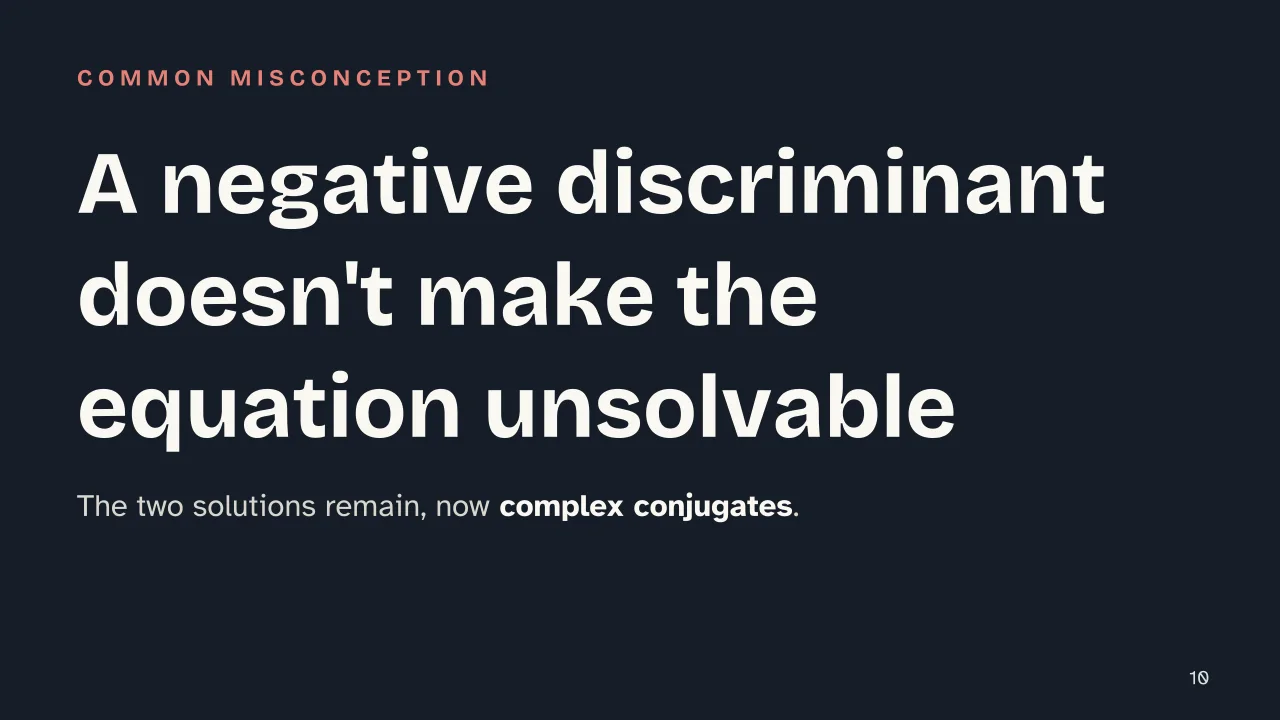
    • ✗ Myth A negative discriminant means the equation is unsolvable.

      ✓ Reality There are no real solutions, but the equation still has two, complex conjugate ones. 'Unsolvable' describes an equation with no solution in any number system, which is not the case for a negative discriminant.

    Mind map

    Drag the background to move around and the nodes to reposition them; use − and + to collapse and expand branches.
    Customize
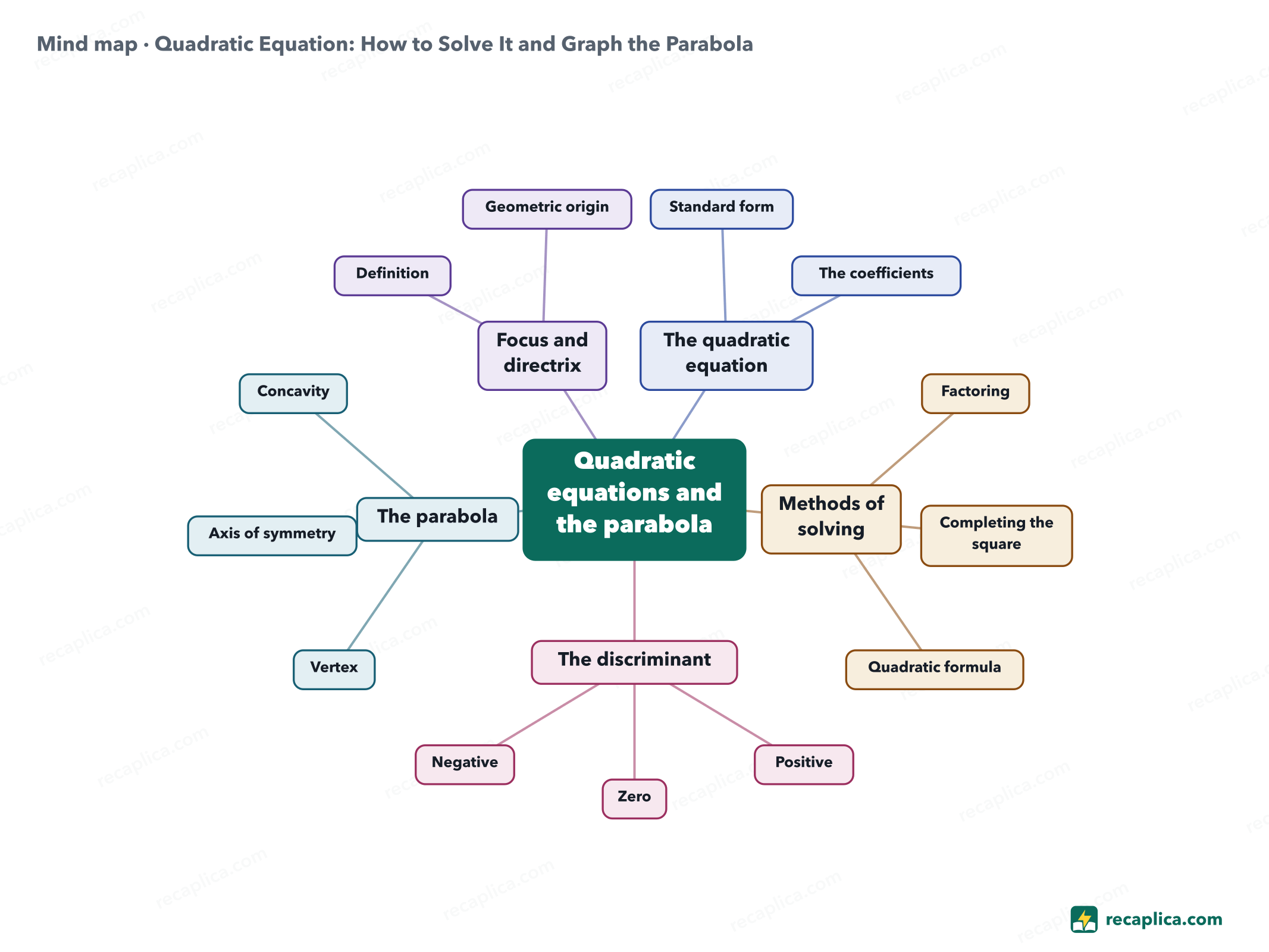
    Mind map: Quadratic Equation: How to Solve It and Graph the Parabola
    • Quadratic equations and the parabola
      • The quadratic equation
        • Standard form ax² + bx + c = 0, with a not equal to zero
        • The coefficients a, b, and c, the real numbers that define the equation
      • Methods of solving
        • Factoring zero-product property
        • Completing the square perfect square trinomial
        • Quadratic formula x = (-b ± √Δ) / 2a
      • The discriminant
        • Positive two distinct real solutions
        • Zero one repeated real solution
        • Negative two complex conjugate solutions
      • The parabola
        • Vertex x-coordinate -b/(2a)
        • Axis of symmetry line through the focus, perpendicular to the directrix
        • Concavity upward if a is positive, downward if a is negative
      • Focus and directrix
        • Definition set of points equally distant from focus and directrix
        • Geometric origin one of the conic sections, sliced from a cone

    Quiz: test yourself

    Answer the questions to check what you have learned: you get instant feedback and a short explanation.

    Grade 0/10 0/5
    1 What is the standard form of a quadratic equation?

    The standard form collects every term on one side, in decreasing order of degree: the quadratic term, the linear term, and the constant term.

    2 What does the discriminant Δ = b² - 4ac tell you?

    The discriminant is the quantity under the square root in the quadratic formula: its sign determines whether the solutions are two distinct reals, one repeated real, or two complex conjugates.

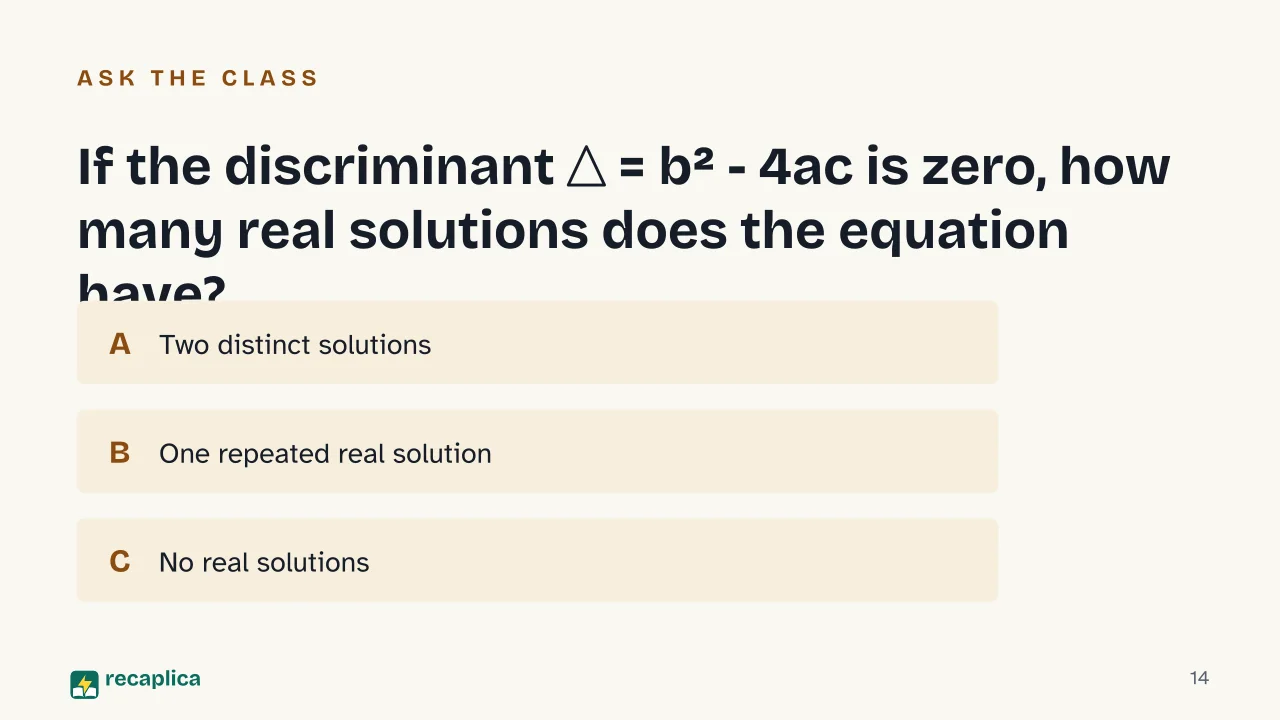
    3 If the discriminant of a quadratic equation is zero, how many real solutions does it have?

    With a discriminant of zero, the square root in the quadratic formula vanishes: only one value of x is left, counted as a repeated solution.

    4 What is the x-coordinate of the vertex of the parabola y = ax² + bx + c?

    The vertex's x-coordinate comes from h = -b/(2a); the y-coordinate k is then found by evaluating the function at that point.

    5 True or false: if the coefficient a is negative, the parabola is concave down and the vertex is a maximum point.

    With a negative, the curve opens downward and the highest point of the graph, the vertex, is a maximum; with a positive, the opposite holds.

    Answers: 1-A · 2-A · 3-B · 4-A · 5-A

    Flashcards

    Tap the card to flip it and check whether you remember the answer, then move to the next one.

    1 / 8

    Explain it in your own words

    The ultimate test: if you can explain it in simple words, you've truly understood it. Write your explanation, then compare it with the Recap.

    Your explanation is saved only on this device.

    A quadratic equation has the form ax²+bx+c=0, with a not equal to zero, and it can be solved with the quadratic formula, by completing the square, or, when possible, by factoring. The discriminant Δ = b²-4ac tells you what to expect before you finish the calculation: positive for two distinct real solutions, zero for one repeated solution, negative for two complex conjugate solutions. The graph of this equation is a parabola, a curve with a vertex, an axis of symmetry, and a concavity that depends on the sign of a. Geometrically, the same curve comes from a focus and a directrix: it's the set of points equally distant from both.

    Frequently asked questions

    What is the axis of a parabola?

    It's the curve's line of symmetry, perpendicular to the directrix d and passing through the focus F. The parabola looks the same on both sides of this line, and the vertex sits exactly where the line meets the curve.

    When is a parabola concave up or concave down?

    It depends on the sign of the coefficient a in y = ax² + bx + c. With a above zero, the graph rises on both sides and its lowest point, the vertex, is a minimum; with a below zero, the graph falls on both sides and that point becomes the highest one, a maximum.

    What does the discriminant of a parabola tell you?

    The sign of the discriminant of the trinomial ax² + bx + c tells you where the curve meets the x-axis: two distinct points if it's positive, a single tangent point if it's zero, no points at all if it's negative.

    How many solutions does a quadratic equation have?

    It depends on the discriminant: two distinct real solutions if it's positive, one repeated real solution if it's zero, two complex conjugate solutions if it's negative.

    What is the quadratic formula?

    x = (-b ± √(b² - 4ac)) / 2a, where a, b, and c are the coefficients of the equation ax² + bx + c = 0 and a is not equal to zero.

    Sources

    • OpenStax, Algebra and Trigonometry 2e, §5.1 Quadratic Functions
    • OpenStax, College Algebra 2e, §2.5 Quadratic Equations
    • Treccani, Enciclopedia della Matematica, entry Parabola

    Every Recap goes through an independent review before publication.

    Every evening, the day's new Recaps on our Telegram channel. Join the channel →

    Keep learning

    • Science Correlation: What It Means and How to Read the Coefficient Correlation measures how closely two variables move together, and the most common way to put a number on it is the correlation coefficient, which runs from -1 to +1. A value near +1 means the two variables rise together, near -1 means one rises while the other falls, and near 0 means no linear relationship stands out. The coefficient only captures the strength of a straight-line relationship, and a single unusual data point can push it up or down by a lot. Even when it's strong, a correlation between two variables never shows that one causes the other. Read the Recap →
    • Science Light Refraction: What It Is, the Laws Behind It, and Examples A surface that separates two transparent materials sends some light back, reflecting it, and lets the rest through while bending it toward a new direction. The law of reflection keeps the incoming and outgoing angles equal, both measured from the normal to the surface. Snell's law governs refraction instead, linking the index of each material to how much the ray tilts before and after it crosses over. These two laws alone explain mirrors, lenses, prisms and everyday sights such as a pencil that appears to snap inside a glass of water. Read the Recap →
    • Science Total Internal Reflection and the Critical Angle: Definition and Formula Total internal reflection is what happens when a light ray stops being able to leave a transparent medium and gets sent back inside it completely. It takes place past a specific angle of incidence, called the critical angle, calculated with Snell's law by comparing the refractive indices of the two materials involved. It only happens under one precise condition: the ray must be traveling from an optically denser medium into a less dense one, such as from water into air or from glass into air. Optical fibers and, in part, the sparkle of diamonds rely on this same principle. Read the Recap →

    recaplica

    Clear in 30 seconds, yours in 10 minutes.

    Recaps Mind maps Request a Recap Telegram channel Mind map maker Our method About Privacy & cookies Legal notes & terms of use

    © 2026 Recaplica · A project by Curi S.r.l. — VAT IT05472000750

    Statistics, only if you say so

    To learn which Recaps help most we would use Google Analytics, with aggregate, anonymous data. It starts only with your OK, and you can change your mind anytime. Privacy policy