Skip to content
recaplica

    One moment: security check

    Cloudflare wants to make sure you're not a robot. Tick the box below and your search will continue on its own.

    IT
    recaplica Kepler's Laws of Planetary Motion, Explained
    © 2026 Recaplica · recaplica.com — All rights reserved
    Home › Science

    Kepler's Laws of Planetary Motion, Explained

    By Recaplica Newsroom · Updated on September 27, 2026

    What to print

    Page numbers appear when printing with default margins.

    Slides

    Choose a cut

    Flash10 slidesThe essential thread, to present in classFull15 slidesEvery chapter and the deeper detail

    Both come with speaker notes.

    Telegram channel
    recaplica Clear in 30 seconds, yours in 10 minutes.
    In 30 seconds Key points Figures Deep dive Slides Myths Mind map Quiz Flashcards FAQ

    In 30 seconds quick read

    Kepler's laws are three rules that describe how the planets move around the sun. Johannes Kepler worked them out from Tycho Brahe's observations, publishing the first two in 1609 and the third in 1619. They say that orbits are ellipses with the sun at one of the two foci, that a planet speeds up when it's close to the sun and slows down when it's far away, and that the square of the orbital period is proportional to the cube of the average distance from the sun. Before Kepler, orbits were assumed to be perfect circles, as in Copernicus's model.

    Key Points

    • The first law says every planet traces an ellipse, with the sun at one of the two foci.
    • The second law (the law of areas) says the line between a planet and the sun sweeps out equal areas in equal times: the planet speeds up near the sun and slows down when it's far away.
    • The third law links orbital period and distance from the sun: the square of the period is proportional to the cube of the orbit's semi-major axis.
    • Kepler published the first two laws in 1609 in Astronomia Nova, and the third in 1619 in Harmonices Mundi.
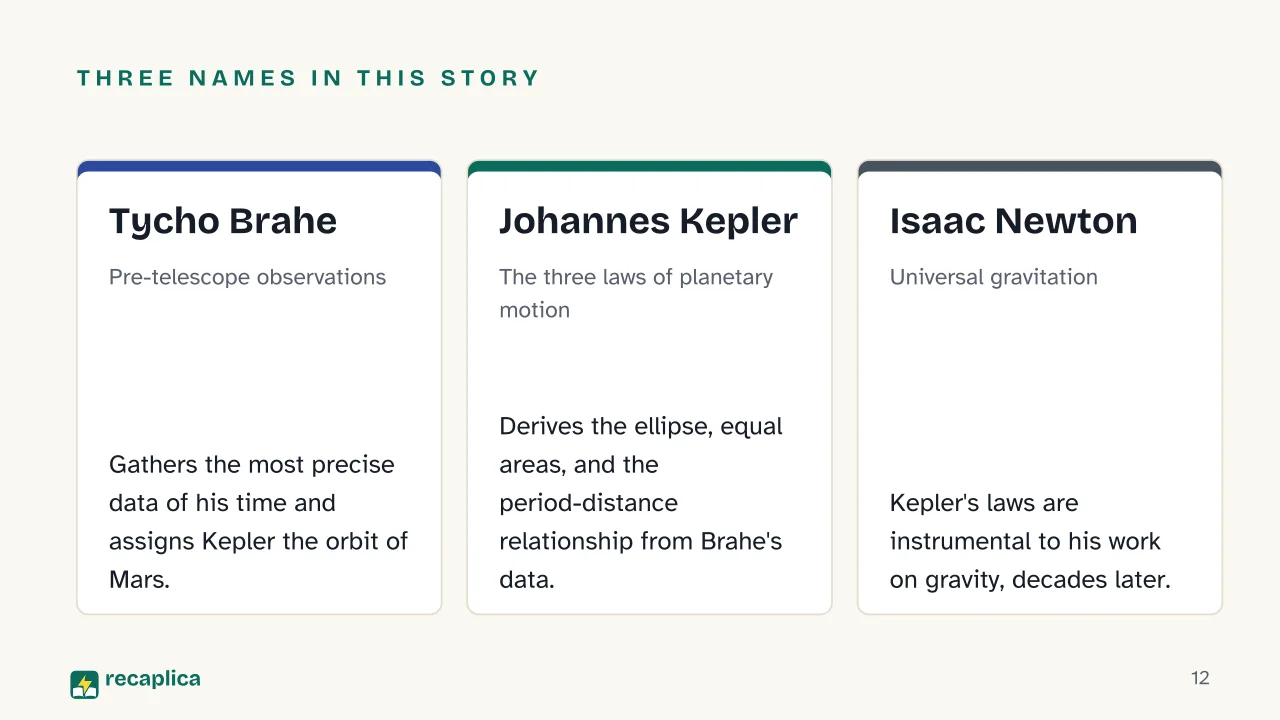
    • The laws rest on Tycho Brahe's observations; Brahe assigned Kepler the task of working out Mars's orbit.
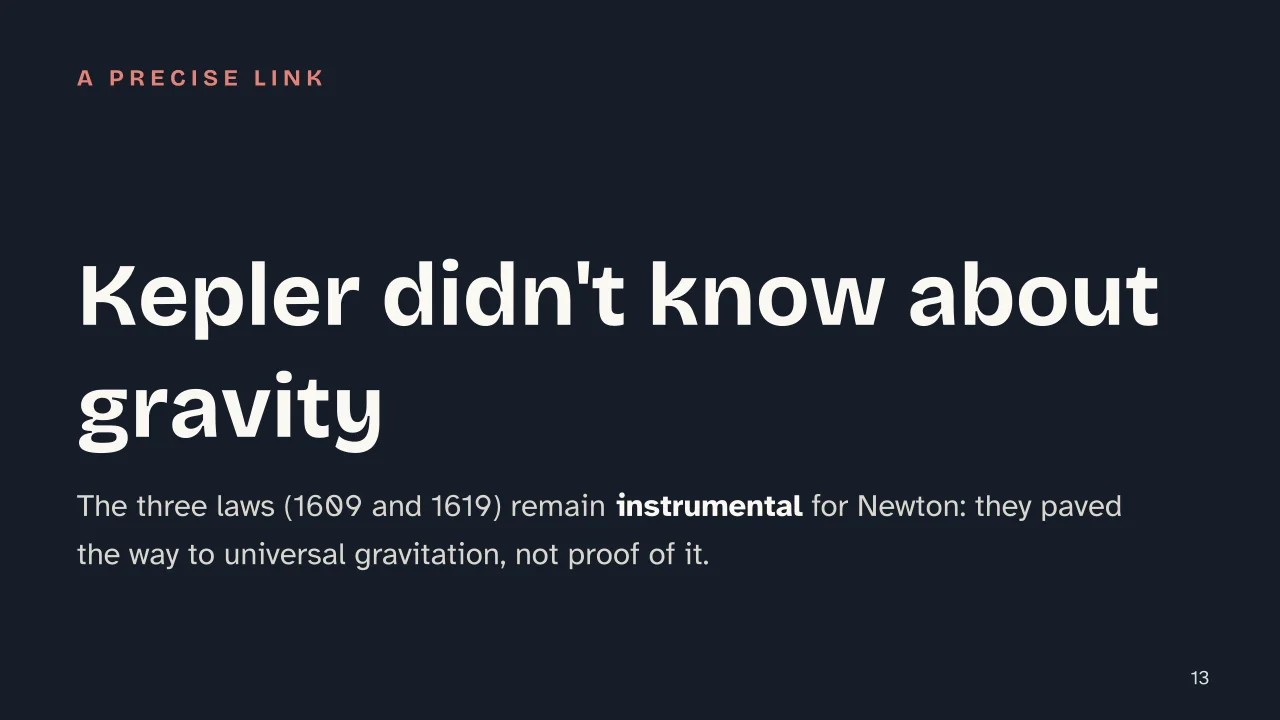
    • Kepler didn't know about gravity, but his laws were instrumental in Isaac Newton's development of the theory of universal gravitation.

    Key figures

    • 1609 and 1619 Publication years of the three laws: the first two in Astronomia Nova, the third in Harmonices Mundi. Source: NASA Science
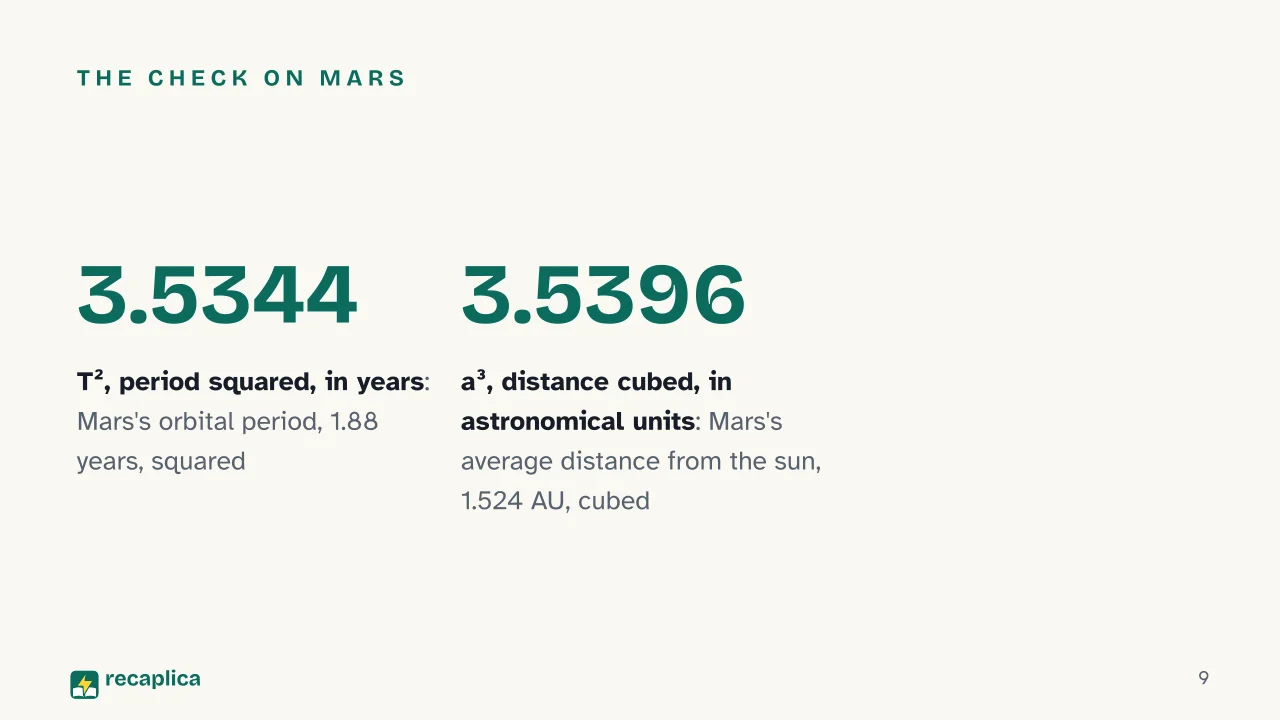
    • T² = 3.5344, a³ = 3.5396 For Mars, the square of the orbital period (in years) and the cube of the average distance from the sun (in astronomical units) come out almost identical: the practical check of the third law. Source: NASA Goddard Space Flight Center
    • 88 and 10,759 days Orbital periods of Mercury and Saturn: the fastest and the slowest planets to complete one trip around the sun. Source: NASA Science

    Deep Dive

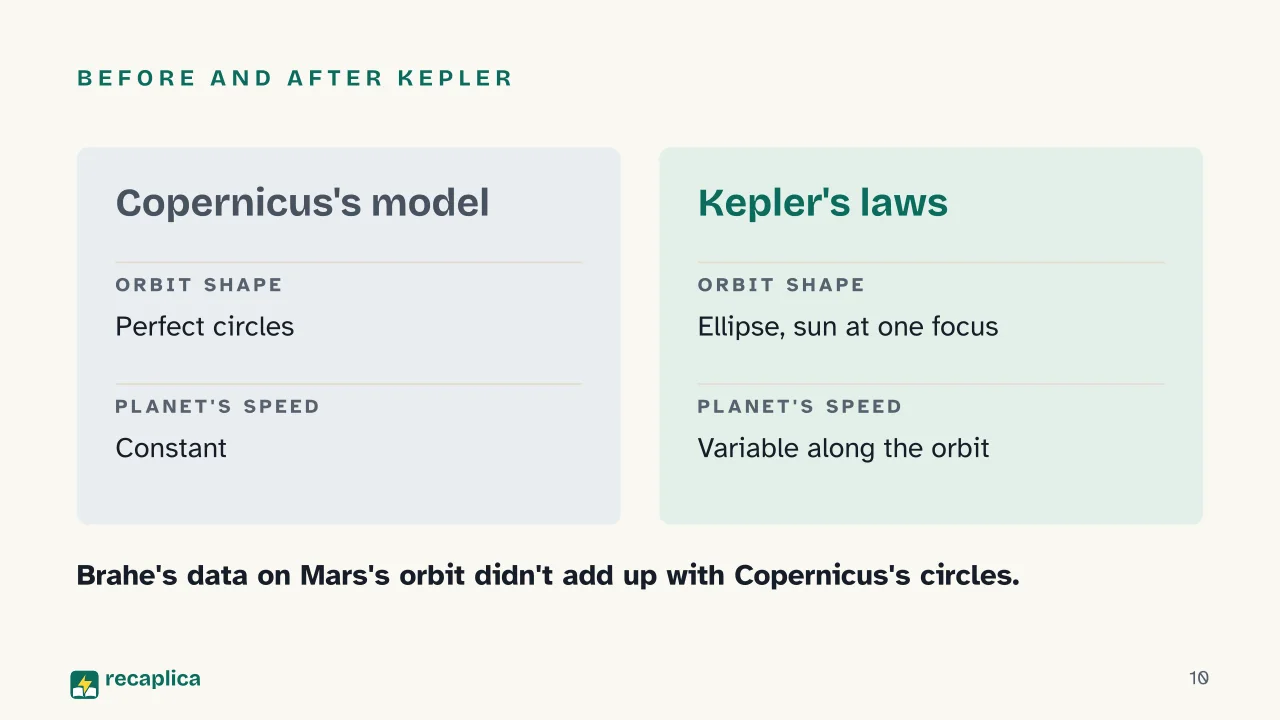
    Before Kepler, the dominant model of planetary motion was Copernicus’s: the sun at the center, the planets circling it along perfectly round orbits. But Tycho Brahe’s observations — the astronomer who had gathered the most precise data of the pre-telescope era — didn’t line up with that model. It was Johannes Kepler whom Brahe assigned the task of figuring out how Mars really moved, and that work produced the three laws that carry his name.

    Kepler’s first law: orbits are ellipses

    Kepler’s first law says that every planet’s orbit around the sun is an ellipse, with the sun occupying one of the two foci of the shape — not the center. The ellipse was already a familiar figure in Euclidean geometry long before Kepler, but no one had yet applied it to the motion of real planets.

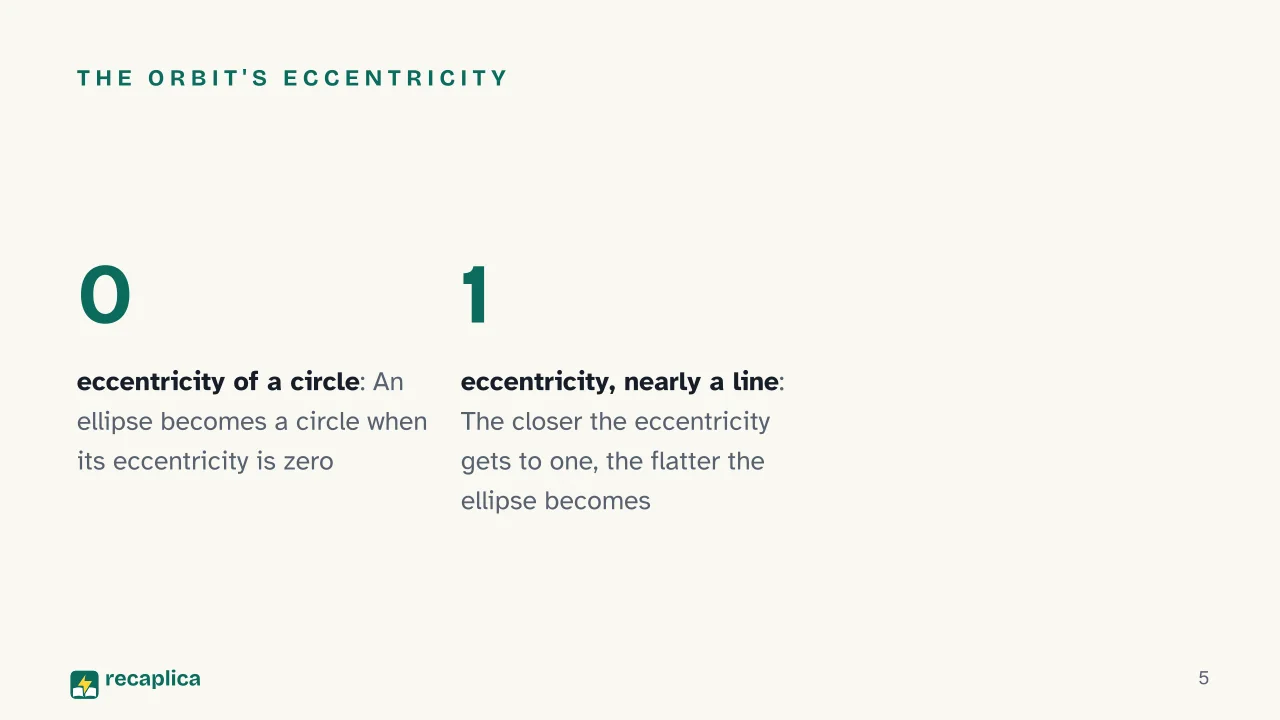
    How far an ellipse departs from a circle is measured by its eccentricity, a value between zero and one: at zero the ellipse is a circle, and the closer it gets to one, the flatter the shape becomes, until it’s almost a straight line. Every planet has its own eccentricity, but no orbit in the solar system is an exact circle.

    Kepler’s second law: the law of areas

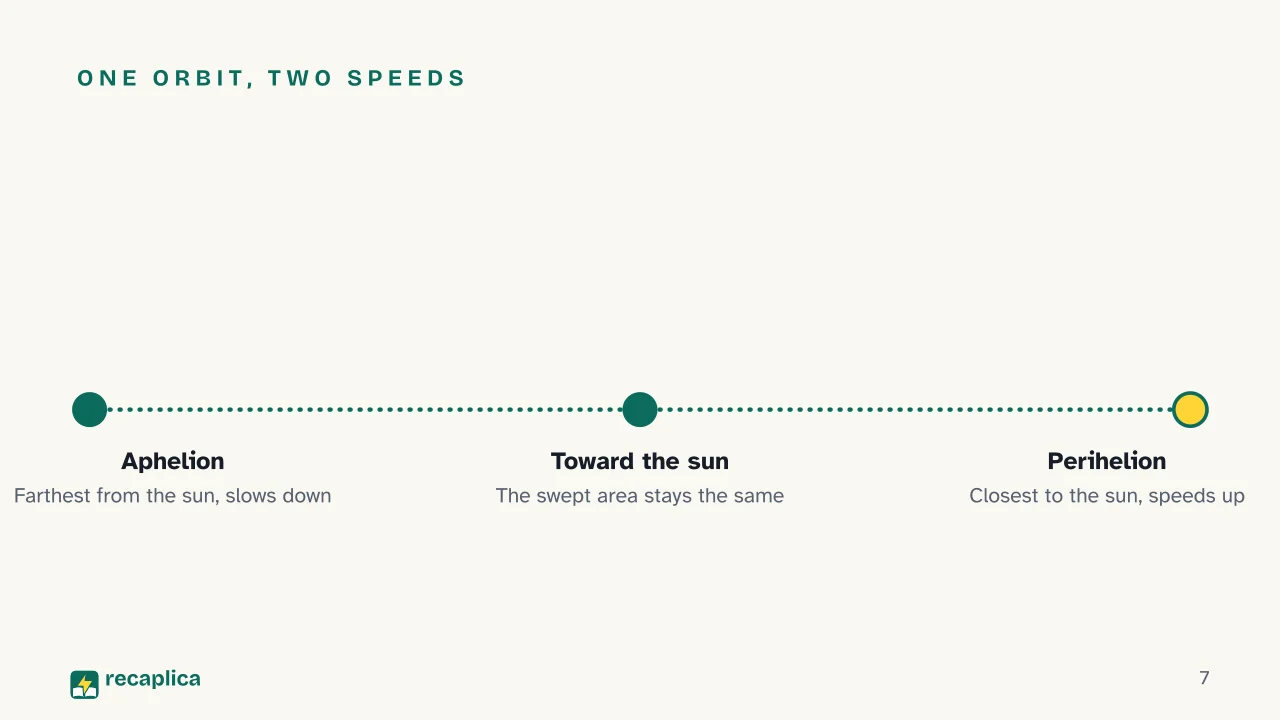
    The second law concerns how fast a planet moves along its orbit, and the technical statement translates into a simple picture: the imaginary line joining the planet and the sun sweeps out equal areas in equal times. When the planet is close to the sun, that line is short, so to cover the same area in the same time the planet has to travel a longer stretch of orbit: it speeds up. When it’s far from the sun, the line is long and a short arc is enough to cover the same area: the planet slows down.

    The point of the orbit closest to the sun is called perihelion, the farthest one aphelion. No planet moves at a constant speed; the second law says exactly why.

    Kepler’s third law: the relationship between period and distance

    The third law connects two quantities that look independent at first glance: the time a planet takes to complete one orbit (the period) and its average distance from the sun. The law states that the square of the orbital period is proportional to the cube of the average distance: planets farther out take much longer to circle the sun, and not in direct proportion.

    Worked example: Earth, by definition, has a period of 1 year and an average distance of 1 astronomical unit (AU); so its period squared is 1 and its distance cubed is 1. Mars has a period of 1.88 years and a distance of 1.524 AU: the period squared gives 3.5344, the distance cubed gives 3.5396 — almost the same number. Jupiter has a period of 11.9 years and a distance of 5.203 AU: the period squared gives 141.61, the distance cubed gives 140.85, again nearly identical. The small gaps come only from rounding in the data, not from an exception to the law.

    The table below compares five planets, from the closest to the sun to the farthest among those the source reports:

    PlanetPeriod T (years)Average distance a (AU)T²a³
    Mercury0.2410.3870.058080.05796
    Earth1111
    Mars1.881.5243.53443.5396
    Jupiter11.95.203141.61140.85
    Saturn29.59.539870.25867.98

    In every row, T² and a³ are practically the same number: the numerical confirmation of the third law, valid for planets whose mass is negligible next to that of the star they orbit.

    Solar system orbits, seen through Kepler’s laws

    The three laws don’t describe some abstract case: they hold for every planet in the solar system. Every orbit is an ellipse with the sun at one focus, every planet speeds up as it nears the sun and slows down as it moves away, and the period-distance relationship checks out for Mercury just as it does for Saturn, as the table above shows.

    From Tycho Brahe to Newton

    Kepler published the first two laws in 1609, in the work Astronomia Nova. The third law arrived ten years later, in 1619, in Harmonices Mundi. In between came a long stretch of calculation on Tycho Brahe’s data, particularly on the orbit of Mars, the planet Brahe had assigned to Kepler.

    Kepler didn’t know about gravity: his laws describe how the planets move, and it would be Isaac Newton, decades later, who explained why, with his theory of universal gravitation. Kepler’s laws were instrumental to that work.

    Slide deck

    Slides ready to download and make your own in PowerPoint or Google Slides, with speaker notes. Pick the Flash cut or the Full one.
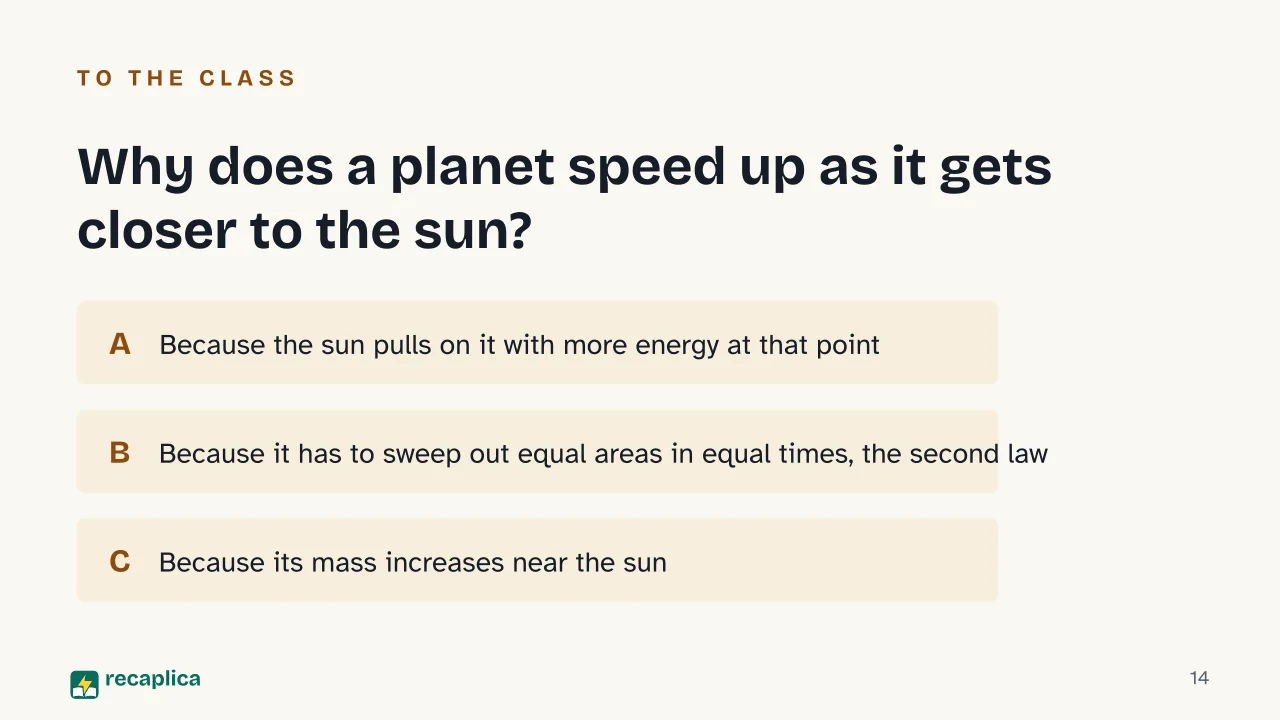
    Slide 1 of the presentation on Kepler's Laws of Planetary Motion, Explained: Kepler's LawsSlide 2 of the presentation on Kepler's Laws of Planetary Motion, Explained: Do planets trace circles around the sun?Slide 3 of the presentation on Kepler's Laws of Planetary Motion, Explained: The route aheadSlide 4 of the presentation on Kepler's Laws of Planetary Motion, Explained: Chapter 01: The first lawSlide 5 of the presentation on Kepler's Laws of Planetary Motion, Explained: The orbit's eccentricitySlide 6 of the presentation on Kepler's Laws of Planetary Motion, Explained: Chapter 02: The second lawSlide 7 of the presentation on Kepler's Laws of Planetary Motion, Explained: One orbit, two speedsSlide 8 of the presentation on Kepler's Laws of Planetary Motion, Explained: Chapter 03: The third lawSlide 9 of the presentation on Kepler's Laws of Planetary Motion, Explained: The check on MarsSlide 10 of the presentation on Kepler's Laws of Planetary Motion, Explained: Before and after KeplerSlide 11 of the presentation on Kepler's Laws of Planetary Motion, Explained: Chapter 04: From Brahe to NewtonSlide 12 of the presentation on Kepler's Laws of Planetary Motion, Explained: Three names in this story: Tycho Brahe, Johannes Kepler, Isaac NewtonSlide 13 of the presentation on Kepler's Laws of Planetary Motion, Explained: Kepler didn't know about gravitySlide 14 of the presentation on Kepler's Laws of Planetary Motion, Explained: Why does a planet speed up as it gets closer to the sun?Slide 15 of the presentation on Kepler's Laws of Planetary Motion, Explained: To learn more
    Flash10 slidesThe essential thread, to present in classFull15 slidesEvery chapter and the deeper detail

    Common myths

    • ✗ Myth The planets orbit the sun in perfect circles.

      ✓ Reality They actually move in ellipses, with the sun at one of the two foci. Before Kepler's laws, a circular orbit was assumed, as in Copernicus's model, but Tycho Brahe's observations of Mars's orbit didn't add up under that model.

    • ✗ Myth Kepler's three laws were all published together.

      ✓ Reality The first two arrived in 1609, in Astronomia Nova; the third law, the one on period and distance, came out ten years later, in 1619, in Harmonices Mundi.

    • ✗ Myth A planet always moves at the same speed along its orbit.

      ✓ Reality Kepler's second law requires the line between a planet and the sun to sweep out equal areas in equal times: close to the sun that line is short, so the planet must cover a longer stretch of orbit in the same time and speeds up; far from the sun it slows down.

    Mind map

    Drag the background to move around and the nodes to reposition them; use − and + to collapse and expand branches.
    Customize
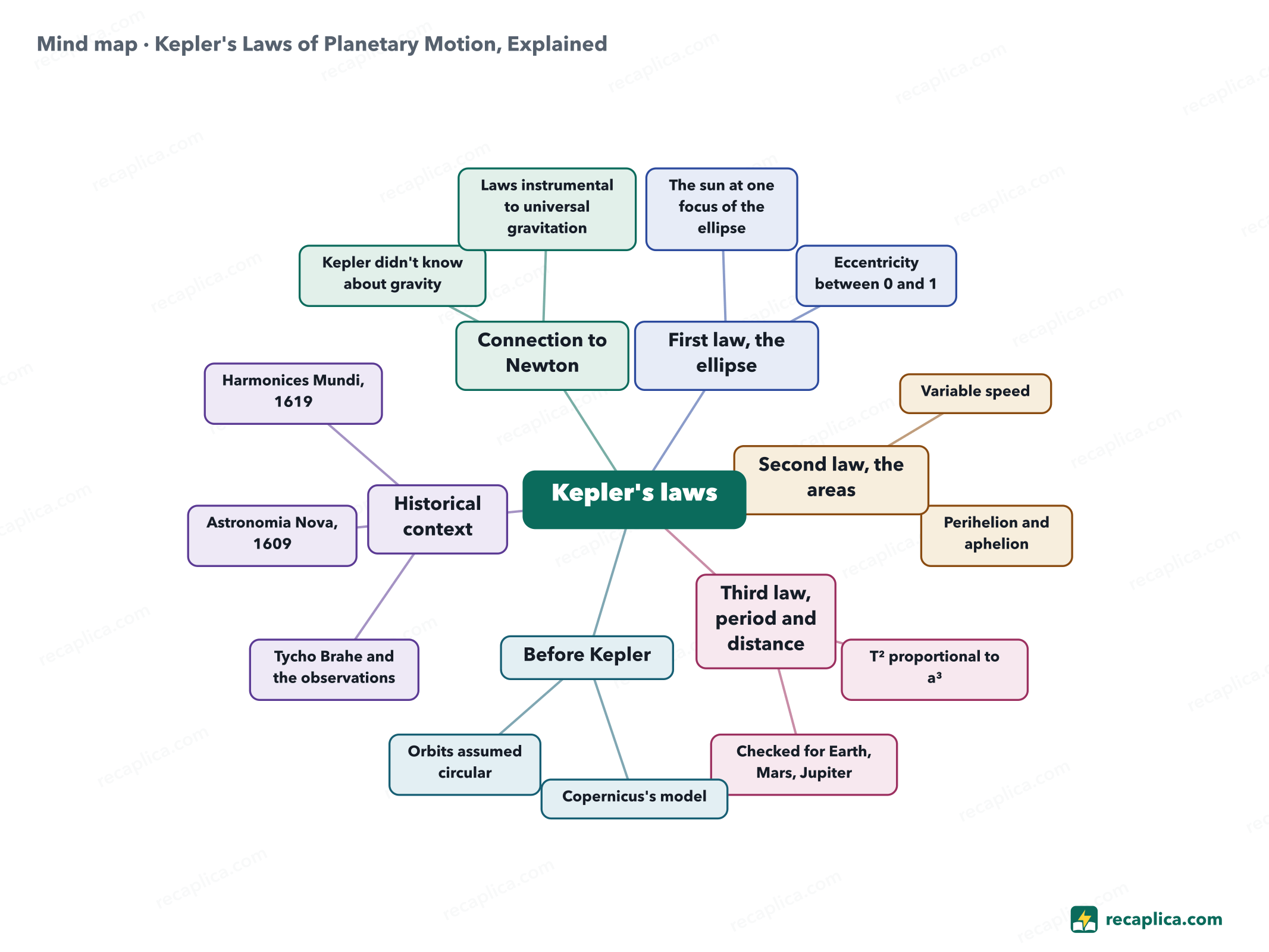
    Mind map: Kepler's Laws of Planetary Motion, Explained
    • Kepler's laws
      • First law, the ellipse
        • The sun at one focus of the ellipse
        • Eccentricity between 0 and 1 0 is a circle, 1 is almost a straight line
      • Second law, the areas
        • Variable speed
        • Perihelion and aphelion
      • Third law, period and distance
        • T² proportional to a³
        • Checked for Earth, Mars, Jupiter
      • Before Kepler
        • Copernicus's model
        • Orbits assumed circular
      • Historical context
        • Tycho Brahe and the observations
        • Astronomia Nova, 1609
        • Harmonices Mundi, 1619
      • Connection to Newton
        • Kepler didn't know about gravity
        • Laws instrumental to universal gravitation

    Quiz: test yourself

    Answer the questions to check what you have learned: you get instant feedback and a short explanation.

    Grade 0/10 0/5
    1 According to Kepler's first law, what shape is a planet's orbit around the sun?

    The first law says every planet's orbit is an ellipse, with the sun occupying one of the two foci.

    2 What does Kepler's second law, the law of areas, state?

    The imaginary line between a planet and the sun covers equal areas in equal time intervals: to manage that, the planet speeds up near the sun and slows down when it's far away.

    3 True or false: according to Kepler's third law, the square of a planet's orbital period is proportional to the cube of its average distance from the sun.

    That's exactly the third law, T² proportional to a³: it checks out when you compare the orbital data of different planets, such as Earth, Mars and Jupiter.

    4 Who supplied Kepler with the astronomical observations his laws were based on?

    Tycho Brahe, who had gathered the most precise observations of the pre-telescope era, assigned Kepler the task of working out Mars's orbit.

    5 In what year did Kepler publish the third law?

    The first two laws came out in 1609 with Astronomia Nova; the third arrived ten years later, in 1619, with Harmonices Mundi.

    Answers: 1-B · 2-B · 3-A · 4-C · 5-B

    Flashcards

    Tap the card to flip it and check whether you remember the answer, then move to the next one.

    1 / 8

    Explain it in your own words

    The ultimate test: if you can explain it in simple words, you've truly understood it. Write your explanation, then compare it with the Recap.

    Your explanation is saved only on this device.

    Kepler's laws are three rules that describe how the planets move around the sun. Johannes Kepler worked them out from Tycho Brahe's observations, publishing the first two in 1609 and the third in 1619. They say that orbits are ellipses with the sun at one of the two foci, that a planet speeds up when it's close to the sun and slows down when it's far away, and that the square of the orbital period is proportional to the cube of the average distance from the sun. Before Kepler, orbits were assumed to be perfect circles, as in Copernicus's model.

    Frequently asked questions

    Are solar system orbits really ellipses, not circles?

    Yes: according to Kepler's first law, every planet in the solar system traces an ellipse with the sun at one of the two foci; before Kepler, Copernicus's model assumed circular orbits. Eccentricity, which measures how far an ellipse departs from a circle, ranges from zero (a circle) to one (an almost flat line), and it varies from planet to planet.

    Why does a planet move faster when it's close to the sun?

    Because of Kepler's second law: the line joining a planet and the sun must cover equal areas in equal times. When the planet is close to the sun (at perihelion) it has to travel a longer arc in the same time, so it speeds up; far from the sun (at aphelion) it slows down.

    What's the connection between Kepler's laws and Newton's gravity?

    Kepler worked out his three laws without knowing about gravity, deriving them from Tycho Brahe's data on planetary motion. Those laws were nonetheless instrumental to Isaac Newton's work, who decades later built the theory of universal gravitation from them.

    How do you check Kepler's third law against real planetary data?

    You compare a planet's orbital period (in years) and average distance from the sun (in astronomical units): square the period and cube the distance, and the two values come out almost identical. For Mars, for instance, T² equals 3.5344 and a³ equals 3.5396.

    Who was Tycho Brahe and what role did he play in Kepler's laws?

    Tycho Brahe was an astronomer who gathered the most precise observations of the pre-telescope era; he assigned Kepler the task of working out Mars's orbit, and it was from that data that Kepler arrived at his three laws.

    Sources

    • NASA Science, "Orbits and Kepler's Laws"
    • NASA Goddard Space Flight Center, "Kepler's Third Law"
    • EduINAF, "Le leggi di Keplero"

    Every Recap goes through an independent review before publication.

    Every evening, the day's new Recaps on our Telegram channel. Join the channel →

    Keep learning

    • Science The solar system: the planets and what holds them together The solar system is the Sun plus everything that circles it: eight planets, hundreds of moons, millions of asteroids and comets. It formed about 4.6 billion years ago when a dense cloud of gas and dust collapsed, and the Sun took more than 99% of the available matter — the planets are what was left over. Gravity is what holds it together: the Sun's pull bends each planet's path without ever pulling it in, because the planet is moving sideways fast enough to keep missing. Close to the star only rock survived and small solid worlds formed; far out, where ice held on, the giants grew. Read the Recap →
    • Economics What Is the Space Economy? Value, Growth and Who Runs It The space economy covers every economic activity built around space: launches, satellites, telecommunications, Earth observation and, increasingly, lunar resources. In 2025 the global market was worth about $600 billion, according to the OECD, while McKinsey and the World Economic Forum project it could reach $1.8 trillion by 2035. Before 2010, launches were mostly government-run; by 2025, 88% launched privately. Control of the busiest orbits and of the Moon has meanwhile become a contest between two coalitions, the US-led Artemis Accords and the China-Russia International Lunar Research Station. Read the Recap →
    • History Apollo 11: How the 1969 Moon Landing Happened On 20 July 1969 the lunar module Eagle from Apollo 11 touches down in the Sea of Tranquility, and a few hours later Neil Armstrong becomes the first person to walk on the Moon, followed by Buzz Aldrin, while Michael Collins stays in orbit aboard the command module Columbia. It comes after years of a space race with the Soviet Union, opened by the 1957 launch of Sputnik and given a fresh target by President John F. Kennedy in 1961, and after the rehearsals flown under Project Mercury and Project Gemini. The Apollo program is not without accidents — a crew dies on the ground in 1967, another nearly fails to return in 1970 — but it puts twelve astronauts on the Moon in all, across six successful missions between 1969 and 1972. Read the Recap →

    recaplica

    Clear in 30 seconds, yours in 10 minutes.

    Recaps Mind maps Request a Recap Telegram channel Mind map maker Our method About Privacy & cookies Legal notes & terms of use

    © 2026 Recaplica · A project by Curi S.r.l. — VAT IT05472000750

    Statistics, only if you say so

    To learn which Recaps help most we would use Google Analytics, with aggregate, anonymous data. It starts only with your OK, and you can change your mind anytime. Privacy policy