Skip to content
recaplica

    One moment: security check

    Cloudflare wants to make sure you're not a robot. Tick the box below and your search will continue on its own.

    IT
    recaplica Literary Genres: What They Are and How to Tell Them Apart
    © 2026 Recaplica · recaplica.com — All rights reserved
    Home › Literature

    Literary Genres: What They Are and How to Tell Them Apart

    By Recaplica Newsroom · Updated on October 8, 2026

    What to print

    Page numbers appear when printing with default margins.

    Slides

    Choose a cut

    Flash10 slidesThe essential thread, to present in classFull15 slidesEvery chapter and the deeper detail

    Both come with speaker notes.

    Telegram channel
    recaplica Clear in 30 seconds, yours in 10 minutes.
    In 30 seconds Key points Deep dive Slides Myths Mind map Quiz Flashcards FAQ

    In 30 seconds quick read

    Literary genres are the categories writers and critics use to group literary works, built mainly around form and technique, with subject matter as a secondary clue. The idea goes back to ancient Greece, where Plato set out the first systematic classification of poetry and told apart three ways of narrating: imitating characters directly, speaking in the author's own voice, or mixing the two. Aristotle picked up that distinction and widened it, though the scheme that reached us owes more to the thinkers who came after him. In school, the usual map sorts works into fiction, poetry and theatre, with the short story and the novel as two different shapes of prose fiction. Any genre can be spotted from three traits: the form it is written in, the purpose it serves and the way it gets read or watched.

    Key Points

    • A literary genre groups works mainly by form and technique; what the story is actually about matters less.
    • Plato gave poetry its first systematic classification, telling apart a dramatic mode (characters are imitated directly), a narrative mode (the author speaks in the first person) and a mixed mode.
    • Aristotle built on Plato's distinction and widened it, but the classification still used in the West today owes more to the thinkers who followed Aristotle than to Aristotle himself.
    • A novel follows a person or a family over time, against a historical, invented or realistic backdrop; a short story is shorter, sticks to a single plot line and is almost always invented from scratch.
    • Poetry is set apart from prose by its metre, the rules that measure the line, and aims to put feelings and images into words.
    • Theatre, or drama, is written to be performed by actors on a stage rather than just read: for Aristotle, tragedy and comedy were both staged to music.

    Deep Dive

    What is a literary genre

    A literary genre is the label used to classify literary works: it looks above all at how a work is written, with what technique, and only sometimes at its subject matter. The idea goes back to ancient Greece and Rome, and turns into a widespread ordering principle mostly from the Renaissance onward, when classicist tradition starts using it as a tool for sorting works that imitated ancient models, each with its own rules.

    Talking about a work’s “form” means talking about its structure and how it is built, leaving the content aside. Two texts can tell the same love story and still belong to different genres: one written in prose, the other in verse; one meant for silent reading, the other for the stage. Every classification starts from there.

    What are the different literary genres?

    Pull the three classical modes apart from the scheme taught in school today, and “different literary genres” turns out to mean two different things. Plato split narration into three modes, one that imitates characters directly, one where the narrator speaks in the first person, and a blend of the two, describing how a story gets told. The scheme used in most classrooms sorts works by a different logic, grouping fiction, poetry and theatre, with the novel and the short story as fiction’s two prose shapes. Different type of literature, in other words, is a question with more than one answer, depending on which layer is doing the sorting — form, technique, or the oldest classical split of all.

    From Plato to Aristotle: the first map of genres

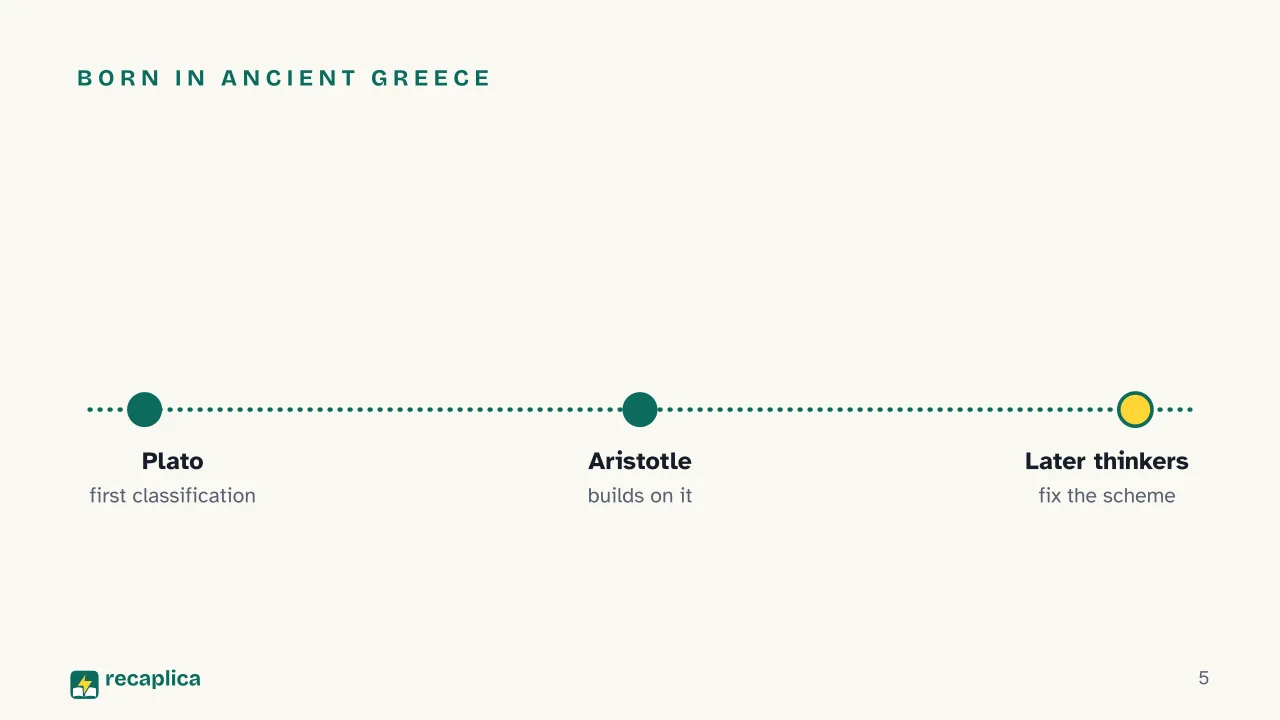
    The first systematic classification of poetry is credited to Plato, who built it around a work’s ethical content and its degree of mimesis, or imitation. Plato sorted narration into three modes: one where characters are imitated directly (dramatic), one where the author speaks in the first person (narrative), and one that blends the two (mixed).

    Aristotle built on that distinction and opened it up, no longer treating genre as a fixed box. The classification of literary genres actually in use in the Western tradition, though, comes from the thinkers who followed him, the Peripatetic school and the scholars of Alexandria, who fixed the shape that reached us more than Aristotle himself did.

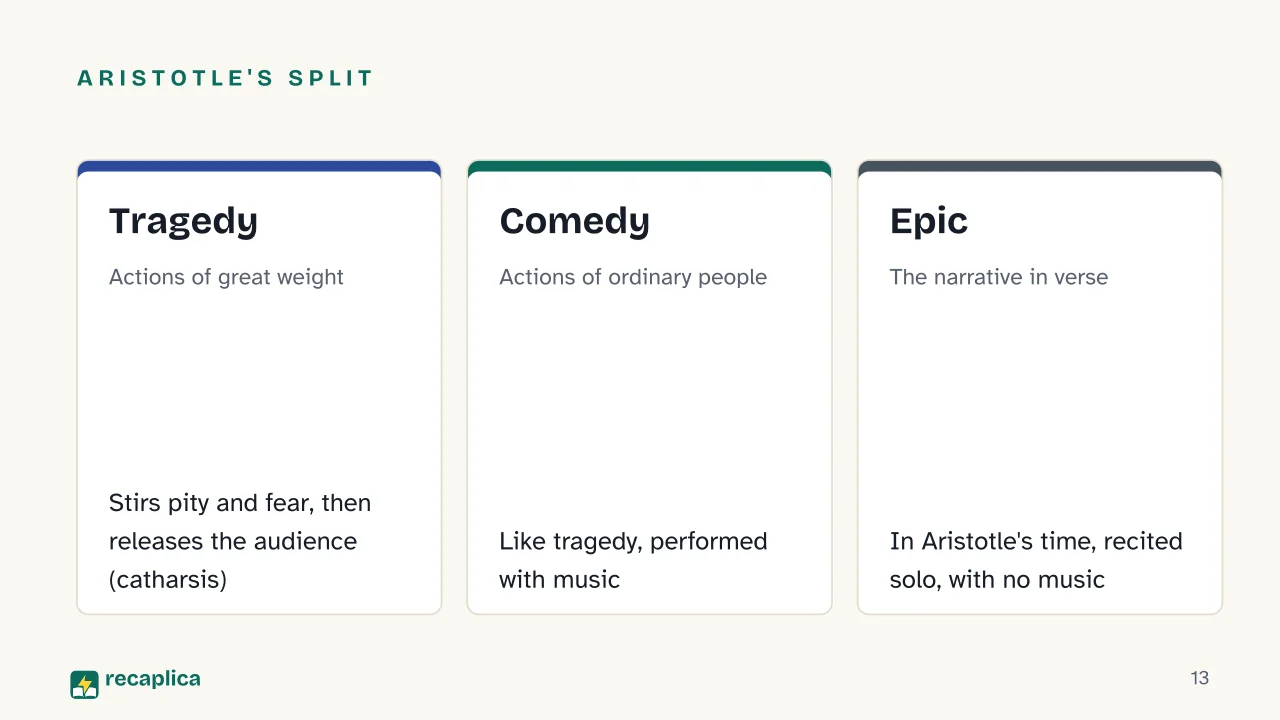
    Aristotle added a criterion of his own: in his view, poetry had split into two strands from the start, depending on the character of the poet, who portrayed either noble actions or the actions of ordinary, lesser people. Tragedy, in this scheme, imitates an action of great weight, able to stir pity and fear and then release the audience from those same emotions — catharsis.

    Short story and novel: two prose narratives

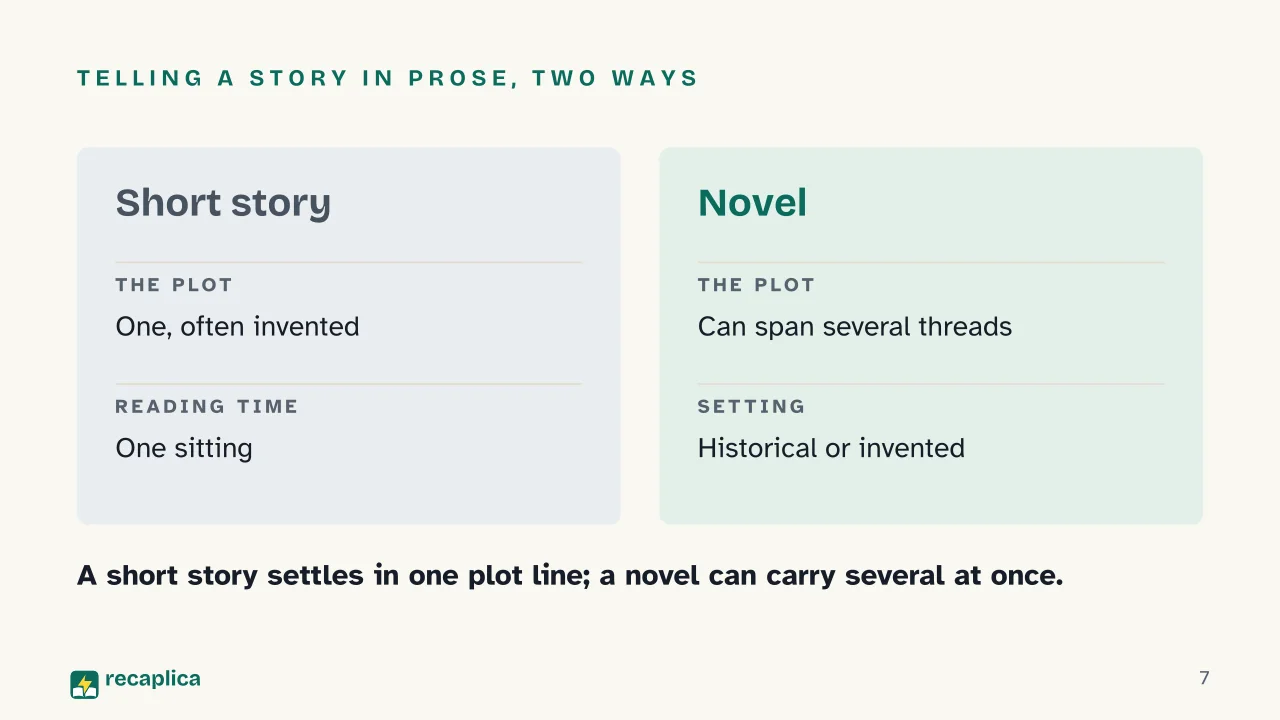
    The novel is a prose work that follows a person, or an entire family, through events that stretch out chapter after chapter. The setting changes from book to book: it can be historical, invented out of whole cloth, or set in the present, and the events told can be real or not. The Betrothed by Alessandro Manzoni follows this pattern: a plot set in a precise historical past, with invented characters woven into real events.

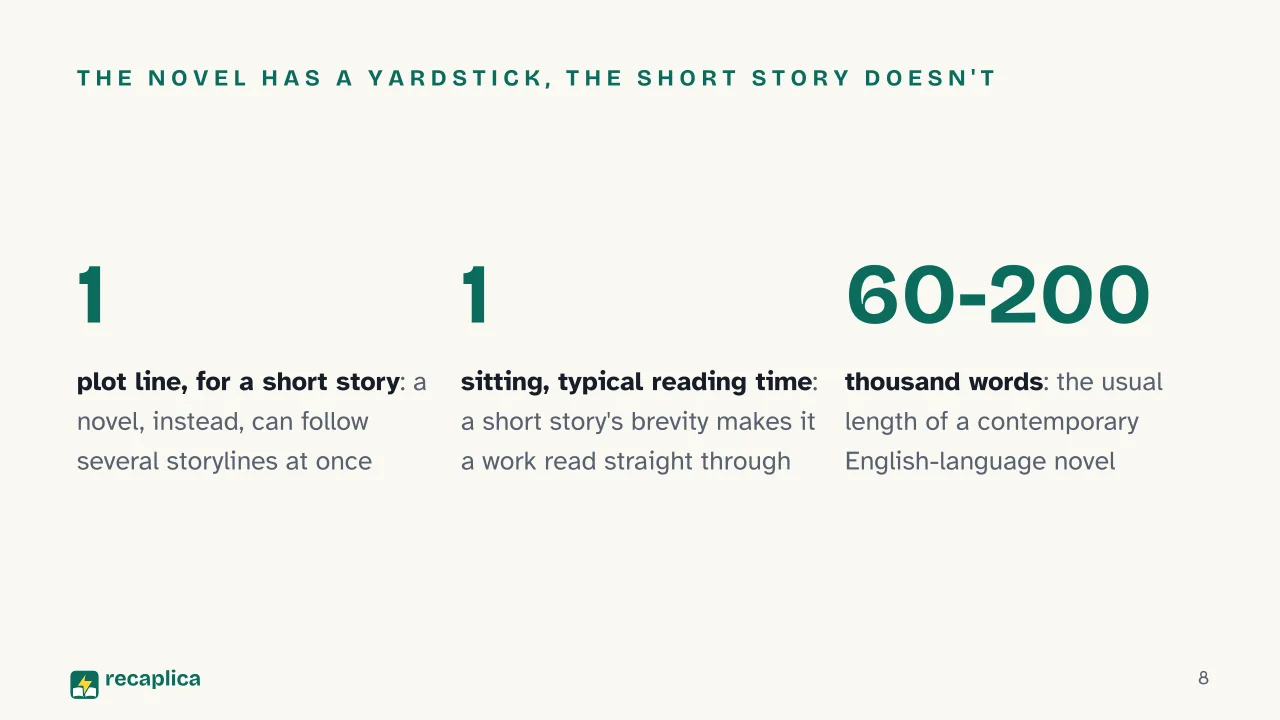
    The short story, by contrast, stays short and lean in its construction: it follows a single plot line from start to finish, almost always invented, while a novel weaves several threads together. Because of its contained length, it reads in one go, in a single sitting. In English, for instance, a contemporary novel typically runs from 60,000 to about 200,000 words, while a short story has no fixed length but still stays too short to be published on its own, the way a novel is. Boccaccio’s Decameron lines up a hundred stories of exactly this kind, each one closed within its own plot.

    Hands-on example: open the Decameron at any tale: in a few pages the story starts and ends, a single plot with no detours. Now pick up a chapter of The Betrothed: Renzo’s thread breaks off, moves to Lucia, comes back to Renzo, tangles with the plague and with the history of Milan. It is the same difference the sources draw between short story and novel: one line against several that interweave.

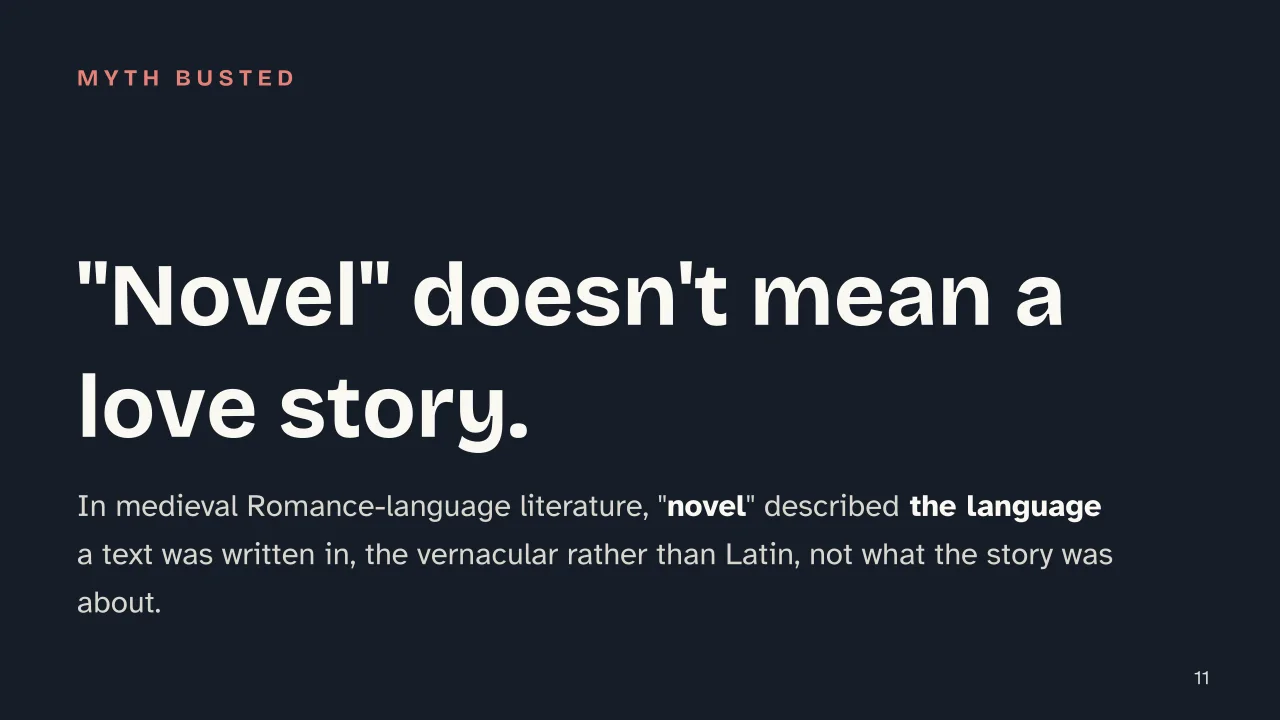
    The name itself carries a piece of history: in the Middle Ages, in Romance-language literature, “novel” simply flagged that a text was written in the vernacular, the tongue descended from Latin, rather than in Latin itself, in either prose or verse. Those early texts existed mostly to entertain listeners with tales of knights and adventure.

    Within the novel, subgenres split off around recurring subjects and moods: Gothic literature, for instance, begins in England in 1764 around castles hiding a secret, dark atmospheres and supernatural events, and lays the ground for the broader horror fiction genre.

    GenreFormPurposeHow it’s read
    Short storyProse, short, single plot lineEntertain with a closed storyIn one sitting
    NovelExtended prose, several storylinesFollow people or families over timeIn instalments, over time
    PoetryVerse, with metreExpress feelings and imagesAloud or silently, minding the rhythm
    TheatreDialogue written for the stageBe performed by actorsWatched in a theatre, or read as a script

    Poetry: the form in verse

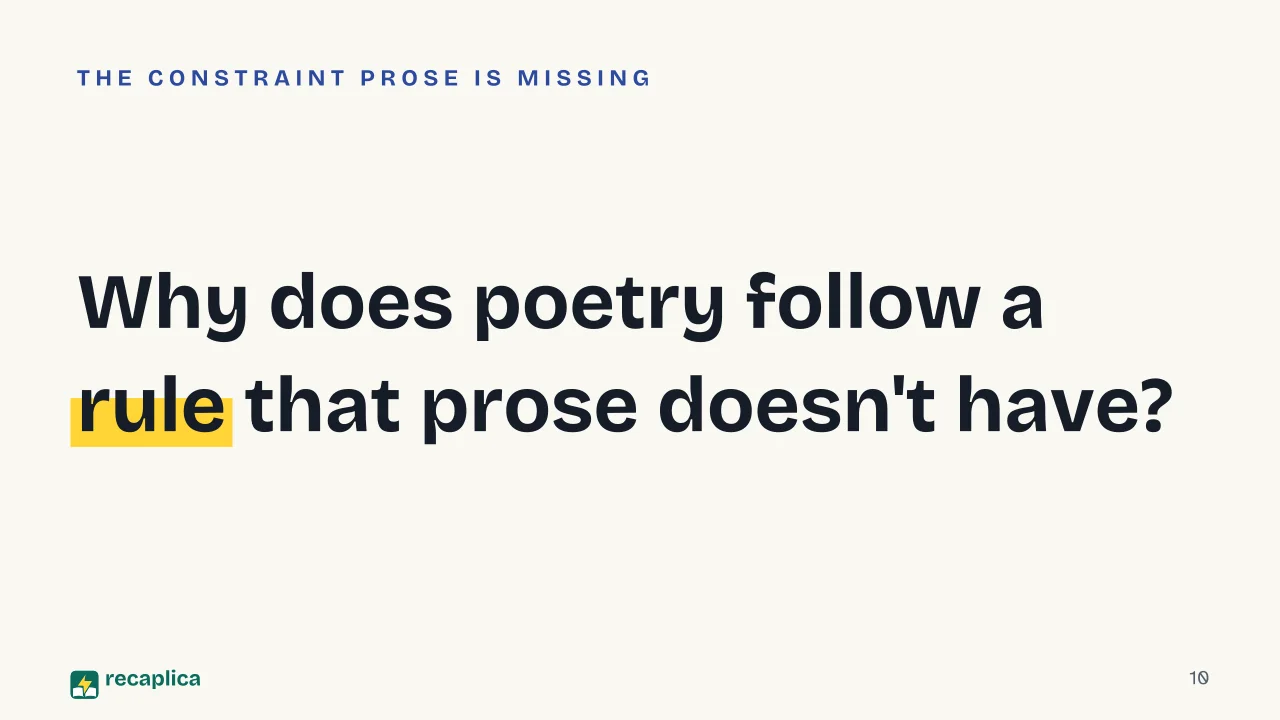
    Poetry is a literary form composed in verse, that is, following defined metrical rules or other formal constraints. The main difference between poetry and prose comes down to exactly that: poetry carries a metrical constraint that prose simply does not have. The sonnet pushes that constraint to an extreme, with a fixed rhyme scheme the poet has to follow line by line.

    Alongside that metrical measure sits a second trait, often mentioned in the same breath: poetry carries the knack for putting intense feelings into words and calling up emotions and images in the reader’s mind. A novel can move a reader just as deeply, of course; what still defines the genre, though, is the pairing of that expressive power with the constraint of verse.

    Theatre: written for the stage

    In the broad sense, drama, the text written for the theatre, is a literary work built above all to be performed on a stage, taking either the path of tragedy or the path of comedy. In a narrower, more modern sense, today a drama centers on a painful episode sparked by conflict between the people living it. English speakers call individual works of this kind “plays,” and “genre” itself, more broadly, groups texts by how they are built and with what technique, only occasionally by theme. Carlo Goldoni worked directly from this staged nature: his reform of comedy starts from the idea that a script has to hold up in front of a live audience, on top of working on the page. Aristotle pointed out one more difference between the staged forms and epic poetry: tragedy and comedy were fully acted out, with music running underneath, while epic, the narrative written in verse, stuck in his time to plain recitation. In his view, that was one more reason why audiences stayed more drawn to theatre.

    When genres blend: fiction literature genres in practice

    Plato’s three modes, dramatic, narrative, mixed, are a reminder that the lines between genres are rarely clean. Dante’s Divine Comedy is a narrative poem: it follows a single long plot, the way a novel does, but writes it in tercets of hendecasyllables, the way poetry does. Fiction literature genres, in short, come down to a loose cluster of traits, and a single work can easily sit across more than one at once.

    Spotting a genre is less about filing a work under one label than about reading its form, its purpose and the way it asks to be taken in. Writing one’s own text raises the opposite question: how to choose a genre for writing a story.

    Slide deck

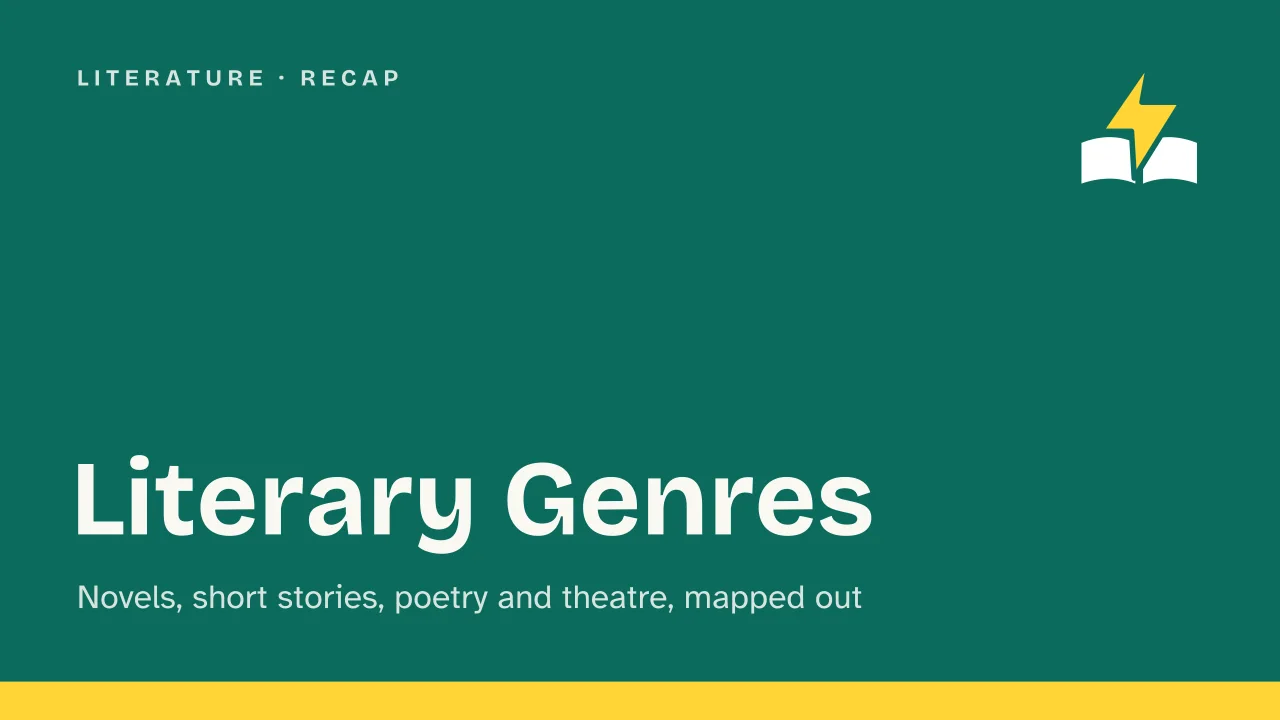
    Slides ready to download and make your own in PowerPoint or Google Slides, with speaker notes. Pick the Flash cut or the Full one.
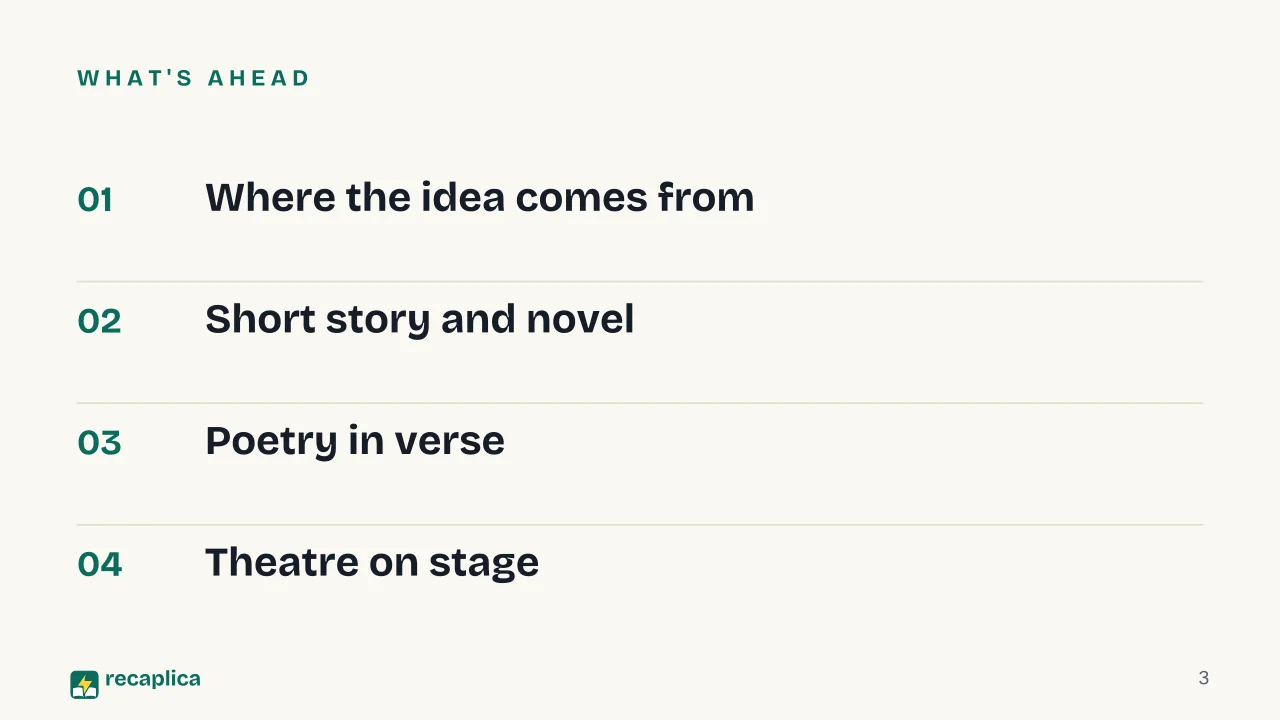
    Slide 1 of the presentation on Literary Genres: Literary GenresSlide 2 of the presentation on Literary Genres: Is a short story just a shorter novel?Slide 3 of the presentation on Literary Genres: What's aheadSlide 4 of the presentation on Literary Genres: Chapter 01: Where the idea comes fromSlide 5 of the presentation on Literary Genres: Born in ancient GreeceSlide 6 of the presentation on Literary Genres: Chapter 02: Short story and novelSlide 7 of the presentation on Literary Genres: Telling a story in prose, two waysSlide 8 of the presentation on Literary Genres: The novel has a yardstick, the short story doesn'tSlide 9 of the presentation on Literary Genres: Chapter 03: Poetry in verseSlide 10 of the presentation on Literary Genres: Why does poetry follow a rule that prose doesn't have?Slide 11 of the presentation on Literary Genres: "Novel" doesn't mean a love story.Slide 12 of the presentation on Literary Genres: Chapter 04: Theatre on stageSlide 13 of the presentation on Literary Genres: Aristotle's split: Tragedy, Comedy, EpicSlide 14 of the presentation on Literary Genres: What mainly sets poetry apart from prose?Slide 15 of the presentation on Literary Genres: Time to review
    Flash10 slidesThe essential thread, to present in classFull15 slidesEvery chapter and the deeper detail

    Common myths

    • ✗ Myth Theatre is just a text to be read, like a short story.

      ✓ Reality Drama, broadly speaking, is a literary work written to be performed on a stage by actors. For Aristotle, tragedy and comedy were staged with musical accompaniment, while epic poetry, the narrative in verse, stuck to plain recitation in his time.

    • ✗ Myth A novel is, by definition, a long story made up from scratch.

      ✓ Reality According to Treccani, a novel can tell real events or entirely invented ones, and its setting can be historical, fantastical or realistic and contemporary: the backdrop always varies, with no fixed format for the content.

    • ✗ Myth The word "novel" points to a type of content, like a love story.

      ✓ Reality It actually started as a linguistic label, born in medieval Romance-language literature: the "Romance" tongue was the one descended from Latin, used instead of Latin itself in texts written in both prose and verse. The term was about the language of the text.

    Mind map

    Drag the background to move around and the nodes to reposition them; use − and + to collapse and expand branches.
    Customize
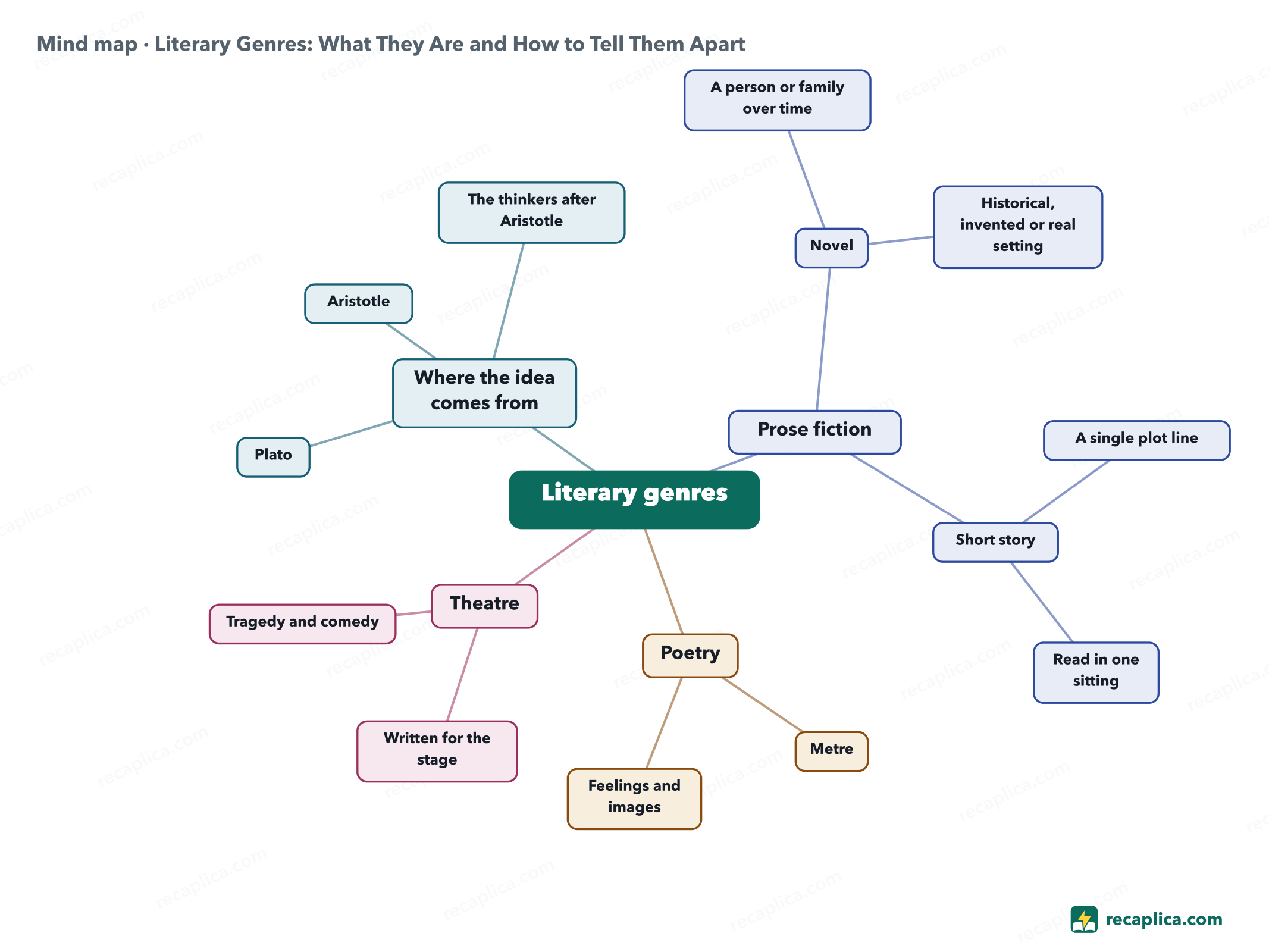
    Mind map: Literary Genres: What They Are and How to Tell Them Apart
    • Literary genres
      • Prose fiction
        • Novel
          • A person or family over time
          • Historical, invented or real setting
        • Short story
          • A single plot line
          • Read in one sitting
      • Poetry
        • Metre The rules that measure the line
        • Feelings and images Credited to the verse form
      • Theatre
        • Written for the stage Performed by actors, rather than read
        • Tragedy and comedy For Aristotle, both set to music
      • Where the idea comes from
        • Plato First systematic classification of poetry
        • Aristotle Built on and widened Plato's distinction
        • The thinkers after Aristotle Fixed the classification that reached us

    Quiz: test yourself

    Answer the questions to check what you have learned: you get instant feedback and a short explanation.

    Grade 0/10 0/5
    1 What mainly sets poetry apart from prose?

    The key difference is metre, the set of rules that measure the line, which prose simply doesn't have. On top of the verse form, poetry is also credited with putting strong feelings and vivid images into words.

    2 What is one difference between a short story and a novel?

    A short story is a piece of narrative fiction, almost always invented, shorter and simpler in structure, built around one plot line. A novel is longer, can follow several storylines at once, and can draw on invented events, real ones, or both.

    3 Who first proposed a systematic classification of poetry in antiquity?

    The first systematic classification, based on the ethical content of a work and its degree of imitation (mimesis), is credited to Plato. Aristotle later built on it and widened it, though the classification that actually reached us owes more to the thinkers who followed him than to Aristotle himself.

    4 True or false: for Aristotle, tragedy and comedy were accompanied by music, while epic poetry was not.

    True: according to Aristotle, tragedy and comedy were fully acted out and set to music, while epic poetry, in his time, was only recited, without that musical accompaniment.

    5 Where does the word "novel" historically come from?

    In Romance-language medieval literature, texts in the vernacular — the Romance tongue descended from Latin, used instead of Latin itself in both prose and verse — gave the word its root. The label was about the language a text used, quite apart from its story.

    Answers: 1-A · 2-A · 3-A · 4-A · 5-A

    Flashcards

    Tap the card to flip it and check whether you remember the answer, then move to the next one.

    1 / 8

    Explain it in your own words

    The ultimate test: if you can explain it in simple words, you've truly understood it. Write your explanation, then compare it with the Recap.

    Your explanation is saved only on this device.

    Literary genres are the categories writers and critics use to group literary works, built mainly around form and technique, with subject matter as a secondary clue. The idea goes back to ancient Greece, where Plato set out the first systematic classification of poetry and told apart three ways of narrating: imitating characters directly, speaking in the author's own voice, or mixing the two. Aristotle picked up that distinction and widened it, though the scheme that reached us owes more to the thinkers who came after him. In school, the usual map sorts works into fiction, poetry and theatre, with the short story and the novel as two different shapes of prose fiction. Any genre can be spotted from three traits: the form it is written in, the purpose it serves and the way it gets read or watched.

    Frequently asked questions

    How many literary genres are there?

    Classical sources tell apart three ways of narrating — dramatic, narrative and mixed — following Plato's distinction, later widened by Aristotle. In school, that scheme becomes fiction (with the novel and the short story as its two prose forms), poetry and theatre, each with its own shape and purpose.

    What are the different literary genres, in practice?

    Beyond the three classical modes, the working map used in schools and in most style guides groups fiction, poetry and theatre, and then splits fiction again into the novel and the short story. Each genre is told apart by how it is built, what it sets out to do and how a reader is meant to take it in.

    What is the difference between a short story and a novel?

    A short story rides on a single thread of events and wraps up in a few pages, almost always born from the writer's imagination; a novel, much longer, follows a person or a family through chapters that weave together, and can mix invented events with real ones.

    Why is poetry set apart from prose?

    Because it has to answer to a metre that prose simply ignores: that constraint is what makes it recognisable at a glance, together with its knack for calling up images and strong feelings in just a few words.

    What is drama, in the technical sense?

    In the broad sense, it is a text written specifically to be staged by actors, able to take the shape of either tragedy or comedy; in English, any work of this kind is also called a "play." In a narrower, more modern sense, "drama" today points to a work built around a painful episode born out of conflict.

    Sources

    • Treccani, Enciclopedia Italiana — «Genere letterario»
    • Treccani, Vocabolario — «Romanzo»
    • Treccani, Vocabolario — «Racconto»
    • Treccani, Vocabolario — «Poesia»
    • Treccani, Vocabolario — «Dramma» (dramma¹)
    • Stanford Encyclopedia of Philosophy — «Aristotle's Aesthetics»
    • Gustavus Adolphus College, LibGuide — «Literary Form»
    • Texas Tech University — «Basic Literary Terms»

    Every Recap goes through an independent review before publication.

    Every evening, the day's new Recaps on our Telegram channel. Join the channel →

    Keep learning

    • Literature Best Dark Romance Books: A List for Every Subgenre A selection of dark romance books sorted by subgenre, for readers who already know what the genre is and just want a place to start. Dark mafia romance books cover forced marriages and warring crime families, as in Ruthless People and Killing Sarai. Dark fantasy romance books and paranormal romance move the same pull between desire and threat into worlds with gods, vampires and power struggles. Dark academia romance sets it among visions and fairy tales, while spicy dark romance books and stalker romance push the premise to the edge of real obsession. Read the Recap →
    • Literature Best Stephen King Books: 10 Novels and the Case for Each One Stephen King has written novels across several genres, from Carrie in 1974 to The Institute in 2019, and Wikipedia credits his books with more than 400 million copies sold overall. This list lines up ten titles that come up often in recommendations, with a reason for each pick, from horror staples like It and The Shining to novels that step outside the genre, such as 11/22/63 and The Green Mile. Every book comes with its publication year, its publisher and, where one exists, the award it won or was nominated for. There's no single agreed ranking: Hans-Åke Lilja, interviewed by Five Books as someone who has followed King's career for over 40 years, leaves well-known titles such as Carrie and The Shining out of his own personal picks. Read the Recap →
    • Literature Horror Story Ideas: Everyday Details, Old Fears and a Twist That Lands Writing a horror story often starts with a blank page more uncomfortable than the story itself. This Recap collects starting situations, recurring fears and ways to build a twist, with concrete examples to work from. It doesn't cover the techniques that build tension on the page — those live in the parent Recap on how to write a horror story. The sturdiest ideas tend to start with an everyday detail that stops behaving the way it should, or an old fear dressed in a setting readers recognize. Read the Recap →

    recaplica

    Clear in 30 seconds, yours in 10 minutes.

    Recaps Mind maps Request a Recap Telegram channel Mind map maker Our method About Privacy & cookies Legal notes & terms of use

    © 2026 Recaplica · A project by Curi S.r.l. — VAT IT05472000750

    Statistics, only if you say so

    To learn which Recaps help most we would use Google Analytics, with aggregate, anonymous data. It starts only with your OK, and you can change your mind anytime. Privacy policy