|
recaplica
Horror Fiction: What It Means and the Classics That Shaped It |
| © 2026 Recaplica · recaplica.com — All rights reserved |
Horror Fiction: What It Means and the Classics That Shaped ItWhat to print Page numbers appear when printing with default margins. SlidesChoose a cut Flash10 slidesThe essential thread, to present in classFull14 slidesEvery chapter and the deeper detailBoth come with speaker notes. In 30 seconds quick readHorror fiction is writing built to produce fear in the reader, sometimes through supernatural elements such as ghosts and vampires, sometimes through the psychological terror of ordinary life. It grows out of the Gothic novel of the 18th century, the first form to cultivate fear as a literary purpose in itself. Writers such as Edgar Allan Poe, Mary Shelley, Bram Stoker, H.P. Lovecraft and Shirley Jackson each gave it a different shape, from Frankenstein's monster to Dracula's vampire to Lovecraft's cosmic horrors. It is a genre distinct from Gothic fiction, its historical ancestor, and sits inside the wider map of literary genres. Key Points
Deep DiveRoots in the Gothic novelHorror fiction tells stories whose core, according to Encyclopedia Britannica, is the creation of a sense of fear in the reader. In Western literature, this cultivation of fear as a literary purpose in its own right emerges in the pre-Romantic 18th century, with the Gothic novel. Britannica credits Horace Walpole, with “The Castle of Otranto” (1764), with founding horror fiction as a legitimate literary form. Before Walpole, fear often showed up in fiction, but rarely as the main point of the text. The Gothic novel, then, is the historical ancestor of horror fiction, not a synonym for it: it has its own separate guide on our site, with the castles, settings and atmospheres that belong to it alone — see our guide to Gothic literature. The horror that grew out of that strand later expanded well past those settings. The authors who defined the genreMary Shelley brings pseudoscience into the genre with “Frankenstein” (1818): the plot of a created monster that turns on its own maker, according to Britannica. By the end of the century, Bram Stoker published “Dracula” (1897), the genre’s defining vampire tale; Britannica credits it with a decisive role in shaping the vampire trope that later spread through Western popular culture, in both fiction and film, with a line of influence running all the way to Stephen King’s “Salem’s Lot,” one of the titles covered in our guide to the best horror books. Edgar Allan Poe deserves a section of his own. According to Britannica, he pushed the horror story well past simple entertainment, skillfully blending reason and madness within an unsettling everyday atmosphere; his first published story is itself a horror tale, “Metzengerstein,” which appeared in the Saturday Courier on January 14, 1832. Yet, according to the Edgar Allan Poe Society of Baltimore, horror tales make up only a small part of his overall output, which also included poetry and literary criticism. The source itself notes that it is not Poe who is morbid for having written those tales, but readers who are morbid for remembering him chiefly for them. In the 20th century, Britannica places H.P. Lovecraft among the masters of the gothic tale of terror, an author of novellas and short stories blending horror and macabre fantasy. Lovecraft was born in Providence, Rhode Island, on August 20, 1890, and died there on March 15, 1937; drawn to science from childhood, he was kept out of university by lifelong frail health. His Cthulhu Mythos tells of ordinary New Englanders who encounter horrific beings of extraterrestrial origin, built on an intimate knowledge of the region’s geography and culture fused with an original mythology. The geometry Lovecraft imagines for those beings is nothing you would find in a classroom: a separate Recap covers it on its own. Per Britannica, Lovecraft’s fame as a writer grew mostly after his death.
Two strands, not oneBritannica marks out two strands of the horror story. The first plays on explicit supernatural elements, such as ghosts and vampires. The second builds fear on psychological ground, closer to ordinary life. Shirley Jackson’s “The Haunting of Hill House,” a 1959 novel adapted in 1963 into a film often ranked among the best haunted-house movies, belongs, per Britannica, to this second strand: a horror story with Gothic roots that explores psychological suspense. In some horror stories, Britannica notes, the tension comes precisely from the absence of a mysterious atmosphere, from the contrast with an everyday setting. Horror, Gothic fiction and the map of literary genresHorror fiction does not line up exactly with the Gothic novel: Gothic fiction is the historical strand that gave rise to it in the 18th century, while horror also includes works with no castles or Gothic settings at all, from the Cthulhu Mythos to the domestic suspense of Hill House. Britannica still groups Bierce, Machen, Blackwood, Lovecraft and Stephen King among the authors who shaped the horror story’s evolution in the 20th century, alongside the names from the century before. To place horror within the wider system of narrative genres, novel, short story, poetry, drama, and their branches, our guide to literary genres lays out the full picture. Anyone deciding which genre to write in, horror included, can turn to our guide on choosing a literary genre. Readers curious about the subgenre blending horror and romance can turn to our guide on horror romance. Anyone ready to move from reading to writing can find the concrete techniques, atmosphere, pacing, point of view, in our guide on how to write a horror story. Slide deckSlides ready to download and make your own in PowerPoint or Google Slides, with speaker notes. Pick the Flash cut or the Full one.     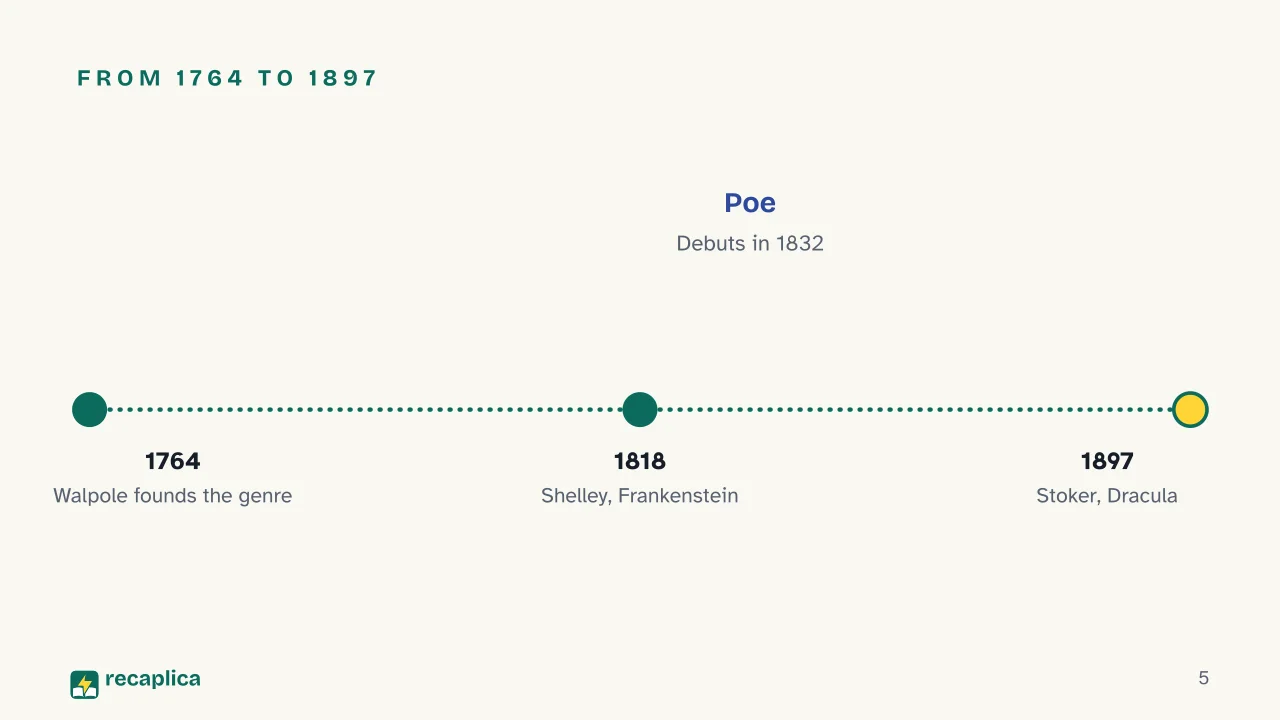  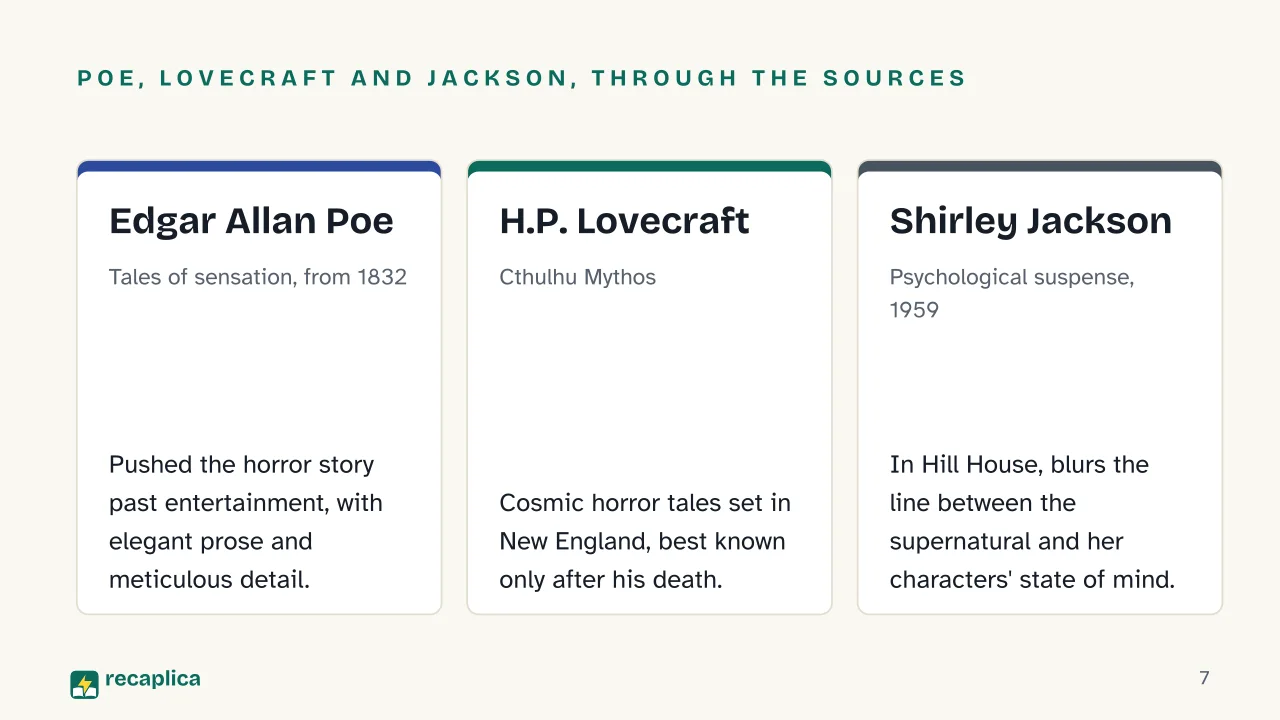 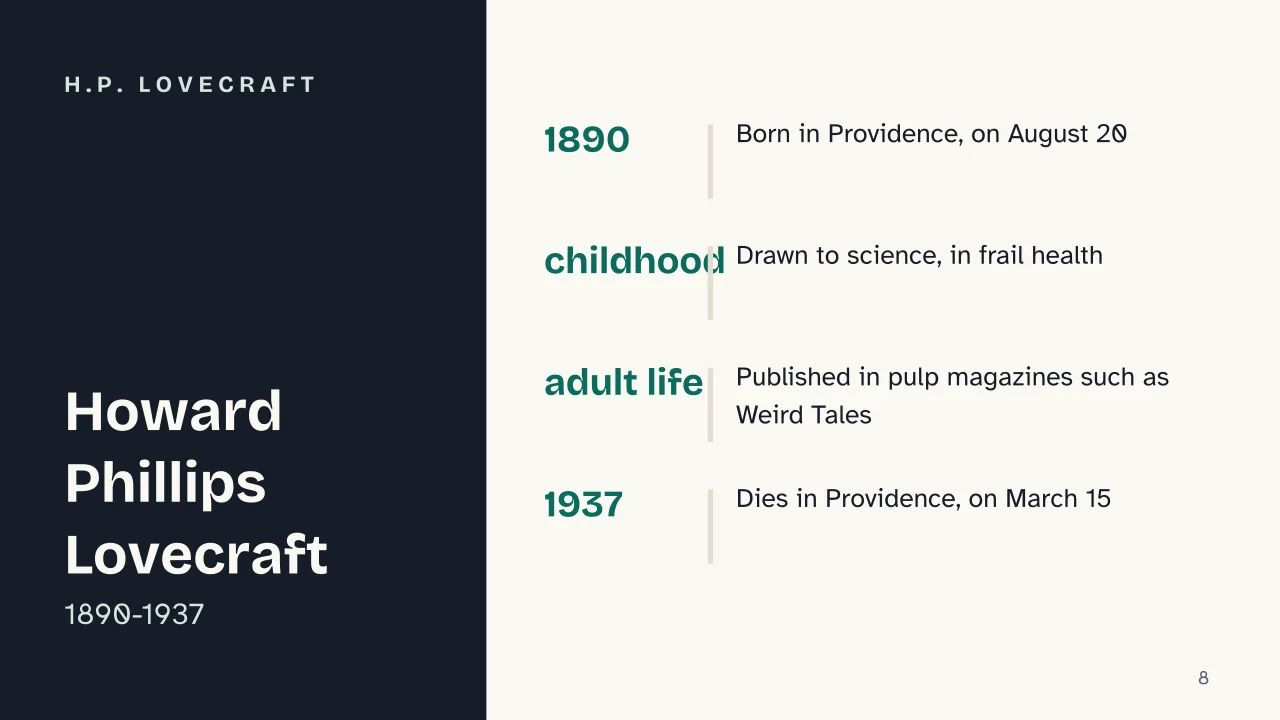  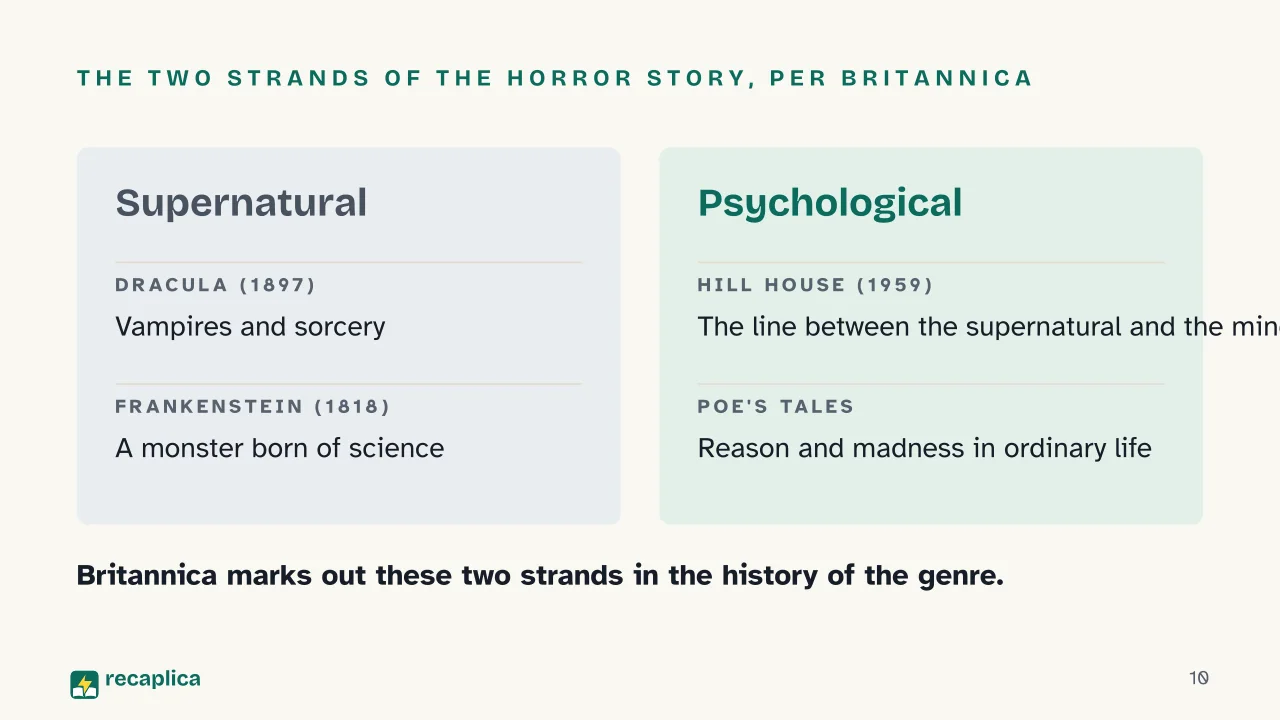  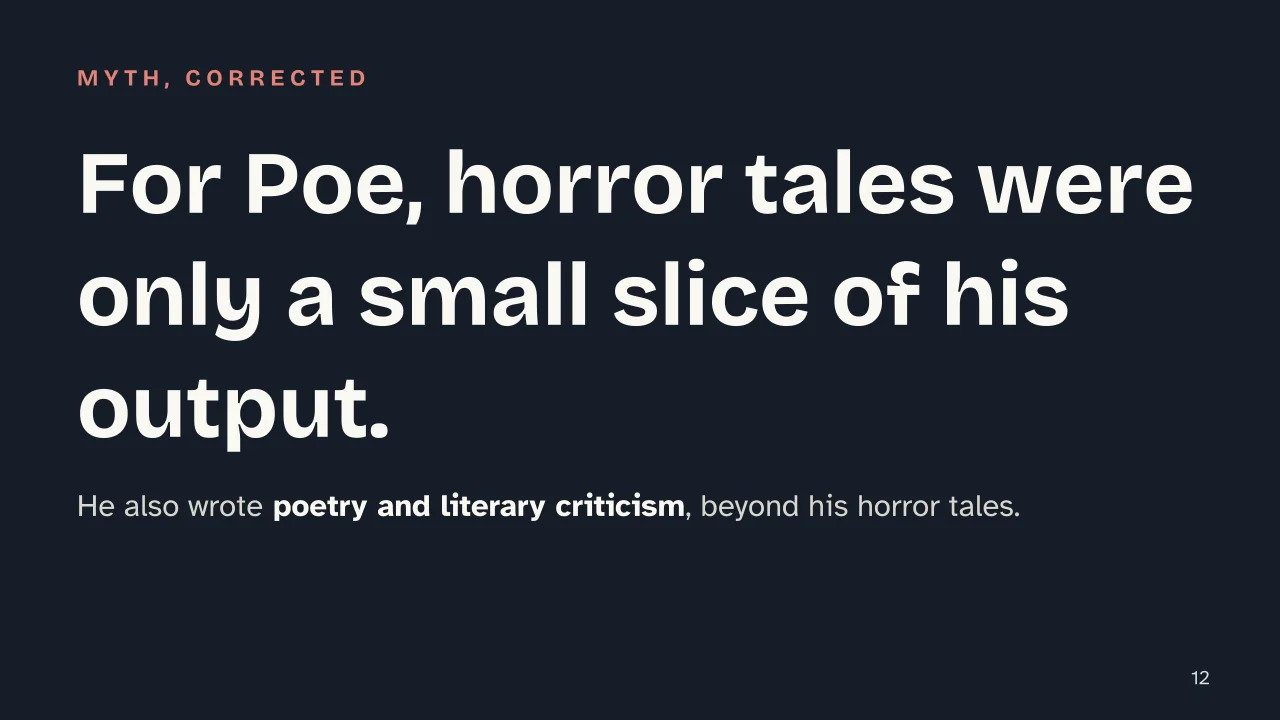 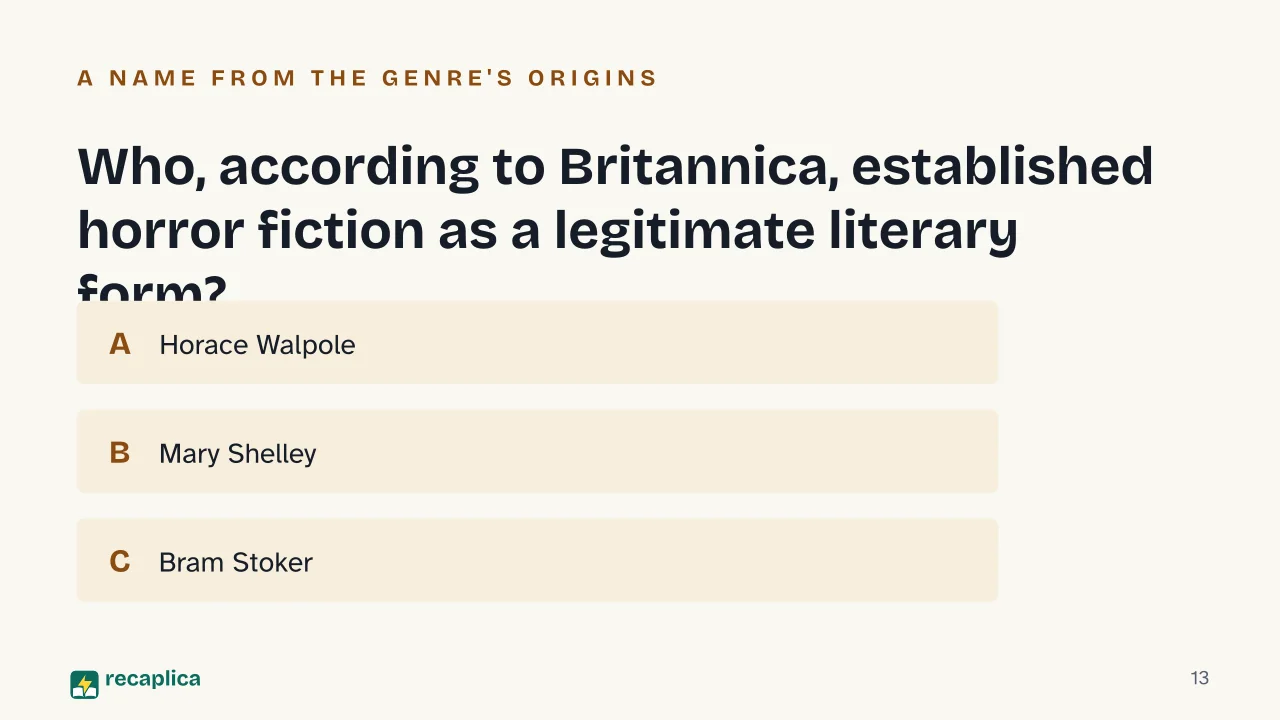  Common myths
Mind mapDrag the background to move around and the nodes to reposition them; use − and + to collapse and expand branches. 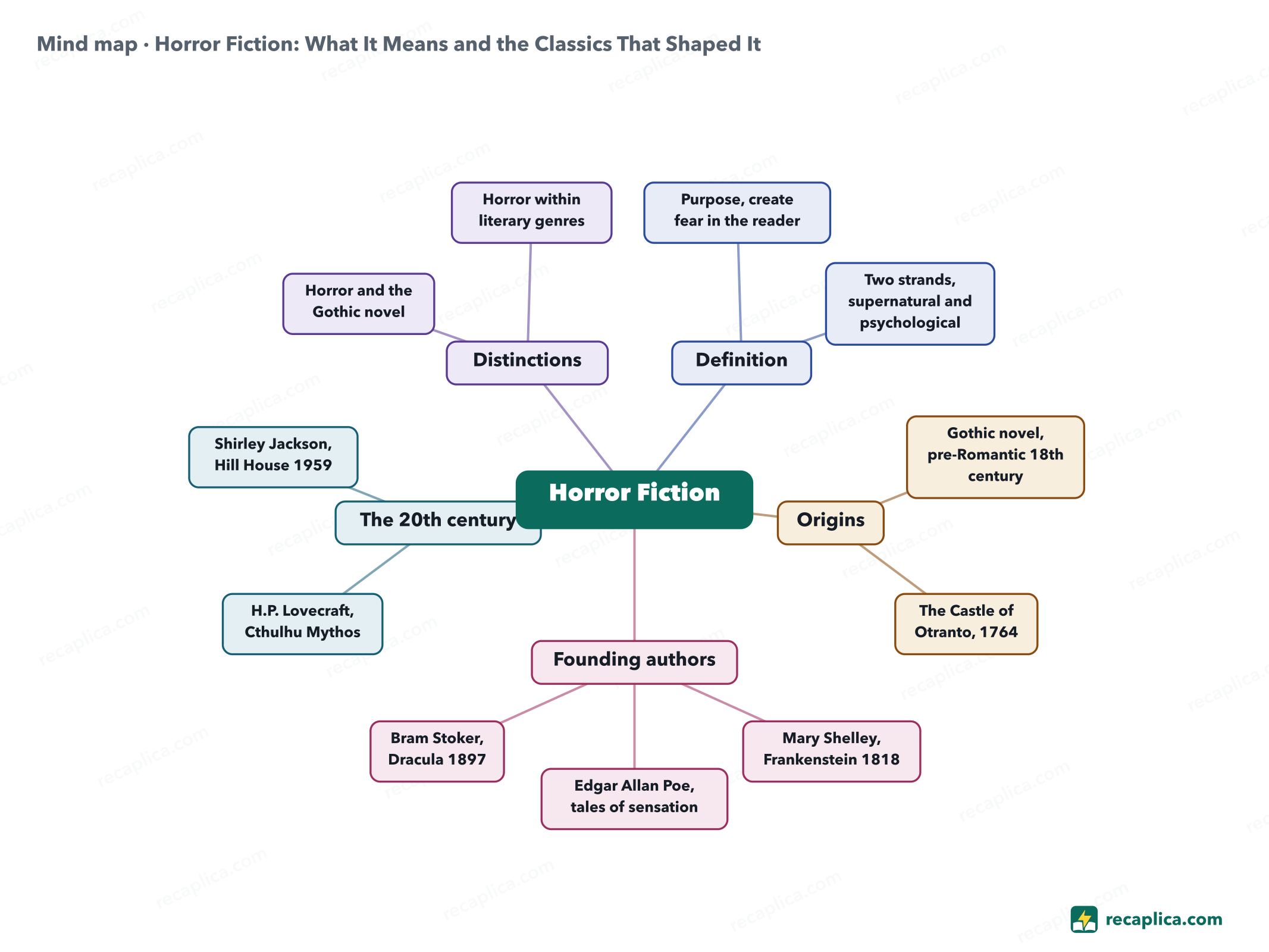
Quiz: test yourselfAnswer the questions to check what you have learned: you get instant feedback and a short explanation. Grade 0/10 0/5
FlashcardsTap the card to flip it and check whether you remember the answer, then move to the next one. 1 / 8 Explain it in your own wordsThe ultimate test: if you can explain it in simple words, you've truly understood it. Write your explanation, then compare it with the Recap. Your explanation is saved only on this device.
Frequently asked questionsWhat is the difference between horror fiction and the Gothic novel?The Gothic novel is the strand that emerged in the pre-Romantic 18th century and first cultivated fear as a literary purpose; according to Britannica, that is where the horror story has its roots, with Horace Walpole establishing it as a legitimate form. Horror fiction later expanded well beyond that setting, reaching as far as Lovecraft's cosmic horror. Who invented horror fiction?Britannica credits Horace Walpole with giving this kind of story a literary standing it had not had before, with "The Castle of Otranto" (1764); before him, fear appeared in fiction, but not as a purpose in its own right. What are some of the most famous classics of horror literature?Among the works Britannica singles out as shaping the genre: "Frankenstein" by Mary Shelley (1818), "Dracula" by Bram Stoker (1897), the tales of Edgar Allan Poe and H.P. Lovecraft, and "The Haunting of Hill House" by Shirley Jackson (1959). Was Edgar Allan Poe mainly a horror writer?No. The Edgar Allan Poe Society of Baltimore frames horror as a small slice of his wider body of work, alongside poetry and literary criticism. Are horror and Gothic fiction the same thing?No: the Gothic novel is defined by its setting, castles, brooding atmospheres, a fixed historical period, while horror is defined by its purpose, creating fear, and can do without that setting: Lovecraft's Cthulhu Mythos is the clearest case. Every Recap goes through an independent review before publication. |