recaplica
Clear in 30 seconds, yours in 10 minutes.
In 30 seconds quick read
Giovanni Boccaccio wrote the Decameron between 1349 and 1353: one hundred tales told by ten young Florentines, seven women and three men, who take shelter in the countryside to escape the 1348 plague and pass the time telling one story each per day for ten days. Many of the tales turn on the same idea, fortune and cleverness, and Boccaccio's prose is treated as a founding moment for Italian literary language. Alongside Dante Alighieri and Francesco Petrarch, Boccaccio is one of the Three Crowns of Italian literature: he was among the first editors of Dante's work and gave what scholars consider the first public lecture series on the Divine Comedy.
Key Points
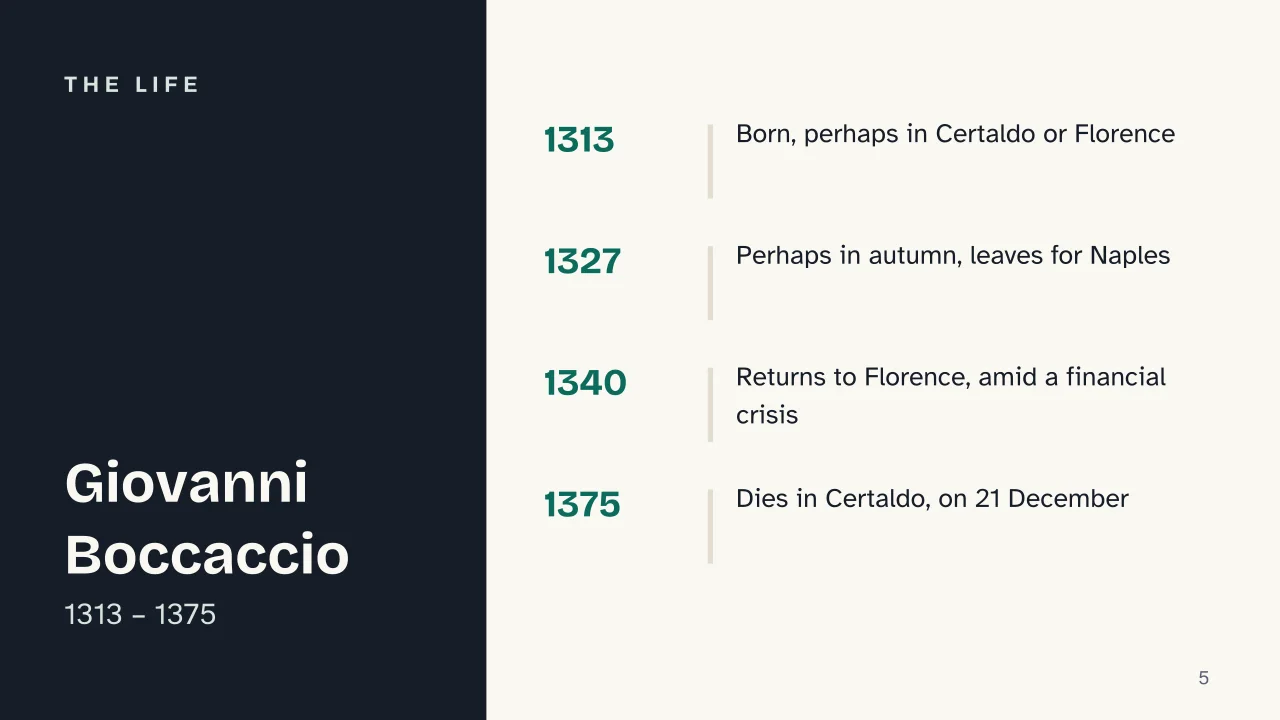
Giovanni Boccaccio was born in 1313, probably in Florence, the illegitimate son of a Florentine merchant; he died in Certaldo on 21 December 1375.
The Decameron opens with a proem and an introduction, then runs through ten days of ten tales each, one hundred tales in total; Boccaccio wrote it between 1349 and 1353, according to the most widely accepted estimate.
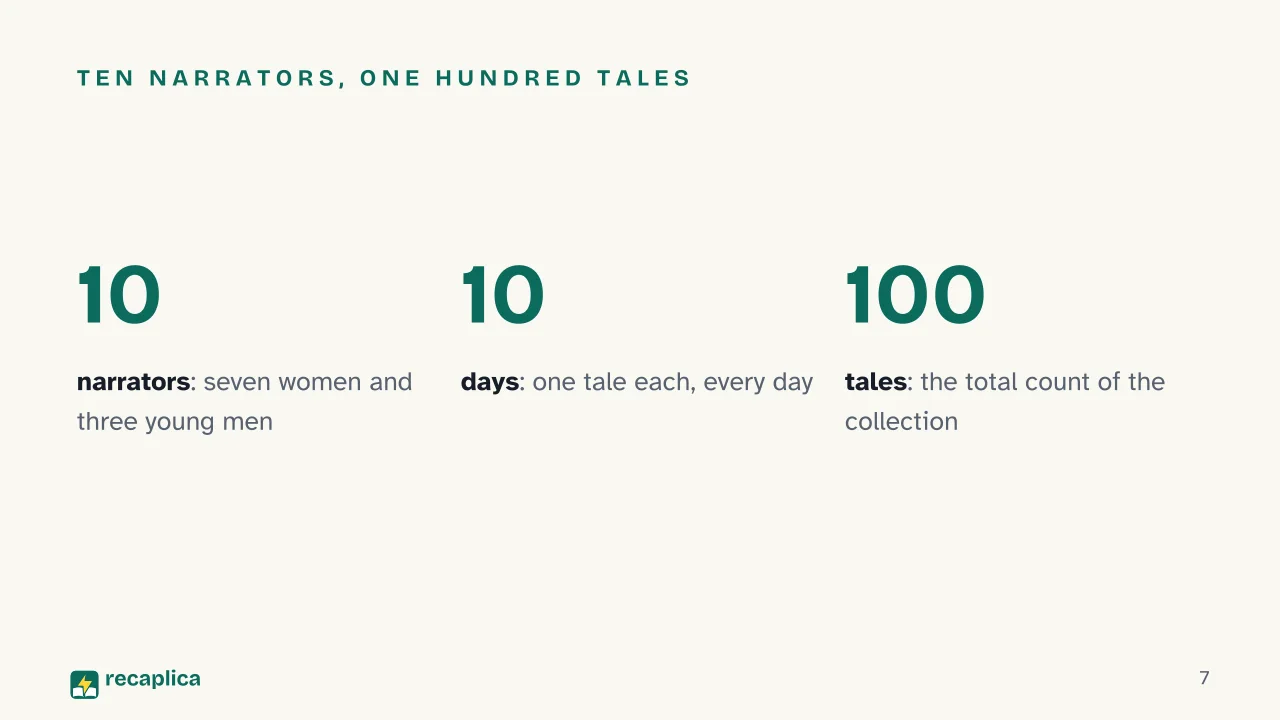
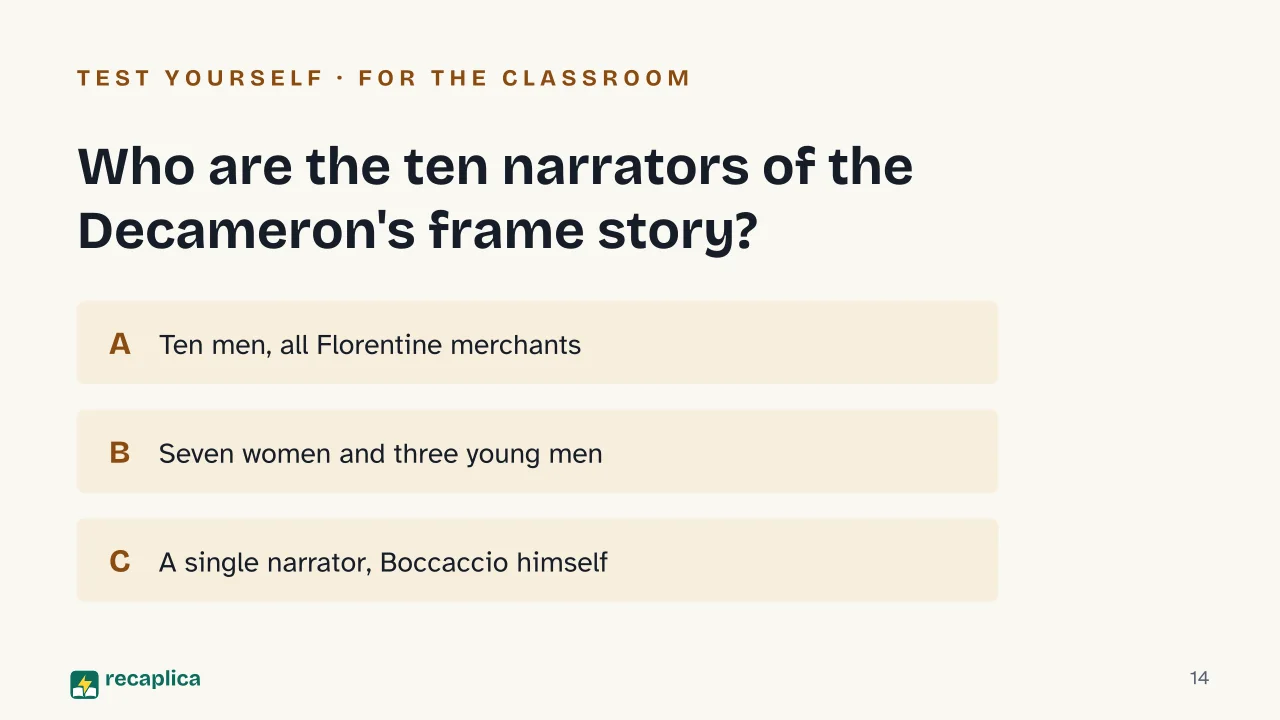
The frame story is set during the 1348 plague: ten young people, seven women (Pampinea, Filomena, Neifile, Fiammetta, Elisa, Lauretta, Emilia) and three men (Filostrato, Dioneo, Panfilo), leave Florence for the countryside and tell stories to fill the days.
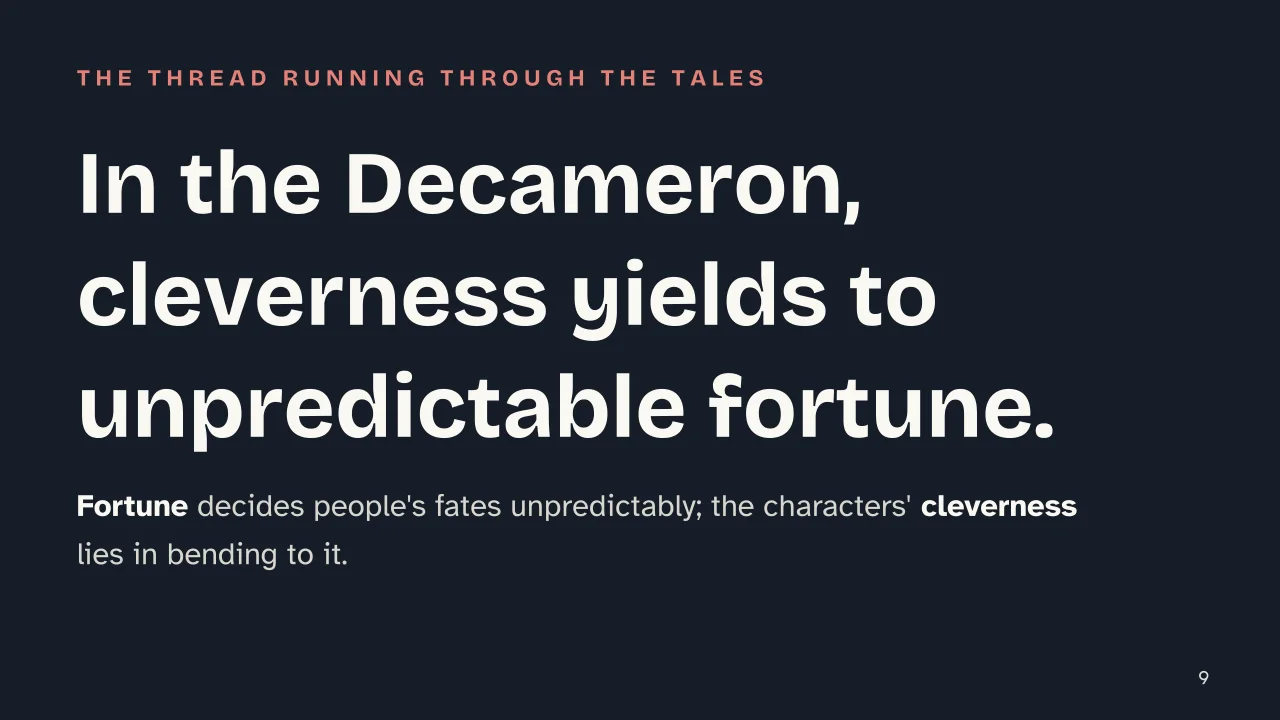
Many tales share the theme of fortune and cleverness: chance decides people's fates in ways no one can control, and the characters' intelligence lies in adapting to it, not in trying to master it.
Alongside Dante Alighieri and Francesco Petrarch, Boccaccio forms the Three Crowns of Italian literature; he was among the first editors of Dante's work and gave what scholars regard as the first public lecture series on the Divine Comedy.
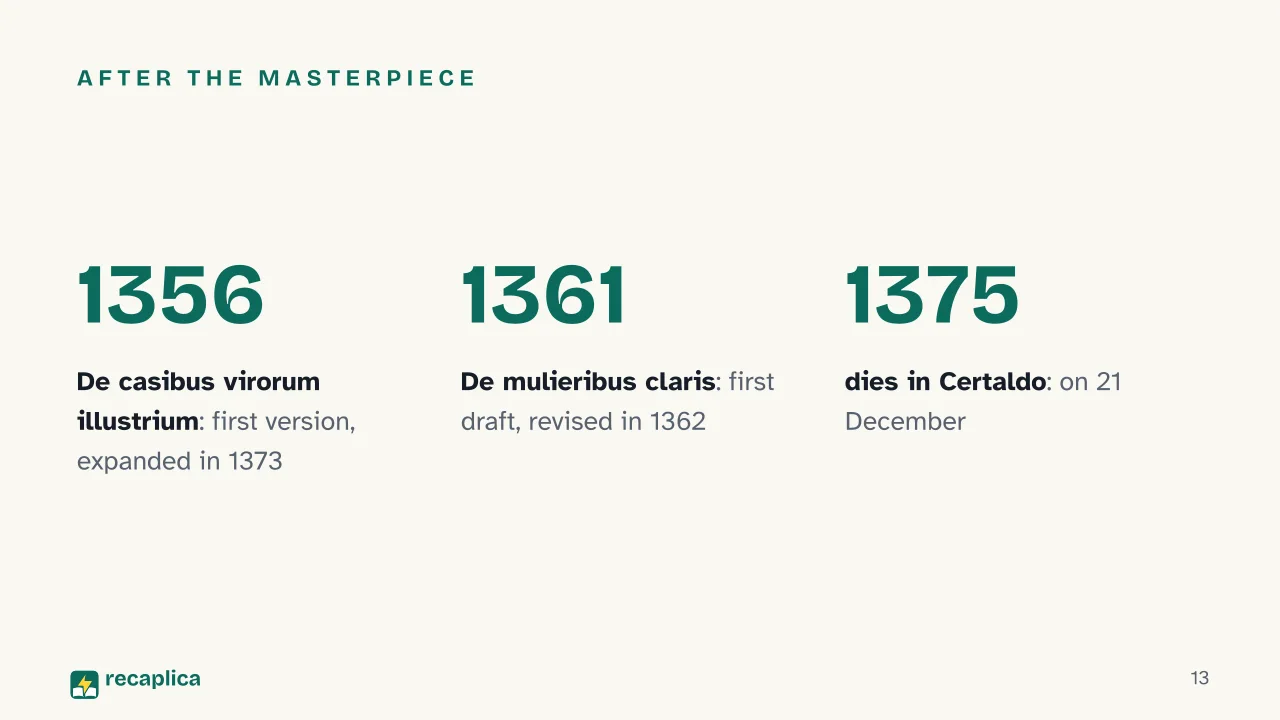
After the Decameron, Boccaccio turned to scholarly works in Latin, such as De casibus virorum illustrium and De mulieribus claris, revised more than once into the 1360s and 1370s.
Key figures
1348 the year the plague struck Florence and set the scene for the Decameron's frame story; Boccaccio was in the city at the time Source: Treccani, Enciclopedia — Boccàccio, Giovanni (Dizionario Biografico)
1349-1353 the years in which Boccaccio wrote the Decameron, according to the most widely accepted estimate Source: Treccani, Enciclopedia — Boccàccio, Giovanni (Dizionario Biografico)
Deep Dive
A Florentine raised between Naples and books
Giovanni Boccaccio was born in 1313, perhaps in Certaldo but more likely
in Florence, sometime between June and July. He was the illegitimate son
of a Florentine merchant, who sent him to Naples, perhaps in autumn
1327: first to learn the trade at the house of the Bardi
family, then to study canon law. In Naples he used the Royal Library,
and through it came into contact with scholars and writers at court.
He returned to Florence in the winter of 1340-41, during a period of
financial crisis for his family. Those were the years of his first
works in the vernacular: the Commedia delle ninfe fiorentine (1341-42),
the poem L’amorosa visione (1342-43), the novel Elegia di Madonna
Fiammetta (1343-44) and the short poem Ninfale fiesolano (1344-46). The
masterpiece came later.
The frame story: ten narrators fleeing the plague
In 1348, the year the plague struck Florence, Boccaccio was in the city
again. That plague arrived near the end of the long historical period
scholars call the Middle Ages, which the Recap on the Middle
Ages covers in full, from feudalism
to the Crusades. It is the backdrop Boccaccio chose for his masterpiece,
written, according to the most widely accepted estimate, between 1349
and 1353: ten young people — seven women, Pampinea, Filomena, Neifile,
Fiammetta, Elisa, Lauretta and Emilia, and three men, Filostrato, Dioneo
and Panfilo — leave Florence for the countryside to escape the
contagion.
There, they tell each other one story each per day for ten days: ten
days, ten tales each, one hundred in total, preceded by a proem and an
introduction. The book’s name comes straight from this structure: it
derives from the Greek déka hēmérai, meaning ten days.
A useful example: the difference between a tale and a novel shows
up right here. A Decameron tale — like the one about Andreuccio of
Perugia, covered further below — closes within a single episode, with
a beginning and an end fitted into a few pages. A novel such as
Alessandro Manzoni’s The
Betrothed instead
follows a single plot that runs across hundreds of pages, with
characters who return from chapter to chapter.
The Treccani encyclopedia entry points to the contrast between the
orderly life the group chooses and the disorder of the plague-stricken
city: it is the frame that gives the tales their meaning, not just a
device for stringing one hundred stories together.
Fortune and cleverness, the thread running through the tales
Many of the Decameron’s tales share an underlying theme: the
relationship between fortune and human intelligence. Chance decides
people’s fates unpredictably and seems to escape every attempt to bend
it by sheer force of will; because of this, in Boccaccio’s characters,
cleverness learns to work with it.
One reason the Decameron is a turning point for Italian prose is the
language itself: the Treccani entry describes a prose that reads
naturally while being carefully constructed, free of the mannerisms
common to the schools of the time.
Andreuccio of Perugia, the most-searched tale
Among the hundred tales, the story of Andreuccio of Perugia, on the
second day, as the fifth tale, is one of the most famous. It follows a
naive young provincial who arrives in Naples and falls victim to a
string of swindles, getting drawn into the adventures of the city’s
underworld.
A useful example: it is the fortune-and-cleverness pattern applied
to a single character. Andreuccio loses everything through naivety,
but comes out of trouble — with a new fortune — thanks to chance and a
cunning he picks up firsthand over the course of a single night.
This same tale is one of the ten Pier Paolo Pasolini chose for his film
The Decameron (1971), with Ninetto
Davoli playing Andreuccio.
Boccaccio, Dante and Petrarch: the Three Crowns
Alongside Dante Alighieri and Francesco Petrarch, Boccaccio forms what
tradition calls the Three Crowns of Italian literature. Dante, who died
years before Boccaccio and Petrarch reached their full maturity as
writers, was a model for both of them: his work, covered in full in the
Recap on the Divine Comedy, became a
point of reference for the writers who came after him.
Boccaccio had a different relationship with each of the other two. With
Dante, whom he never met in person, the link ran through the texts: he
became one of Dante’s first editors and gave what scholars regard as the
first public lecture series on record, a series of public lessons on
the Comedy. With Francesco
Petrarch, the relationship was
personal instead: the two met several times, and in March 1351 Boccaccio
returned a visit from Petrarch by travelling to see him in Padua.
Author
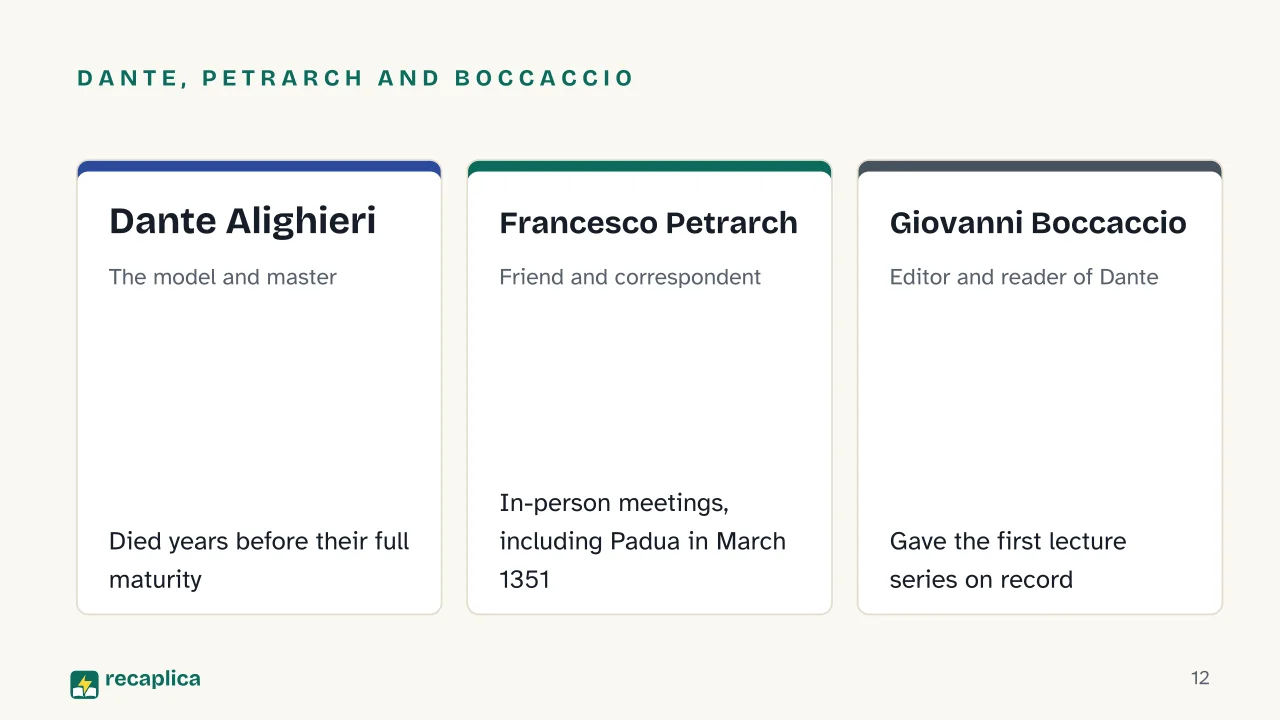
Role in the network of the Three Crowns
Link with Boccaccio
Dante Alighieri
Model and master for later generations
Boccaccio was his editor and gave the first lecture series on record
Francesco Petrarch
Friend and direct correspondent
In-person meetings, including Boccaccio’s visit to Padua in March 1351
Giovanni Boccaccio
Author of the Decameron
Bridges the other two: editor of one, friend of the other
After the Decameron: the scholarly works
In the years after his masterpiece in the vernacular, Boccaccio turned
to scholarly works in Latin. De casibus virorum illustrium had a first
version between 1356 and 1360 and a second, longer one, dedicated to
his friend Mainardo Cavalcanti, in 1373. De mulieribus claris followed a
similar path: a first draft in 1361, then a revised version dedicated
to Andrea Acciaiuoli in 1362.
Boccaccio died in Certaldo on 21 December 1375.
Slide deck
Slides ready to download and make your own in PowerPoint or Google Slides, with speaker notes. Pick the Flash cut or the Full one.
✗ Myth The Decameron is a novel with a single, continuous plot.
✓ Reality It is a collection of one hundred self-contained tales, each closed within a single episode, held together by a shared frame story. A tale and a novel are different forms by definition, not just by length, as the comparison with a novel like Alessandro Manzoni's The Betrothed shows: a tale is over in a few pages, a novel follows a single plot that runs across hundreds of pages.
✗ Myth The Decameron's tales are one hundred unrelated stories, strung together only to fill ten days.
✓ Reality Many of the tales share the theme of fortune and cleverness, where chance decides people's fates unpredictably and the characters' intelligence lies in learning to work with it. Scholars treat this as a real thread running through the book, not a label applied after the fact.
✗ Myth Dante, Petrarch and Boccaccio worked side by side, as equals, like a group of contemporaries.
✓ Reality Dante died years before Boccaccio and Petrarch reached their full maturity as writers, so his relationship with them was not direct: he was a model for both. Boccaccio in particular became one of the first editors of Dante's work and gave what scholars regard as the first public lecture series on the Divine Comedy. With Petrarch, by contrast, Boccaccio had a personal, direct relationship, built on real meetings.
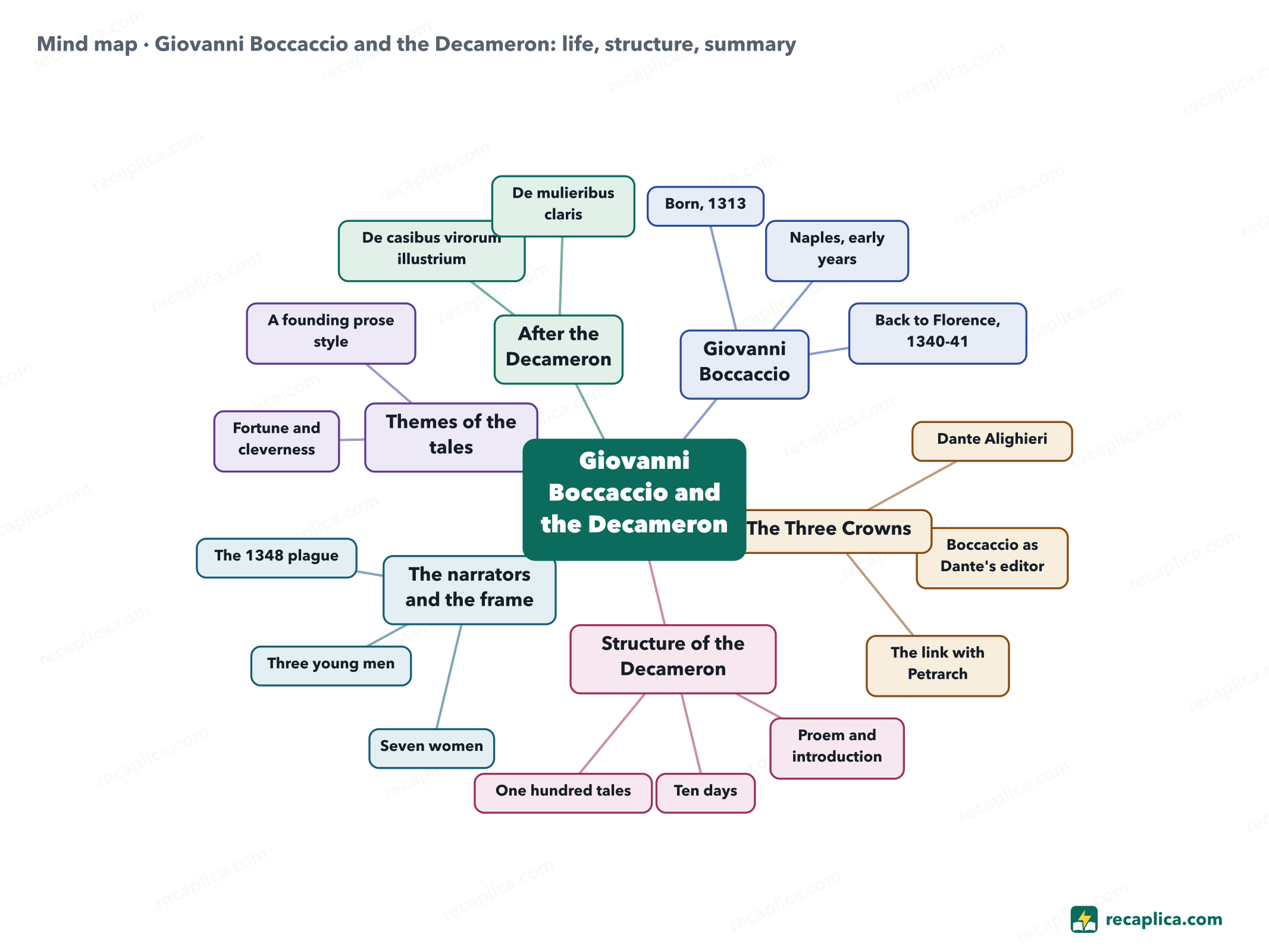
Mind map
Drag the background to move around and the nodes to reposition them; use − and + to collapse and expand branches.
The 1348 plagueThe backdrop to the flight to the countryside
Themes of the tales
Fortune and clevernessChance is unpredictable, cleverness bends to it
A founding prose styleA model for Italian literary language
After the Decameron
De casibus virorum illustriumFirst version 1356-1360, second in 1373
De mulieribus clarisFirst draft 1361, revised in 1362
Quiz: test yourself
Answer the questions to check what you have learned: you get instant feedback and a short explanation.
Grade0/100/5
Answers: 1-A · 2-B · 3-A · 4-A · 5-A
Flashcards
Tap the card to flip it and check whether you remember the answer, then move to the next one.
1 / 8
Explain it in your own words
The ultimate test: if you can explain it in simple words, you've truly understood it. Write your explanation, then compare it with the Recap.
Your explanation is saved only on this device.
Giovanni Boccaccio wrote the Decameron between 1349 and 1353: one hundred tales told by ten young Florentines, seven women and three men, who take shelter in the countryside to escape the 1348 plague and pass the time telling one story each per day for ten days. Many of the tales turn on the same idea, fortune and cleverness, and Boccaccio's prose is treated as a founding moment for Italian literary language. Alongside Dante Alighieri and Francesco Petrarch, Boccaccio is one of the Three Crowns of Italian literature: he was among the first editors of Dante's work and gave what scholars consider the first public lecture series on the Divine Comedy.
Frequently asked questions
What is the Decameron about?
One hundred tales told by ten young people who take shelter in the countryside near Florence during the 1348 plague. The stories range from love and deception to cleverness and fortune, arranged across ten days of ten tales each.
Why is it called the Decameron?
The name comes from the Greek déka hēmérai, meaning ten days: it describes the book's structure, ten days in which the narrators take turns telling tales.
Who was Giovanni Boccaccio?
A Florentine writer born in 1313, the illegitimate son of a merchant, sent to Naples at a young age for trade and later to study canon law. Back in Florence by the winter of 1340-41, he wrote the Decameron between 1349 and 1353 and died in Certaldo in 1375.
Who is Andreuccio of Perugia?
The protagonist of one of the Decameron's most famous tales (day two, tale five): a naive newcomer who arrives in Naples and falls victim to a string of swindles in the city's underworld, coming out of it with a new fortune won through chance and street cunning.
What are the Three Crowns of Italian literature?
The name tradition gives to Dante Alighieri, Francesco Petrarch and Giovanni Boccaccio. Boccaccio has a direct link to both of the others, editor and first public reader of Dante and a personal friend of Petrarch, whom he met in person starting in 1351.
Every Recap goes through an independent review before publication.
Statistics, only if you say so
To learn which Recaps help most we would use Google Analytics, with aggregate, anonymous data. It starts only with your OK, and you can change your mind anytime. Privacy policy