|
recaplica
Petrarchan Sonnet: Structure and Rhyme Scheme |
| © 2026 Recaplica · recaplica.com — All rights reserved |
Petrarchan Sonnet: Structure and Rhyme SchemeWhat to print Page numbers appear when printing with default margins. SlidesChoose a cut Flash10 slidesThe essential thread, to present in classFull15 slidesEvery chapter and the deeper detailBoth come with speaker notes. In 30 seconds quick readThe Petrarchan sonnet is a 14-line poem written in iambic pentameter, split into an eight-line octave and a six-line sestet. The octave almost always rhymes ABBA ABBA; the sestet allows more freedom, and Francesco Petrarch favored CDE CDE. Between the eighth and ninth lines sits the volta, the turn where the argument raised in the octave gets an answer in the sestet. The form began in the 1200s with the Sicilian School and became, through Petrarch, the leading model of Italian lyric poetry. Key Points
Deep DiveFourteen lines, two halvesA sonnet is a 14-line poetic form. It splits into two blocks: an octave, the first eight lines, and a sestet, the last six. In the Italian tradition each line is an endecasillabo, an eleven-syllable line; the English equivalent is iambic pentameter, a ten-syllable line built on the same rise-and-fall rhythm. English poets eventually reshaped the rhyme scheme too, into a separate form known today as the Shakespearean sonnet. That two-part structure, octave plus sestet, holds up everything else in the sonnet: the rhyme scheme and the volta discussed further down both depend on this split. The octave’s rhyme scheme, between alternation and enclosureIn the earliest 13th-century sonnets, the octave could follow either of two schemes: alternating (ABAB ABAB) or enclosed (ABBA ABBA). The two coexisted for a few decades, until the enclosed scheme took over with the Dolce Stil Novo poets and became, in practice, the standard for the form.
Francesco Petrarch, whose life and work Recaplica covers in a separate Recap on the Canzoniere, shows an almost total preference for the enclosed ABBA ABBA scheme, though a few rarer variants appear too, such as ABAB BABA or ABAB BAAB. The tercets, looser rulesThe closing tercets allow more freedom. Besides the alternating scheme (CDC DCD), documented patterns include CDD DCC, CDD CDD, CDE ECD, and CDE CDE. The last of these, with the same three rhymes repeated in the same order across both tercets, is the one Petrarch favored. There is no single fixed recipe for the sestet, unlike the octave, where one scheme eventually pushed out the rest. The volta, the sonnet’s hingeBetween the eighth and ninth lines, exactly where the octave gives way to the sestet, sits the volta: the moment the sonnet changes direction. In the octave the poet lays out an observation, a question, or an argument; in the sestet comes the answer, the comment, or the consequence. From Giacomo da Lentini to PetrarchThe sonnet form began in Italy in the 1200s with Giacomo da Lentini, a poet of the Sicilian School and a notary at the court of Emperor Frederick II: tradition credits him as its inventor, and his sonnets remain the earliest known examples. Scholars still debate its exact origin: a 19th-century theory held that it was built by joining two strambotti, a popular meter of the period; the leading theory, first proposed in the 1500s, traces it instead to the canzone stanza, another verse form in use at the time. A generation later, Dante recognized Giacomo da Lentini as a master and named him in the Purgatorio, the second realm of the afterlife journey told in the Divine Comedy. Why Petrarch’s scheme became the modelWith Francesco Petrarch the sonnet stopped being just one of many short forms in the tradition and rose to the same standing as the canzone, the most prestigious meter in Italian lyric poetry. It remained the reference point throughout the 1500s, before later being adapted into other languages and traditions, each with its own rhyme schemes. Slide deckSlides ready to download and make your own in PowerPoint or Google Slides, with speaker notes. Pick the Flash cut or the Full one.  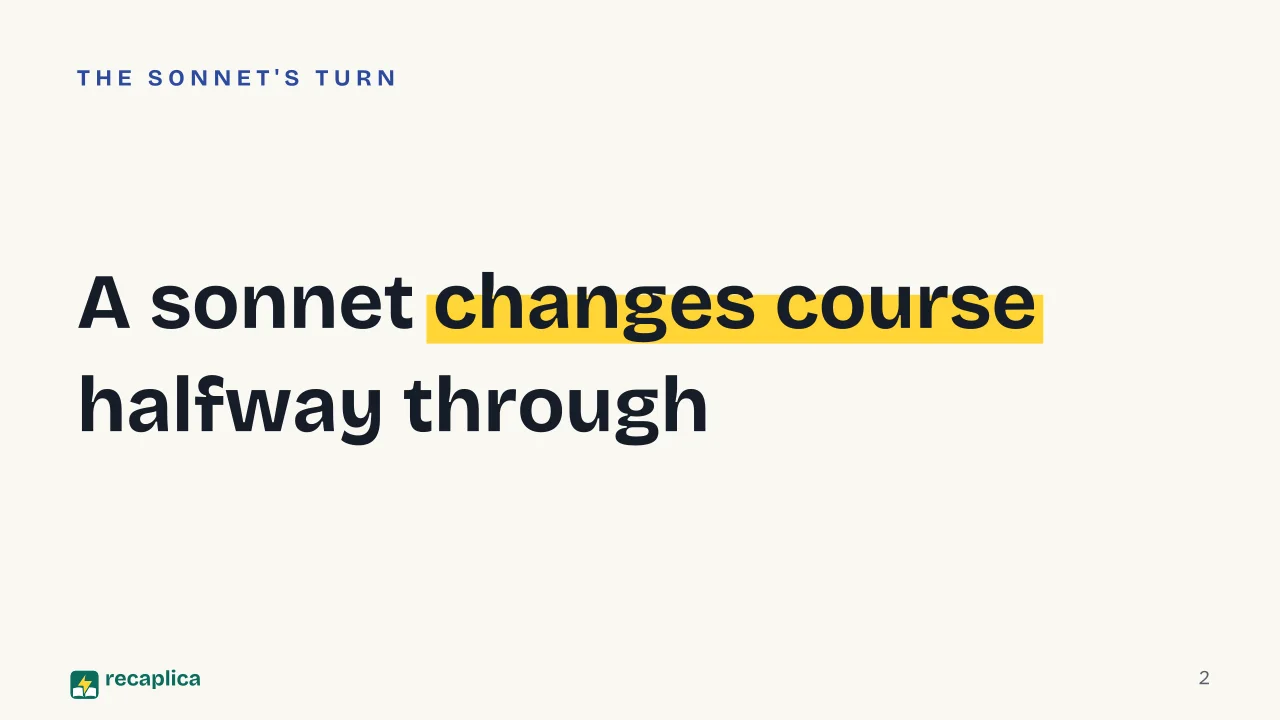  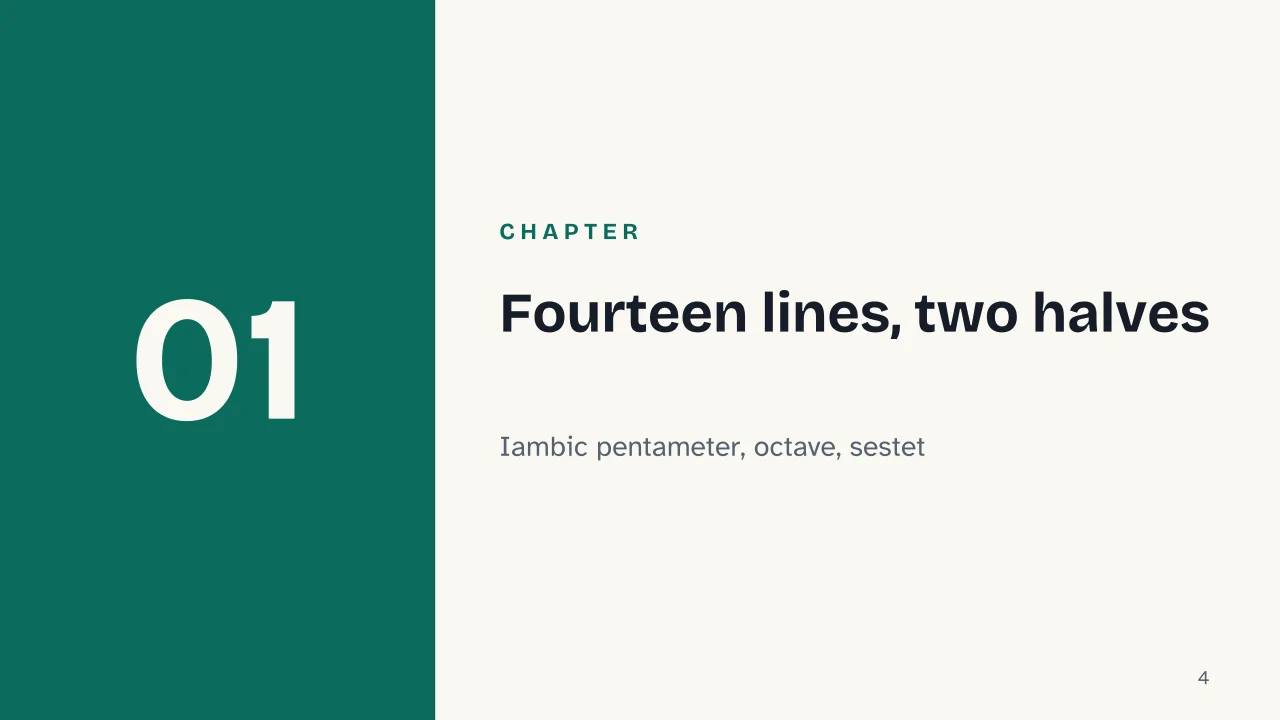 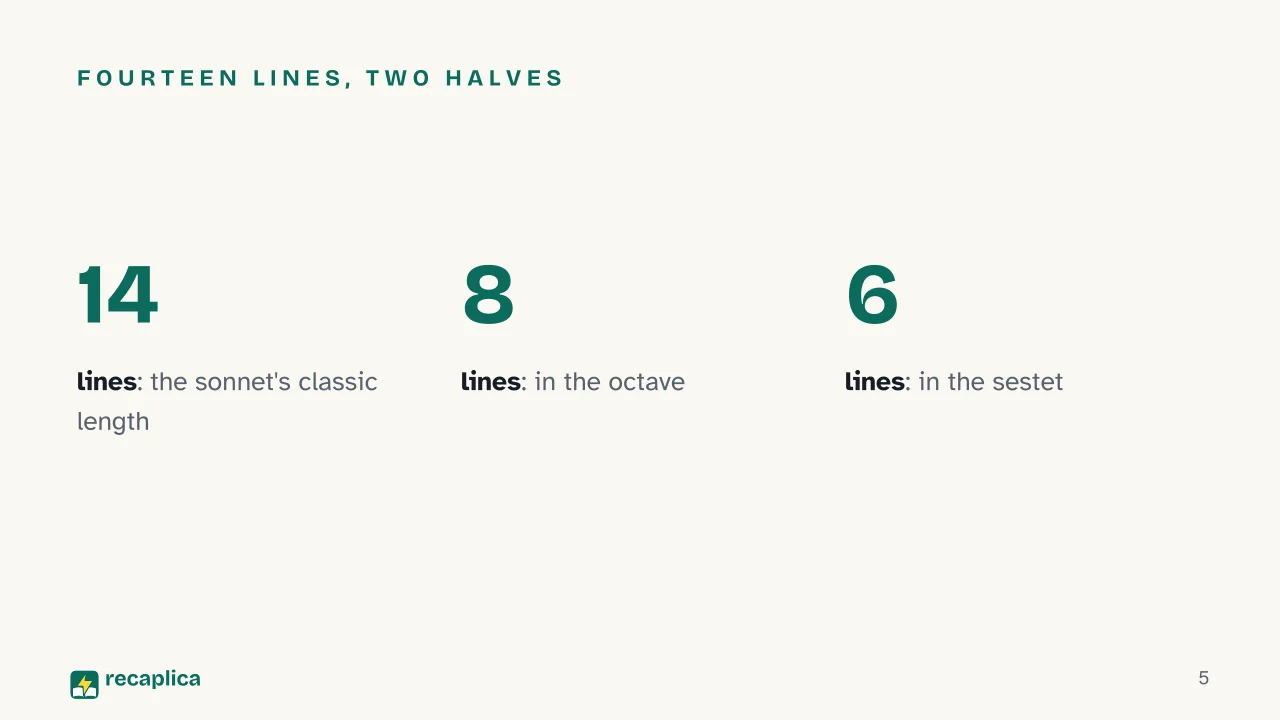  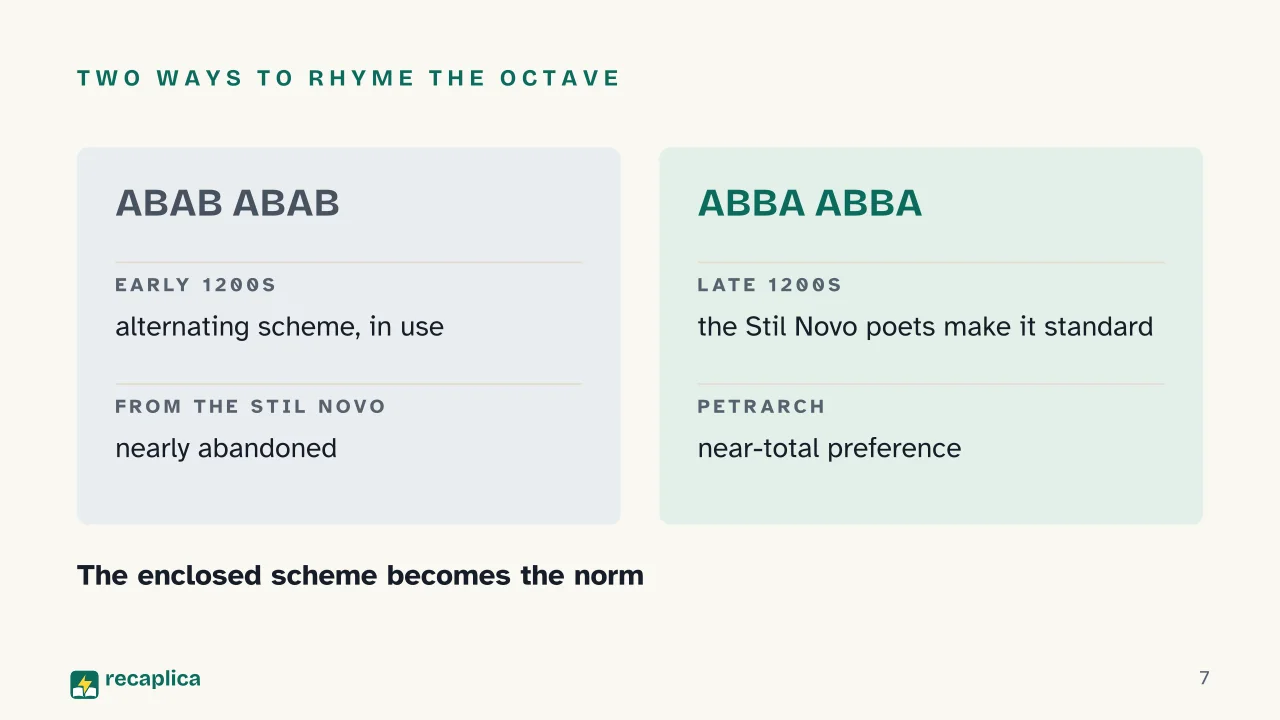 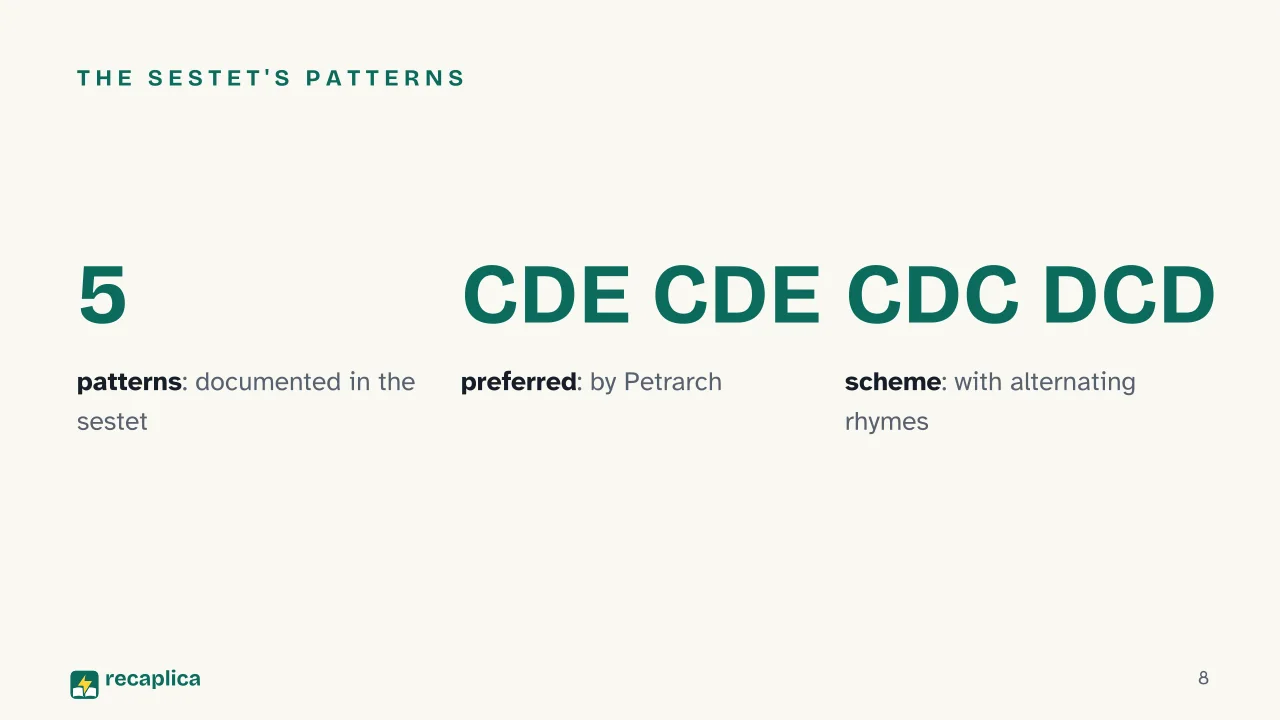  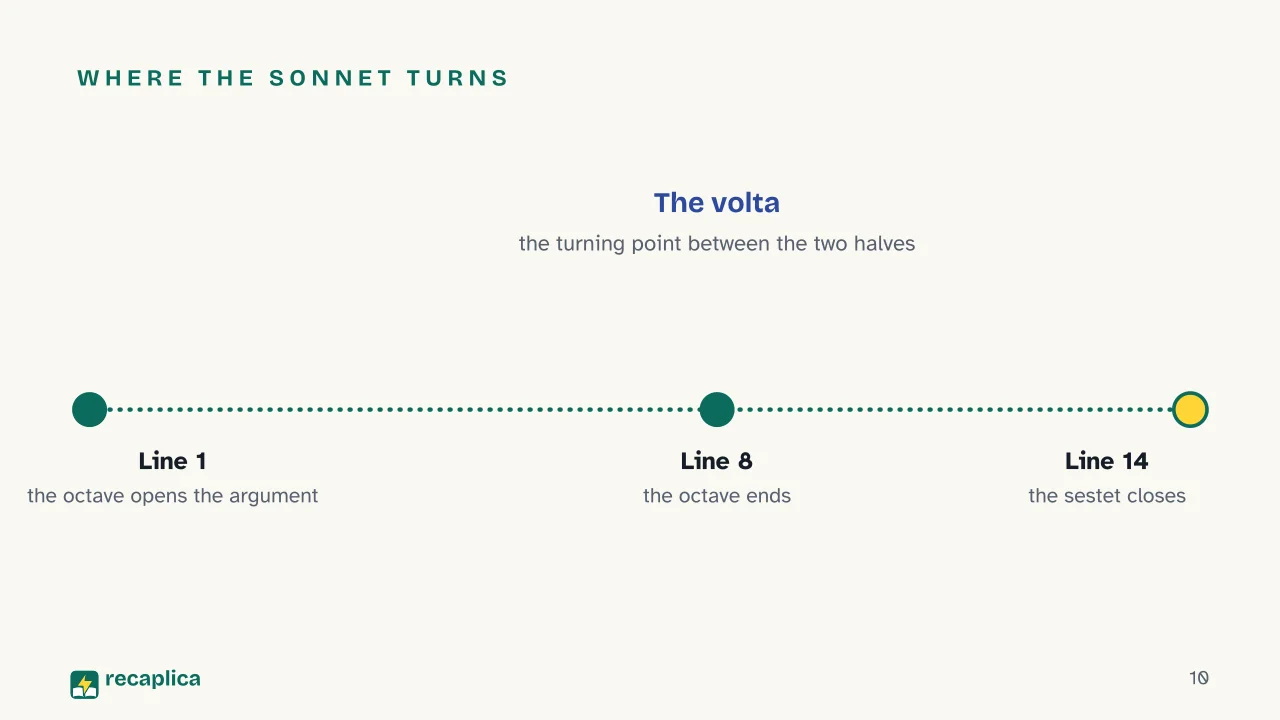  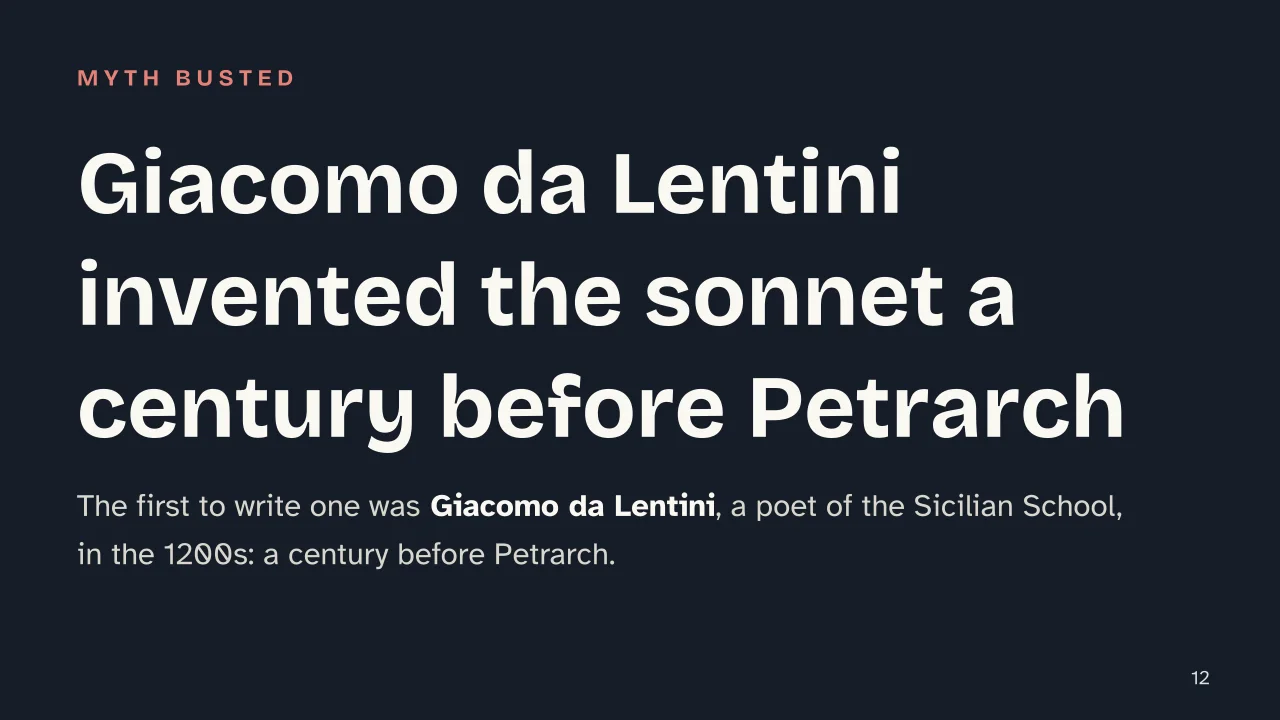 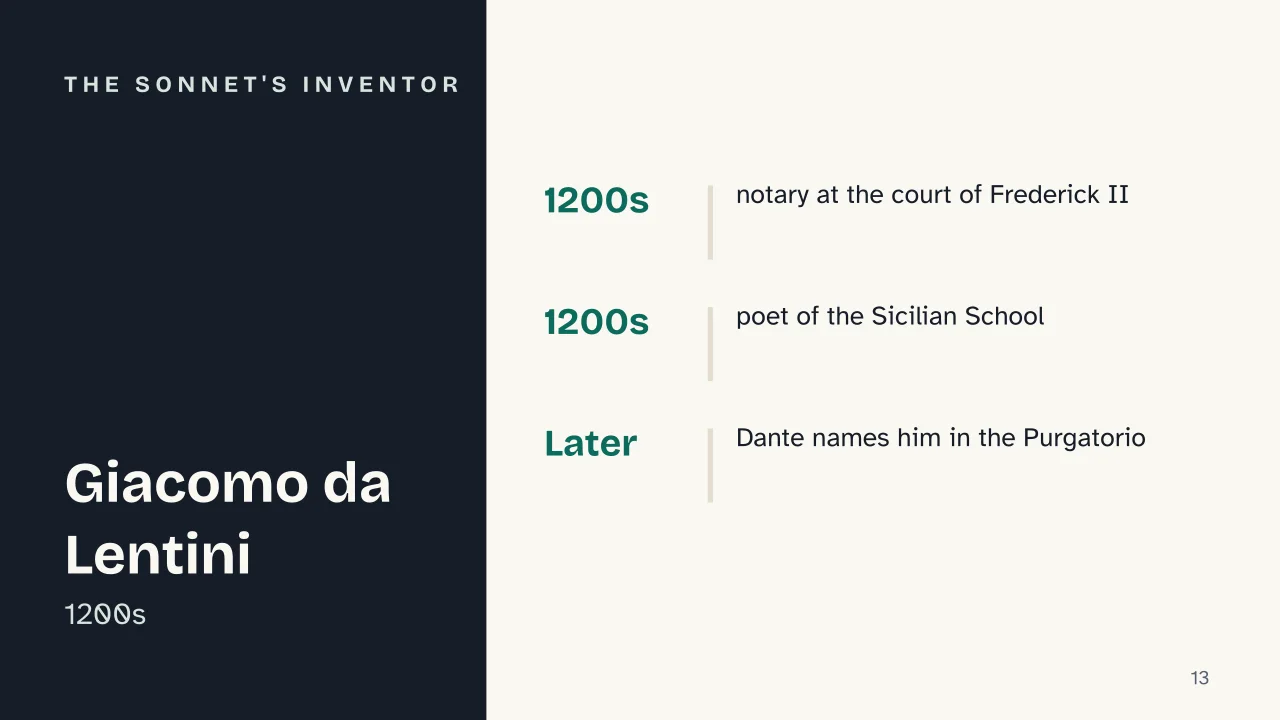 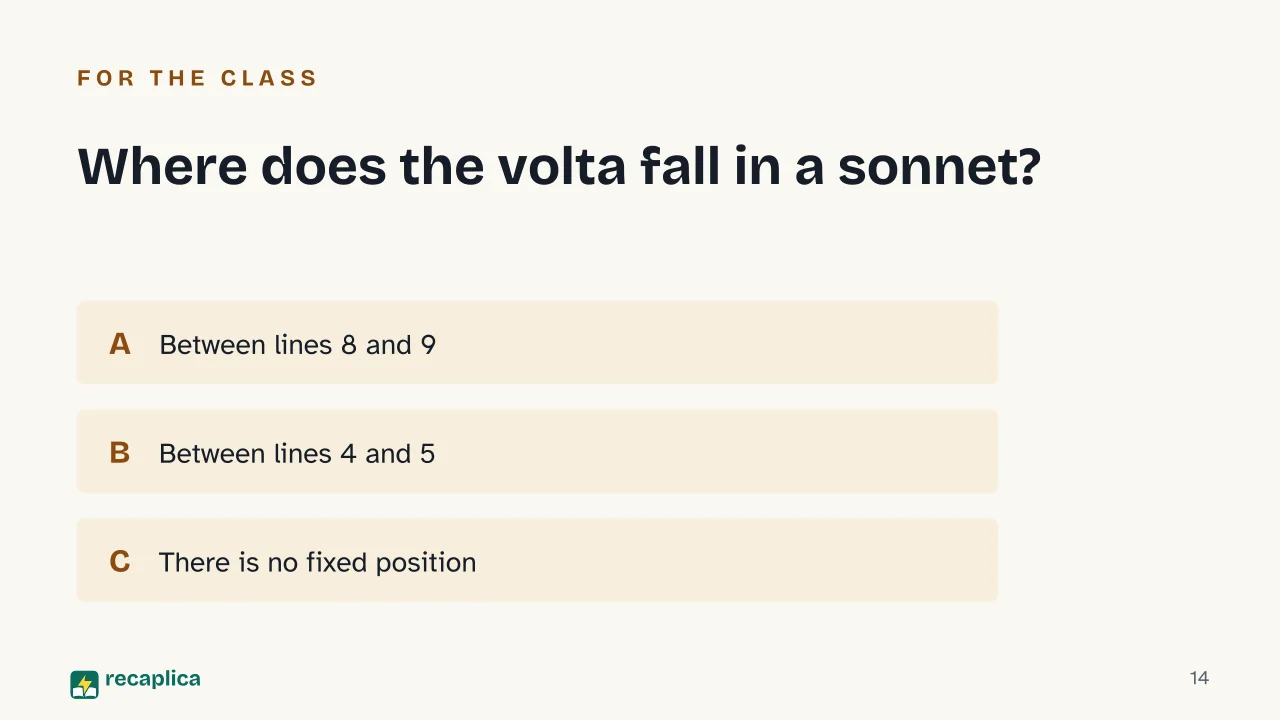  Common myths
Mind mapDrag the background to move around and the nodes to reposition them; use − and + to collapse and expand branches. 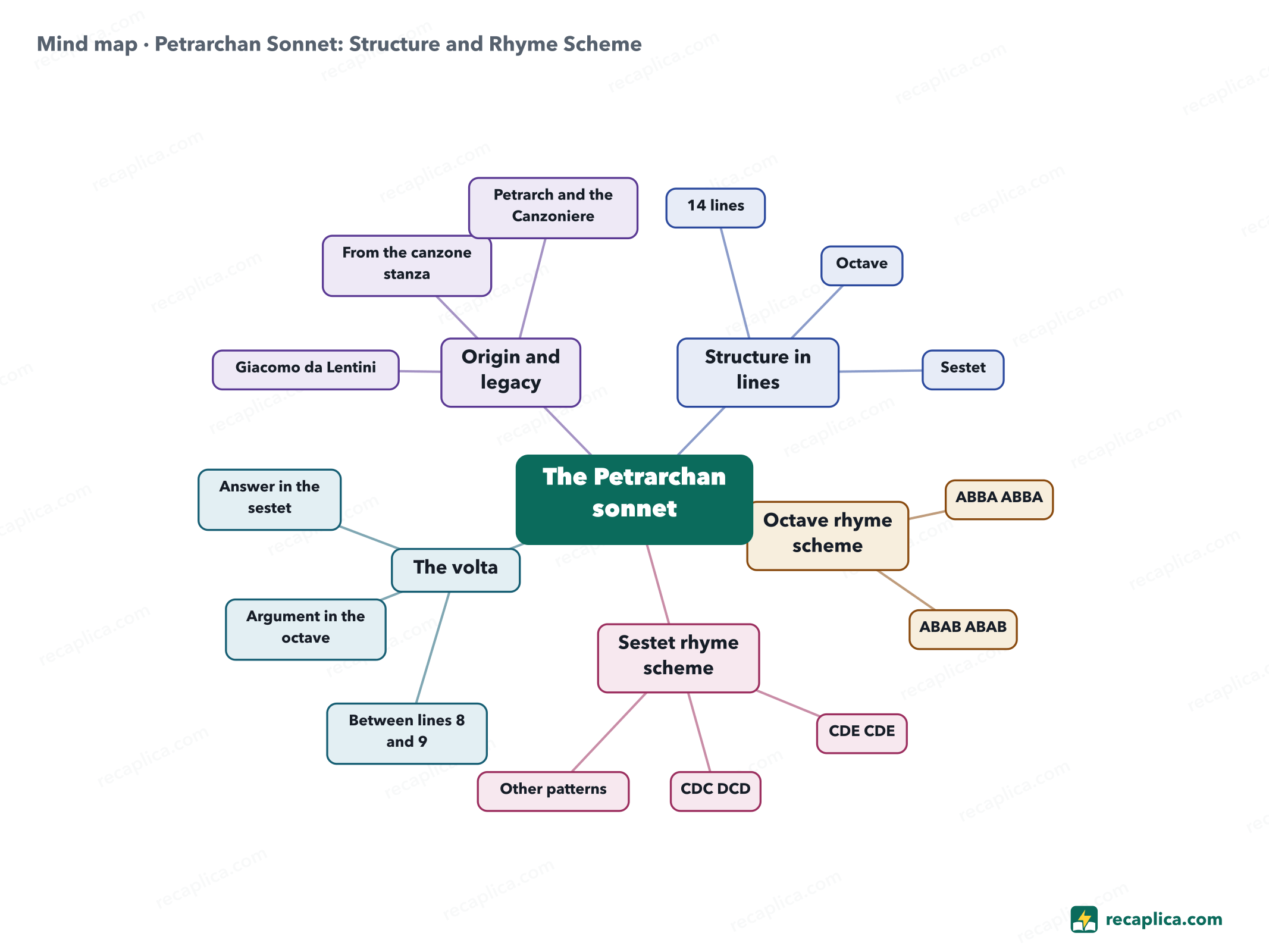
Quiz: test yourselfAnswer the questions to check what you have learned: you get instant feedback and a short explanation. Grade 0/10 0/5
FlashcardsTap the card to flip it and check whether you remember the answer, then move to the next one. 1 / 7 Explain it in your own wordsThe ultimate test: if you can explain it in simple words, you've truly understood it. Write your explanation, then compare it with the Recap. Your explanation is saved only on this device.
Frequently asked questionsHow many rhymes does a sonnet use?A sonnet typically uses four different rhymes: two in the octave, almost always ABBA ABBA, and two or three more in the sestet, depending on the pattern chosen. What is the rhyme scheme of a Petrarchan sonnet?The octave is almost always ABBA ABBA; in the sestet, Francesco Petrarch favored CDE CDE, though CDC DCD, CDD DCC, CDD CDD, and CDE ECD are all documented patterns. What is the volta in a sonnet?It is the turn between lines 8 and 9: the argument, question, or observation raised in the octave finds an answer or a comment in the sestet. Did Petrarch invent the sonnet?No: the form is traditionally credited to Giacomo da Lentini, a poet of the Sicilian School active in the 1200s at the court of Frederick II. Petrarch, a century later, turned that scheme into the leading model of Italian lyric poetry. Every Recap goes through an independent review before publication. |