|
recaplica
Gothic Literature: Meaning, Features and Classic Novels | ||||||||||
| © 2026 Recaplica · recaplica.com — All rights reserved | ||||||||||
Gothic Literature: Meaning, Features and Classic NovelsWhat to print Page numbers appear when printing with default margins. SlidesChoose a cut Flash10 slidesThe essential thread, to present in classFull16 slidesEvery chapter and the deeper detailBoth come with speaker notes. In 30 seconds quick readGothic literature begins in England in 1764 with Horace Walpole's «The Castle of Otranto» and grows into a distinct genre between the late eighteenth and early nineteenth centuries. The recurring ingredients are easy to spot: old castles or houses hiding a secret, dark and mysterious atmospheres, supernatural events and characters pushed to the margins of society. After Walpole the genre widens with Ann Radcliffe, Matthew Lewis and Mary Shelley, reaching all the way to Bram Stoker's «Dracula», itself indebted to a lesser-known story, Sheridan Le Fanu's «Carmilla». From the start, the genre has given shape to our deepest fears, real or imagined, through horror and mystery. Key Points
Deep DiveA novel pretending to be something elseIn 1764 Horace Walpole publishes «The Castle of Otranto» and presents it as something it is not: the translation of a medieval manuscript found by chance. Only with the second edition does he admit he wrote it himself. It’s a small detail, but it already says something about the genre taking shape. Walpole weaves supernatural and horrific elements into the story - omens, a suit of armor that moves on its own, a castle that collapses from within - and builds the setting on something real: Strawberry Hill, his house outside London, which he had rebuilt in the Gothic Revival style. That house becomes the model for a backdrop the genre keeps reusing: ruined castles and dark corridors turn up again and again. The novel is widely credited as the starting point of Gothic literature, one of the literary genres that fiction history tells apart through its own set of conventions. The ingredients that keep returningCritic Gerald Kennedy identifies a precise set of traits in Gothic fiction: picturesque, gloomy scenery; startling narrative devices pushed to melodrama; an atmosphere that blends exoticism, mystery and terror. A typical setting goes with those traits: a sprawling old house, concealing some terrible secret or housing a character everyone fears. It can be a castle. It can just as easily be a ruined monastery. Another source adds two more elements to that list: an insistence on archaic settings and a heavy reliance on the supernatural. Ghosts, omens, events reason can’t explain. Scholar Fred Botting notes that Gothic texts are openly, if ambiguously, irrational, and that they tell of disturbances to sanity and personal safety. Writer Elizabeth Bowen adds one specific figure: the ghost, something believed dead that returns, vividly, into the present. It reads almost like a miniature definition of the whole genre.
From Walpole to Shelley: classics of the Gothic centuryGothic fiction establishes itself as an English narrative genre over roughly two generations, between the late eighteenth and early nineteenth centuries. After Walpole, the name nearly every source cites is Ann Radcliffe: «The Mysteries of Udolpho» is widely seen as eighteenth-century Gothic fiction at its best, a novel that refines the atmosphere of suspense without losing its underlying mystery. In 1796 comes Matthew Lewis’s «The Monk», louder and more violent in tone. In 1820, Charles Robert Maturin’s «Melmoth the Wanderer» closes out a stretch that had bent the genre toward stories of damnation and impossible bargains. In between, in 1818, Mary Shelley writes «Frankenstein»: a novel that carries the Gothic into the science of its time and raises questions about the responsibility of a creator who can no longer control what he has made. Gothic novels often lean on eerie medieval props - old castles, monasteries, hidden trapdoors - as recurring symbols readers recognize from one book to the next. That’s part of why a genre born in England still reads as instantly recognizable. The vampire strand, from Carmilla to DraculaThe vampire isn’t part of the genre from the start: it arrives more than a century after Walpole. Sheridan Le Fanu publishes «Carmilla» in installments in The Dark Blue between 1871 and 1872: it follows a companion who never ages and is eventually revealed to be a vampire, one of the story’s undead. Le Fanu ranks among the most important writers of Victorian ghost and horror fiction, and «Carmilla» leaves a specific legacy behind. «Carmilla» is one of the sources behind «Dracula», the novel Bram Stoker publishes in 1897, twenty-five years later. Le Fanu’s frank treatment of female desire in «Carmilla» left its mark on «Dracula», the novel that would go on to give literature its most famous vampire. A genre that keeps changing shapeSince it began, the Gothic genre has changed shape many times, but its core purpose has stayed the same: giving voice to humanity’s deepest fears and to wrongs otherwise left unspoken, whether real or imagined. In the United States, Edgar Allan Poe stands among the most influential figures in shaping what would become the American Gothic tradition, built more on short stories than long novels. The influence of English Gothic fiction crosses the continent too. It marked French writers, Gaston Leroux among them, and Russian writers, including Fyodor Dostoevsky and Anton Chekhov. In the twentieth century, that same legacy carries into weird fiction, a strand that moves Gothic mystery from castles and ghosts into fears that are more abstract and cosmic: that’s the case with Lovecraft’s non-Euclidean geometry, where the ruined castle gives way to a space the human mind cannot fully grasp. A contemporary and neighboring movement, meanwhile, was growing on another side of Europe: German Romanticism, which shares with the Gothic a taste for the sublime and the uncanny, but follows its own path. Slide deckSlides ready to download and make your own in PowerPoint or Google Slides, with speaker notes. Pick the Flash cut or the Full one.     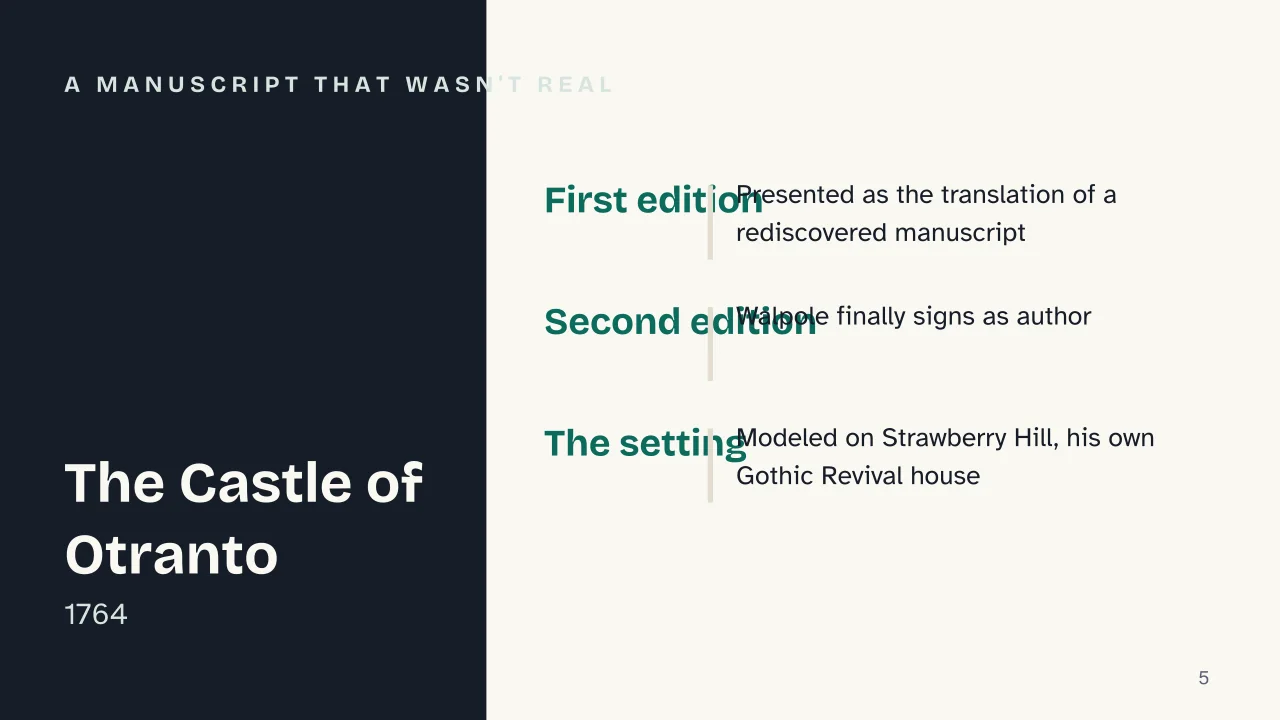  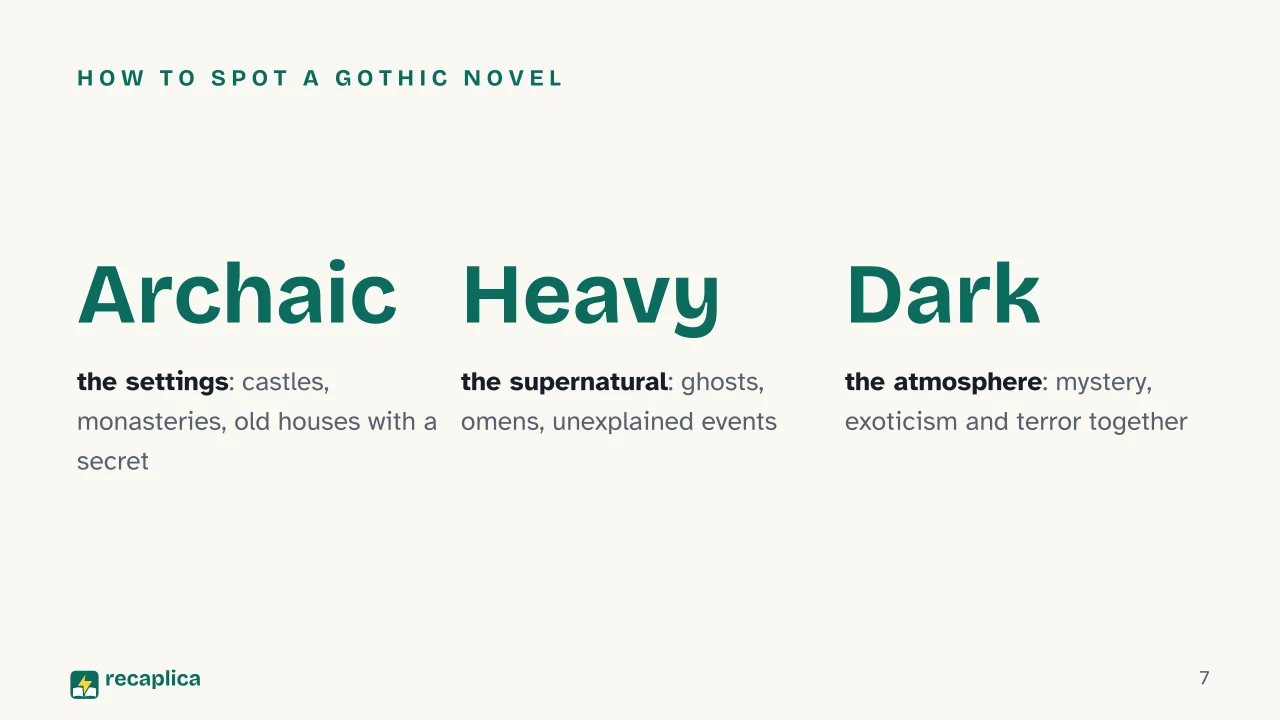 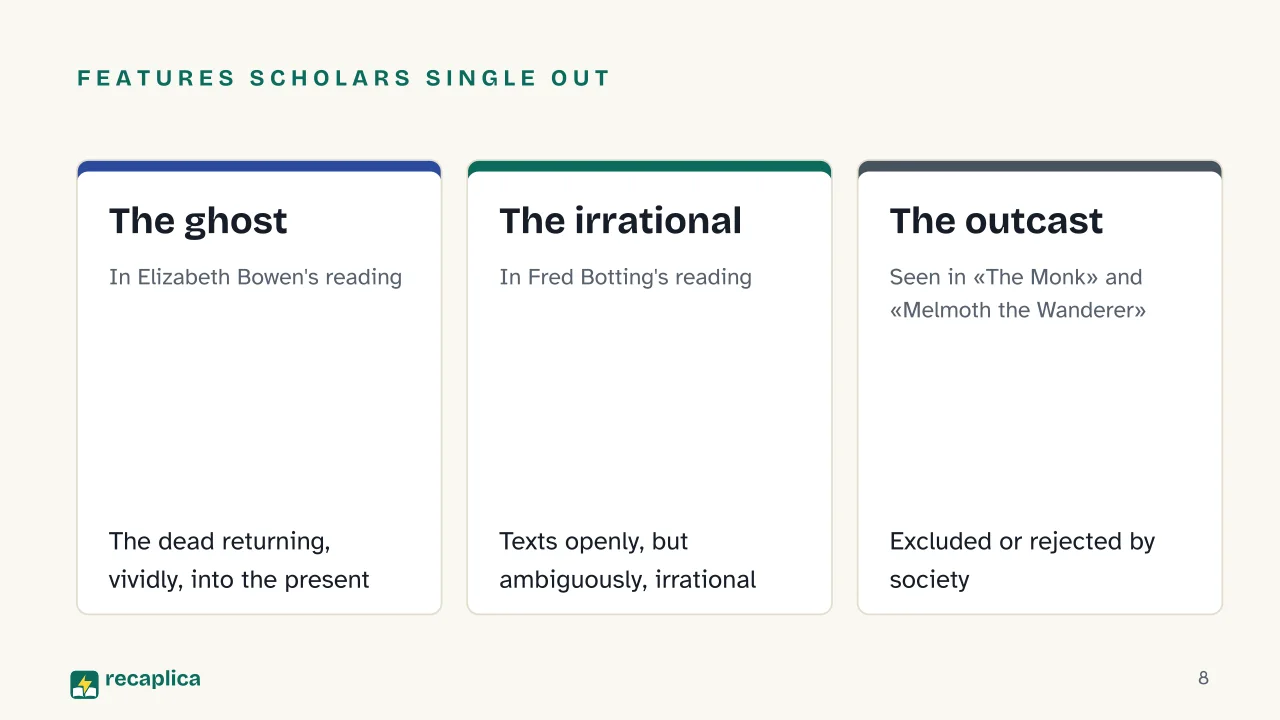  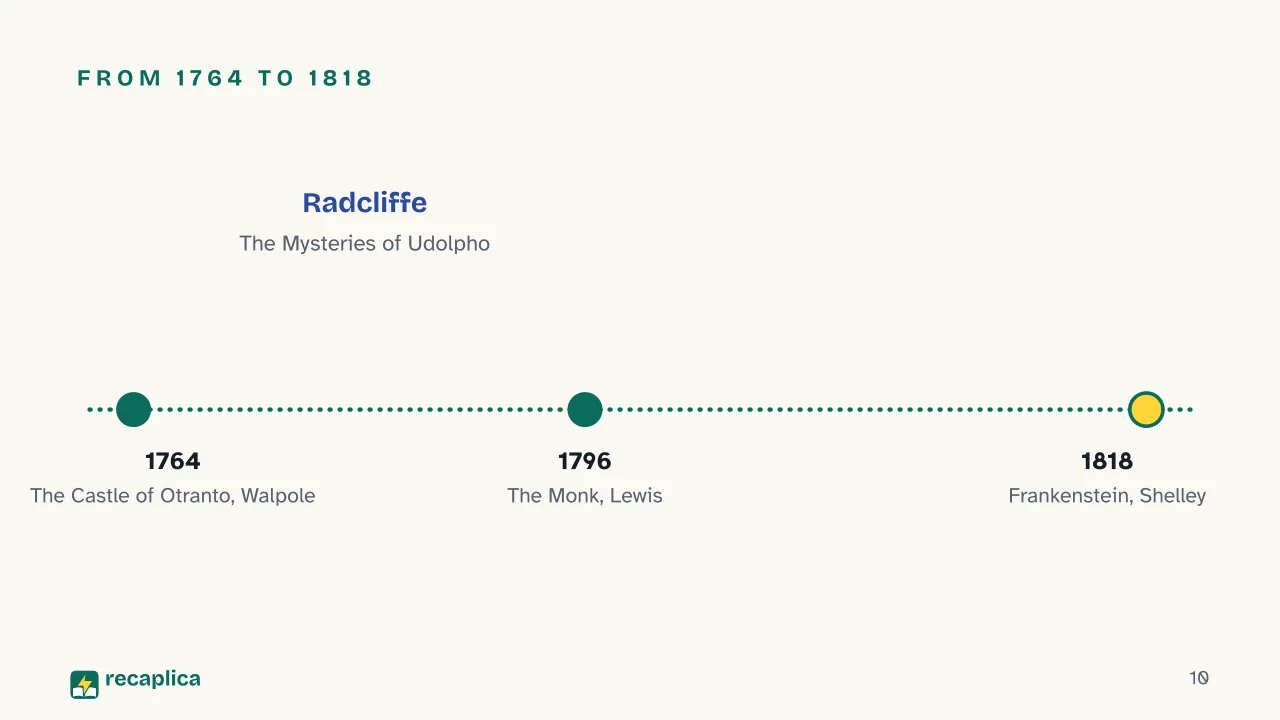  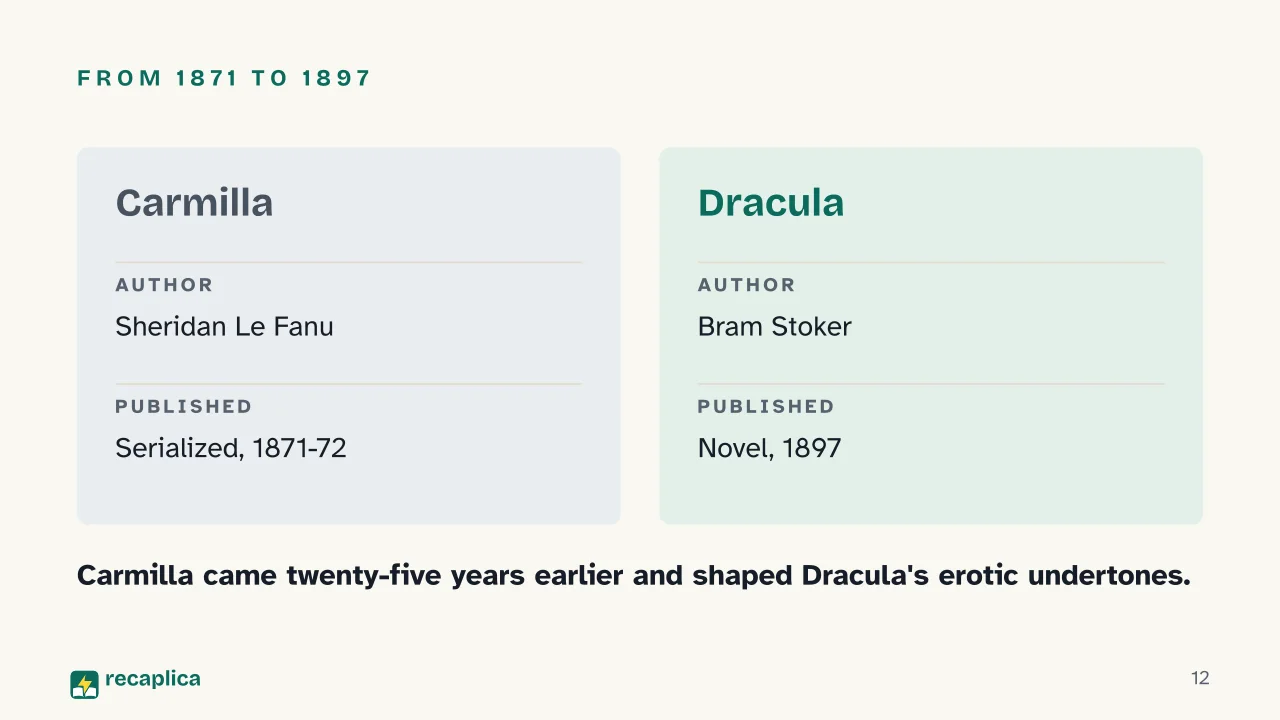 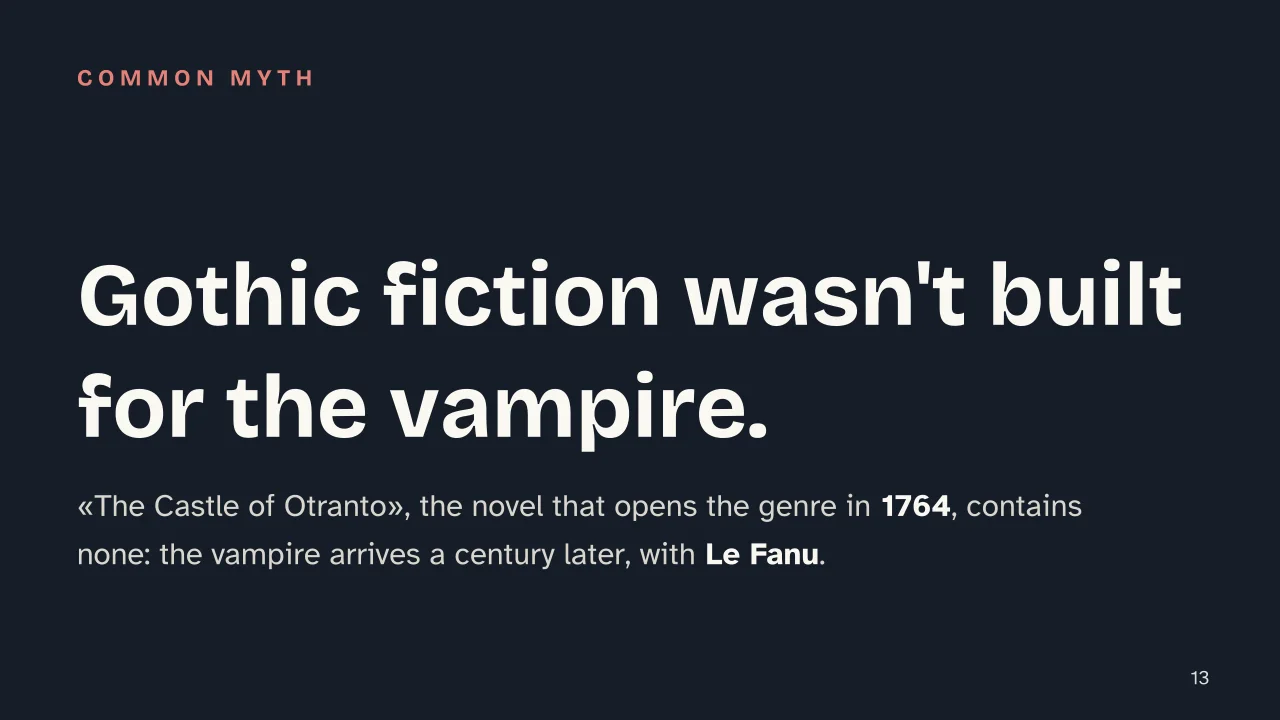 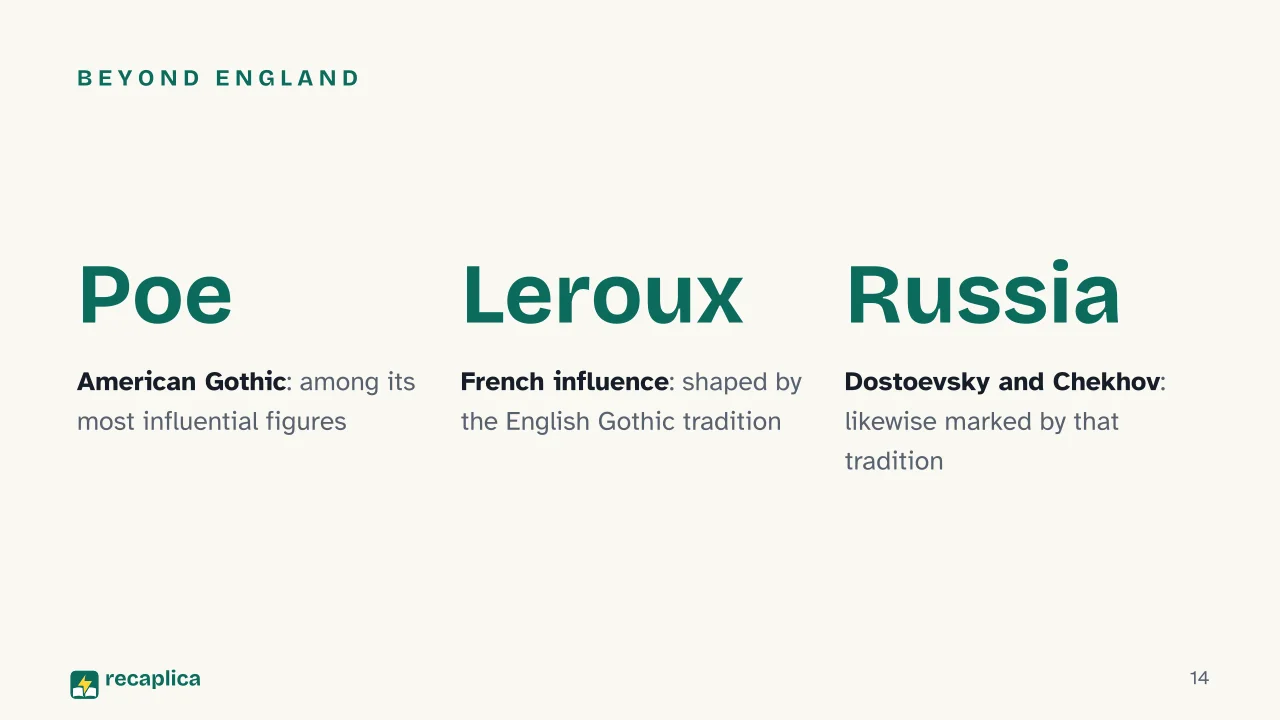 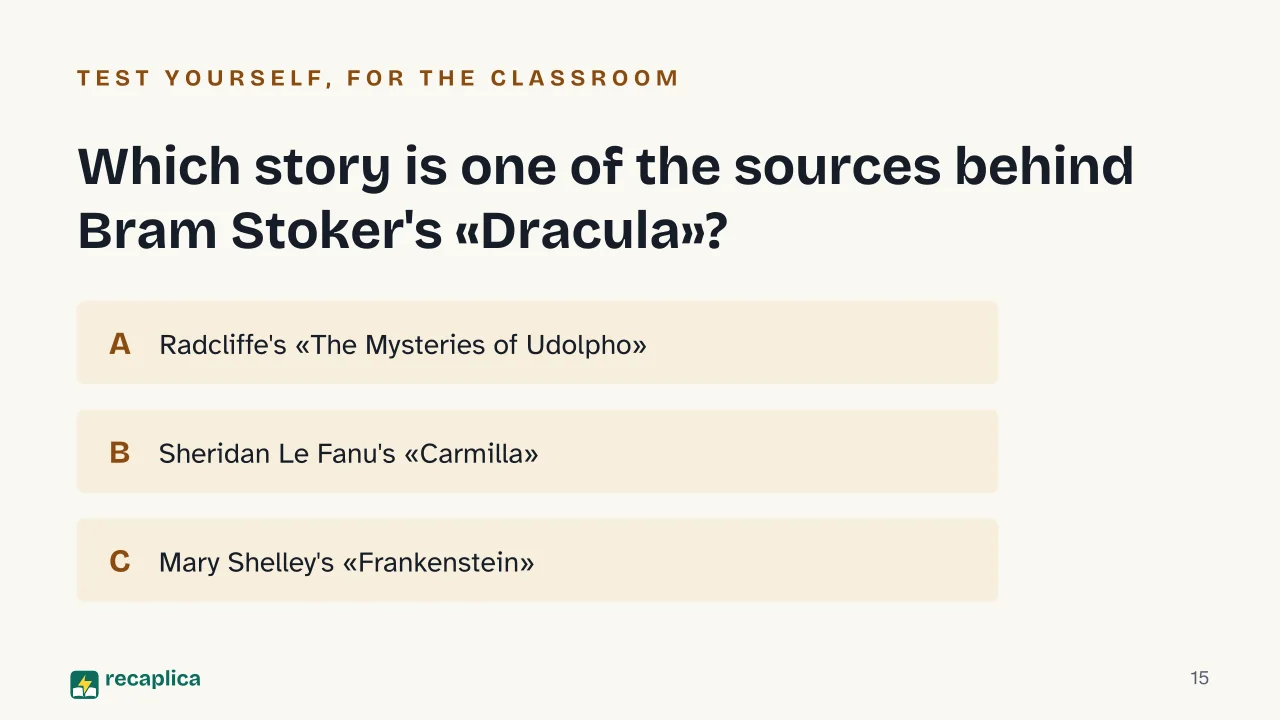  Common myths
Mind mapDrag the background to move around and the nodes to reposition them; use − and + to collapse and expand branches. 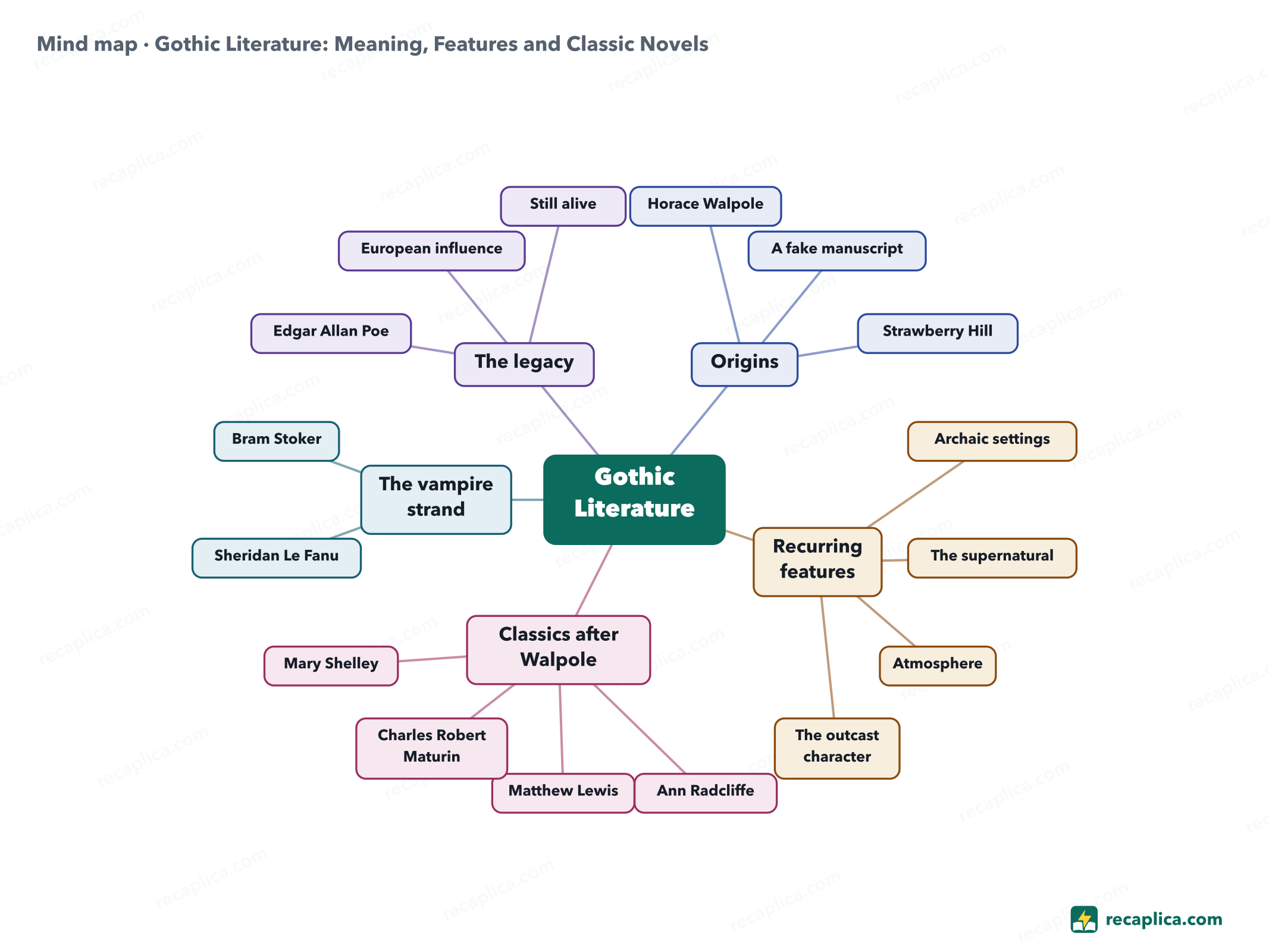
Quiz: test yourselfAnswer the questions to check what you have learned: you get instant feedback and a short explanation. Grade 0/10 0/5
FlashcardsTap the card to flip it and check whether you remember the answer, then move to the next one. 1 / 8 Explain it in your own wordsThe ultimate test: if you can explain it in simple words, you've truly understood it. Write your explanation, then compare it with the Recap. Your explanation is saved only on this device.
Frequently asked questionsWhat is Gothic literature?A genre of English fiction that flourished between the late eighteenth and early nineteenth centuries, recognizable by archaic settings, supernatural elements and an atmosphere of mystery and terror. The text critics point to as its starting point is Horace Walpole's «The Castle of Otranto», from 1764. What are the typical features of a Gothic novel?Dark, picturesque scenery - castles, monasteries, old houses with hidden trapdoors - melodramatic narrative devices, a heavy reliance on the supernatural, and a setting that often conceals a terrible secret. The outcast character, excluded from society, is another recurring figure. What was the first Gothic novel?«The Castle of Otranto» by Horace Walpole, published in 1764. Walpole passed it off as an old document rediscovered by chance, and only admitted to being its author starting with the second edition. What are the best-known Gothic novels after Walpole?«The Mysteries of Udolpho» by Ann Radcliffe, «The Monk» by Matthew Lewis, «Melmoth the Wanderer» by Charles Robert Maturin, «Frankenstein» by Mary Shelley and, later in the century, «Dracula» by Bram Stoker. Is Gothic literature tied to the vampire?Only in part, and only from a certain point in the genre's history onward. The vampire strand enters the Gothic with Sheridan Le Fanu's «Carmilla», serialized in 1871-72, and becomes firmly established with Bram Stoker's «Dracula» in 1897, almost a century and a half after the genre began with Walpole. Every Recap goes through an independent review before publication. |