|
recaplica
Dante's Divine Comedy: the structure of the journey, summarized | ||||||||||||||||
| © 2026 Recaplica · recaplica.com — All rights reserved | ||||||||||||||||
Dante's Divine Comedy: the structure of the journey, summarizedWhat to print Page numbers appear when printing with default margins. SlidesChoose a cut Flash10 slidesThe essential thread, to present in classFull19 slidesEvery chapter and the deeper detailBoth come with speaker notes. In 30 seconds quick readThe Divine Comedy is the poem Dante Alighieri wrote in exile, between 1308 and 1321, describing an imagined journey through the three realms of the Christian afterlife. The numbers that govern it are rigid: three canticles (Inferno, Purgatorio, Paradiso), one hundred cantos in all, and 14,233 hendecasyllabic lines locked together by terza rima. The traveller is Dante himself, lost in a dark wood and led through the afterlife first by the Roman poet Virgil, then by Beatrice, and at the very end by St Bernard. The title Dante gave it was simply Comedìa: the adjective "divine" came from Boccaccio and only became a fixed part of the name with a Venetian edition printed in 1555. Key Points
Key figures
Deep DiveA man writing far from homeDante Alighieri was born in Florence between May and June 1265. By 1300 he was a prominent citizen: from 15 June to 15 August that year he sat among the priors, the highest governing office in the city. They were hard months. Florence was split between two Guelph factions, the Whites and the Blacks, and during that term the leaders of both were banished. Two years later it was his turn. On 17 January 1302, while he was outside the city, a first sentence hit him with a fine, banishment and exclusion from public office; on 10 March the penalty became perpetual exile, under threat of death if he fell into the commune’s hands. From then on he lived as a guest, moving from one court to another, and he never saw Florence again. He died in Ravenna during the night of 13-14 September 1321. The Comedy belongs to those homeless years. Earlier he had published the Vita nuova, around 1292-93, then worked on the Convivio and De vulgari eloquentia between roughly 1304 and 1307. The poem came afterwards and grew across the whole span of the exile, from around 1307-1308 on: Inferno was already circulating before April 1314, Purgatorio soon after, and Paradiso was begun around 1316. One hundred cantos held together by a chain of rhymesThe Comedy runs on a system of numbers, and those numbers are the first thing to get straight. There are three canticles: Inferno, Purgatorio, Paradiso. Each contains 33 cantos. That would come to 99, but Inferno has one extra at the front, a prologue to the entire poem — which makes one hundred cantos exactly. The line count is 14,233, all hendecasyllables, lines of eleven syllables. The verse form is terza rima, and Dante was the first poet to use it. The text runs in tercets, groups of three lines, with a scheme that hooks into itself: ABA, BCB, CDC, and onwards. The middle line of every tercet sets the rhyme for the one that follows, like a link closing into the next.
Seven days, three guidesThe journey is set in the spring of 1300, when Dante is in his thirty-fifth year: the exact midpoint of a life, if you accept the biblical span of seventy years. It begins on the evening of Good Friday and lasts seven days. The precise date is still argued over, because the reckonings behind the two candidates differ. Treccani places the journey between 8 and 14 April 1300, while Dantedì — the national day established by Italy’s Council of Ministers in 2020, proposed by the then culture minister Dario Franceschini — falls on 25 March. There are three guides, and they follow one another. Virgil, the Roman poet of the Aeneid, takes Dante through Hell and up Mount Purgatory to the summit. There Beatrice arrives — in the author’s own life most likely Bice di Folco Portinari, married to Simone de’ Bardi and dead on 8 June 1290 — and carries him through the heavens. For the final stretch, in the Empyrean, St Bernard steps in. Hell: nine circles in a strict orderDante’s Hell is an inverted funnel inside the body of the Earth, divided into nine concentric circles that narrow as they go down. The deeper the circle, the graver the sin and the harsher the punishment. It is a medieval geography, imagined centuries before anyone knew anything solid about the planet’s interior; for the real picture, see the recap on volcanoes and earthquakes. The ordering of sins is deliberate, and it is the part exams ask about most. In canto XI Virgil stops to explain it, citing Aristotle’s Ethics: there are three dispositions heaven rejects — incontinence, malice and bestiality. Incontinence, failing to rein in a desire, is the mildest and sits in the upper circles. Malice, which sets out to injure someone, is carried out in two ways: by force, which is violence, or by fraud. That is why the violent lie below the incontinent and the fraudulent below the violent: fraud is “de l’uom proprio male”, an evil belonging to humans alone, because it takes intelligence, and for Dante betraying by cunning offends more than striking by force. Each sin draws a punishment built to echo or invert it — the principle known as contrappasso. None of this came out of nowhere. Picturing an afterlife with a precise map and a judge weighing souls is very old; long before the Christian version, ancient Egypt put Osiris in charge of judging the dead. Purgatory: the effort of climbingHell is descended; Purgatory is climbed. It is a mountain divided into nine zones: an Ante-Purgatory where souls wait before they may begin, seven terraces, and the Earthly Paradise at the summit. Each terrace is given over to one capital vice, and souls stay until they have finished purging it. Here too the ordering is explained inside the text. In canto XVII Virgil says that everything, good and bad alike, springs from some form of love: “né creator né creatura mai […] fu sanza amore” — neither creator nor creature was ever without love. Vices are misdirected loves, and the terraces are arranged by how badly the love has gone wrong. On the fourth, for instance, souls purge sloth: love that is too lukewarm towards the good. The difference from Hell is time. In the circles the punishment is final; on the terraces it is a stage, and the souls Dante meets often ask for prayers from the living to shorten the wait. Paradise: nine heavens and the EmpyreanThe last canticle follows the cosmology of Dante’s day, which held the Earth still at the centre of the universe with the celestial spheres turning around it. Dante and Beatrice pass through nine concentric heavens, and beyond the outermost lies the Empyrean, not a physical place but the seat of God and the blessed. As the ascent goes on, the writing itself changes. Hell has bodies, wounds and mud; Paradise is left with light, music and ideas. It is also the most experimental canticle of the three: Dante says over and over that language cannot hold what he has seen. Why “comedy” does not mean funnyThe title Dante chose was Comedìa. In the Middle Ages “tragedy” and “comedy” classified two things at once: how the story moves — tragedy ends badly, comedy well — and the register, refined in the first, plainer and more everyday in the second. Dante’s poem answers both tests: it starts in a dark wood and ends in the vision of God, and it mixes the lowest subjects and tones with the highest, often inside a single canto. The adjective “divine” came later, and not from the author. Boccaccio used it first; it became a permanent part of the name when it appeared on the title page of the Venetian edition of 1555, edited by Ludovico Dolce. From that point on, for everyone, the book was the Divine Comedy. A text that has crossed seven centuriesThe Comedy spread quickly, and for that very reason messily. Around 600 manuscripts survive; the oldest among those carrying a date is codex Landiano 190, produced in 1336 and held in Piacenza — barely fifteen years after the author’s death. But scribes were constantly comparing different exemplars and correcting one against another: no copy stayed clean, and working out what Dante actually wrote is a job scholars have not finished. The poem also left marks on the Italian language, which still carries expressions that came from it. Anyone following Italian literature forward finds the next step six centuries on, with Luigi Pirandello and the theatre of the twentieth century. Slide deckSlides ready to download and make your own in PowerPoint or Google Slides, with speaker notes. Pick the Flash cut or the Full one.  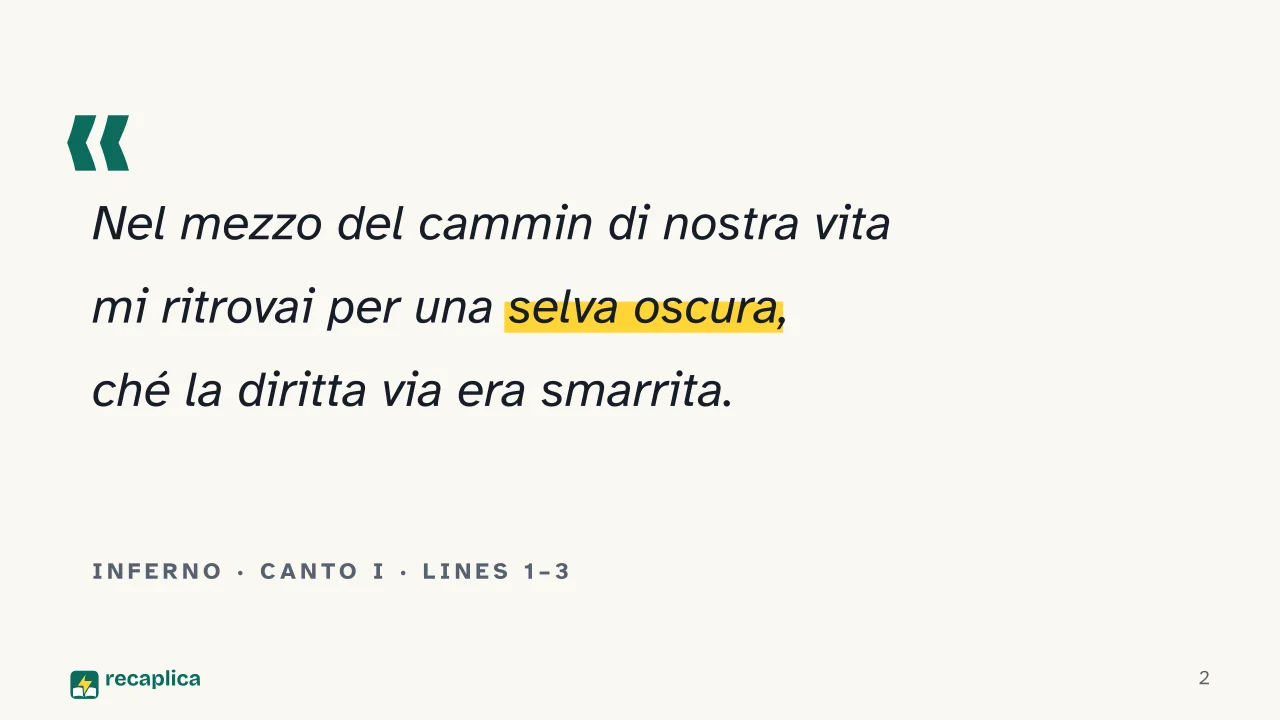   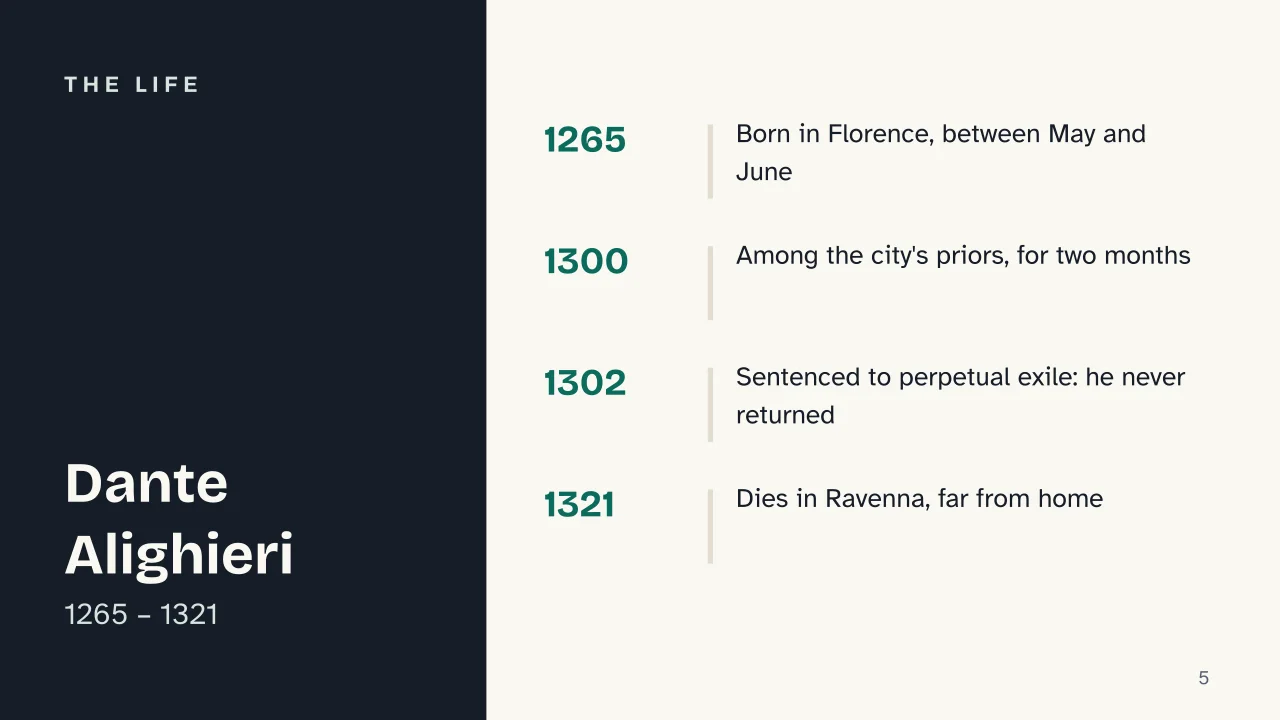  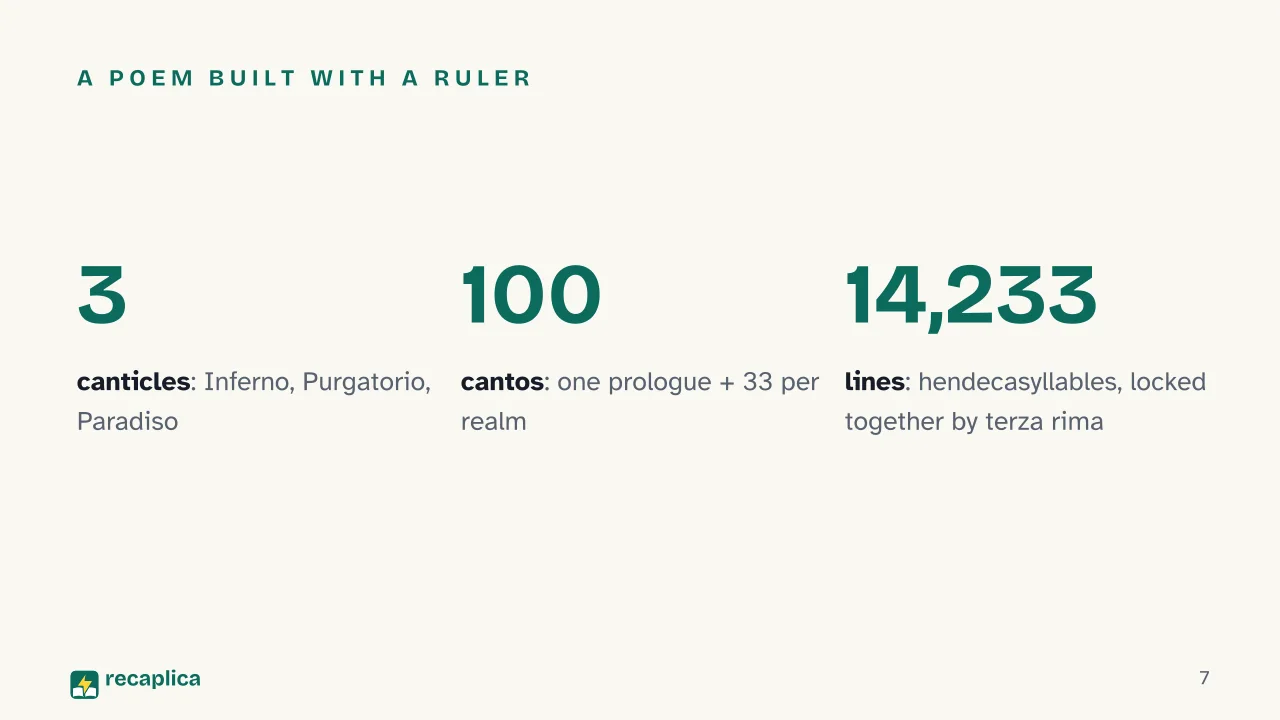 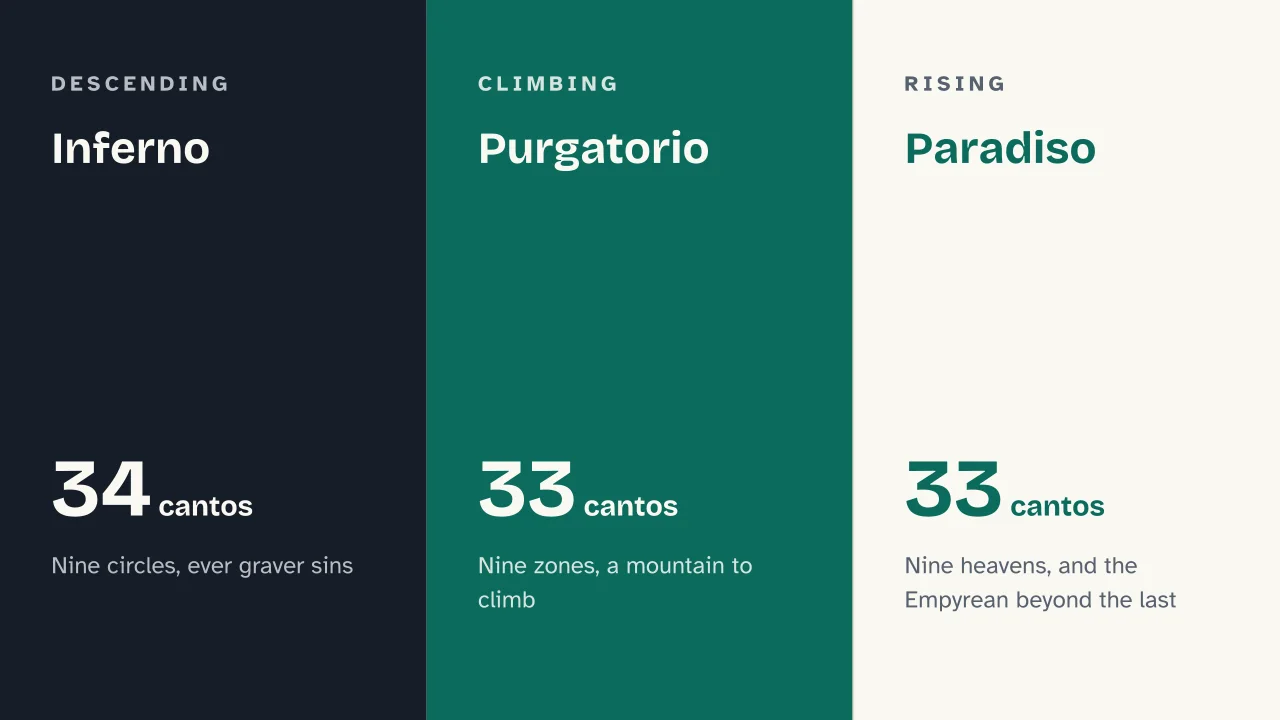  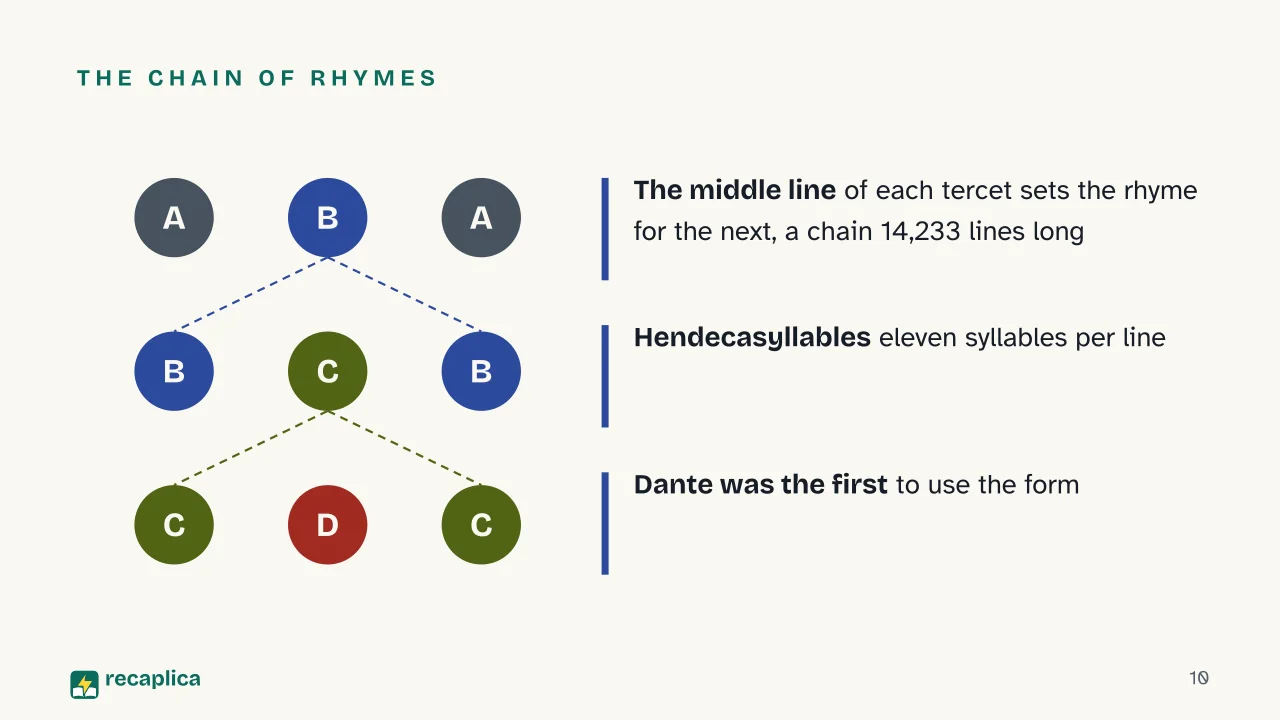  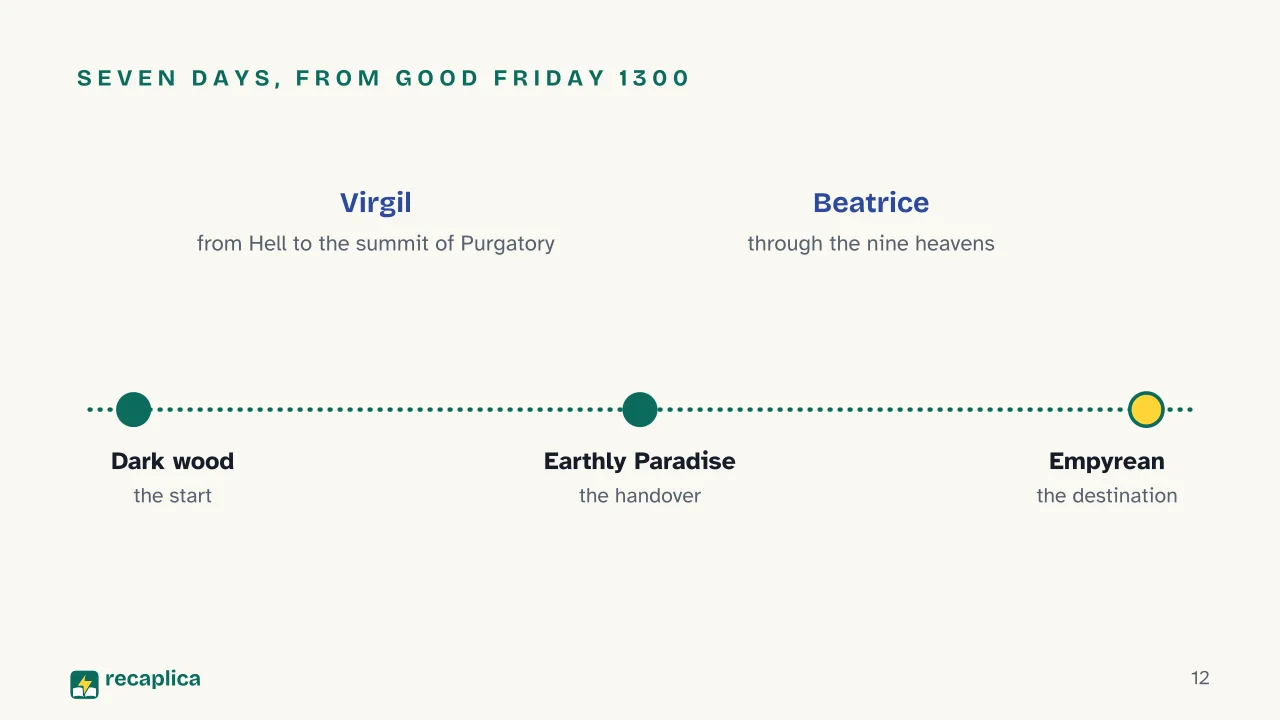 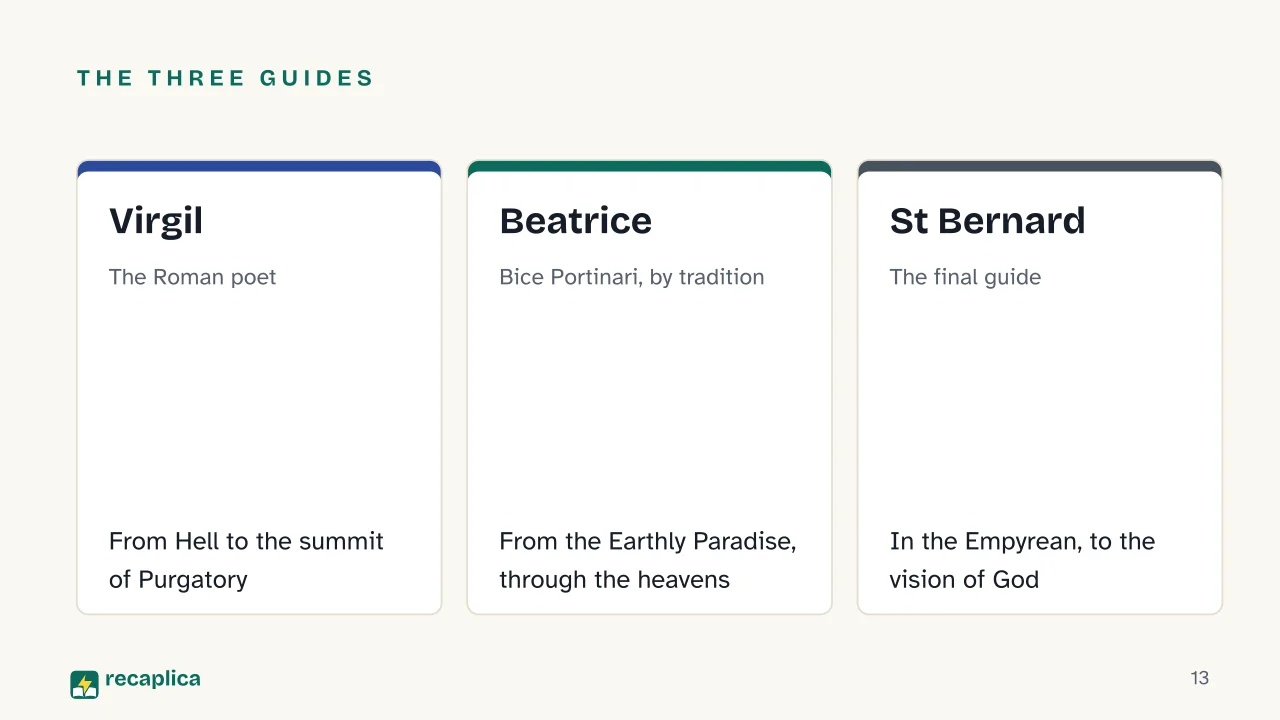  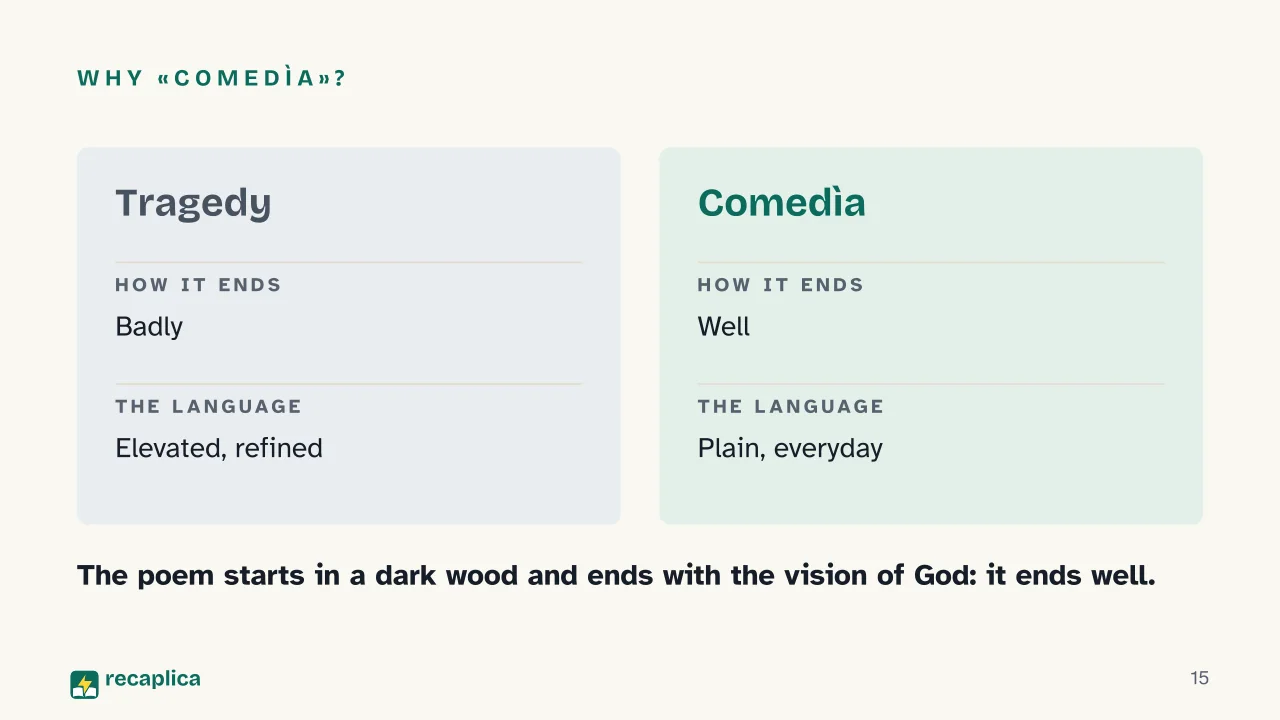 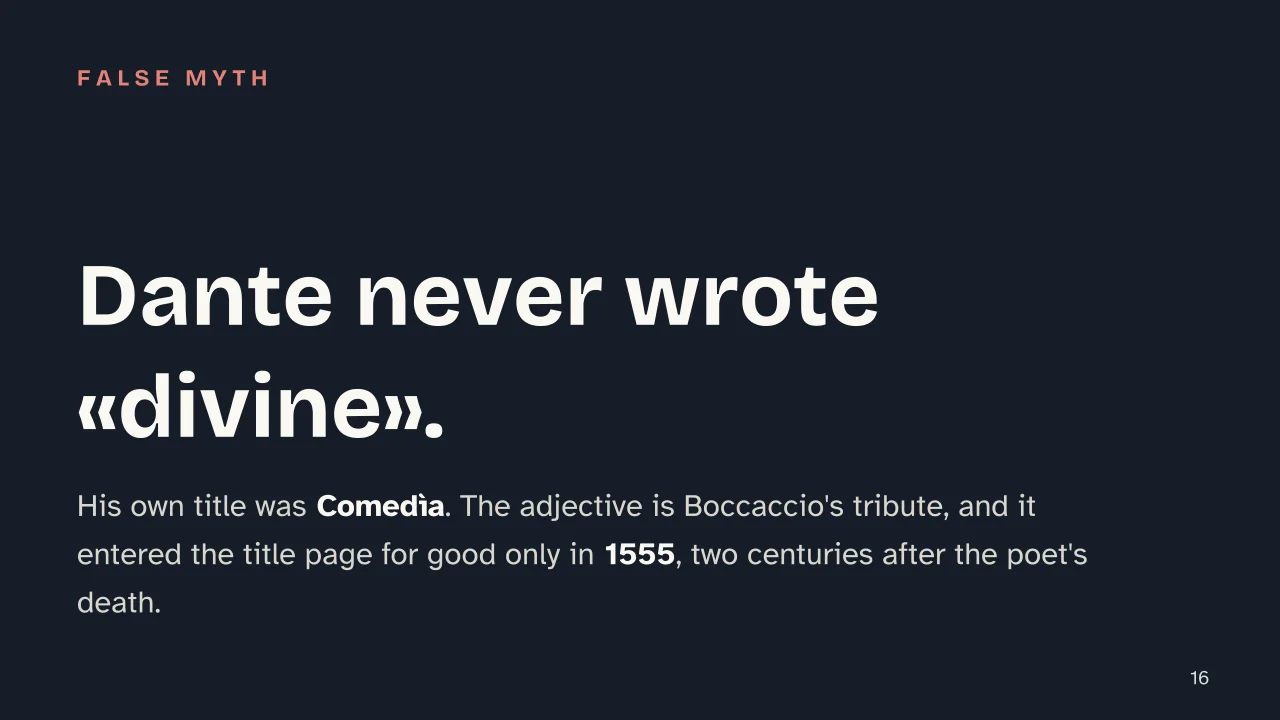 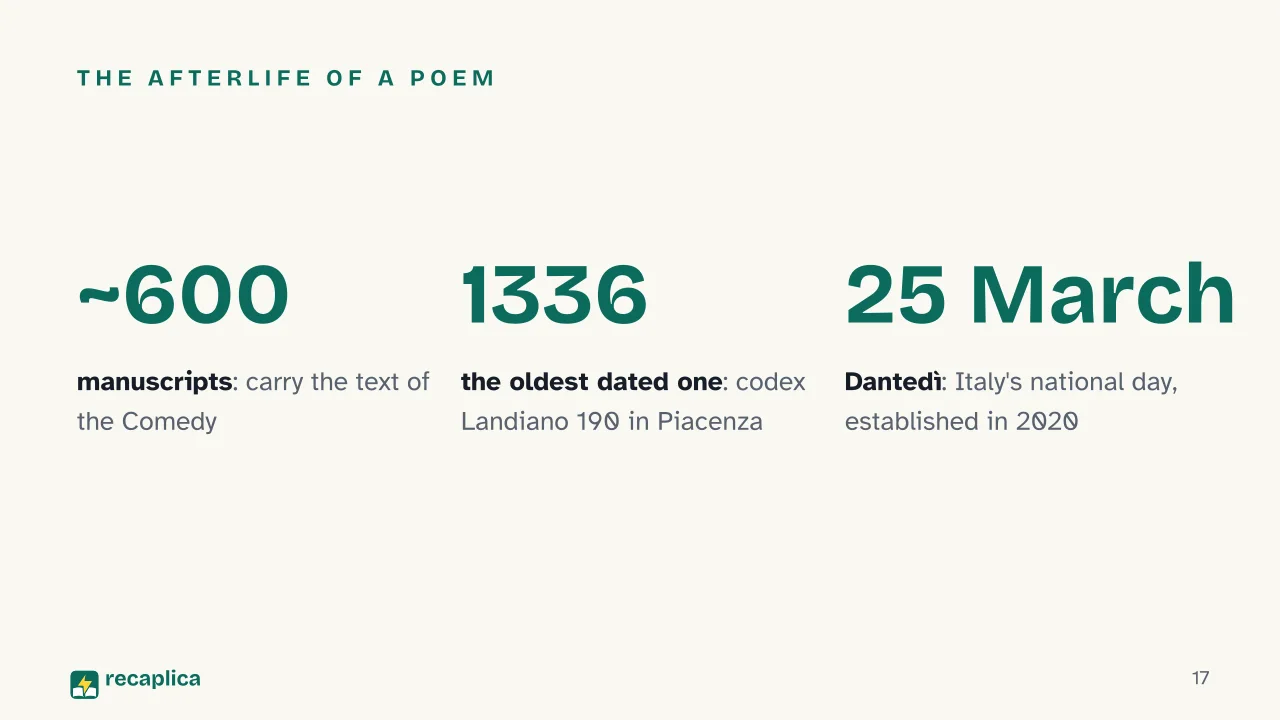 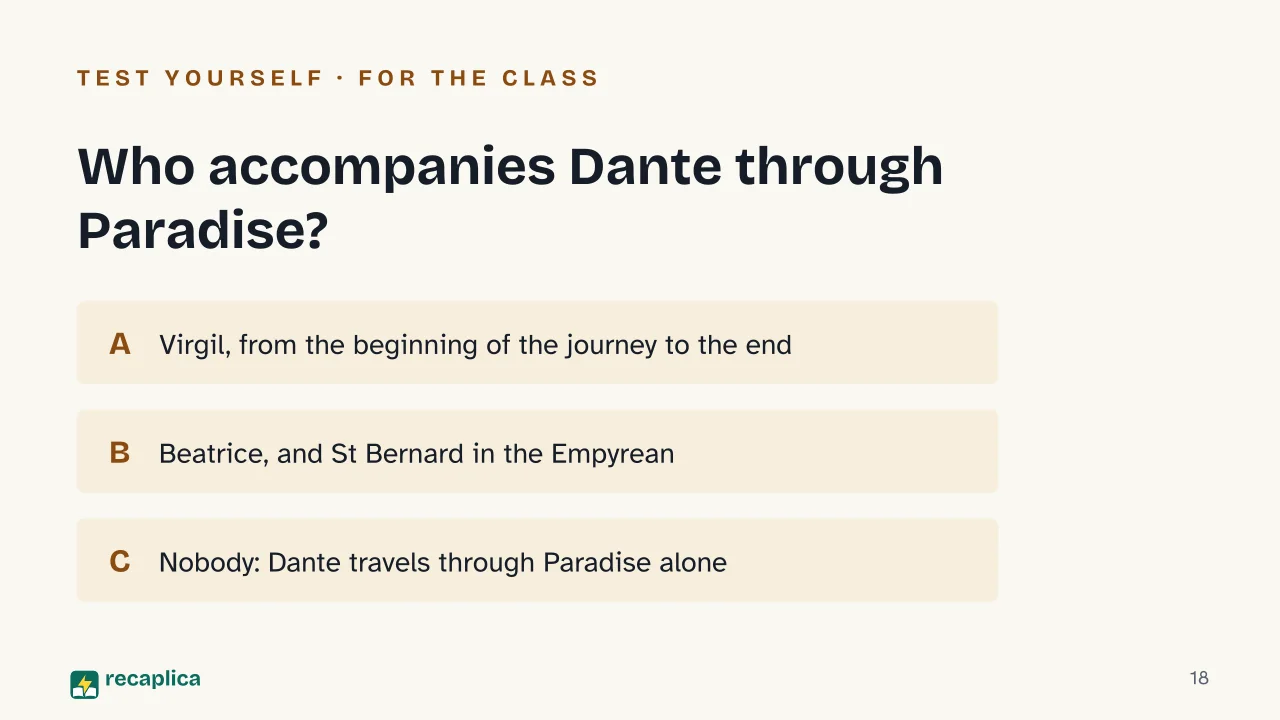  Common myths
Mind mapDrag the background to move around and the nodes to reposition them; use − and + to collapse and expand branches. 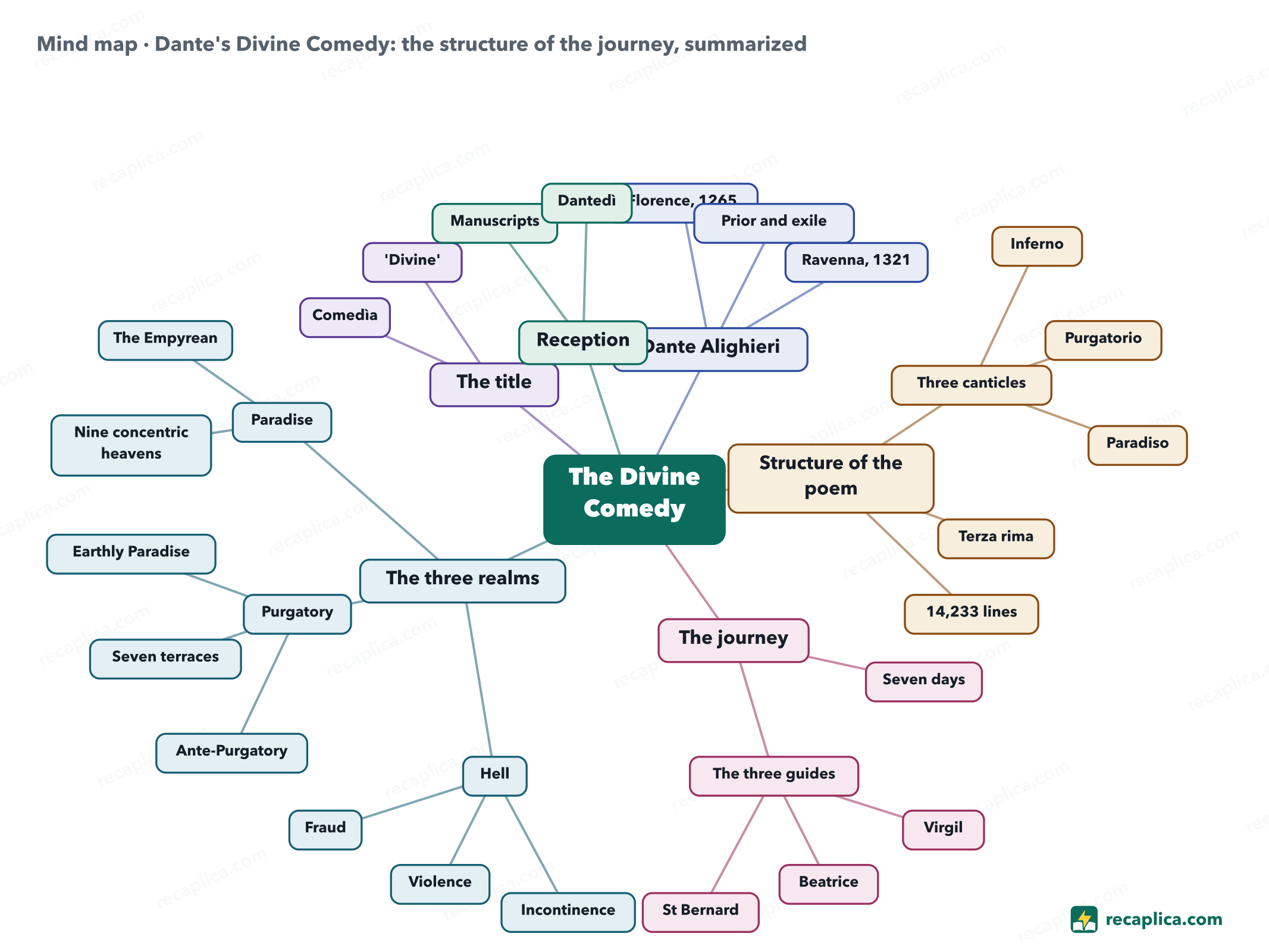
Quiz: test yourselfAnswer the questions to check what you have learned: you get instant feedback and a short explanation. Grade 0/10 0/5
FlashcardsTap the card to flip it and check whether you remember the answer, then move to the next one. 1 / 8 Explain it in your own wordsThe ultimate test: if you can explain it in simple words, you've truly understood it. Write your explanation, then compare it with the Recap. Your explanation is saved only on this device.
Frequently asked questionsWhat is the Divine Comedy about?It follows Dante's imagined journey through the three realms of the Christian afterlife. The traveller finds himself lost in a dark wood and gets out by descending through Hell, climbing the mountain of Purgatory and rising through the heavens of Paradise to the Empyrean. Along the way he meets hundreds of figures — ancient and contemporary, famous and obscure — and through them the poem takes on the politics, faith, history and passions of his own time. How long does Dante's journey last, and when is it set?Seven days, starting on the evening of Good Friday 1300, when the poet is about to turn 35: the midpoint of a life, going by the biblical span of seventy years. Scholars still disagree on the exact date, because the proposed reckonings differ. Treccani places the journey between 8 and 14 April 1300, while Dantedì, Italy's national day for the poet, is held on 25 March. Why is it called the Divine Comedy?Dante's own title was Comedìa. In the Middle Ages 'comedy' did not mean a funny work: it described both a story that ends well and a plain, everyday narrative style, as opposed to the unhappy ending and refined language of tragedy. The adjective 'divine' was added later, growing out of Boccaccio's admiration and becoming a permanent part of the title with the Venetian edition of 1555. Why was Dante exiled from Florence?For political reasons. Dante belonged to the White Guelphs and served among Florence's priors in 1300, from 15 June to 15 August; during that term the leaders of both city factions, White and Black, were banished. When the Blacks took power the reckoning came: a first sentence on 17 January 1302 and, on 10 March, perpetual exile under threat of death if he returned. Dante spent the rest of his life as a guest at various courts and died in Ravenna. What is Dantedì?It is Italy's national day dedicated to Dante Alighieri, established in 2020 by the Council of Ministers on a proposal from the then culture minister, Dario Franceschini. It falls on 25 March, the date some scholars identify as the start of the otherworldly journey told in the Comedy. Every Recap goes through an independent review before publication. |