|
recaplica
Lovecraft Non-Euclidean Geometry: What He Really Meant by It | |||||||||||||||
| © 2026 Recaplica · recaplica.com — All rights reserved | |||||||||||||||
Lovecraft Non-Euclidean Geometry: What He Really Meant by ItWhat to print Page numbers appear when printing with default margins. SlidesChoose a cut Flash10 slidesThe essential thread, to present in classFull15 slidesEvery chapter and the deeper detailBoth come with speaker notes. In 30 seconds quick readH. P. Lovecraft writes the phrase 'non-Euclidean' only twice in his entire body of fiction, in 'The Call of Cthulhu' (written in 1926, published in 1928) and in 'The Dreams in the Witch House' (1933), yet those two appearances were enough to turn the term into a fixture of cosmic horror. He is not describing mathematical formulas: in the stories it labels angles that feel wrong, surfaces where 'climbing' is actually walking level ground, sensations the human brain cannot reconcile. Lovecraft ties that disorientation to his own philosophy, cosmicism, in which an indifferent universe leaves the human mind unable even to read the space around it correctly. Physicist Benjamin K. Tippett later showed that the textual description of R'lyeh, Cthulhu's city, matches what an observer would experience inside a bubble of curved spacetime — a reading made after the fact, not the source Lovecraft was drawing on. Key Points
Key figures
Deep DiveIn math textbooks, “non-Euclidean geometry” is a precise label: a family of coherent systems built by replacing Euclid’s parallel postulate. In H. P. Lovecraft’s stories, the same phrase does entirely different work. It appears only twice across his whole body of fiction, yet today it is almost a trademark of his name — enough that many readers picture it scattered across dozens of stories. Here is what Lovecraft actually meant, why he chose it, and where the literary use ends and the mathematical one begins. Two words, two storiesThe first appearance is in “The Call of Cthulhu”, written in the summer of 1926 and published in February 1928 in the pulp magazine Weird Tales. The story describes R’lyeh, the sunken city in the South Pacific that imprisons the cosmic entity Cthulhu, and follows the crew of the ship Alert, led by Gustaf Johansen, as they “struggled to comprehend the non-Euclidean geometry” of the city before accidentally freeing the monster. The second, and last, appearance is in “The Dreams in the Witch House”, written between January and February 1932 and published in July 1933. The protagonist, Walter Gilman, is a mathematics student at Miskatonic University who rents a room in an old building tied to the witch Keziah Mason. The room has “unusual dimensions” that form what the text calls “unearthly geometry”, supposedly able — in the fiction — to allow travel between different planes of reality. Gilman studies “non-Euclidean calculus and quantum physics” and connects it to legends of ancient witchcraft; the story names Einstein, Planck, Heisenberg and Willem de Sitter, real scientists and contemporaries of Lovecraft. Cthulhu non-Euclidean geometry: what R’lyeh’s architecture describesIn the stories the phrase takes shape in concrete images. In “The Call of Cthulhu” a crew member climbs along a stone moulding — that is what he would call it, if the movement were not, in fact, horizontal. Another sailor is swallowed by a masonry angle that should not be there: an angle that is acute, yet behaves as if it were obtuse.
That architecture lies to the senses: it promises one thing (an angle, a climb, a wall) and delivers another, and the mind that tries to straighten it out finds no foothold. That gap between what the body feels and what reason expects is, for Lovecraft, the raw material of horror. Why Lovecraft picks this word: cosmicismLovecraft subscribed to a literary philosophy critics call cosmicism: the idea that no recognizable divine presence exists in the universe and that humanity is particularly insignificant within it. The theme recurs in works such as “Herbert West-Reanimator” (1922), The Dream-Quest of Unknown Kadath (1927) and “The Call of Cthulhu” (1928): horror does not come from a fanged monster but from the realization that human beings have no power to change anything in an indifferent universe. Critics describe Lovecraft’s cosmicism as a form of “mechanistic materialism”: he rejected religious claims unsupported by evidence and believed in a universe that was “meaningless, mechanical, and uncaring”. Within that frame, “wrong” geometry is not a stage trick: it is the most direct symptom of cosmicism. In the stories, characters “become insane from the elimination of recognizable geometry”; the horror also comes from the “failure of our geometry”. If a person cannot even read the space they move through correctly — the most basic tool by which anyone orients every action — then their claim to understand the universe, or to hold a special place in it, collapses along with the certainty that an angle is acute or a climb is vertical. An “alien” term for the 1920s reader: the historical and mathematical contextTo see why that name worked so well on the audience of the time, it helps to look at the history of the mathematical field itself, which develops by replacing a single postulate of Euclidean geometry, the one about parallel lines: in the hyperbolic variant, infinitely many lines through a point avoid a given line; in the elliptic variant, every line through a point crosses it. Carl Friedrich Gauss developed germinal ideas in this field around 1813, without publishing them; he later said he had worked them out “several years earlier”. Nikolai Ivanovich Lobachevsky published the first treatises on hyperbolic geometry between 1829 and 1830, and the Hungarian mathematician János Bolyai independently reached similar results in 1832. Bernhard Riemann, in a celebrated 1854 lecture, founded Riemannian geometry and built an entire family of non-Euclidean geometries. For centuries before those discoveries, Euclidean geometry had been treated as absolute truth; the alternatives were not widely accepted as legitimate until the 19th century. When Lovecraft was writing, between 1926 and 1933, that breakthrough was under a century old. It was a real mathematical discovery, but still foreign to the average reader’s cultural baggage: a term that sounded technical, recent, and faintly subversive, able to evoke something genuinely “other” than the geometric common sense everyone learns as a child. That is why borrowing that name, rather than inventing a fictional one, worked better: it told the reader that behind the horror stood real science, just out of ordinary reach. What a physicist would say today: Tippett’s analysisThat narrative instinct had an unexpected sequel. Physicist Benjamin K. Tippett scientifically analyzed the textual descriptions of R’lyeh — the angle that behaves as obtuse, the “climb” that is actually horizontal — and showed that they match what one would expect to observe while exploring a bubble of curved spacetime, the same kind of geometric distortion studied by general relativity (the same theoretical framework at work when discussing black holes). It is a link drawn after the fact, not the source Lovecraft was drawing on while writing in the 1920s: he was not applying curvature equations, he was building a sensory experience of disorientation by impression. But the fact that the description holds up, decades later, to a rereading through real physics shows how effective his instinct was: he had found, by literary means, a way to make a reader “feel” what it is like to move through a space that does not obey familiar geometry — the same kind of space physics describes with different tools.
A legacy that continuesThe trope of Lovecraft’s “non-Euclidean” architecture did not end in the 1930s. The novel The City We Became features an antagonist whose name draws on R’lyeh, and the video game Doom: The Dark Ages, released in 2025, includes a setting called “The City of Ry’uul” with openly Lovecraftian design and a creature named “The Old One”, a clear nod to Cthulhu. Two sentences, written nearly a century ago in a pulp magazine, were enough to put the phrase into the vocabulary of writers, screenwriters and game designers: they still reach for it whenever they need to describe a place that no longer follows the rules a reader learned to expect. Slide deckSlides ready to download and make your own in PowerPoint or Google Slides, with speaker notes. Pick the Flash cut or the Full one.     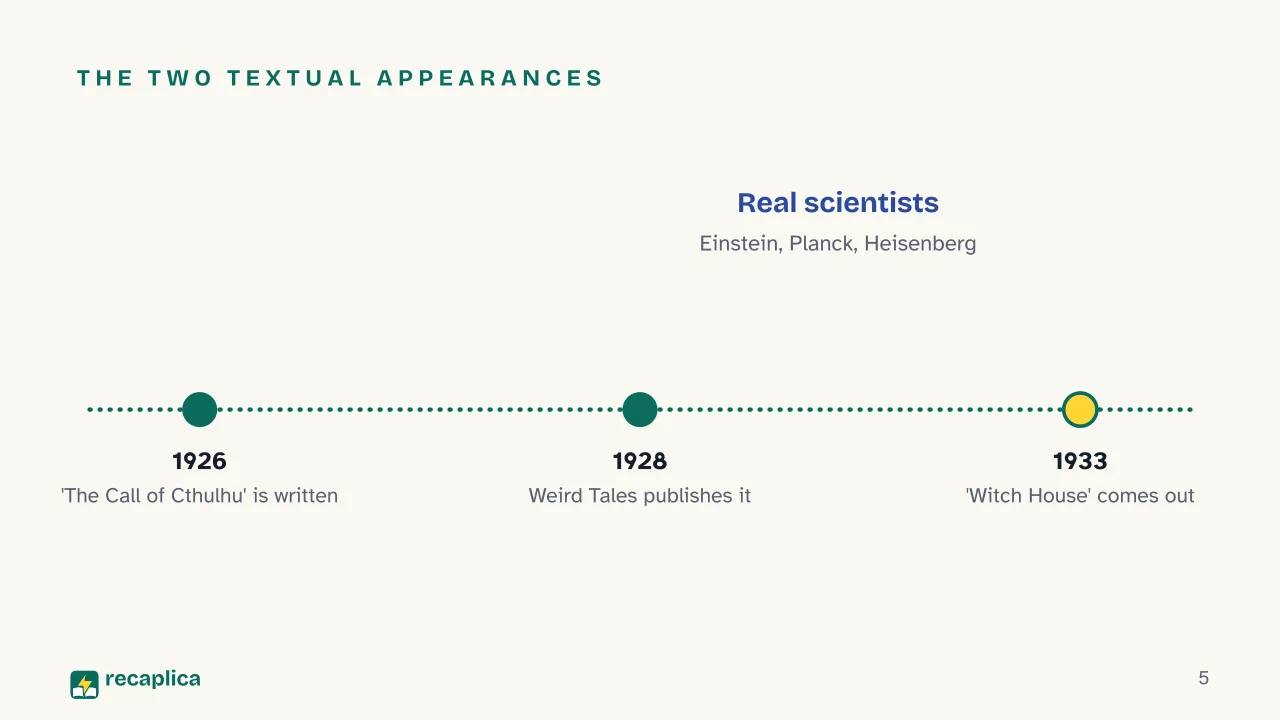  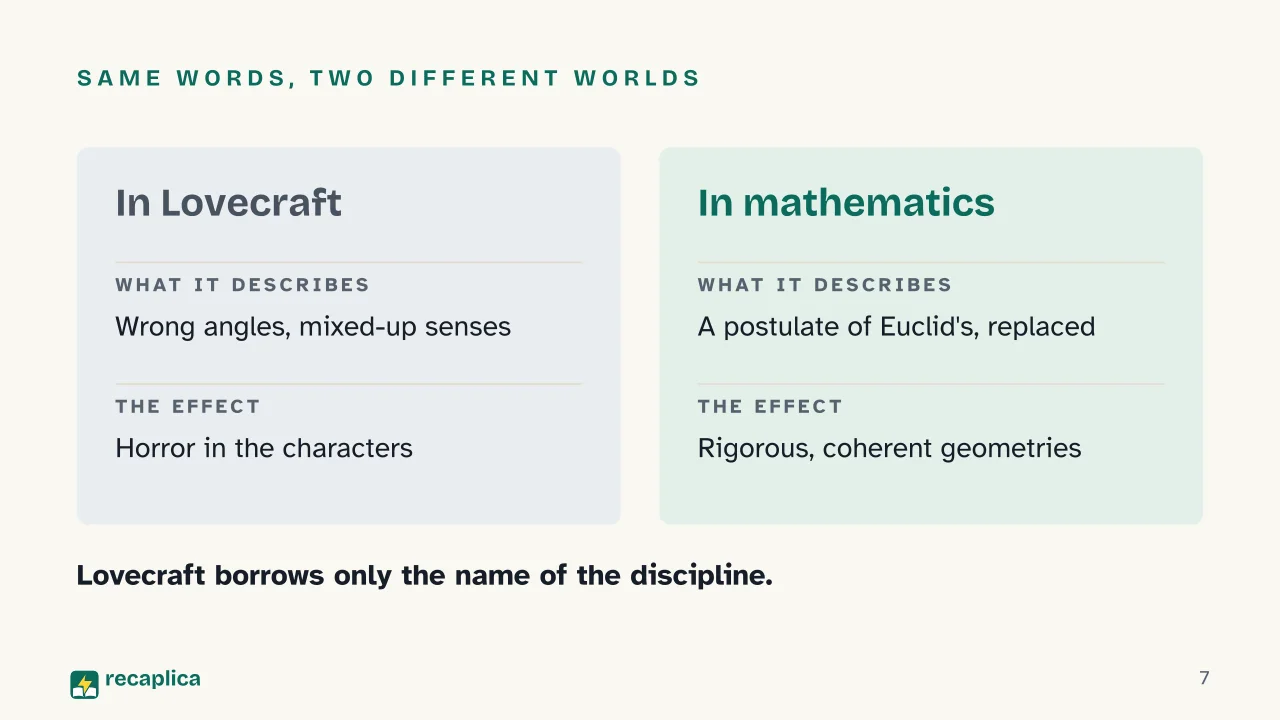   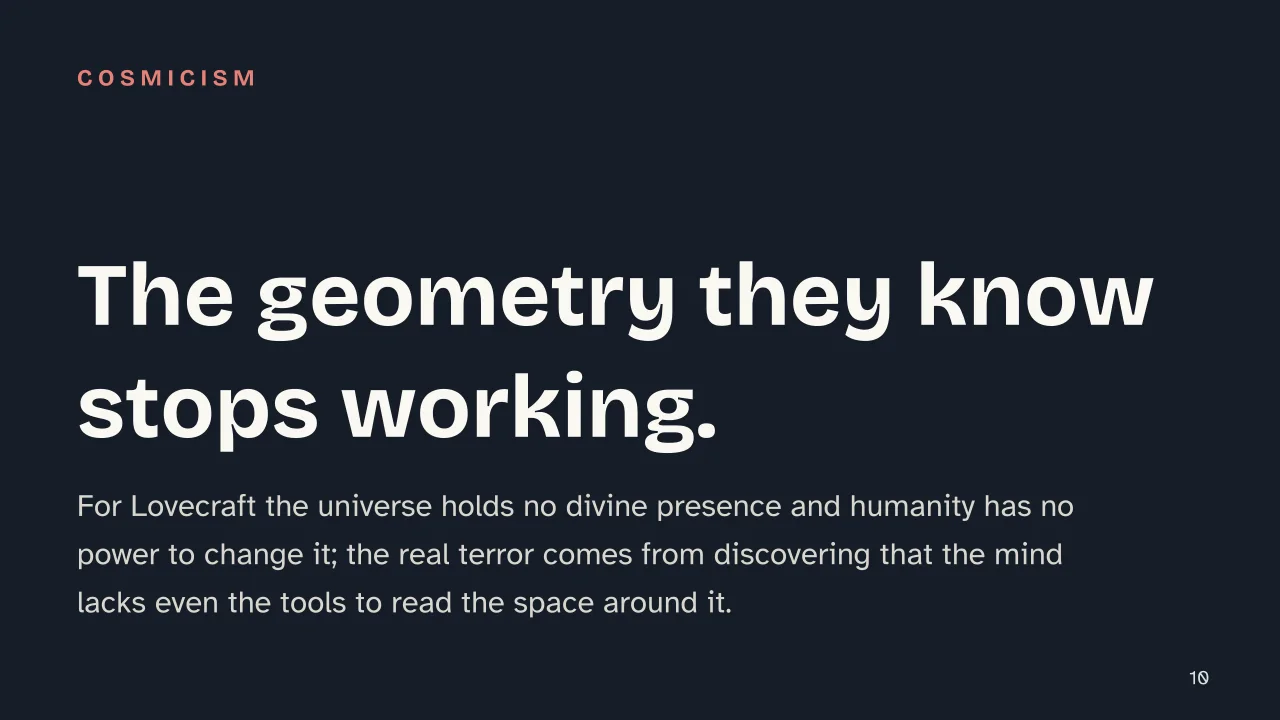  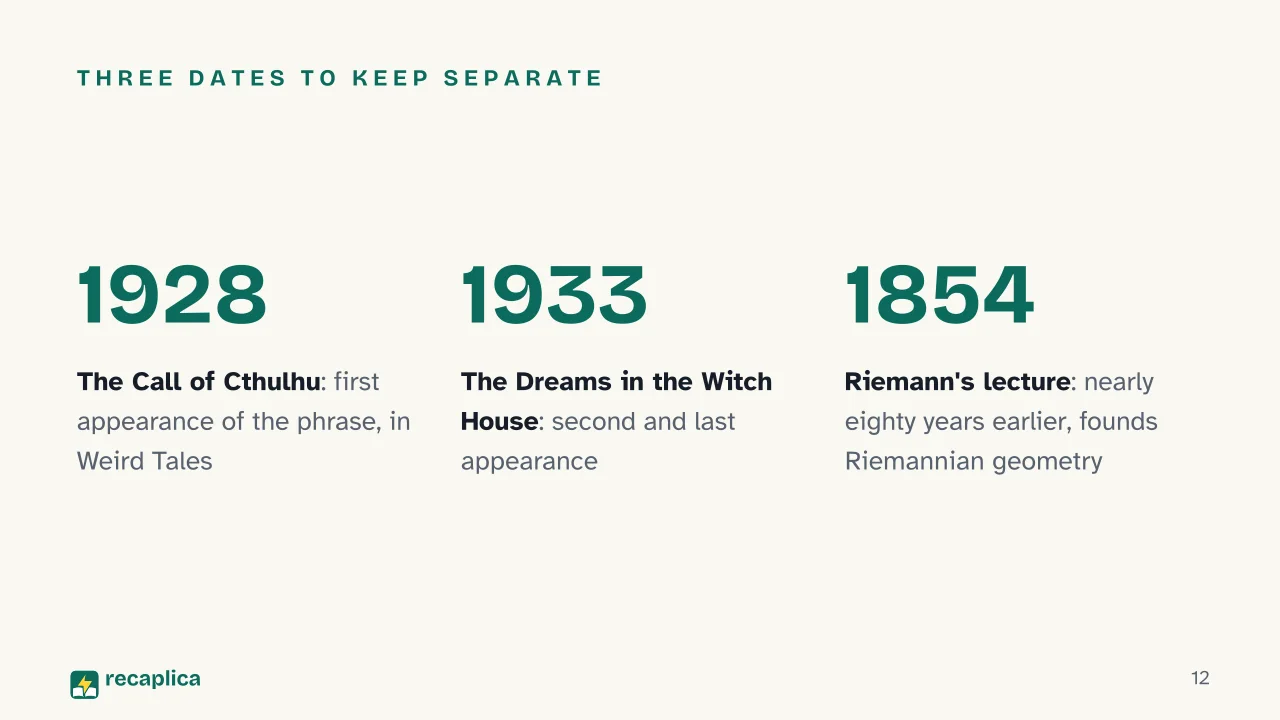  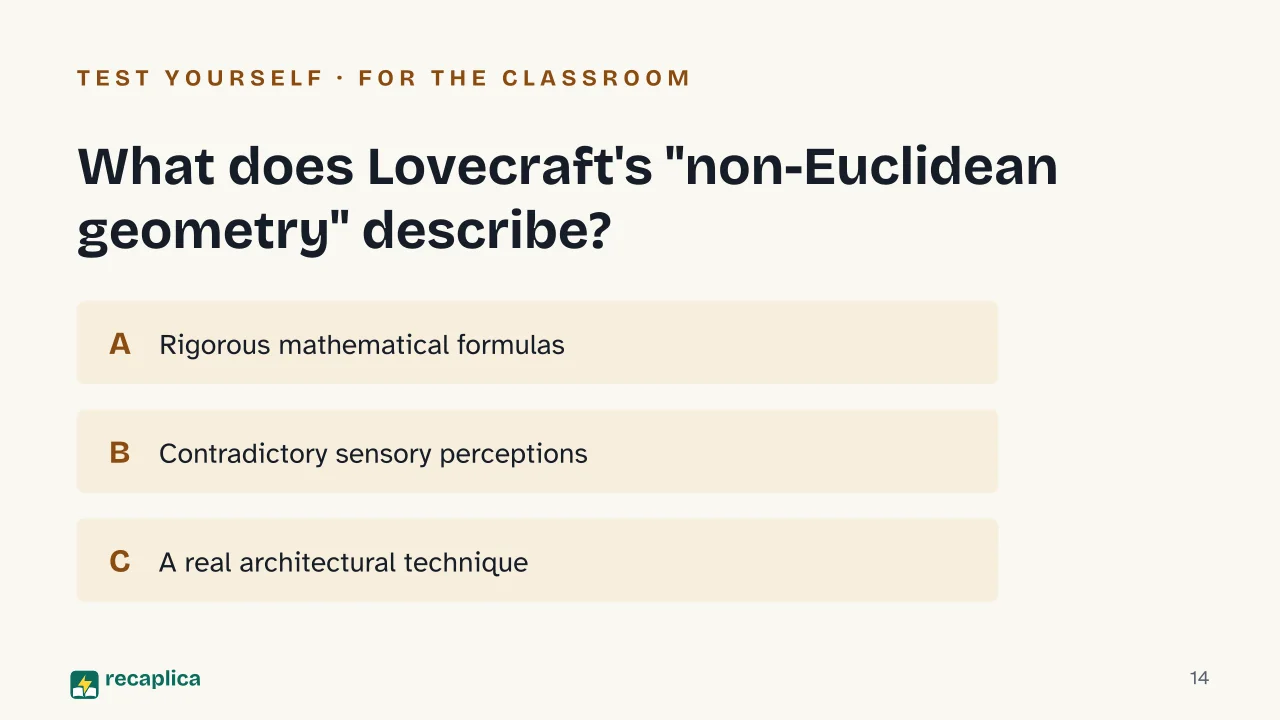  Common myths
Mind mapDrag the background to move around and the nodes to reposition them; use − and + to collapse and expand branches. 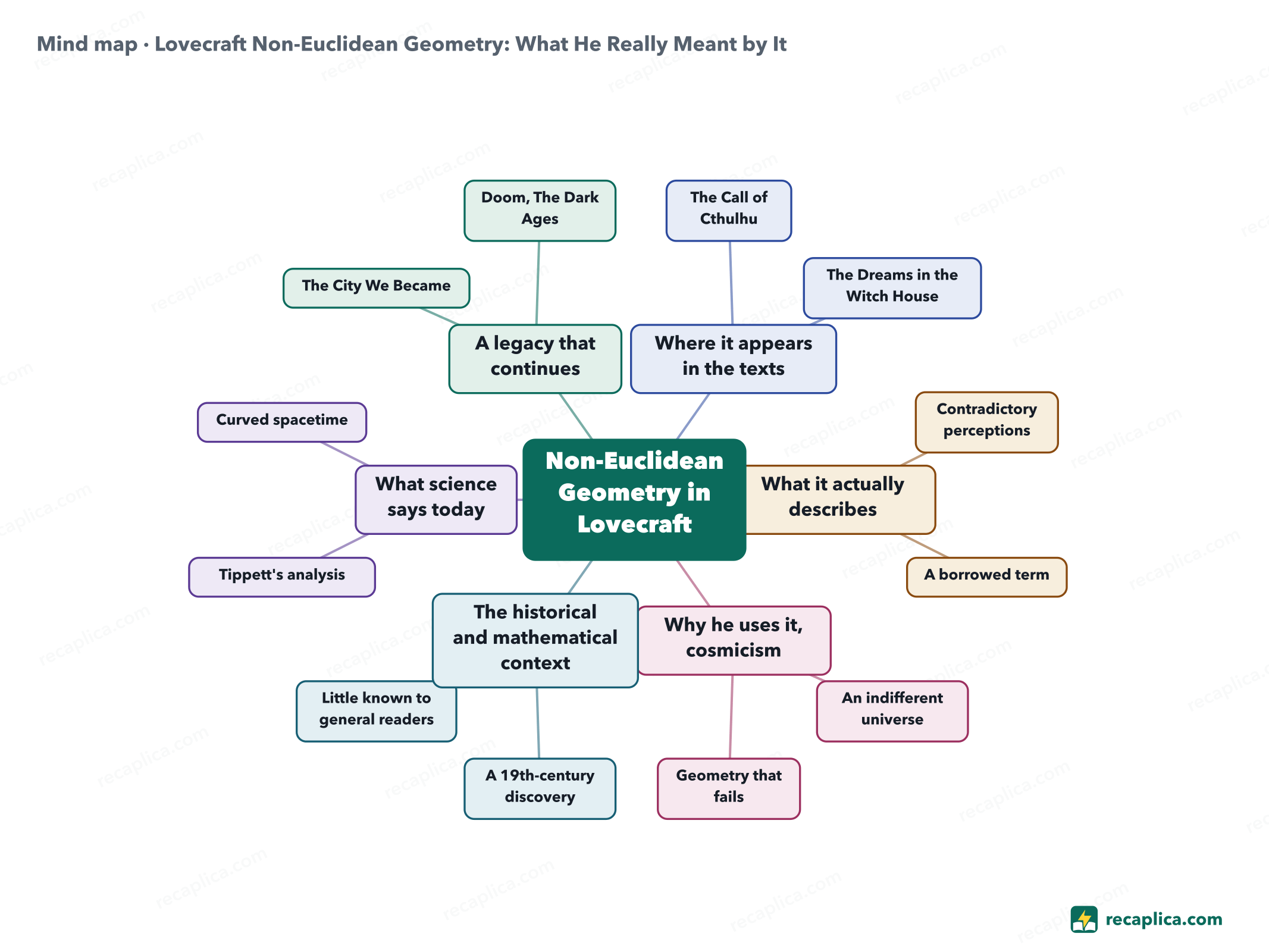
Quiz: test yourselfAnswer the questions to check what you have learned: you get instant feedback and a short explanation. Grade 0/10 0/5
FlashcardsTap the card to flip it and check whether you remember the answer, then move to the next one. 1 / 8 Explain it in your own wordsThe ultimate test: if you can explain it in simple words, you've truly understood it. Write your explanation, then compare it with the Recap. Your explanation is saved only on this device.
Frequently asked questionsWhat does "non-Euclidean geometry" actually mean in Lovecraft's stories?In the two stories where Lovecraft uses the phrase, it describes architecture the senses cannot correctly interpret — an acute masonry angle that behaves as if it were obtuse, a level surface you "climb" as if it were vertical. The reader is left with the sense of a space that no longer obeys familiar rules. What does "Cthulhu non-Euclidean geometry" refer to exactly?It refers to the architecture of R'lyeh, the sunken city that imprisons Cthulhu in "The Call of Cthulhu". Lovecraft describes a sailor climbing along stonework that turns out to be horizontal, and another swallowed by a masonry angle that is acute yet behaves as obtuse — the two textual passages that gave the phrase its lasting association with the character. In which stories does the phrase "non-Euclidean geometry" appear?Only two, across the whole of Lovecraft's fiction. In "The Call of Cthulhu" (written in 1926, published in February 1928 in Weird Tales), about the sunken city of R'lyeh; and in "The Dreams in the Witch House" (published in July 1933), about a room with "unusual dimensions" said to allow travel between different planes of reality. How does Lovecraft's non-Euclidean geometry differ from the real mathematical field?Mathematical non-Euclidean geometry comes from replacing a single postulate of Euclid's, the one about parallel lines, and produces rigorous, coherent systems such as hyperbolic and elliptic geometry, developed by Lobachevsky, Bolyai and Riemann in the 19th century. Lovecraft does not apply those systems: he borrows the name, which still sounded exotic and modern in the 1920s and 1930s, to describe a sensory experience of disorientation. Why does Lovecraft link "wrong" geometry to cosmic horror and Cthulhu?Because of his philosophy, cosmicism, a universe without meaning and indifferent to humanity, which critics describe as 'mechanistic materialism'. In that view the purest horror is not a fanged monster but the discovery that the human mind lacks even the tools to read the space around it correctly: once familiar geometry stops working, his characters find nothing to hold onto and lose their minds. Every Recap goes through an independent review before publication. |