Skip to content
recaplica

    One moment: security check

    Cloudflare wants to make sure you're not a robot. Tick the box below and your search will continue on its own.

    IT
    recaplica Horror Romance: What the Subgenre Blending Fear and Love Means
    © 2026 Recaplica · recaplica.com — All rights reserved
    Home › Literature

    Horror Romance: What the Subgenre Blending Fear and Love Means

    By Recaplica Newsroom · Updated on October 8, 2026

    What to print

    Page numbers appear when printing with default margins.

    Slides

    Choose a cut

    Flash10 slidesThe essential thread, to present in classFull15 slidesEvery chapter and the deeper detail

    Both come with speaker notes.

    Telegram channel
    recaplica Clear in 30 seconds, yours in 10 minutes.
    In 30 seconds Key points Deep dive Slides Myths Mind map Quiz Flashcards FAQ

    In 30 seconds quick read

    Horror romance puts a couple at the center of a story where the danger feels real, page after page, for the reader as much as for the characters. It belongs to the wider dark romance territory, built on power imbalances, morally murky choices and taboo desire, but it layers on a requirement of its own: genuine fear that readers experience as the romance unfolds. Gothic fiction keeps the love story in the background of a larger mystery, while in horror romance the relationship and the fear travel together, neither one subordinate to the other. The term is often shortened to horromance in English-language publishing.

    Key Points

    • Horror romance asks readers to feel real, life-or-death fear that runs alongside the romantic plot itself.
    • It sits inside dark romance, the broader category built on power imbalances, moral ambiguity, and taboo desire.
    • Dark romance in general can star dangerous protagonists without ever aiming to scare the reader.
    • Gothic fiction keeps the love story secondary to a wider mystery; horror romance keeps fear and romance equally central.
    • Monster romance and paranormal romance often skip genuine fear even when characters face high-stakes danger.
    • A traditional romance novel almost always promises a resolved ending for its central couple.

    Deep Dive

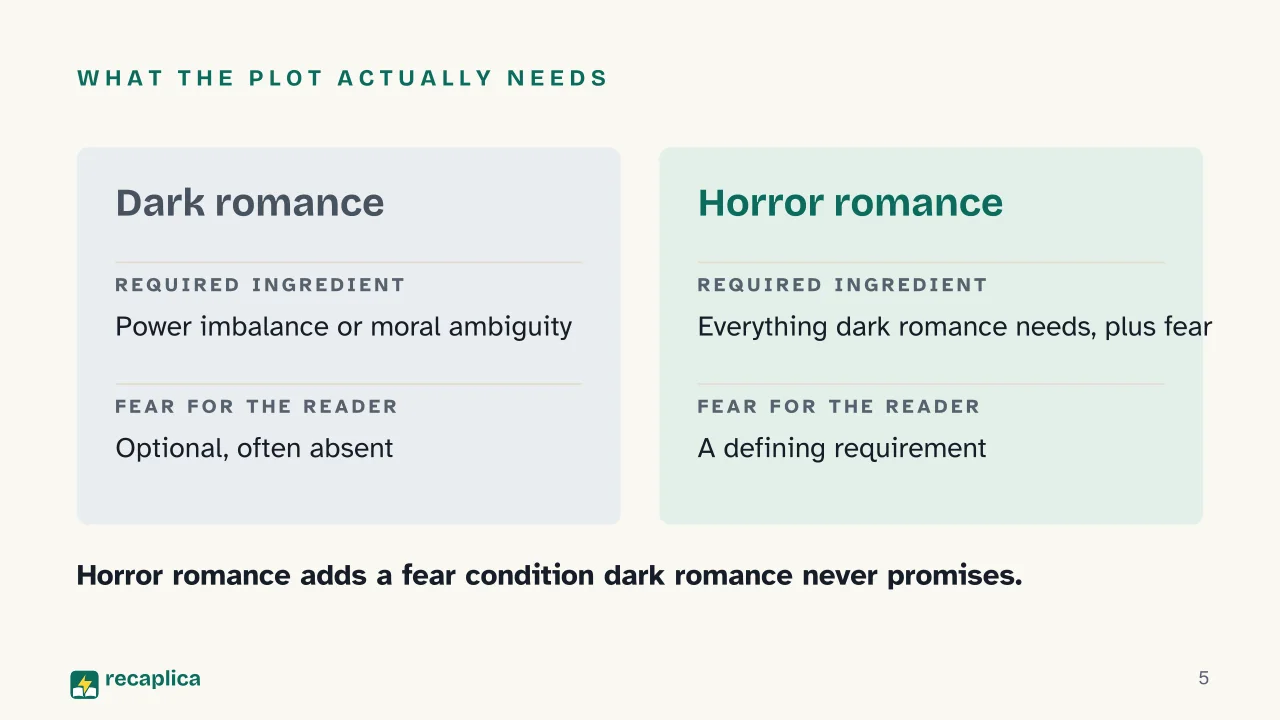
    A love story can carry real danger and a lopsided balance of power without automatically becoming horror. Horror romance lives on that exact edge, inside the wider territory of dark romance, where power imbalances, morally murky choices, and taboo desire already drive the plot. The genre adds one further requirement: readers need to feel actual fear as the romantic plot plays out.

    Dark romance: the wider category horror romance belongs to

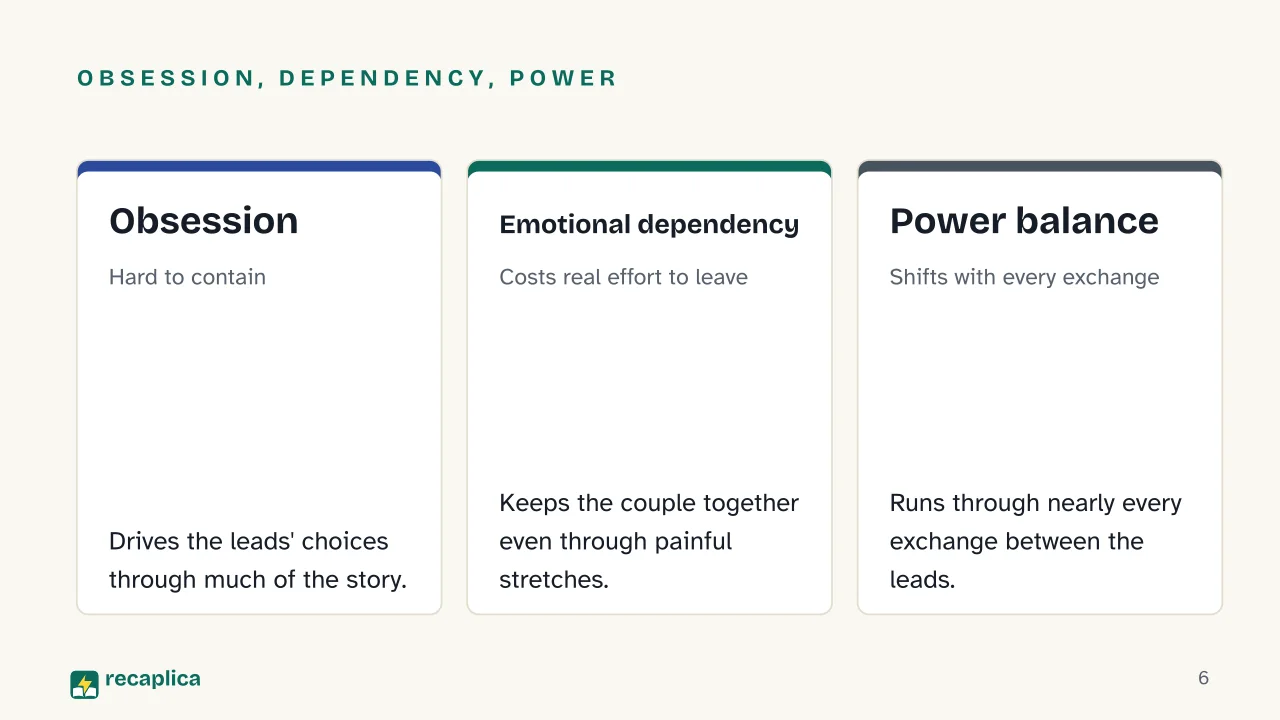
    Protagonists in dark romance rarely resemble the conventional romantic hero. They tend to be morally complex or outright antagonistic figures: criminals, antiheroes, characters marked by psychological instability. Three threads recur across much of the genre: obsession, emotional dependency, and an ongoing negotiation of power between the leads. These elements, more than any particular setting, hold the plot together.

    Dark romance became a recognizable publishing category during the 2010s, alongside the growth of self-publishing and digital reading platforms, which gave authors a direct channel to readers drawn to this kind of story. What dark romance means, and its main strands covers the umbrella genre in full, from mafia romance to paranormal romance.

    Horror romance, or horromance: when fear becomes central

    The term horror romance, often shortened to horromance, marks a more specific cut within dark romance. What qualifies a book as horror romance is the emphasis on fear: readers need to feel a life-or-death tension alongside the romantic one. A dark mood or an unsettling antagonist is not enough on its own; the danger has to feel real, chapter after chapter. Readers looking for horror romance books, horror romance novels, or scary romance books in general are usually after exactly that combination.

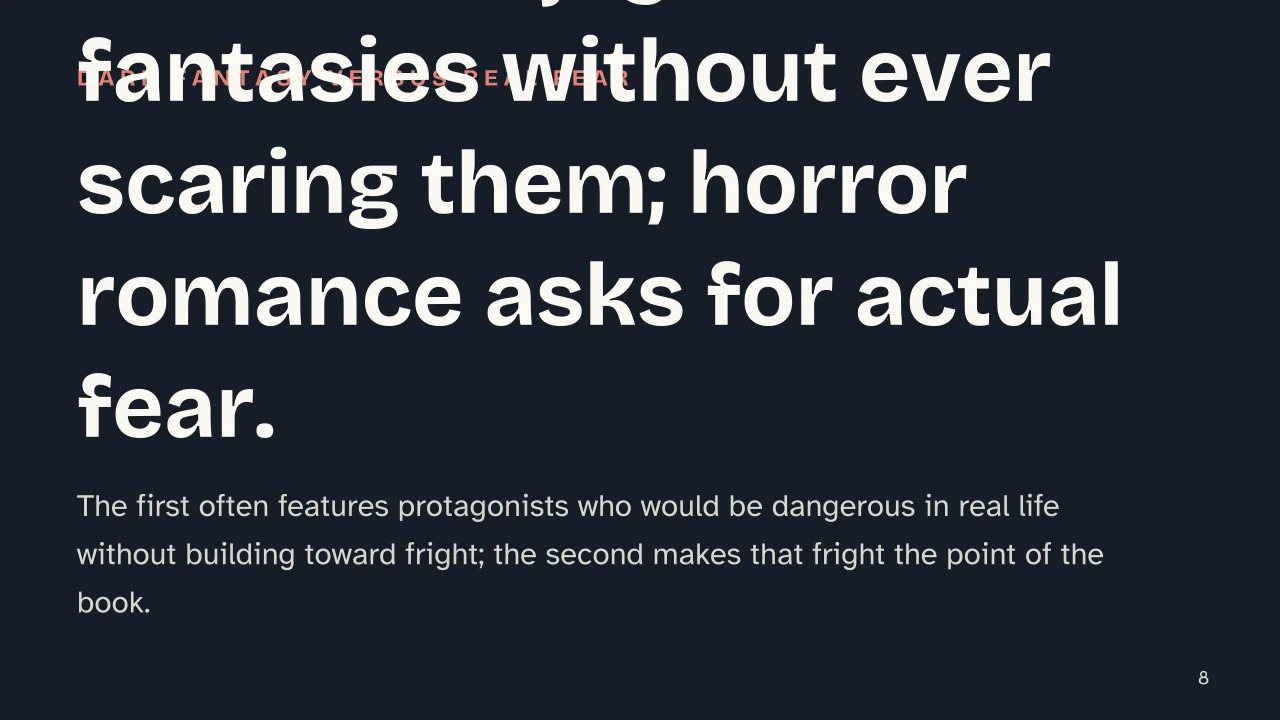
    Dark romance in general often stars protagonists best avoided in real life: serial killers, mob figures, drug traffickers, stalkers. Its job, though, stays focused on letting readers indulge dark fantasies. Actually feeling afraid, as a stated experience, stays a trait reserved for horror romance, which in turn sits apart from horror fiction as a genre: the latter can build its tension with no romantic plot at all, while horror romance makes the two elements travel together on purpose.

    Fiction built on cosmic dread, like the kind examined in the piece on Lovecraft’s non-Euclidean geometry, shows how horror tension can stand entirely on its own, without any love story attached.

    Horror romance and gothic fiction, two different genres

    The genre most often confused with dark romance is gothic fiction. Gothic fiction shares an atmosphere of dread, the threat of supernatural events, and the past intruding on the present. When romance appears in a gothic novel, though, it stays a secondary element within that wider atmosphere.

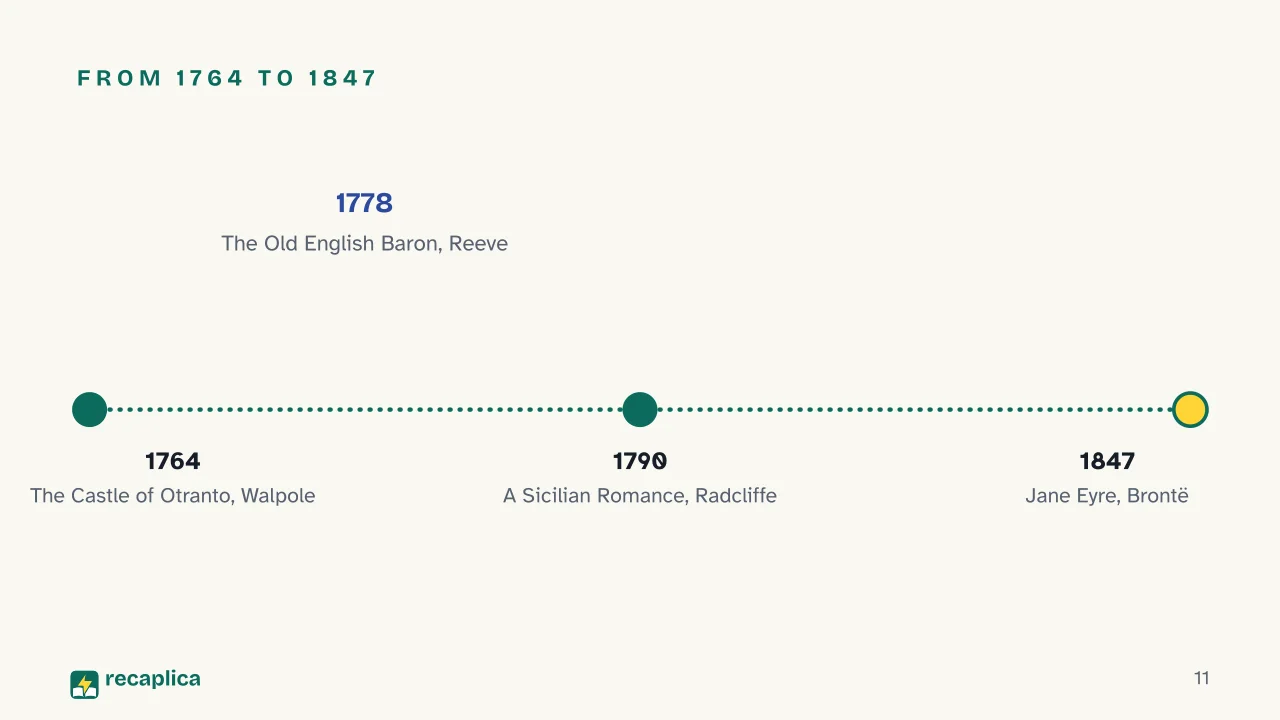
    The first work labeled gothic was The Castle of Otranto by Horace Walpole, published in 1764, which set the tropes that many contemporaries imitated, including Clara Reeve’s The Old English Baron, published in 1778. Gothic romance, a specific branch of the gothic, emerged in 1790 with Ann Radcliffe’s A Sicilian Romance, built on those same tropes. Radcliffe’s novels introduced heroines who face terrifying ordeals while fighting to stay with their true love: that pairing of ordeal and romance is what separates gothic romance from pure gothic horror. The gothic subgenre came to be defined and dominated by female protagonists, especially after the 1847 publication of Charlotte Brontë’s Jane Eyre.

    GenreWhere the couple sitsHow much fear matters
    Pure horrorOften absentThe point of the story
    Horror romance (horromance)Central, alongside fearGenuinely felt by the reader
    Dark romance with no horror elementCentral to the plotNot required
    Gothic fictionSecondary to a wider mysteryPart of the overall atmosphere

    In dark romance, dark themes don’t stay in the background the way they do in gothic fiction: they directly shape the emotional intensity and development of the central relationship. Strip the romance out of a gothic story and the horror plot can still stand on its own; strip it out of dark romance, and there is no plot left.

    Works that blend mystery with an unsettling setting, like The Name of the Rose, show how a disturbing atmosphere can accompany an investigation while staying distinct from any romantic core, a mechanism close to what gothic fiction does.

    Genres related to dark romance

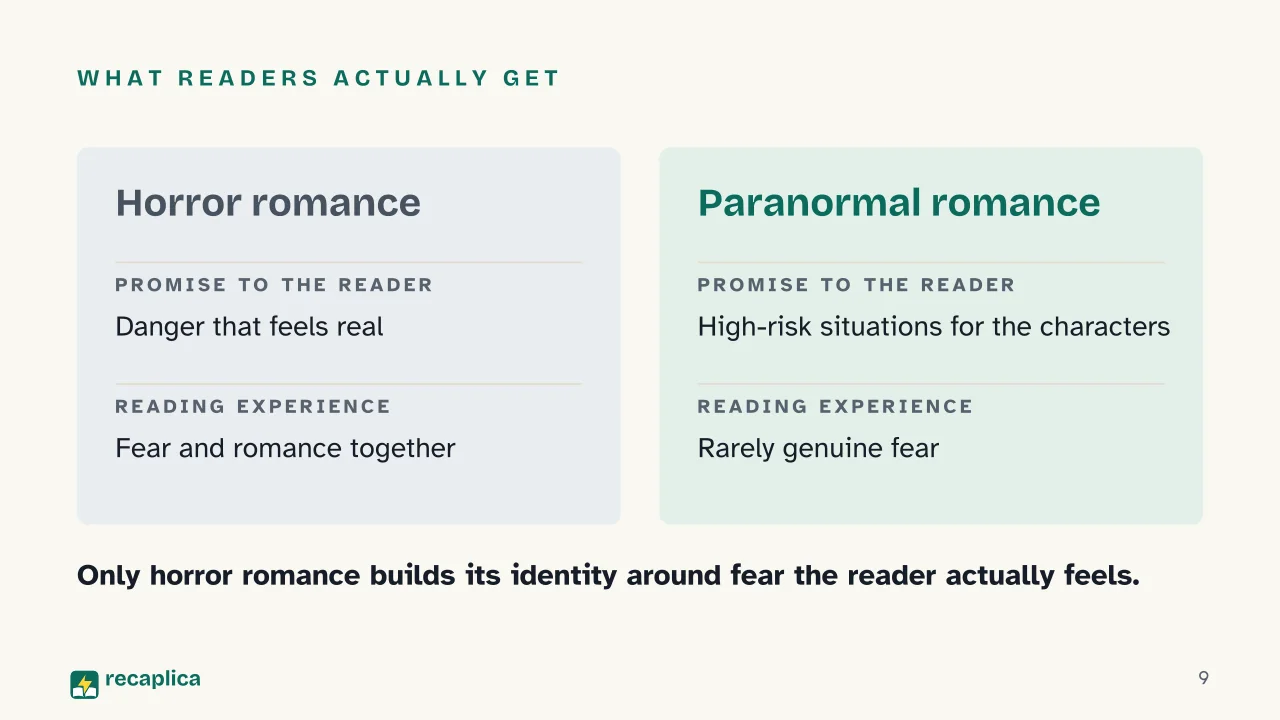
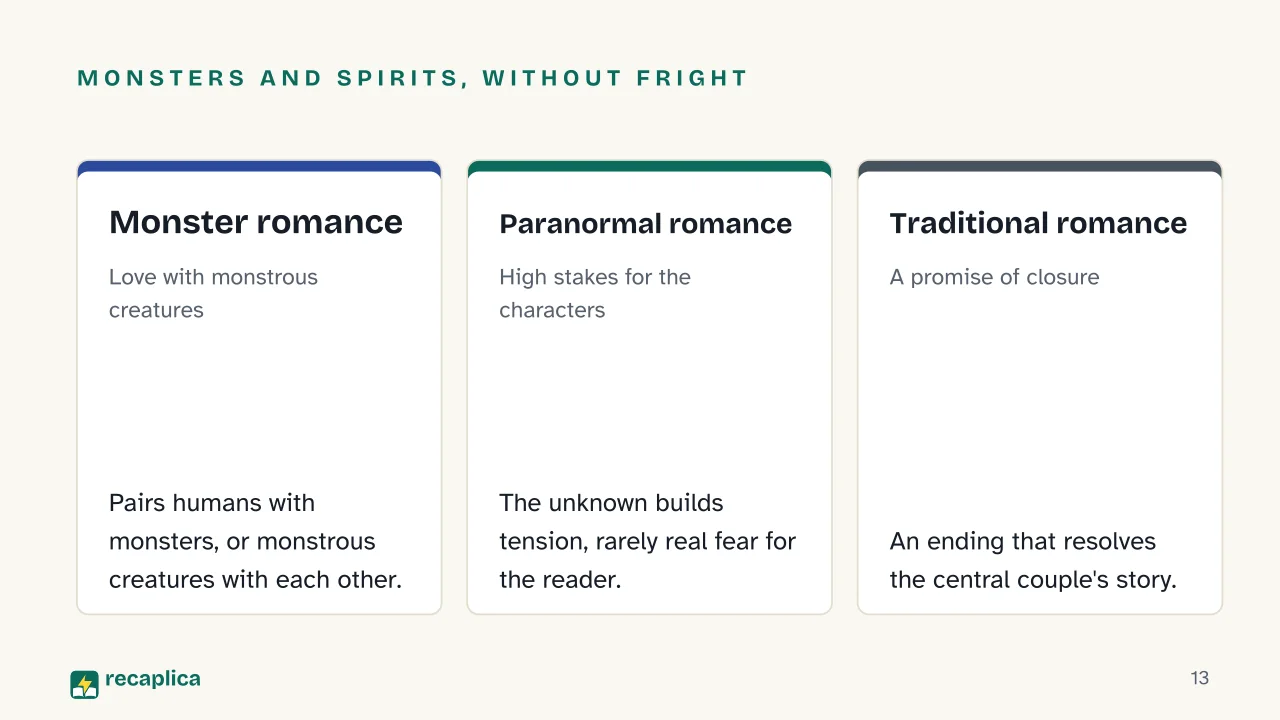
    Several subgenres sit near dark romance while keeping their own rules. Many monster romance stories, which pair humans with monstrous creatures or pair monstrous creatures with each other, stay free of any real fright. The same often holds for paranormal romance, where conflict between humans and supernatural beings creates high-stakes situations for the characters, rarely genuine terror for the reader.

    Even literary movements further removed in time have explored the darker edges of passion while staying outside horror territory: the decadent sensibility described in the piece on Gabriele D’Annunzio lingers on desire and emotional excess, in a register that stays affective rather than frightening.

    Dark romance and traditional romance: a shared promise

    One last line is worth drawing, the one with romance in its most traditional form. That genre almost always reaches an ending that resolves the central couple’s story, a promise that carries over into dark romance too, even when getting there means spending time with mob bosses, stalkers, and other characters nobody would want to meet in person. Pure horror shares no such guarantee: it can leave a story open, or close it in a way that resolves nothing at all.

    Slide deck

    Slides ready to download and make your own in PowerPoint or Google Slides, with speaker notes. Pick the Flash cut or the Full one.
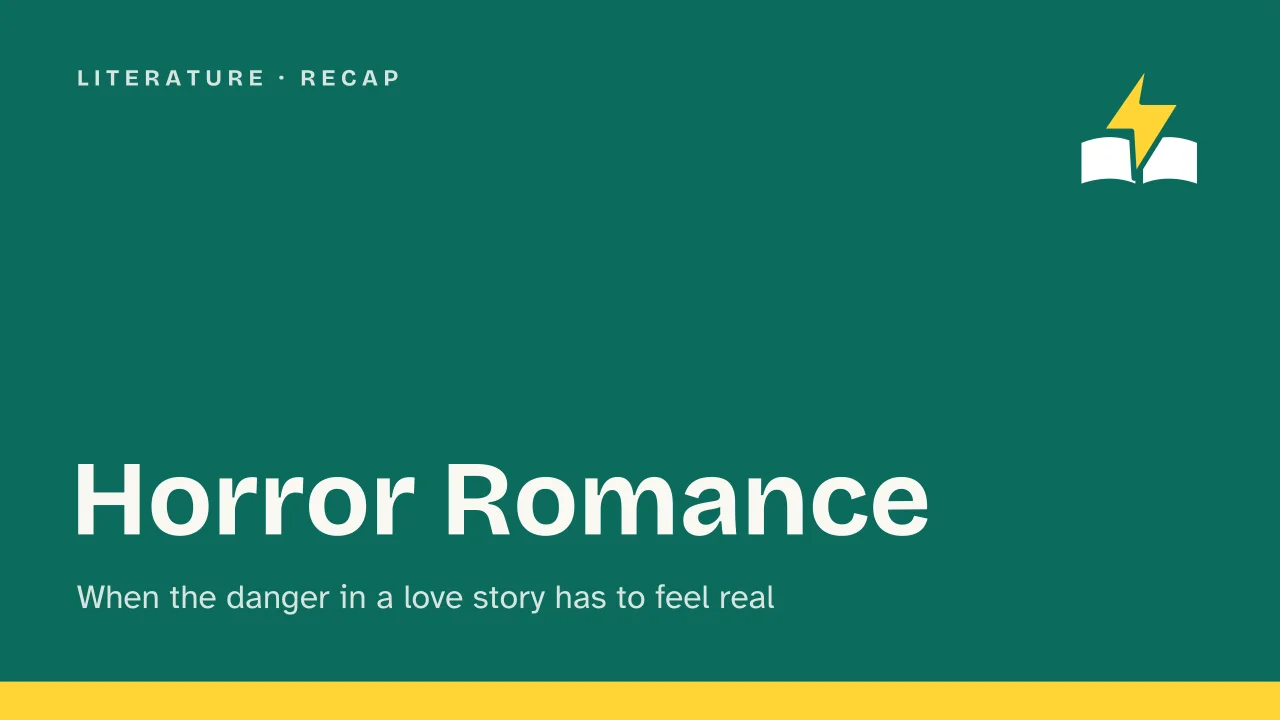
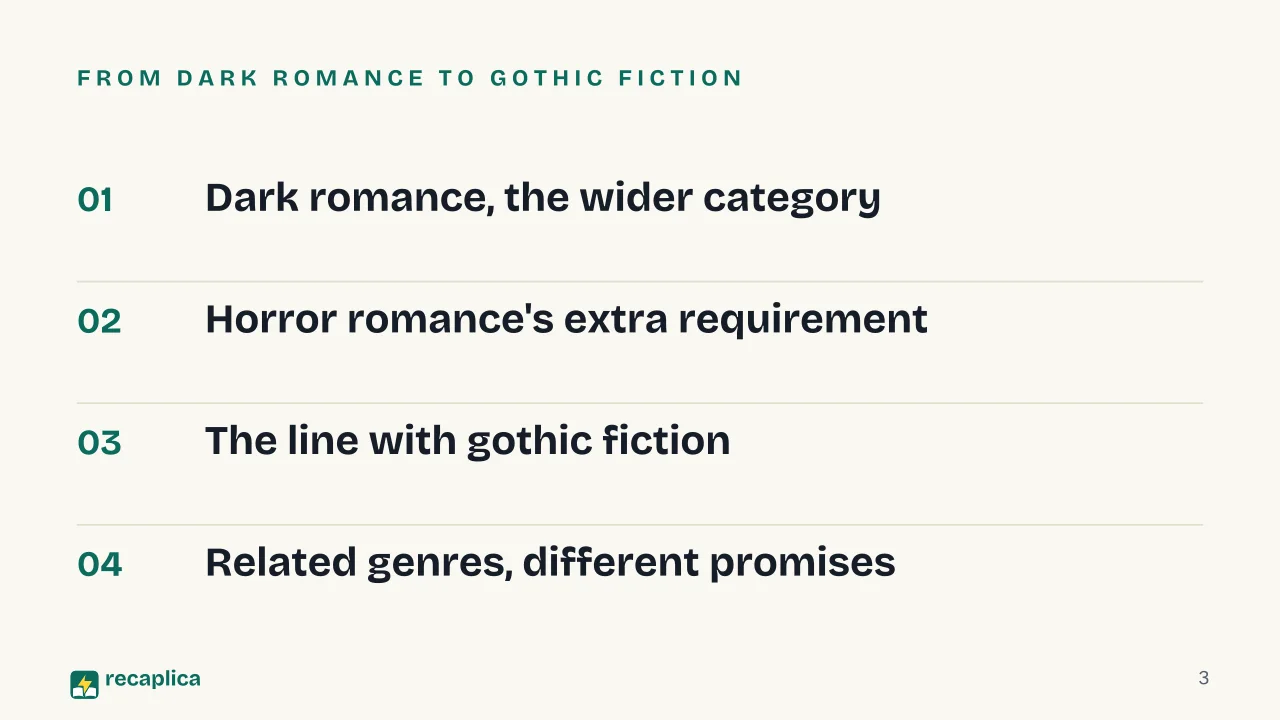
    Slide 1 of the presentation on Horror Romance: Horror RomanceSlide 2 of the presentation on Horror Romance: What turns a dark romance into a horror romance?Slide 3 of the presentation on Horror Romance: From dark romance to gothic fictionSlide 4 of the presentation on Horror Romance: Chapter 01: Dark romance, the wider categorySlide 5 of the presentation on Horror Romance: What the plot actually needsSlide 6 of the presentation on Horror Romance: Obsession, dependency, power: Obsession, Emotional dependency, Power balanceSlide 7 of the presentation on Horror Romance: Chapter 02: Horror romance's extra requirementSlide 8 of the presentation on Horror Romance: Dark romance can let readers enjoy dark fantasies without ever scaring them; horror romance asks for actual fear.Slide 9 of the presentation on Horror Romance: What readers actually getSlide 10 of the presentation on Horror Romance: Chapter 03: The line with gothic fictionSlide 11 of the presentation on Horror Romance: From 1764 to 1847Slide 12 of the presentation on Horror Romance: Chapter 04: Related genres, different promisesSlide 13 of the presentation on Horror Romance: Monsters and spirits, without fright: Monster romance, Paranormal romance, Traditional romanceSlide 14 of the presentation on Horror Romance: Which work is credited with the first gothic fiction label?Slide 15 of the presentation on Horror Romance: Time for a quick review
    Flash10 slidesThe essential thread, to present in classFull15 slidesEvery chapter and the deeper detail

    Common myths

    • ✗ Myth Many readers assume horror romance and dark romance are just two names for the same shelf.

      ✓ Reality In reality, dark romance only requires moral ambiguity or a power imbalance between the leads; horror romance adds a further, specific condition, real fear felt by the reader, which plenty of dark romance titles never attempt.

    • ✗ Myth Some readers expect every horror romance to feel like a traditional horror novel with a love subplot bolted on.

      ✓ Reality In reality, the romance in horror romance carries equal weight to the fear: the genre builds both threads together from the start, each one shaping the other.

    • ✗ Myth It is common to treat monster romance and paranormal romance as simple variants of horror romance.

      ✓ Reality In reality, many of these stories stay free of genuine fright, because the focus lands squarely on the relationship with the unknown, even when the characters face serious risk.

    Mind map

    Drag the background to move around and the nodes to reposition them; use − and + to collapse and expand branches.
    Customize
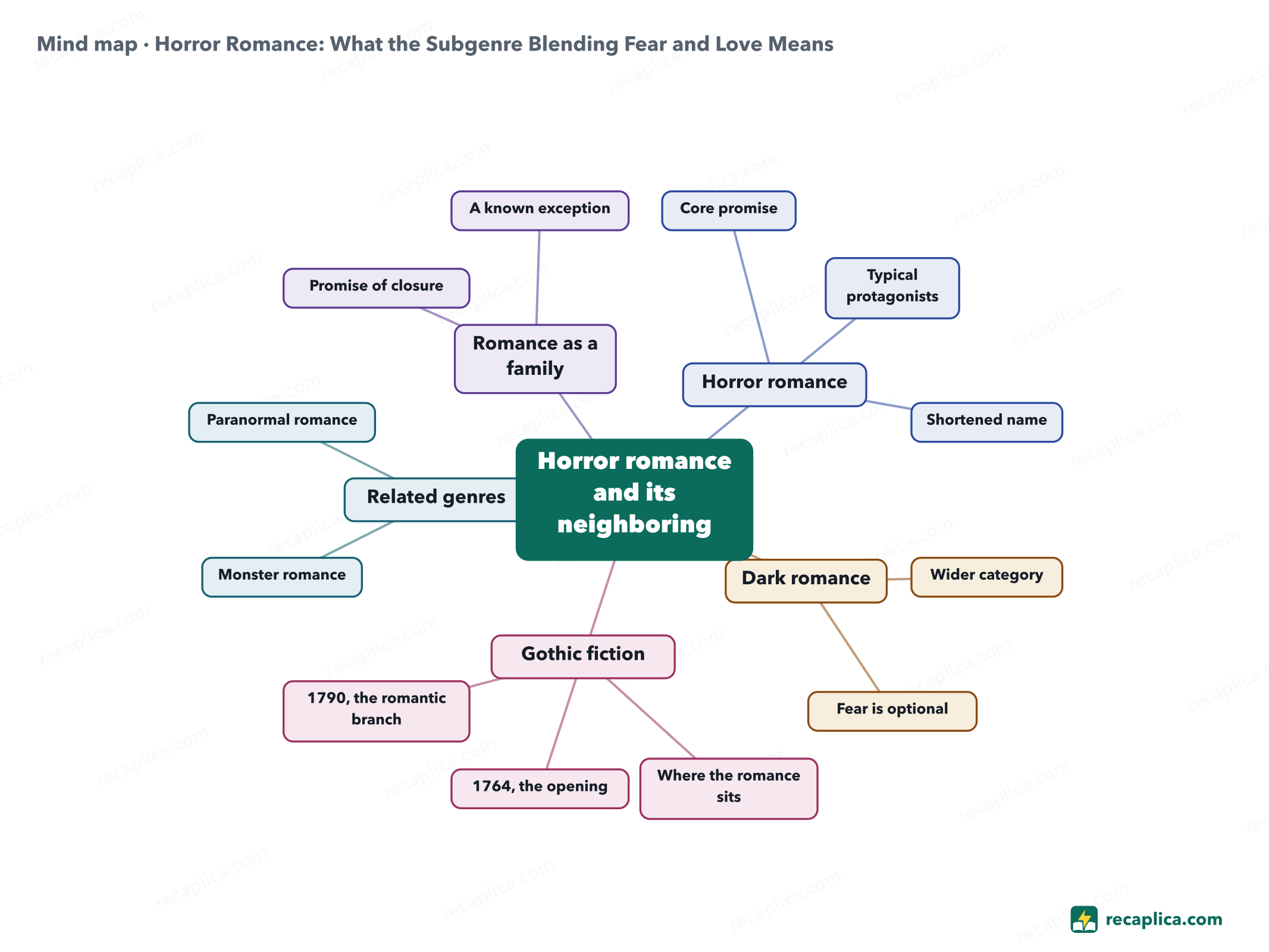
    Mind map: Horror Romance: What the Subgenre Blending Fear and Love Means
    • Horror romance and its neighboring genres
      • Horror romance
        • Core promise Readers feel real danger alongside the romantic plot
        • Typical protagonists Often antiheroes, criminals, or unstable characters
        • Shortened name Horromance, used across English-language publishing
      • Dark romance
        • Wider category Power imbalance, moral ambiguity, and taboo desire drive the plot
        • Fear is optional Many dark romance books never aim to scare the reader
      • Gothic fiction
        • Where the romance sits Secondary to a broader atmosphere of mystery and threat
        • 1764, the opening Horace Walpole's The Castle of Otranto sets the genre
        • 1790, the romantic branch Ann Radcliffe's A Sicilian Romance opens gothic romance
      • Related genres
        • Monster romance Love stories with monstrous creatures, rarely built to frighten
        • Paranormal romance High stakes for characters, rarely real fear for the reader
      • Romance as a family
        • Promise of closure An ending that resolves the central couple's story
        • A known exception Pure horror makes no such promise to the reader

    Quiz: test yourself

    Answer the questions to check what you have learned: you get instant feedback and a short explanation.

    Grade 0/10 0/5
    1 What sets horror romance apart from dark romance in general?

    Dark romance only needs moral ambiguity or a power imbalance; horror romance adds the specific demand that fear itself feels real to the reader.

    2 Where does the love story typically sit in gothic fiction?

    When romance appears in gothic fiction, it stays secondary to the atmosphere of dread, unlike horror romance, where fear and relationship carry equal weight.

    3 True or false: in horror romance, readers need to sense a real, life-threatening risk, not just an unsettling mood.

    That emphasis on fear, experienced alongside the romantic plot, is exactly what qualifies a book as horror romance, or horromance.

    4 What often happens in monster romance and paranormal romance, according to Book Riot's survey of the genre?

    Many of these stories put characters in risky situations without aiming to make the reader actually afraid.

    5 Which work is credited with the first gothic fiction label?

    Published in 1764, Horace Walpole's The Castle of Otranto opened the genre and set its recurring tropes.

    Answers: 1-A · 2-A · 3-A · 4-A · 5-B

    Flashcards

    Tap the card to flip it and check whether you remember the answer, then move to the next one.

    1 / 8

    Explain it in your own words

    The ultimate test: if you can explain it in simple words, you've truly understood it. Write your explanation, then compare it with the Recap.

    Your explanation is saved only on this device.

    Horror romance puts a couple at the center of a story where the danger feels real, page after page, for the reader as much as for the characters. It belongs to the wider dark romance territory, built on power imbalances, morally murky choices and taboo desire, but it layers on a requirement of its own: genuine fear that readers experience as the romance unfolds. Gothic fiction keeps the love story in the background of a larger mystery, while in horror romance the relationship and the fear travel together, neither one subordinate to the other. The term is often shortened to horromance in English-language publishing.

    Frequently asked questions

    What is horror romance, exactly?

    Horror romance pairs a romantic plot with real, felt fear: readers sense genuine danger for the characters as the story unfolds.

    Is horror romance the same as dark romance?

    No: horror romance sits inside dark romance but adds one specific condition, that the fear itself feels real to the reader as the story moves forward.

    What's the difference between horror romance and gothic fiction?

    In gothic fiction the love story stays secondary to a wider mystery; horror romance gives fear and romance equal billing instead.

    Do monster romance and paranormal romance count as horror romance?

    Usually not: both can place characters in high-risk situations without making the reader feel real fear, which is the trait that defines horror romance specifically.

    Sources

    • Wikipedia, "Dark romance"
    • Wikipedia, "Gothic fiction"
    • Book Riot, "What is Horromance?"

    Every Recap goes through an independent review before publication.

    Every evening, the day's new Recaps on our Telegram channel. Join the channel →

    Keep learning

    • Literature Best Dark Romance Books: A List for Every Subgenre A selection of dark romance books sorted by subgenre, for readers who already know what the genre is and just want a place to start. Dark mafia romance books cover forced marriages and warring crime families, as in Ruthless People and Killing Sarai. Dark fantasy romance books and paranormal romance move the same pull between desire and threat into worlds with gods, vampires and power struggles. Dark academia romance sets it among visions and fairy tales, while spicy dark romance books and stalker romance push the premise to the edge of real obsession. Read the Recap →
    • Literature Best Stephen King Books: 10 Novels and the Case for Each One Stephen King has written novels across several genres, from Carrie in 1974 to The Institute in 2019, and Wikipedia credits his books with more than 400 million copies sold overall. This list lines up ten titles that come up often in recommendations, with a reason for each pick, from horror staples like It and The Shining to novels that step outside the genre, such as 11/22/63 and The Green Mile. Every book comes with its publication year, its publisher and, where one exists, the award it won or was nominated for. There's no single agreed ranking: Hans-Åke Lilja, interviewed by Five Books as someone who has followed King's career for over 40 years, leaves well-known titles such as Carrie and The Shining out of his own personal picks. Read the Recap →
    • Literature Horror Story Ideas: Everyday Details, Old Fears and a Twist That Lands Writing a horror story often starts with a blank page more uncomfortable than the story itself. This Recap collects starting situations, recurring fears and ways to build a twist, with concrete examples to work from. It doesn't cover the techniques that build tension on the page — those live in the parent Recap on how to write a horror story. The sturdiest ideas tend to start with an everyday detail that stops behaving the way it should, or an old fear dressed in a setting readers recognize. Read the Recap →

    recaplica

    Clear in 30 seconds, yours in 10 minutes.

    Recaps Mind maps Request a Recap Telegram channel Mind map maker Our method About Privacy & cookies Legal notes & terms of use

    © 2026 Recaplica · A project by Curi S.r.l. — VAT IT05472000750

    Statistics, only if you say so

    To learn which Recaps help most we would use Google Analytics, with aggregate, anonymous data. It starts only with your OK, and you can change your mind anytime. Privacy policy