|
recaplica
Schopenhauer: who he was and what he argued, from will to pessimism | |||||||||||||||
| © 2026 Recaplica · recaplica.com — All rights reserved | |||||||||||||||
Schopenhauer: who he was and what he argued, from will to pessimismWhat to print Page numbers appear when printing with default margins. SlidesChoose a cut Flash10 slidesThe essential thread, to present in classFull14 slidesEvery chapter and the deeper detailBoth come with speaker notes. In 30 seconds quick readArthur Schopenhauer, born in 1788 and died in 1860, is the German philosopher who put will at the centre of the world, using that word in an unusual sense: a force with no awareness and no goal, at work everywhere in nature. In his main book, The World as Will and Representation, the world has two sides. As representation it is the world of appearances, things as they show up for us; as will it is what Schopenhauer identifies with Kant's thing in itself. His pessimism follows from that description, because a striving that heads nowhere leaves existence in constant conflict and dissatisfaction. To quiet the urge he points to the contemplation of art, to compassion and to asceticism. Key Points
Deep DiveWho Arthur Schopenhauer wasArthur Schopenhauer was born on 22 February 1788 in Danzig, now Gdańsk in Poland, the son of a wealthy merchant; his mother later made a name for herself as a popular novelist. He studied at the universities of Göttingen and Berlin and tried to build a university teaching career in Berlin, without success. In 1833 he settled in Frankfurt am Main, the city where he died on 21 September 1860, in his own apartment. His best-known book, The World as Will and Representation, was already finished in March 1818. A reluctant publisher brought it out that December, dated 1819, and it found no readers. The second edition arrived in 1844. Fame, when it came, didn’t come from this systematic work but from Parerga and Paralipomena, the collection of essays and aphorisms he published in 1851. Another text, The Art of Being Right, written around 1830, stayed among his papers and appeared only after his death, in 1864. Plato’s theory of Ideas comes back at the centre of his aesthetics, so the ancient debate is worth having in mind: the Recap on Aristotle and Plato sets the two Greek masters side by side. The world as will and representationThe starting point is a distinction Schopenhauer inherits from Kant: the world we know is the world of phenomena, things as they appear to us, and underneath it lies the thing in itself, which Schopenhauer identifies with the will. He accepts the distinction and puts a name to the other half. Whatever can be said about the interior of things, he answers, comes down to will. The world, he writes, is will and representation at the same time. The word deserves a warning, because in everyday English it pulls in the wrong direction. Schopenhauer’s will is not a subject deciding to do something. It is the force underlying every representation and the world as a whole, blind and unaware, at work throughout nature: a principle of striving with neither consciousness nor goal.
Human beings, in this picture, are first of all expressions of the will to live; will is also the underlying essence of human character. Why Schopenhauer is called a pessimistCalling Schopenhauer a pessimist is the most common way of introducing him, and the pessimism comes from the description just given rather than from a sour temperament. If the ground of the world is a blind striving with no destination, then the world as a whole is left without plan or purpose, it is not put together rationally, and existence turns out to be marked by conflict, struggle and dissatisfaction. Everyday life is suffering by its very definition, and the world of everyday life is essentially violent and frustrating. The world’s single will tears itself apart endlessly through the multitude of individuals, and what you see, looking at existence, is a permanent war of all against all. He goes as far as arguing that anyone who truly grasped the nature of their own existence would judge it preferable never to have existed. The ways outIf the will is the problem, the answer is to quiet it, and Schopenhauer names three attitudes that manage it. Art. Its highest aim, for him, is to communicate the Platonic Ideas (the theory of Ideas has its own Recap on Plato). In aesthetic contemplation a person stops registering themselves as a separate individual, absorbed in the object in front of them; the experience is precious because it offers a respite from the cycle of craving and suffering. Genius, in his account, is a person given by nature a surplus of intellect over will.
Compassion. In compassion, according to Schopenhauer, every person feels all the suffering of the world as their own, and that is exactly why it is the basis of morality. His moral maxim comes down to two plain imperatives: injure nobody, and give others whatever help you can. To moral consciousness he assigns the job of quieting the will, so the support of morality here is feeling someone else’s suffering rather than a form of reason. Asceticism. This is the most radical attitude: renunciation, resignation, willlessness. Schopenhauer calls this the denial of the will to live, and salvation, for him, sits in that resignation. Ancient philosophy came at the question of how to live from its own angles, and two Recaps cover them: Hellenistic philosophy and Neoplatonism. What is left, after SchopenhauerOf the thinkers Schopenhauer influenced, the one named most often is Friedrich Nietzsche, who subordinated science to art; the influence of Schopenhauer’s denial of the will on him was especially marked. There is also a more precise point: the Stanford Encyclopedia notes that his account of intelligible character resonates with Nietzsche’s injunction to “become what one is”. Slide deckSlides ready to download and make your own in PowerPoint or Google Slides, with speaker notes. Pick the Flash cut or the Full one.     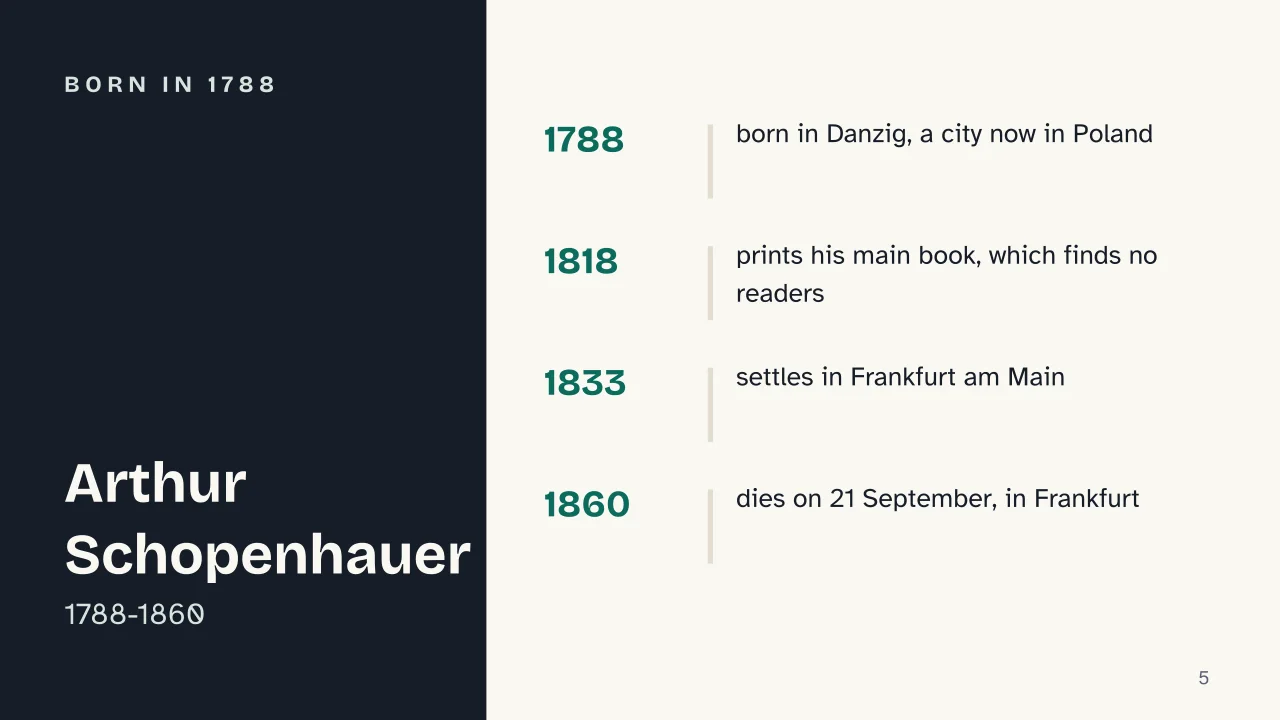  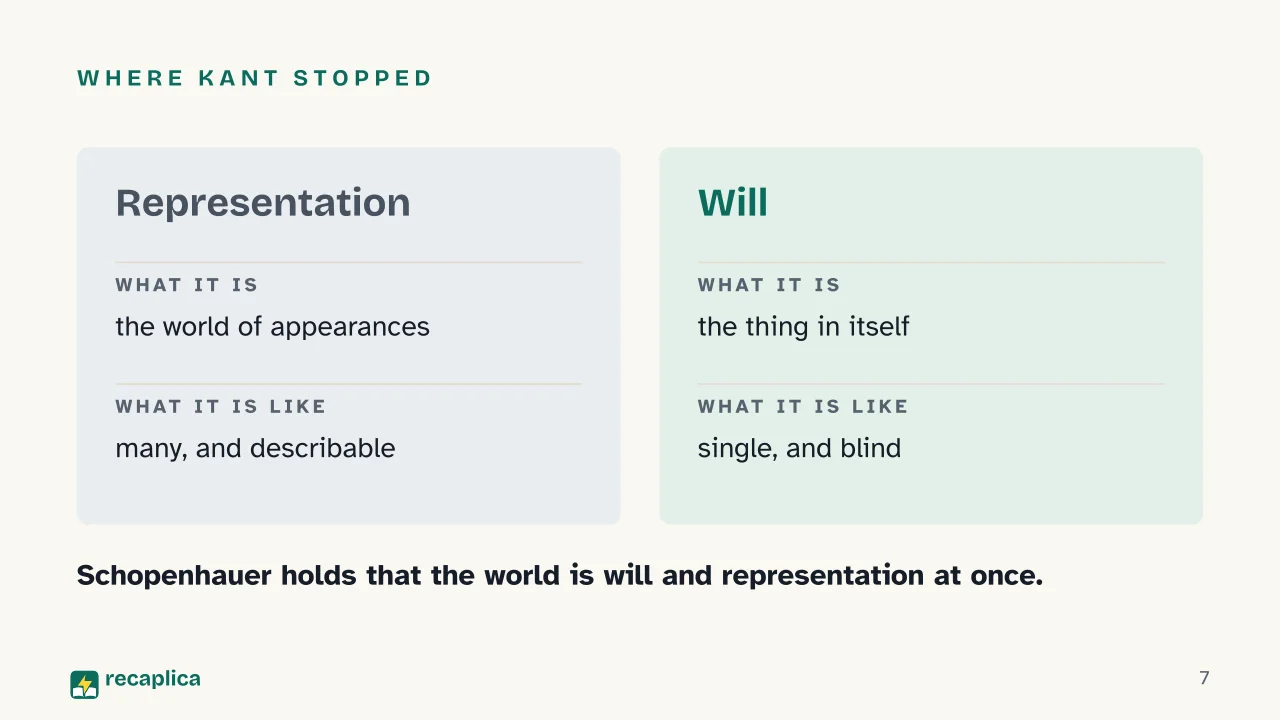 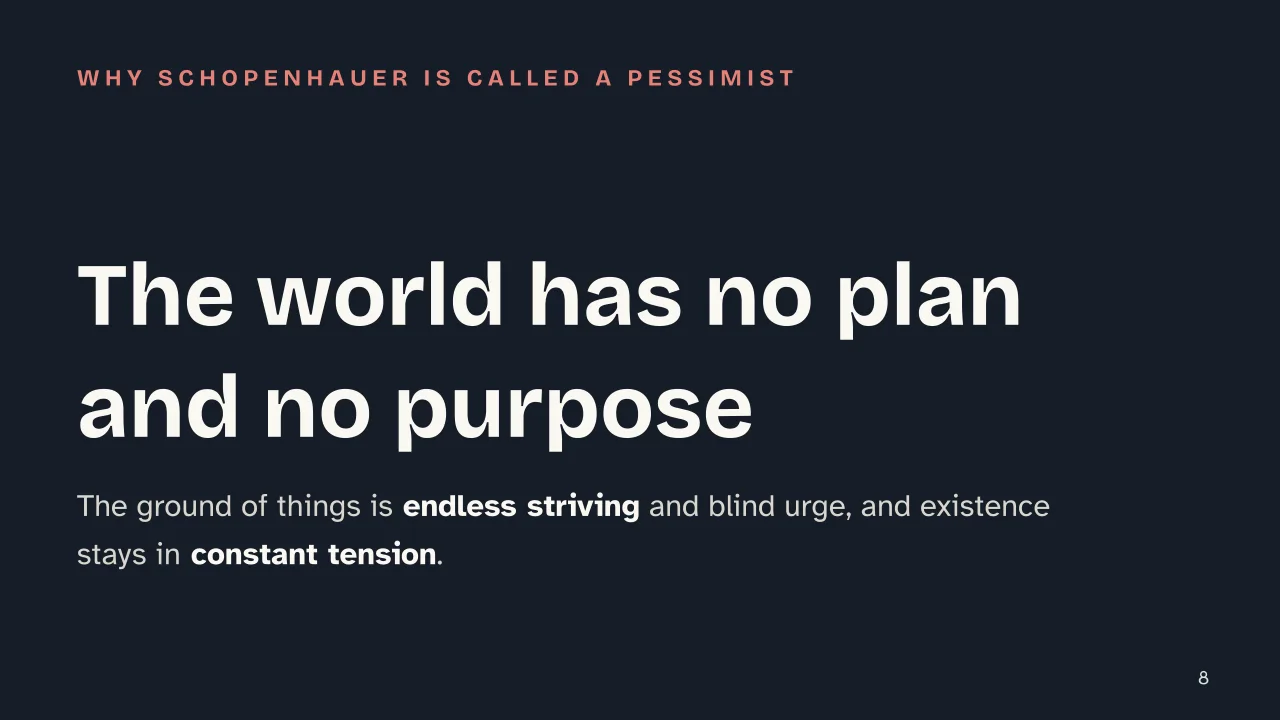  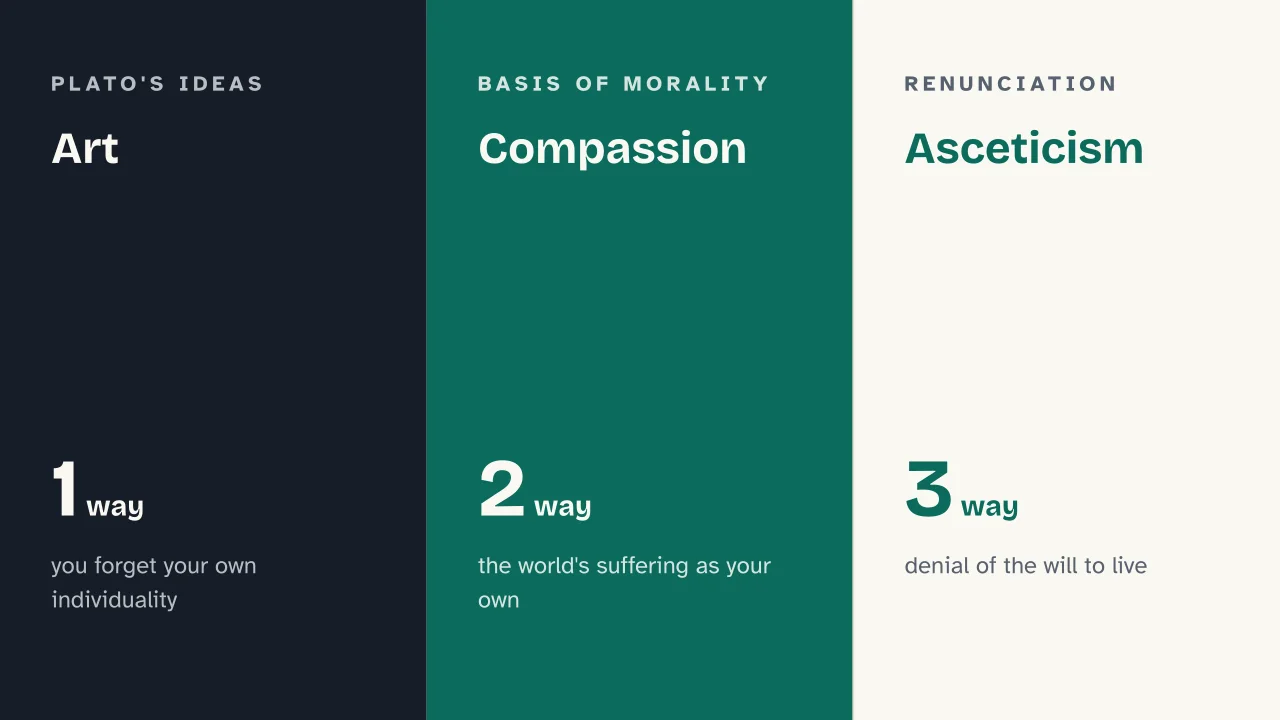  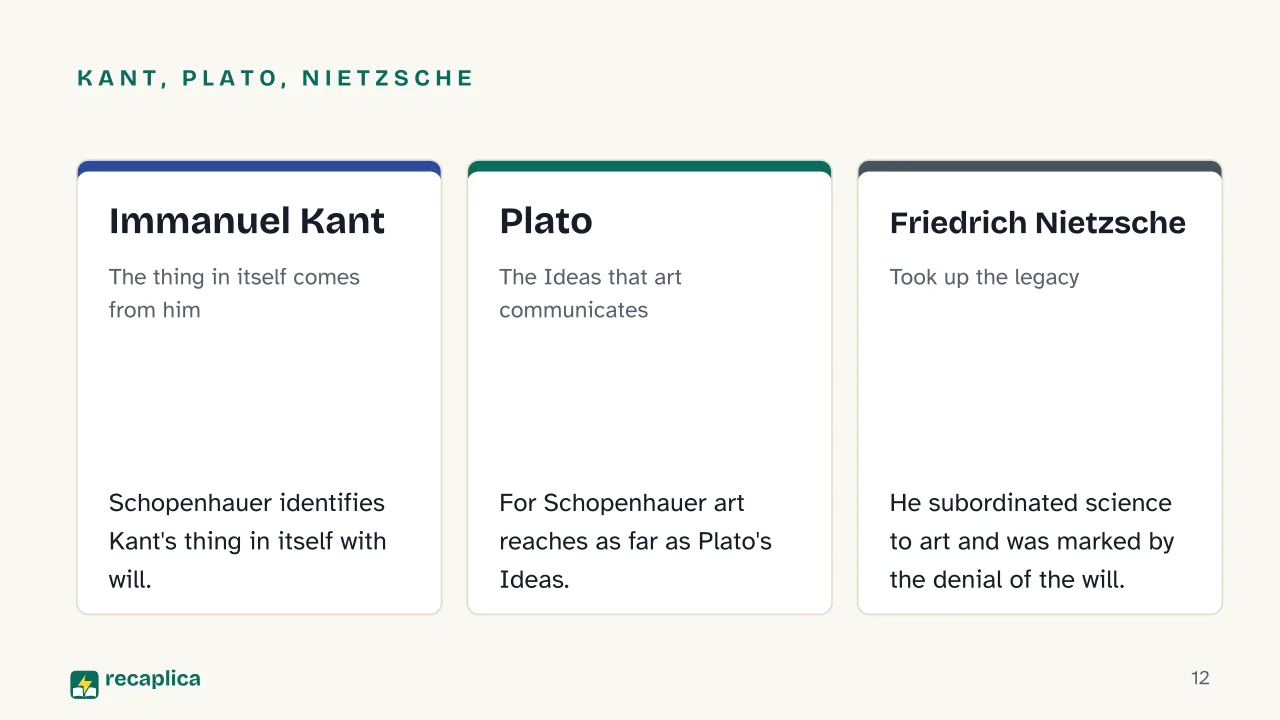 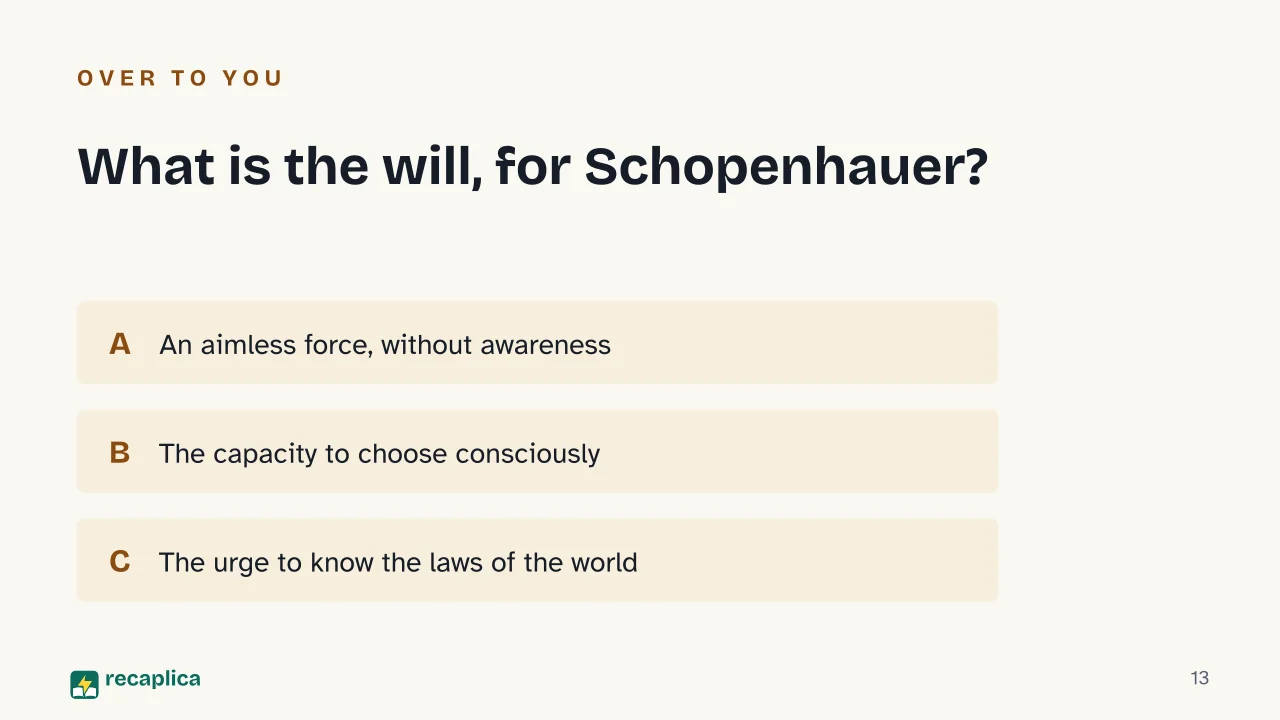  Common myths
Mind mapDrag the background to move around and the nodes to reposition them; use − and + to collapse and expand branches. 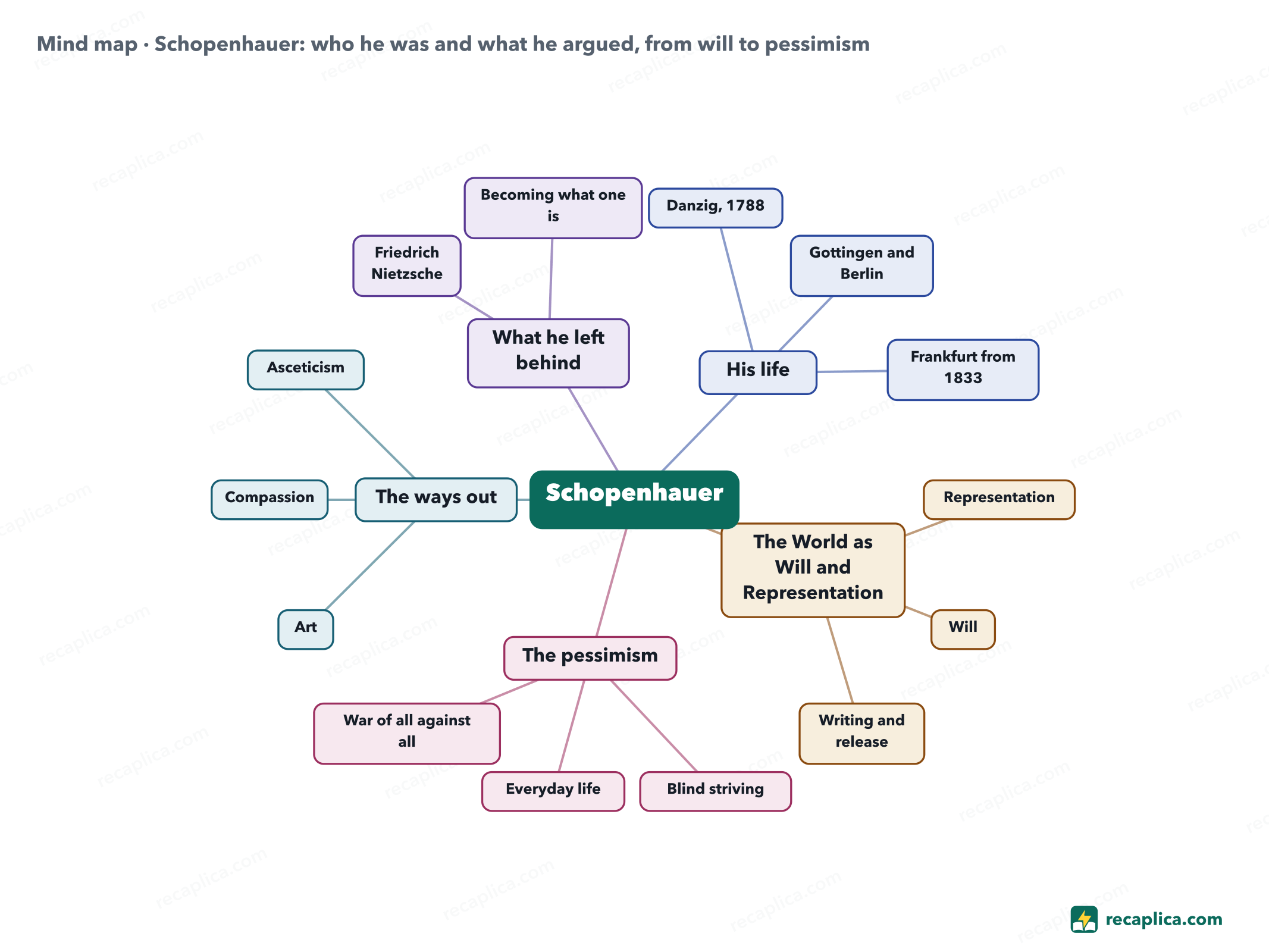
Quiz: test yourselfAnswer the questions to check what you have learned: you get instant feedback and a short explanation. Grade 0/10 0/5
FlashcardsTap the card to flip it and check whether you remember the answer, then move to the next one. 1 / 7 Explain it in your own wordsThe ultimate test: if you can explain it in simple words, you've truly understood it. Write your explanation, then compare it with the Recap. Your explanation is saved only on this device.
Frequently asked questionsWhat does the title "The World as Will and Representation" mean?It means that the world, for Schopenhauer, is two things together. As representation it is the sum of appearances, the world Kant had described. As will it is the thing in itself, what things are on the inside, one and undivided, which he describes as endless striving and blind urge. Why is Schopenhauer considered a pessimistic philosopher?Because the pessimism follows from his description of the world. If the ground of things is a striving that heads in no direction, then existence stays in constant tension and dissatisfaction, and everyday life, he writes, amounts to suffering. Someone who saw their own existence for what it is, he argues, would judge it preferable never to have existed. What ways out does Schopenhauer offer?Three. Aesthetic contemplation, where you forget yourself in what you are looking at and craving stops tormenting you for a moment. Compassion, which makes all the suffering of the world feel like your own and which he puts at the basis of morality. Asceticism, that is, renunciation and resignation, in which he sees the denial of the will to live. How is Schopenhauer related to Kant?He starts from Kant's distinction between appearances and the thing in itself, and identifies the latter with will. What he calls the world as representation is exactly the realm of appearances Kant had mapped, so the question Schopenhauer takes on is what lies underneath it. Did Schopenhauer influence Nietzsche?Yes, and Nietzsche is the most prominent of those who took up his legacy. Nietzsche subordinated science to art, and Schopenhauer's idea of denying the will marked him especially strongly. There is also a more technical point, intelligible character, which has been read alongside Nietzsche's injunction to become what one is. Every Recap goes through an independent review before publication. |