|
recaplica
Hellenistic Philosophy: What Is It and What Are Its Schools | ||||||||||||
| © 2026 Recaplica · recaplica.com — All rights reserved | ||||||||||||
Hellenistic Philosophy: What Is It and What Are Its SchoolsWhat to print Page numbers appear when printing with default margins. SlidesChoose a cut Flash10 slidesThe essential thread, to present in classFull15 slidesEvery chapter and the deeper detailBoth come with speaker notes. In 30 seconds quick readHellenistic philosophy is the philosophical thought that developed in the Greek world between the death of Aristotle, in 322 BCE, and the death of Cleopatra, in 30 BCE. Over these three centuries philosophical reflection moves from Athens to the whole Mediterranean, and the schools of Stoicism, Epicureanism and Skepticism take shape. The Stoics pursue virtue by living in agreement with nature, the Epicureans pursue happiness as freedom from pain and disturbance, and the Skeptics pursue suspension of judgment in the face of every claim. These are different answers to the same question: how to live well in a world that is no longer the one of the small Greek city-states of the classical age. Key Points
Deep DiveWhat is Hellenistic philosophyAccording to Treccani, the Hellenistic age of philosophy conventionally runs from 322 BCE, the year of Aristotle’s death (one year after Alexander the Great’s), to 30 BCE, the year of Cleopatra’s death. It is not a geographic label in a strict sense: it is a period, three centuries long, in which the practice of philosophy changes along with the world around it. The context: from Athens to the MediterraneanIn the classical age Greek philosophy has an almost single center: Athens, with Plato’s Academy and Aristotle’s Lyceum. Treccani notes that, in the Hellenistic age, philosophical thought instead spreads across the whole Mediterranean, reaching areas far from Attica by the end of the 1st century BCE. A common reading among historians of philosophy links this shift to the crisis of the polis as a self-sufficient political form, following Alexander the Great’s conquests. The sources cited here do not state this connection explicitly, but the reading helps explain why ethical questions — how to live, what to pursue, what to fear — become so central in the new schools. The audience philosophy speaks to also changes. The two main schools of the period are Stoicism and Epicureanism, alongside smaller movements such as the Cynics and Cyrenaics; Pyrrhonian skepticism sits beside them. Readers coming from a path on the pre-Socratic philosophers or on Socrates will find a shared attention to practical life, but with one difference: these schools form and teach outside the institutions of Athens in the 5th and 4th centuries BCE, often addressing a wider audience than the one reached by Plato’s dialogues or Aristotle’s lectures. Stoicism: virtue and natureZeno of Citium, of Phoenician origin, founds the Stoa shortly before 300 BCE, teaching at the Painted Porch in Athens — the source of the school’s name. According to the Stanford Encyclopedia of Philosophy, the Stoics hold that the virtues (prudence, justice, courage, moderation) are the only true good, and their opposites the only true bad. The goal of life, for this school, is to live in agreement with nature: one’s own rational nature and that of the cosmos as a whole.
Epicureanism: happiness without disturbanceFor Epicurus, according to the Stanford Encyclopedia of Philosophy, the goal of human life is happiness, understood in a precise way: as aponia, freedom from physical pain, and as ataraxia, freedom from mental disturbance. Two further positions follow from this, and the school places them at the center of its teaching. Epicurus holds that death is nothing to us, because while we exist death is not present, and once death is present we no longer exist: fearing it, then, is a disturbance without an object. He also holds that the gods do not concern themselves with human affairs, since doing so would compromise their own blessedness — a way of removing another common source of anxiety, the religious one. Skepticism: the suspension of judgmentPyrrho of Elis, who lived roughly between 360 and 270 BCE, is the founder of the skepticism that bears his name; he left nothing in writing, and what we know of his thought comes down through students and later commentators, reports the Internet Encyclopedia of Philosophy. His position is a method more than a doctrine: refraining from forming opinions, remaining steadfast in saying of every single thing that it is no more this than that. A distinct branch, the Academic branch that grew within Plato’s Academy, develops in parallel during the same period, but the details of this second tradition fall outside the scope of this Recap. Pyrrhonian skepticism, after a less documented phase, was revived in the 1st century BCE by Aenesidemus and continued through Sextus Empiricus, who lived between the 2nd and 3rd centuries CE. The three schools compared
The three schools share the same question: what does it actually take to live well, once the certainty of belonging to a city-state that decides almost everything on the individual’s behalf is gone. Readers arriving at this topic from the Sophists will find an echo of that earlier season, when the question of whether virtue could be taught was already being debated: Hellenistic philosophy shifts the question from the polis to the individual person, and stays there for three centuries. Slide deckSlides ready to download and make your own in PowerPoint or Google Slides, with speaker notes. Pick the Flash cut or the Full one.     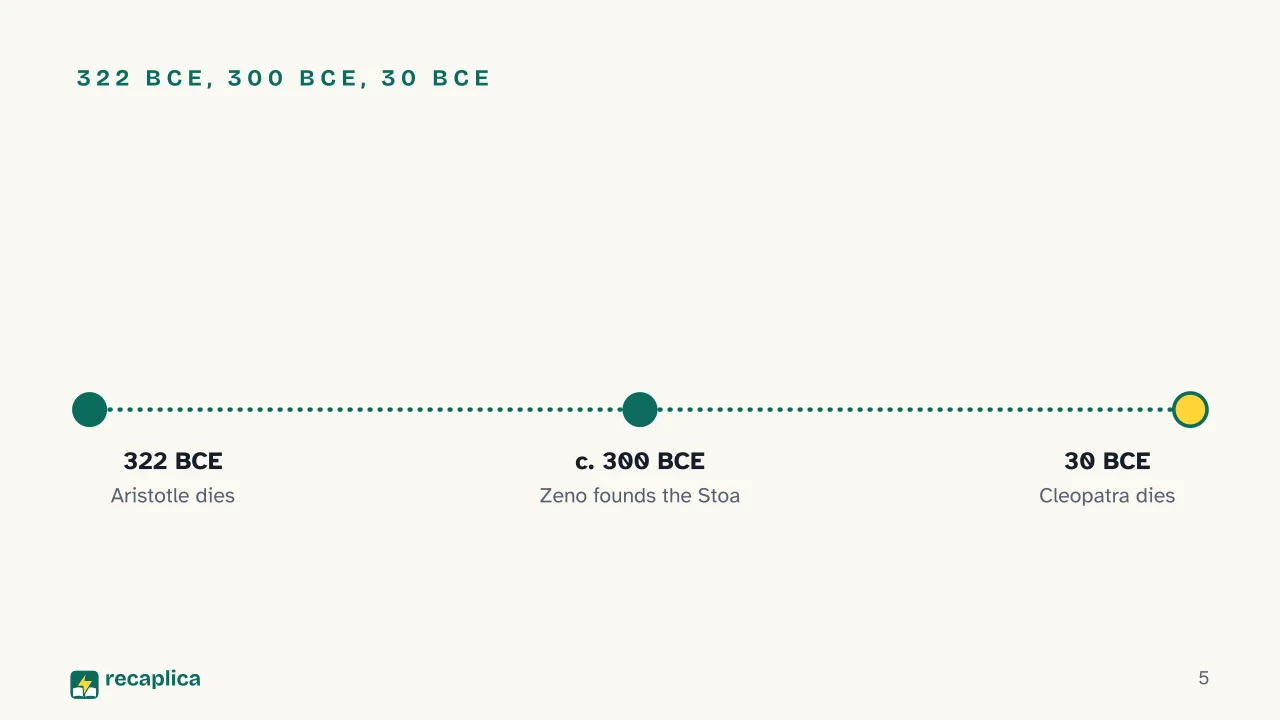  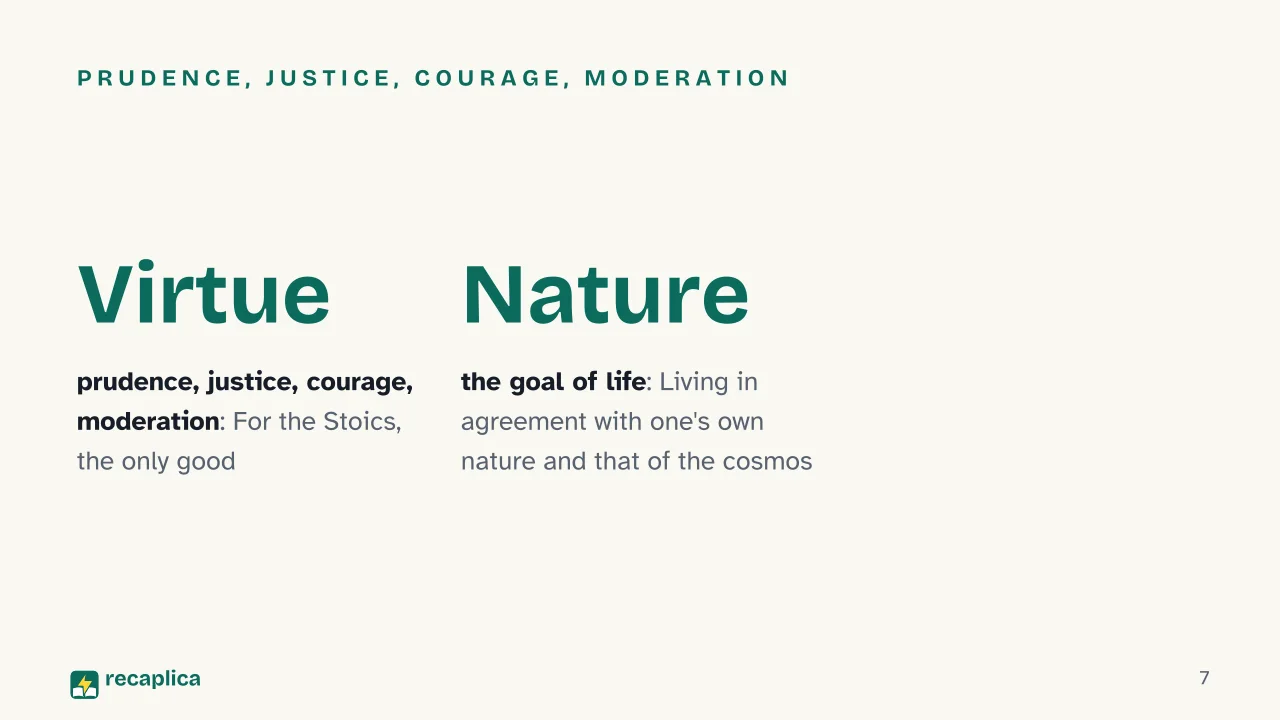  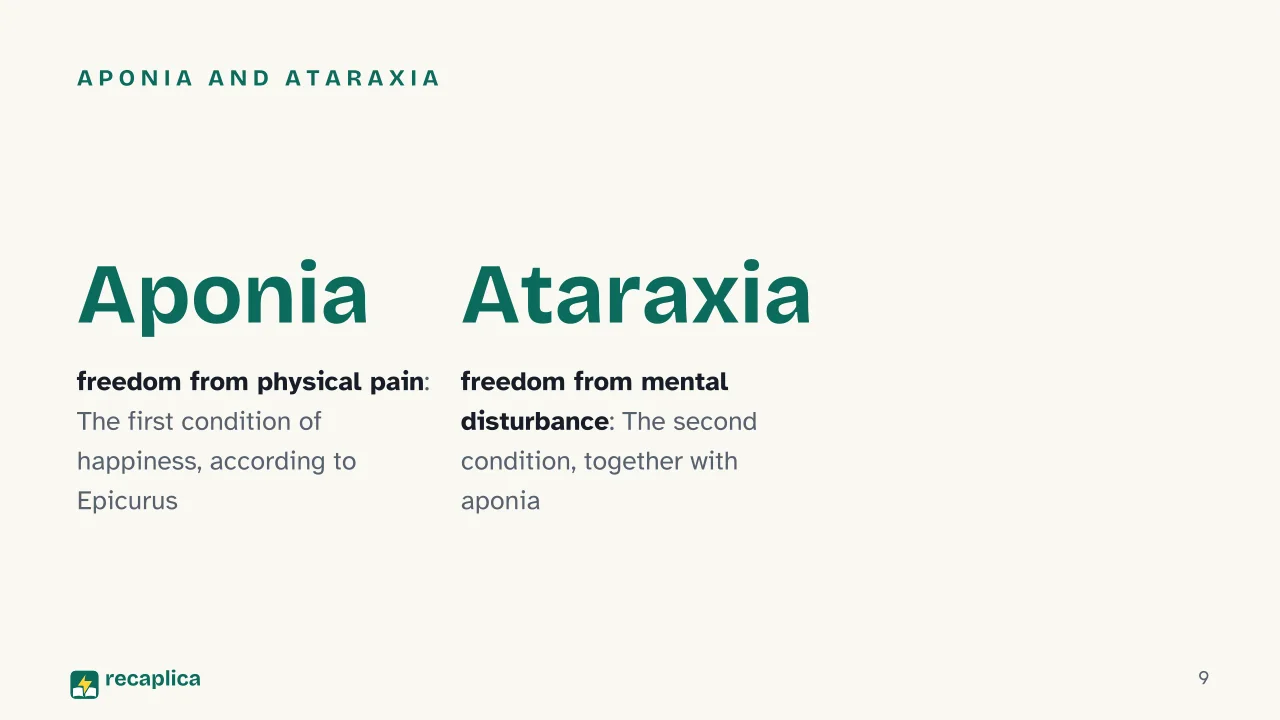    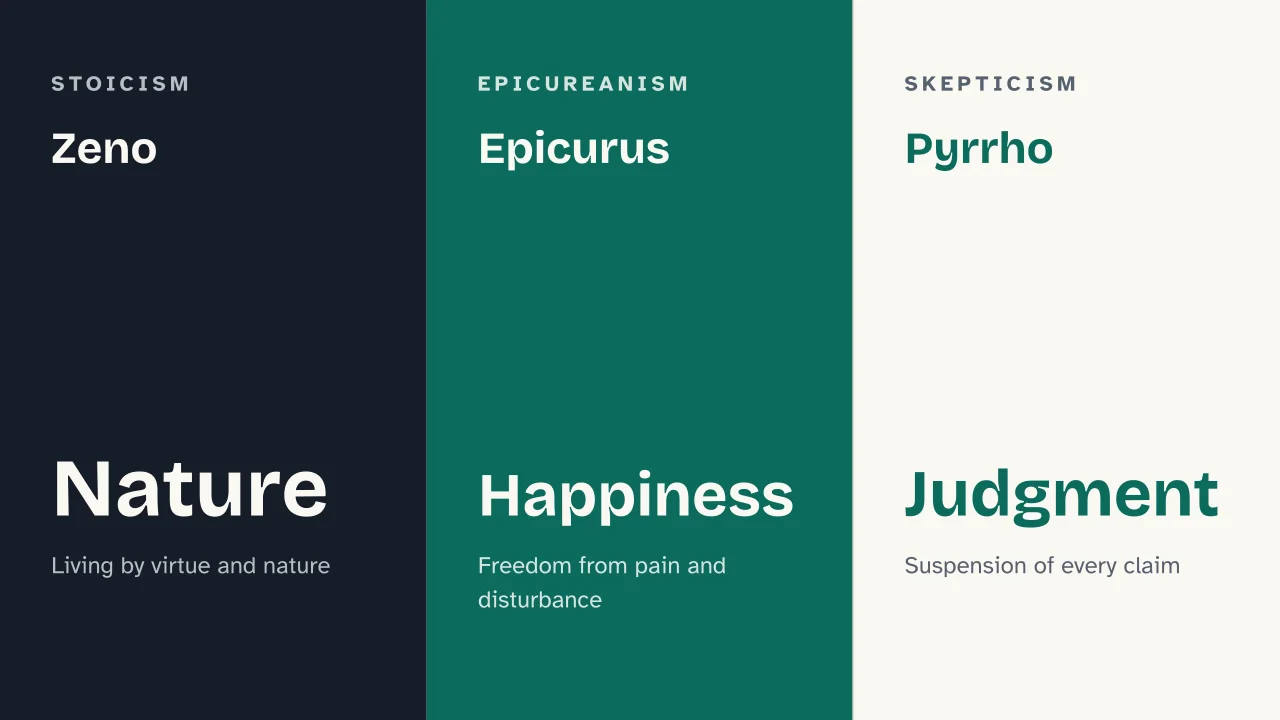   Common myths
Mind mapDrag the background to move around and the nodes to reposition them; use − and + to collapse and expand branches. 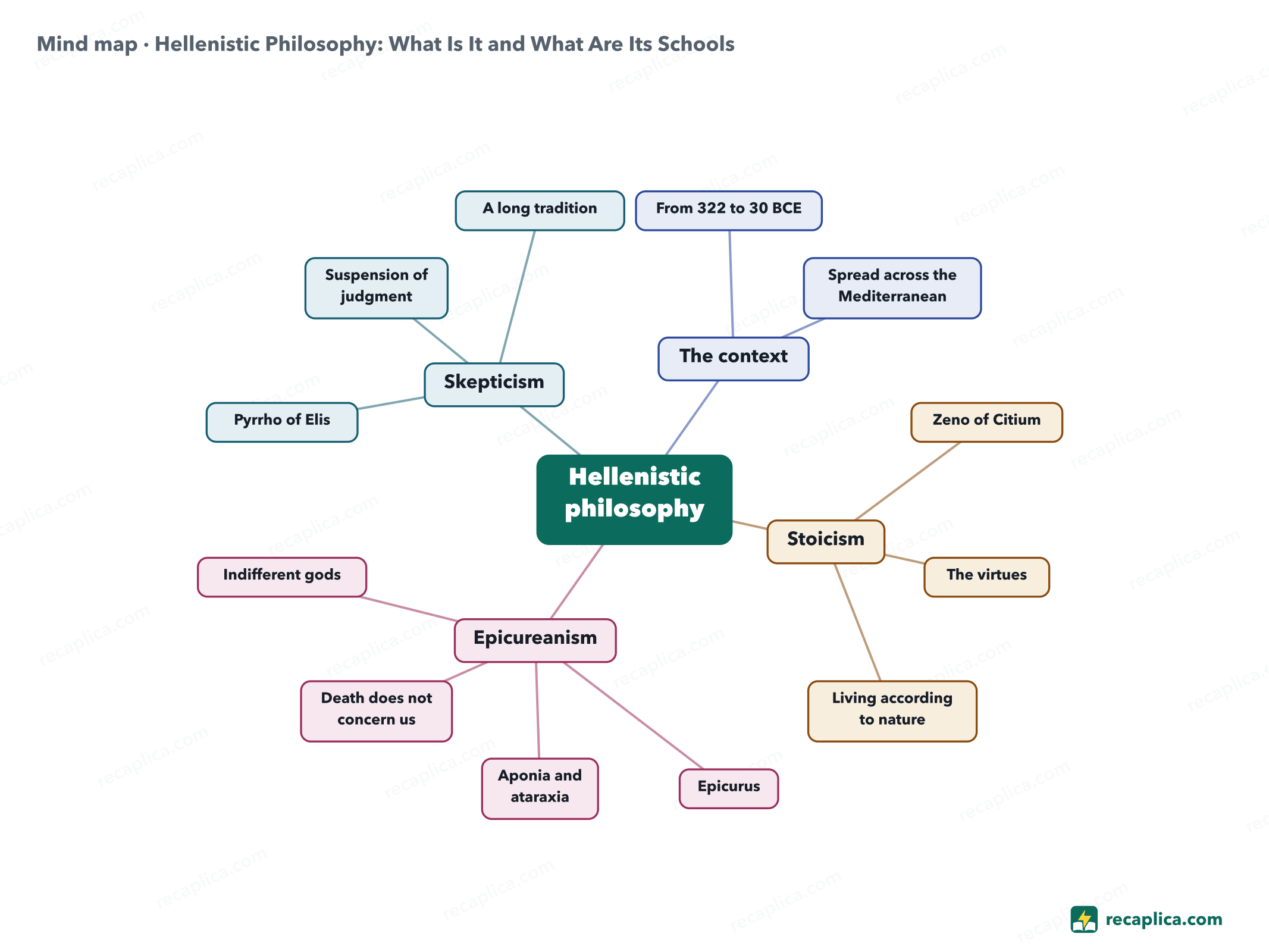
Quiz: test yourselfAnswer the questions to check what you have learned: you get instant feedback and a short explanation. Grade 0/10 0/5
FlashcardsTap the card to flip it and check whether you remember the answer, then move to the next one. 1 / 8 Explain it in your own wordsThe ultimate test: if you can explain it in simple words, you've truly understood it. Write your explanation, then compare it with the Recap. Your explanation is saved only on this device.
Frequently asked questionsWhat are the schools of Hellenistic philosophy?According to Treccani, the two main schools are Stoicism, founded by Zeno of Citium shortly before 300 BCE, and Epicureanism, founded by Epicurus; alongside them remain smaller movements such as the Cynics and Cyrenaics, as well as the skepticism started by Pyrrho of Elis. When does Hellenistic philosophy begin and end?Conventionally from 322 BCE, the year of Aristotle's death, to 30 BCE, the year of Cleopatra's death: Treccani marks it as a three-century span in which philosophical reflection leaves the boundaries of Athens and reaches the whole Mediterranean basin. What did the Stoics believe?According to the Stanford Encyclopedia of Philosophy, the Stoics treat virtue — prudence, justice, courage, moderation — as the only true good and its opposites as the only true bad; living well, for them, means staying in step with nature, both one's own and the cosmos as a whole. What did Epicurus mean by happiness?According to the Stanford Encyclopedia of Philosophy, Epicurus identifies happiness with aponia, the body free of pain, and ataraxia, the mind free of disturbance; he also held that death does not concern us and that the gods live indifferent to human affairs. What is Pyrrhonian skepticism?According to the Internet Encyclopedia of Philosophy, it is the school founded by Pyrrho of Elis, which calls for suspending judgment on everything; after him it was revived in the 1st century BCE by Aenesidemus and continued through Sextus Empiricus, who lived between the 2nd and 3rd centuries CE. Every Recap goes through an independent review before publication. |