Skip to content
recaplica

    One moment: security check

    Cloudflare wants to make sure you're not a robot. Tick the box below and your search will continue on its own.

    IT
    recaplica The Art of Being Right: Schopenhauer's 38 Stratagems
    © 2026 Recaplica · recaplica.com — All rights reserved
    Home › History

    The Art of Being Right: Schopenhauer's 38 Stratagems

    By Recaplica Newsroom · Updated on October 14, 2026

    What to print

    Page numbers appear when printing with default margins.

    Slides

    Choose a cut

    Flash10 slidesThe essential thread, to present in classFull16 slidesEvery chapter and the deeper detail

    Both come with speaker notes.

    Telegram channel
    recaplica Clear in 30 seconds, yours in 10 minutes.
    In 30 seconds Key points Figures Deep dive Slides Myths Mind map Quiz Flashcards FAQ

    In 30 seconds quick read

    The Art of Being Right is an unfinished treatise by Arthur Schopenhauer, found among his papers after his death and published for the first time in 1864. It lists 38 stratagems for winning an argument regardless of who is actually right: not a manual of logic, but a satirical catalogue of the rhetorical tricks people use to mislead an opponent or talk their way out of a corner. It also circulates under the title The Art of Always Being Right, and it should not be confused with the Chinese book of "36 Stratagems", a separate work that shares only the theme's name. Schopenhauer himself refused to have it printed: the purely competitive aim of disputation, detached from truth, disgusted him.

    Key Points

    • The manuscript, 46 pages, dates to around 1830 but stays unpublished for as long as Schopenhauer is alive.
    • It appears posthumously in 1864, edited by his pupil Julius Frauenstädt from the philosopher's papers.
    • It lists 38 dialectical stratagems, each paired with a countermove for defending against it.
    • The eristic dialectic it describes aims to win a dispute regardless of the merits, not to establish the truth.
    • It is a satirical work, not a conduct manual: the Stanford Encyclopedia of Philosophy calls it a satirical account of dialectic.
    • It should be kept separate from the Chinese book of "36 Stratagems", a different tradition and author.

    Key figures

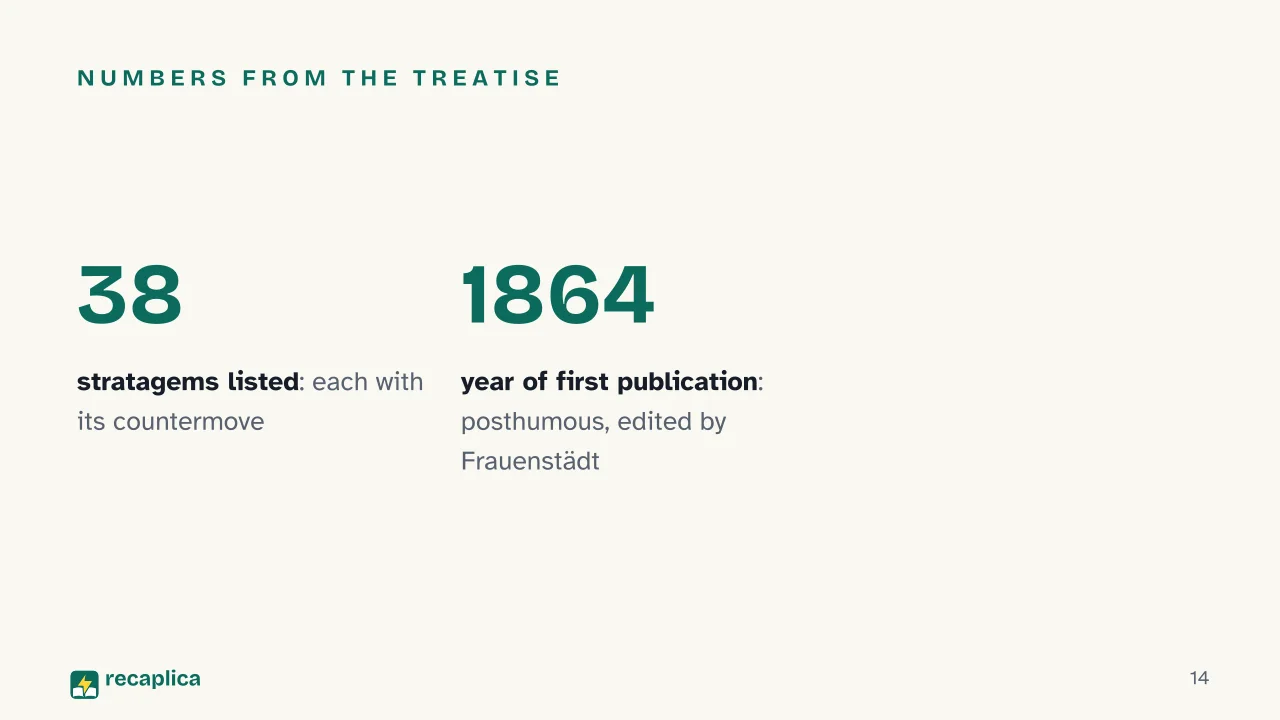
    • 38 the stratagems listed in the treatise, each with its countermove. Source: Wikipedia EN
    • 1864 the year of the first posthumous publication, four years after Schopenhauer's death. Source: Wikipedia DE

    Deep Dive

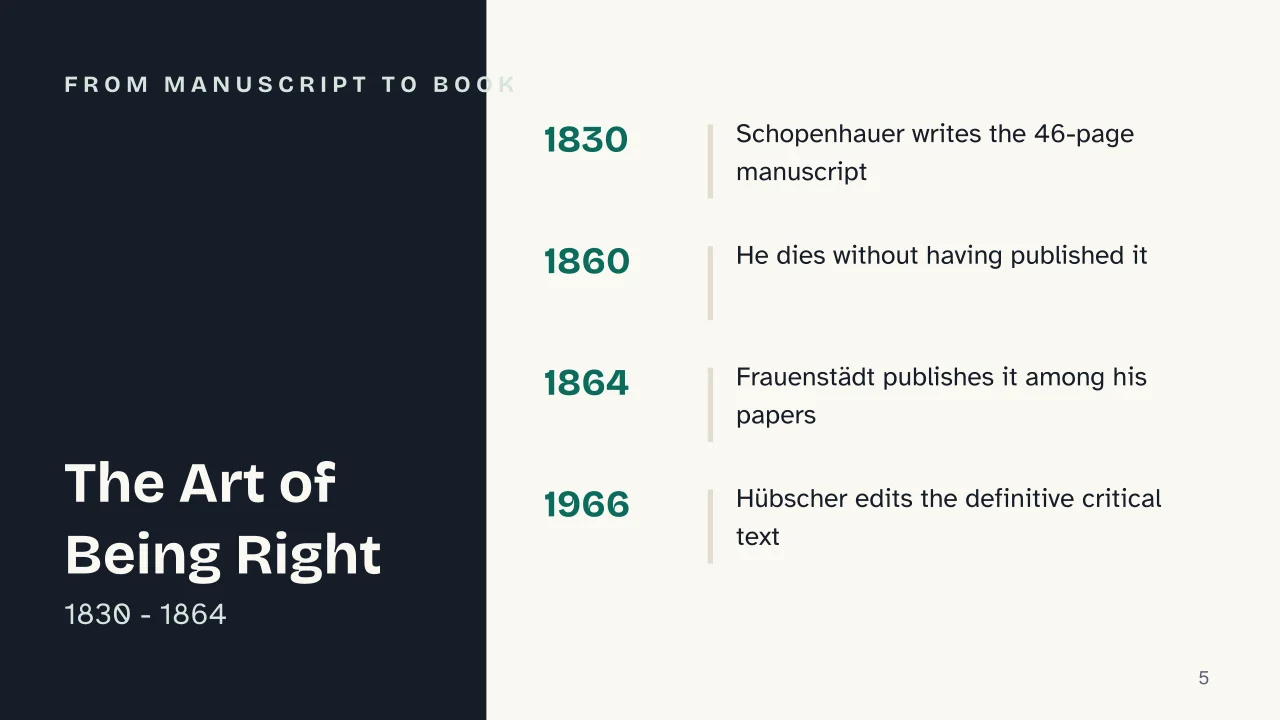
    Arthur Schopenhauer composed The Art of Being Right (Die Kunst, Recht zu behalten) around 1830, according to the German Wikipedia entry: a 46-page manuscript the author never published in his lifetime. The text also circulates in English as The Art of Always Being Right, a variant title for the same work. By its own nature it remains an unfinished treatise: a list of recorded techniques, not a book polished for the press. The material surfaced only after the philosopher’s death, in 1860, among the papers scholars call the “Manuscript Remains”. According to Wikipedia DE, it was his pupil and editor Julius Frauenstädt who published it for the first time in 1864, within the collection of manuscript papers Schopenhauer left behind. For over a century readers knew only that version; a philologically reliable critical edition arrived only after 1966, edited by Arthur Hübscher.

    Logic and dialectic: a distinction that gets lost

    Schopenhauer opens the treatise with an observation that anchors everything that follows: philosophers spent centuries on the rules of logic but left a darker art, the art of disputation, almost entirely unexplored. The English Wikipedia entry makes the point by calling the work an “acerbic, sarcastic” treatise — a tone worth keeping in mind through every page that follows.

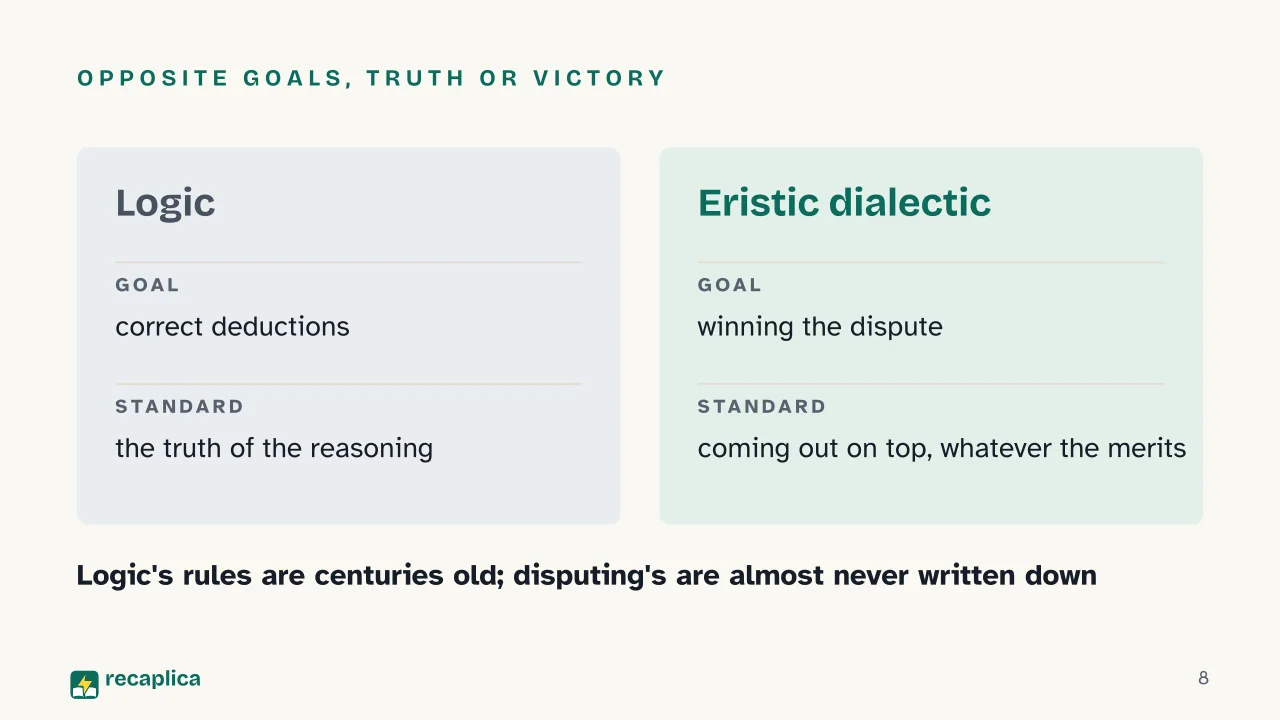
    According to Wikisource EN, in T. Bailey Saunders’s English translation, Schopenhauer defines controversial, or eristic, dialectic as the art of disputing so as to come out on top, regardless of whether one is right or wrong on the actual merits of the question. It’s the work’s central claim: logic concerns the correctness of reasoning, eristic dialectic concerns only the outcome of the dispute in the eyes of whoever is watching.

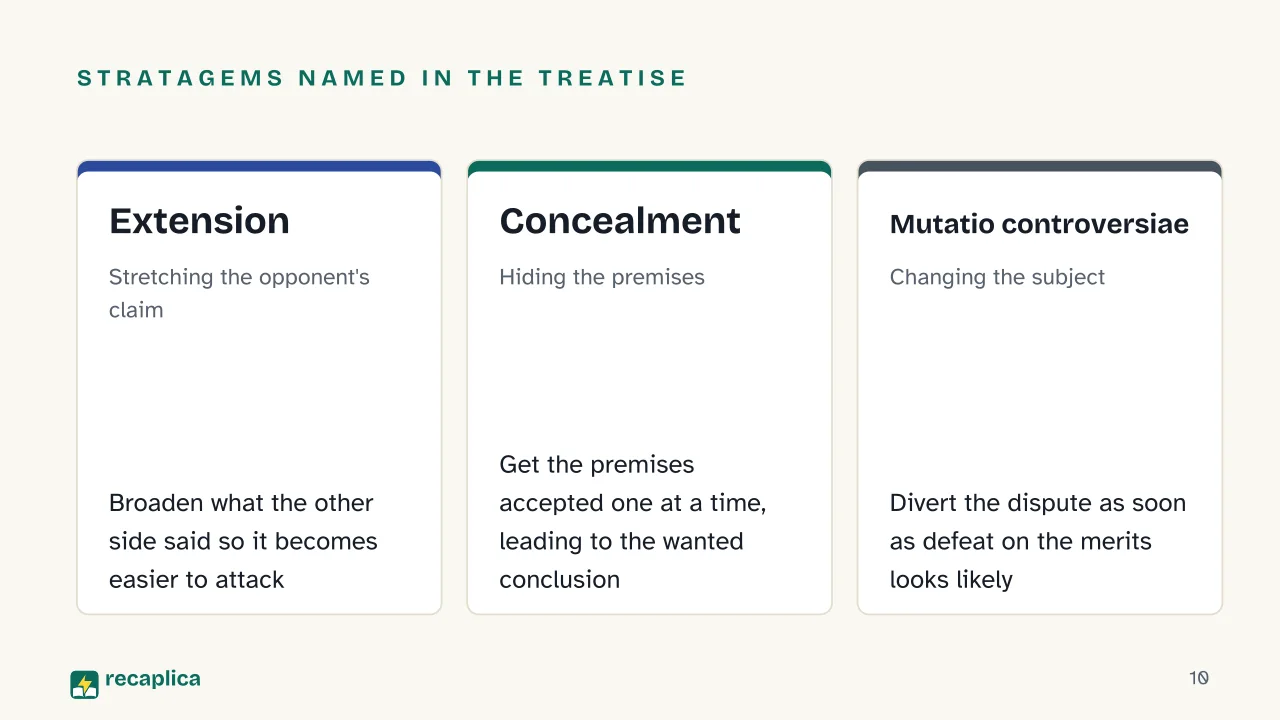
    Practical example: in a classroom debate over which energy source makes the most sense, one student argues that “solar power costs too much.” An opponent using Extension answers as if the student had said “every form of renewable energy costs too much,” a much broader claim and one far easier to knock down with a single counterexample. The original student, unless they catch it, ends up defending a position they never actually took.

    The German title, Die Kunst, Recht zu behalten, uses a verb meaning to “keep” or “retain” the right side of the argument. Whoever applies these stratagems is aiming only to still be standing when the discussion ends.

    The stratagems, one at a time (though not in order)

    Wikipedia EN confirms the number handed down: 38 stratagems, each paired with the countermove for recognizing and resisting it. Schopenhauer himself, in the manuscript, speaks of “about forty” techniques according to Wikipedia DE — a sign that the list stayed unfinished, and that the exact count depends on how one counts variants of the same move.

    StratagemHow it works
    ExtensionThe opponent’s claim is stretched to make it more general, and therefore easier to attack, while one’s own claim is kept as narrow as possible
    ConcealmentThe opponent is led to accept, one premise at a time and without noticing, the steps that lead to the wanted conclusion
    Schopenhauer’s Socratic methodThe premises are secured through pointed questions rather than direct statements
    Mutatio controversiaeThe subject of the dispute is changed as soon as defeat on the merits looks likely
    Argumentum ad personamPersonal insults are used once the opponent is winning the discussion on its merits

    The name “Schopenhauer’s Socratic method” for one of these stratagems should not be confused with the method of Socrates himself, who used questions to search for the truth alongside his interlocutor, in a spirit of shared inquiry. Schopenhauer borrows that same form for an opposite purpose: readers who want to dig further into the historical figure of Socrates can turn to the Recap on the Socratic method, his trial, and the search for truth.

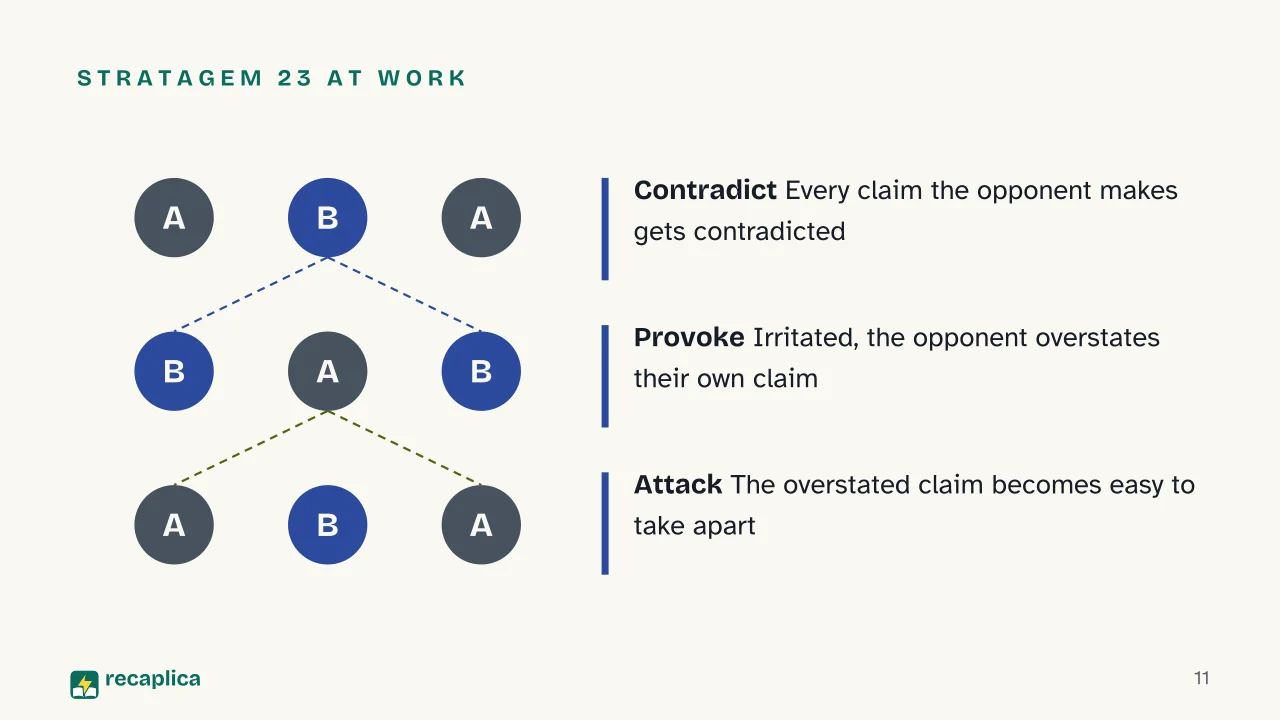
    Stratagem number 23 out of 38 deserves its own mention, because it describes a three-step mechanism rather than a single move: according to Wikisource EN, it consists of contradicting every claim the opponent makes until, irritated, they overstate their own position to the point where it becomes attackable. The last on the list, number 38, is the end of the road: when the opponent is winning on the merits, what’s left is the personal insult, which Wikisource EN calls the extreme resort of someone out of arguments and which the treatise names the Argumentum ad personam.

    Why the author refused to publish it

    Yet the treatise was never published, by Schopenhauer’s own choice. According to Wikipedia DE, the treatise’s purpose was to teach how to appear, in a dispute, as the one who “keeps the right” by any means, fair or foul — the Latin formula used is per fas et nefas. And that very purpose, the same source says, disgusted Schopenhauer enough that he chose not to publish the text himself: a catalogue he wrote but never signed for print.

    The work’s first English translator, T. Bailey Saunders, in his 1896 preface, presents it as a partly ironic text, assembled from papers Schopenhauer left unfinished and published only after his death, according to Wikisource EN. And the Stanford Encyclopedia of Philosophy, one of the leading academic philosophy reference works in English, describes it explicitly as a satirical account of dialectic — an independent, academic confirmation that the tone is not that of a conduct manual.

    This treatise is a minor piece next to the philosophical system Schopenhauer built in his main work: readers who want to place it inside Schopenhauer’s philosophy as a whole will find there the pessimism and the theory of the will from which this catalogue of rhetorical tricks also grows.

    One name, two different books

    The word “stratagems” on its own points, almost every time, to a different work: the 36 Stratagems of Chinese tradition, a compendium of military and political tactics with an origin and era unrelated to Schopenhauer. The two works share only the word: one concerns military and political strategy in ancient China, the other a verbal dispute between two people in early nineteenth-century Germany.

    Readers coming to this treatise from other classics of logic and argument will also find points of contact with Aristotle’s logic, which first codified the rules of correct reasoning, the very discipline that, according to the opening lines of the treatise, philosophers had studied closely while leaving the dialectic of disputation almost untouched.

    Slide deck

    Slides ready to download and make your own in PowerPoint or Google Slides, with speaker notes. Pick the Flash cut or the Full one.
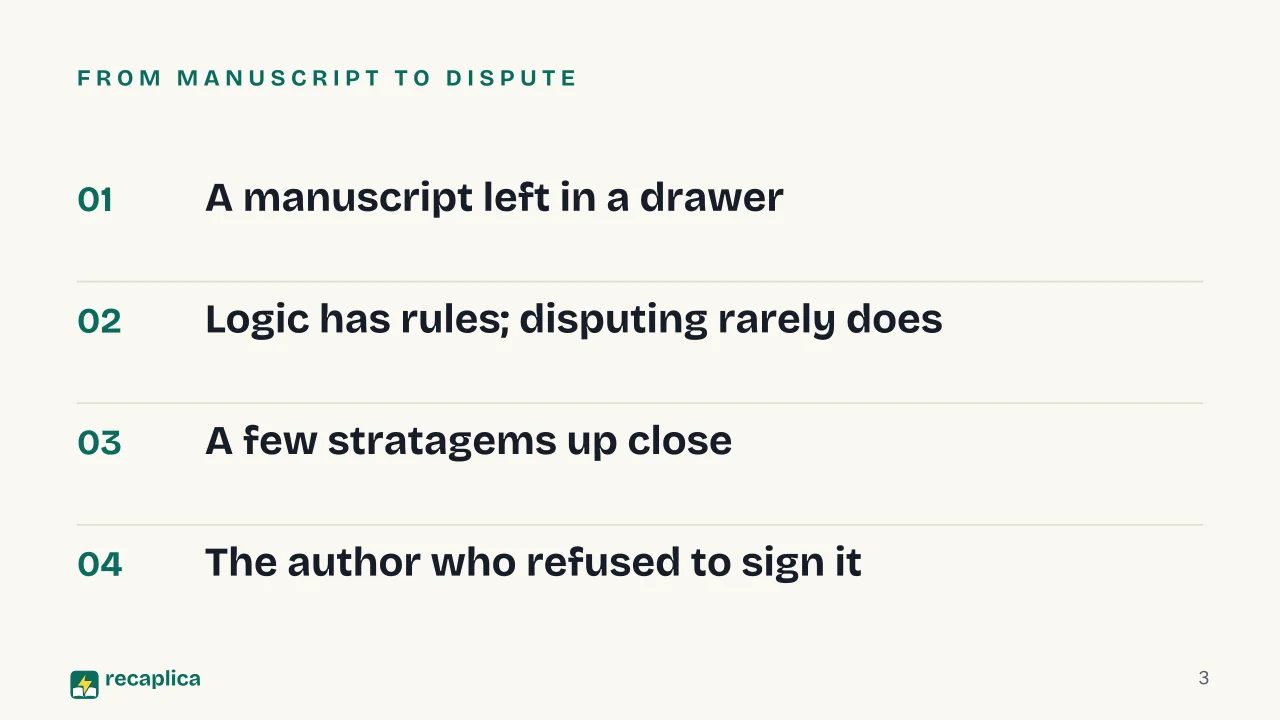
    Slide 1 of the presentation on The Art of Being Right: The Art of Being RightSlide 2 of the presentation on The Art of Being Right: Can you win an argument without being right?Slide 3 of the presentation on The Art of Being Right: From manuscript to disputeSlide 4 of the presentation on The Art of Being Right: Chapter 01: A manuscript in the drawerSlide 5 of the presentation on The Art of Being Right: From manuscript to bookSlide 6 of the presentation on The Art of Being Right: Schopenhauer wrote the treatise, then refused to publish it.Slide 7 of the presentation on The Art of Being Right: Chapter 02: Logic versus disputingSlide 8 of the presentation on The Art of Being Right: Opposite goals, truth or victorySlide 9 of the presentation on The Art of Being Right: Chapter 03: A few stratagemsSlide 10 of the presentation on The Art of Being Right: Stratagems named in the treatise: Extension, Concealment, Mutatio controversiaeSlide 11 of the presentation on The Art of Being Right: Stratagem 23 at workSlide 12 of the presentation on The Art of Being Right: When losing, what's left is the personal insult.Slide 13 of the presentation on The Art of Being Right: Chapter 04: Not to be confusedSlide 14 of the presentation on The Art of Being Right: Numbers from the treatiseSlide 15 of the presentation on The Art of Being Right: Is The Art of Being Right the same book as the Chinese 36 Stratagems?Slide 16 of the presentation on The Art of Being Right: Now, the recap
    Flash10 slidesThe essential thread, to present in classFull16 slidesEvery chapter and the deeper detail

    Common myths

    • ✗ Myth It's a self-help book that teaches you how to win people over.

      ✓ Reality The English Wikipedia entry describes it as an "acerbic, sarcastic" treatise, and the Stanford Encyclopedia of Philosophy calls it a satirical account of dialectic: Schopenhauer lists the rhetorical tricks to expose them, not to recommend them as a method for success.

    • ✗ Myth It covers formal logic, like Aristotle's classical treatises.

      ✓ Reality Schopenhauer draws the line from the opening pages: logic concerns the rules of correct deduction, while controversial (eristic) dialectic concerns how to appear to win a dispute, regardless of whether the argument is actually sound.

    • ✗ Myth It's the same book as the Chinese 36 Stratagems.

      ✓ Reality They are two separate works, different in author, era and tradition: the 36 Stratagems collect military and political tactics from ancient China, while Schopenhauer wrote a century later, in Germany, a catalogue of tricks for verbal disputes. The confusion comes only from the shared word "stratagems".

    Mind map

    Drag the background to move around and the nodes to reposition them; use − and + to collapse and expand branches.
    Customize
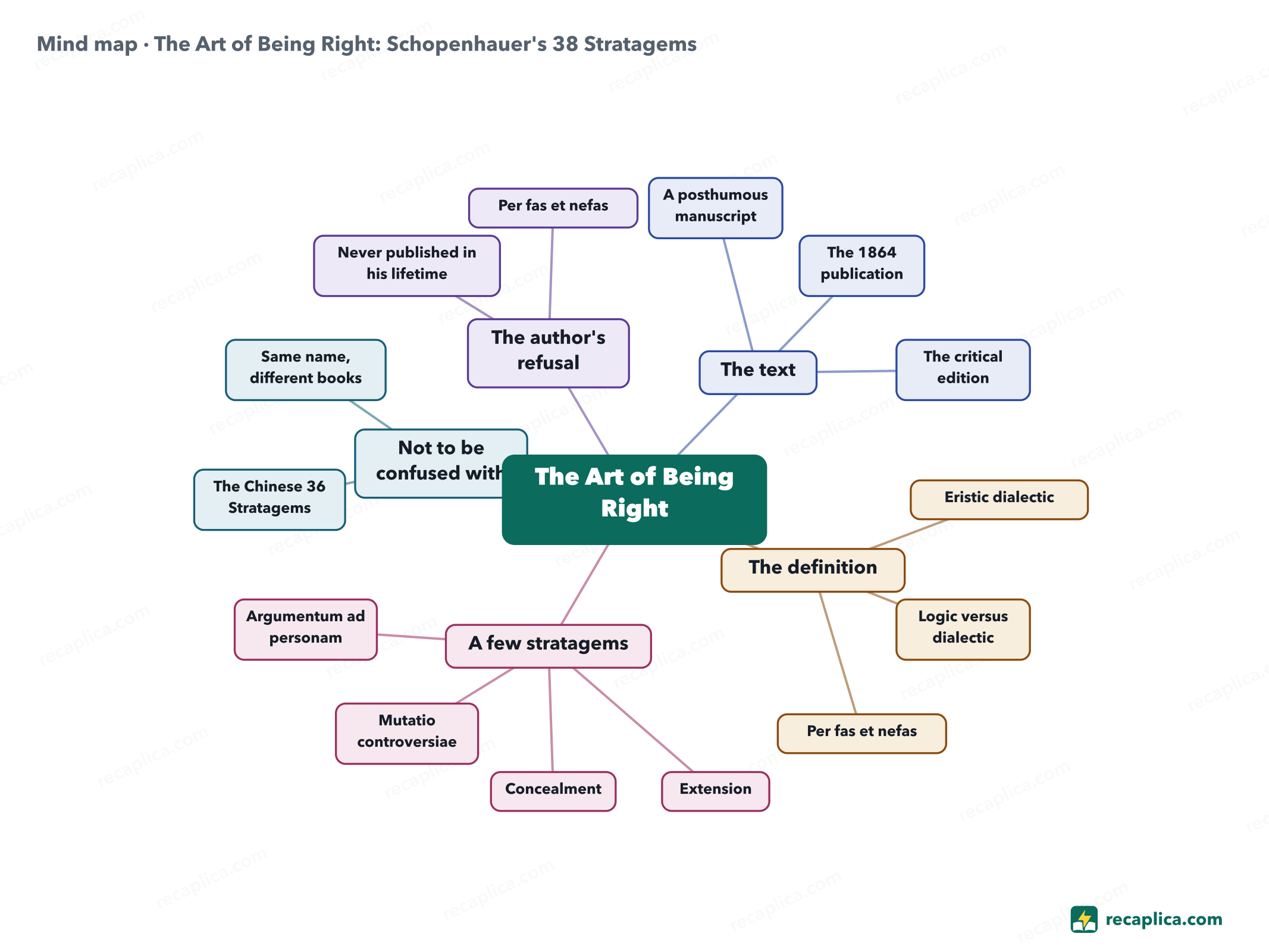
    Mind map: The Art of Being Right: Schopenhauer's 38 Stratagems
    • The Art of Being Right
      • The text
        • A posthumous manuscript 46 pages written around 1830, unpublished in his lifetime
        • The 1864 publication edited by Julius Frauenstädt
        • The critical edition Hübscher's definitive text, after 1966
      • The definition
        • Eristic dialectic winning regardless of the merits
        • Logic versus dialectic the treatise's opening distinction
        • Per fas et nefas by fair means or foul
      • A few stratagems
        • Extension stretching the opponent's claim to attack it
        • Concealment securing the premises one at a time
        • Mutatio controversiae changing the subject when losing
        • Argumentum ad personam the personal insult, a last resort
      • Not to be confused with
        • The Chinese 36 Stratagems a different tradition and author
        • Same name, different books they share only the word stratagems
      • The author's refusal
        • Never published in his lifetime the competitive aim of disputation disgusted him
        • Per fas et nefas by fair means or foul

    Quiz: test yourself

    Answer the questions to check what you have learned: you get instant feedback and a short explanation.

    Grade 0/10 0/5
    1 When was The Art of Being Right first published?

    The manuscript dates to around 1830, but Schopenhauer never published it himself; it appeared in 1864, four years after his death, within the collection of papers edited by his pupil Julius Frauenstädt.

    2 How many stratagems does the treatise list?

    There are 38, each paired with a countermove for defending against it; Schopenhauer himself referred to "about forty" in the manuscript, a sign that the list was never meant to be final.

    3 What does Schopenhauer mean by eristic dialectic?

    It is the work's central claim: controversial dialectic aims to win the dispute regardless of the merits, a standard that sets it apart from logic.

    4 True or false: The Art of Being Right is the same book as the Chinese 36 Stratagems.

    False: they are different works. The 36 Stratagems belong to a Chinese tradition of military and political tactics; Schopenhauer's treatise is a catalogue of rhetorical tricks for verbal disputes, written in Germany a century later.

    5 What does the Argumentum ad personam, the last stratagem on the list, describe?

    Schopenhauer presents it as the last resort of someone out of arguments: when the opponent is winning on the merits, the final stratagem is to attack the person instead of the claim.

    Answers: 1-C · 2-C · 3-B · 4-B · 5-C

    Flashcards

    Tap the card to flip it and check whether you remember the answer, then move to the next one.

    1 / 8

    Explain it in your own words

    The ultimate test: if you can explain it in simple words, you've truly understood it. Write your explanation, then compare it with the Recap.

    Your explanation is saved only on this device.

    The Art of Being Right is an unfinished treatise by Arthur Schopenhauer, found among his papers after his death and published for the first time in 1864. It lists 38 stratagems for winning an argument regardless of who is actually right: not a manual of logic, but a satirical catalogue of the rhetorical tricks people use to mislead an opponent or talk their way out of a corner. It also circulates under the title The Art of Always Being Right, and it should not be confused with the Chinese book of "36 Stratagems", a separate work that shares only the theme's name. Schopenhauer himself refused to have it printed: the purely competitive aim of disputation, detached from truth, disgusted him.

    Frequently asked questions

    Who wrote The Art of Being Right?

    Arthur Schopenhauer, in a 46-page manuscript that stayed among his papers and was published only after his death, in 1864.

    How many stratagems are in the work?

    38, each named and paired with a countermove for recognizing it and defending against it; Schopenhauer himself mentions "about forty" in the manuscript, a sign the list stayed unfinished.

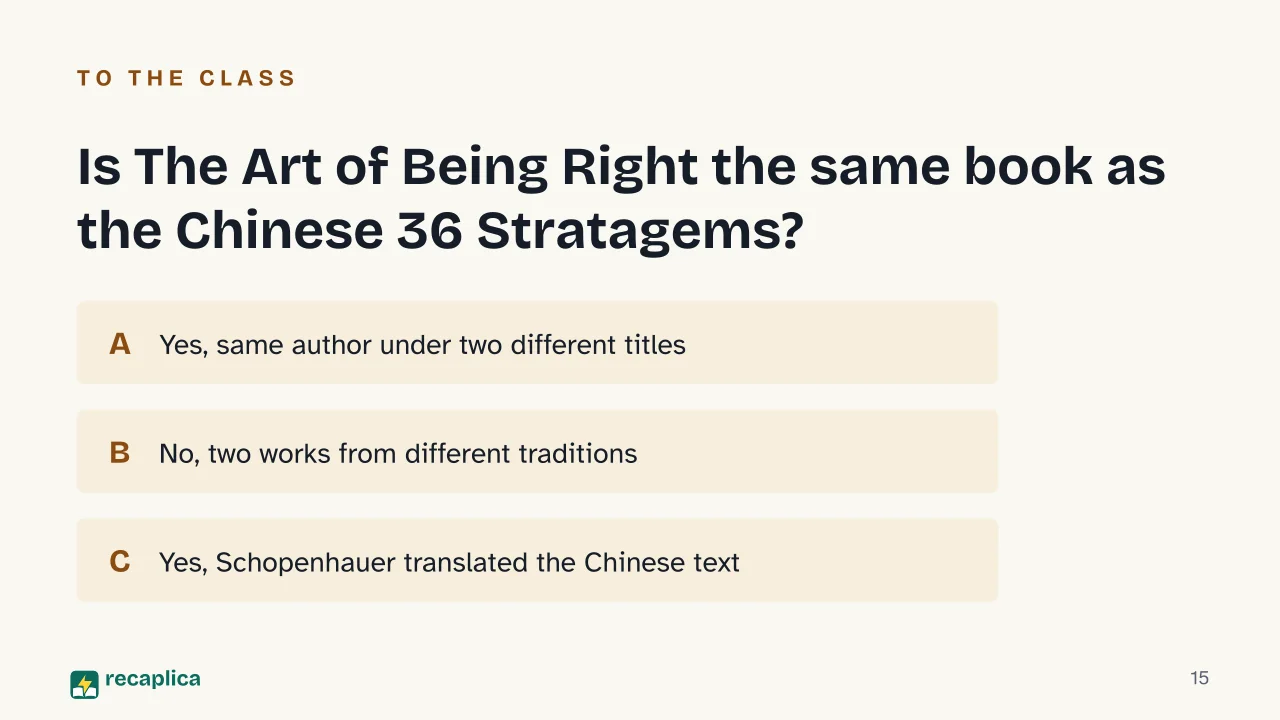
    Is The Art of Being Right the same book as the Chinese 36 Stratagems?

    No. The 36 Stratagems are a compendium of Chinese military and political tactics; Schopenhauer's treatise is a separate work, written in Germany around 1830, devoted to the rhetorical tricks of verbal disputes.

    Is The Art of Being Right a guide to winning arguments?

    Not as a guide to follow: the English Wikipedia entry calls it an acerbic, sarcastic treatise, and the Stanford Encyclopedia of Philosophy describes it as a satirical account of dialectic. It lists the tricks to expose them, not to recommend them.

    Why is it also called The Art of Always Being Right?

    It's the same treatise: in English it circulates under both titles, variants translating the same German title, Die Kunst, Recht zu behalten.

    Sources

    • The Art of Being Right — Wikipedia (EN)
    • The Art of Controversy — Wikisource (EN), trans. T. Bailey Saunders
    • Eristische Dialektik — Wikipedia (DE)
    • L'arte di ottenere ragione — Wikipedia (IT)
    • Arthur Schopenhauer — Stanford Encyclopedia of Philosophy

    Every Recap goes through an independent review before publication.

    Every evening, the day's new Recaps on our Telegram channel. Join the channel →

    Keep learning

    • History What Is Existentialism? Heidegger, Being and Time, and Dasein Existentialism is a current of twentieth-century philosophy centered on human existence, freedom and the search for meaning. According to the Stanford Encyclopedia of Philosophy, the German philosopher Martin Heidegger (1889-1976) shaped that current more than almost anyone else, even though he never accepted the label. In 1927 he published Being and Time, his major work, where he introduced the concept of Dasein: the human being as the one entity that questions its own existence. That book influenced Jean-Paul Sartre's existentialism, but in 1946, in the Letter on Humanism, Heidegger openly broke with Sartre and refused to be called an existentialist. In 1933 he was elected rector of the University of Freiburg and became a Nazi party member, keeping that membership until the regime fell - an episode Heidegger himself later denied or played down more than once. Read the Recap →
    • History What Is Phenomenology? Husserl's Philosophy Explained Edmund Husserl founded phenomenology as a philosophical discipline around 1900-1901, with his Logical Investigations. His method starts from the epoché, a suspension of our everyday, unquestioning stance toward the world, and moves toward phenomenological reduction: studying how things appear to consciousness rather than what they are in themselves. At the center sits intentionality, the idea that every experience is always an experience of something specific, whether hoping, perceiving, or desiring. The method Husserl built carried into the 20th century through Heidegger, Sartre, and Merleau-Ponty, moving from German philosophy into French philosophy along the way. Read the Recap →
    • History Legal Positivism: What It Is, from Austin to Kelsen and Hart According to the Stanford Encyclopedia of Philosophy, legal positivism measures legal validity against observable social facts, keeping moral judgment on a separate track. Its roots lie in Hobbes and Hume. Jeremy Bentham produced the theory's first full account, which John Austin later took up and spread: for Austin, a rule is law only when a sovereign commands it under threat of punishment. In the twentieth century, Hans Kelsen grounded legal validity in a hierarchy that traces back to a presupposed basic norm, while Herbert Hart located it instead in a rule of recognition actually followed by judges and officials. Natural law theory takes the opposite view: an unjust law is not really a law. Legal positivism disagrees — a law stays valid even when it is morally unjust, as long as it was made the way the system requires. Read the Recap →

    recaplica

    Clear in 30 seconds, yours in 10 minutes.

    Recaps Mind maps Request a Recap Telegram channel Mind map maker Our method About Privacy & cookies Legal notes & terms of use

    © 2026 Recaplica · A project by Curi S.r.l. — VAT IT05472000750

    Statistics, only if you say so

    To learn which Recaps help most we would use Google Analytics, with aggregate, anonymous data. It starts only with your OK, and you can change your mind anytime. Privacy policy