|
recaplica
Neoplatonism: What It Is, Who Founded It, and Why It Lasted Centuries |
| © 2026 Recaplica · recaplica.com — All rights reserved |
Neoplatonism: What It Is, Who Founded It, and Why It Lasted CenturiesWhat to print Page numbers appear when printing with default margins. SlidesChoose a cut Flash10 slidesThe essential thread, to present in classFull15 slidesEvery chapter and the deeper detailBoth come with speaker notes. In 30 seconds quick readNeoplatonism is the philosophical current born in the Greco-Roman world of late antiquity, between the mid-3rd and mid-7th centuries CE. It is commonly traced back to Plotinus, a philosopher born in Egypt around 204 or 205 CE, for whom all of reality flows from a single, absolute, simple principle: the One. Plotinus's work survives today thanks to the editorial work of his student Porphyry, who arranged it into the Enneads. The ideas spread through medieval Christian thought, from Augustine of Hippo to the Cappadocian Fathers, and resurfaced at the center of Florentine culture during the Renaissance with Marsilio Ficino. Key Points
Key figures
Deep DiveA current born in late antiquityNeoplatonism is the philosophical current that emerges and develops in the Greco-Roman world of late antiquity, spanning, according to the Stanford Encyclopedia of Philosophy, from the mid-3rd to the mid-7th century CE. It picks up themes from Plato and takes them in a new direction, built around a principle that becomes the heart of the whole system: the One. Tradition links the current’s birth to the name of Plotinus, though the same source notes the attribution remains conventional, not free of scholarly debate. Plotinus, from Alexandria to RomePlotinus was born in Egypt, around 204 or 205 CE. At 28 he began following the lectures of Ammonius Saccas in Alexandria, remaining his student for the following eleven years; he then moved to Rome, settling there permanently at the end of 244, where he kept teaching without a single break all the way to 270, the year he died. The Recap on Plotinus covers his full biography. The One, the principle of everythingIn Plotinus’s doctrine, the First Principle must be entirely without composition: it is the absolute One. It stands beyond Being itself and transcends all physical reality; of it, according to the source, little can be said, except that it is absolute Unity. The One is also what everything else strives toward, and it is identified with the absolute Good. The Enneads, a work saved by a studentMost of Plotinus’s writings reached us because a student, Porphyry, lived with his teacher for about five years and, after his death, gathered those texts by theme, trying to arrange them by content. The result took the name Enneads, for its symmetrical structure of six groups of nine treatises each.
From paganism to Christian theologyNeoplatonism did not stay confined to the pagan world of late antiquity: it deeply shaped the emergence of Christian theology. In the West the path runs through Augustine of Hippo, who lived from 354 to 430 and knew the writings of Plotinus and Porphyry well. In the East the channel runs through the Cappadocian Fathers in the 4th century and, in the 6th century, through the writings attributed to Pseudo-Dionysius the Areopagite. It is a legacy the Middle Ages carried forward for centuries, down to Pseudo-Dionysius in the 6th century. Renaissance Neoplatonism, from Ficino to BotticelliNeoplatonism returns to center stage over a millennium after Plotinus, in the Florence of the Renaissance. In 1463 Cosimo de’ Medici granted Marsilio Ficino a small property with a house at Careggi. In a letter to Cosimo, dated September 1462, Ficino describes his devotion to the Academy established on the estate as a place of contemplation. Scholars find no evidence of regular meetings in a fixed venue: rather than a school with a classroom, that “academy” was a shared intellectual outlook, and Ficino taught young members of the Florentine elite. In the late 1480s he completed the first full Latin version of Plotinus’s works, with commentary; in his discussion of the levels of being, his main debt is to Plotinus. Among his intellectual circle was also Giovanni Pico della Mirandola. The influence reached painting too. Many art historians specializing in the Italian Renaissance consider the Neoplatonic reading the key to The Birth of Venus by Sandro Botticelli: in the painting’s nude Venus they recognize a double-faced love, physical and intellectual, which Neoplatonic doctrine calls earthly and celestial respectively. The theory that the Medici commissioned the painting was long accepted, but today is widely questioned by scholars, though still held by some. Slide deckSlides ready to download and make your own in PowerPoint or Google Slides, with speaker notes. Pick the Flash cut or the Full one.   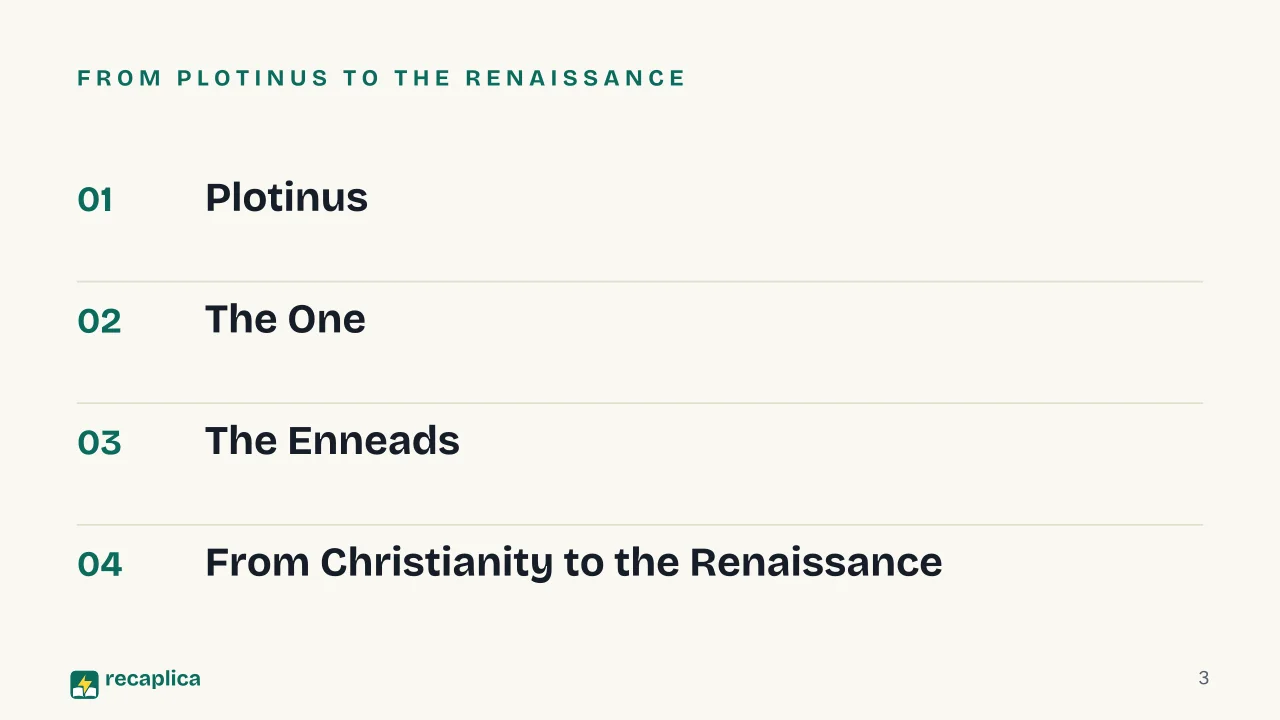  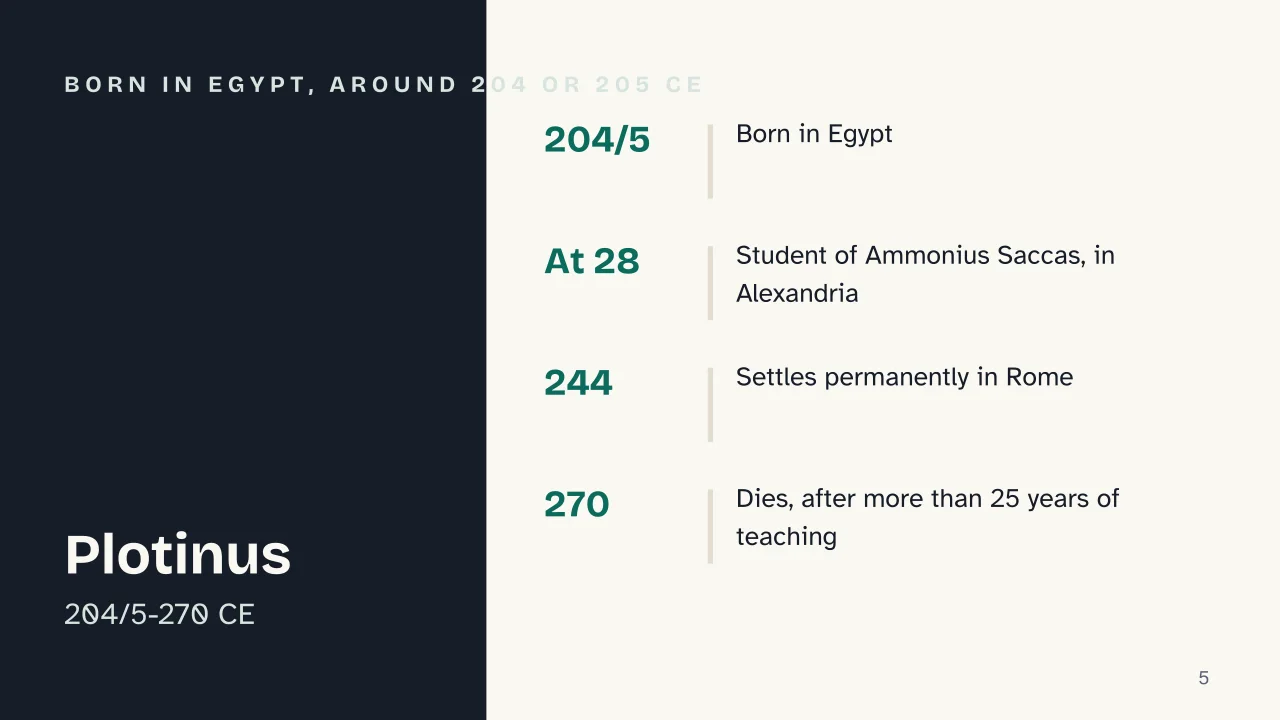  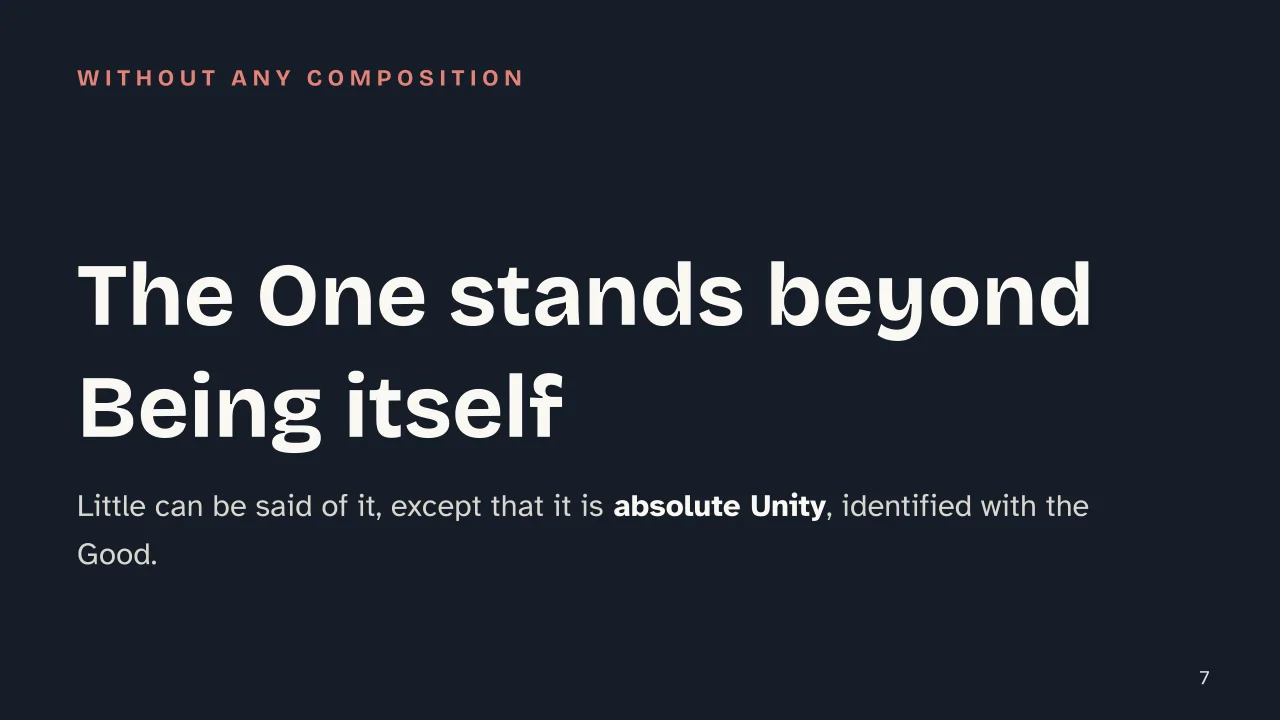  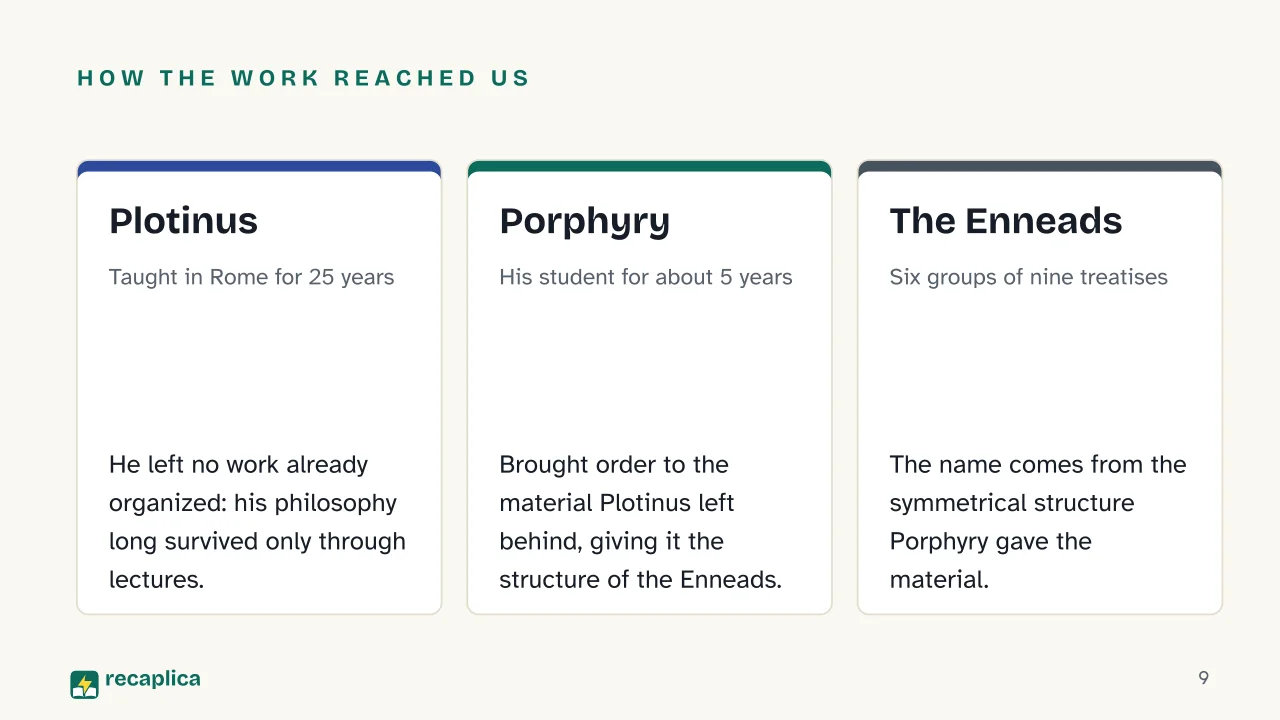  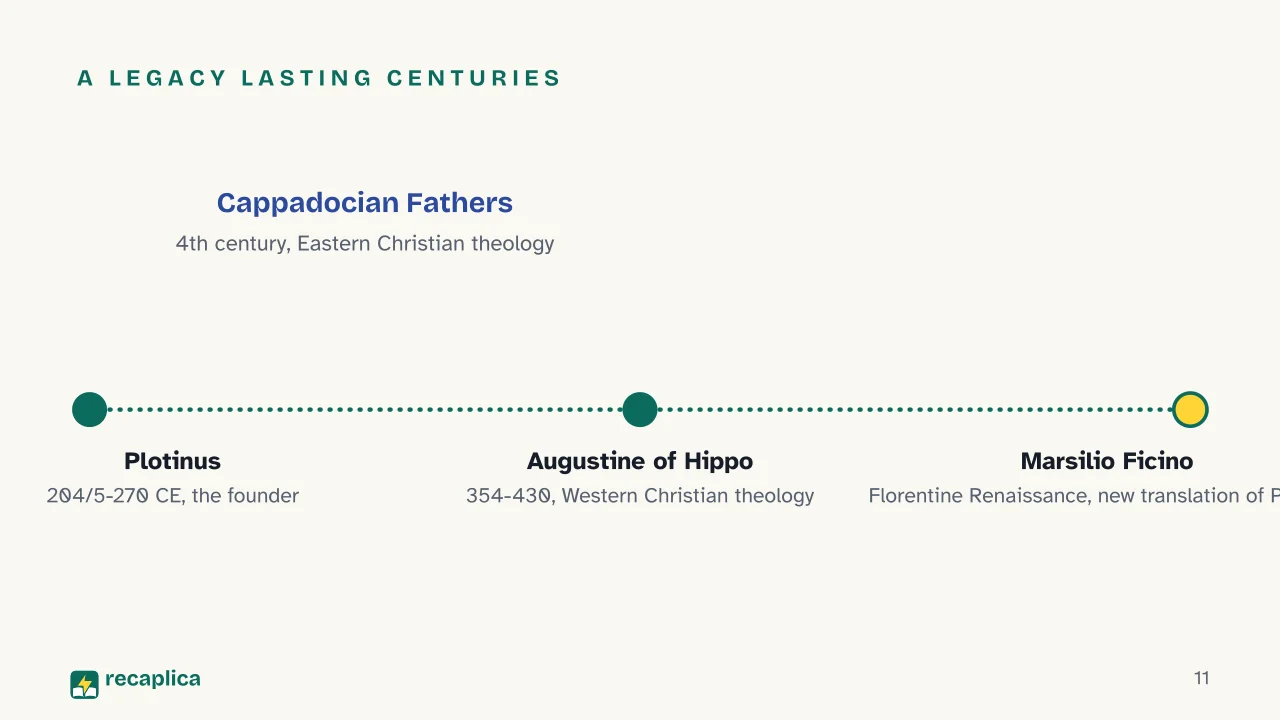 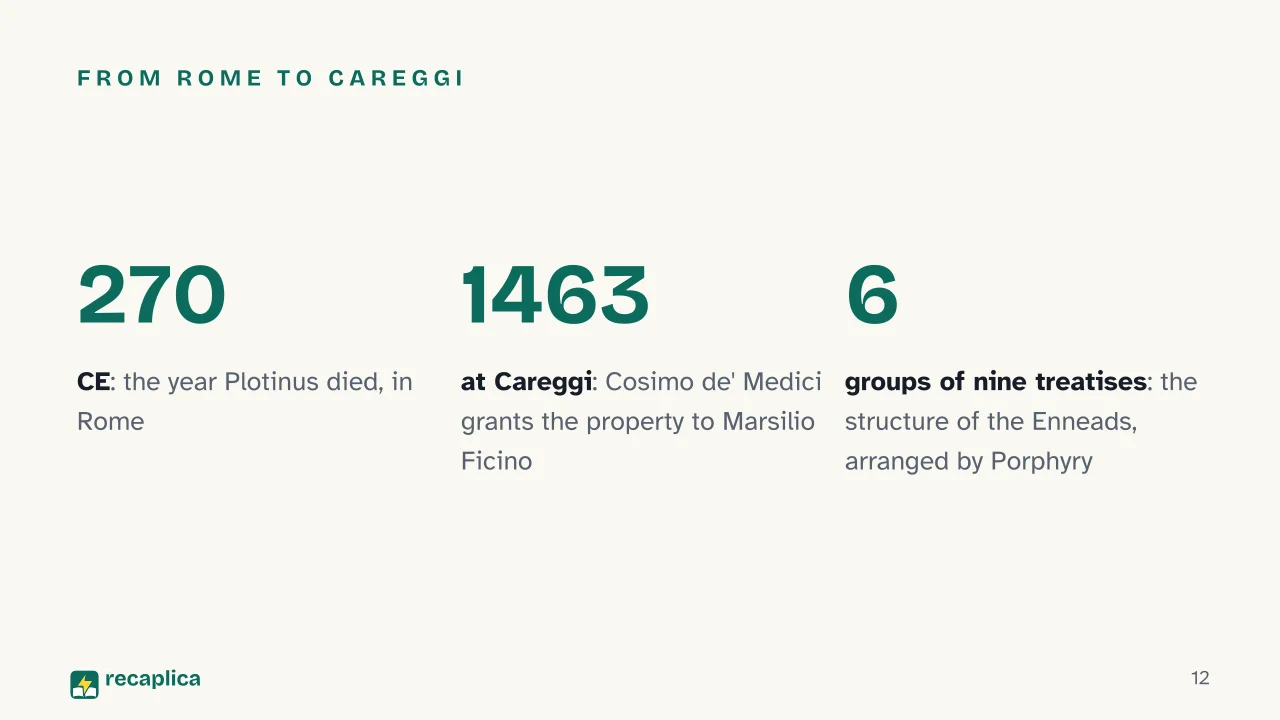 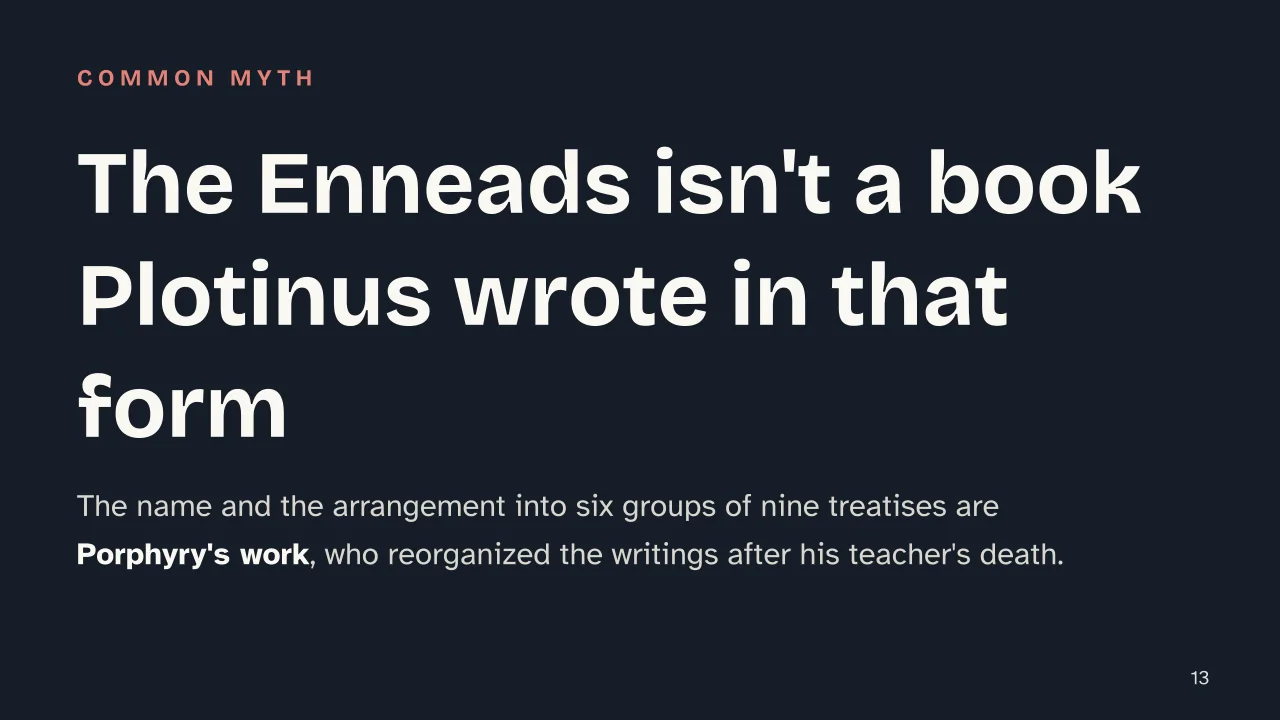   Common myths
Mind mapDrag the background to move around and the nodes to reposition them; use − and + to collapse and expand branches. 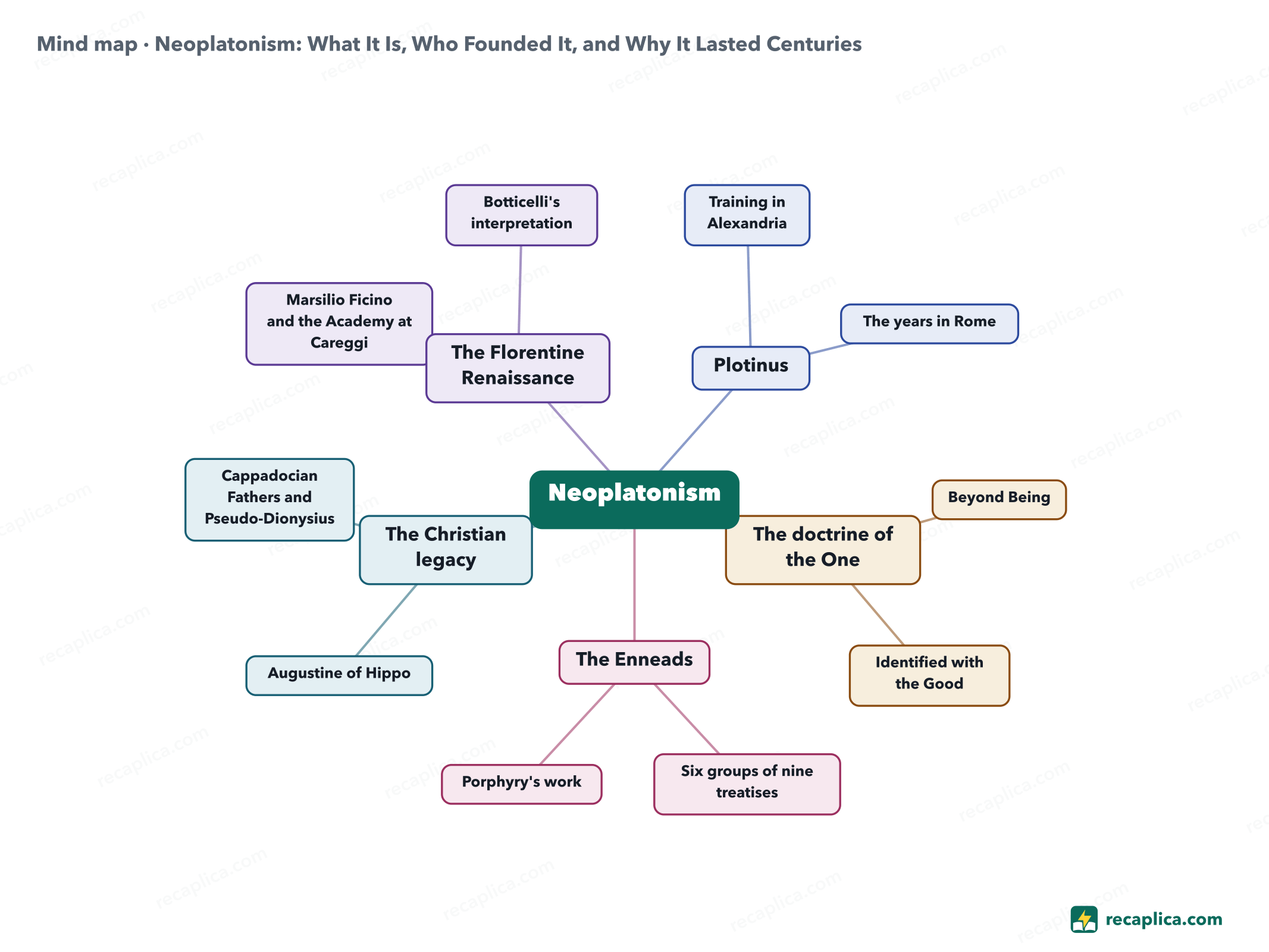
Quiz: test yourselfAnswer the questions to check what you have learned: you get instant feedback and a short explanation. Grade 0/10 0/5
FlashcardsTap the card to flip it and check whether you remember the answer, then move to the next one. 1 / 8 Explain it in your own wordsThe ultimate test: if you can explain it in simple words, you've truly understood it. Write your explanation, then compare it with the Recap. Your explanation is saved only on this device.
Frequently asked questionsIs Neoplatonism the same thing as Plato's own philosophy?No. Neoplatonism is Plotinus's reworking of Plato's ideas starting in the 3rd century CE, built around a principle, the One, absolute and without composition, that Platonic doctrine had never formulated in these terms. Who wrote the Enneads?The texts are by Plotinus, but the collection and arrangement into six groups of nine treatises bear the signature of his student Porphyry, who reorganized them after his teacher's death in 270 CE. What is the relationship between Neoplatonism and Christianity?Neoplatonism deeply shaped the emergence of Christian theology: in the West through Augustine of Hippo, who knew Plotinus and Porphyry well, in the East through the 4th-century Cappadocian Fathers and, in the 6th century, through the writings attributed to Pseudo-Dionysius the Areopagite. What was the Florentine Platonic Academy?It was the circle Marsilio Ficino cultivated on a property at Careggi, given to him by Cosimo de' Medici in 1463; scholars find no evidence it was a formal school with regular meetings in a fixed place, more an activity of teaching young members of the Florentine elite and a shared intellectual outlook. Why is Botticelli's Birth of Venus read in a Neoplatonic light?Many Renaissance art historians see in the painting's nude Venus the Neoplatonic idea of love in its double nature: earthly, physical love, and celestial, intellectual love. A Medici commission was long assumed, but scholars today are divided on it. Every Recap goes through an independent review before publication. |