Skip to content
recaplica

    One moment: security check

    Cloudflare wants to make sure you're not a robot. Tick the box below and your search will continue on its own.

    IT
    recaplica What Is Scholasticism? Origins and the 14th-Century Turn
    © 2026 Recaplica · recaplica.com — All rights reserved
    Home › History

    What Is Scholasticism? Origins and the 14th-Century Turn

    By Recaplica Newsroom · Updated on October 11, 2026

    What to print

    Page numbers appear when printing with default margins.

    Slides

    Choose a cut

    Flash10 slidesThe essential thread, to present in classFull16 slidesEvery chapter and the deeper detail

    Both come with speaker notes.

    Telegram channel
    recaplica Clear in 30 seconds, yours in 10 minutes.
    In 30 seconds Key points Figures Deep dive Slides Myths Mind map Quiz Flashcards FAQ

    In 30 seconds quick read

    Scholasticism is the method of teaching and reasoning that ran the cathedral schools and then the European universities from the 12th century onward, built to bring Christian faith into conversation with Aristotelian logic. It took hold in Paris and Oxford around 1200 through the disputatio, the back-and-forth of question, objections and answer that Thomas Aquinas would later put to constant use. Through the 1200s, Aristotle's works reached Latin readers both through direct translation and through Arabic, carrying the commentaries of Avicenna and Averroes rendered mainly in Toledo and Sicily. In the 1300s the method went through an internal shake-up, marked by the 1277 condemnation and the nominalism of William of Ockham; university philosophy in Latin nonetheless carried on for centuries.

    Key Points

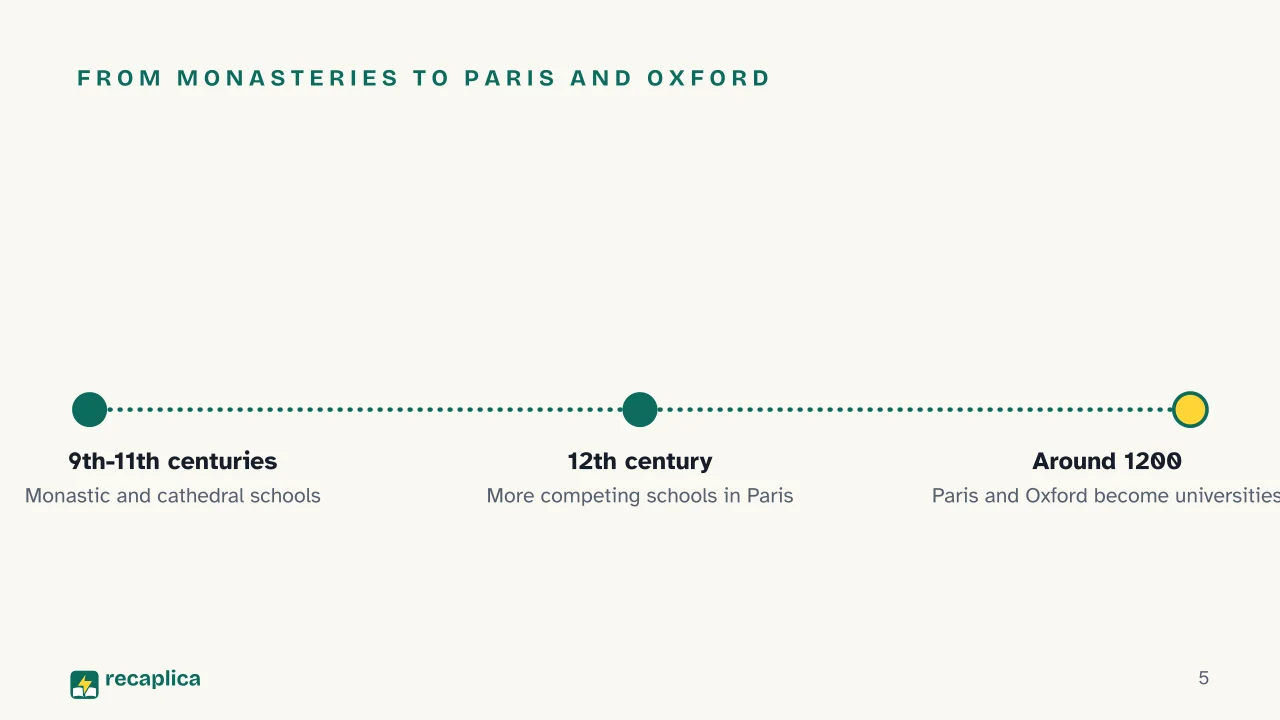
    • It starts in monasteries, then moves to schools attached to cathedrals: the universities of Paris and Oxford only arrive around 1200.
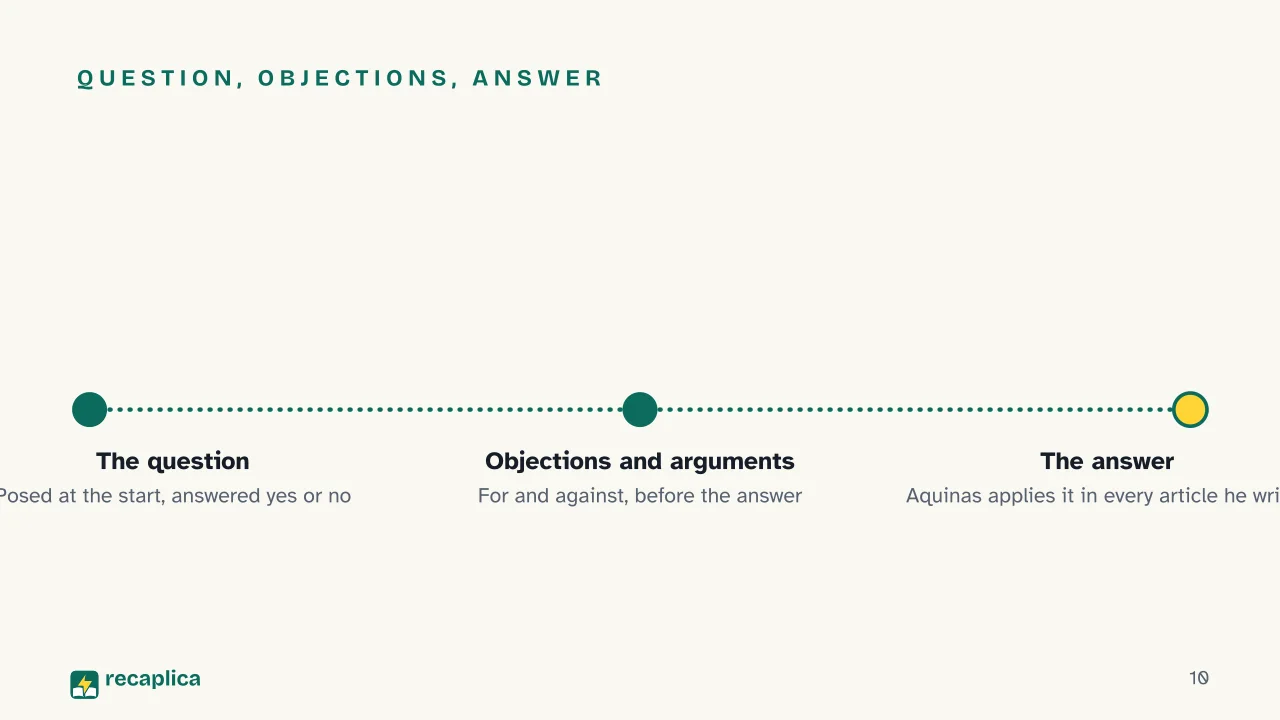
    • A question, then objections laid out one by one, then an answer that takes each of them apart in turn: the pattern behind every article Thomas Aquinas wrote.
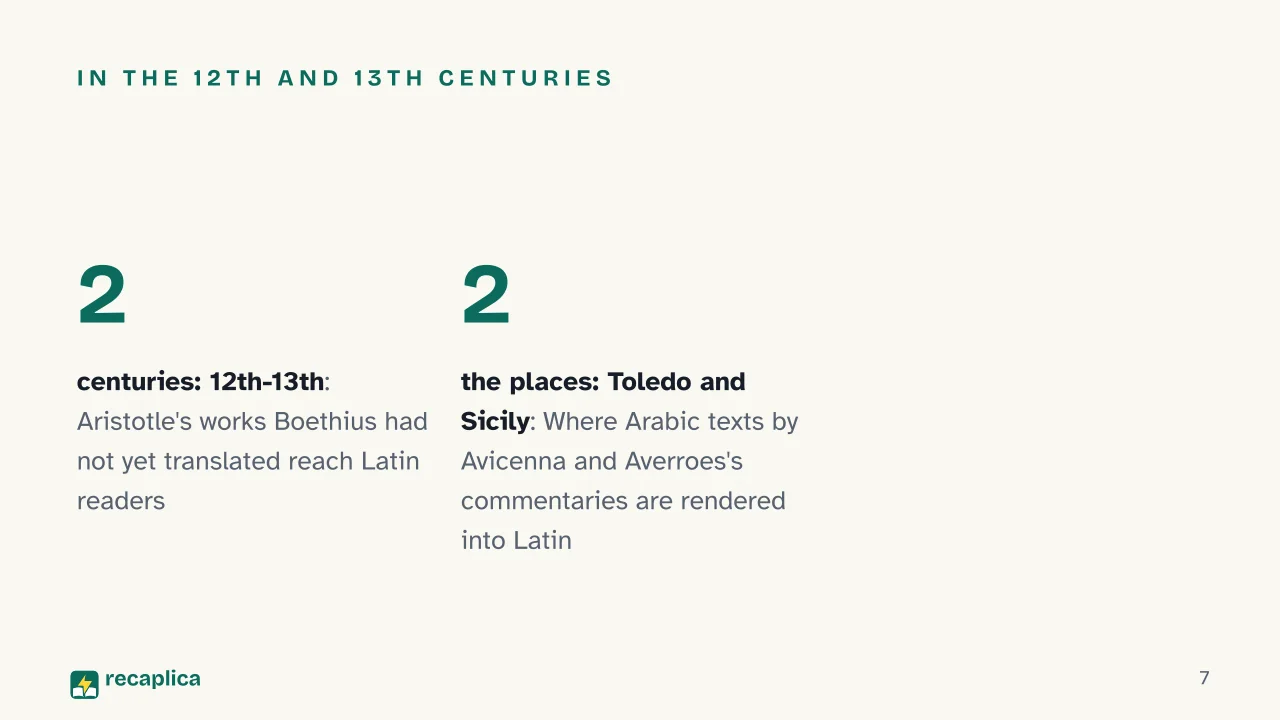
    • Aristotle's full body of work comes together over two centuries: first direct translations, then texts filtered through Arabic, chiefly between Toledo and Sicily.
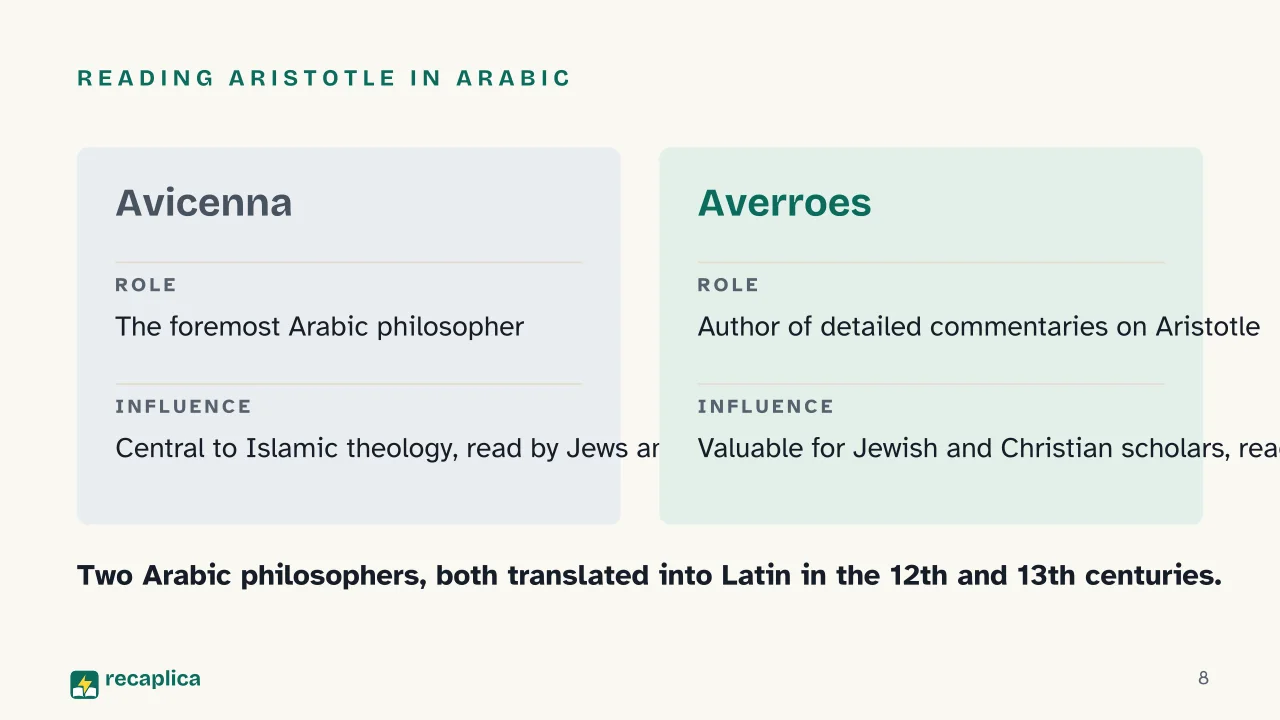
    • Avicenna and Averroes act as a bridge: once rendered into Latin, their commentaries on Aristotle circulate among Jewish and Christian scholars alike.
    • Albert the Great shapes Aquinas during his Paris years, 1245 to 1248, where Aquinas builds his fusion of Christian theology and Greek-Arabic philosophy.
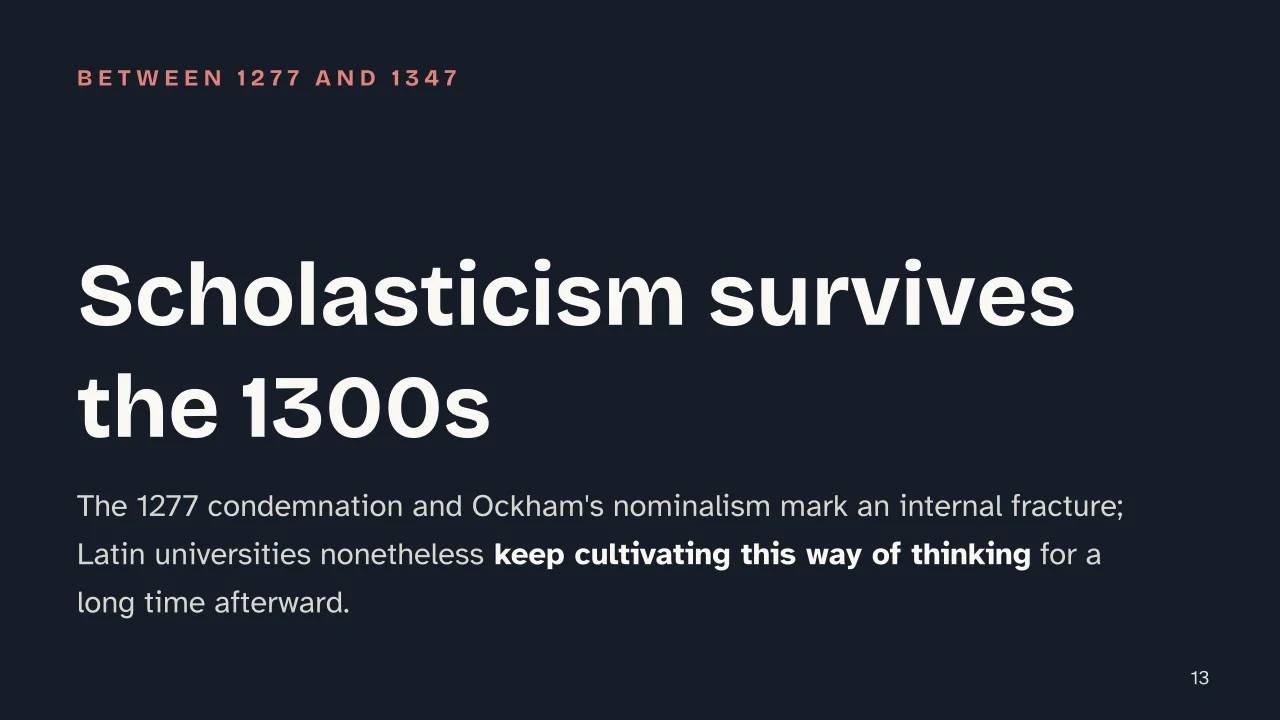
    • The 1300s bring a fracture: the 1277 condemnation and Ockham's nominalism sit alongside a university system that keeps going for a long time after.

    Key figures

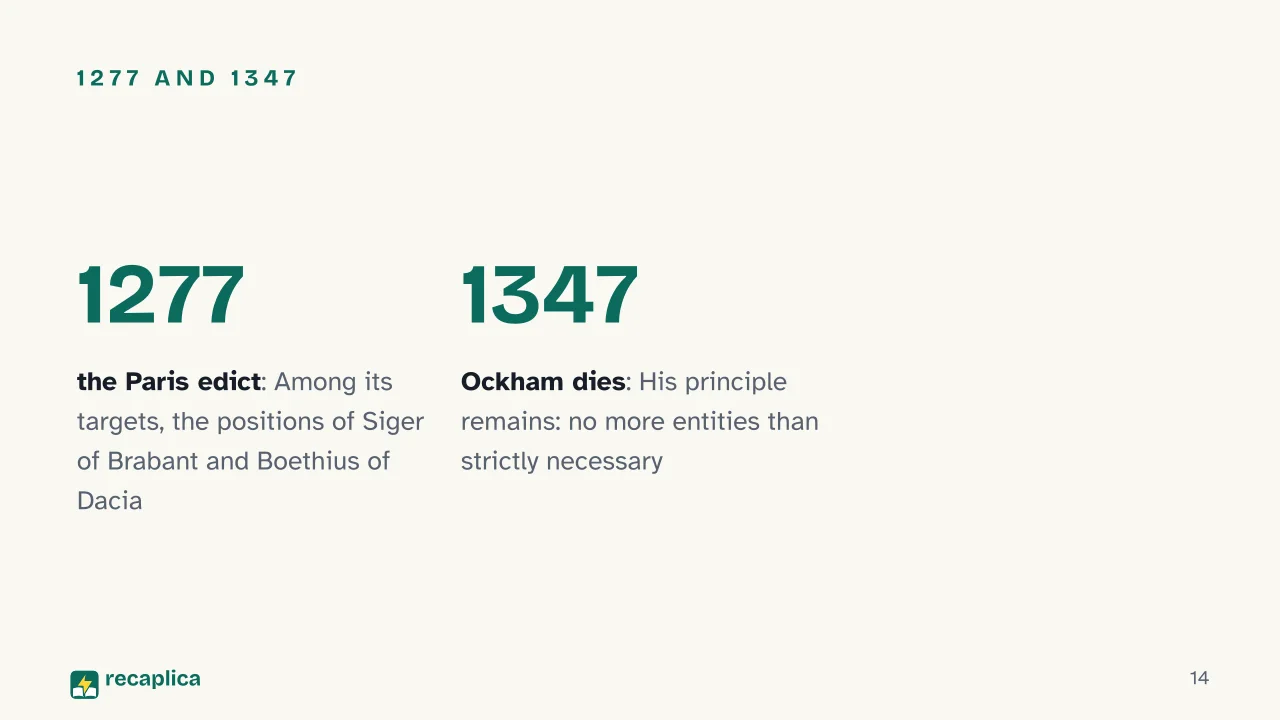
    • 1277 Siger of Brabant and Boethius of Dacia end up among the targets of an edict issued by the bishop of Paris. Source: Stanford Encyclopedia of Philosophy, «Medieval Philosophy»
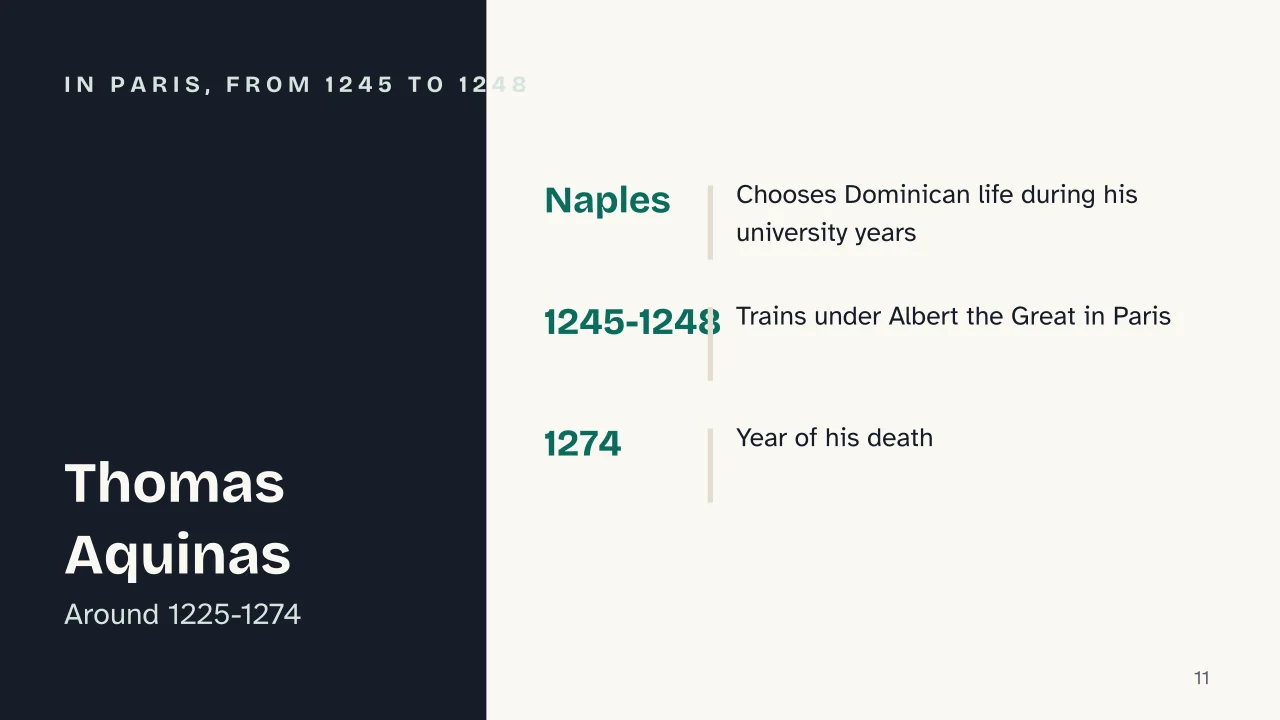
    • 1245-1248 Three years of study in Paris alongside Albert the Great, the stretch that shapes the future Dominican theologian. Source: Internet Encyclopedia of Philosophy, «Thomas Aquinas»
    • 1347 William of Ockham dies at around sixty, leaving behind the principle now known as his razor. Source: Stanford Encyclopedia of Philosophy, «William of Ockham»

    Deep Dive

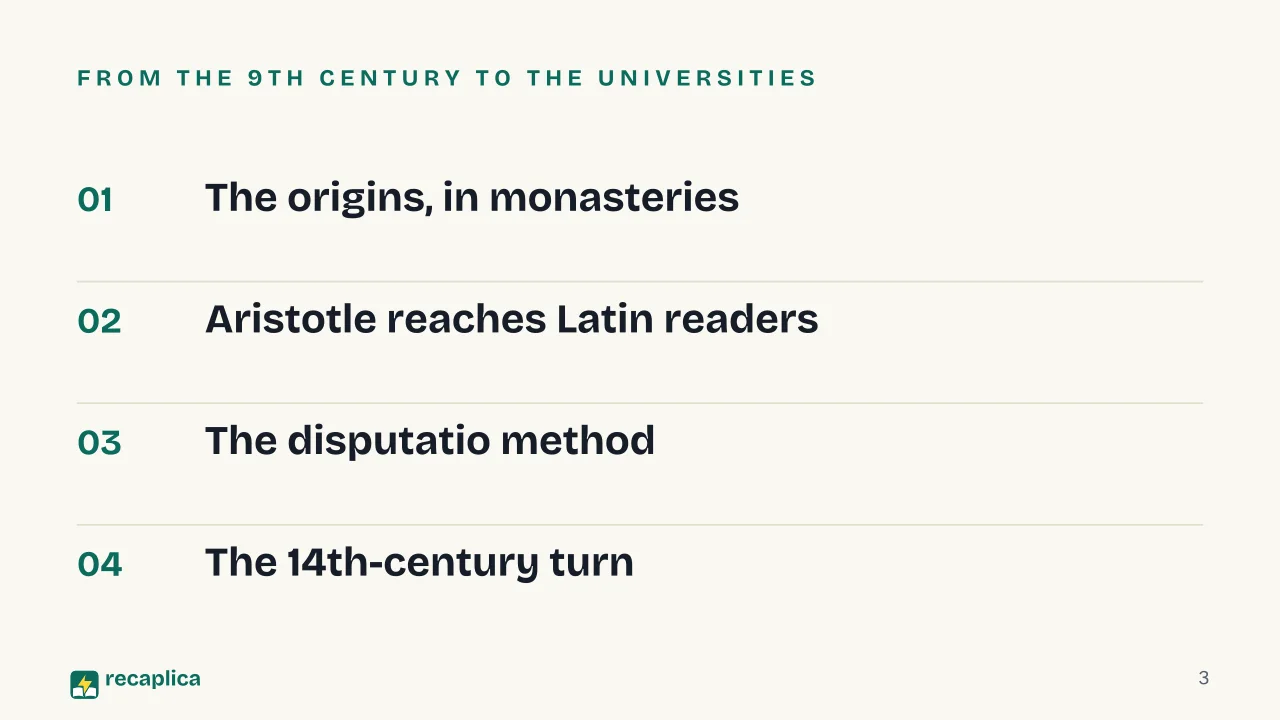
    Scholasticism takes its name from the schools where it was born: first the monasteries and cathedral schools of Latin Europe, between the 9th and 11th centuries, then the universities that start taking shape around 1200. Paris becomes its center over the course of the 12th century, partly because the cathedral authorities allow several competing schools instead of running a single one. Within a few decades, those schools become a full-fledged university. An Oxford university emerges around the same period.

    The method: the disputatio

    What sets scholasticism apart from other ways of doing philosophy isn’t a subject matter but a way of arguing. In the disputatio, or disputed question, a precise question opens the discussion, arguments for and objections are laid out, and the answer closes by refuting the objections one by one. It’s the pattern Thomas Aquinas follows in every article of his major works, treating each as a question to be answered yes or no.

    Worked example: in a disputed question, the teacher first states the question (“Does God exist?”), then lays out the arguments against it as if arguing them himself, then gives his own answer, and finally returns to each initial objection to show where it goes wrong. The reader sees the whole path of the reasoning, not just the conclusion.

    How Aristotle arrives

    Much of the material scholasticism works from comes from outside Latin Europe. In the 12th and 13th centuries, the works of Aristotle that Boethius had not yet made available are translated into Latin, including the non-logical writings and the Posterior Analytics. In the same period, mainly in Toledo and Sicily, a wide range of Arabic texts is translated into Latin: among them, portions of Avicenna’s great encyclopedic work on Aristotle (including sections on the soul and on metaphysics) and numerous commentaries by Averroes on the same philosopher. Avicenna is regarded as the foremost Arabic philosopher, influential within the Islamic tradition and also on Jewish and Latin philosophy; Averroes’s commentaries, read in translation, prove valuable for Jewish and Christian scholars alike. Readers who want to revisit the Greek starting point can compare this path with the Recap on Aristotle and Plato. The wider picture of these centuries, including patristics and medieval Arabic and Jewish philosophy, is in the Recap on medieval philosophy.

    Thomas Aquinas and the synthesis

    Thomas Aquinas, a Dominican priest and theologian of Scripture who lived until 1274, is the figure in whom this convergence of sources becomes a system. He decides to join the Order of Preachers during his university studies in Naples, a choice not without controversy; once his talent is recognized, his Dominican superiors send him to study under Albert the Great at the University of Paris, from 1245 to 1248. In Albert the Great he finds a steady guide, among the first to bring Christian theology into sustained dialogue with Greek and Arabic philosophy. The sciences of his time were advancing quickly once the Aristotelian corpus became available in Latin, and Aquinas took them in with remarkable breadth; he follows Avicenna’s lead in giving the senses real weight in human knowledge, and openly criticizes Averroes on the question of the possible intellect as a single faculty shared by all human beings. The method that results, the disputed question, is the same one met above: a question posed at the start of the treatise, answered only after working through the opposing arguments.

    Thomas AquinasWilliam of Ockham
    PeriodAround 1225-1274Around 1287-1347
    TrainingDominican, trained under Albert the Great in Paris (1245-1248)Franciscan, among the leading figures of the late Middle Ages
    Core ideaA synthesis of Christian theology and Greek-Arabic philosophy, cast as the disputed questionNominalism: only universal concepts exist in the mind, never separate universal entities

    The 14th-century turn

    The 1300s don’t close the story of scholasticism: they open a phase of internal transformation, made up of condemnations, new schools of thought, and finer distinctions.

    In 1277 the bishop of Paris issues an edict targeting, among others, the philosophers Siger of Brabant and Boethius of Dacia. Duns Scotus, shortly after, rejects the Aristotelian account of modality and locates in divine will what determines good and evil. William of Ockham, who died on the night of April 9-10, 1347, at around sixty, pushes this critical line all the way to nominalism: for him, the only universals worth talking about are concepts in the mind and terms in language, and a label like “catness” remains just a way of referring to individual cats. From this view follows the principle known as Occam’s razor: don’t introduce more elements than are needed to explain a phenomenon.

    The story of university philosophy running out of steam by the mid-1300s circulates often; the Stanford Encyclopedia of Philosophy notes instead that this way of doing philosophy stayed alive at universities for at least another three centuries. Readers who want to trace how this crossroads is reached from the side of earlier Christian theology can turn to the Recap on Augustine of Hippo and on those who carried his legacy forward; for the wider frame of the period, the Middle Ages summary is also useful.

    Slide deck

    Slides ready to download and make your own in PowerPoint or Google Slides, with speaker notes. Pick the Flash cut or the Full one.
    Slide 1 of the presentation on What Is Scholasticism? Origins and the 14th-Century Turn: ScholasticismSlide 2 of the presentation on What Is Scholasticism? Origins and the 14th-Century Turn: How did a classroom actually teach someone to think, in the 1200s?Slide 3 of the presentation on What Is Scholasticism? Origins and the 14th-Century Turn: From the 9th century to the universitiesSlide 4 of the presentation on What Is Scholasticism? Origins and the 14th-Century Turn: Chapter 01: The originsSlide 5 of the presentation on What Is Scholasticism? Origins and the 14th-Century Turn: From monasteries to Paris and OxfordSlide 6 of the presentation on What Is Scholasticism? Origins and the 14th-Century Turn: Chapter 02: Aristotle in LatinSlide 7 of the presentation on What Is Scholasticism? Origins and the 14th-Century Turn: In the 12th and 13th centuriesSlide 8 of the presentation on What Is Scholasticism? Origins and the 14th-Century Turn: Reading Aristotle in ArabicSlide 9 of the presentation on What Is Scholasticism? Origins and the 14th-Century Turn: Chapter 03: The methodSlide 10 of the presentation on What Is Scholasticism? Origins and the 14th-Century Turn: Question, objections, answerSlide 11 of the presentation on What Is Scholasticism? Origins and the 14th-Century Turn: In Paris, from 1245 to 1248Slide 12 of the presentation on What Is Scholasticism? Origins and the 14th-Century Turn: Chapter 04: The 14th-century turnSlide 13 of the presentation on What Is Scholasticism? Origins and the 14th-Century Turn: Scholasticism survives the 1300sSlide 14 of the presentation on What Is Scholasticism? Origins and the 14th-Century Turn: 1277 and 1347Slide 15 of the presentation on What Is Scholasticism? Origins and the 14th-Century Turn: For William of Ockham, what actually exists when we say 'cat'?Slide 16 of the presentation on What Is Scholasticism? Origins and the 14th-Century Turn: Now, time to review
    Flash10 slidesThe essential thread, to present in classFull16 slidesEvery chapter and the deeper detail

    Common myths

    • ✗ Myth Many people think scholasticism was just reciting Aristotle's opinions from memory.

      ✓ Reality The heart of the method, the disputatio, actually forced a precise question onto the table and weighed opposing reasons before reaching a verdict: Thomas Aquinas builds every article of his work this way, through confrontation rather than repetition.

    • ✗ Myth Many people think scholasticism ended abruptly in the 1300s, swept away by Ockham's nominalism.

      ✓ Reality The Stanford Encyclopedia of Philosophy notes that this style of thought stayed in use at universities for centuries, well past the common story of a mid-1300s ending.

    • ✗ Myth Many people think Occam's razor is a modern scientific principle, unconnected to medieval philosophy.

      ✓ Reality It is in fact an idea from William of Ockham, a scholastic philosopher who died in 1347: among competing explanations, pick the one that doesn't add anything unnecessary.

    Mind map

    Drag the background to move around and the nodes to reposition them; use − and + to collapse and expand branches.
    Customize
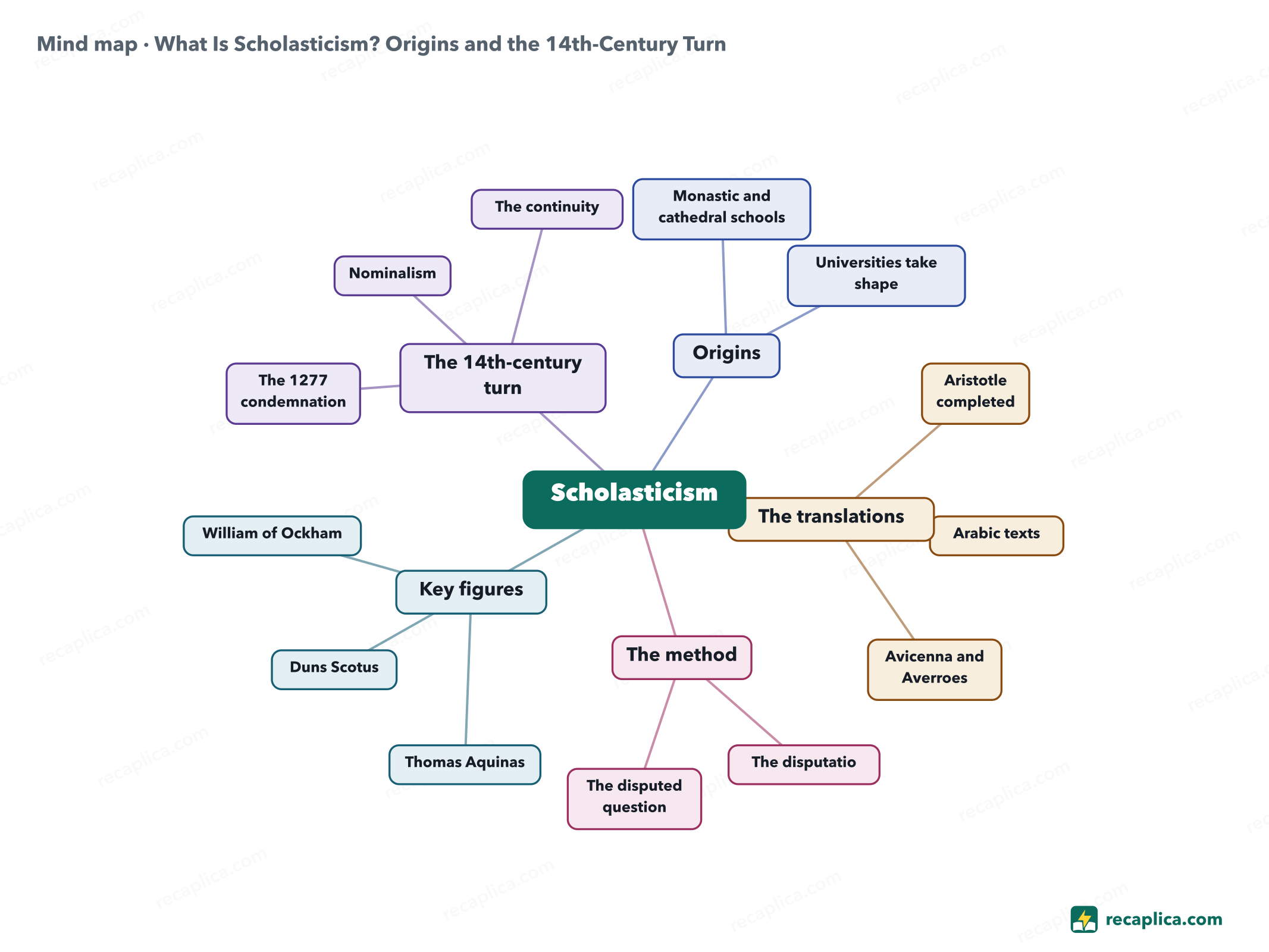
    Mind map: What Is Scholasticism? Origins and the 14th-Century Turn
    • Scholasticism
      • Origins Before the universities
        • Monastic and cathedral schools Between the 9th and 11th centuries
        • Universities take shape Paris and Oxford, around 1200
      • The translations How Aristotle reaches Latin readers
        • Aristotle completed Works Boethius had left untranslated, 12th-13th centuries
        • Arabic texts Translated mainly in Toledo and Sicily
        • Avicenna and Averroes Commentaries on Aristotle, read by Jews and Christians alike
      • The method How debate worked in class
        • The disputatio Question, objections, answer
        • The disputed question The pattern Thomas Aquinas used
      • Key figures
        • Thomas Aquinas Dominican, student of Albert the Great in Paris
        • Duns Scotus Puts divine will at the center of good and evil
        • William of Ockham Nominalist, author of the razor that bears his name
      • The 14th-century turn An internal fracture, with continuity
        • The 1277 condemnation Bishop of Paris, targets Siger of Brabant and Boethius of Dacia
        • Nominalism For Ockham, only individual concepts exist in the mind
        • The continuity The method carries on for centuries, per the Stanford Encyclopedia

    Quiz: test yourself

    Answer the questions to check what you have learned: you get instant feedback and a short explanation.

    Grade 0/10 0/5
    1 Where did medieval philosophical thought begin, before the universities?

    Medieval philosophizing starts in religious settings, first within monastery walls and then in cathedral schools, in a span the Stanford Encyclopedia of Philosophy places between the 9th and 11th centuries.

    2 Which method defines scholasticism, also used by Thomas Aquinas?

    Every article in Aquinas's works opens with a precise question, weighs the opposing arguments, and lands on a firm conclusion: that's the disputatio method described by the Internet Encyclopedia of Philosophy.

    3 Where did many works of Aristotle and the commentaries of Avicenna and Averroes reach Europe from, in the 12th and 13th centuries?

    In the 12th and 13th centuries, mainly in Toledo and Sicily, a wide range of Arabic texts was translated into Latin, including portions of Avicenna and Averroes's commentaries on Aristotle.

    4 What happened in 1277?

    That's the year the bishop of Paris singles out, among others, the positions of Siger of Brabant and Boethius of Dacia (Stanford Encyclopedia of Philosophy).

    5 For William of Ockham, what actually exists when we talk about a concept like 'catness'?

    For Ockham, only the concept in the mind and the word used to express it count: there is no separate 'catness,' just individual cats that resemble one another.

    Answers: 1-A · 2-A · 3-A · 4-A · 5-A

    Flashcards

    Tap the card to flip it and check whether you remember the answer, then move to the next one.

    1 / 7

    Explain it in your own words

    The ultimate test: if you can explain it in simple words, you've truly understood it. Write your explanation, then compare it with the Recap.

    Your explanation is saved only on this device.

    Scholasticism is the method of teaching and reasoning that ran the cathedral schools and then the European universities from the 12th century onward, built to bring Christian faith into conversation with Aristotelian logic. It took hold in Paris and Oxford around 1200 through the disputatio, the back-and-forth of question, objections and answer that Thomas Aquinas would later put to constant use. Through the 1200s, Aristotle's works reached Latin readers both through direct translation and through Arabic, carrying the commentaries of Avicenna and Averroes rendered mainly in Toledo and Sicily. In the 1300s the method went through an internal shake-up, marked by the 1277 condemnation and the nominalism of William of Ockham; university philosophy in Latin nonetheless carried on for centuries.

    Frequently asked questions

    What is scholasticism?

    It's the method of teaching and reasoning developed first in monasteries, then in cathedral schools, and finally practiced at the universities of Paris and Oxford from around 1200 onward: its defining trait is the disputatio, a confrontation between a question and opposing arguments.

    Who is the best-known scholastic philosopher?

    Thomas Aquinas, a Dominican priest who died in 1274, is among the most frequently cited: he chose Dominican life during his studies in Naples, trained under Albert the Great in Paris between 1245 and 1248, and cast his thought in the form of the disputed question.

    What is Occam's razor?

    A criterion attributed to William of Ockham, who died in 1347: among different explanations for the same phenomenon, the simpler one, with the fewest added elements, should be preferred. For Ockham only concepts in the mind count, with individual cats serving as his concrete example.

    Did scholasticism end in the 1300s?

    The century brings a fracture: the 1277 condemnation in Paris and Ockham's nominalism coexist with university activity that, according to the Stanford Encyclopedia of Philosophy, carries on for a long time.

    What role did Aristotle play in scholasticism?

    A decisive one: in the 12th and 13th centuries his body of work is completed in Latin, through fresh direct translations and through Arabic texts rendered into Latin mainly between Toledo and Sicily, with the commentaries of Avicenna and Averroes following close behind. Much of scholastic thought is built on this foundation.

    Sources

    • Stanford Encyclopedia of Philosophy, «Medieval Philosophy»
    • Stanford Encyclopedia of Philosophy, «William of Ockham»
    • Internet Encyclopedia of Philosophy, «Thomas Aquinas»
    • Stanford Encyclopedia of Philosophy, «Thomas Aquinas»

    Every Recap goes through an independent review before publication.

    Every evening, the day's new Recaps on our Telegram channel. Join the channel →

    Keep learning

    • History What Is Existentialism? Heidegger, Being and Time, and Dasein Existentialism is a current of twentieth-century philosophy centered on human existence, freedom and the search for meaning. According to the Stanford Encyclopedia of Philosophy, the German philosopher Martin Heidegger (1889-1976) shaped that current more than almost anyone else, even though he never accepted the label. In 1927 he published Being and Time, his major work, where he introduced the concept of Dasein: the human being as the one entity that questions its own existence. That book influenced Jean-Paul Sartre's existentialism, but in 1946, in the Letter on Humanism, Heidegger openly broke with Sartre and refused to be called an existentialist. In 1933 he was elected rector of the University of Freiburg and became a Nazi party member, keeping that membership until the regime fell - an episode Heidegger himself later denied or played down more than once. Read the Recap →
    • History What Is Phenomenology? Husserl's Philosophy Explained Edmund Husserl founded phenomenology as a philosophical discipline around 1900-1901, with his Logical Investigations. His method starts from the epoché, a suspension of our everyday, unquestioning stance toward the world, and moves toward phenomenological reduction: studying how things appear to consciousness rather than what they are in themselves. At the center sits intentionality, the idea that every experience is always an experience of something specific, whether hoping, perceiving, or desiring. The method Husserl built carried into the 20th century through Heidegger, Sartre, and Merleau-Ponty, moving from German philosophy into French philosophy along the way. Read the Recap →
    • History Legal Positivism: What It Is, from Austin to Kelsen and Hart According to the Stanford Encyclopedia of Philosophy, legal positivism measures legal validity against observable social facts, keeping moral judgment on a separate track. Its roots lie in Hobbes and Hume. Jeremy Bentham produced the theory's first full account, which John Austin later took up and spread: for Austin, a rule is law only when a sovereign commands it under threat of punishment. In the twentieth century, Hans Kelsen grounded legal validity in a hierarchy that traces back to a presupposed basic norm, while Herbert Hart located it instead in a rule of recognition actually followed by judges and officials. Natural law theory takes the opposite view: an unjust law is not really a law. Legal positivism disagrees — a law stays valid even when it is morally unjust, as long as it was made the way the system requires. Read the Recap →

    recaplica

    Clear in 30 seconds, yours in 10 minutes.

    Recaps Mind maps Request a Recap Telegram channel Mind map maker Our method About Privacy & cookies Legal notes & terms of use

    © 2026 Recaplica · A project by Curi S.r.l. — VAT IT05472000750

    Statistics, only if you say so

    To learn which Recaps help most we would use Google Analytics, with aggregate, anonymous data. It starts only with your OK, and you can change your mind anytime. Privacy policy