Skip to content
recaplica

    One moment: security check

    Cloudflare wants to make sure you're not a robot. Tick the box below and your search will continue on its own.

    IT
    recaplica Augustinians: Who They Are and How the Order of Saint Augustine Began
    © 2026 Recaplica · recaplica.com — All rights reserved
    Home › History

    Augustinians: Who They Are and How the Order of Saint Augustine Began

    By Recaplica Newsroom · Updated on October 11, 2026

    What to print

    Page numbers appear when printing with default margins.

    Slides

    Choose a cut

    Flash10 slidesThe essential thread, to present in classFull10 slidesEvery chapter and the deeper detail

    Both come with speaker notes.

    Telegram channel
    recaplica Clear in 30 seconds, yours in 10 minutes.
    In 30 seconds Key points Figures Deep dive Slides Myths Mind map Quiz Flashcards FAQ

    In 30 seconds quick read

    The Augustinians are the friars of the Order of Saint Augustine, born in 1244 when communities of Tuscan hermits asked Pope Innocent IV for a shared rule. In 1256 the Grand Union merged four separate hermit branches into a single order, through the bull "Licet Ecclesiae Catholicae". They follow the Rule written by Augustine of Hippo, centered on common life and humility. Within a century the order already counted 8,000 friars across several countries, and over time it opened up to preaching as well.

    Key Points

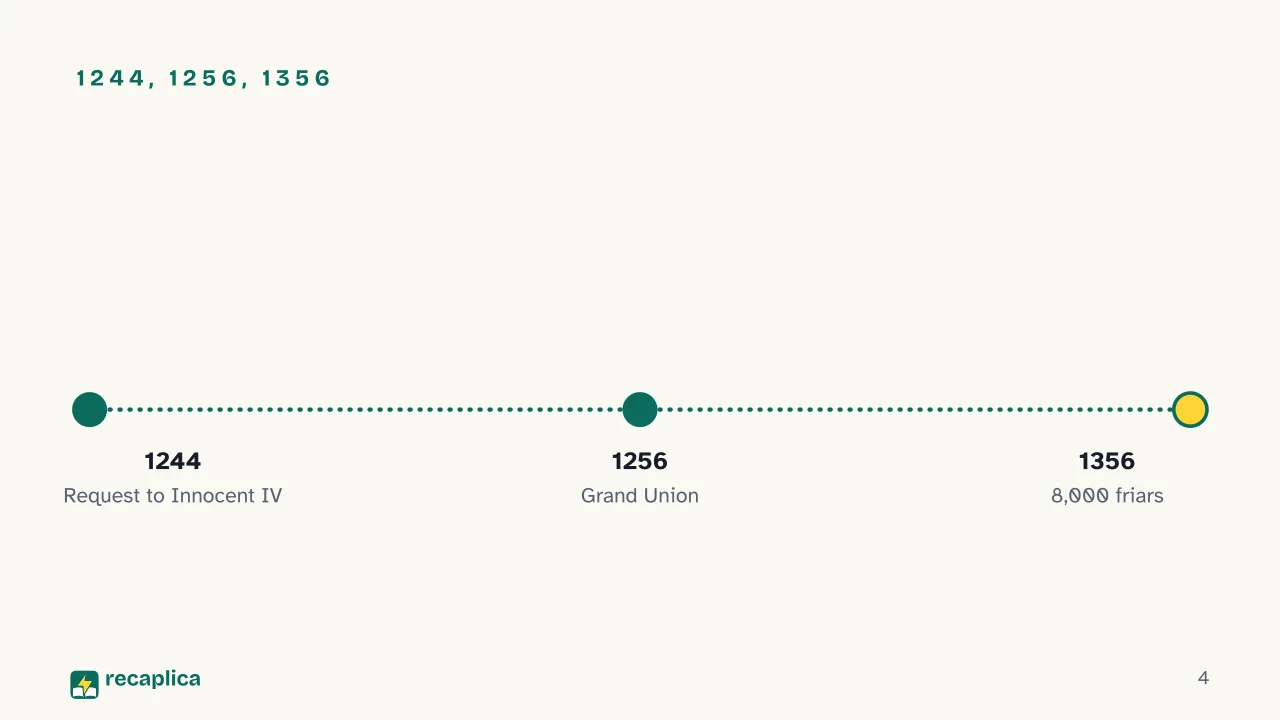
    • In 1244 communities of Tuscan hermits asked Pope Innocent IV for a shared rule and a single superior.
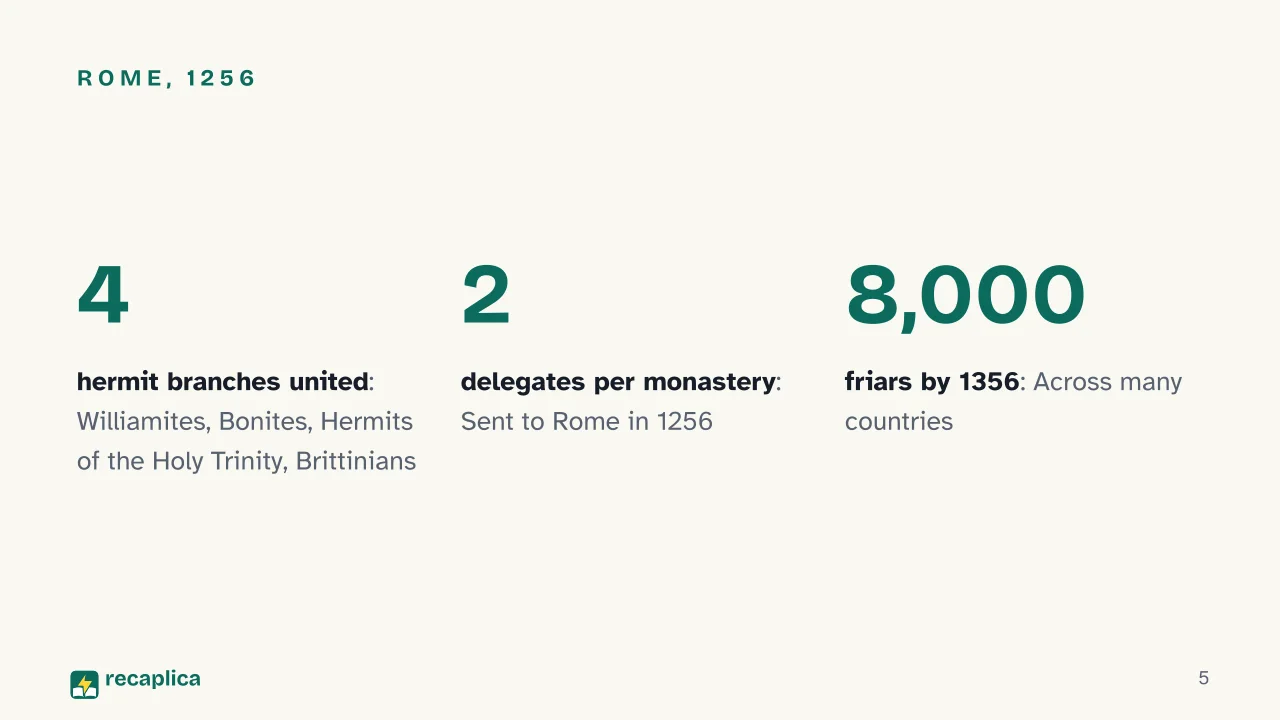
    • The Grand Union of 1256 brought together four hermit branches, the Williamites, the Bonites, the Hermits of the Holy Trinity and the Brittinians, into one order.
    • The bull "Licet Ecclesiae Catholicae", issued in 1256, is the order's formal founding act.
    • Within a century of the Grand Union, by around 1356, the order already counted 8,000 friars across many countries.
    • The Rule of Saint Augustine puts common life, shared property and humility at its center.
    • Starting out as hermit communities, the order gradually opened up to preaching and pastoral work as well.

    Key figures

    • 8,000 friars Within a century of the Grand Union, by around 1356, the order counted roughly 8,000 friars across many countries. Source: Augustinian.org, Order of Saint Augustine
    • 1256 Year of the bull "Licet Ecclesiae Catholicae", which united four hermit branches into the Order of Saint Augustine. Sources disagree on the exact day (4 May according to the Catholic Encyclopedia, 9 April according to other accounts). Source: New Advent, Catholic Encyclopedia (1910); Encyclopedia.com

    Deep Dive

    From Tuscan Hermits to a Single Order

    According to the website of the Augustinian province (augustinian.org), in 1244 various hermit communities scattered across Tuscany asked Pope Innocent IV to be brought together under one Rule and one superior general. The pope entrusted those communities with the Rule written centuries earlier by Augustine of Hippo and asked representatives of the individual houses, meeting in chapter, to elect a prior general — an elective mechanism quite different from the one that elects the pope in conclave. That is the order’s founding act: not a creation from nothing, but the union of groups that already existed.

    The setting is thirteenth-century Italy, the age of city-states and the first mendicant orders: the Recap on the Middle Ages covers that context in more detail.

    The Grand Union of 1256

    Twelve years later, in 1256, the process widens. According to the 1910 Catholic Encyclopedia (New Advent), the bull “Licet Ecclesiae Catholicae” is the formal founding act of the Order of the Hermits of Saint Augustine: every hermit monastery involved sent two delegates to Rome, under the presidency of Cardinal Riccardo Annibaldi. Sources disagree on the bull’s exact day (4 May according to the Catholic Encyclopedia, 9 April according to other historical accounts): this Recap reports only the year, on which all sources agree. That meeting merged four distinct hermit branches, the Williamites, the Bonites (also called Giamboniti), the Hermits of the Holy Trinity and the Brittinians, into a single order. Other, smaller congregations, such as the Friars of the Penance of Christ, joined one of the larger branches before or during the process, though the source does not fix a precise year for these individual mergers.

    Practical example: a novice entering one of the Brittinian monasteries before 1256 followed the customs of his own house. After the Grand Union, that same community answered to a shared prior general and to the Rule of Saint Augustine, now common to the Williamites and to the other newly united branches.

    The Rule of Saint Augustine

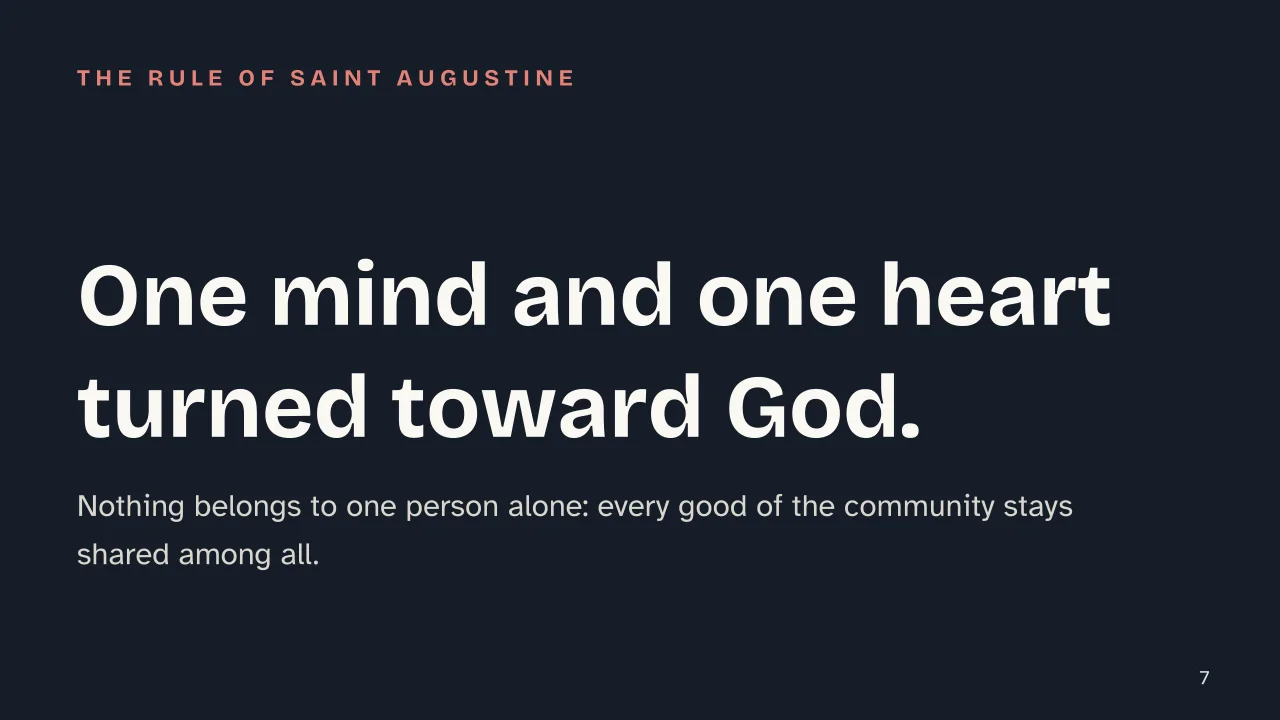
    The Rule, as EWTN tells it, opens by asking the community to share a single purpose and a single devotion, centered on God. It asks them to regard nothing as personal property, but to hold everything in common; it sets love for God, and immediately after, love for one’s neighbor, as the commandments on which community life rests. In fraternal correction it separates love for the person who errs from condemnation of the fault itself, a principle meant for everyday life among friars.

    One passage of the Rule asks members to find a reason for pride in the company of their poor brothers, not in the rank of their own family of origin. The warning that follows is that pride creeps in quietly, and can undo even good deeds.

    From Hermits to Mendicant Friars

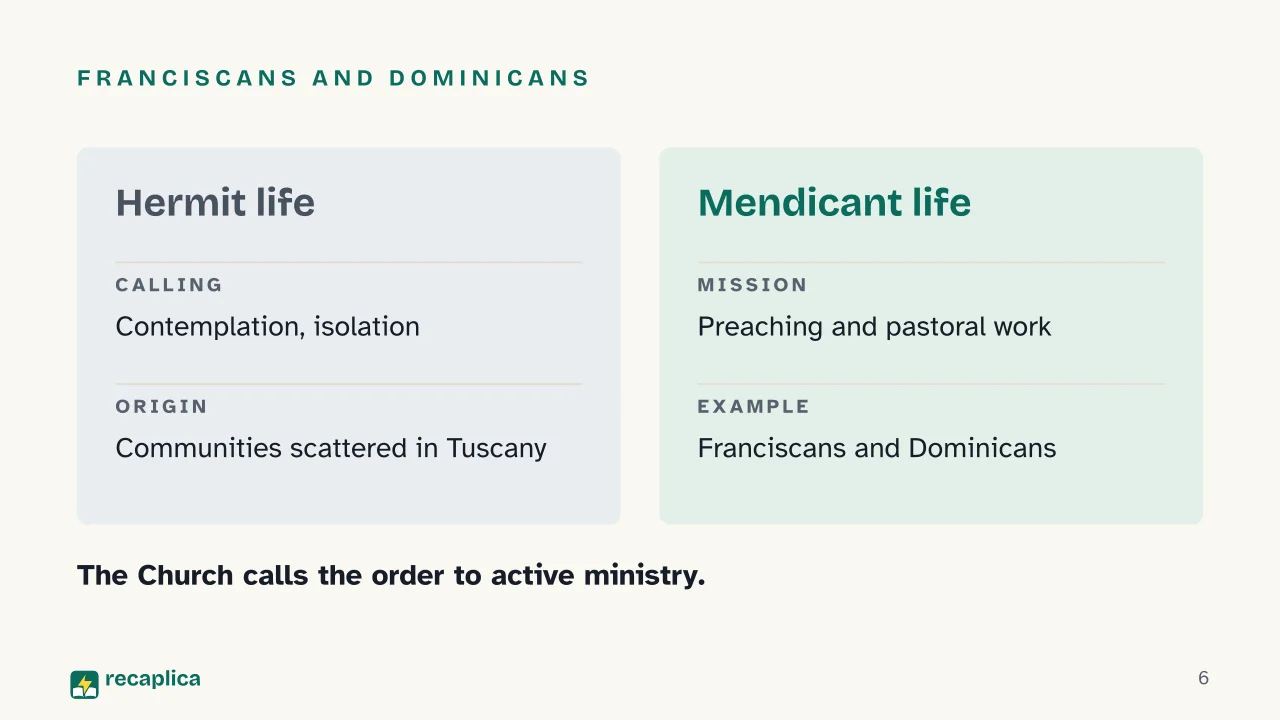
    The hermit imprint of the earliest groups gradually loosened, making room for a blend of contemplation and pastoral duties, once the Church called the order into the mendicant movement. According to the Catholic Encyclopedia, the shift was also prompted by the good example set by the Franciscans and Dominicans, already active in preaching; the source gives no precise year for this evolution.

    A Century Later: 8,000 Friars

    According to augustinian.org, within a century of the Grand Union of 1256, so by around 1356, the order already counted 8,000 friars across many countries. That growth came long after the death of Augustine of Hippo, the philosopher and bishop from whom the order takes its name and its Rule: readers looking for his biography and his thought can find the full picture in the Recap on Augustine of Hippo.

    A Later Episode: Erfurt and the Reformation

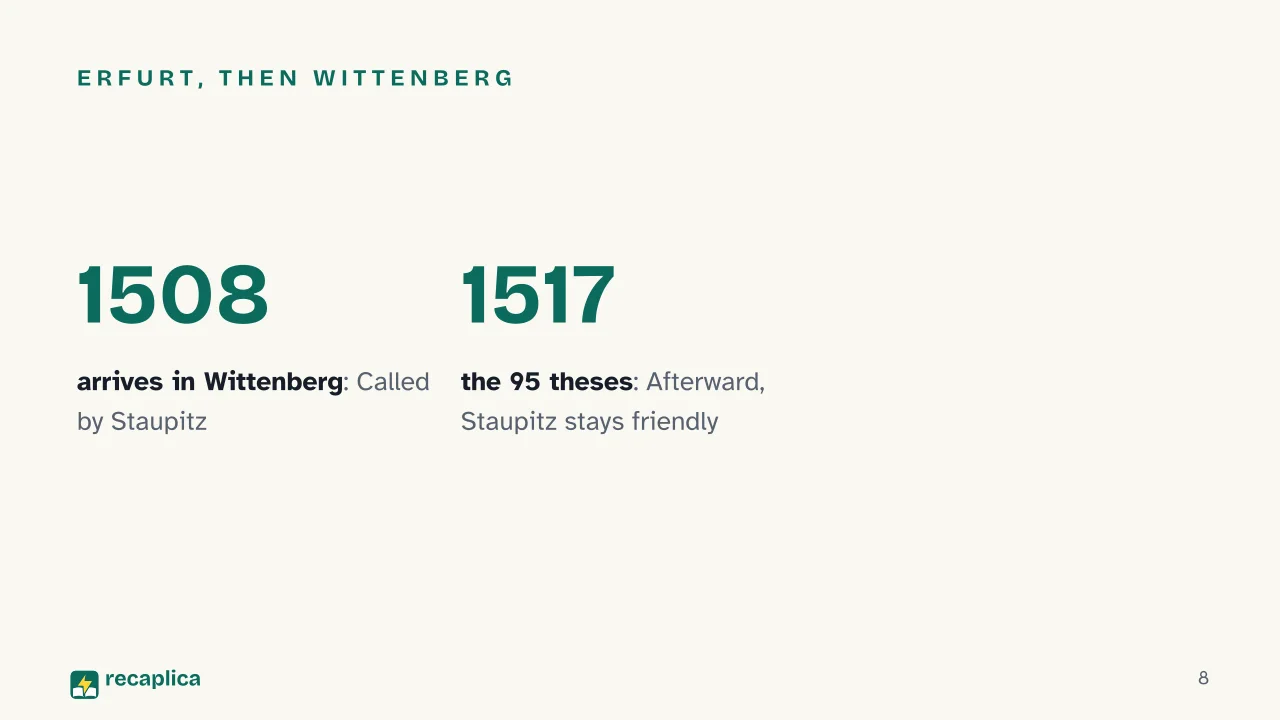
    Much later, the order faced an internal crisis of its own over reform: seven houses, including Erfurt, refused to obey a reform directive, in the context of events tied to Johann von Staupitz, vicar general of the reformed Augustinian congregation in Germany. It was Staupitz, who had come to know Martin Luther at Erfurt, who called him to Wittenberg in 1508. Even after 1517, the year of the 95 theses, Staupitz kept friendly feelings toward Luther: he read Luther’s initiatives as an attack on abuses within the Church, not as a break. Luther’s path from Augustinian friar to reformer is told in full in the Recap on Martin Luther and the Protestant Reformation.

    Slide deck

    Slides ready to download and make your own in PowerPoint or Google Slides, with speaker notes. Pick the Flash cut or the Full one.
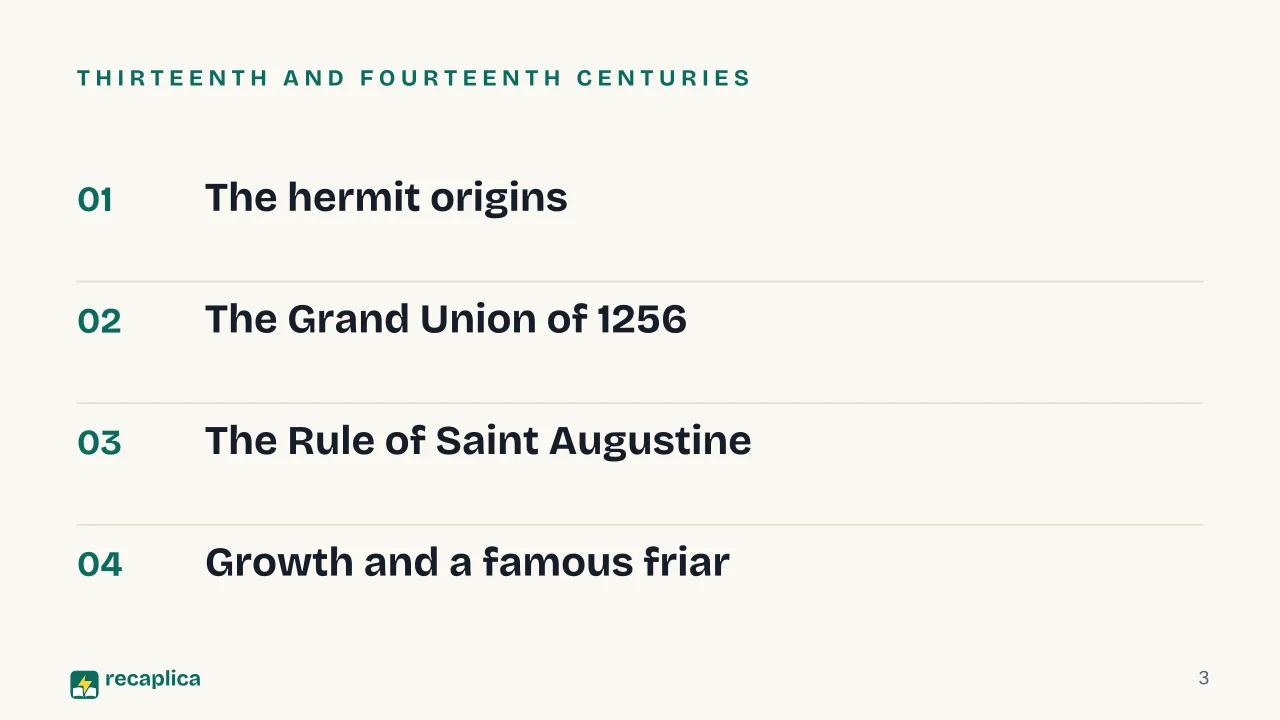
    Slide 1 of the presentation on Augustinians: AugustiniansSlide 2 of the presentation on Augustinians: Who were the Augustinians before they became a single order?Slide 3 of the presentation on Augustinians: Thirteenth and fourteenth centuriesSlide 4 of the presentation on Augustinians: 1244, 1256, 1356Slide 5 of the presentation on Augustinians: Rome, 1256Slide 6 of the presentation on Augustinians: Franciscans and DominicansSlide 7 of the presentation on Augustinians: One mind and one heart turned toward God.Slide 8 of the presentation on Augustinians: Erfurt, then WittenbergSlide 9 of the presentation on Augustinians: In what year was the Grand Union's bull signed?Slide 10 of the presentation on Augustinians: Now for the review
    Flash10 slidesThe essential thread, to present in classFull10 slidesEvery chapter and the deeper detail

    Common myths

    • ✗ Myth The Augustinians are a branch of the Franciscan friars.

      ✓ Reality They are a distinct order, born from the union of hermit communities around the Rule written by Augustine of Hippo; the resemblance to the Franciscans concerns the mendicant lifestyle adopted later, not the order's origin.

    • ✗ Myth The order was born already united, in one single moment, in 1256.

      ✓ Reality The 1256 bull united hermit groups that had already existed for some time, the Williamites, the Bonites, the Hermits of the Holy Trinity and the Brittinians, who up to that point lived apart, each with its own customs.

    • ✗ Myth Martin Luther broke with the Church the moment he left his life as an Augustinian friar.

      ✓ Reality Luther remained an Augustinian friar well beyond the 95 theses of 1517: his superior Staupitz, who had called him to Wittenberg in 1508, kept reading his initiatives as criticism of abuses inside the Church, not as a break.

    Mind map

    Drag the background to move around and the nodes to reposition them; use − and + to collapse and expand branches.
    Customize
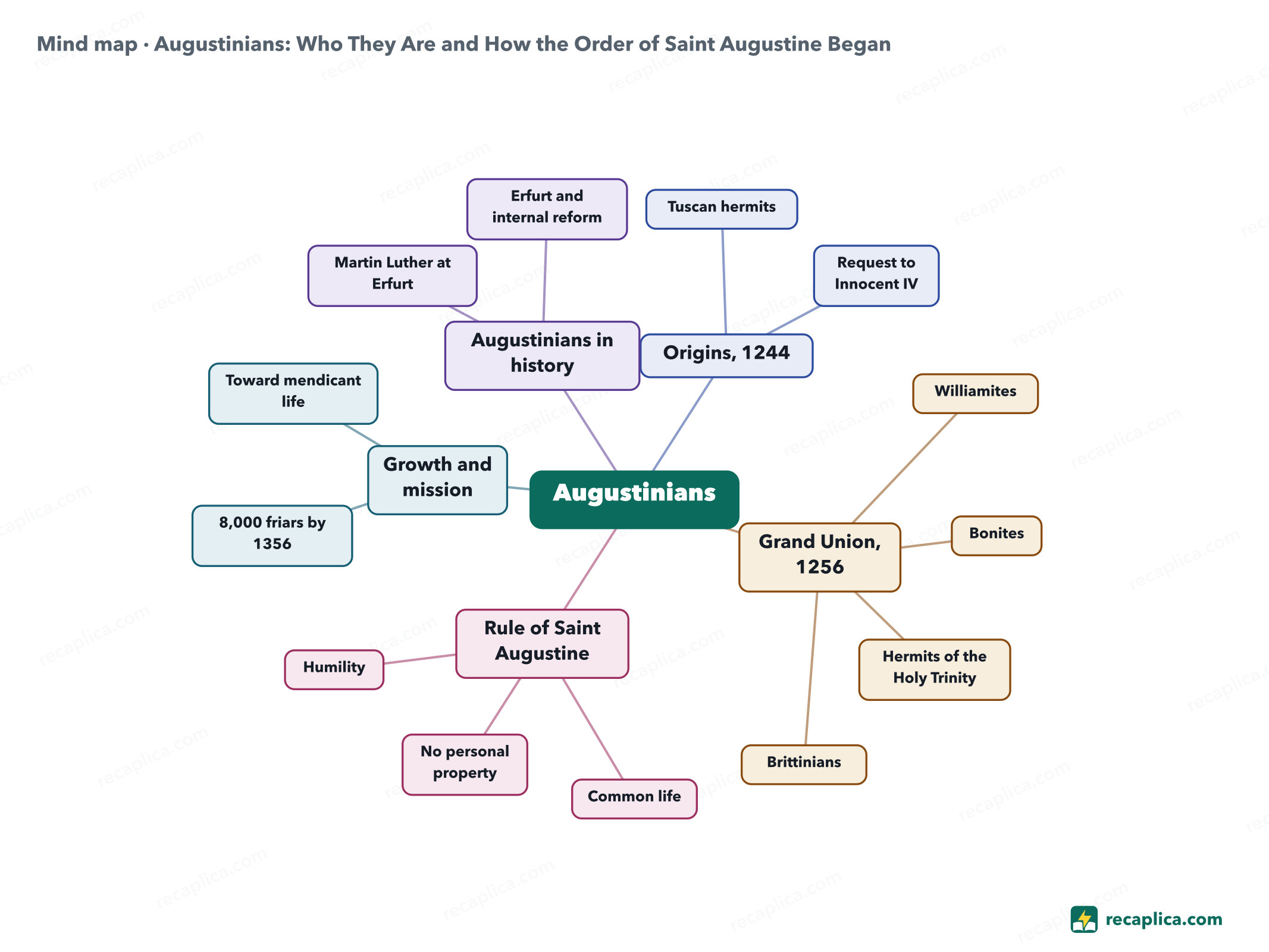
    Mind map: Augustinians: Who They Are and How the Order of Saint Augustine Began
    • Augustinians
      • Origins, 1244
        • Tuscan hermits Communities scattered across Tuscany
        • Request to Innocent IV One shared rule, one superior
      • Grand Union, 1256
        • Williamites
        • Bonites
        • Hermits of the Holy Trinity
        • Brittinians
      • Rule of Saint Augustine
        • Common life One mind and one heart
        • No personal property
        • Humility Against quiet pride
      • Growth and mission
        • 8,000 friars by 1356
        • Toward mendicant life Preaching and pastoral work
      • Augustinians in history
        • Martin Luther at Erfurt Called to Wittenberg in 1508
        • Erfurt and internal reform Seven houses defied a directive

    Quiz: test yourself

    Answer the questions to check what you have learned: you get instant feedback and a short explanation.

    Grade 0/10 0/5
    1 In what year was the Order of Saint Augustine born?

    In 1244 communities of Tuscan hermits asked Pope Innocent IV to be joined under a shared Rule and a single prior general.

    2 What was the Grand Union?

    In 1256 the bull "Licet Ecclesiae Catholicae" united the Williamites, the Bonites, the Hermits of the Holy Trinity and the Brittinians into a single order.

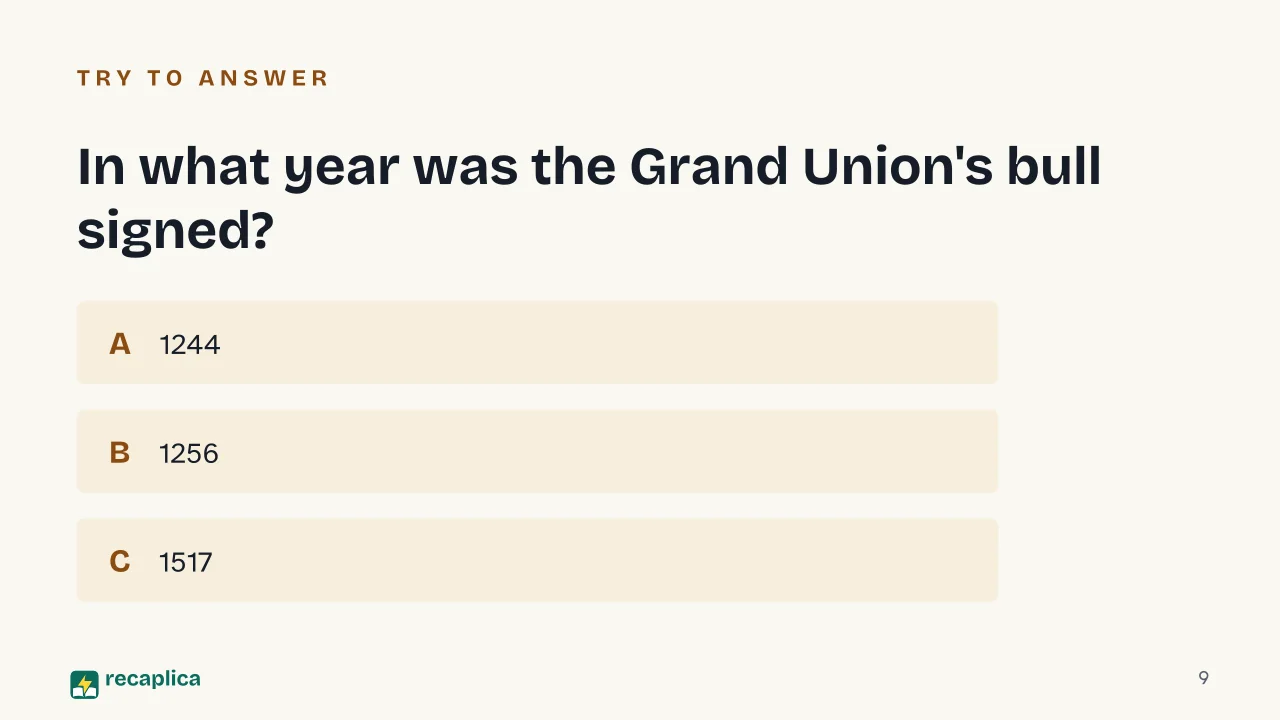
    3 True or false: the bull "Licet Ecclesiae Catholicae" was issued in 1517.

    It was issued in 1256; 1517 is the year of Martin Luther's 95 theses, a later and separate episode from the order's founding.

    4 Which rule does the Augustinian order follow?

    The order follows the text written by Augustine of Hippo, which asks members to live together without personal property and with humility toward one another.

    5 Which friary was Martin Luther living in before the Reformation?

    Luther was an Augustinian friar at Erfurt; in 1508 Johann von Staupitz called him to Wittenberg.

    Answers: 1-A · 2-A · 3-B · 4-A · 5-A

    Flashcards

    Tap the card to flip it and check whether you remember the answer, then move to the next one.

    1 / 7

    Explain it in your own words

    The ultimate test: if you can explain it in simple words, you've truly understood it. Write your explanation, then compare it with the Recap.

    Your explanation is saved only on this device.

    The Augustinians are the friars of the Order of Saint Augustine, born in 1244 when communities of Tuscan hermits asked Pope Innocent IV for a shared rule. In 1256 the Grand Union merged four separate hermit branches into a single order, through the bull "Licet Ecclesiae Catholicae". They follow the Rule written by Augustine of Hippo, centered on common life and humility. Within a century the order already counted 8,000 friars across several countries, and over time it opened up to preaching as well.

    Frequently asked questions

    Where does the name "Augustinians" come from?

    From the order's adoption of the Rule written by Augustine of Hippo: its historical name is the Order of the Hermits of Saint Augustine.

    What does the Rule of Saint Augustine ask, in short?

    It asks members to live in community with one mind and one heart, to hold no personal property, and to separate, in fraternal correction, love for the person from condemnation of the fault.

    Why is Martin Luther linked to the Augustinians?

    Because he was an Augustinian friar at the Erfurt monastery before becoming the Protestant reformer; it was his superior Johann von Staupitz who called him to Wittenberg in 1508.

    How many hermit branches joined in the Grand Union of 1256?

    Four: the Williamites, the Bonites (also called Giamboniti), the Hermits of the Holy Trinity and the Brittinians, plus smaller congregations folded into one of the larger branches.

    Sources

    • The Order of St. Augustine, About the Order
    • Hermits of St. Augustine, Catholic Encyclopedia (1910)
    • Rule of St. Augustine, EWTN

    Every Recap goes through an independent review before publication.

    Every evening, the day's new Recaps on our Telegram channel. Join the channel →

    Keep learning

    • History What Is Existentialism? Heidegger, Being and Time, and Dasein Existentialism is a current of twentieth-century philosophy centered on human existence, freedom and the search for meaning. According to the Stanford Encyclopedia of Philosophy, the German philosopher Martin Heidegger (1889-1976) shaped that current more than almost anyone else, even though he never accepted the label. In 1927 he published Being and Time, his major work, where he introduced the concept of Dasein: the human being as the one entity that questions its own existence. That book influenced Jean-Paul Sartre's existentialism, but in 1946, in the Letter on Humanism, Heidegger openly broke with Sartre and refused to be called an existentialist. In 1933 he was elected rector of the University of Freiburg and became a Nazi party member, keeping that membership until the regime fell - an episode Heidegger himself later denied or played down more than once. Read the Recap →
    • History What Is Phenomenology? Husserl's Philosophy Explained Edmund Husserl founded phenomenology as a philosophical discipline around 1900-1901, with his Logical Investigations. His method starts from the epoché, a suspension of our everyday, unquestioning stance toward the world, and moves toward phenomenological reduction: studying how things appear to consciousness rather than what they are in themselves. At the center sits intentionality, the idea that every experience is always an experience of something specific, whether hoping, perceiving, or desiring. The method Husserl built carried into the 20th century through Heidegger, Sartre, and Merleau-Ponty, moving from German philosophy into French philosophy along the way. Read the Recap →
    • History Legal Positivism: What It Is, from Austin to Kelsen and Hart According to the Stanford Encyclopedia of Philosophy, legal positivism measures legal validity against observable social facts, keeping moral judgment on a separate track. Its roots lie in Hobbes and Hume. Jeremy Bentham produced the theory's first full account, which John Austin later took up and spread: for Austin, a rule is law only when a sovereign commands it under threat of punishment. In the twentieth century, Hans Kelsen grounded legal validity in a hierarchy that traces back to a presupposed basic norm, while Herbert Hart located it instead in a rule of recognition actually followed by judges and officials. Natural law theory takes the opposite view: an unjust law is not really a law. Legal positivism disagrees — a law stays valid even when it is morally unjust, as long as it was made the way the system requires. Read the Recap →

    recaplica

    Clear in 30 seconds, yours in 10 minutes.

    Recaps Mind maps Request a Recap Telegram channel Mind map maker Our method About Privacy & cookies Legal notes & terms of use

    © 2026 Recaplica · A project by Curi S.r.l. — VAT IT05472000750

    Statistics, only if you say so

    To learn which Recaps help most we would use Google Analytics, with aggregate, anonymous data. It starts only with your OK, and you can change your mind anytime. Privacy policy