|
recaplica
Medieval Philosophy: History, Schools and Key Thinkers |
| © 2026 Recaplica · recaplica.com — All rights reserved |
Medieval Philosophy: History, Schools and Key ThinkersWhat to print Page numbers appear when printing with default margins. SlidesChoose a cut Flash10 slidesThe essential thread, to present in classFull14 slidesEvery chapter and the deeper detailBoth come with speaker notes. In 30 seconds quick readMedieval philosophy, in the most widely shared periodization, spans the years from 500 to 1500, though some historians push the start earlier or the end later. It is not a single Latin-language tradition that begins with Augustine of Hippo: it also includes Byzantine Christians who wrote in Greek, Muslims (and some Christians) who wrote in Arabic, and Jewish thinkers who wrote in Arabic or Hebrew. Much of this thought took the form of commentary on older texts, a genre that routinely went well beyond plain explanation. Between the 8th and 10th centuries, Greek works were rendered into Arabic; between the 12th and 13th centuries they moved into Latin, above all in Toledo and Sicily, carrying figures such as Avicenna, Averroes and Maimonides into Europe. Key Points
Key figures
Deep DiveFour centuries, four language traditionsIn current historiographical use, according to the Stanford Encyclopedia of Philosophy, the label “medieval philosophy” is not limited to Latin thinkers: it also covers Byzantine authors writing in Greek, scholars of the Islamic world writing in Arabic, and Jewish philosophers who wrote in Arabic or Hebrew. Most scholars place the start of this period in 500 and its close in 1500, though the exact boundaries stay open to debate: in Latin universities, on some readings, this kind of philosophy keeps going until around 1700, when the new science and Cartesian thought finally reshape the curriculum. A large part of this long stretch is built around a specific method, commentary on older and revered texts: the same root that grows into scholasticism, covered in full in the Recap on Scholasticism. The Middle Ages work, in this sense, as the setting for an ongoing conversation with antiquity, not a break from it. Latin patristics and the commentary methodThe Latin patristic tradition looks to Augustine of Hippo, born in 354 and dead in 430, as its starting point: some chronologies treat him as the single most influential thinker in that tradition. His thought takes shape inside the patristic world, the same setting the page on Augustine of Hippo explores more closely. Much of the best medieval philosophy grew this way, in dialogue with earlier texts. A commentary would often end up far from a plain paraphrase of the source.
Arabic philosophy, from Baghdad to ToledoBetween the 8th century and the early 10th, much of the Greek heritage of scientific and philosophical texts was translated into Arabic. Translations of works by al-Kindi, al-Farabi, Avicenna and Greek texts carried through Arabic gathered full momentum in Toledo in the second half of the 12th century, and within about a hundred years a large body of Arabic texts, 131 according to a recent publication, reached Latin. Avicenna, whose Arabic name is Ibn Sina, was born around 970 and died in 1037; within his own culture, only Aristotle ranked above him in philosophy and medicine, and the title Preeminent Master reflected that standing. His main work, the Book of Healing, holds science and philosophy together in a single construction. Averroes (Ibn Rushd), born in Cordoba in 1126 and dead in Marrakesh in 1198, chose instead to put his energy into commentaries on Aristotle, convinced that no one had yet matched those results: by the 1230s, Latin Europe was already calling him simply the Commentator. Latin translations of Averroes’s commentaries reached the newly founded European universities only some thirty years after his death. In 1255 a ruling by the University of Paris arts faculty required students to read the whole known body of Aristotle, a decision that did a great deal to turn Averroes’s commentaries into the standard secondary literature of Latin university culture. Jewish philosophy, from Cordoba to FustatMoses ben Maimon, known as Maimonides, was born in Cordoba in 1138 into a prominent family: he is, for the medieval Jewish philosophical tradition, its most influential name. In 1148 the Almohads invaded the region and gave non-Muslims a choice between conversion, exile or death; the family had to leave Cordoba and, after a long and uncertain journey, reached Fez, in Morocco, by 1160, before settling in Egypt, in Fustat, in 1166, where Maimonides spent the rest of his life. With the Mishneh Torah, his large-scale codification of Jewish law, Maimonides established himself as a thinker of historic scale. The Guide for the Perplexed, completed in 1190, gathers instead his broader philosophical arguments. Maimonides’s thought was strongly shaped by the Neoplatonized Aristotelianism common in the Islamic circles of his time, the same legacy traced on the page about Neoplatonism, even as he set himself apart from the prevailing currents of that thought. After his death in 1204, Arabic-language Jewish philosophy died out in the Islamic world, then found new life in Hebrew: the Jewish communities of Christian Europe revived it through translation work from Arabic. Slide deckSlides ready to download and make your own in PowerPoint or Google Slides, with speaker notes. Pick the Flash cut or the Full one.   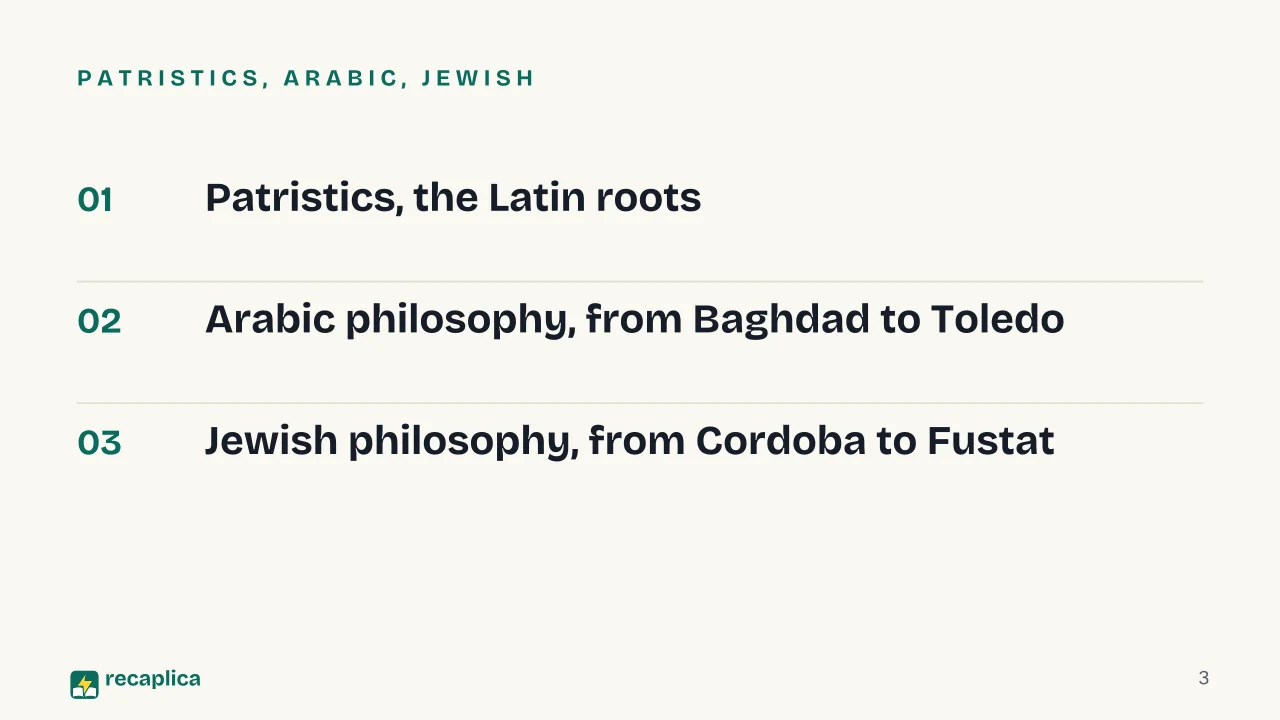  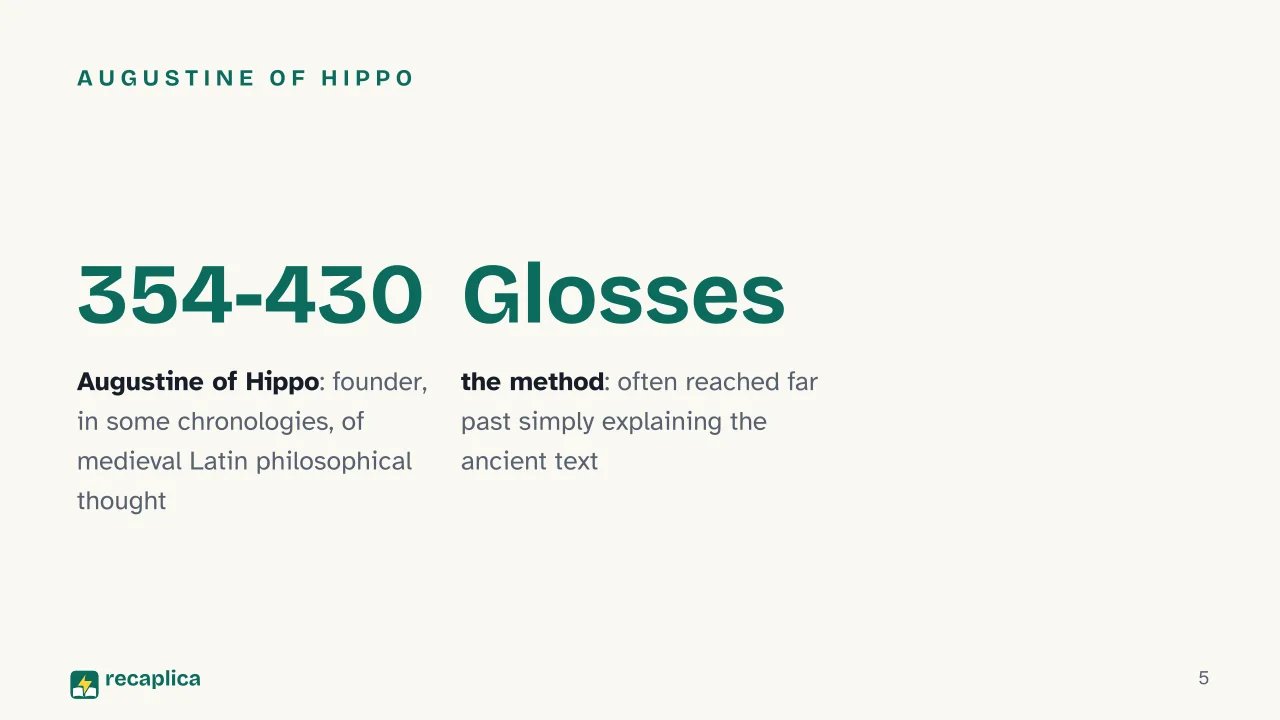  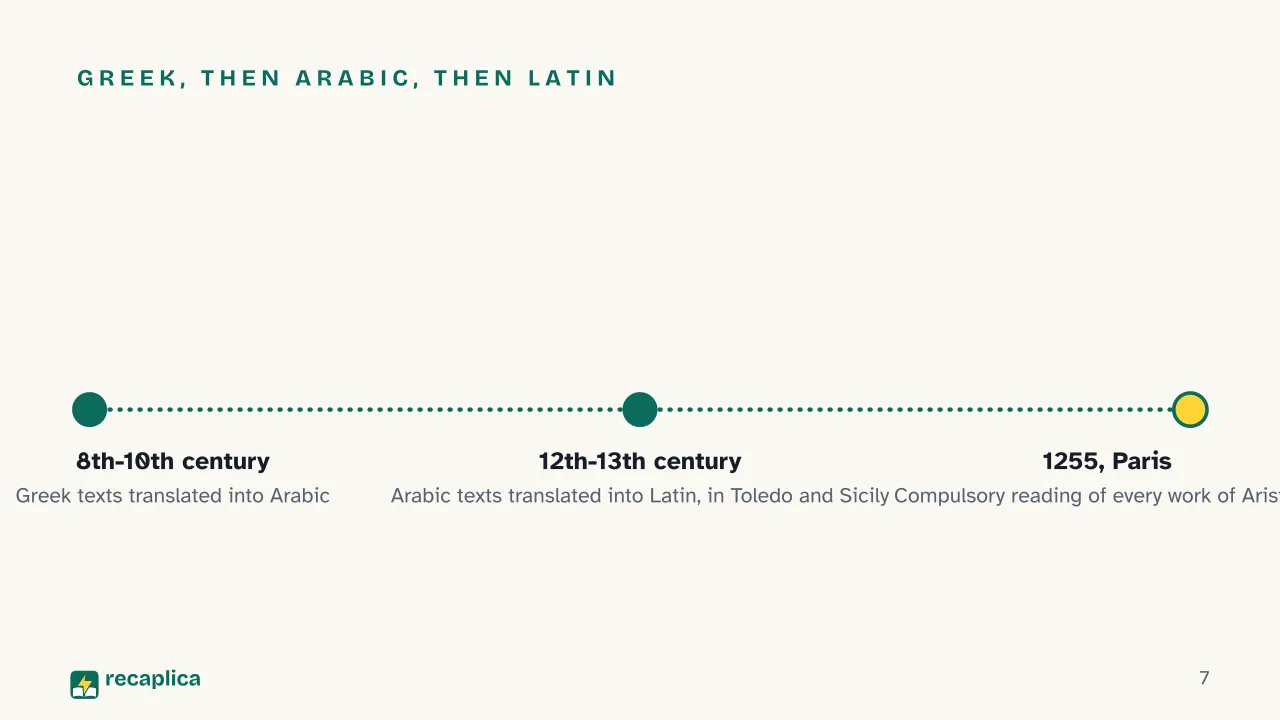 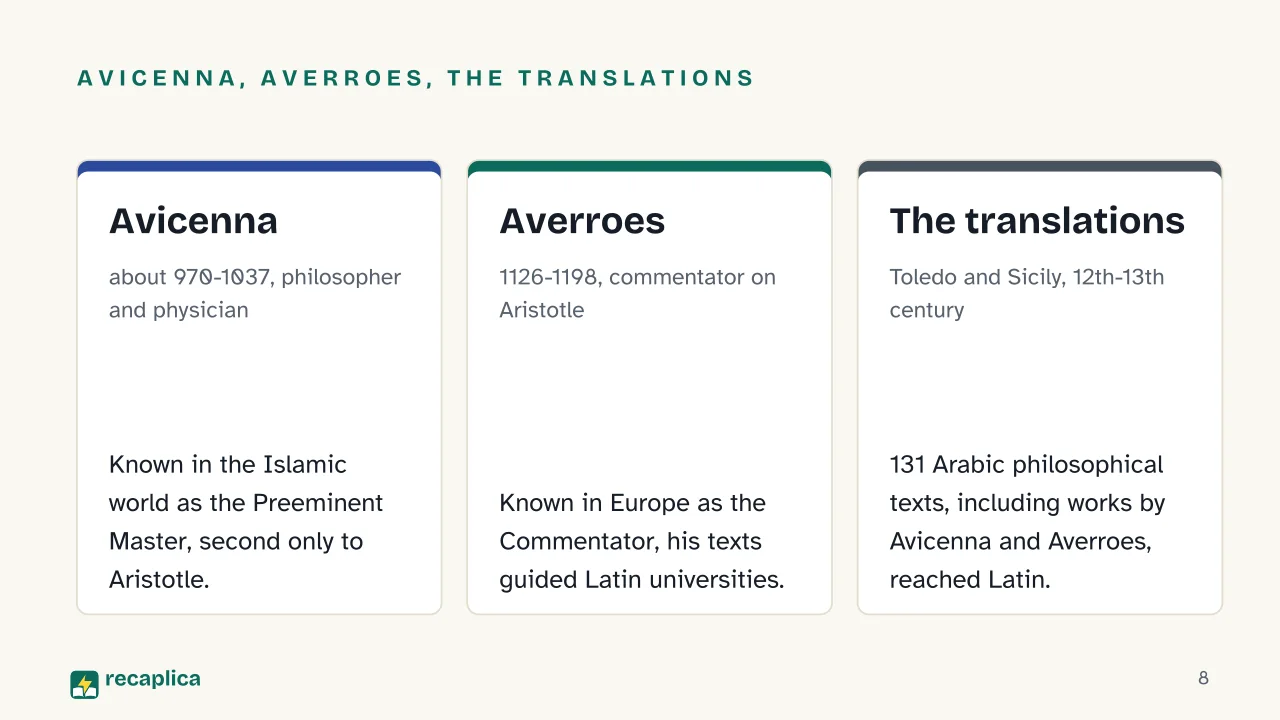  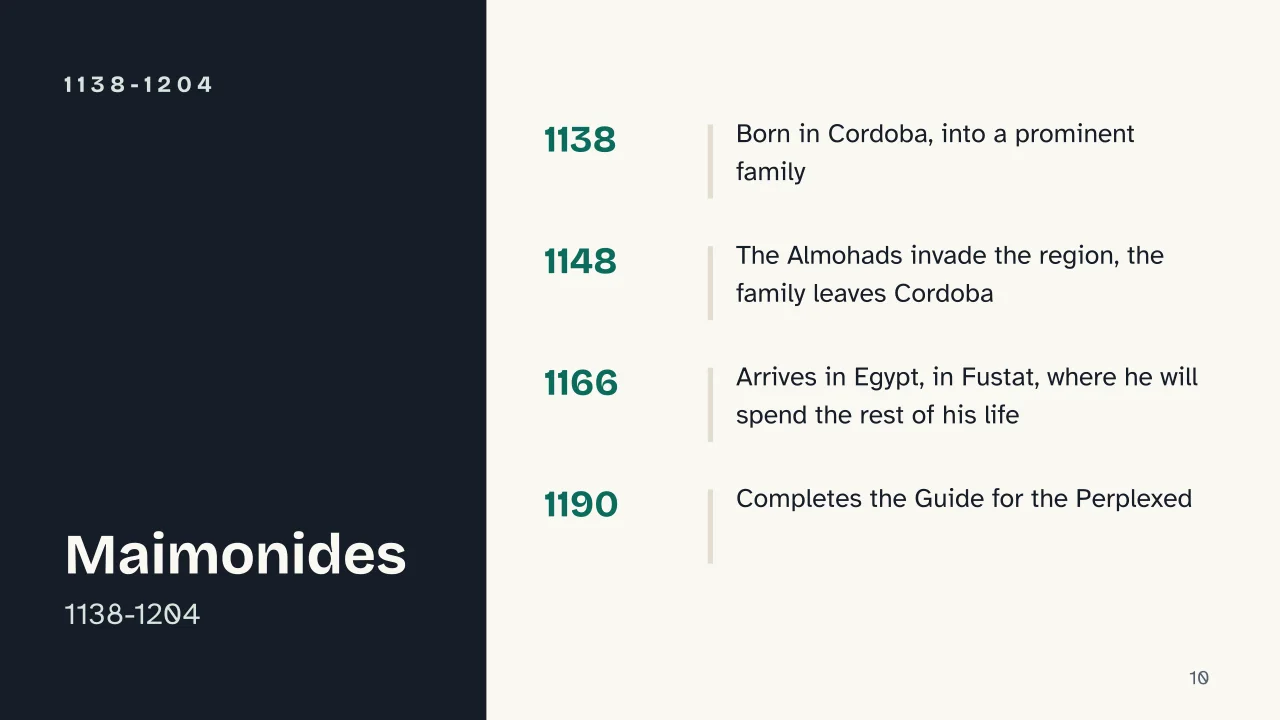  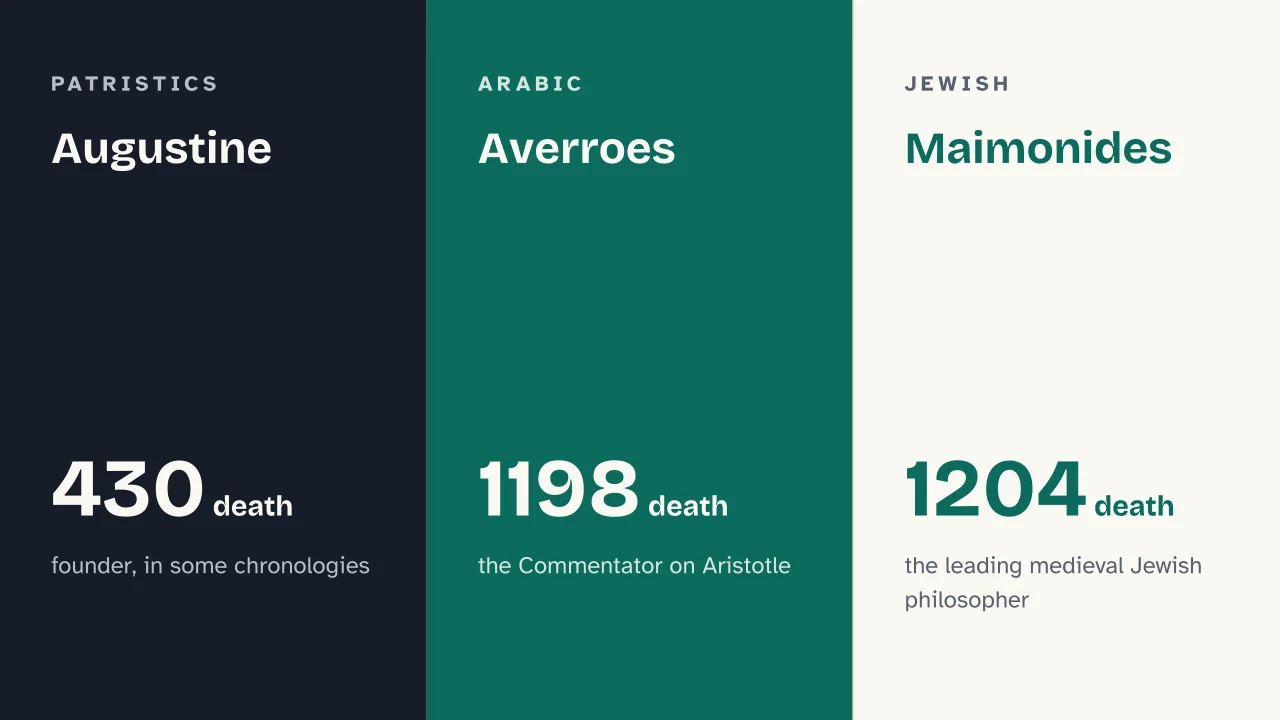 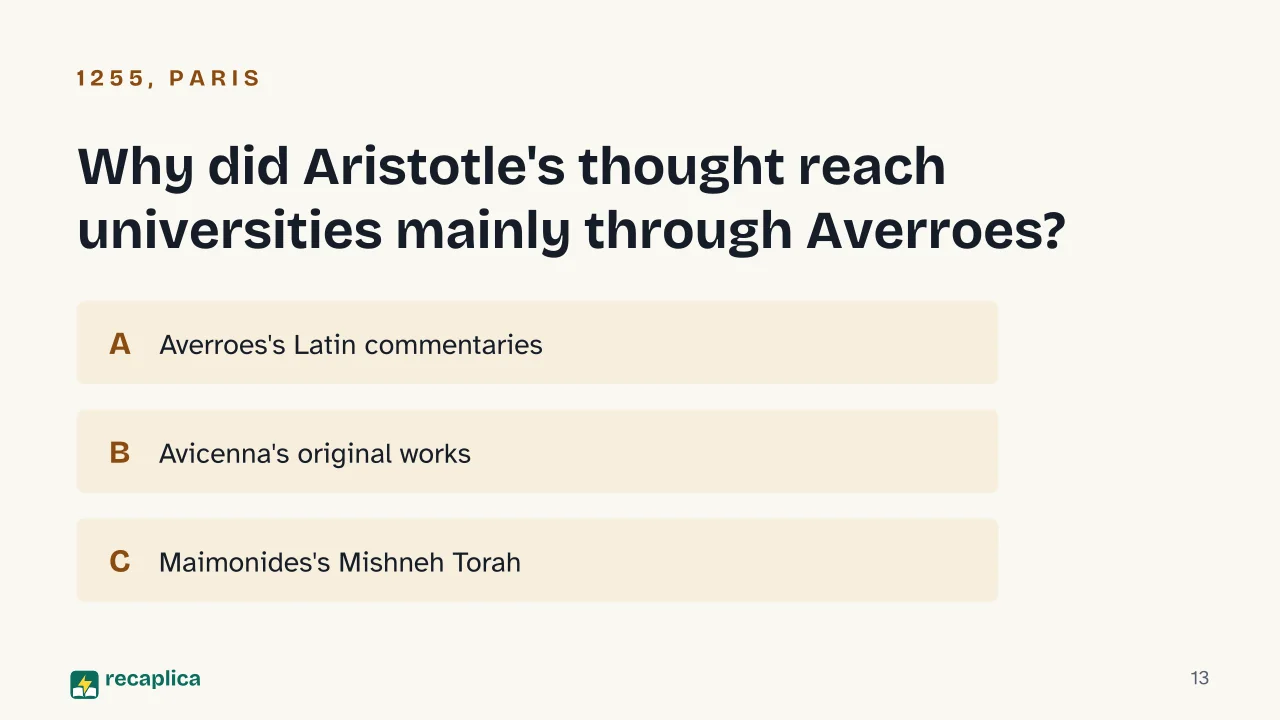  Common myths
Mind mapDrag the background to move around and the nodes to reposition them; use − and + to collapse and expand branches. 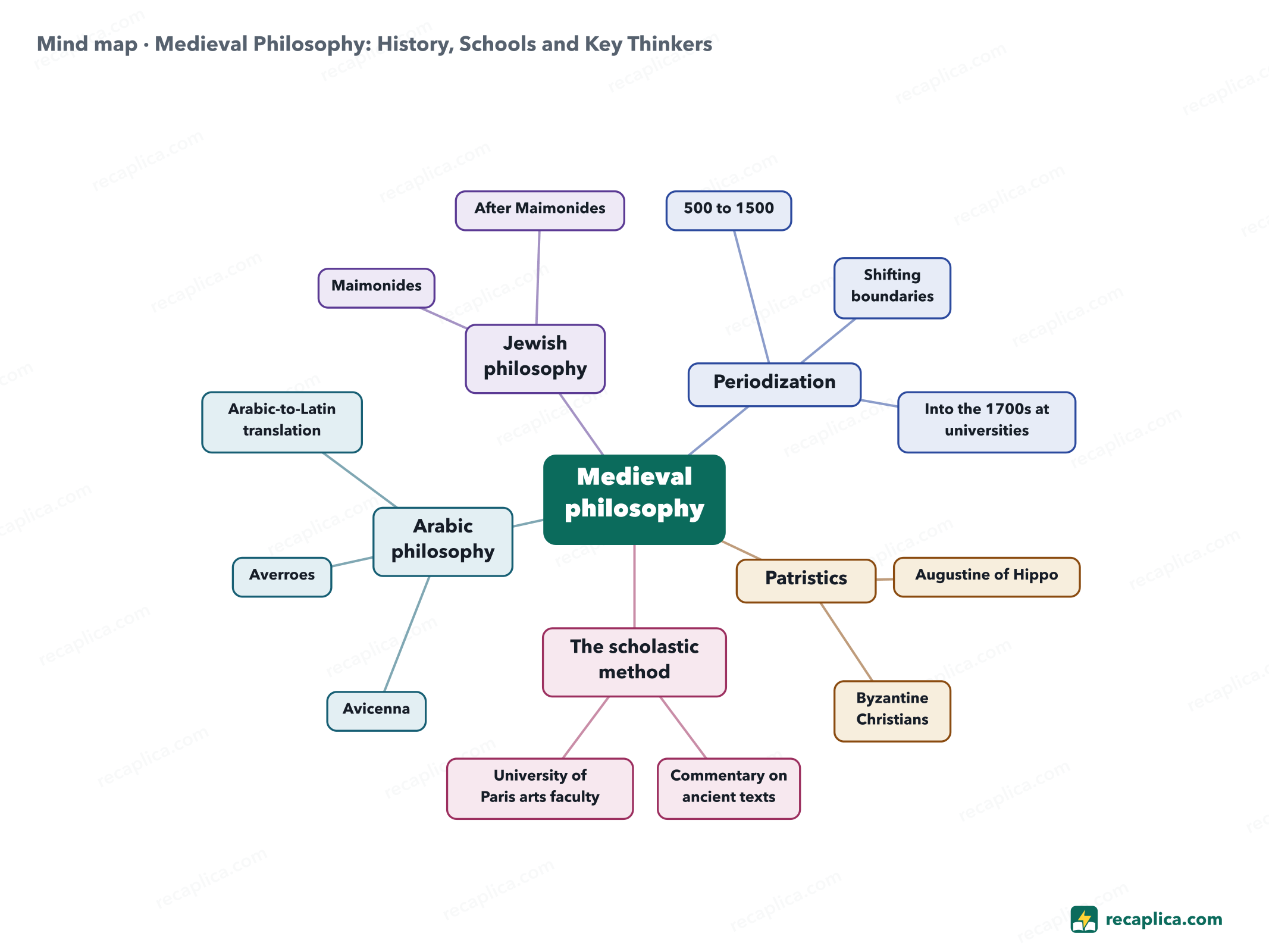
Quiz: test yourselfAnswer the questions to check what you have learned: you get instant feedback and a short explanation. Grade 0/10 0/5
FlashcardsTap the card to flip it and check whether you remember the answer, then move to the next one. 1 / 8 Explain it in your own wordsThe ultimate test: if you can explain it in simple words, you've truly understood it. Write your explanation, then compare it with the Recap. Your explanation is saved only on this device.
Frequently asked questionsWhat is medieval Christian philosophy?It is the part of medieval philosophy written by Christian thinkers, in Latin (patristics and later scholasticism) or in Greek in the Byzantine world. It includes figures such as Augustine of Hippo, whom some chronologies credit as the starting point of the Latin tradition, and the scholastic method covered in the [Recap on Scholasticism](/en/history/scholasticism/). What is the history of medieval philosophy, and what was the medieval period in philosophy?In the most widely shared periodization, it runs from 500 to 1500. It starts with Latin and Byzantine patristics, continues through the transmission of Greek texts into Arabic between the 8th and 10th centuries and then of Arabic texts into Latin between the 12th and 13th, and reaches the scholasticism of European universities, where Aristotle's works, read through Averroes's commentaries, became required reading. What are the main schools of medieval philosophy, and who were the middle age philosophers?There are four: Latin patristics and scholasticism, Byzantine philosophy in Greek, Arabic philosophy (with Avicenna and Averroes), and Jewish philosophy (with Maimonides), written in Arabic or Hebrew. Who are the main medieval philosophers?Among the most cited names: Augustine of Hippo for Latin patristics, Avicenna and Averroes for Arabic philosophy, Maimonides for Jewish philosophy, and Thomas Aquinas for scholasticism, which Recaplica covers in a Recap of its own. What is medieval scholasticism?It is the method of teaching and debate that grew out of commentary on ancient texts in European universities, the same method the University of Paris arts faculty made compulsory for Aristotle's works in 1255. The [Recap on Scholasticism](/en/history/scholasticism/) covers it in detail. Every Recap goes through an independent review before publication. |