Skip to content
recaplica

    One moment: security check

    Cloudflare wants to make sure you're not a robot. Tick the box below and your search will continue on its own.

    IT
    recaplica Karl Marx: his thought and critique of capitalism, summary
    © 2026 Recaplica · recaplica.com — All rights reserved
    Home › History

    Karl Marx: his thought and critique of capitalism, summary

    By Recaplica Newsroom · Updated on October 14, 2026

    What to print

    Page numbers appear when printing with default margins.

    Slides

    Choose a cut

    Flash10 slidesThe essential thread, to present in classFull15 slidesEvery chapter and the deeper detail

    Both come with speaker notes.

    Telegram channel
    recaplica Clear in 30 seconds, yours in 10 minutes.
    In 30 seconds Key points Figures Deep dive Slides Myths Mind map Quiz Flashcards FAQ

    In 30 seconds quick read

    Karl Marx was born in Trier in 1818 and died in London in 1883, after living in the British capital from 1849 onward. Together with Friedrich Engels, who for much of those years was also his financial support, he built a critique of capitalism around surplus value, the alienation of labor and, more indirectly, class struggle. Underlying that critique is historical materialism, the thesis that a society's economic structure shapes its social forms. Capital, his major work, was published in German in 1867 and reached English readers only in 1887, four years after his death.

    Key Points

    • Karl Marx was born in Trier on May 5, 1818, and died in London on March 14, 1883, at age 64.
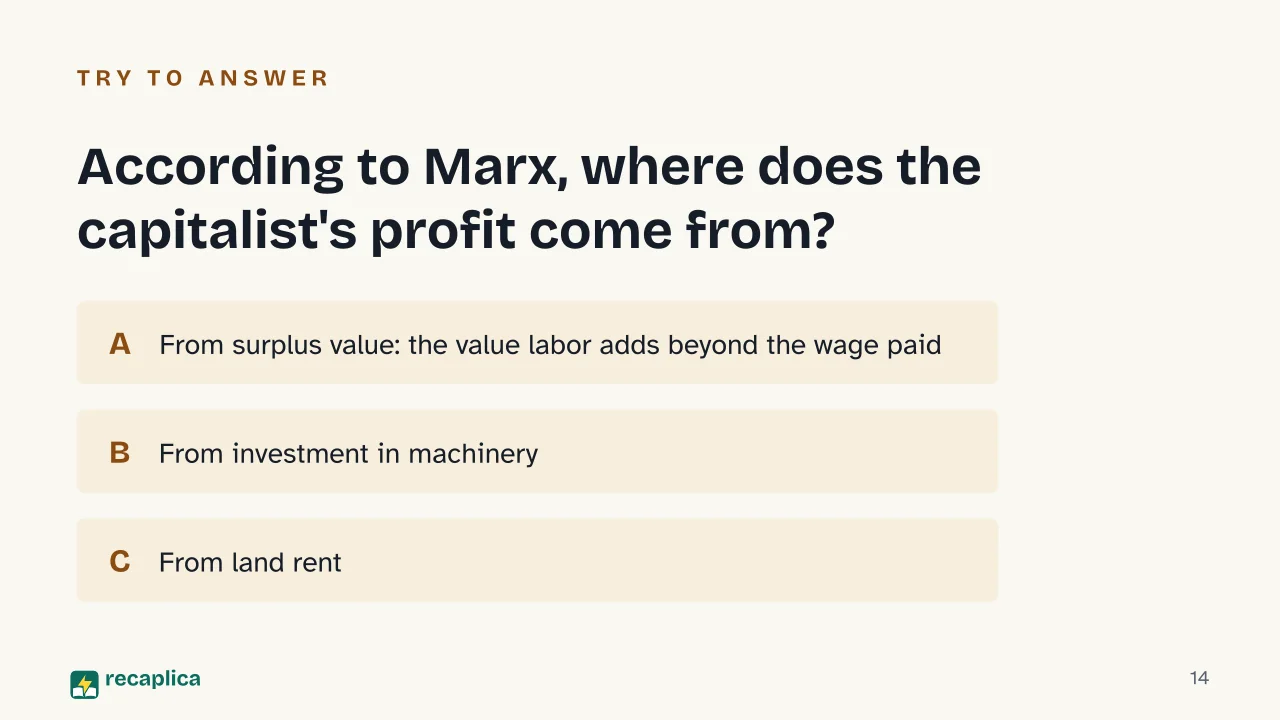
    • For Marx, surplus value is the value labor produces beyond the wage paid for it, and that gap is where the capitalist's profit comes from.
    • Marx's theory of alienation distinguishes four separate dimensions in which capitalist labor alienates the worker.
    • Under historical materialism, a community's economic base shapes its social institutions.
    • Marx and Engels were friends and collaborators for life: Engels supported Marx financially in London and likely oversaw the posthumous publication of Capital.
    • Capital, volume 1, was published in German in 1867; the English translation did not arrive until 1887.

    Key figures

    • 1818 year Karl Marx was born in Trier, then part of the Kingdom of Prussia Source: Encyclopedia.com
    • 1867 year the first volume of Capital was published in German; the English translation arrived only in 1887 Source: Marxists Internet Archive

    Deep Dive

    Who Karl Marx was

    Karl Marx was born on May 5, 1818, in Trier, then part of the Kingdom of Prussia, to Heinrich Marx and Henriette Pressburg. According to Encyclopedia.com he was the third child and first son of the couple: both parents came from families with prominent rabbis, and his father practiced law with some local standing. The Marx family had nine children, but only four survived infancy.

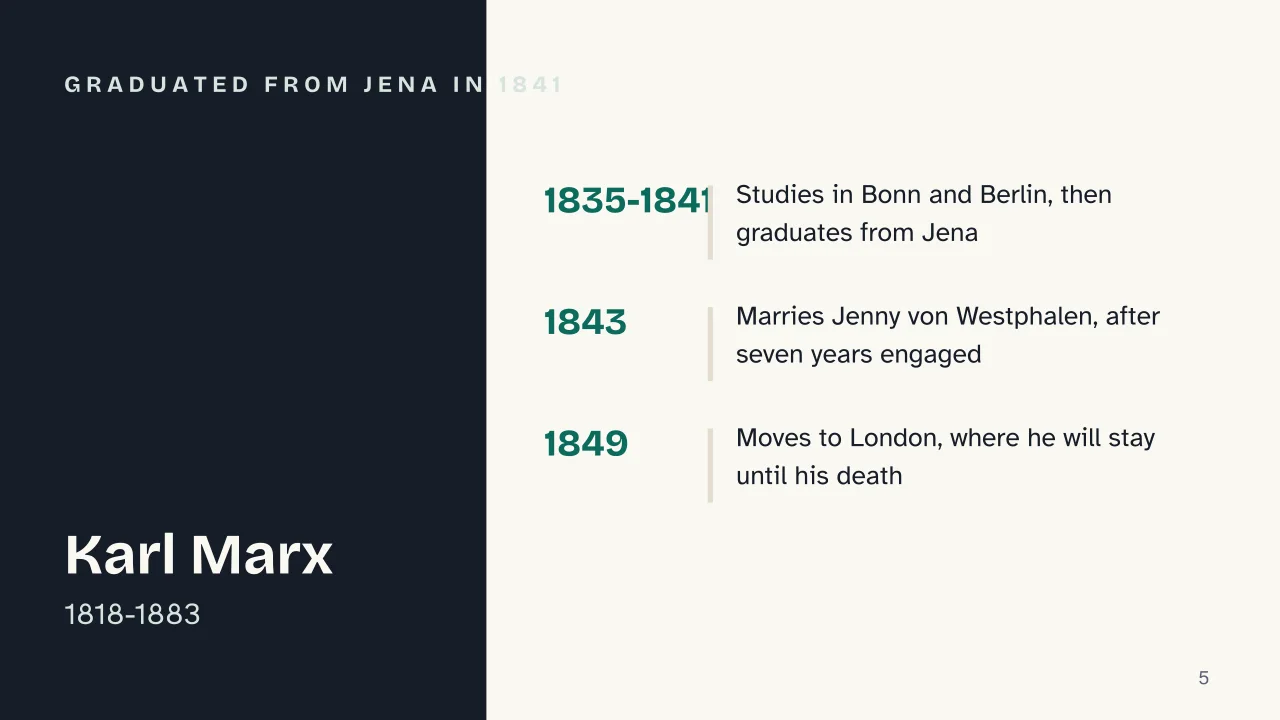
    Between 1835 and 1841 Marx studied in Bonn and Berlin, starting with law at his father’s wish before turning to philosophy and history. He earned his degree in 1841 from the University of Jena with a thesis on the difference between the natural philosophies of Democritus and Epicurus.

    He had become engaged to Jenny von Westphalen in 1836, according to Encyclopedia.com, and married her on June 19, 1843, after seven years engaged, in a Protestant church in Kreuznach, according to Wikipedia. From June 1849 he lived permanently in London, where he stayed until his death on March 14, 1883, at age 64.

    As a student in Berlin, Marx also lived through a less austere episode. One night of excess with Bruno Bauer ended with a donkey ride through the streets of Bonn, which scandalized the academic circles of the time, according to Wikipedia.

    From German idealism to historical materialism

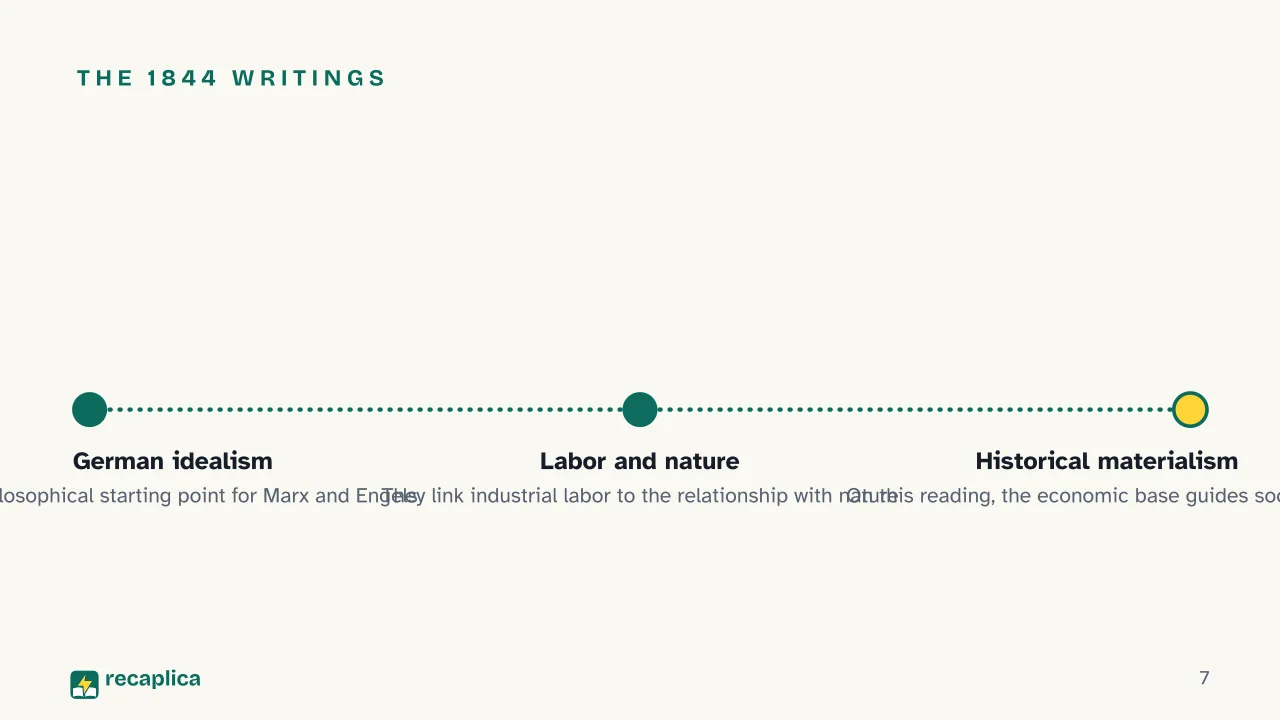
    Marx’s philosophical training began within German idealism, the current that dominated German universities in his day. Marx first met Friedrich Engels in Cologne and then, decisively, in Paris in 1844, according to Encyclopedia.com: that meeting launched a partnership that lasted until Marx’s death. Together they wrote the manuscripts of The German Ideology, the text in which they set their own materialist method against the idealism of earlier German philosophy, according to the Stanford Encyclopedia of Philosophy. For the Communist League they later wrote The Communist Manifesto, drafted in 1847 and 1848. In that same year, 1844, in his earliest writings, Marx linked the relationship between man and nature to industrial labor, an idea that lays the groundwork for historical materialism, again according to the Stanford Encyclopedia of Philosophy. Readers wanting the economic backdrop of those same decades can turn to the Recap on the industrial revolution, whose transformations of labor frame these early pages of Marx’s work.

    The core of Marx’s historical materialism is that the material conditions of production explain a community’s social forms. The source, though, pairs this idea with the more cautious verb “conditions” alongside “determines”: a sign that even interpreters distinguish a conditioning from a rigid determinism.

    Marx and the critique of capitalism: surplus value, alienation, class struggle

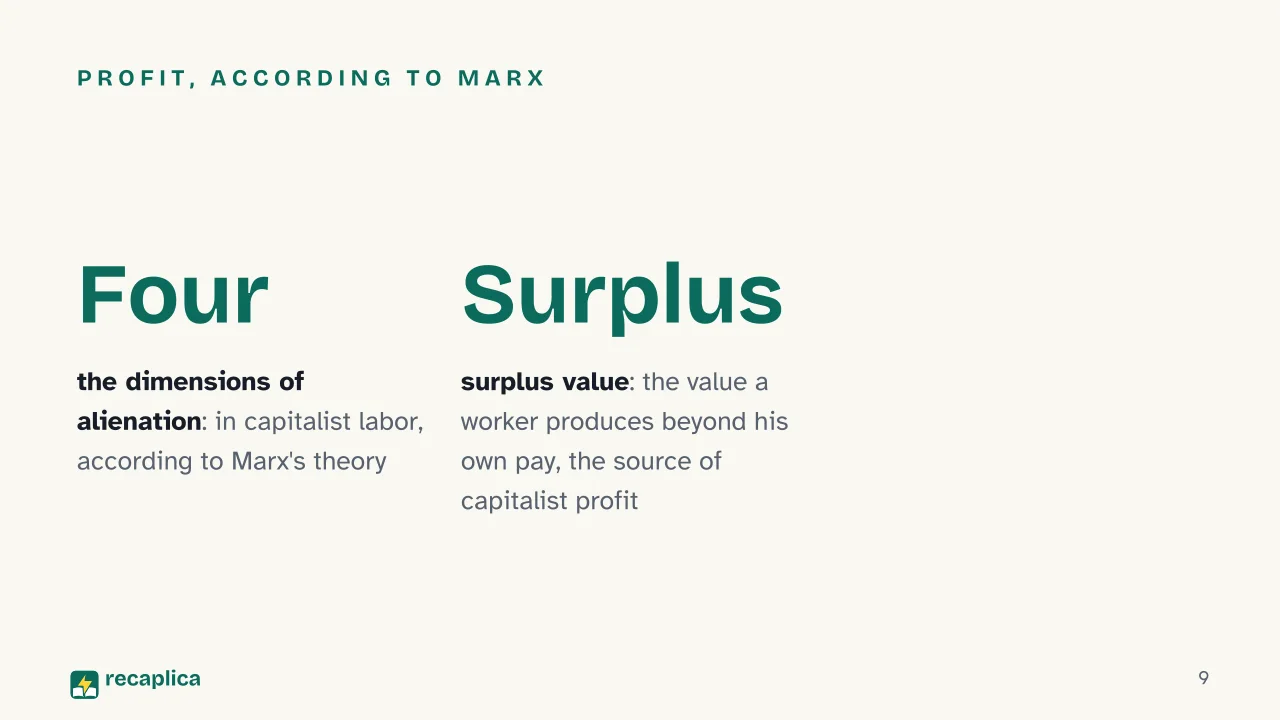
    At the center of Marx’s thought is his account of capitalist profit through surplus value: on this account, the capitalist’s profit comes entirely from the value a worker produces beyond what he is paid.

    Practical example: picture a worker who, in a day’s labor, produces goods worth more than the wage he receives. That gap, for Marx, becomes the capitalist’s profit: the mechanism he names surplus value.

    Marx’s theory of alienation adds a second layer to the critique. According to the Stanford Encyclopedia of Philosophy, labor in capitalist society alienates the worker along four distinct dimensions: separate layers of the same experience. Later interpretations of capitalism, such as neoclassical economics, start from premises quite different from Marx’s on this point.

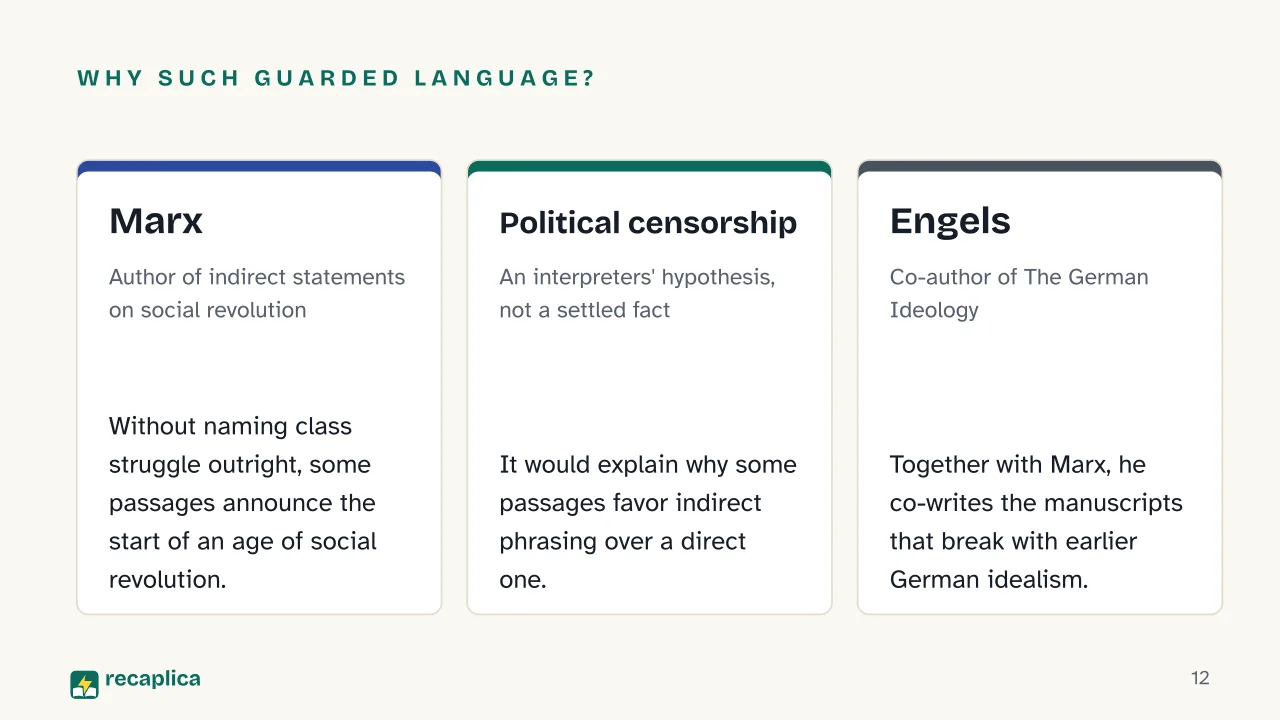
    The theme of class struggle, while not named outright in some of Marx’s texts, remains traceable through indirect phrasing, such as a passage announcing the start of an age of social revolution. On one possible reading, not as a certainty, Marx may have chosen guarded language in some writings precisely to avoid the attention of the political censorship of his time.

    Marx, Engels and the publication of Capital

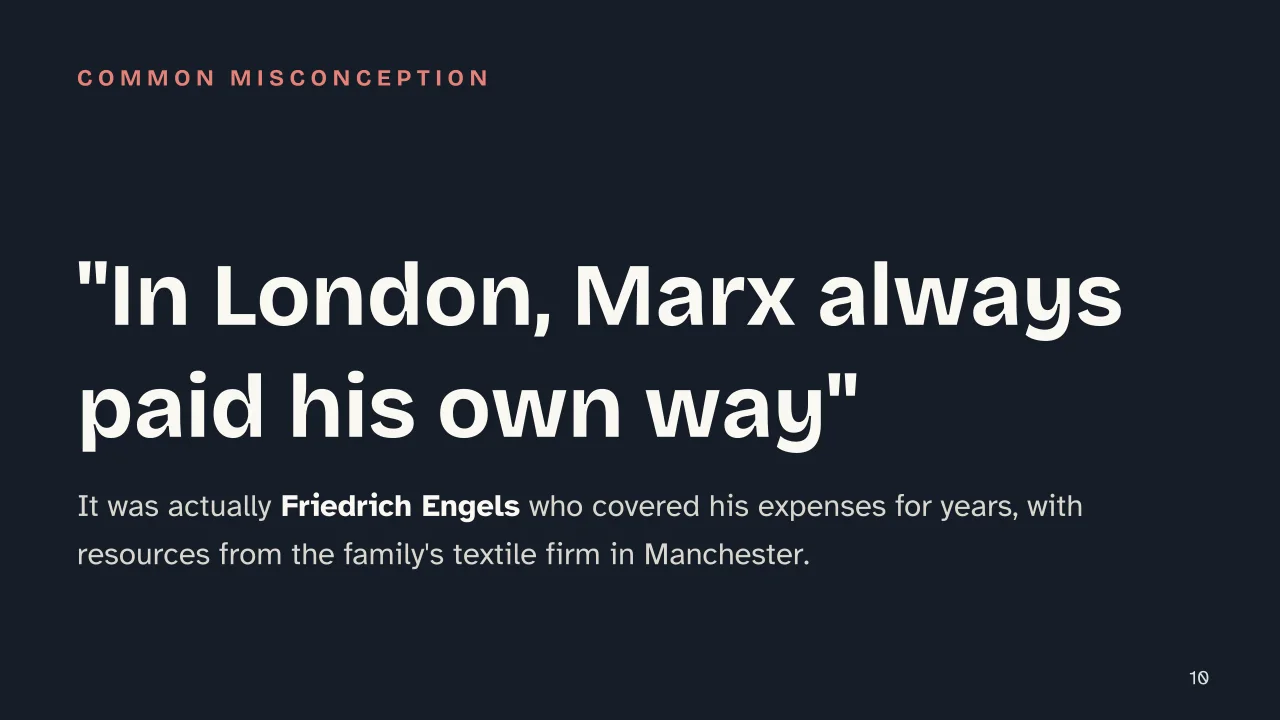
    For much of his London life Marx was supported financially by Friedrich Engels, who in turn drew on the wealth of his own industrial family, according to Wikipedia. In 1850 Engels had settled in Manchester to work at his father’s textile firm, and from there he became his friend’s main financial support, according to Encyclopedia.com. How the two worked together beyond the money is the subject of the Recap on the Marx–Engels partnership.

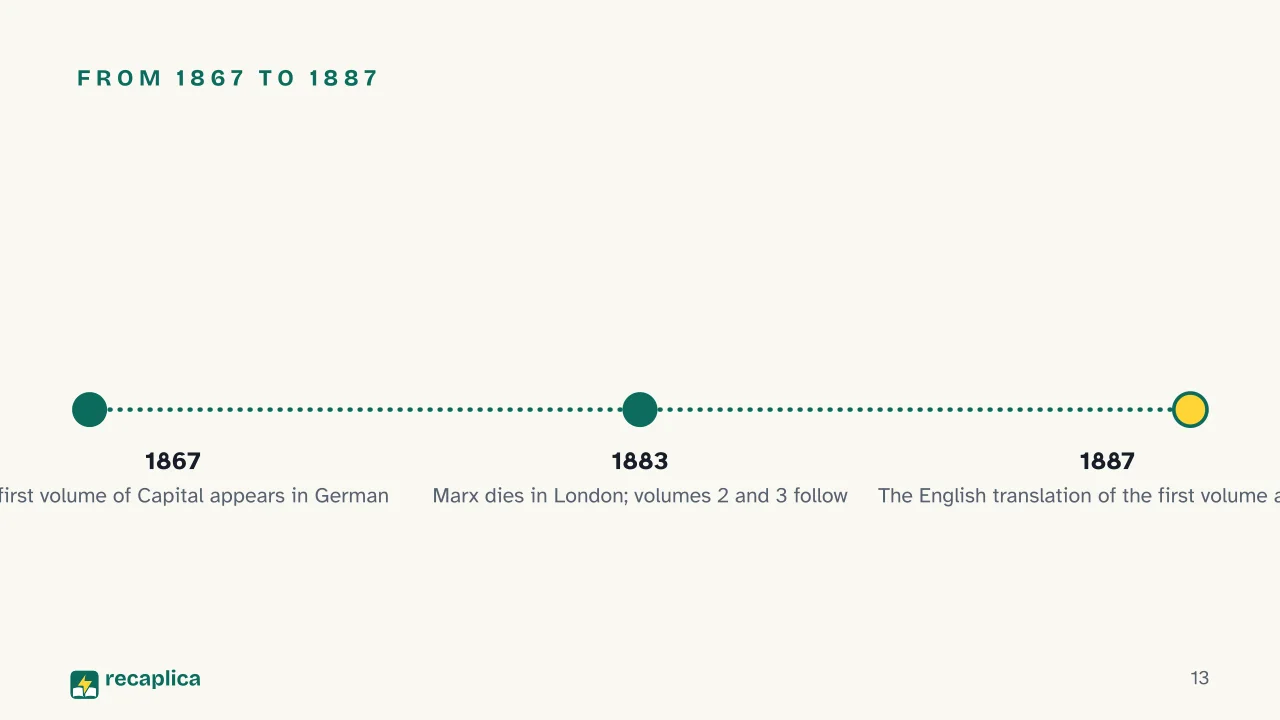
    The first volume of Capital appeared in German in 1867. The English translation did not arrive until 1887, four years after Marx’s death, according to the Marxists Internet Archive. Volumes 2 and 3 appeared after his death, in 1883: it was likely Friedrich Engels who oversaw their posthumous publication.

    Slide deck

    Slides ready to download and make your own in PowerPoint or Google Slides, with speaker notes. Pick the Flash cut or the Full one.

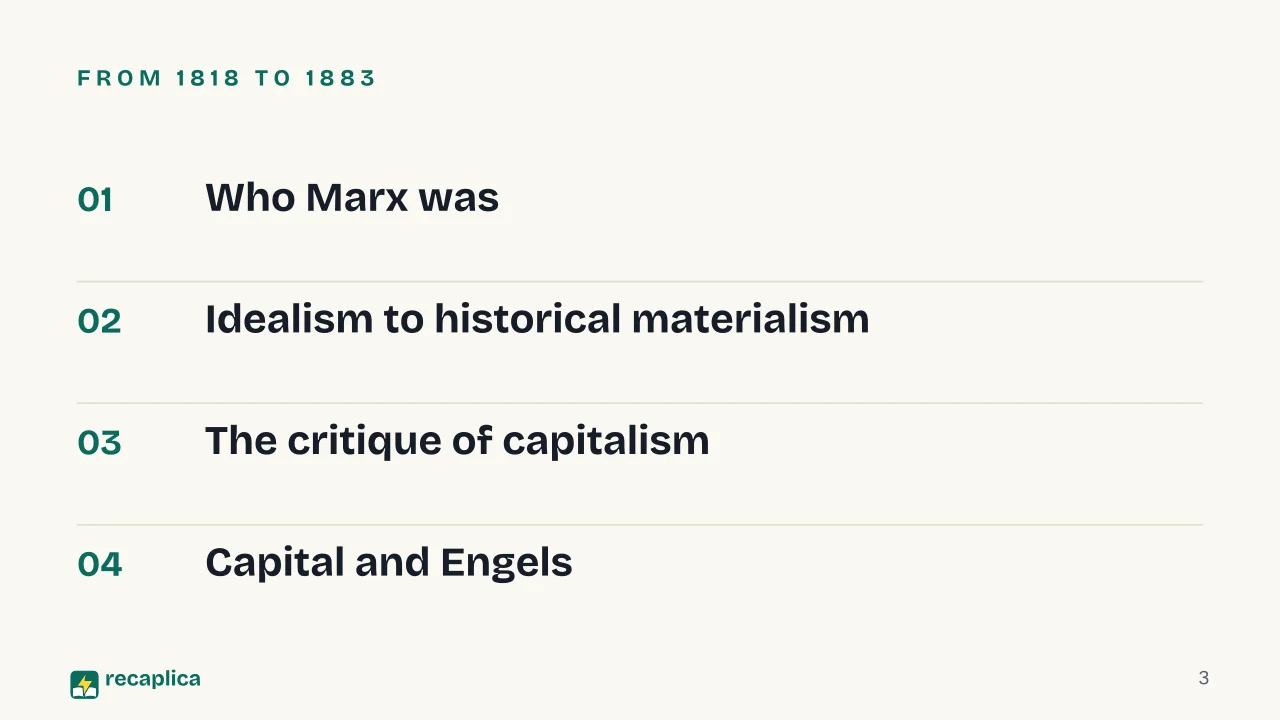
    Slide 1 of the presentation on Karl Marx: Karl MarxSlide 2 of the presentation on Karl Marx: Where does a factory owner's profit actually come from?Slide 3 of the presentation on Karl Marx: From 1818 to 1883Slide 4 of the presentation on Karl Marx: Chapter 01: Who Marx wasSlide 5 of the presentation on Karl Marx: Graduated from Jena in 1841Slide 6 of the presentation on Karl Marx: Chapter 02: Idealism to historical materialismSlide 7 of the presentation on Karl Marx: The 1844 writingsSlide 8 of the presentation on Karl Marx: Chapter 03: The critique of capitalismSlide 9 of the presentation on Karl Marx: Profit, according to MarxSlide 10 of the presentation on Karl Marx: "In London, Marx always paid his own way"Slide 11 of the presentation on Karl Marx: Chapter 04: Capital and EngelsSlide 12 of the presentation on Karl Marx: Why such guarded language?: Marx, Political censorship, EngelsSlide 13 of the presentation on Karl Marx: From 1867 to 1887Slide 14 of the presentation on Karl Marx: According to Marx, where does the capitalist's profit come from?Slide 15 of the presentation on Karl Marx: Now, time to review
    Flash10 slidesThe essential thread, to present in classFull15 slidesEvery chapter and the deeper detail

    Common myths

    • ✗ Myth Marx's theory of alienation describes a single, generic form of estrangement from work

      ✓ Reality the Stanford Encyclopedia of Philosophy traces four distinct dimensions that act together on the worker inside the capitalist factory.

    • ✗ Myth In London, Marx always supported himself with his own earnings, with no outside help

      ✓ Reality for much of those years it was Friedrich Engels, drawing on the resources of his textile firm in Manchester, who supported him financially, according to Wikipedia.

    • ✗ Myth Marx's historical materialism claims that economics rigidly determines every aspect of society

      ✓ Reality the Stanford Encyclopedia of Philosophy pairs the verb determines with the more cautious conditions: a sign that, even for interpreters, the link between material structure and social forms is a conditioning, not an automatic mechanism.

    Mind map

    Drag the background to move around and the nodes to reposition them; use − and + to collapse and expand branches.
    Customize
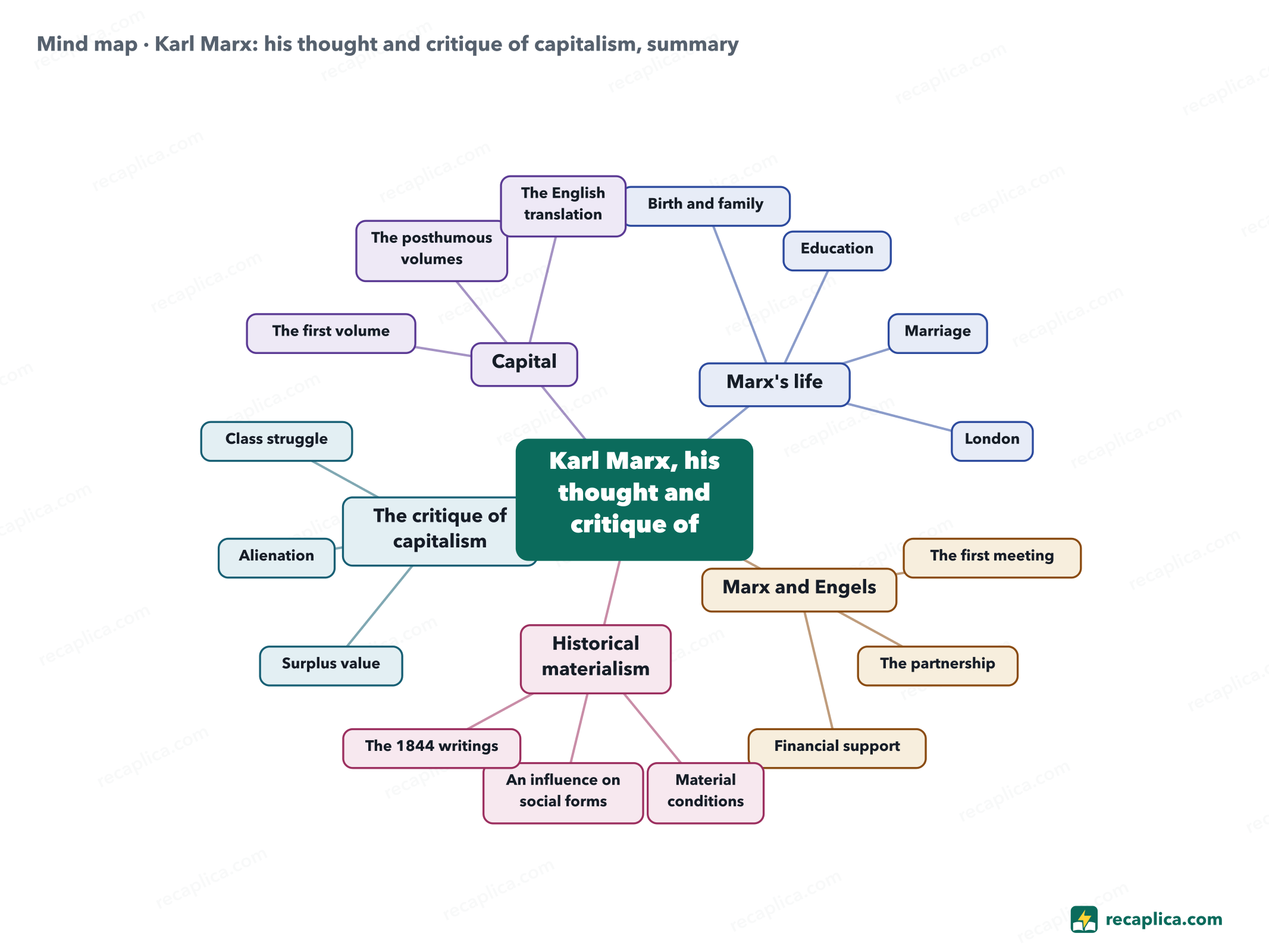
    Mind map: Karl Marx: his thought and critique of capitalism, summary
    • Karl Marx, his thought and critique of capitalism
      • Marx's life
        • Birth and family Trier, 1818, a family of nine children, four survived
        • Education Bonn and Berlin between 1835 and 1841, a degree from Jena in 1841
        • Marriage Marries Jenny von Westphalen in 1843, after seven years engaged
        • London Moves there in 1849, dies there in 1883
      • Marx and Engels
        • The first meeting Cologne, then decisively Paris in 1844
        • The partnership Co-write the manuscripts of The German Ideology
        • Financial support Engels supports Marx in London with the resources of the Manchester textile firm
      • Historical materialism
        • Material conditions Shape the social forms of a community
        • An influence on social forms The economic base guides a community's institutions
        • The 1844 writings An early draft of what becomes historical materialism
      • The critique of capitalism
        • Surplus value Profit comes from the value the worker produces beyond the wage
        • Alienation Four distinct dimensions, according to Marx's theory
        • Class struggle Indirect expressions, such as the announcement of an age of social revolution
      • Capital
        • The first volume Published in German in 1867
        • The posthumous volumes Published after 1883, likely edited by Engels
        • The English translation Arrives only in 1887

    Quiz: test yourself

    Answer the questions to check what you have learned: you get instant feedback and a short explanation.

    Grade 0/10 0/5
    1 Where and when was Karl Marx born?

    Marx was born on May 5, 1818, in Trier, then part of the Kingdom of Prussia, to Heinrich Marx and Henriette Pressburg.

    2 According to Marx, where does the capitalist's profit come from?

    Marx argues that profit comes entirely from what labor produces beyond the wage paid for it: that is surplus value.

    3 True or false: in London, Marx always paid all his own expenses by himself.

    For much of his London years, Marx was supported financially by Friedrich Engels, who drew on his industrial family's wealth.

    4 Who likely oversaw the publication of volumes 2 and 3 of Capital, which appeared after Marx's death?

    Volumes 2 and 3 appeared after 1883: it was likely Friedrich Engels, Marx's friend and collaborator, who oversaw their posthumous publication.

    5 According to the Stanford Encyclopedia of Philosophy, how many dimensions does Marx's theory of alienation distinguish?

    Marx's theory of alienation distinguishes four distinct dimensions in which capitalist labor alienates the worker: separate layers of the same experience.

    Answers: 1-A · 2-A · 3-B · 4-A · 5-B

    Flashcards

    Tap the card to flip it and check whether you remember the answer, then move to the next one.

    1 / 8

    Explain it in your own words

    The ultimate test: if you can explain it in simple words, you've truly understood it. Write your explanation, then compare it with the Recap.

    Your explanation is saved only on this device.

    Karl Marx was born in Trier in 1818 and died in London in 1883, after living in the British capital from 1849 onward. Together with Friedrich Engels, who for much of those years was also his financial support, he built a critique of capitalism around surplus value, the alienation of labor and, more indirectly, class struggle. Underlying that critique is historical materialism, the thesis that a society's economic structure shapes its social forms. Capital, his major work, was published in German in 1867 and reached English readers only in 1887, four years after his death.

    Frequently asked questions

    Who was Karl Marx?

    Karl Marx (1818-1883) was born in Trier, then part of the Kingdom of Prussia, and died in London at age 64. He studied in Bonn and Berlin and earned his degree from Jena in 1841; from 1849 he lived permanently in London, where he wrote his critique of capitalism together with his friend Friedrich Engels.

    What is surplus value according to Marx?

    It is the value a worker produces beyond what he receives as a wage. In Marx's account, the capitalist's profit comes entirely from that gap.

    What is Marx's historical materialism?

    It is the thesis that the economic base shapes a community's social forms, institutions included: a relationship of influence more than a mechanism that fixes every detail.

    What was the relationship between Marx and Engels?

    They met in Cologne and then, decisively, in Paris in 1844; together they wrote the manuscripts of The German Ideology. For much of Marx's London life, Engels covered his expenses, drawing on his family's Manchester textile business.

    When was Capital published?

    The first volume appeared in German in 1867; the English translation arrived only in 1887, four years after Marx's death. Volumes 2 and 3 appeared after 1883, likely edited by Friedrich Engels.

    Sources

    • Stanford Encyclopedia of Philosophy – Karl Marx
    • Wikipedia (EN) – Karl Marx
    • Encyclopedia.com – Complete Dictionary of Scientific Biography, Karl Marx
    • Marxists Internet Archive – Capital, Volume I

    Every Recap goes through an independent review before publication.

    Every evening, the day's new Recaps on our Telegram channel. Join the channel →

    Keep learning

    • History What Is Existentialism? Heidegger, Being and Time, and Dasein Existentialism is a current of twentieth-century philosophy centered on human existence, freedom and the search for meaning. According to the Stanford Encyclopedia of Philosophy, the German philosopher Martin Heidegger (1889-1976) shaped that current more than almost anyone else, even though he never accepted the label. In 1927 he published Being and Time, his major work, where he introduced the concept of Dasein: the human being as the one entity that questions its own existence. That book influenced Jean-Paul Sartre's existentialism, but in 1946, in the Letter on Humanism, Heidegger openly broke with Sartre and refused to be called an existentialist. In 1933 he was elected rector of the University of Freiburg and became a Nazi party member, keeping that membership until the regime fell - an episode Heidegger himself later denied or played down more than once. Read the Recap →
    • History What Is Phenomenology? Husserl's Philosophy Explained Edmund Husserl founded phenomenology as a philosophical discipline around 1900-1901, with his Logical Investigations. His method starts from the epoché, a suspension of our everyday, unquestioning stance toward the world, and moves toward phenomenological reduction: studying how things appear to consciousness rather than what they are in themselves. At the center sits intentionality, the idea that every experience is always an experience of something specific, whether hoping, perceiving, or desiring. The method Husserl built carried into the 20th century through Heidegger, Sartre, and Merleau-Ponty, moving from German philosophy into French philosophy along the way. Read the Recap →
    • History Legal Positivism: What It Is, from Austin to Kelsen and Hart According to the Stanford Encyclopedia of Philosophy, legal positivism measures legal validity against observable social facts, keeping moral judgment on a separate track. Its roots lie in Hobbes and Hume. Jeremy Bentham produced the theory's first full account, which John Austin later took up and spread: for Austin, a rule is law only when a sovereign commands it under threat of punishment. In the twentieth century, Hans Kelsen grounded legal validity in a hierarchy that traces back to a presupposed basic norm, while Herbert Hart located it instead in a rule of recognition actually followed by judges and officials. Natural law theory takes the opposite view: an unjust law is not really a law. Legal positivism disagrees — a law stays valid even when it is morally unjust, as long as it was made the way the system requires. Read the Recap →

    recaplica

    Clear in 30 seconds, yours in 10 minutes.

    Recaps Mind maps Request a Recap Telegram channel Mind map maker Our method About Privacy & cookies Legal notes & terms of use

    © 2026 Recaplica · A project by Curi S.r.l. — VAT IT05472000750

    Statistics, only if you say so

    To learn which Recaps help most we would use Google Analytics, with aggregate, anonymous data. It starts only with your OK, and you can change your mind anytime. Privacy policy