|
recaplica
Communist Manifesto: What It Says and How It Was Written | ||||||||||
| © 2026 Recaplica · recaplica.com — All rights reserved | ||||||||||
Communist Manifesto: What It Says and How It Was WrittenWhat to print Page numbers appear when printing with default margins. SlidesChoose a cut Flash10 slidesThe essential thread, to present in classFull16 slidesEvery chapter and the deeper detailBoth come with speaker notes. In 30 seconds quick readThe Communist Manifesto is the text Karl Marx and Friedrich Engels write at the request of the Communist League, after its leaders had already warmed to the pair's ideas at an earlier congress. The writing runs from late 1847 into January 1848 (sources differ slightly on the exact dates), and the pamphlet comes off the press in London on February 21, 1848, one day before revolution breaks out in Paris — a timing that overlaps without one event causing the other. The text reads history as a long run of class conflicts and reduces the society of its own day to two classes, the bourgeoisie and the proletariat, naming the proletariat the only truly revolutionary class of its time. Despite opening with the most quoted line in socialist writing, the Manifesto spends years as a minor pamphlet; it finds a real audience only after the founding of the International Workingmen's Association in 1864. Key Points
Key figures
Deep DiveThe Communist Manifesto grew out of a specific commission: at its congress in November 1847, the Communist League asked Karl Marx and Friedrich Engels to write up the organization’s programme. According to Encyclopedia.com, the commission came about because the two had already won the League’s other members over to their ideas at an earlier congress. The fuller biographical picture, including Marx joining the League of the Just in 1847, is in Karl Marx: His Thought and the Critique of Capitalism. How the text came to beThe League of the Just was a secret society of German workers exiled in London, and in 1847 it asked Marx to join; the organization would later be renamed the Communist League. The sources don’t fully agree on the exact writing dates: Marxists Internet Archive, in Engels’ preface, places the work in late 1847, while History.com says Marx wrote most of the text in January 1848. The writing most likely ran, then, from December 1847 through the end of January 1848. Behind it lay a text Engels had written earlier that year as a series of questions and answers, the Principles of Communism. The finished manuscript went to press in London, where it appeared on February 21, 1848. The London publication landed at a charged moment: the very next day, February 22, 1848, revolution broke out in Paris, in a Europe already crossed by unrest. With the two dates sitting so close together, it’s tempting to draw a straight line between them, but what connects them is only the calendar: the Manifesto didn’t set the revolution in motion, which grew out of causes specific to France at the time: the two episodes run side by side without touching, and that story is told in full in French Revolution Summary: Causes, Phases and Consequences. What the Manifesto saysThe text is organized in four chapters, plus prefaces added to later editions. It opens with what became socialist writing’s single most quoted line, the image of a spectre haunting Europe, and from there lays out its central argument: class struggle as the key to reading everything that came before. Chapter I lists historical pairs of classes in conflict — freeman and slave, patrician and plebeian, lord and serf — as examples of that conflict before capitalism.
According to the Manifesto, the society of its own day — the one shaped by the industrial revolution, which had already redrawn how people made and sold things — tends to settle into just two opposing classes: the bourgeoisie and the proletariat. That shift is the subject of Industrial Revolution: What Changed and Why. The text credits the bourgeoisie with a historically revolutionary role, pointing to its role in tearing down older feudal relations, before turning to criticize its effects, and it casts the proletariat as the sole genuinely revolutionary class of its day. It also describes proletarian labor under industrial society as reduced to a commodity, traded on the same market that sets the supply and demand for work — the mechanism covered in Labor Market: How Supply, Demand and Unemployment Work. Chapter II, titled “Proletarians and Communists,” sets out where the communists stand: the text describes them as the sharpest and most committed wing of the working-class parties already active in every country, operating from inside those same organizations. The same chapter sums up the programme in the short formula “abolition of private property,” meaning specifically bourgeois ownership of the means of production. It then lists ten concrete measures, presented as applicable “in the most advanced countries” of the time. Chapter III criticizes the other socialist currents of the day, and Chapter IV sets out the communists’ tactical stance toward the opposition parties already in existence. The closing paragraph commits to the union of the democratic parties of every country, ahead of the two lines that end the text: the condition of proletarians, left with nothing but the chains that bind them, and the final call to all workers.
A success that came lateAt first, the Manifesto made little noise: according to History.com, its impact in 1848 was limited. For years it remained a minor text, read by few. That changed in 1864, with the founding of the International Workingmen’s Association: according to Encyclopedia.com, the organization opened up new readers and the push the text had been missing. In the four decades after its first edition, the text was translated into French in 1848, English in 1850 (and again in 1888, in the version that became standard), Russian in the 1860s and again in 1882, plus early Polish and Danish editions. The 1888 English translation is by Samuel Moore, done in collaboration with Engels. In his preface to that edition, Engels describes the Manifesto as the most widely spread and most international production of all socialist literature of its time — his own judgment, tied to that particular moment. The text’s fortunes kept building through the twentieth century. In 1917, nearly seventy years after publication, Lenin led the first successful communist revolution in Russia. By 1950, History.com notes, close to half of all people alive were living under self-described Marxist governments. Given that path, from early obscurity to a worldwide readership within a century, History.com goes so far as to call it arguably the most influential political pamphlet in history, a widely held historical assessment rather than a measurable fact. Slide deckSlides ready to download and make your own in PowerPoint or Google Slides, with speaker notes. Pick the Flash cut or the Full one.   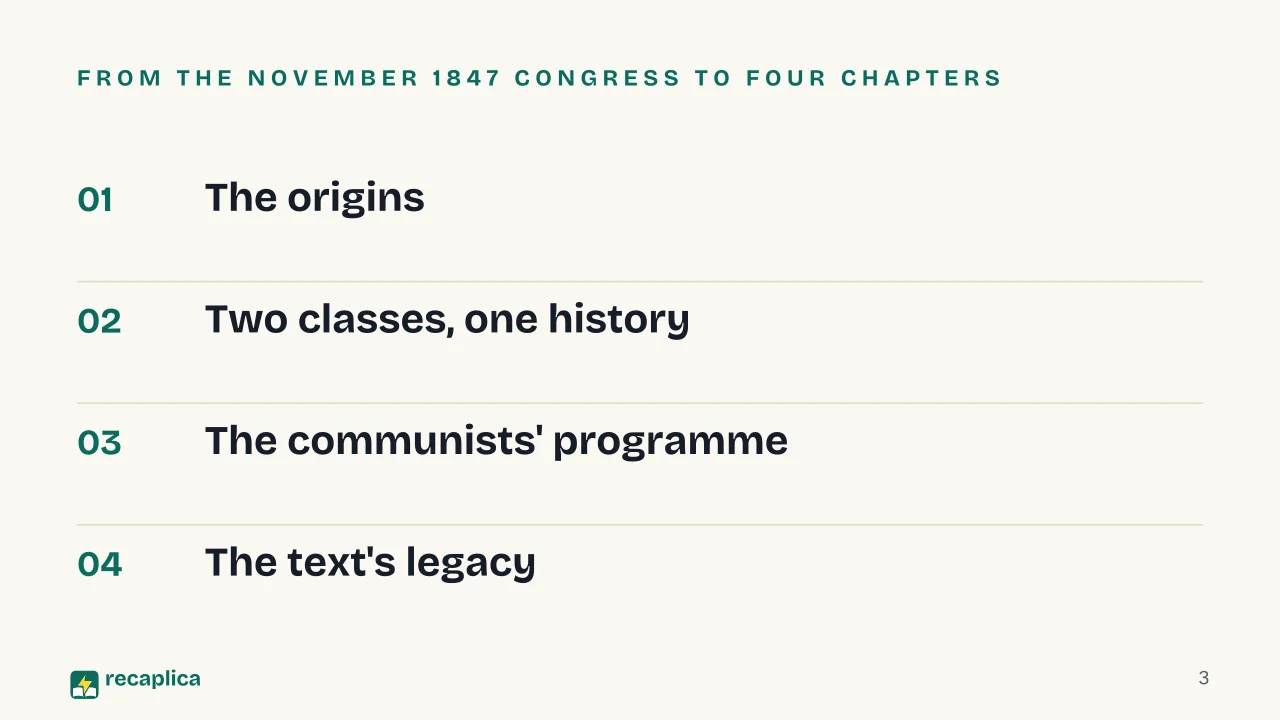  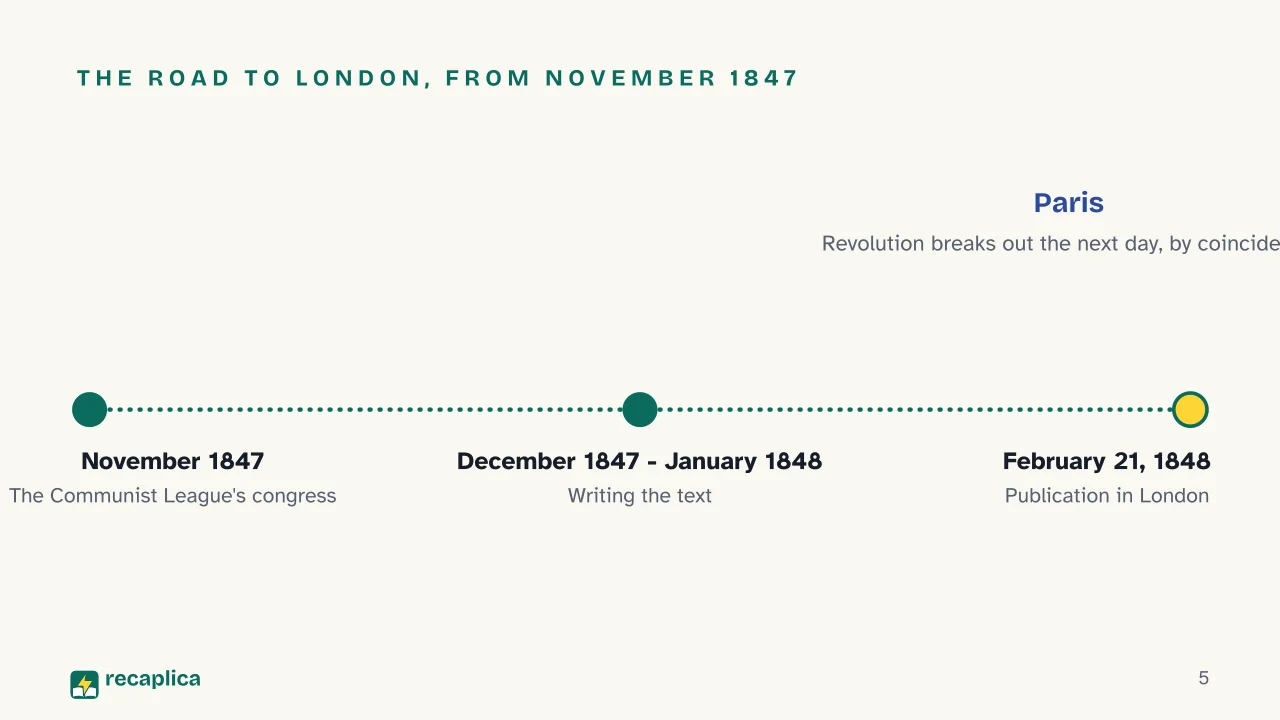  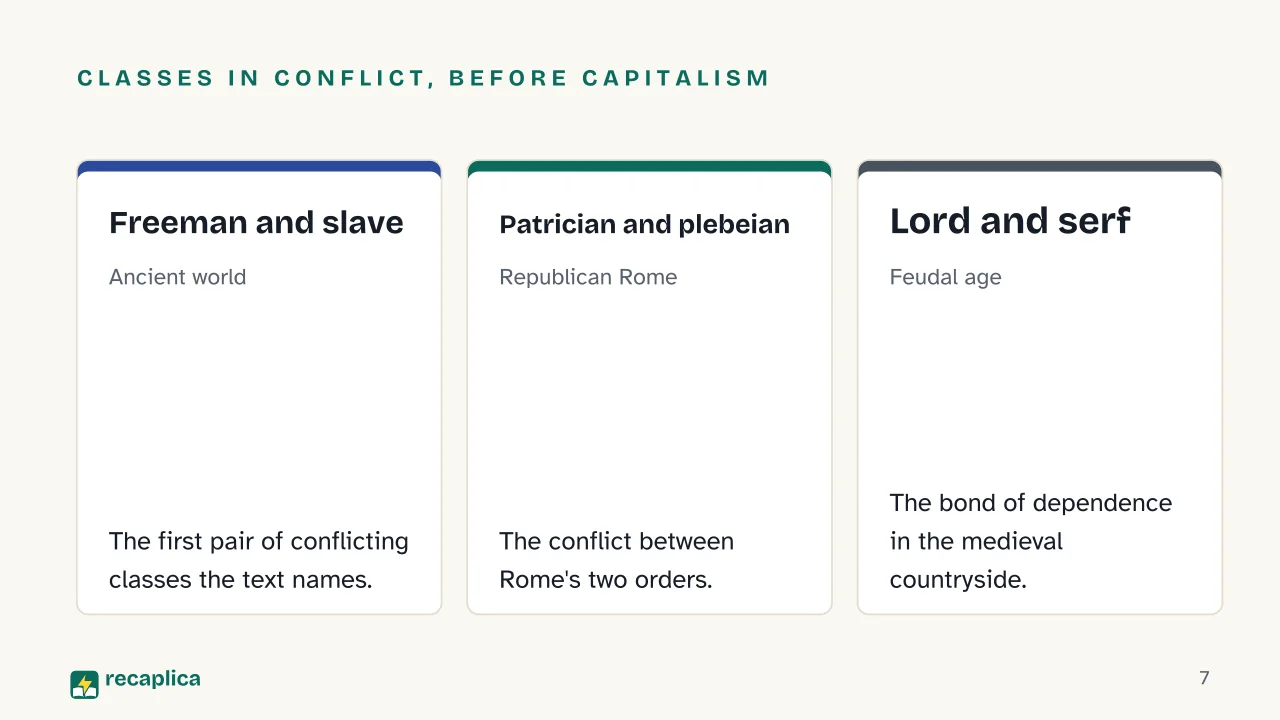  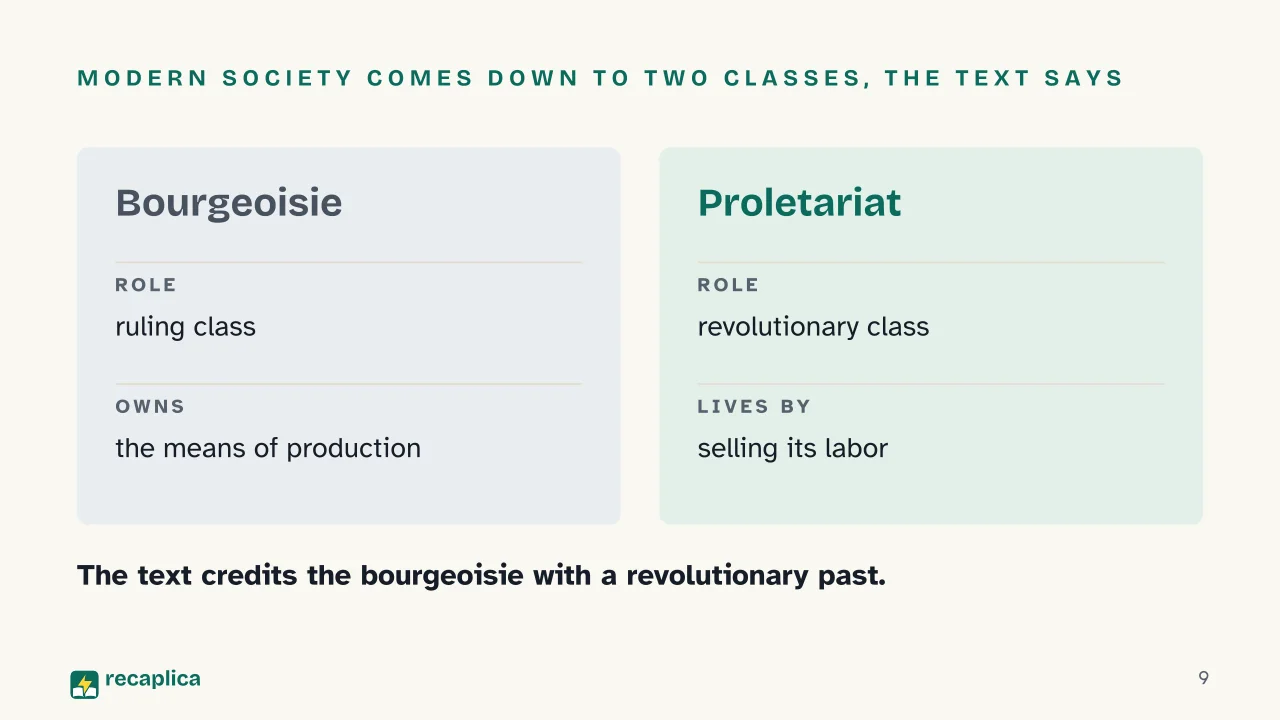 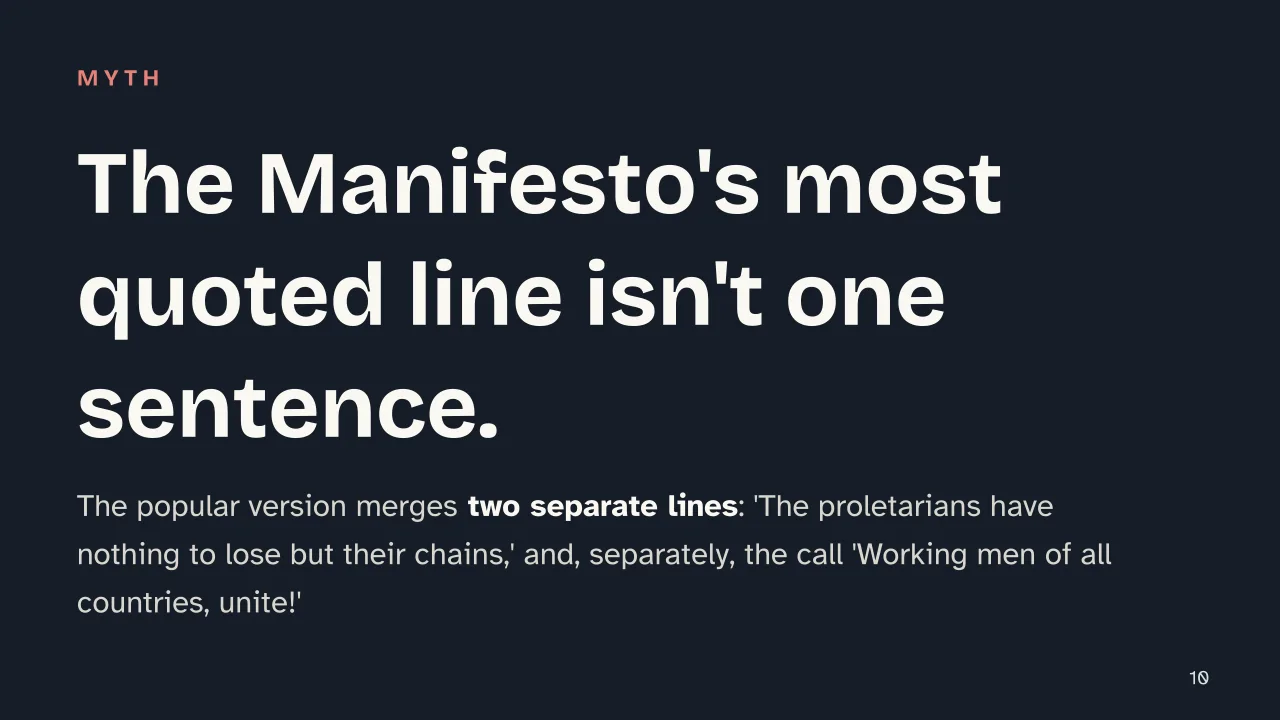  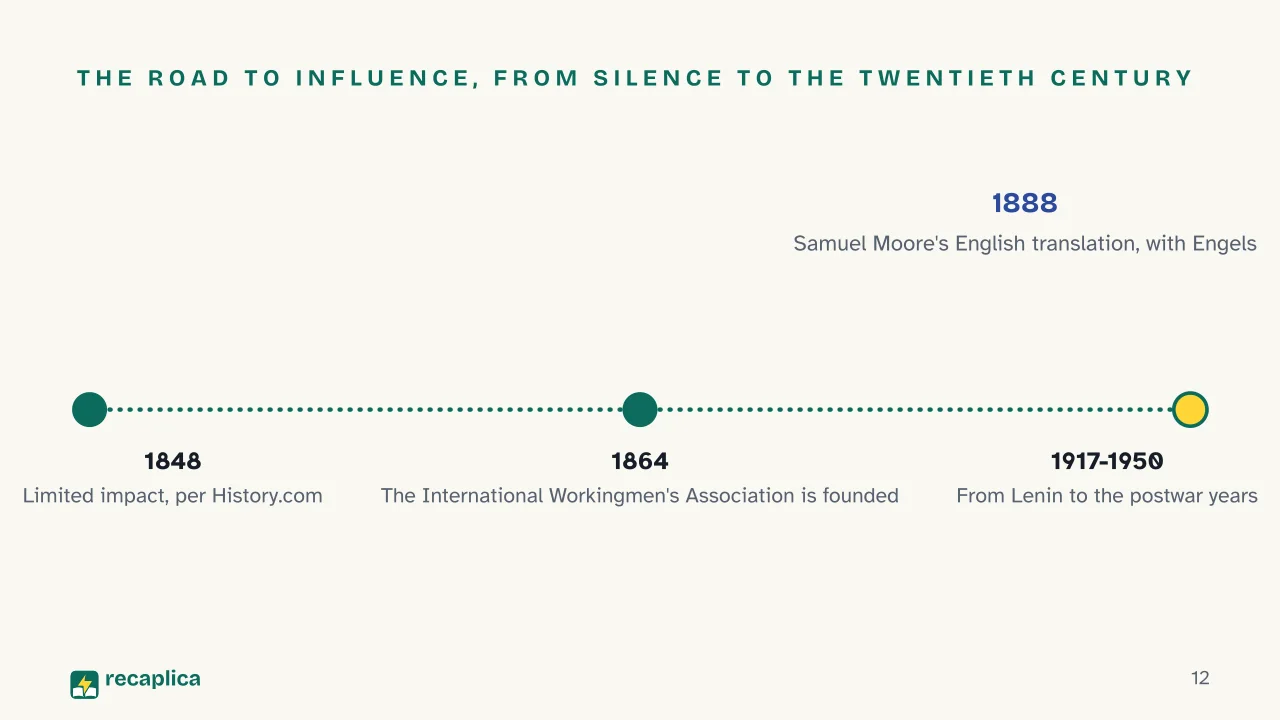 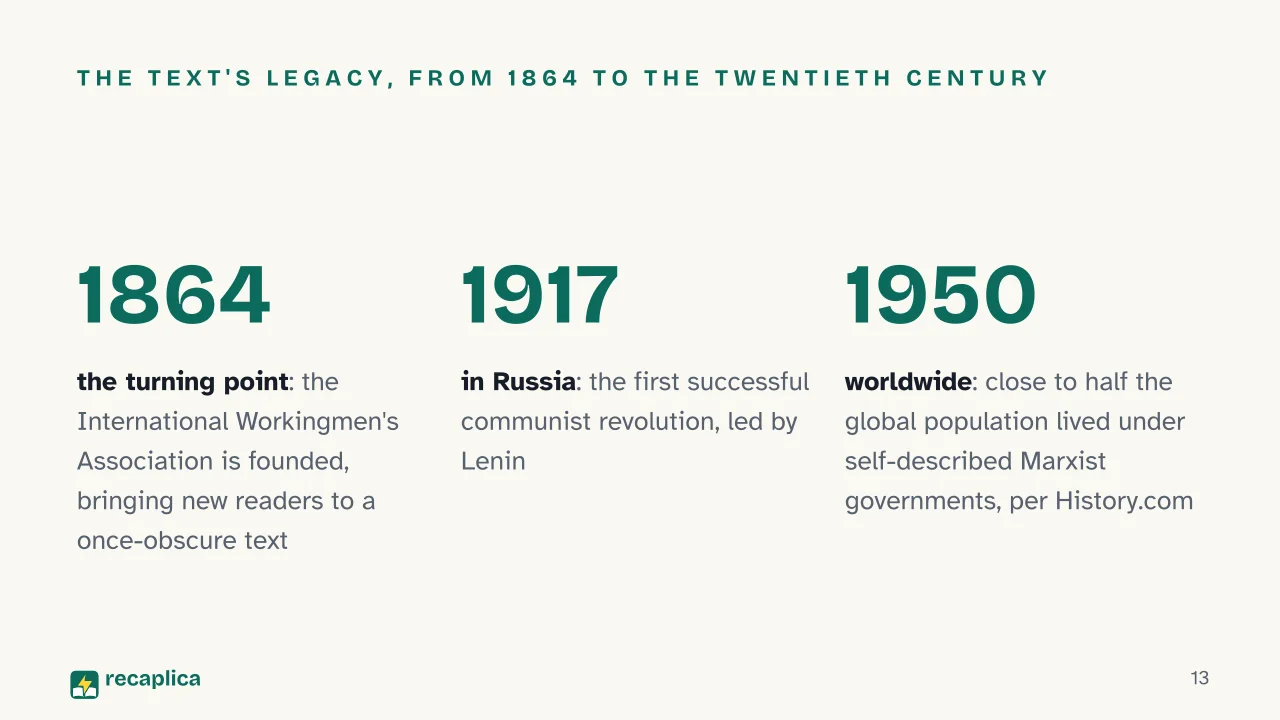 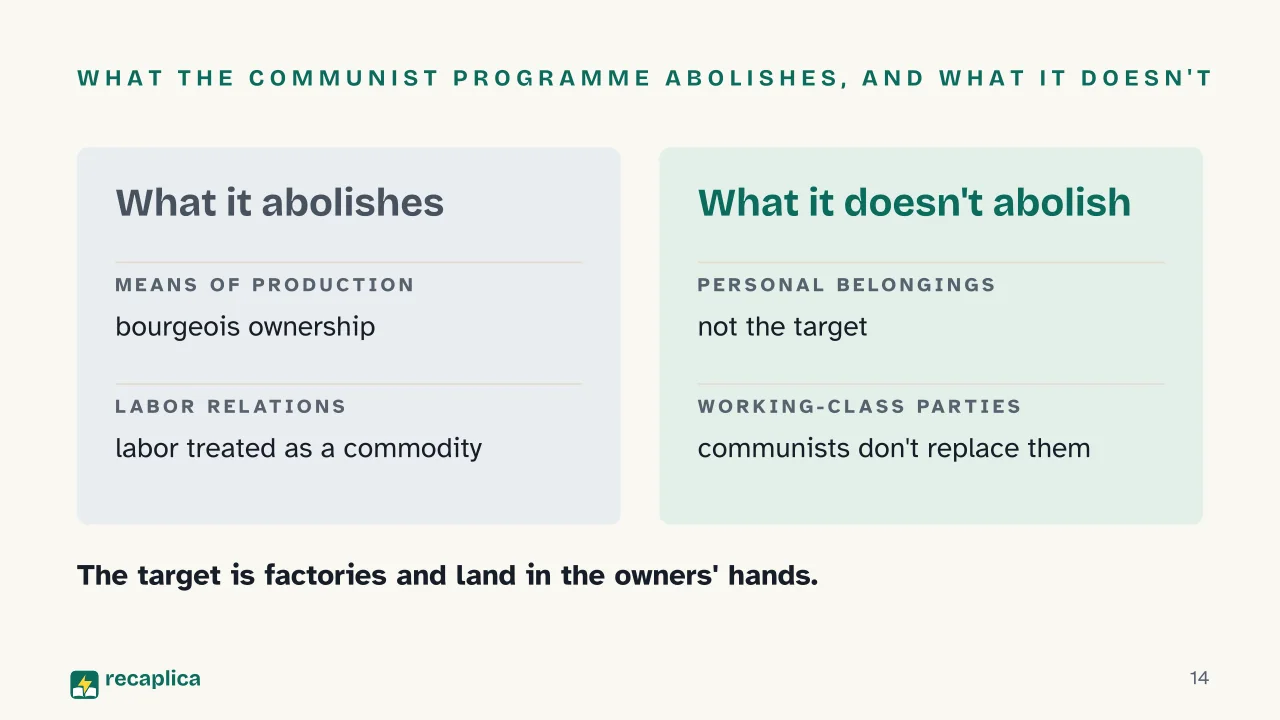   Common myths
Mind mapDrag the background to move around and the nodes to reposition them; use − and + to collapse and expand branches. 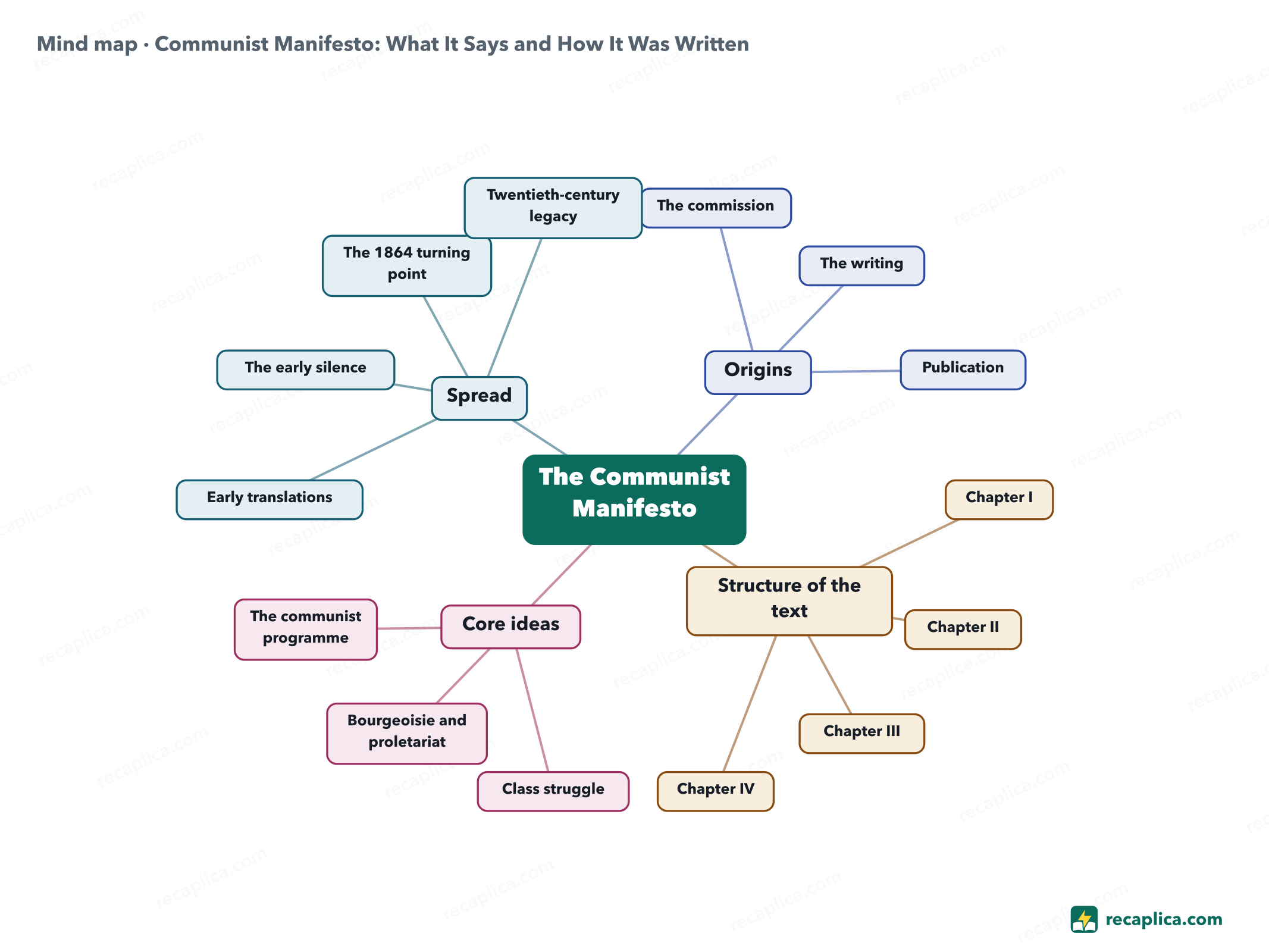
Quiz: test yourselfAnswer the questions to check what you have learned: you get instant feedback and a short explanation. Grade 0/10 0/5
FlashcardsTap the card to flip it and check whether you remember the answer, then move to the next one. 1 / 8 Explain it in your own wordsThe ultimate test: if you can explain it in simple words, you've truly understood it. Write your explanation, then compare it with the Recap. Your explanation is saved only on this device.
Frequently asked questionsWho wrote the Communist Manifesto?Karl Marx and Friedrich Engels, commissioned by the Communist League at its congress in November 1847. What year was the Communist Manifesto published?It was published in London on February 21, 1848, on behalf of the Communist League. Did the Manifesto cause the French Revolution of 1848?No. The Manifesto's London publication and the outbreak of revolution in Paris, on February 22, 1848, landed within a day of each other by coincidence, not because one caused the other. What does the Manifesto mean by abolishing private property?It means bourgeois private ownership of the means of production, not personal belongings — the text says so explicitly. Was the Manifesto an instant success?No. History.com says its impact in 1848 was limited; its readership grew only after the International Workingmen's Association, founded in 1864, gave it a new audience (Encyclopedia.com). Every Recap goes through an independent review before publication. |