|
recaplica
Marx and Engels: The Partnership That Lasted Almost Forty Years | |||||||||||||||
| © 2026 Recaplica · recaplica.com — All rights reserved | |||||||||||||||
Marx and Engels: The Partnership That Lasted Almost Forty YearsWhat to print Page numbers appear when printing with default margins. SlidesChoose a cut Flash10 slidesThe essential thread, to present in classFull14 slidesEvery chapter and the deeper detailBoth come with speaker notes. In 30 seconds quick readKarl Marx and Friedrich Engels meet in Paris in the autumn of 1844, as Engels returns from a period in England, and find they agree on almost every point of theory. The partnership that follows lasts until Marx's death in 1883, nearly forty years later. Engels works at, and later becomes a partner in, his father's textile firm in Manchester, and that income often supports Marx's family in London while the two write The German Ideology together and lay the groundwork for the Communist Manifesto. After Marx dies, Engels spends years putting disordered manuscripts in order to publish the second and third volumes of Capital. Key Points
Key figures
Deep DiveThe 1844 Paris meetingMarx and Engels meet in Paris in the autumn of 1844. Engels has just returned from a period in England, where he saw the factories and the conditions of workers up close — material that later fed his writing. According to Encyclopedia.com, the two are in complete theoretical agreement from this very first exchange: their intellectual alignment came before their personal friendship, rather than growing out of it over time. The thought behind Marx’s own ideas, from his Hegelian roots to his critique of political economy, is covered in Karl Marx: his thought and critique of capitalism, summary; this Recap instead looks at the relationship between the two men, how they split the work, and what they wrote together. Two roles, one shared projectMarx writes. Engels, for years, runs his family’s textile firm in Manchester, and becomes a partner in it sometime in the 1860s — sources disagree on the exact year, one giving 1860 and another 1864. That income, together with some personal investments, keeps Marx’s household in London afloat regularly over the London years, according to EBSCO.
The textile firm where Engels works belongs to the same industrial world described in Industrial Revolution: What Changed and Why: it is inside that Manchester factory, not in a university hall, that Engels earns the income that keeps the partnership going. The works they wrote togetherBetween 1845 and 1846, Marx and Engels write The German Ideology together, a text that sets out an early version of their theory of historical materialism. The manuscript, though, stays unpublished for decades: it only comes out in 1932, according to Encyclopedia.com. A few years later, Engels writes a first draft of the Communist League’s program; Marx reworks it, and the result is the Communist Manifesto, published in 1848 — a joint work at its origin, signed by both in its final form, but starting from a draft that is Engels’s own. The theoretical roots they share go back further, to the same philosophical current described in Hegel and German Idealism: What Is His Philosophy?, even though Marx and Engels turn it toward a direction opposite to where it started. After Marx’s deathMarx dies in 1883, leaving Capital unfinished: beyond the first volume, already published, what remains are disordered manuscripts written in handwriting that is hard to read. Engels spends years putting them in order, and that work leads to the publication of the second volume in 1885 and the third in 1894 — an effort that, according to EBSCO, costs Engels his own eyesight. A correspondence that became a historical sourceMarx and Engels exchange letters throughout their lives, a correspondence preserved and studied as a primary historical source. A digital archive, the Marxists Internet Archive, holds 180 letters for the 1833-1849 period, more than 180 for 1850-1859, more than 300 for 1860-1869, and more than 230 for 1870-1895 (this last block also includes Engels’s correspondence after Marx’s death). They are drawn from academic critical editions, the Marx Engels Collected Works, and remain one of the most direct ways to see how the two actually divided the work, day by day. Slide deckSlides ready to download and make your own in PowerPoint or Google Slides, with speaker notes. Pick the Flash cut or the Full one.     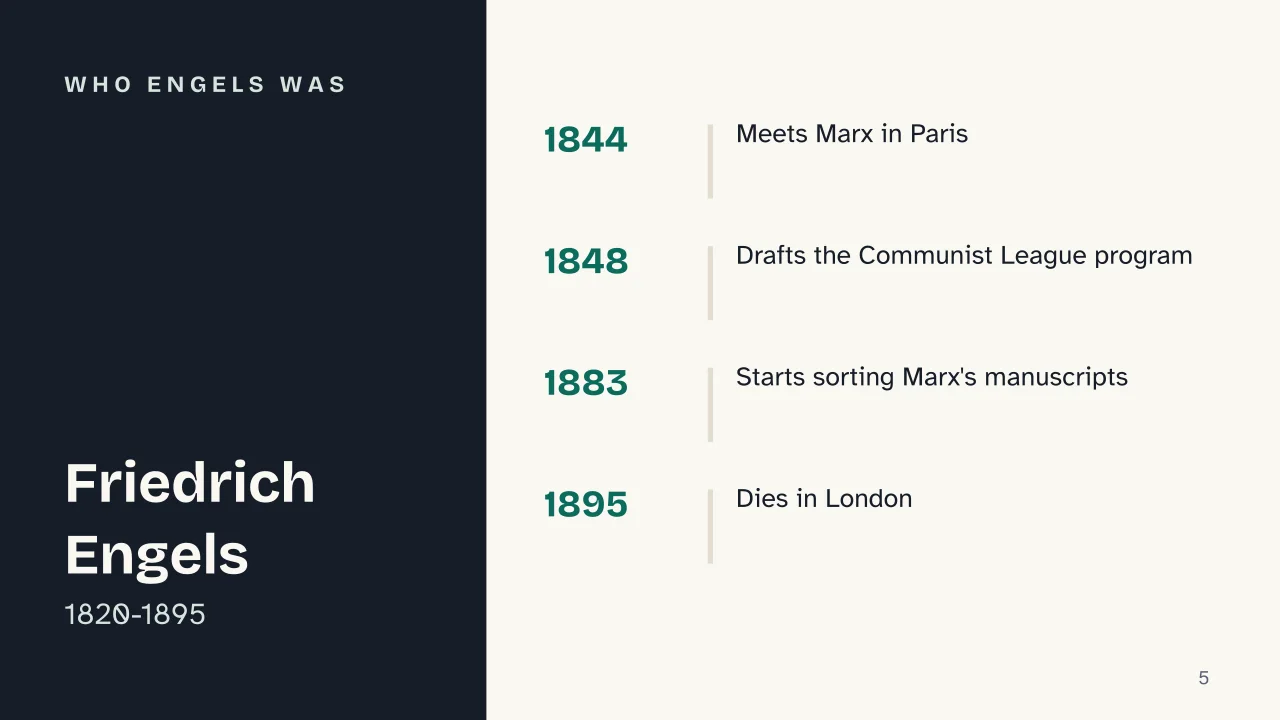  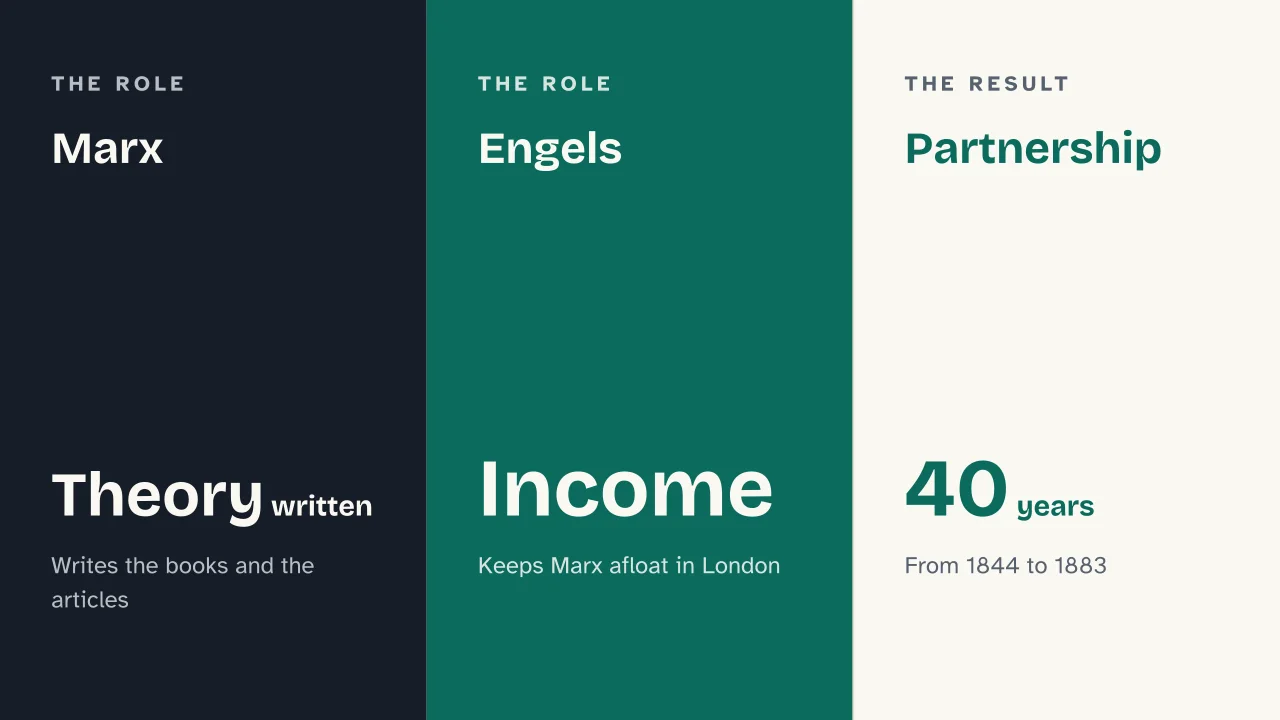  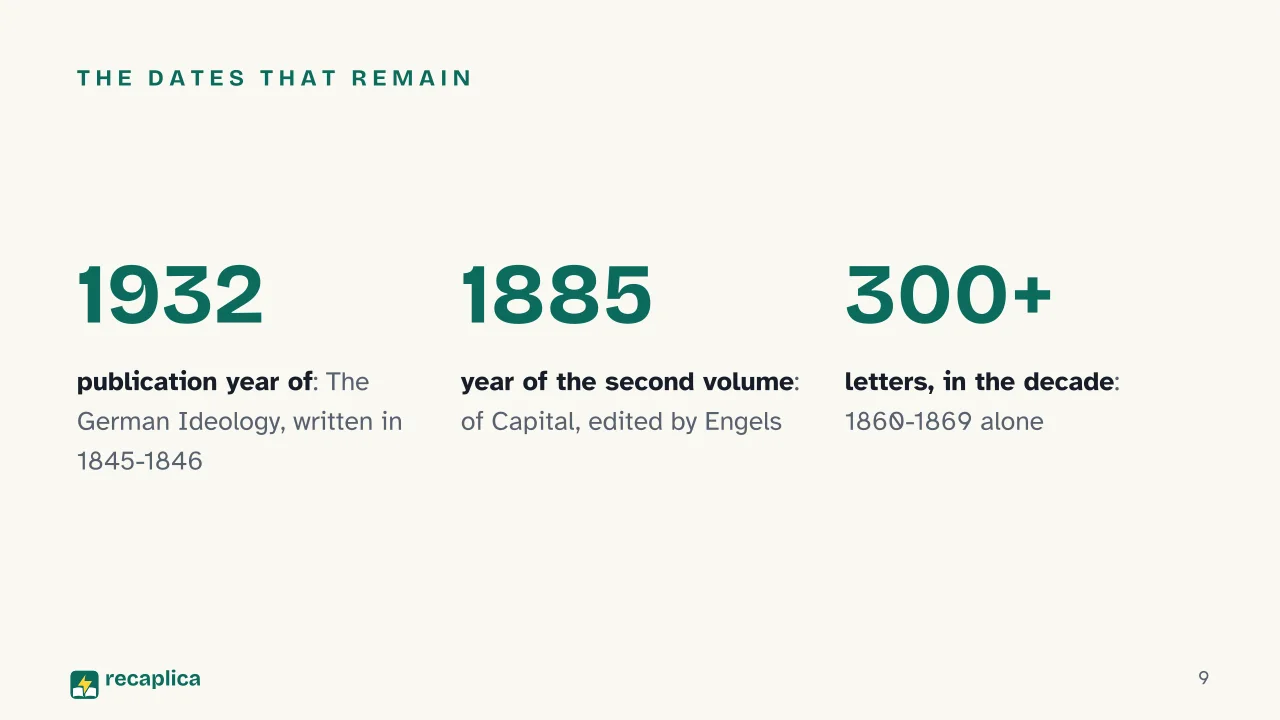 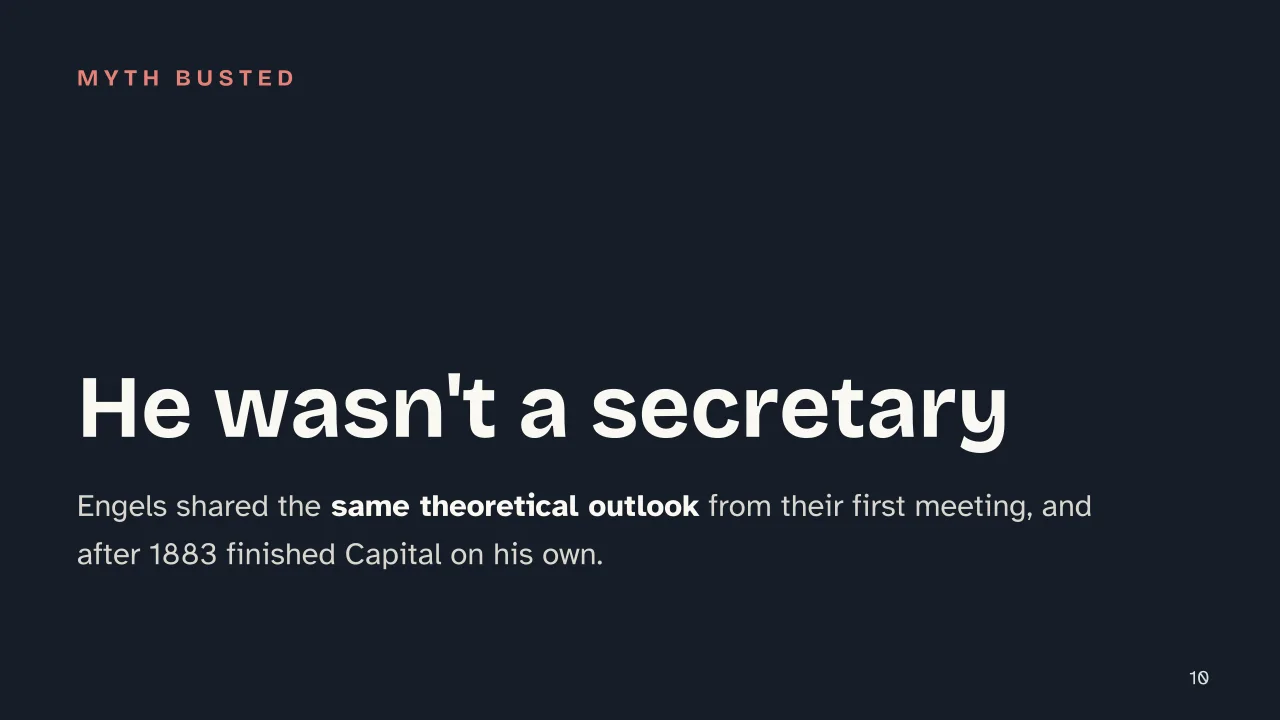  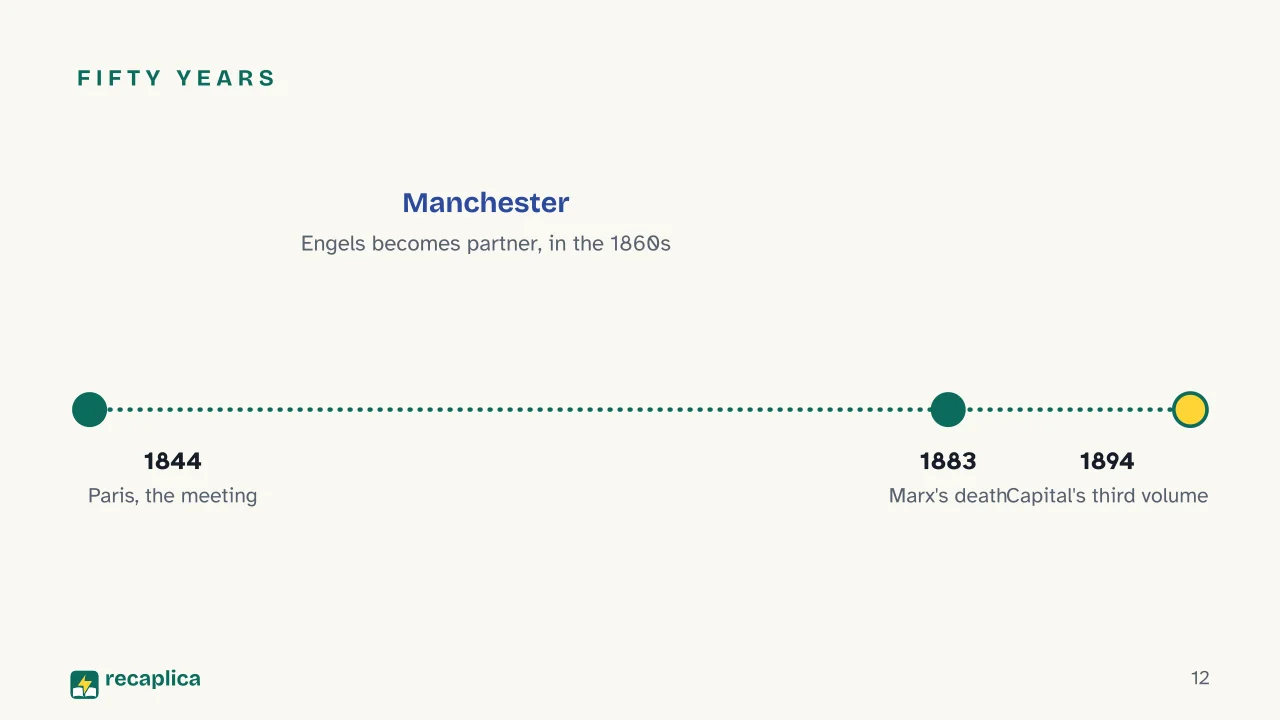 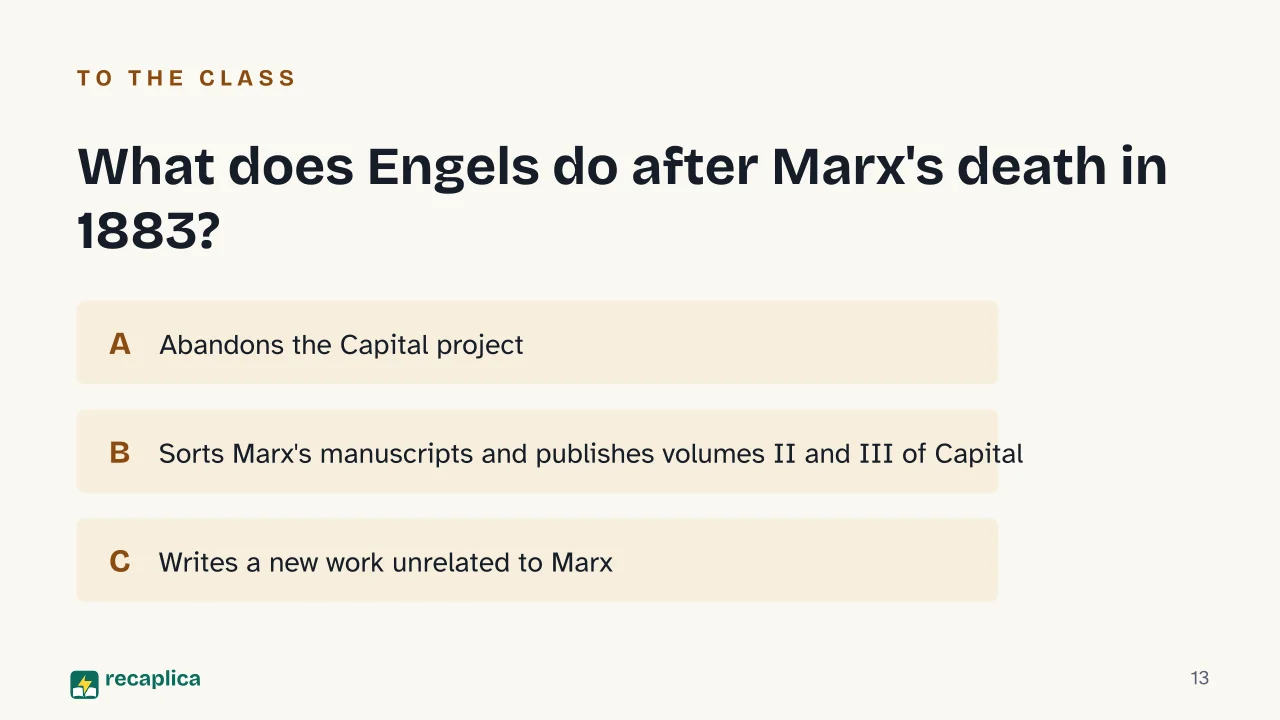  Common myths
Mind mapDrag the background to move around and the nodes to reposition them; use − and + to collapse and expand branches. 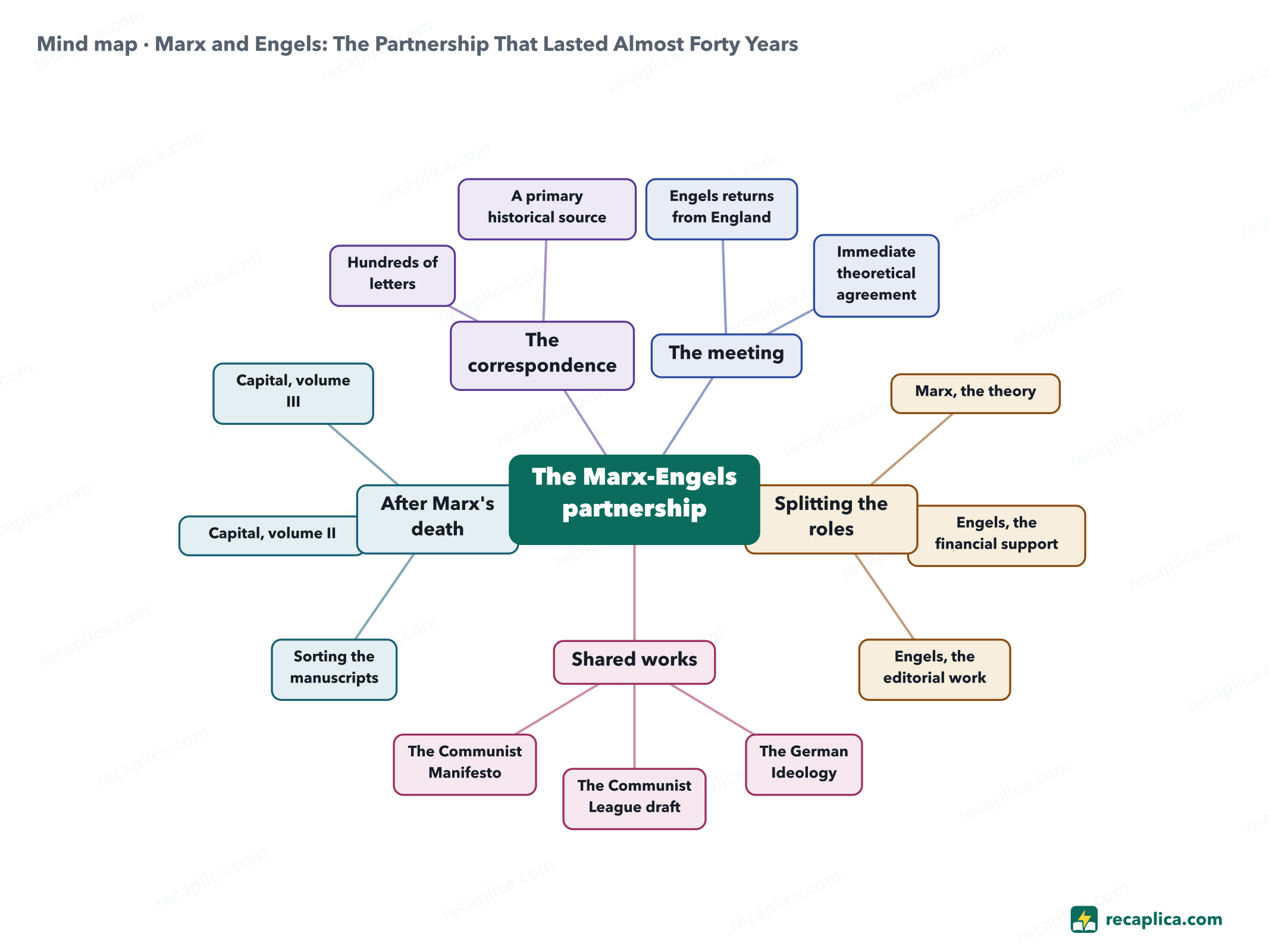
Quiz: test yourselfAnswer the questions to check what you have learned: you get instant feedback and a short explanation. Grade 0/10 0/5
FlashcardsTap the card to flip it and check whether you remember the answer, then move to the next one. 1 / 7 Explain it in your own wordsThe ultimate test: if you can explain it in simple words, you've truly understood it. Write your explanation, then compare it with the Recap. Your explanation is saved only on this device.
Frequently asked questionsWere Marx and Engels friends or business partners?Both: the two agree on theory from the moment they meet in Paris in 1844, and Engels supports Marx's family financially with income from his Manchester firm. Did Engels write the Communist Manifesto?He writes a first draft for the Communist League, but the text published in 1848 is Marx's reworking of it. Why wasn't The German Ideology published right away?The manuscript, written by Marx and Engels between 1845 and 1846, stays unpublished and only comes out in 1932. Who finished Capital after Marx's death?Engels, who sorts the unfinished manuscripts and publishes the second volume in 1885 and the third in 1894. Every Recap goes through an independent review before publication. |