Skip to content
recaplica

    One moment: security check

    Cloudflare wants to make sure you're not a robot. Tick the box below and your search will continue on its own.

    IT
    recaplica Das Kapital by Karl Marx: Summary of the Three Volumes and Surplus Value
    © 2026 Recaplica · recaplica.com — All rights reserved
    Home › History

    Das Kapital by Karl Marx: Summary of the Three Volumes and Surplus Value

    By Recaplica Newsroom · Updated on October 15, 2026

    What to print

    Page numbers appear when printing with default margins.

    Slides

    Choose a cut

    Flash10 slidesThe essential thread, to present in classFull14 slidesEvery chapter and the deeper detail

    Both come with speaker notes.

    Telegram channel
    recaplica Clear in 30 seconds, yours in 10 minutes.
    In 30 seconds Key points Figures Deep dive Slides Myths Mind map Quiz Flashcards FAQ

    In 30 seconds quick read

    Das Kapital is Karl Marx's major work of economics, published in three volumes between 1867 and 1894. Marx writes and publishes only the first volume himself, in 1867; the other two remain unfinished when he dies, in 1883, and Friedrich Engels completes and publishes them, in 1885 and 1894. The theory of surplus value ties the three volumes together: the share of value created by labor that capital keeps without paying it back as wages. In the preface to the first edition, Marx states that his goal is to uncover the economic law governing the movement of modern capitalist society.

    Key Points

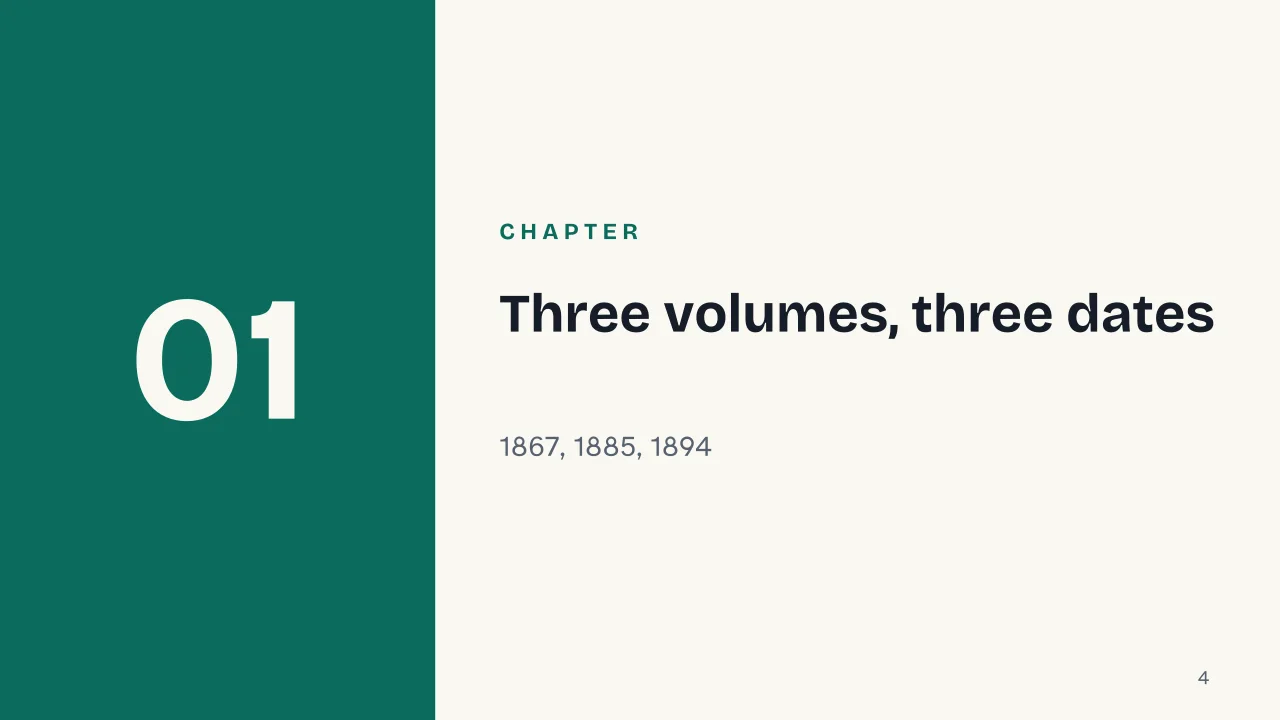
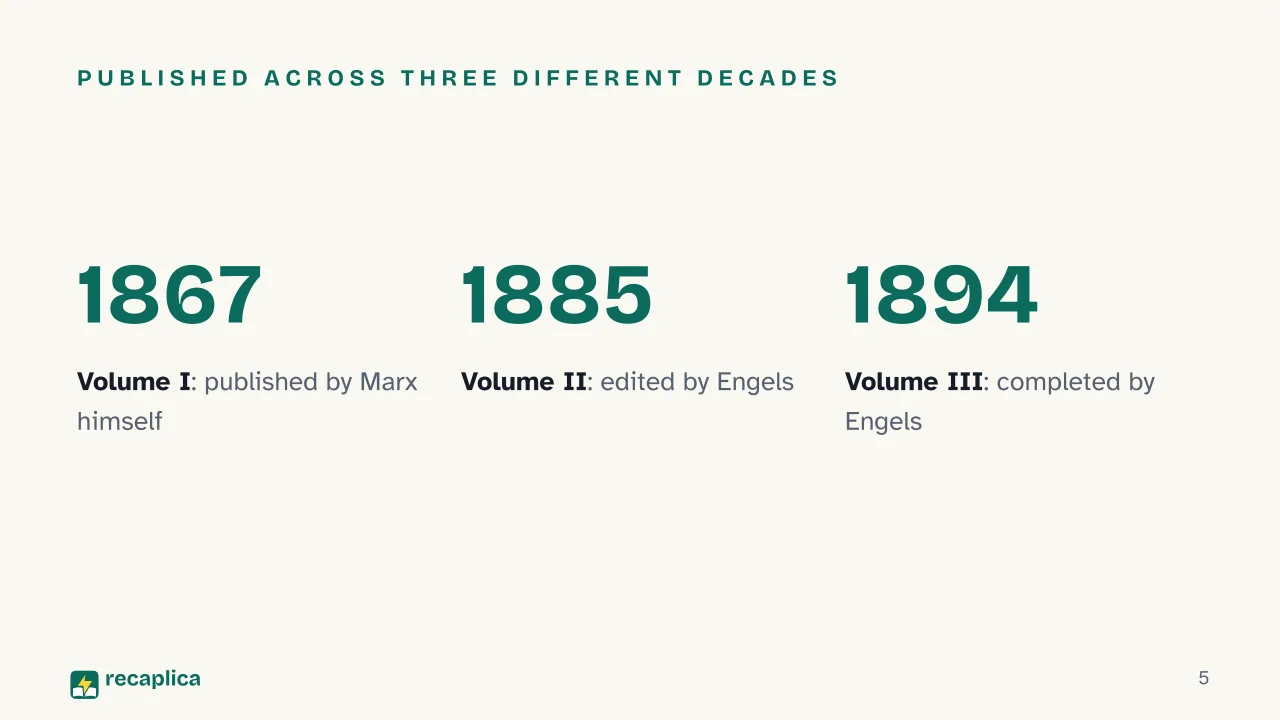
    • Das Kapital by Karl Marx is split into three volumes: Volume I (1867), Volume II (1885), and Volume III (1894).
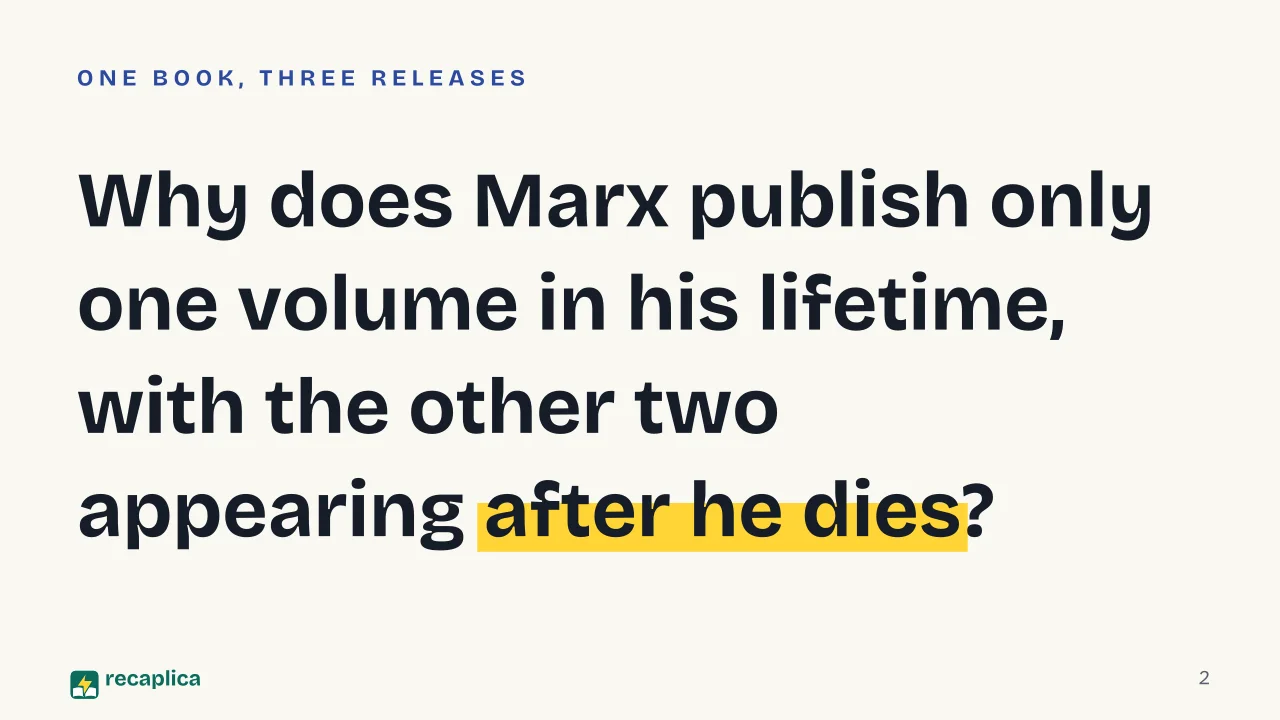
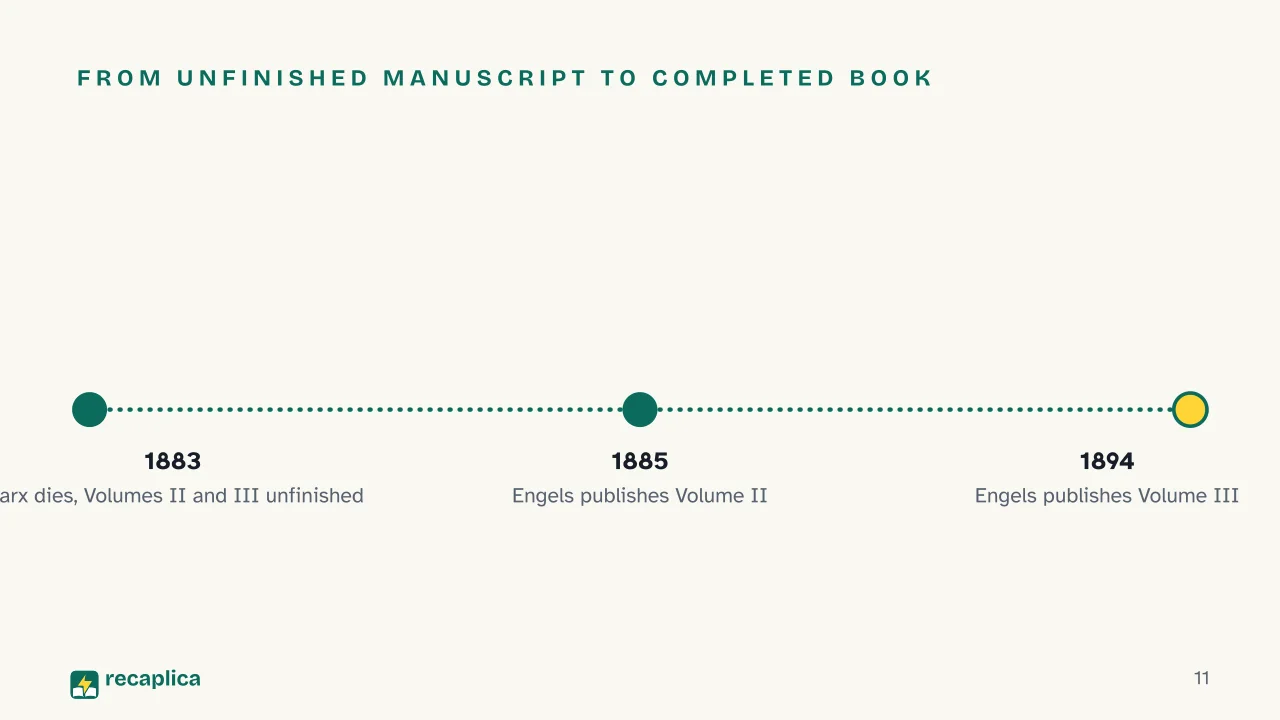
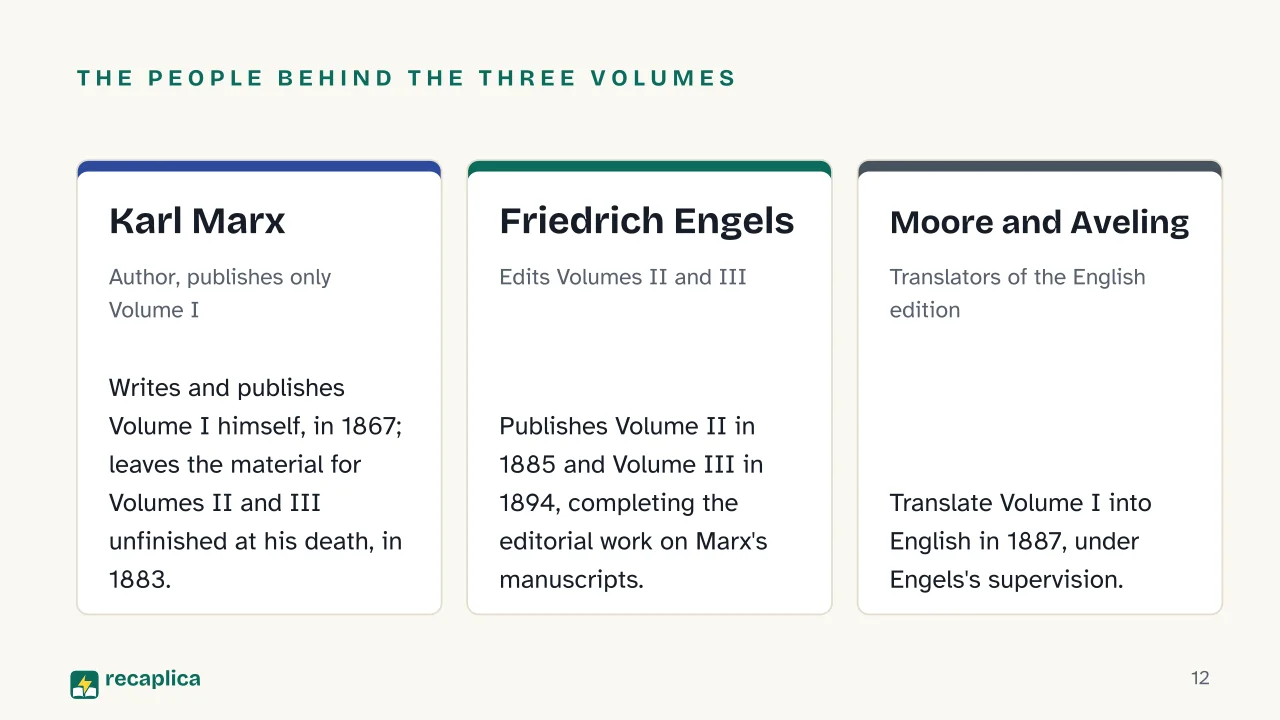
    • Marx publishes only Volume I himself; Friedrich Engels edits and completes Volumes II and III after Marx's death in 1883.
    • Volume I is titled The Process of Production of Capital and sets out the theory of surplus value.
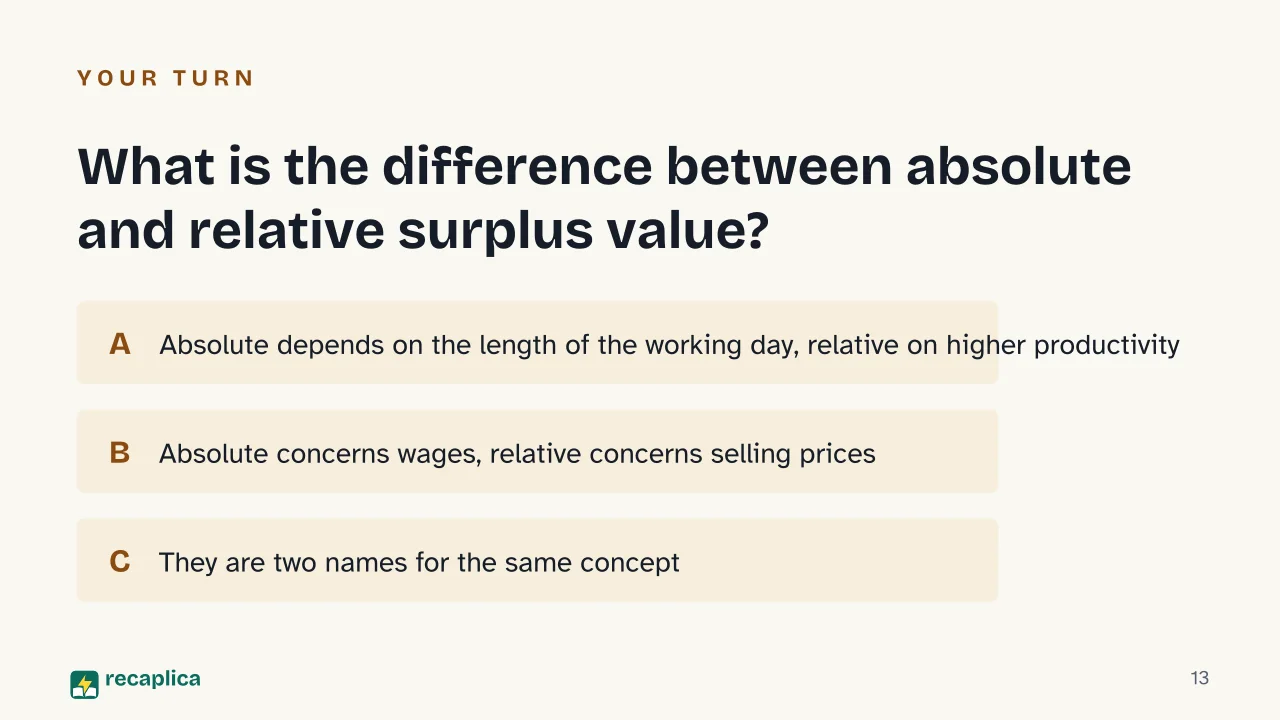
    • Absolute surplus value comes from lengthening the working day; relative surplus value comes from raising productivity without extending the hours.
    • The first English edition of Volume I appears only in 1887, translated by Samuel Moore and Edward Aveling under Engels's supervision.
    • In the 1867 preface, Marx states his aim as uncovering the economic law behind the movement of modern capitalist society.

    Key figures

    • 1867 Year Volume I of Capital is published, in German, by the publisher Otto Meissner. Source: Marxists Internet Archive
    • 1885 Year Volume II is published, edited by Friedrich Engels after Marx's death. Source: Marxists Internet Archive
    • 1894 Year Volume III is published, completed by Engels eleven years after Marx's death. Source: Marxists Internet Archive

    Deep Dive

    According to the Stanford Encyclopedia of Philosophy, studies of Marx often describe him as a revolutionary activist, engaged in the labor movements of his time more than as a professional philosopher. Capital, his major work, went on to inspire the founding of communist states in several countries during the 20th century.

    Readers looking for a biography of Marx or a summary of his broader thought will find that in the Recap on Karl Marx: his thought and critique of capitalism; the focus here is the book itself, Das Kapital: how it is structured, what it says about surplus value, and how it reached its final, three-volume form in 1894, in pieces published years apart.

    Three volumes, published across three different decades

    Marx publishes Volume I of Capital in 1867, through the publisher Otto Meissner. It is the only volume of the work Marx sees printed in his own lifetime, titled The Process of Production of Capital, and it remains the most widely read of the three. The first English edition does not appear until 1887, translated by Samuel Moore and Edward Aveling under the supervision of Friedrich Engels.

    Marx works on the material for Volume II between 1863 and 1878, and on Volume III up to 1883, without reaching a publishable version for either; he dies in 1883 leaving both manuscripts unfinished. Engels takes them on: he publishes Volume II in 1885 and Volume III in 1894, closing out an editorial task that runs eleven years past his friend’s death. In the preface to Volume II, Engels writes that he limited himself to reproducing Marx’s manuscripts as literally as possible, touching the style only where he judged Marx himself would have changed it; the passages written or reworked in his own hand, he adds, fill barely ten printed pages and concern matters of form alone. Only the first and third parts of the manuscript, he says, gave him real and considerable editorial trouble.

    The relationship that makes this posthumous editing possible grows out of decades of shared work, told in the Recap on Marx and Engels: The Partnership That Lasted Almost Forty Years; the same partnership had already produced, in the 1840s, The German Ideology, the pair’s first attempt at explaining history through the material activity of human beings.

    The theory of surplus value: absolute and relative

    Surplus value is the thread running through all three volumes. For Marx it is, by definition, the source of all profit under capitalism: the capitalist pays the worker a wage, but the labor the worker performs produces more value than that wage, and the gap stays with the capitalist. Marx had first worked through the link between wages and capital in lectures he gave in Brussels in December 1847, published in 1849 and known as Wage Labour and Capital. The concrete setting Marx draws his examples from — factories, grinding working days, mechanized labor — is the one described in the Recap on the Industrial Revolution.

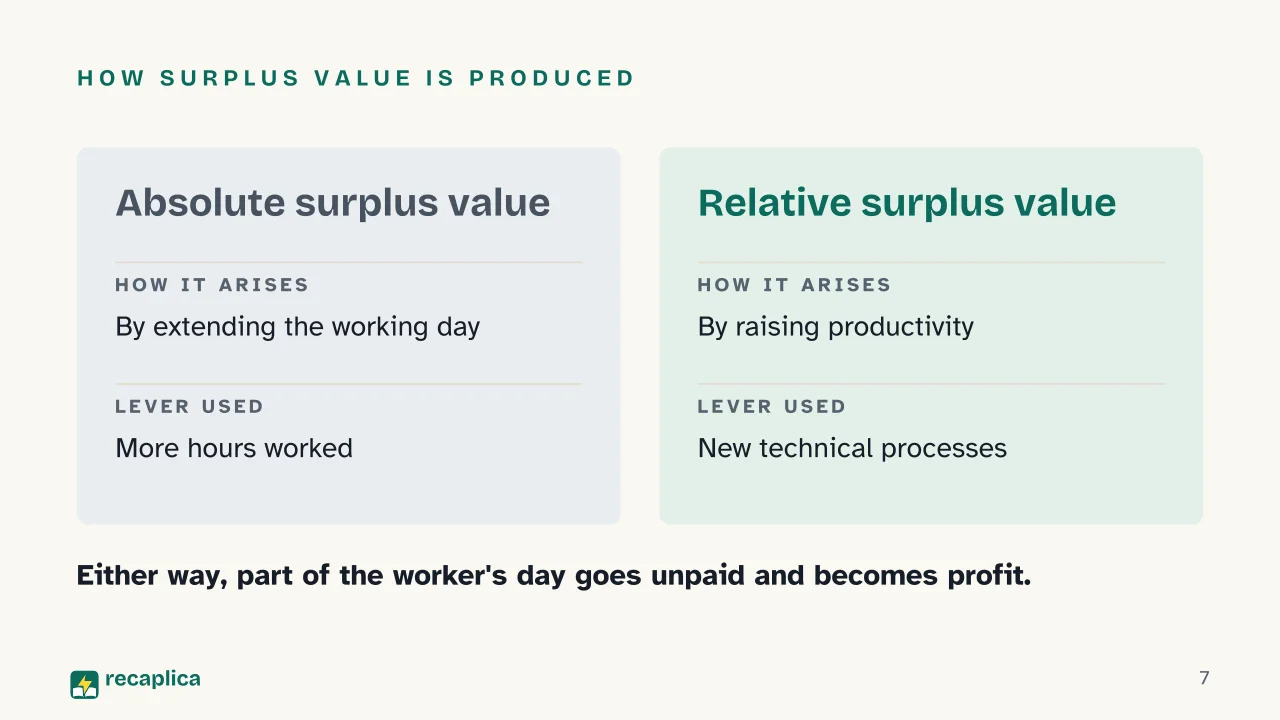
    In chapter 16 of Volume I, Marx separates two forms of surplus value. Absolute surplus value appears when the working day runs longer than the time needed for the worker to produce a value equal to their own wage: that extra stretch goes to capital. Relative surplus value, instead, comes from overhauling the technical processes of labor and raising productivity, without extending the hours.

    AspectAbsolute surplus valueRelative surplus value
    How it is producedBy extending the working dayBy raising the productivity of labor
    What changesThe length of the working dayThe technical processes of production
    Where Marx discusses itChapter 16, Volume IChapter 16, Volume I

    Example: picture a factory worker on an eight-hour shift. If the employer tacks on two more hours without raising her pay, those two hours are absolute surplus value. If the shift stays the same length but a new machine lets her turn out more in that time, the extra value comes from relative surplus value instead: nothing about her schedule changed, only what one hour of her labor can now produce.

    The stated aim: uncovering the economic law of capitalism

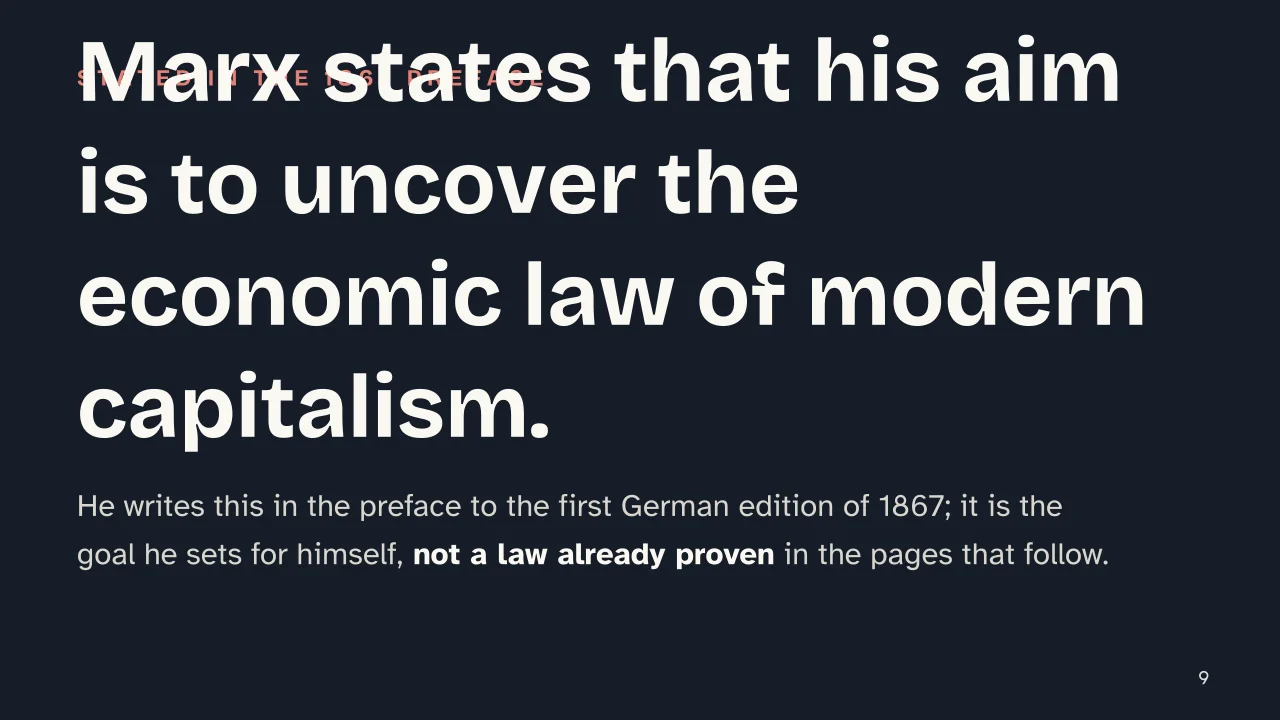
    In the preface to the first German edition of 1867, Marx sets out what the book is for: to bring to light the economic law that, in his view, governs the movement of modern capitalist society. It is the ambition he announces up front, before building the argument across the three volumes, starting from the factory floor and the wage packet and moving, by Volume III, to the broader mechanics of accumulation.

    The school of neoclassical economics offers an alternative framework for explaining prices and profits, one that does without surplus value altogether.

    Slide deck

    Slides ready to download and make your own in PowerPoint or Google Slides, with speaker notes. Pick the Flash cut or the Full one.
    Slide 1 of the presentation on Das Kapital by Karl Marx: Das KapitalSlide 2 of the presentation on Das Kapital by Karl Marx: Why does Marx publish only one volume in his lifetime, with the other two appearing after he dies?Slide 3 of the presentation on Das Kapital by Karl Marx: How to read the bookSlide 4 of the presentation on Das Kapital by Karl Marx: Chapter 01: Three volumes, three datesSlide 5 of the presentation on Das Kapital by Karl Marx: Published across three different decadesSlide 6 of the presentation on Das Kapital by Karl Marx: Chapter 02: Surplus valueSlide 7 of the presentation on Das Kapital by Karl Marx: How surplus value is producedSlide 8 of the presentation on Das Kapital by Karl Marx: Chapter 03: The stated aimSlide 9 of the presentation on Das Kapital by Karl Marx: Marx states that his aim is to uncover the economic law of modern capitalism.Slide 10 of the presentation on Das Kapital by Karl Marx: Chapter 04: After Marx's deathSlide 11 of the presentation on Das Kapital by Karl Marx: From unfinished manuscript to completed bookSlide 12 of the presentation on Das Kapital by Karl Marx: The people behind the three volumes: Karl Marx, Friedrich Engels, Moore and AvelingSlide 13 of the presentation on Das Kapital by Karl Marx: What is the difference between absolute and relative surplus value?Slide 14 of the presentation on Das Kapital by Karl Marx: 1867 to 1894
    Flash10 slidesThe essential thread, to present in classFull14 slidesEvery chapter and the deeper detail

    Common myths

    • ✗ Myth Many assume that For Marx is an alternative title or an unpublished volume of Das Kapital.

      ✓ Reality For Marx (Pour Marx, 1965) is a collection of essays by the French philosopher Louis Althusser on reading Marxist thought: a distinct work, with no editorial connection to Marx's own Capital.

    • ✗ Myth Many think that books with a near-identical title, such as Capital in the Twenty-First Century or Capital in the Anthropocene, are updated editions of Marx's book.

      ✓ Reality They are works by other authors, published decades later, that examine different questions with their own methods. The title echoes Marx's, but they do not continue or update the text Marx and Engels wrote in the 19th century.

    • ✗ Myth Many believe Marx wrote and published all three volumes of Das Kapital on his own.

      ✓ Reality Marx publishes only Volume I by himself, in 1867. Volumes II and III remain incomplete manuscripts at his death, in 1883, and are edited, finished, and published by Friedrich Engels, in 1885 and 1894 respectively.

    Mind map

    Drag the background to move around and the nodes to reposition them; use − and + to collapse and expand branches.
    Customize
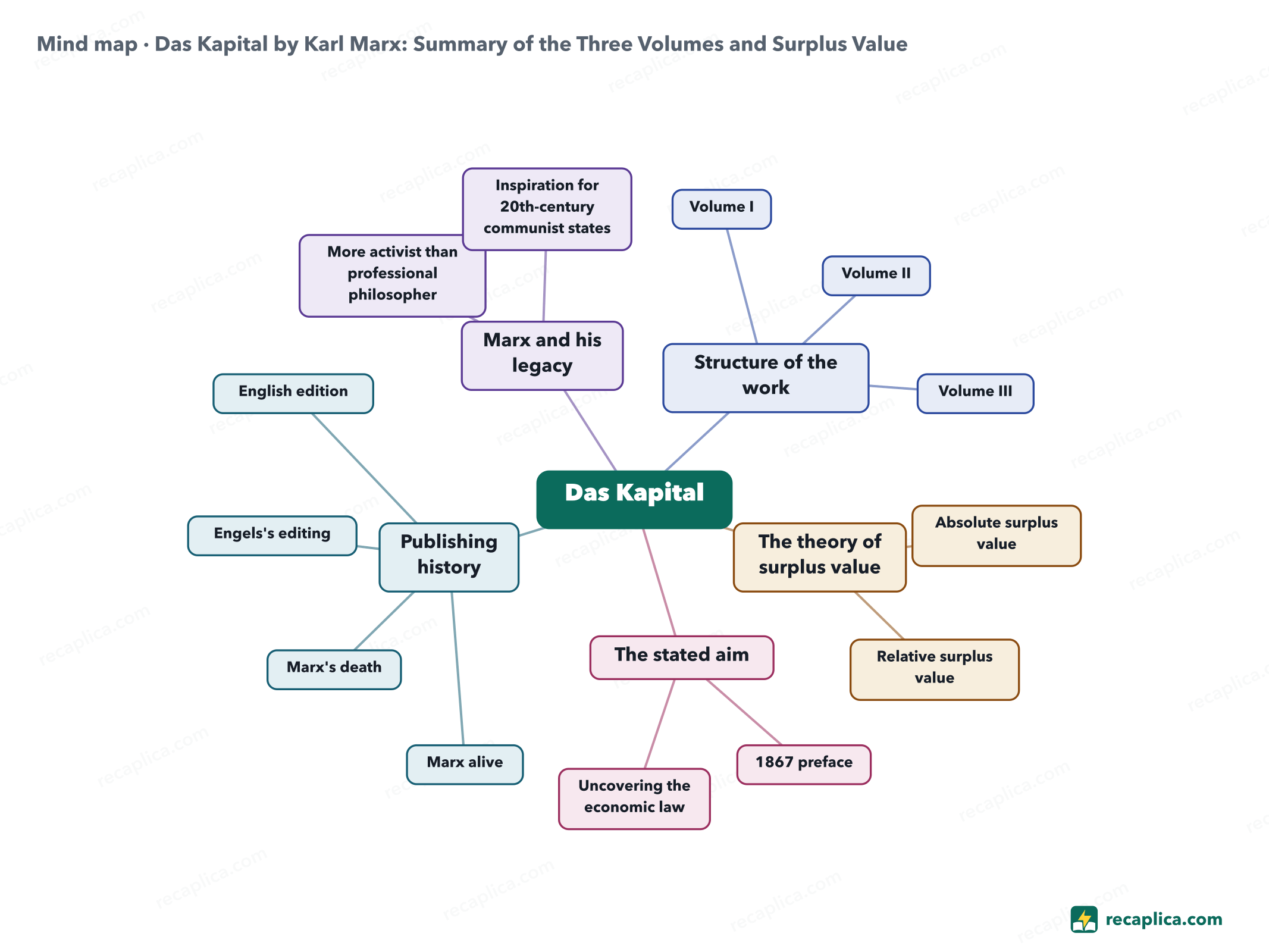
    Mind map: Das Kapital by Karl Marx: Summary of the Three Volumes and Surplus Value
    • Das Kapital
      • Structure of the work Three volumes published across three decades
        • Volume I The Process of Production of Capital, 1867
        • Volume II edited by Engels, 1885
        • Volume III completed by Engels, 1894
      • The theory of surplus value
        • Absolute surplus value longer working day
        • Relative surplus value higher productivity, same hours
      • The stated aim
        • 1867 preface
        • Uncovering the economic law behind the movement of modern capitalist society
      • Publishing history
        • Marx alive only Volume I, in 1867
        • Marx's death in 1883, manuscripts unfinished
        • Engels's editing Volume II in 1885, Volume III in 1894
        • English edition 1887, Moore and Aveling, supervised by Engels
      • Marx and his legacy
        • More activist than professional philosopher according to the Stanford Encyclopedia of Philosophy
        • Inspiration for 20th-century communist states

    Quiz: test yourself

    Answer the questions to check what you have learned: you get instant feedback and a short explanation.

    Grade 0/10 0/5
    1 In what year is Volume I of Capital first published?

    According to the Marxists Internet Archive, Volume I appears in 1867; the English edition follows only in 1887.

    2 What is surplus value, by Marx's own definition in Capital?

    For Marx, surplus value is, by definition, the source of all capitalist profit, according to the Stanford Encyclopedia of Philosophy.

    3 What is the difference between absolute and relative surplus value?

    Marx covers both in chapter 16 of Volume I: one stretches the working day, the other changes the labor process.

    4 Who finished and published Volumes II and III of Capital after Marx's death?

    Marx dies in 1883 without finishing them; Engels edits the manuscripts and publishes them, in 1885 and 1894 respectively.

    5 What is the relationship between Marx's Capital and the book titled For Marx?

    For Marx (Pour Marx, 1965) is a collection of essays the philosopher Louis Althusser published on Marxist thought nearly a century after Capital: an independent book, outside Marx's own body of work.

    Answers: 1-A · 2-A · 3-A · 4-A · 5-A

    Flashcards

    Tap the card to flip it and check whether you remember the answer, then move to the next one.

    1 / 8

    Explain it in your own words

    The ultimate test: if you can explain it in simple words, you've truly understood it. Write your explanation, then compare it with the Recap.

    Your explanation is saved only on this device.

    Das Kapital is Karl Marx's major work of economics, published in three volumes between 1867 and 1894. Marx writes and publishes only the first volume himself, in 1867; the other two remain unfinished when he dies, in 1883, and Friedrich Engels completes and publishes them, in 1885 and 1894. The theory of surplus value ties the three volumes together: the share of value created by labor that capital keeps without paying it back as wages. In the preface to the first edition, Marx states that his goal is to uncover the economic law governing the movement of modern capitalist society.

    Frequently asked questions

    What is Karl Marx's book Das Kapital about?

    It sets out Marx's economic analysis of capitalism across three volumes, from 1867 to 1894, centered on the theory of surplus value and how profit under capitalism actually works.

    How many volumes make up Capital by Karl Marx?

    Three: Volume I, The Process of Production of Capital (1867); Volume II (1885); Volume III (1894). Marx publishes only the first; Friedrich Engels edits the other two after his death.

    Is Das Kapital the same as the book For Marx?

    No. Das Kapital is Marx's own foundational work of political economy. For Marx (Pour Marx, 1965) is the essay collection the philosopher Louis Althusser devoted to Marxist thought nearly a century later; it is not a volume of Capital.

    What is surplus value in Marx's Capital?

    According to Marx, it is the source of all capitalist profit: the value labor produces beyond what the capitalist pays back as wages. Marx separates an absolute surplus value, tied to the length of the working day, from a relative surplus value, tied to productivity.

    Who finished Das Kapital after Marx died?

    Friedrich Engels, who edited the unfinished manuscripts of Volumes II and III and published them, in 1885 and 1894 respectively.

    Sources

    • Stanford Encyclopedia of Philosophy — Karl Marx
    • Marxists Internet Archive — Capital, Volume I
    • Marxists Internet Archive — Capital, Volume II
    • Marxists Internet Archive — Capital, Volume III

    Every Recap goes through an independent review before publication.

    Every evening, the day's new Recaps on our Telegram channel. Join the channel →

    Keep learning

    • History What Is Existentialism? Heidegger, Being and Time, and Dasein Existentialism is a current of twentieth-century philosophy centered on human existence, freedom and the search for meaning. According to the Stanford Encyclopedia of Philosophy, the German philosopher Martin Heidegger (1889-1976) shaped that current more than almost anyone else, even though he never accepted the label. In 1927 he published Being and Time, his major work, where he introduced the concept of Dasein: the human being as the one entity that questions its own existence. That book influenced Jean-Paul Sartre's existentialism, but in 1946, in the Letter on Humanism, Heidegger openly broke with Sartre and refused to be called an existentialist. In 1933 he was elected rector of the University of Freiburg and became a Nazi party member, keeping that membership until the regime fell - an episode Heidegger himself later denied or played down more than once. Read the Recap →
    • History What Is Phenomenology? Husserl's Philosophy Explained Edmund Husserl founded phenomenology as a philosophical discipline around 1900-1901, with his Logical Investigations. His method starts from the epoché, a suspension of our everyday, unquestioning stance toward the world, and moves toward phenomenological reduction: studying how things appear to consciousness rather than what they are in themselves. At the center sits intentionality, the idea that every experience is always an experience of something specific, whether hoping, perceiving, or desiring. The method Husserl built carried into the 20th century through Heidegger, Sartre, and Merleau-Ponty, moving from German philosophy into French philosophy along the way. Read the Recap →
    • History Legal Positivism: What It Is, from Austin to Kelsen and Hart According to the Stanford Encyclopedia of Philosophy, legal positivism measures legal validity against observable social facts, keeping moral judgment on a separate track. Its roots lie in Hobbes and Hume. Jeremy Bentham produced the theory's first full account, which John Austin later took up and spread: for Austin, a rule is law only when a sovereign commands it under threat of punishment. In the twentieth century, Hans Kelsen grounded legal validity in a hierarchy that traces back to a presupposed basic norm, while Herbert Hart located it instead in a rule of recognition actually followed by judges and officials. Natural law theory takes the opposite view: an unjust law is not really a law. Legal positivism disagrees — a law stays valid even when it is morally unjust, as long as it was made the way the system requires. Read the Recap →

    recaplica

    Clear in 30 seconds, yours in 10 minutes.

    Recaps Mind maps Request a Recap Telegram channel Mind map maker Our method About Privacy & cookies Legal notes & terms of use

    © 2026 Recaplica · A project by Curi S.r.l. — VAT IT05472000750

    Statistics, only if you say so

    To learn which Recaps help most we would use Google Analytics, with aggregate, anonymous data. It starts only with your OK, and you can change your mind anytime. Privacy policy