recaplica
Clear in 30 seconds, yours in 10 minutes.
In 30 seconds quick read
Neoclassical economics is the school of economic thought born from the marginalist revolution, the shift that between 1871 and 1874 moved the source of value from production costs to subjective utility. According to the academic site The History of Economic Thought, William Stanley Jevons and Carl Menger published their key works in 1871, and Léon Walras followed in 1874, placing marginal utility inside a system of general equilibrium. The same site calls Walras the father of that theory. In 1890 Alfred Marshall combined cost and utility through supply and demand, in what the source calls a "textbook synthesis" that carried neoclassical theory to a much wider audience.
Key Points
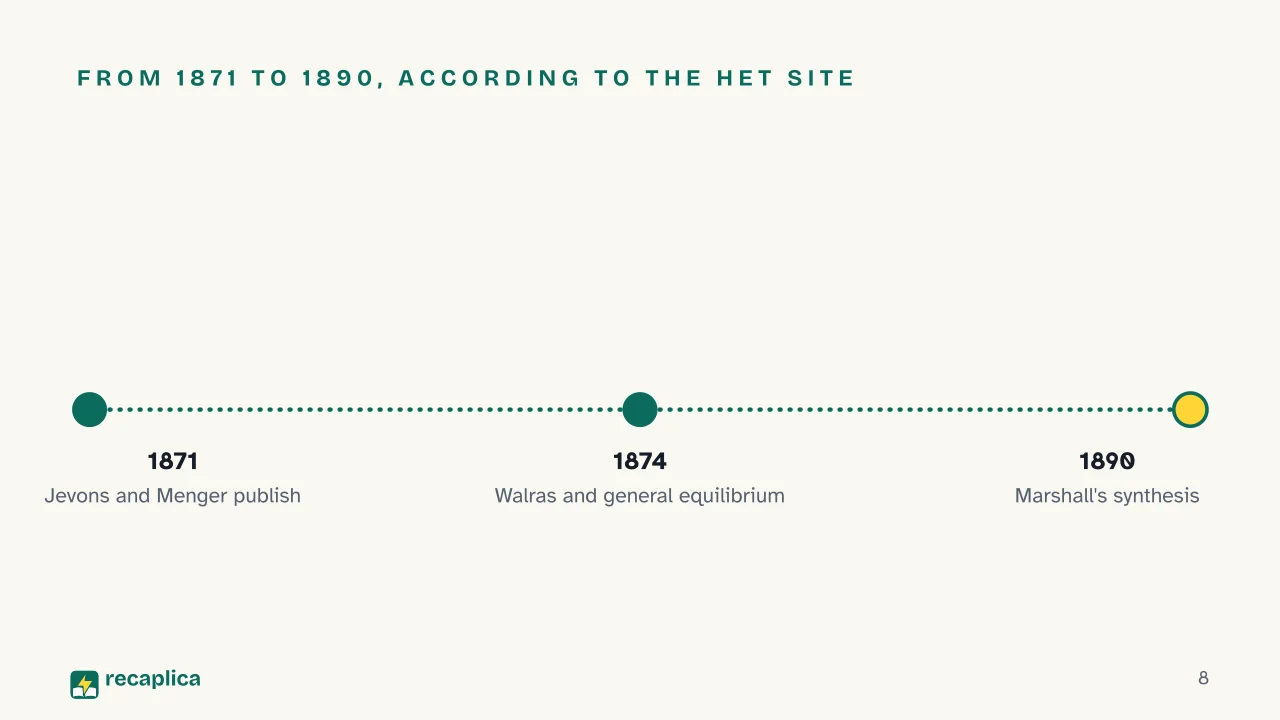
The marginalist revolution starts in 1871 with Jevons and Menger and continues in 1874 with Walras; neoclassical economics grows out of that shift.
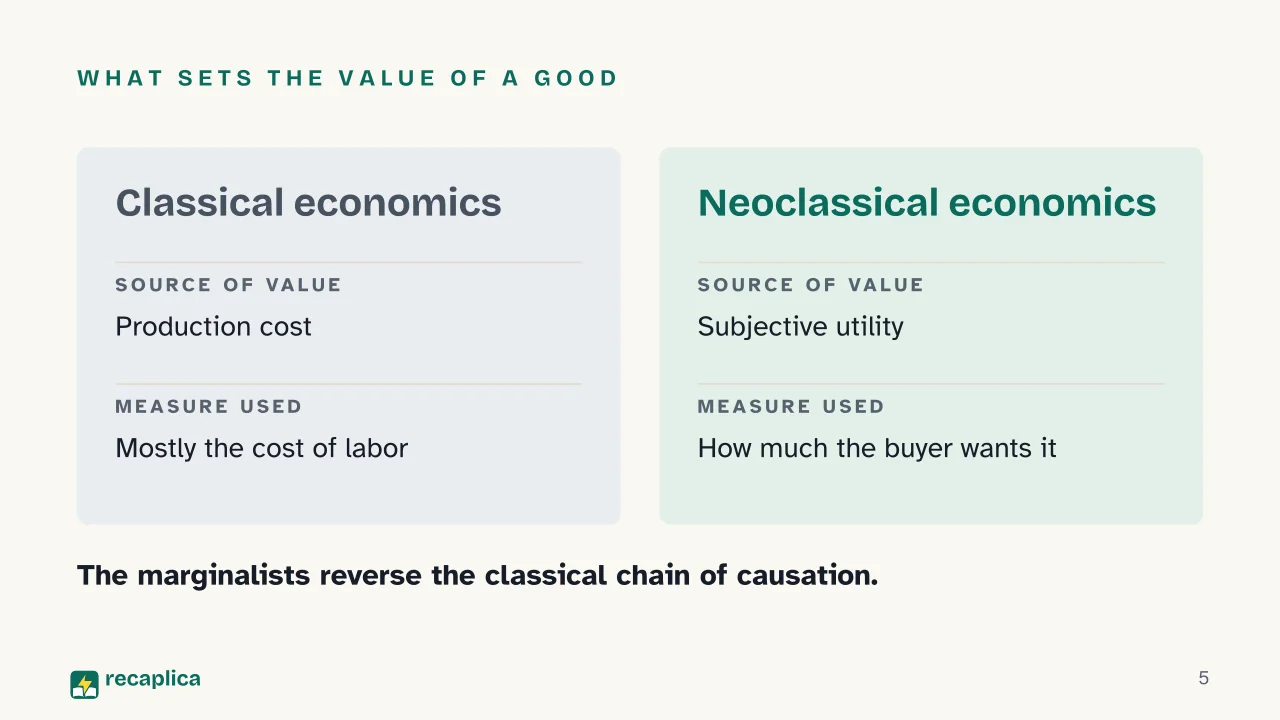
According to The History of Economic Thought, classical economists tied value to production costs, usually relative labor costs.
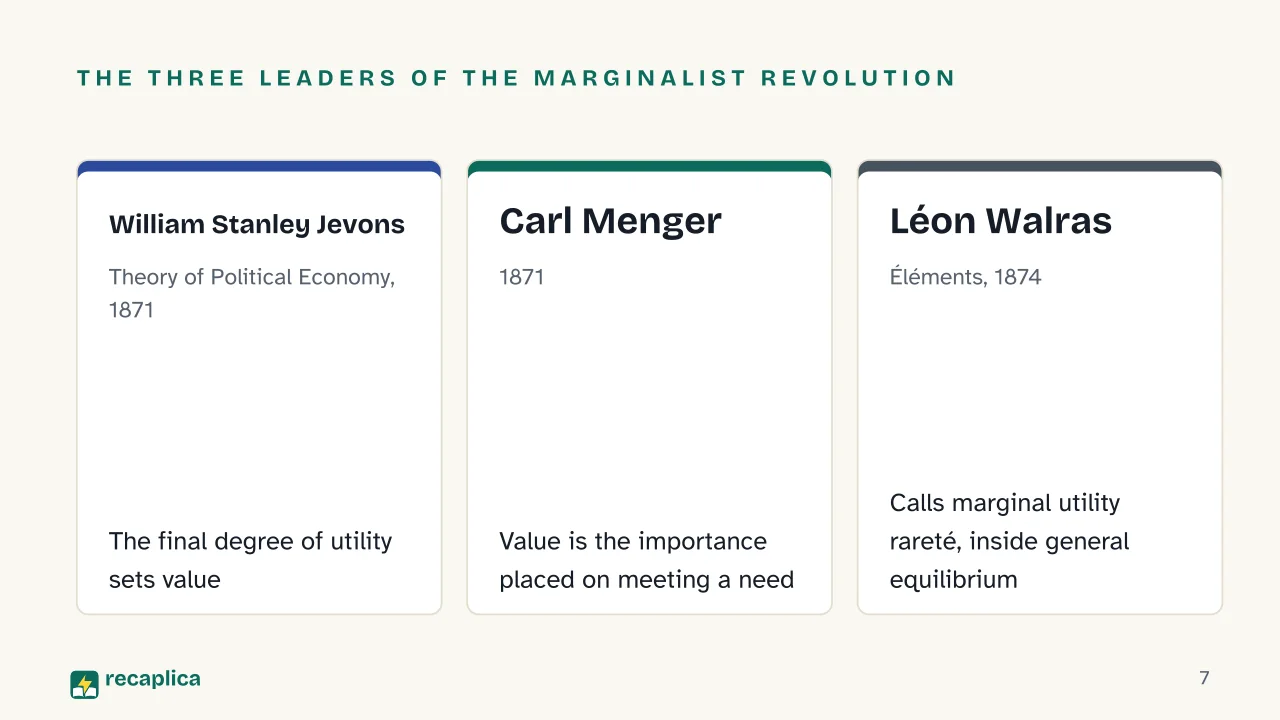
In his 1871 Theory of Political Economy, Jevons reverses that chain: value comes from the final degree of utility the buyer perceives.
For Menger, writing in 1871, value is not a property built into goods; it is the importance people place on meeting their own needs.
Walras, in 1874, calls marginal utility "rareté" and places it inside a system of general equilibrium; the HET site calls him the father of that theory.
Alfred Marshall, in 1890, merges the two chains, Jevons's and the classical one, through supply and demand, in what the source calls a "textbook synthesis."
Deep Dive
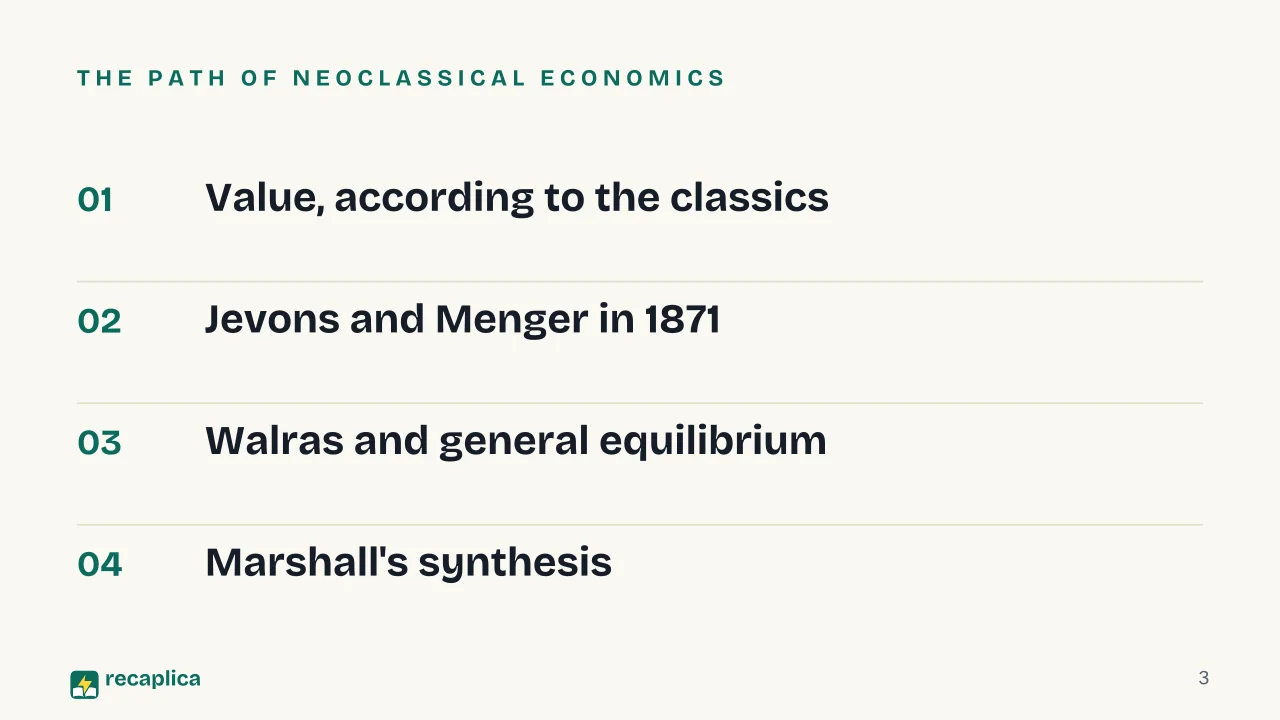
Value, according to the classical economists
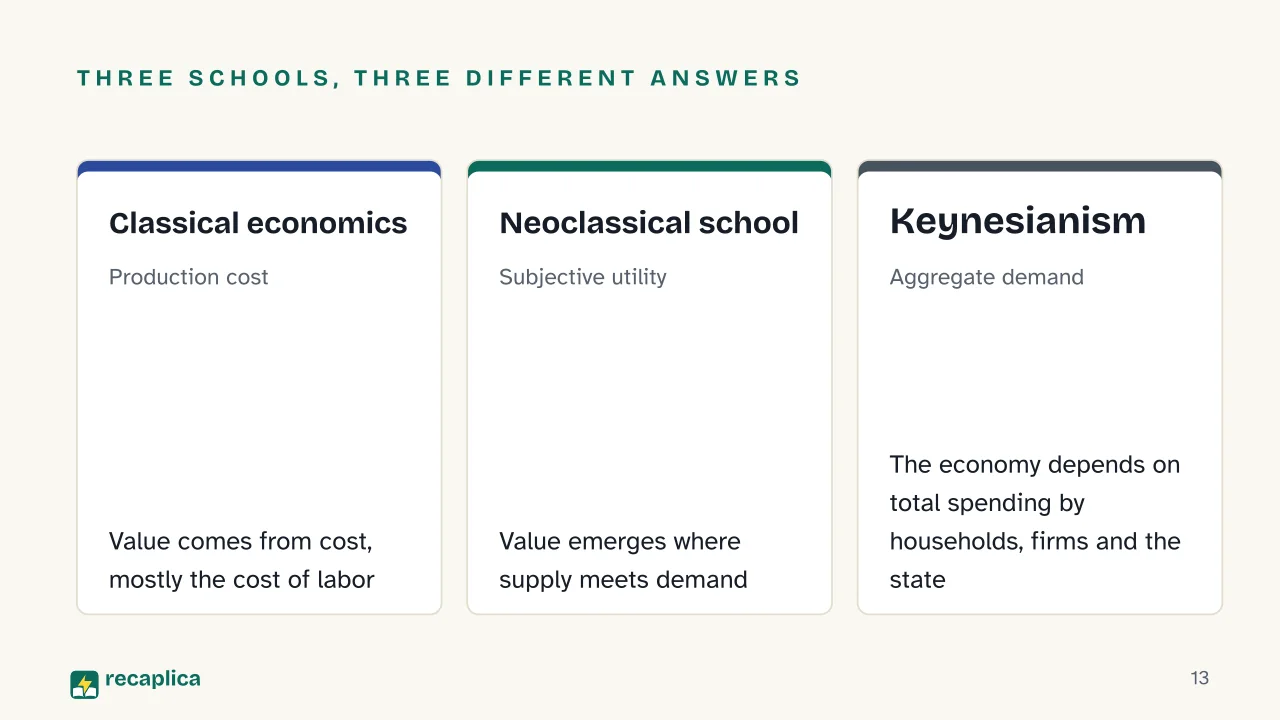
Before the marginalist revolution, the value of a good was explained by looking at how it was made. According to the academic site The History of Economic Thought, classical economists tied natural prices, the equilibrium prices of the long run, mainly to relative production costs, and in particular to relative labor costs. The reasoning started from the supply side: what it costs to make a good decides what it is worth.
Jevons and Menger reverse the chain
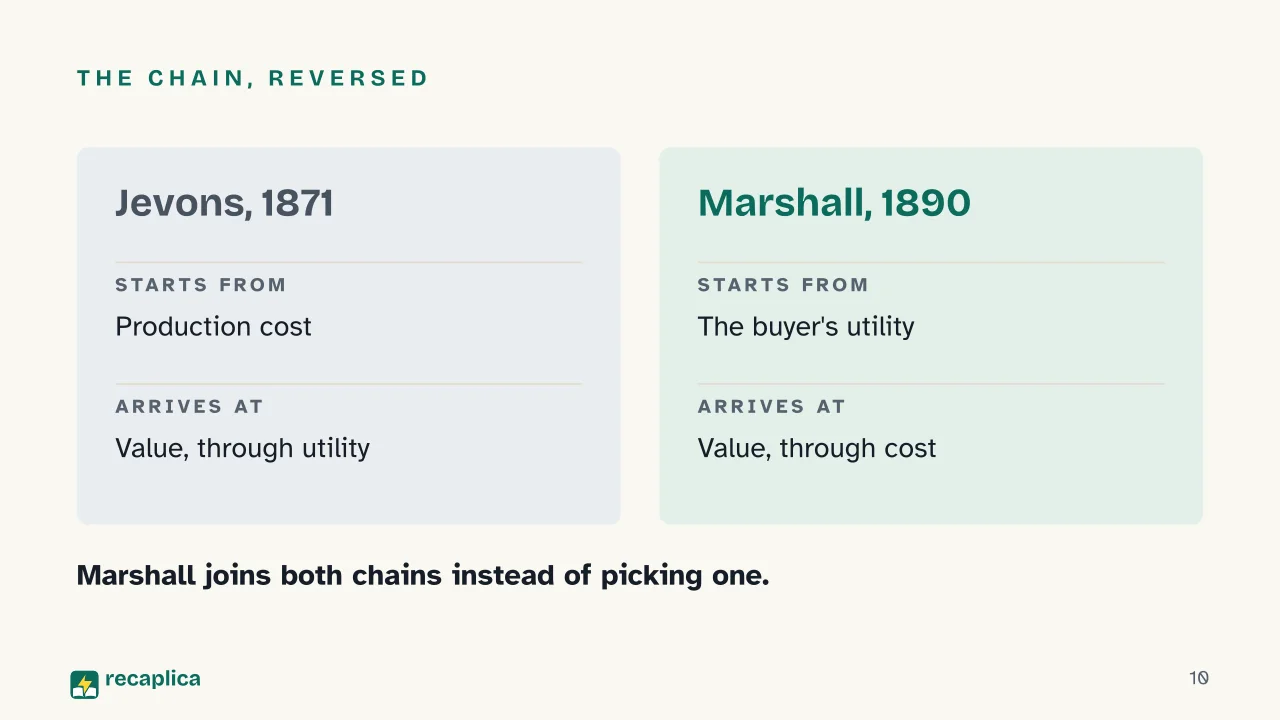
In 1871 William Stanley Jevons published the Theory of Political Economy and turned that reasoning around. According to the HET site, in his construction production cost sets how much gets supplied, supply sets the final degree of utility, and that degree of utility, not the cost, sets value.
That same year, Carl Menger reached a similar conclusion by a different route. For Menger, value is not a property that belongs to goods; it is the importance people place on meeting their own needs — a good is worth something because it serves someone.
A practical example: faced with a rising price, a classical economist asks first how much it cost to produce that extra unit of the good. A marginalist economist asks the opposite question: how much is one more unit, for the person buying it, worth on top of what they already have. The same question gets different answers depending on the good and on who wants it, and that very variability is what Jevons and Menger set out to explain in 1871.
Walras and general equilibrium theory
Léon Walras reached the same turning point three years after his two colleagues, in 1874, with the Éléments d’économie politique pure. He calls what is now known as marginal utility “rareté,” and defines it as personal and subjective. What sets him apart from Jevons and Menger is the framework: the HET site calls him the father of general equilibrium theory, because he alone set the new theory of value inside a complete formal system, one where the prices of every market are determined together. The same source reports Joseph Schumpeter’s judgment that Walras was “the greatest of all economists” — Schumpeter’s own opinion, not a verdict shared by every historian of economic thought.
Marshall’s synthesis
In 1890 Alfred Marshall proposed a synthesis of the two readings. His construction, according to the HET site, runs like this: utility sets how much must be supplied, the quantity to be supplied sets the necessary production cost, and that production cost sets value. It is the same chain as Jevons’s, read backward, and the source calls it a “textbook synthesis,” one that carried neoclassical theory to an audience far wider than specialists. The supply-and-demand diagram that comes out of it is the same one microeconomics textbooks use to introduce the subject.
Where neoclassical economics ends
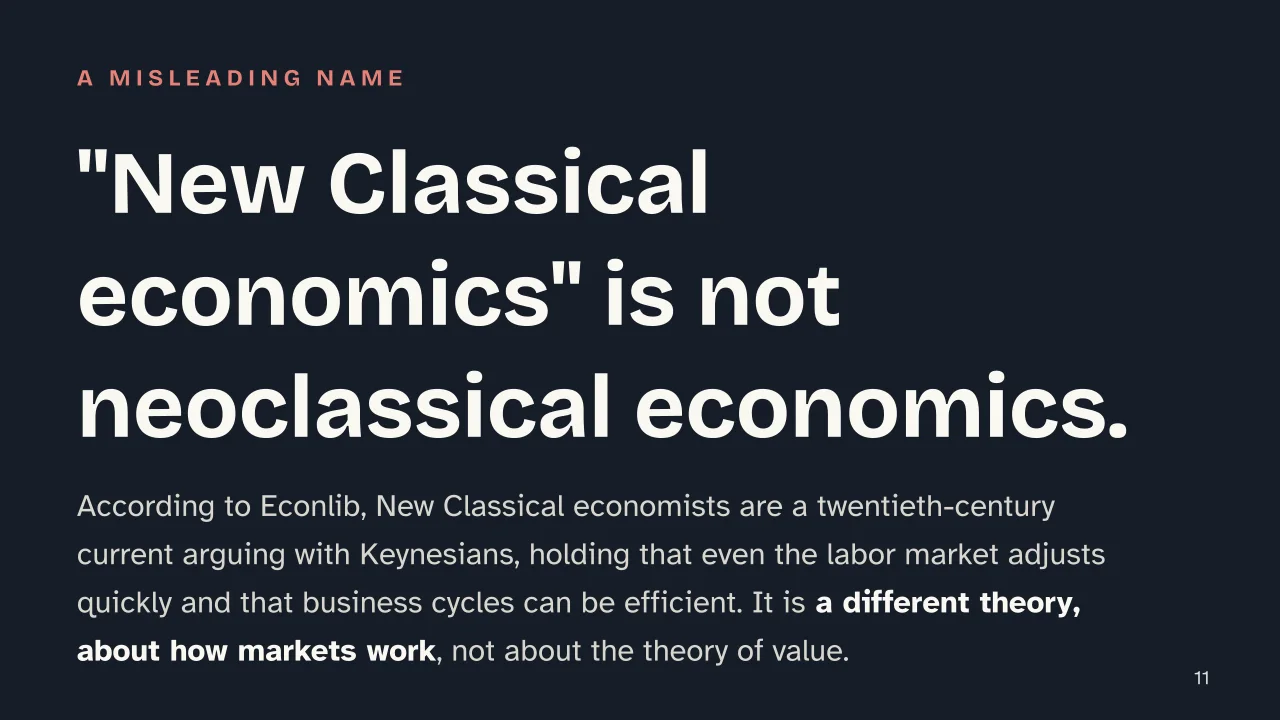
Neoclassical economics, in the form Jevons, Menger, Walras and Marshall gave it between 1871 and 1890, is a theory of value and prices. It should not be confused with “New Classical economics” (sometimes framed as neo classical economics), a separate and more recent school: according to Econlib, the New Classical economists argue with Keynesians in the twentieth century, and hold that even the labor market adjusts quickly on its own, clearing shortages and surpluses, to the point that business cycles can be efficient.
On that ground, the state’s role during expansions and recessions, the same source describes a different position: many Keynesians, though not all, favor an activist stabilization policy to reduce the swings of the business cycle. That is a later debate, and one about managing aggregate demand rather than about the theory of value. The Recap on Keynesianism picks up that chapter.
Slide deck
Slides ready to download and make your own in PowerPoint or Google Slides, with speaker notes. Pick the Flash cut or the Full one.
✗ Myth Neoclassical economics is just classical economics under a newer name.
✓ Reality According to The History of Economic Thought, classical economists tied natural or equilibrium prices mainly to relative production costs, usually labor costs. The marginalists reverse that chain: Jevons, in 1871, makes value depend on the final degree of utility the buyer perceives, and Menger defines value as the subjective importance people place on meeting their needs. Only in 1890 does Marshall fold both views into a single synthesis.
✗ Myth "New classical economics" is just another name for neoclassical economics.
✓ Reality According to Econlib, the New Classical school is a twentieth-century current that argues with Keynesians, holding that even the labor market adjusts quickly on its own, clearing shortages and surpluses, to the point that business cycles can be efficient. That is a separate theory from the marginalism of Jevons, Menger and Walras, born roughly a century earlier around the nature of value.
✗ Myth Léon Walras matters less than Jevons and Menger because he published after them.
✓ Reality The HET site places Walras among the three leaders of the marginalist revolution, while noting that his Éléments d'économie politique pure appeared in 1874, three years after the works of Jevons and Menger. The same site calls him the father of general equilibrium theory, the only one of the three to set it out in a complete formal framework; Joseph Schumpeter, whom the source quotes, called him "the greatest of all economists" — Schumpeter's own judgment, not a consensus among economists.
Mind map
Drag the background to move around and the nodes to reposition them; use − and + to collapse and expand branches.
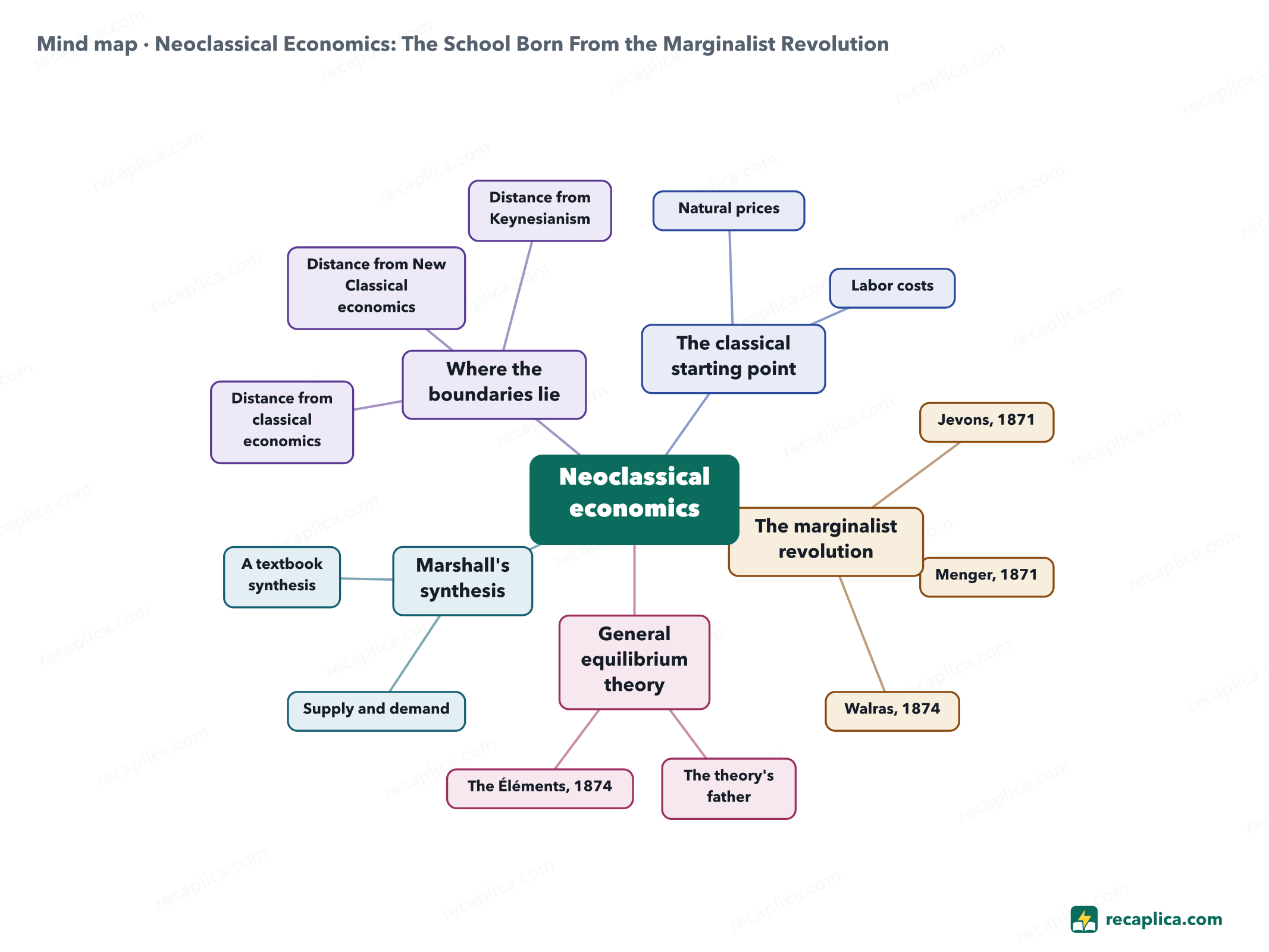
Labor costsThe measure classical economists relied on most
The marginalist revolutionBetween 1871 and 1874
Jevons, 1871Value comes from the final degree of utility
Menger, 1871Value as subjective importance
Walras, 1874Rareté, inside general equilibrium
General equilibrium theory
The theory's fatherHow the HET site describes him
The Éléments, 1874The only complete formal system of the three
Marshall's synthesis1890
Supply and demandUtility, then supply, then cost, then value
A textbook synthesisHow the HET source describes it
Where the boundaries lie
Distance from classical economicsProduction cost against subjective utility
Distance from New Classical economicsA different school, about how markets work
Distance from KeynesianismThe state's role in the business cycle
Quiz: test yourself
Answer the questions to check what you have learned: you get instant feedback and a short explanation.
Grade0/100/5
Answers: 1-B · 2-B · 3-A · 4-A · 5-B
Flashcards
Tap the card to flip it and check whether you remember the answer, then move to the next one.
1 / 7
Explain it in your own words
The ultimate test: if you can explain it in simple words, you've truly understood it. Write your explanation, then compare it with the Recap.
Your explanation is saved only on this device.
Neoclassical economics is the school of economic thought born from the marginalist revolution, the shift that between 1871 and 1874 moved the source of value from production costs to subjective utility. According to the academic site The History of Economic Thought, William Stanley Jevons and Carl Menger published their key works in 1871, and Léon Walras followed in 1874, placing marginal utility inside a system of general equilibrium. The same site calls Walras the father of that theory. In 1890 Alfred Marshall combined cost and utility through supply and demand, in what the source calls a "textbook synthesis" that carried neoclassical theory to a much wider audience.
Frequently asked questions
What is neoclassical economics?
It is the school of economic thought born from the marginalist revolution, the shift that between 1871 and 1874 moved the explanation of value from production costs to subjective utility. Jevons, Menger and Walras started the shift, and Marshall, in 1890, offered a synthesis of it through supply and demand.
Who led the marginalist revolution?
According to The History of Economic Thought, three economists did: William Stanley Jevons and Carl Menger, who published in 1871, and Léon Walras, who published in 1874. The same source calls Walras the father of general equilibrium theory, because he is the only one of the three to set out the new theory of value in a complete formal framework.
How does neoclassical economics differ from classical economics?
In its starting point. According to the HET source, classical economists tied natural prices mainly to relative production costs, usually labor costs. The marginalists make value depend on subjective utility, and Marshall, in 1890, merges both views into a single synthesis.
Is neoclassical economics — sometimes written neo classical economic theory — the same as New Classical economics?
No. According to Econlib, New Classical economics is a twentieth-century school that argues with Keynesians, holding that even the labor market adjusts quickly on its own. It is a separate theory from the marginalism of Jevons, Menger and Walras, centered on the theory of value.
Why is Léon Walras considered so important in the history of economic thought?
The HET site calls him the father of general equilibrium theory, the only one of the three marginalists to set the new theory of value inside a complete formal system, where the prices of all markets are determined together. The same source reports Joseph Schumpeter's judgment that Walras was "the greatest of all economists."
Every Recap goes through an independent review before publication.
Statistics, only if you say so
To learn which Recaps help most we would use Google Analytics, with aggregate, anonymous data. It starts only with your OK, and you can change your mind anytime. Privacy policy