|
recaplica
Pre-Socratic Philosophers: A Summary of the Search for the Arché |
| © 2026 Recaplica · recaplica.com — All rights reserved |
Pre-Socratic Philosophers: A Summary of the Search for the ArchéWhat to print Page numbers appear when printing with default margins. SlidesChoose a cut Flash10 slidesThe essential thread, to present in classFull17 slidesEvery chapter and the deeper detailBoth come with speaker notes. In 30 seconds quick readThe pre-socratic philosophers are the Greek thinkers of the sixth and fifth centuries BC who set out to find one underlying principle, the arché, able to explain the origin and nature of everything without appealing to the gods. The Ionian school of Miletus gave three different answers: water for Thales, the boundless (apeiron) for Anaximander, air for Anaximenes, transformed through rarefaction and condensation. Heraclitus of Ephesus located the order of the cosmos in a fire that burns forever, governed by the Logos; Pythagoras founded a community centered on the fate of the soul, later developed by his followers in a more mathematical direction; Parmenides of Elea reached the most radical answer, denying that true reality can change at all. The label 'pre-socratic' describes a school of thought more than an exact date: the last of these thinkers were contemporaries of Socrates himself. Key Points
Deep DiveIn the sixth century BC, in the Greek cities on the coast of Asia Minor, a group of thinkers starts asking a new kind of question: what does everything that exists derive from? It is a question about nature, pursued through reasoned argument. According to the Stanford Encyclopedia of Philosophy, these philosophers — who were active across the sixth and fifth centuries BC — open up a fresh way of questioning nature and our own place within it. We call them “pre-socratics” because they lived before Socrates, even though the label is not strictly chronological: the last of them were contemporaries of Socrates himself, and even of Plato. It fits better as a school of thought than as a spot on the timeline. These cities belonged to the world of the Greek poleis, where the same period also saw the first forms of participatory government. Thales, water as the principleBorn in Miletus, a Greek city in Ionia, Thales was, according to Aristotle’s testimony, the first to search for the first cause of everything, and he identified it with water. For him water was the arché, the basic principle everything originates from. According to the Internet Encyclopedia of Philosophy, by explaining natural phenomena through material causes, Thales opened a path different from traditional mythological explanations, which is why he is considered the founder of Greek natural philosophy. Anaximander, the boundless apeironAnaximander, active in Miletus from around 610 to 546 BC, is credited with the oldest surviving lines of Western philosophy. The same source calls him the first to have dared to write a treatise in prose rather than in verse, traditionally titled On Nature — a work now lost. Anaximander explicitly ruled out water or any other known element as the principle of everything: he called it apeiron, the boundless, the unbounded, something with no limits and no specific nature of its own. Even in antiquity, the source notes, people complained that Anaximander had never explained precisely what he meant by the boundless — an ambiguity already present in the original text. Thales reached for a substance he could point to; Anaximander reached past every known substance, toward something without a shape at all. Anaximander is also credited with some of the earliest Greek astronomical ideas: he held that the earth floats freely at the center of the universe, with no support underneath it — no water, no pillars — and he was the first to picture the heavenly bodies arranged at different depths, one behind the other. Anaximenes of Miletus, air that transformsAnaximenes of Miletus was active in the middle of the sixth century BC and died around 528 BC: he is the third philosopher of the school of Miletus, after Thales and Anaximander. According to Theophrastus’s testimony, reported by the Internet Encyclopedia of Philosophy, he was linked to Anaximander and perhaps his student. His own mark on the school’s question is the claim that air, found everywhere, underlies everything that exists. Anaximenes described a precise mechanism of transformation: air that is thinned out, rarefied, becomes fire; condensed step by step it becomes wind, then cloud, then water, then earth, finally stone.
Heraclitus of Ephesus and the ever-living fireHeraclitus was a Greek philosopher from Ephesus, near present-day Kuşadası, in Turkey, active around 500 BC. According to the Stanford Encyclopedia of Philosophy, he wrote in fragments with an intentional syntactic ambiguity, a technique that brings his words close, in verbal complexity, to poetry. For Heraclitus, the order of the world is an ever-living fire, created by no god and no human being, which always was, is and will be. He pointed listeners toward the Logos, the rational law running through everything: in a deep sense, he said, all things are one. In his most quoted fragment, Heraclitus observes that different waters flow upon those who step into the same rivers: the classic image of constant change, which later gave rise to the phrase panta rhei, everything flows. He also held that opposites are one and the same in us — living and dying, waking and sleeping, youth and old age — because each one turns continuously into the other. Pythagoras and the Pythagorean communityPythagoras lived roughly from 570 to 490 BC — the Stanford Encyclopedia of Philosophy uses “about” because the exact dates stay uncertain. He spread an optimistic view of the soul’s fate after death, immortal and subject to a series of reincarnations, and founded a way of life people found attractive for its rigor and discipline: the Pythagorean community. Historically his fame rested mainly on this doctrine of the soul, rather than on mathematics: the oldest testimonies do not show Pythagoras’s fame resting mainly on numbers or cosmology, and whether he himself worked on rational cosmology remains a matter of academic debate. It was mainly with his followers in the Pythagorean tradition, Philolaus and Archytas, that the view of the cosmos turned toward science and mathematics, with numerical relationships at the heart of how the cosmos was structured. Readers who want to see where that direction leads, a few centuries later, can read the Recap on Euclidean geometry, with the postulates and theorems of the Elements. Parmenides of Elea and unmoving BeingParmenides of Elea, active in the early part of the fifth century BC, wrote a single metaphysical poem — according to the ancient testimony of Diogenes Laertius — and the Stanford Encyclopedia of Philosophy calls him the most profound and challenging thinker of early Greek philosophy. In the poem, written in hexameters, the form of Greek epic poetry, a goddess describes two paths of inquiry: the first, that something is and cannot possibly not be, is the path of conviction, because it rests on true reality; the second, that something is not and must not be, is a path with no possibility of knowledge at all. For Parmenides, it is necessary to say and think that Being is, because it is possible for it to be, while non-being cannot in any way be thought or said. This is why Being is eternal and unmoving: in true reality there is no birth and no death, and no motion is possible. The need to explain reality from a small set of basic principles does not end with the pre-socratics: the same approach, applied to a different object, numbers, underlies arithmetic and its foundations. Slide deckSlides ready to download and make your own in PowerPoint or Google Slides, with speaker notes. Pick the Flash cut or the Full one.     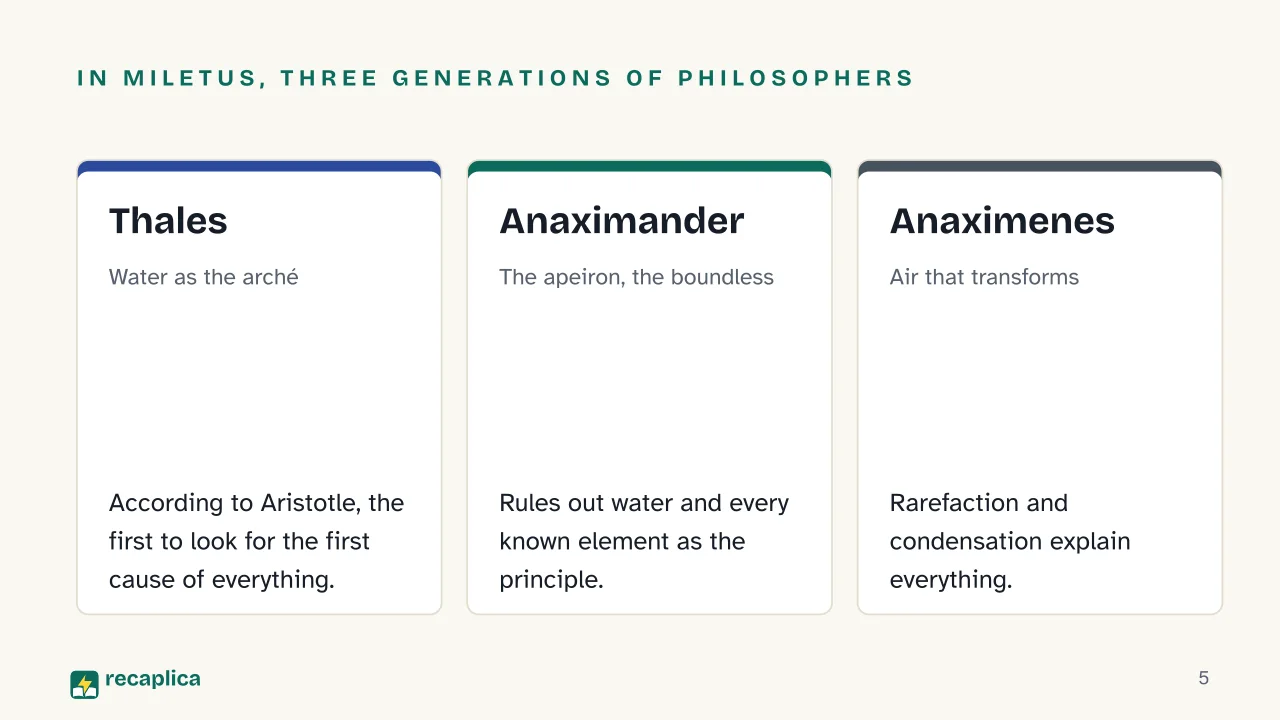 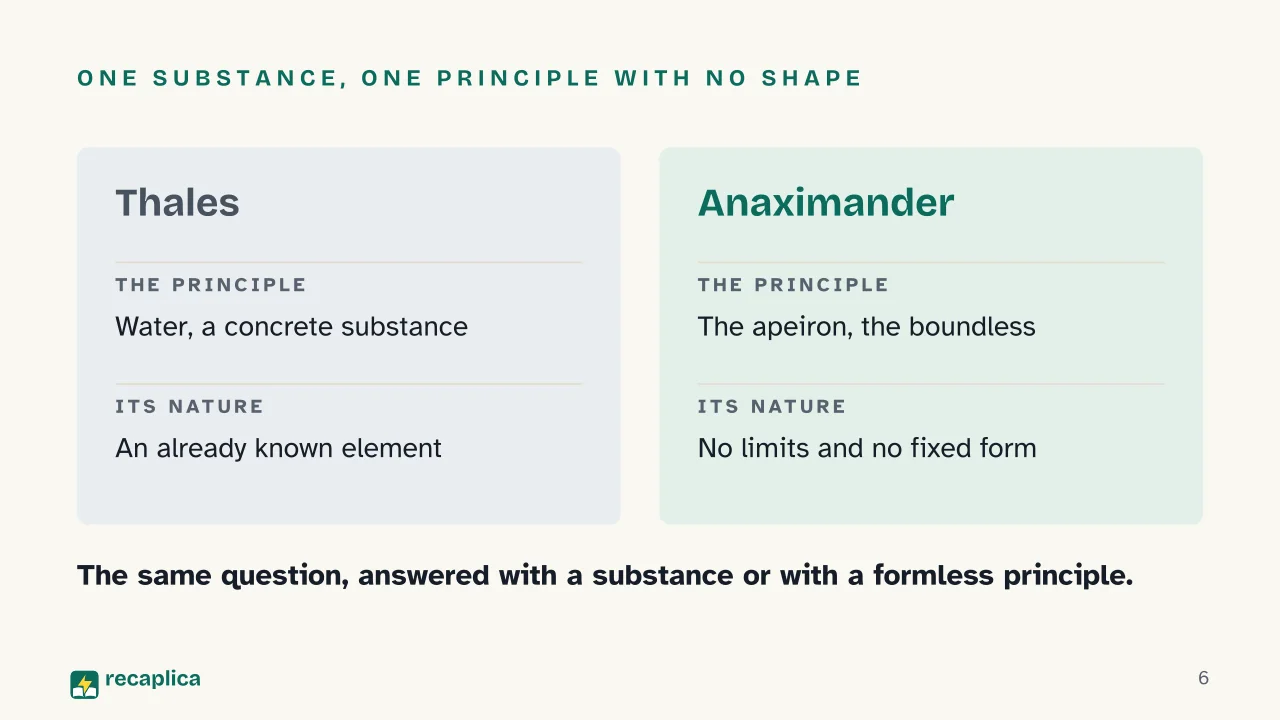 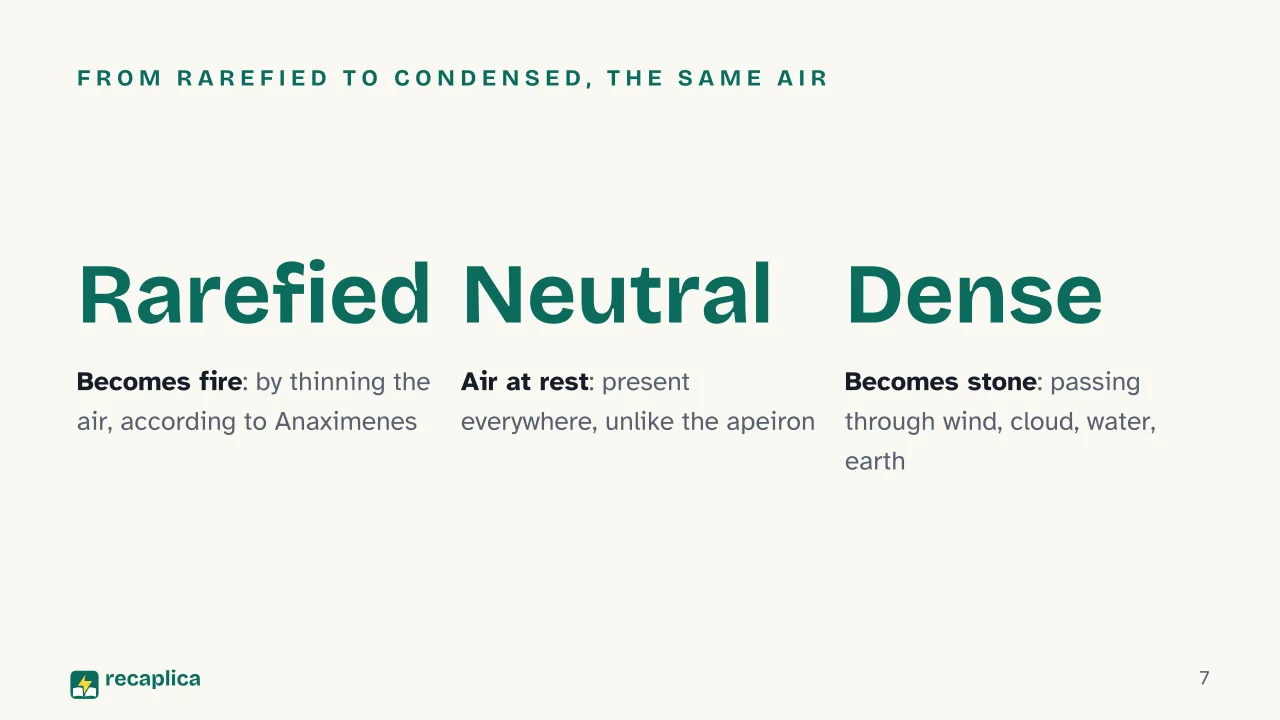 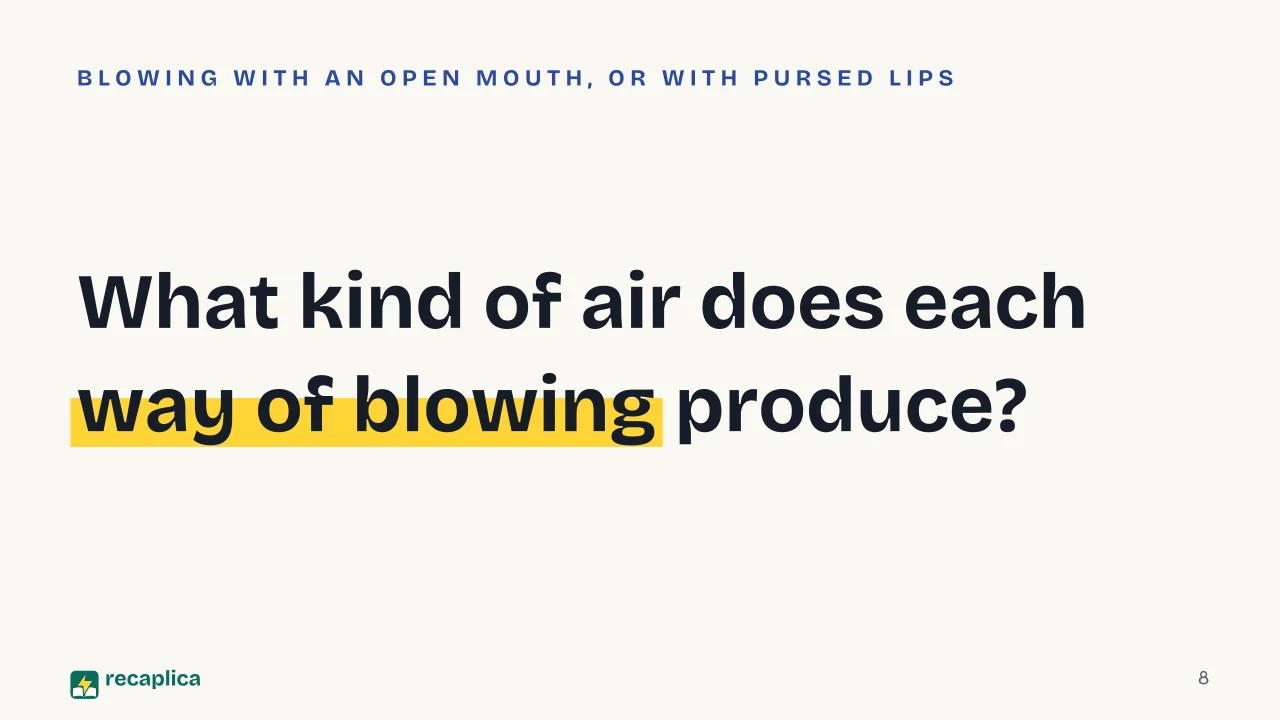    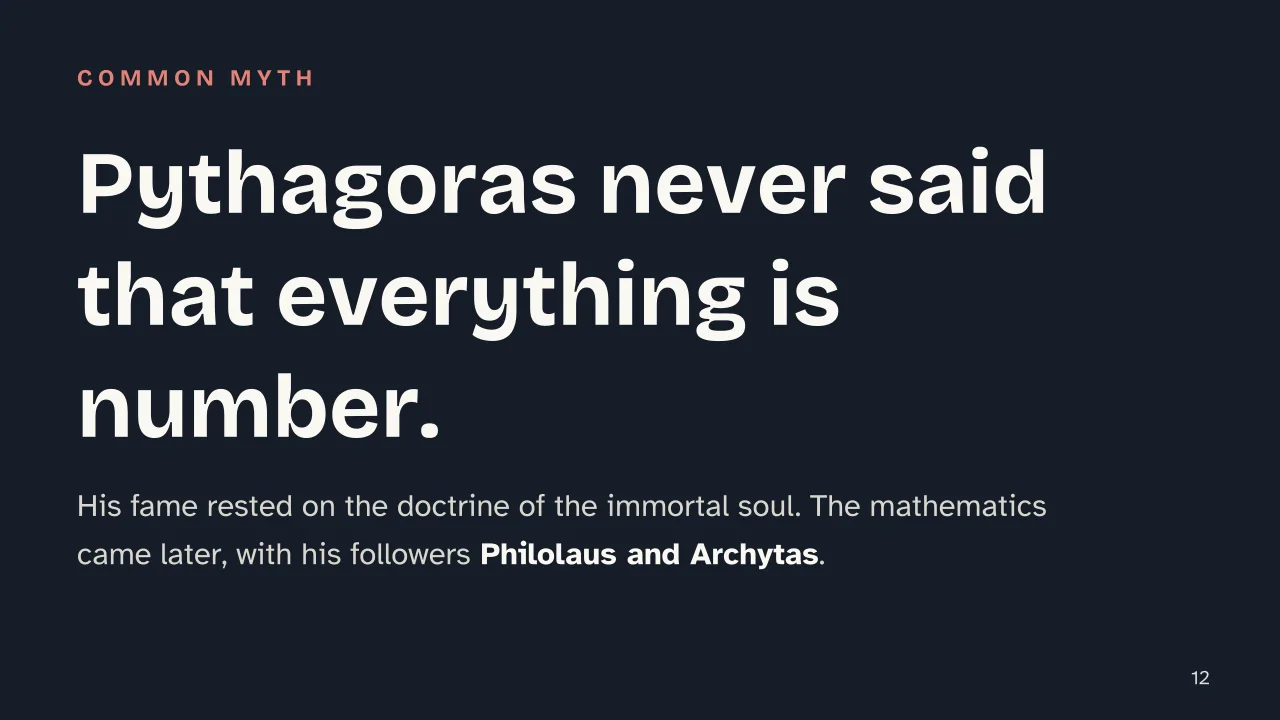 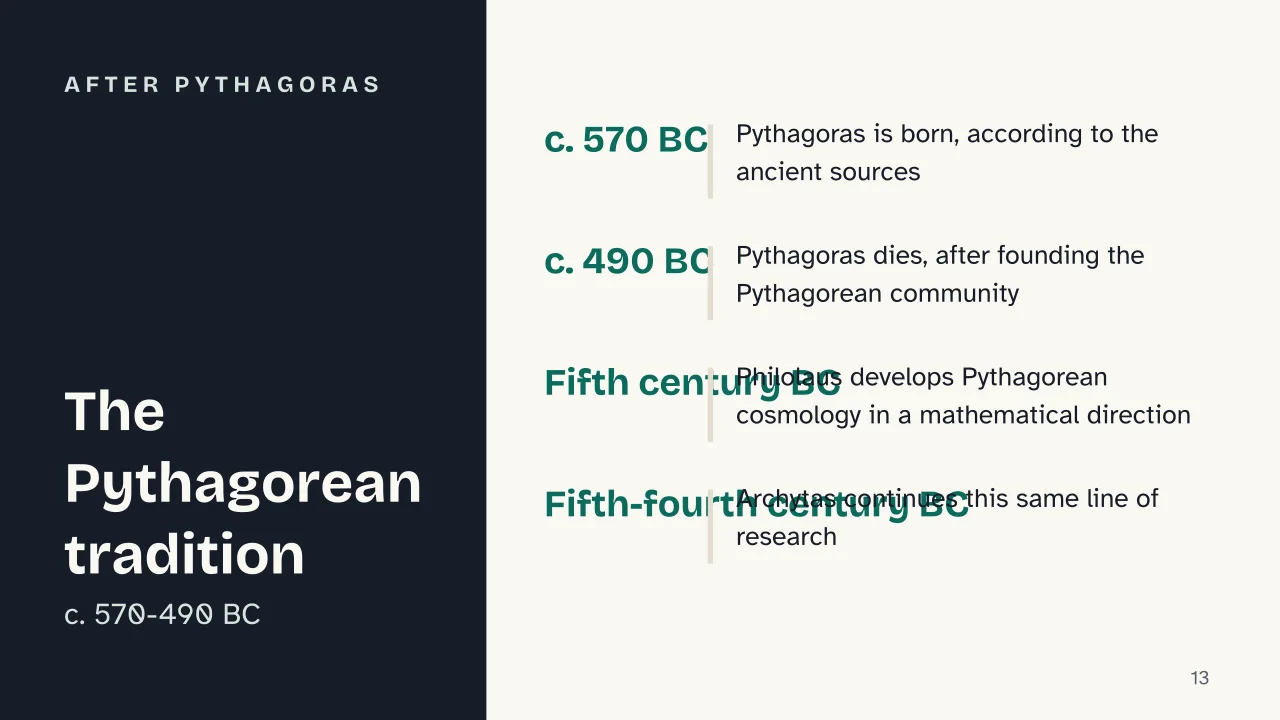  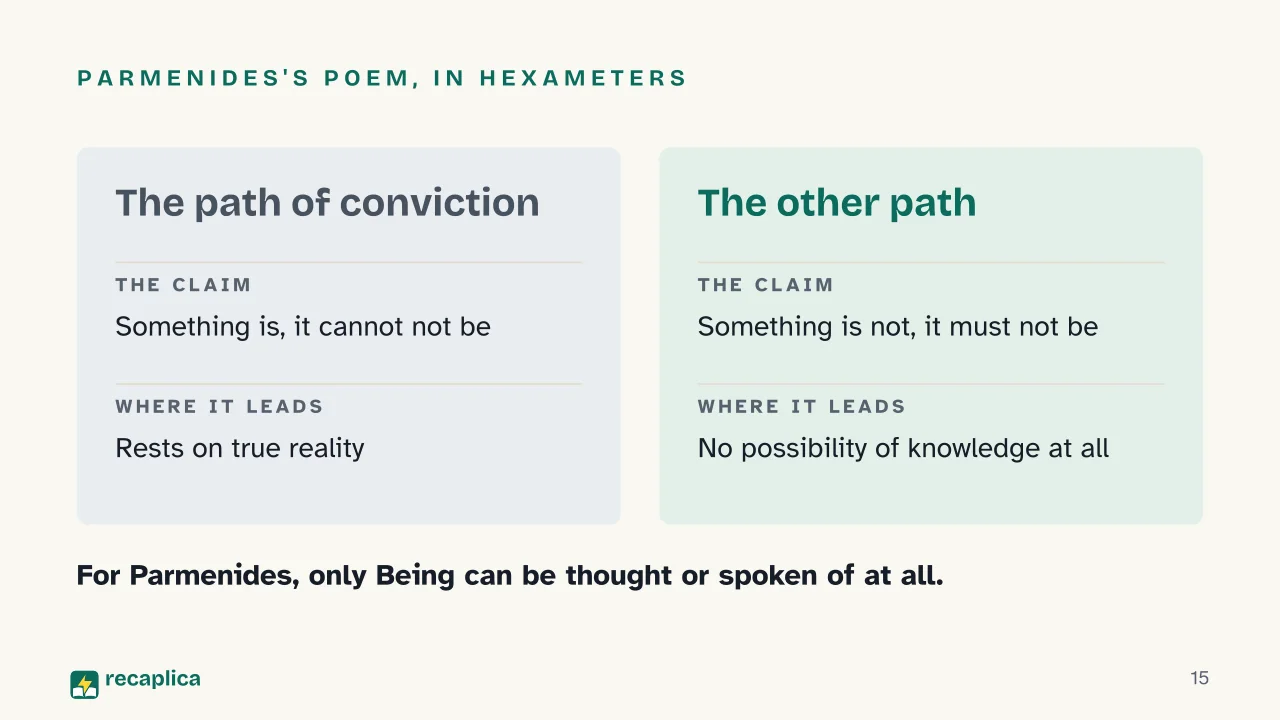 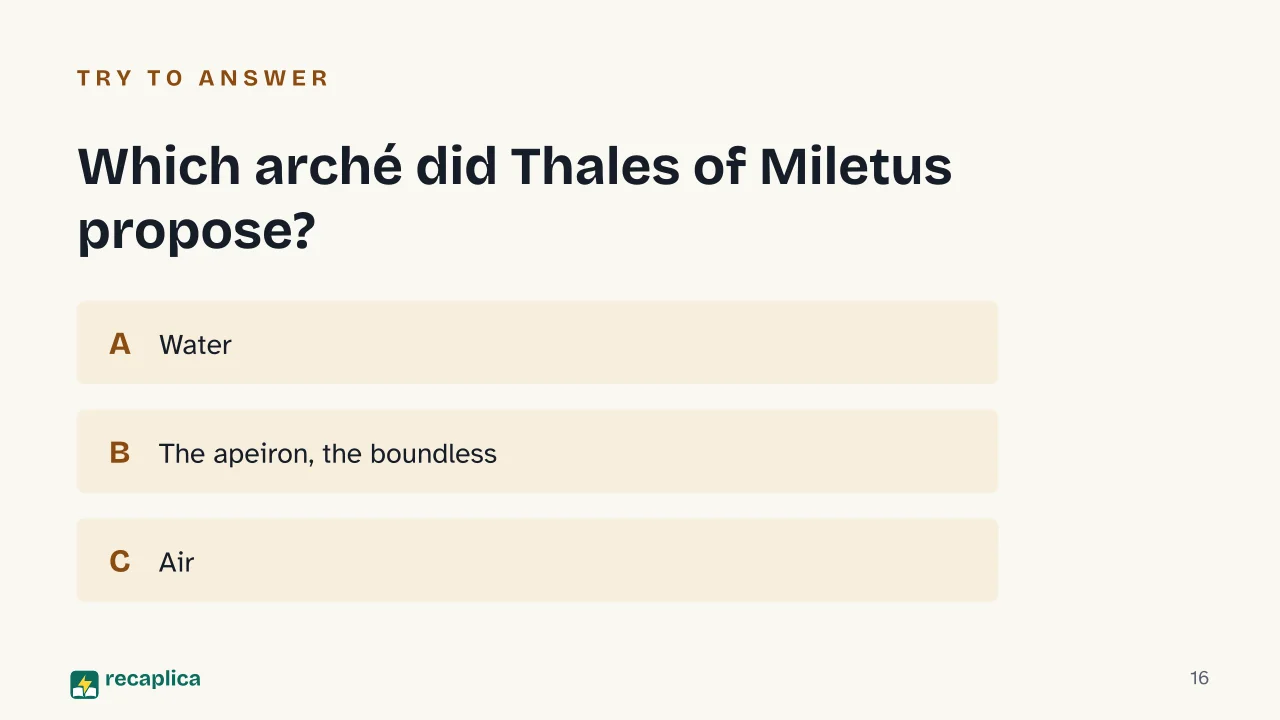  Common myths
Mind mapDrag the background to move around and the nodes to reposition them; use − and + to collapse and expand branches. 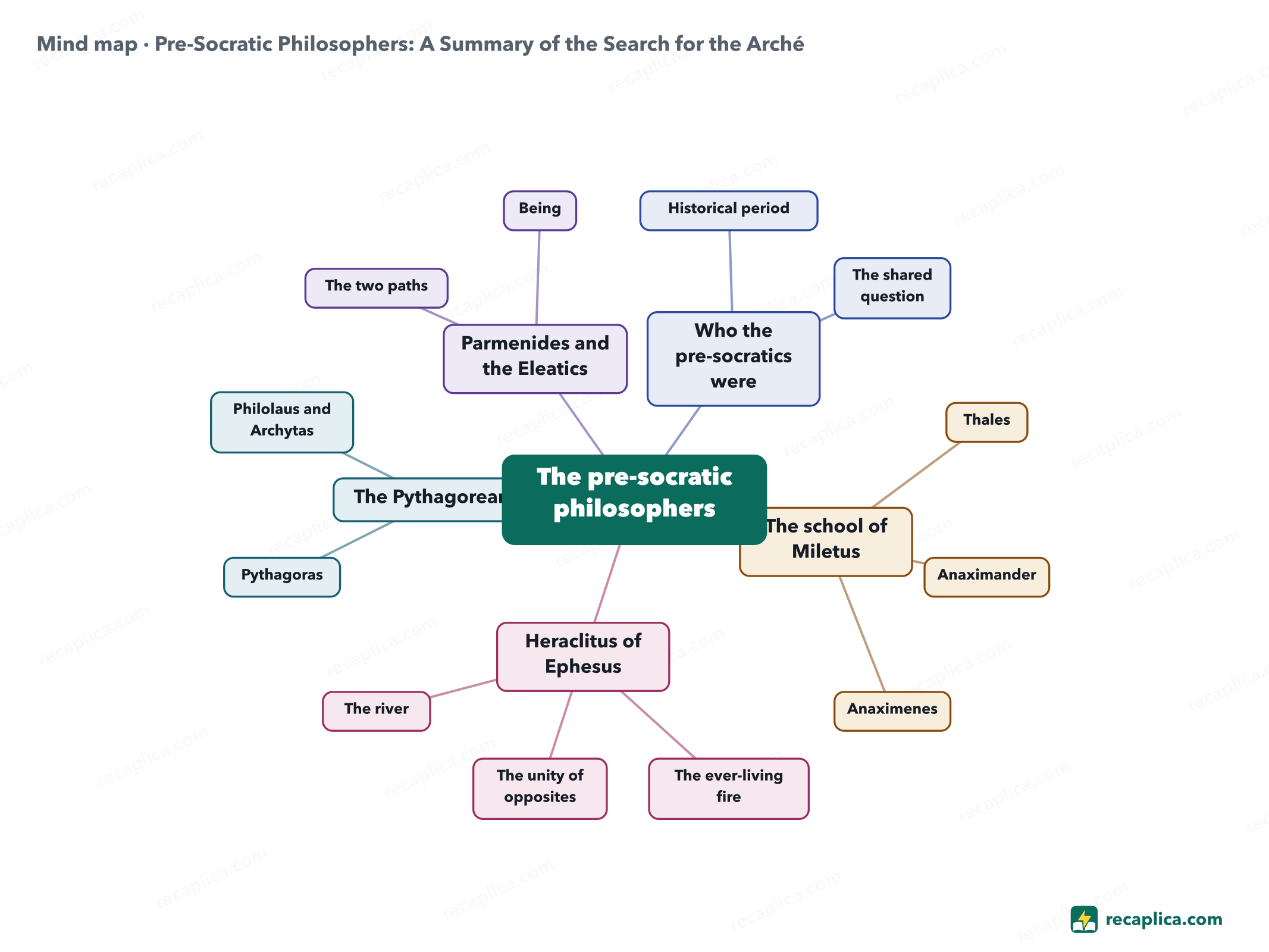
Quiz: test yourselfAnswer the questions to check what you have learned: you get instant feedback and a short explanation. Grade 0/10 0/5
FlashcardsTap the card to flip it and check whether you remember the answer, then move to the next one. 1 / 8 Explain it in your own wordsThe ultimate test: if you can explain it in simple words, you've truly understood it. Write your explanation, then compare it with the Recap. Your explanation is saved only on this device.
Frequently asked questionsWho were the pre-socratic philosophers?Greek thinkers who, across the sixth and fifth centuries BC, were the first to look for a single principle — the arché — that could account for where everything comes from and what it is made of, reasoning from nature rather than from myth. Among them are Thales, Anaximander and Anaximenes of the school of Miletus, Heraclitus, Pythagoras and Parmenides. What is the arché in pre-socratic philosophy?The arché is the principle from which everything derives. It can be a concrete substance, such as water for Thales or air for Anaximenes, or a more abstract principle with no fixed form of its own, such as the apeiron, the boundless, proposed by Anaximander. Why are they called 'pre-socratics' if some of them were alive at the same time as Socrates?The label is not strictly chronological: according to the Stanford Encyclopedia of Philosophy, the last pre-socratics were contemporaries of Socrates himself, and even of Plato. The term marks a school of thought built around the shared question about the arché. What is the difference between the pre-socratic philosophers and the sophists?The pre-socratics, mostly active in the sixth and fifth centuries BC, ask about nature as a whole: what everything derives from. The sophists are teachers active later, in fifth-century BC Athens, who taught rhetoric and argument and focused on human matters such as politics, justice and language: they are not the same group, and they answer different questions. Why did Anaximenes choose air, rather than water or the boundless, as the principle of everything?Anaximenes wanted a concrete substance like Thales's, but one able to explain the variety of what exists through a precise mechanism: thin the air out and it turns to fire; pack it together, little by little, and it turns to wind, cloud, water, earth and finally stone. As evidence he pointed to an everyday observation: blowing with an open mouth produces warm air, blowing with pursed lips produces cold air. Every Recap goes through an independent review before publication. |