Skip to content
recaplica

    One moment: security check

    Cloudflare wants to make sure you're not a robot. Tick the box below and your search will continue on its own.

    IT
    recaplica The solar system: the planets and what holds them together
    © 2026 Recaplica · recaplica.com — All rights reserved
    Home › Science

    The solar system: the planets and what holds them together

    By Recaplica Newsroom · Updated on September 12, 2026

    What to print

    Page numbers appear when printing with default margins.

    Slides

    Choose a cut

    Flash10 slidesThe essential thread, to present in classFull18 slidesEvery chapter and the deeper detail

    Both come with speaker notes.

    Telegram channel
    recaplica Clear in 30 seconds, yours in 10 minutes.
    In 30 seconds Key points Figures Deep dive Slides Myths Mind map Quiz Flashcards FAQ

    In 30 seconds quick read

    The solar system is the Sun plus everything that circles it: eight planets, hundreds of moons, millions of asteroids and comets. It formed about 4.6 billion years ago when a dense cloud of gas and dust collapsed, and the Sun took more than 99% of the available matter — the planets are what was left over. Gravity is what holds it together: the Sun's pull bends each planet's path without ever pulling it in, because the planet is moving sideways fast enough to keep missing. Close to the star only rock survived and small solid worlds formed; far out, where ice held on, the giants grew.

    Key Points

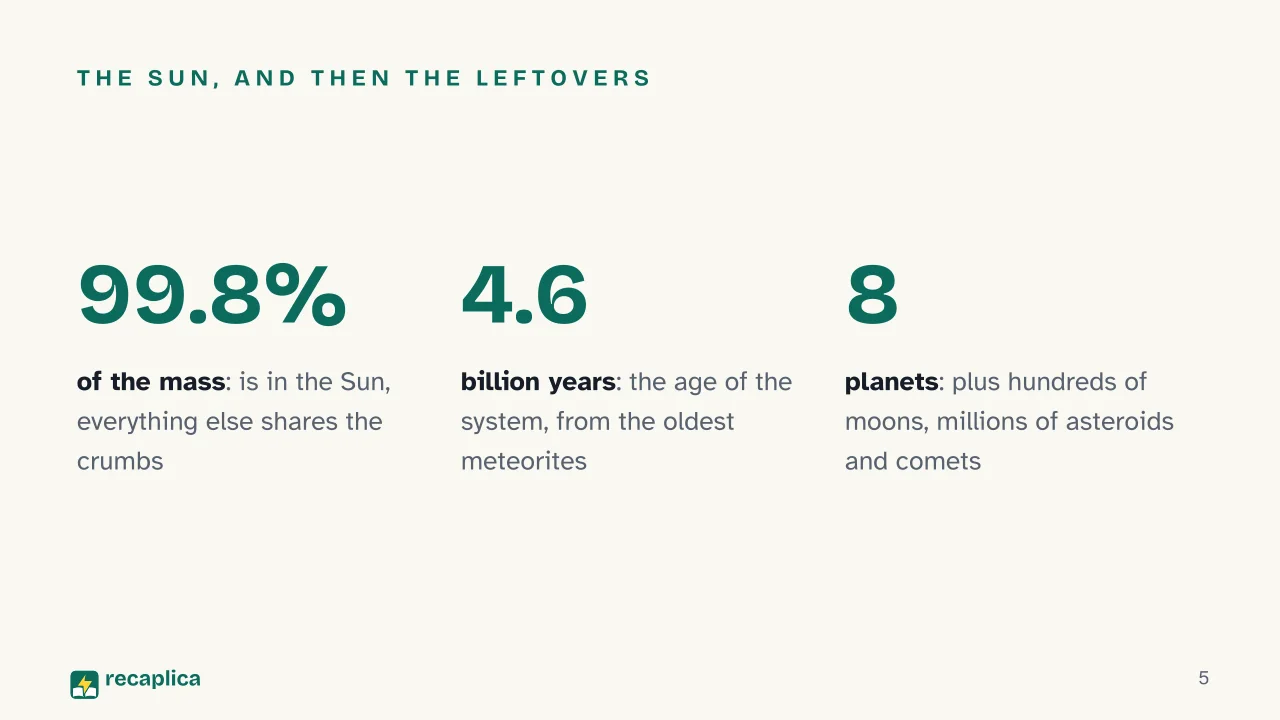
    • The Sun holds 99.8% of the solar system's mass: everything else, planets included, shares the crumbs.
    • The system formed about 4.6 billion years ago from the collapse of a cloud of interstellar gas and dust.
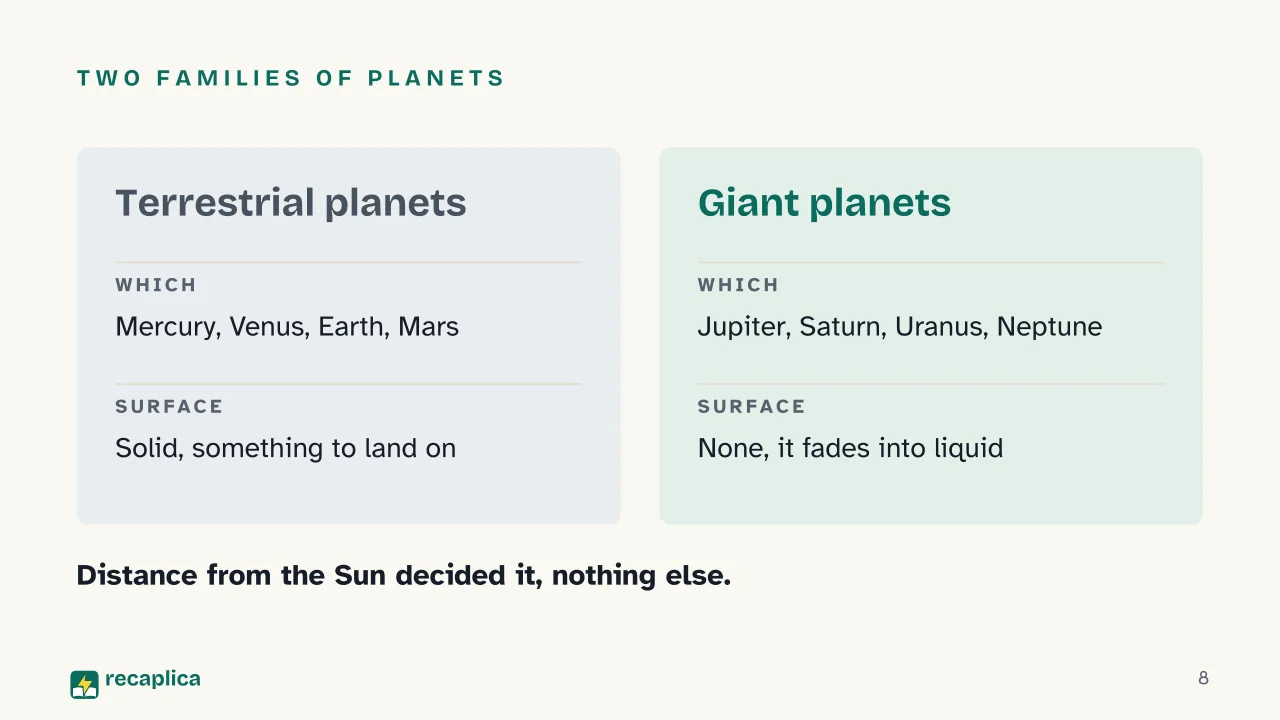
    • The four inner planets are rocky, the four outer ones are giants of gas and ice: the difference comes down to distance from the Sun.
    • Planets don't fall into the Sun because they move sideways: gravity bends that motion into a closed orbit.
    • Since 2006 a planet must meet three IAU criteria, including clearing its orbital neighbourhood — which is why Pluto is a dwarf planet.
    • Beyond Neptune the system continues with the Kuiper Belt and the Oort Cloud, which reaches as far as 1.6 light-years out.

    Key figures

    • 99.8% the share of the solar system's mass held by the Sun Source: NASA
    • 4.6 billion years the age of the solar system, formed from the collapse of a cloud of gas and dust Source: NASA
    • 150 million km one astronomical unit, the average Earth-Sun distance used to measure everything else Source: NASA

    Deep Dive

    One star and its leftovers

    The most honest way to describe the solar system is this: there is the Sun, and then there are the leftovers.

    NASA gives the number: the Sun holds 99.8% of the mass of the entire solar system. Eight planets, hundreds of moons, millions of asteroids and comets divide up what remains — less than two parts in a thousand. If the solar system were a tonne of material, everything other than the Sun would come to barely two kilograms.

    That imbalance isn’t a quiz fact. It explains everything else: a mass concentrated like that keeps bodies billions of kilometres away in orbit, and 4.6 billion years ago it decided where every piece would end up.

    How it all began

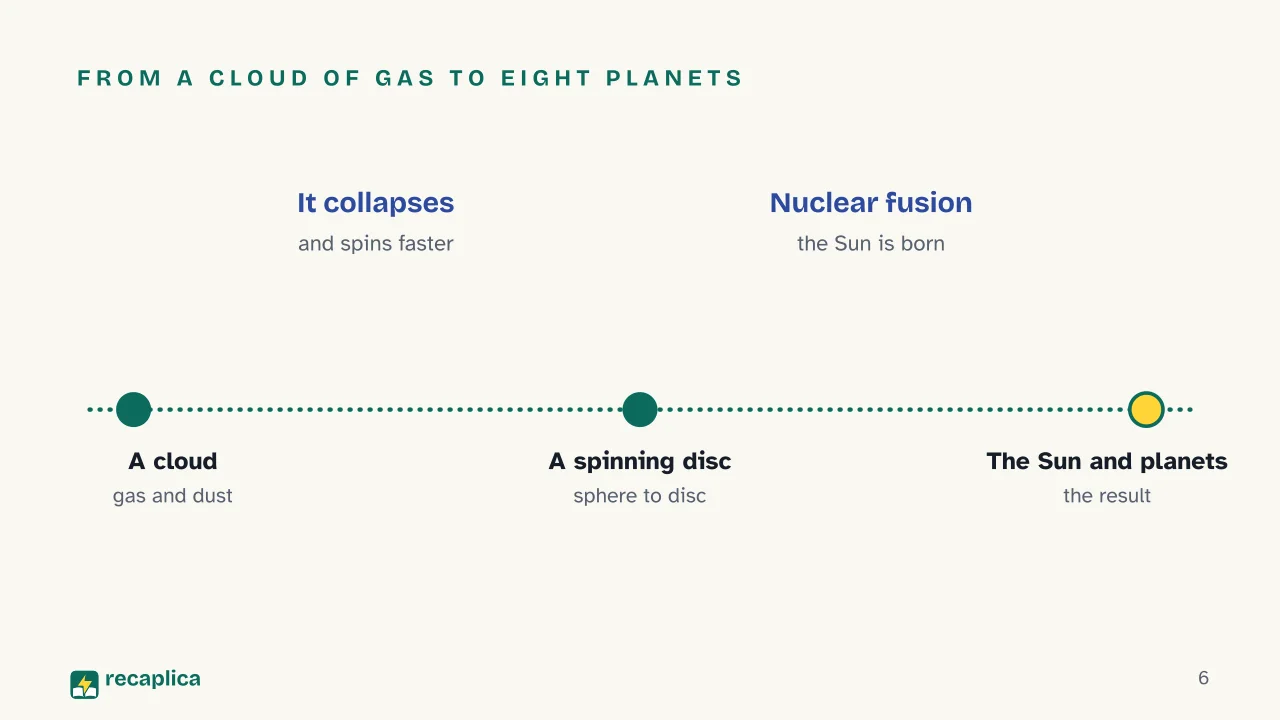
    About 4.6 billion years ago, somewhere in the Milky Way, a dense cloud of interstellar gas and dust began to collapse under its own weight. As it contracted it spun faster and flattened out, the way pizza dough does when it’s spun: sphere to disc.

    At the centre, material piled up until pressure and temperature were high enough to start nuclear fusion. The Sun was born, having taken over 99% of the available matter. In the leftover disc, dust grains started bumping into each other and sticking, building bodies that grew step by step: pebbles, then mountains, then planets.

    Practical example: the age of that process comes from radiometric dating of the oldest meteorites — fragments that never melted and stayed as they were. They’re the cosmic equivalent of tree rings, and reading them is why we can say “4.6 billion” rather than “a very long time ago”.

    The line that separates rock from ice

    Why are the planets near the Sun small and stony, and the distant ones enormous? The answer is the temperature of the disc.

    Close to the star it was too hot for substances like water to stay solid, so only the heat-resistant material was left: rock and metal. Not much of it, so small planets. Beyond a certain distance — what astronomers call the frost line — water and other volatile compounds could freeze, and the supply of solid building material jumped.

    Out there the planetary cores grew fast, and once massive enough their gravity hauled in vast amounts of hydrogen and helium from the disc. The giants are the result. Jupiter is eleven times Earth’s width, and it would take a thousand planets like ours to fill it.

    The eight planets, in two families

    Terrestrial planetsGiant planets
    WhichMercury, Venus, Earth, MarsJupiter, Saturn (gas), Uranus, Neptune (ice)
    SurfaceSolid, something to land onNone: the atmosphere fades into liquid
    Made ofRock and metalsHydrogen and helium, plus frozen water and ammonia in the outer two
    MoonsNone or a fewDozens to hundreds: as of March 2026 the IAU counts 101 for Jupiter and 285 for Saturn
    RingsNoYes, all four

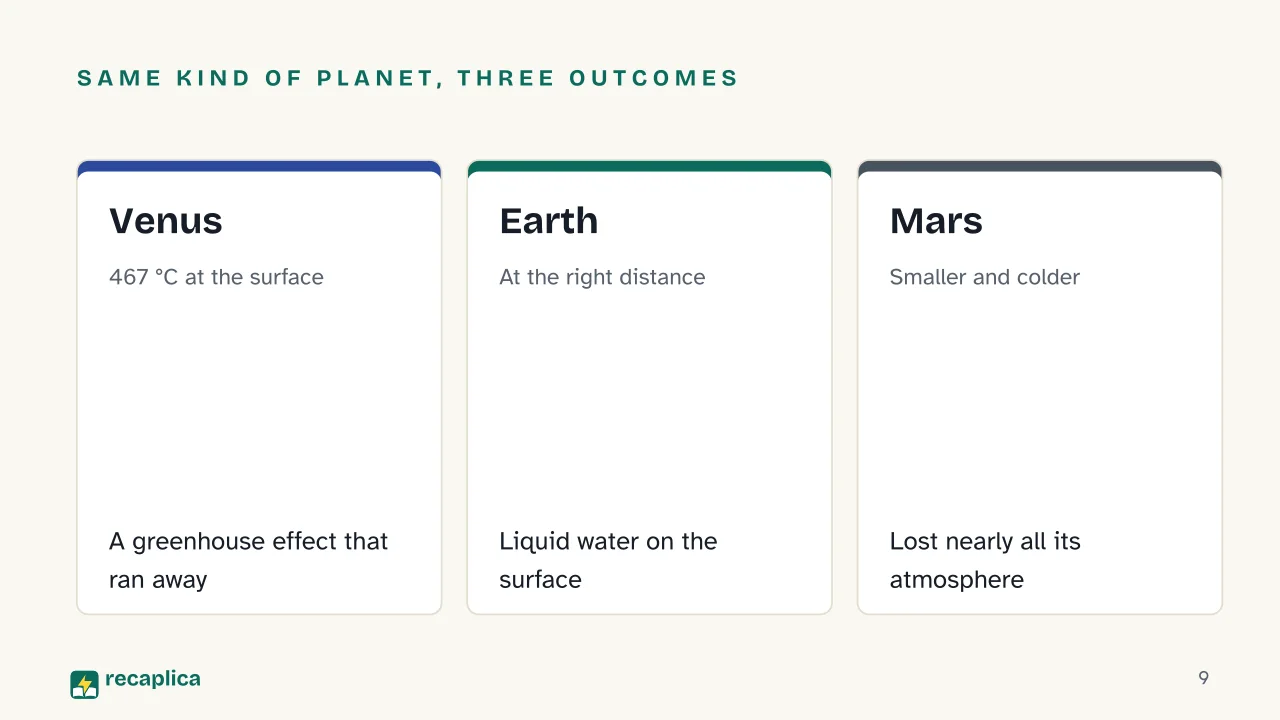
    The four inner planets are built alike but ended up very differently. Venus is wrapped in a crushing carbon dioxide atmosphere, 93 times Earth’s surface pressure: it is the hottest planet in the system at 467 °C, a greenhouse effect that ran away. Earth, at the right distance, has liquid water on its surface, a water cycle that keeps stirring it, and plants running photosynthesis on that star’s light. Mars, smaller and colder, lost nearly all of its atmosphere. Same kind of planet, three outcomes.

    Volcanism isn’t an Earth speciality either, and elsewhere it runs on a different engine from the one behind volcanoes and earthquakes here. Io, a moon of Jupiter, has more active volcanoes than anywhere else in the solar system: hundreds of them, with lava fountains tens of kilometres high. What feeds them isn’t leftover heat from formation. It is gravity: Jupiter pulls one way, the moons Europa and Ganymede the other, and Io’s interior flexes constantly and heats up by friction.

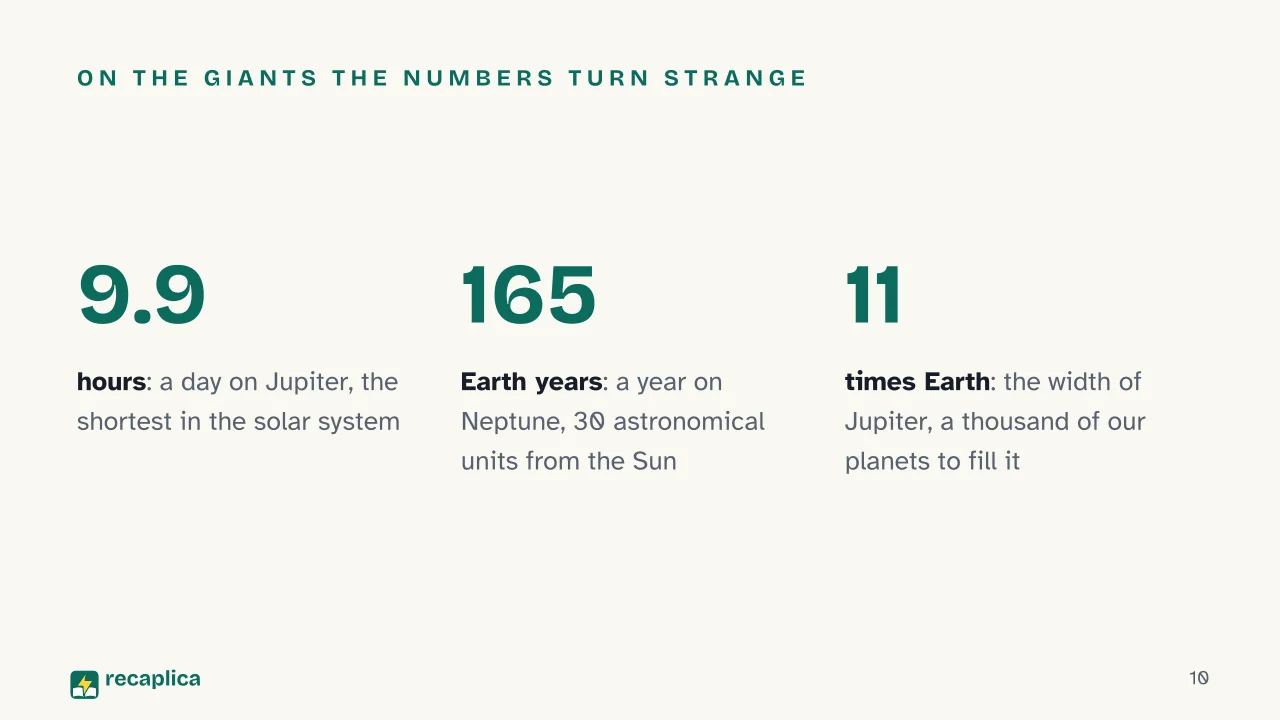
    On the giants the numbers turn strange. A day on Jupiter lasts 9.9 hours, the shortest in the solar system, while its year runs to nearly 12 Earth years. Neptune, 30 astronomical units from the Sun, takes 165 Earth years to go round once: since its discovery in 1846 it has completed barely one orbit.

    Practical example: Neptune was found with mathematics before anyone saw it. The irregularities in Uranus’s orbit didn’t add up; Urbain Le Verrier calculated where the body causing them had to be, and in 1846 Johann Galle looked from the Berlin Observatory and found it, essentially where the calculations said it would be.

    What holds it all together

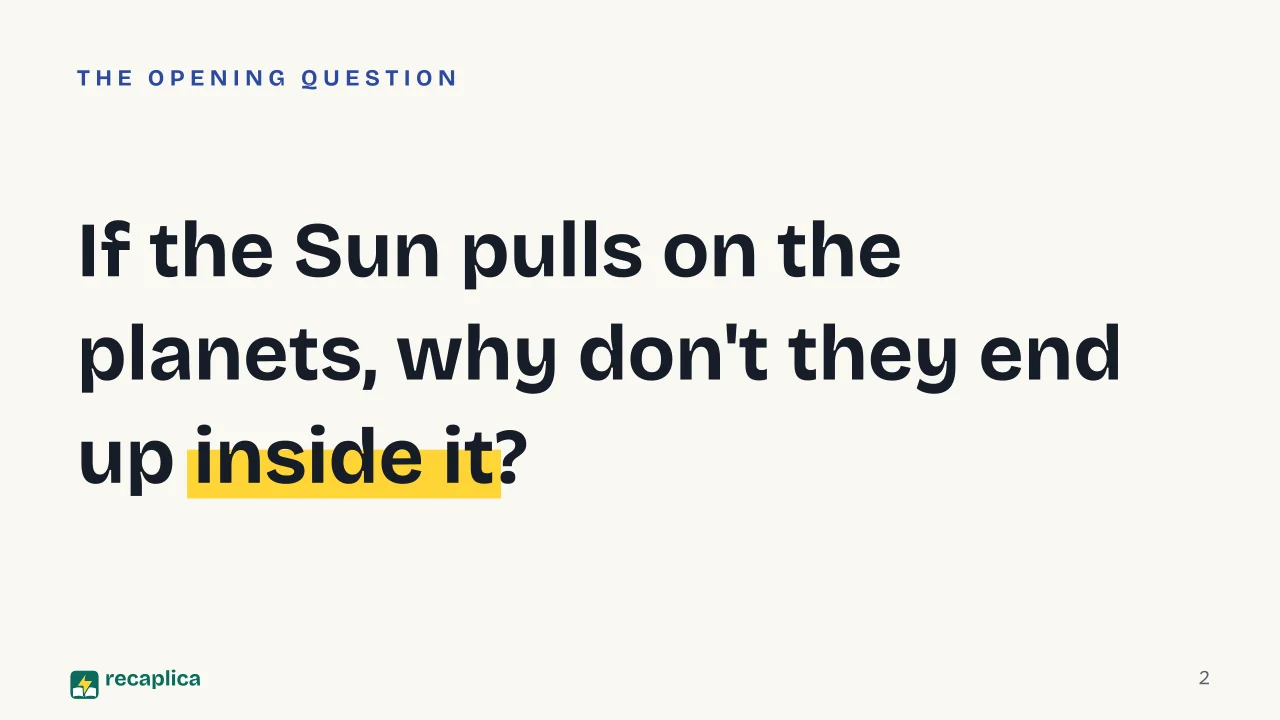
    Here is the question nearly everyone asks as a child: if the Sun pulls on the planets, why don’t they end up inside it?

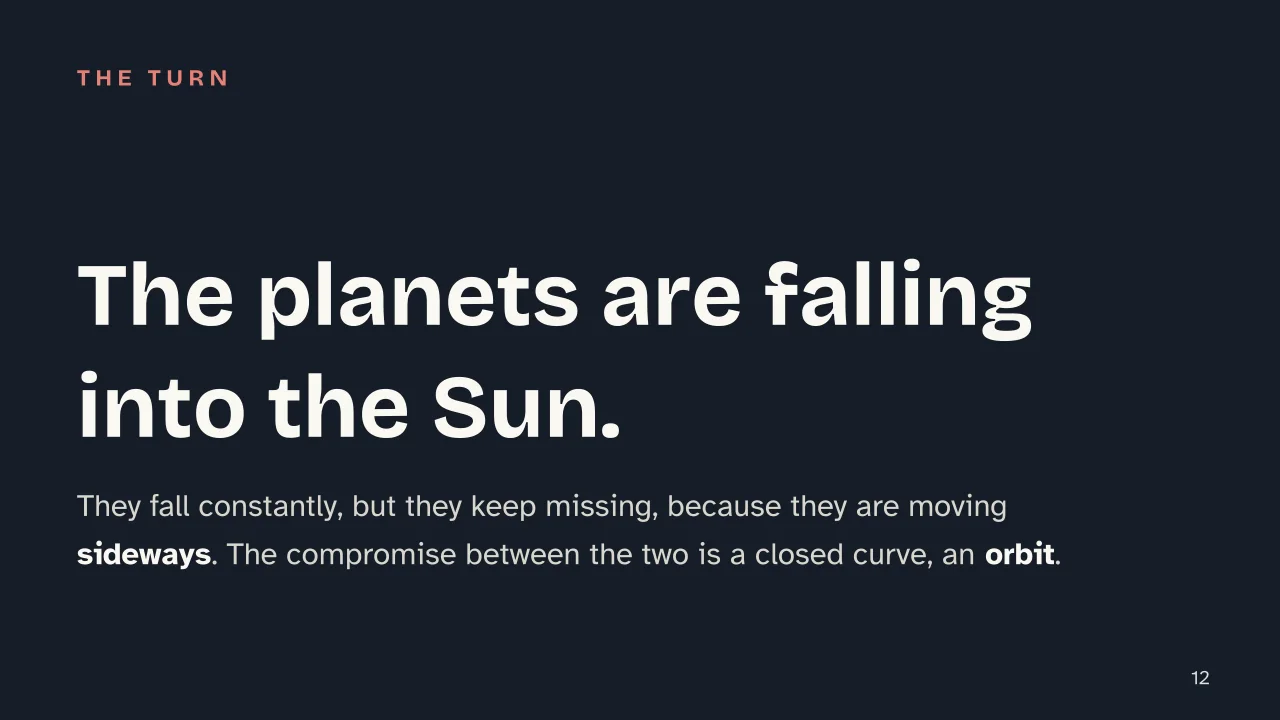
    They are falling in, constantly — they just keep missing. Every planet carries sideways speed inherited from the spinning disc. The Sun’s gravity bends that motion inward; the sideways speed carries the planet past. The compromise between the two is a closed curve: an orbit.

    Practical example: tie a weight to a string and swing it above your head. Your hand pulls the weight towards the centre, as gravity would; the weight never reaches your hand because it is moving sideways. If the string snapped, the weight wouldn’t fall on you — it would fly off in a straight line. Earth works the same way.

    Orbits aren’t perfect circles but ellipses, slightly squashed ones, and that has a practical consequence: the distance from the Sun changes over the year, and planets move faster when they are closer. The distances, too, are far larger than the diagrams suggest. Astronomers use the astronomical unit (AU), the average Earth-Sun distance: about 150 million kilometres. Jupiter sits at 5.2 AU, Neptune at 30. On a model where Earth is one metre from the Sun, Neptune would be thirty metres away, and every planet would be a speck.

    What was left over: rock, ice and comets

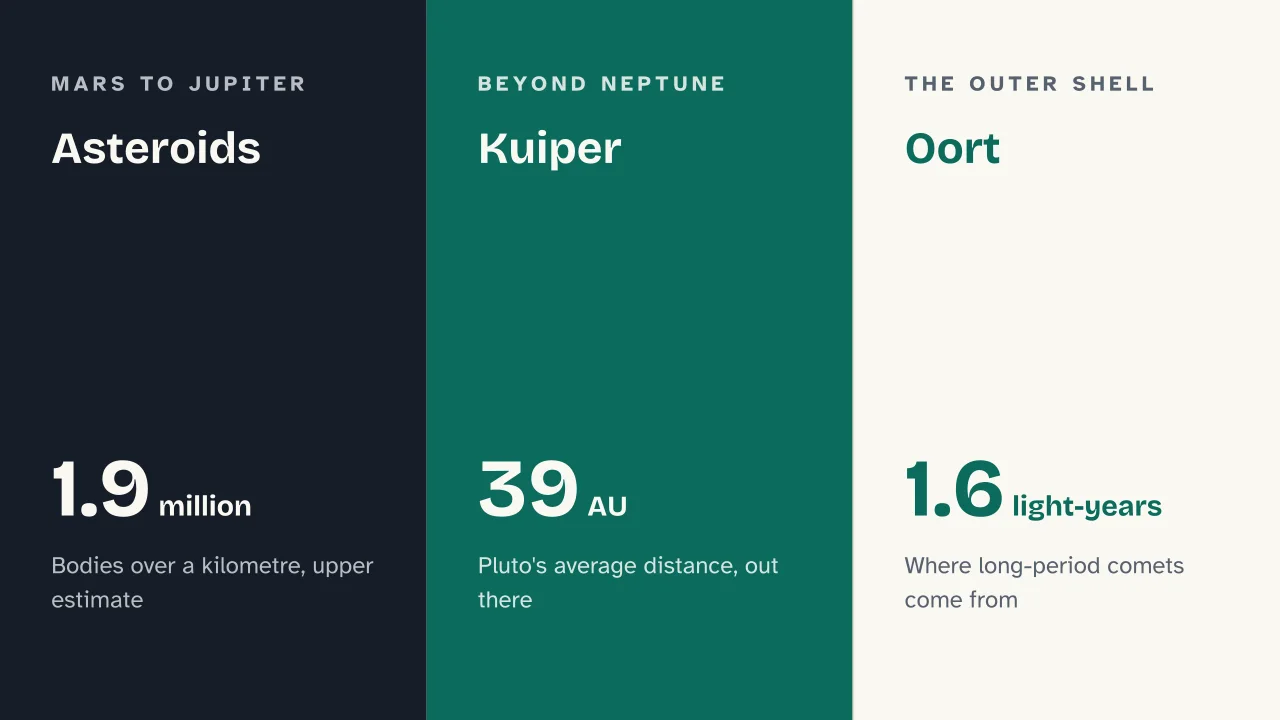
    Between Mars and Jupiter lies the main asteroid belt: somewhere between 1.1 and 1.9 million bodies larger than a kilometre across, plus a great many smaller fragments. It isn’t the wreckage of an exploded planet, as the story often goes, but a planet that never happened: Jupiter’s gravity kept stirring those bodies up, so they smashed into each other instead of sticking together. All the asteroids combined still weigh less than the Moon.

    Beyond Neptune the Kuiper Belt begins, a ring of icy bodies where Pluto lives. Much further out is the Oort Cloud, the shell that long-period comets come from: it extends from 5,000 to 100,000 astronomical units, out to roughly 1.6 light-years from the Sun. That is where our star’s gravitational hold fades into interstellar space.

    Meanwhile the bubble of particles streaming from the Sun, the heliosphere, starts giving way to the interstellar medium between 80 and 100 astronomical units out. That is where the solar wind slows abruptly, at the termination shock: Voyager 1 crossed it in 2004, Voyager 2 in 2007. True interstellar space, past the heliopause, came much later for both — in 2012 and 2018.

    Why Pluto is no longer a planet

    On 24 August 2006, in Prague, the International Astronomical Union voted on a formal definition. A planet is a body that orbits the Sun; has enough mass for its own gravity to pull it into a nearly round shape; and has cleared the neighbourhood around its orbit.

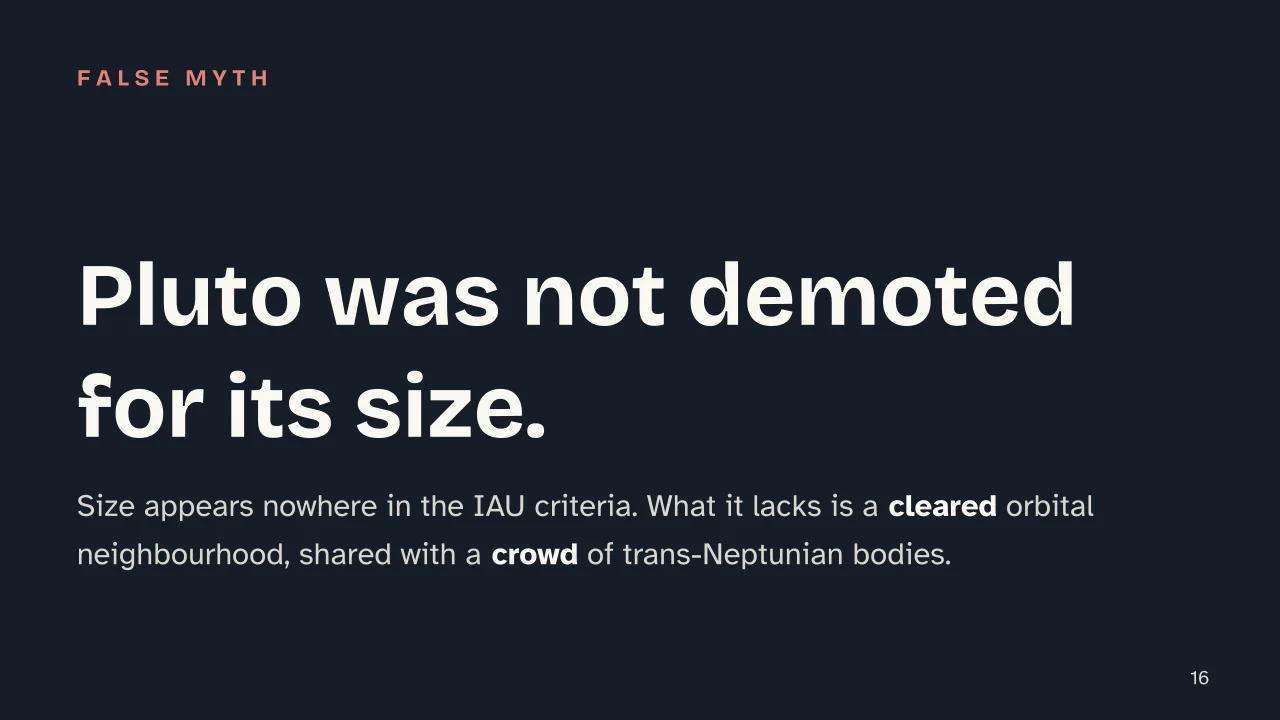
    Pluto meets the first two and fails the third. Not because of its size — size appears nowhere in the criteria — but because it shares its region with a crowd of trans-Neptunian bodies, discovered in growing numbers from the 1990s onward. Hence the category of dwarf planets: round bodies, not satellites, that haven’t swept their surroundings clear. Pluto is the prototype, and five dwarf planets are officially recognised.

    The reclassification took nothing away from Pluto, which remains one of the most studied objects out there: the New Horizons probe flew past it on 14 July 2015. It has five moons — Charon, Nix, Hydra, Kerberos and Styx — a diameter of about 2,377 kilometres, and orbits at an average 39 astronomical units, taking 248 Earth years to go round once: in that time Neptune, whose year runs to 165, gets round one and a half times.

    The solar system is moving

    One last thing the posters leave out: we are not sitting still. The whole solar system orbits the centre of the Milky Way at about 829,000 km/h, taking 230 million years to complete one circuit. Put the two numbers together and you get a sense of how young the Sun is on a galactic scale: since it formed, it has been round about twenty times.

    Slide deck

    Slides ready to download and make your own in PowerPoint or Google Slides, with speaker notes. Pick the Flash cut or the Full one.
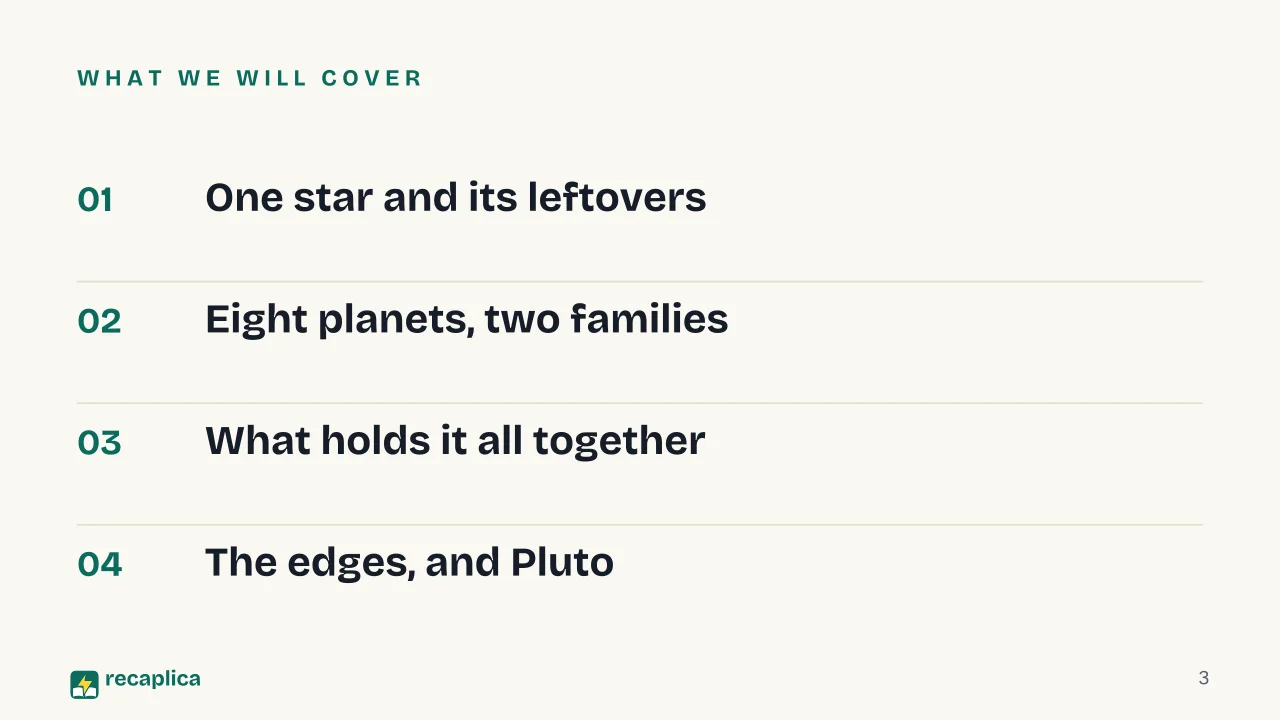
    Slide 1 of the presentation on The solar system: The solar systemSlide 2 of the presentation on The solar system: If the Sun pulls on the planets, why don't they end up inside it?Slide 3 of the presentation on The solar system: What we will coverSlide 4 of the presentation on The solar system: Chapter 01: One star and its leftoversSlide 5 of the presentation on The solar system: The Sun, and then the leftoversSlide 6 of the presentation on The solar system: From a cloud of gas to eight planetsSlide 7 of the presentation on The solar system: Chapter 02: Eight planets, two familiesSlide 8 of the presentation on The solar system: Two families of planetsSlide 9 of the presentation on The solar system: Same kind of planet, three outcomes: Venus, Earth, MarsSlide 10 of the presentation on The solar system: On the giants the numbers turn strangeSlide 11 of the presentation on The solar system: Chapter 03: What holds it all togetherSlide 12 of the presentation on The solar system: The planets are falling into the Sun.Slide 13 of the presentation on The solar system: How big is the solar system really?Slide 14 of the presentation on The solar system: Chapter 04: The edges, and PlutoSlide 15 of the presentation on The solar system: Asteroids · Kuiper · OortSlide 16 of the presentation on The solar system: Pluto was not demoted for its size.Slide 17 of the presentation on The solar system: Where is the main asteroid belt?Slide 18 of the presentation on The solar system: And now, the review
    Flash10 slidesThe essential thread, to present in classFull18 slidesEvery chapter and the deeper detail

    Common myths

    • ✗ Myth Planetary orbits are the perfect circles drawn on the classroom poster.

      ✓ Reality They are ellipses, slightly squashed circles, and the planets are never lined up the way the diagrams show. The distances on the poster aren't real either: if Earth sat one metre from the Sun, Neptune would be thirty metres away, and the asteroid belt would not be a crowded ring of boulders but a nearly empty space where hitting anything is extraordinarily hard.

    • ✗ Myth Pluto was demoted because it is too small.

      ✓ Reality Size appears nowhere in the IAU criteria. What Pluto lacks is a cleared orbital neighbourhood: it shares its space with a crowd of other trans-Neptunian bodies, found in growing numbers from the 1990s onward. Eris settles it — Caltech measurements put it about 27% more massive than Pluto, and it is a dwarf planet too, for exactly the same reason.

    • ✗ Myth The gas giants are balls of gas, so a probe would pass straight through.

      ✓ Reality As you descend, pressure and temperature climb until the gas behaves like a liquid: inside Jupiter there is an ocean of metallic hydrogen, and probably a dense core below that. There is no surface to land on, but there is nothing to pass through either — any probe would be crushed long before the centre.

    Mind map

    Drag the background to move around and the nodes to reposition them; use − and + to collapse and expand branches.
    Customize
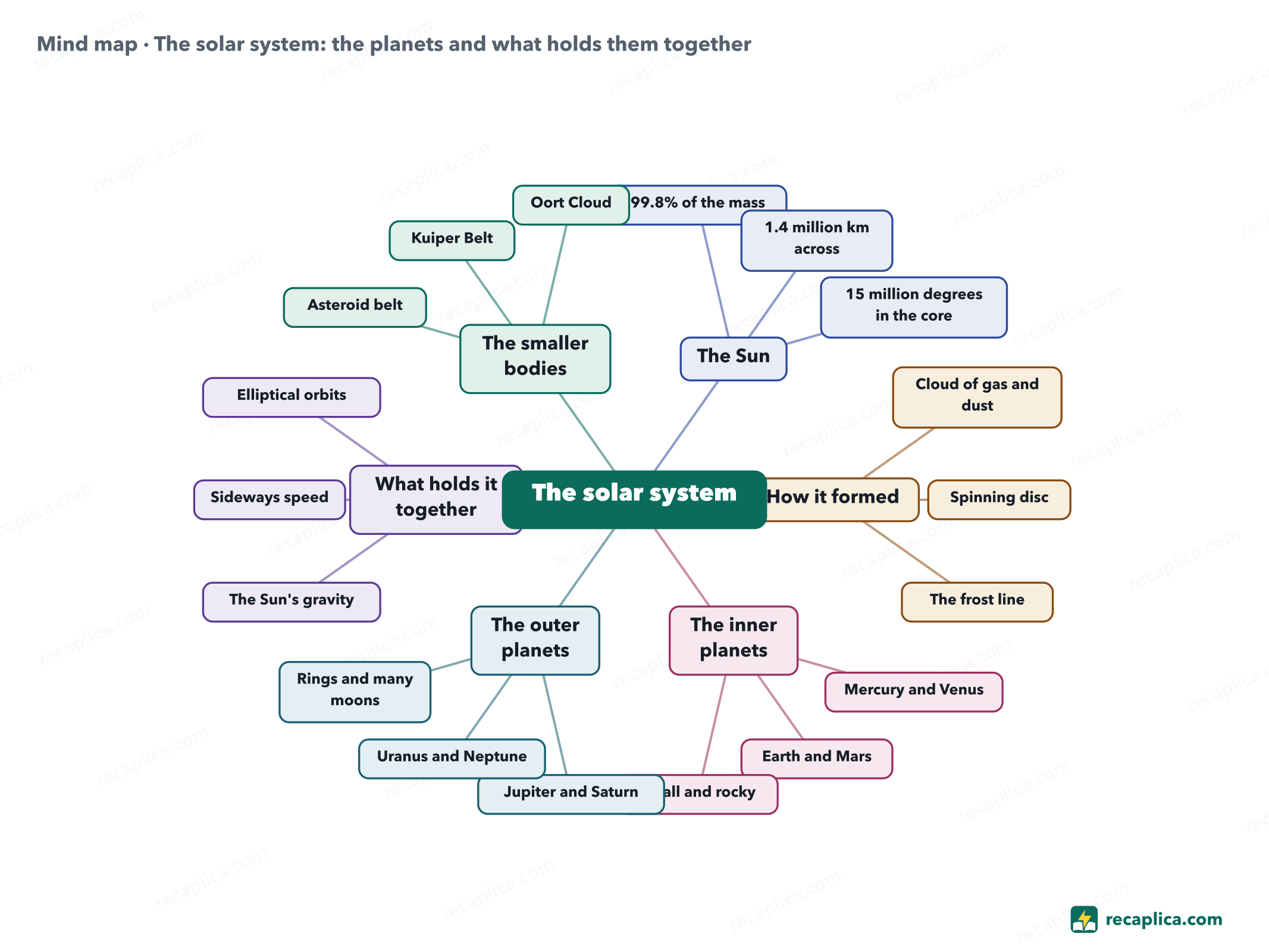
    Mind map: The solar system: the planets and what holds them together
    • The solar system
      • The Sun
        • 99.8% of the mass Everything else shares the crumbs.
        • 1.4 million km across
        • 15 million degrees in the core
      • How it formed
        • Cloud of gas and dust Collapsed about 4.6 billion years ago.
        • Spinning disc
        • The frost line Rock inside it, ice beyond it.
      • The inner planets
        • Mercury and Venus
        • Earth and Mars
        • Small and rocky Solid surface, few moons or none.
      • The outer planets
        • Jupiter and Saturn Gas giants, hydrogen and helium.
        • Uranus and Neptune Ice giants, smaller and colder.
        • Rings and many moons Jupiter 101, Saturn 285 per the IAU.
      • What holds it together
        • The Sun's gravity
        • Sideways speed Without it the planets really would fall in.
        • Elliptical orbits
      • The smaller bodies
        • Asteroid belt Between Mars and Jupiter, a planet that never formed.
        • Kuiper Belt Beyond Neptune, Pluto's territory.
        • Oort Cloud The reservoir of long-period comets.

    Quiz: test yourself

    Answer the questions to check what you have learned: you get instant feedback and a short explanation.

    Grade 0/10 0/5
    1 How much of the solar system's mass is concentrated in the Sun?

    NASA puts the Sun at 99.8% of the solar system's mass. Every planet, moon, asteroid and comet combined shares what remains: less than two parts in a thousand.

    2 Why don't the planets fall into the Sun?

    The Sun's gravity does pull on the planets, and it reaches them perfectly well. But each planet also has sideways speed: the two motions combine into a closed curve, an orbit.

    3 Why are the planets near the Sun rocky and the distant ones giant?

    In the disc of gas and dust around the young Sun, water and other volatile compounds stayed frozen beyond a certain distance. There was far more solid material to build with, and the growing cores got massive enough to capture huge amounts of gas.

    4 Which requirement of the IAU planet definition does Pluto fail?

    Pluto orbits the Sun and is massive enough to be nearly spherical, but it shares its region with many other trans-Neptunian bodies. The third criterion is the one it misses, which is why the IAU classes it as a dwarf planet.

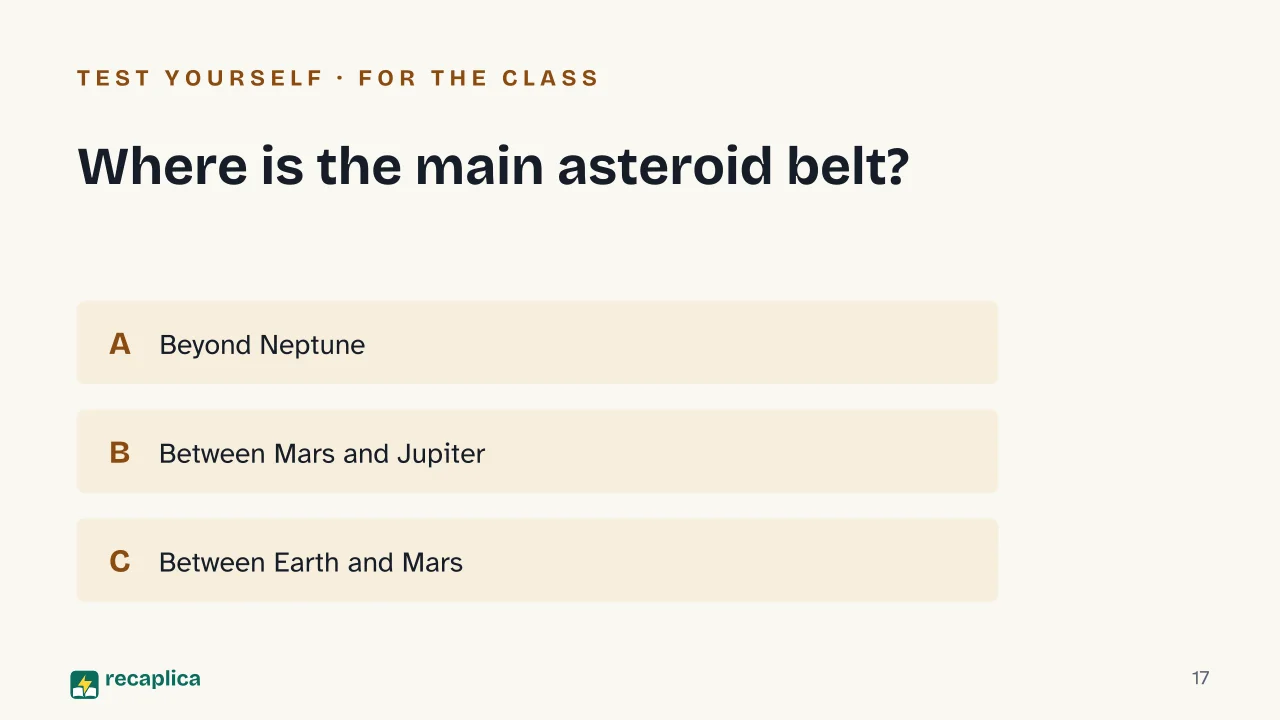
    5 Where is the main asteroid belt?

    The main belt lies between Mars and Jupiter. Jupiter's gravity stopped the fragments there from gathering into a planet: the combined mass of all the asteroids is still less than that of the Moon.

    Answers: 1-C · 2-B · 3-C · 4-C · 5-A

    Flashcards

    Tap the card to flip it and check whether you remember the answer, then move to the next one.

    1 / 8

    Explain it in your own words

    The ultimate test: if you can explain it in simple words, you've truly understood it. Write your explanation, then compare it with the Recap.

    Your explanation is saved only on this device.

    The solar system is the Sun plus everything that circles it: eight planets, hundreds of moons, millions of asteroids and comets. It formed about 4.6 billion years ago when a dense cloud of gas and dust collapsed, and the Sun took more than 99% of the available matter — the planets are what was left over. Gravity is what holds it together: the Sun's pull bends each planet's path without ever pulling it in, because the planet is moving sideways fast enough to keep missing. Close to the star only rock survived and small solid worlds formed; far out, where ice held on, the giants grew.

    Frequently asked questions

    How many planets are in the solar system?

    Eight: Mercury, Venus, Earth, Mars, Jupiter, Saturn, Uranus and Neptune. There were nine until 2006, when the International Astronomical Union adopted a formal definition of a planet and classified Pluto as a dwarf planet. Five dwarf planets are officially recognised.

    Why isn't Pluto a planet any more?

    Because it fails the third criterion the IAU adopted on 24 August 2006: a planet must have cleared the neighbourhood around its orbit. Pluto sits in the region beyond Neptune alongside many other bodies of comparable size, and it is now the prototype of that new class of objects. It wasn't demoted over a measurement error — the definition changed, after bodies like it started turning up.

    How old is the solar system?

    About 4.6 billion years. The figure comes from radiometric dating of the oldest meteorites, fragments that survived untouched from the earliest days of its formation. NASA dates the Sun's formation to about 4.6 billion years ago, in the same cloud.

    What is an astronomical unit?

    It's the unit used for distances inside the solar system: one astronomical unit (AU) is the average distance between Earth and the Sun, about 150 million kilometres. Jupiter sits at 5.2 AU, Neptune at 30 AU. It saves writing out figures with nine zeros every time.

    Where does the solar system end?

    It depends what you count as the edge. The solar wind slows abruptly between 80 and 100 astronomical units, where the bubble of particles from the Sun starts giving way to the interstellar medium; the Voyager probes reached true interstellar space later still, in 2012 and 2018. But the Sun's gravity holds on to far more distant bodies: the Oort Cloud, the reservoir of long-period comets, stretches from 5,000 to 100,000 astronomical units — as far as roughly 1.6 light-years.

    Sources

    • NASA Science — Solar System Facts
    • NASA Science — Sun Facts
    • IAU — 2006 General Assembly: Result of the IAU Resolution votes
    • IAU — Minor Planet Center confirms new moons of Saturn and Jupiter (26 March 2026)
    • Caltech — Dwarf planet Eris is more massive than Pluto
    • NASA Science — Pluto Facts
    • NASA Science — Jupiter Facts
    • NASA Science — Neptune Facts
    • NASA Science — Asteroid Facts
    • NASA Science — Venus Facts
    • NASA Science — Io, moon of Jupiter

    Every Recap goes through an independent review before publication.

    Every evening, the day's new Recaps on our Telegram channel. Join the channel →

    Keep learning

    • Economics What Is the Space Economy? Value, Growth and Who Runs It The space economy covers every economic activity built around space: launches, satellites, telecommunications, Earth observation and, increasingly, lunar resources. In 2025 the global market was worth about $600 billion, according to the OECD, while McKinsey and the World Economic Forum project it could reach $1.8 trillion by 2035. Before 2010, launches were mostly government-run; by 2025, 88% launched privately. Control of the busiest orbits and of the Moon has meanwhile become a contest between two coalitions, the US-led Artemis Accords and the China-Russia International Lunar Research Station. Read the Recap →
    • History Apollo 11: How the 1969 Moon Landing Happened On 20 July 1969 the lunar module Eagle from Apollo 11 touches down in the Sea of Tranquility, and a few hours later Neil Armstrong becomes the first person to walk on the Moon, followed by Buzz Aldrin, while Michael Collins stays in orbit aboard the command module Columbia. It comes after years of a space race with the Soviet Union, opened by the 1957 launch of Sputnik and given a fresh target by President John F. Kennedy in 1961, and after the rehearsals flown under Project Mercury and Project Gemini. The Apollo program is not without accidents — a crew dies on the ground in 1967, another nearly fails to return in 1970 — but it puts twelve astronauts on the Moon in all, across six successful missions between 1969 and 1972. Read the Recap →
    • Science Cognitive Load Theory: The Definition Behind Sweller's Research Cognitive load is the amount of working memory a task uses up while you learn something new. Psychologist John Sweller first described it in 1988, starting from research on problem solving: a strategy that is too demanding leaves little room to build stable mental structures. Later research distinguishes three types of load, intrinsic, extraneous, and germane, though part of the field treats the third as indistinguishable from the first. Cutting extraneous load, with worked examples or less cluttered materials, frees up mental room for actual learning. Read the Recap →

    recaplica

    Clear in 30 seconds, yours in 10 minutes.

    Recaps Mind maps Request a Recap Telegram channel Mind map maker Our method About Privacy & cookies Legal notes & terms of use

    © 2026 Recaplica · A project by Curi S.r.l. — VAT IT05472000750

    Statistics, only if you say so

    To learn which Recaps help most we would use Google Analytics, with aggregate, anonymous data. It starts only with your OK, and you can change your mind anytime. Privacy policy