|
recaplica
Dialogue Concerning the Two Chief World Systems | ||||||||||||
| © 2026 Recaplica · recaplica.com — All rights reserved | ||||||||||||
Dialogue Concerning the Two Chief World SystemsWhat to print Page numbers appear when printing with default margins. SlidesChoose a cut Flash10 slidesThe essential thread, to present in classFull15 slidesEvery chapter and the deeper detailBoth come with speaker notes. In 30 seconds quick readDialogue Concerning the Two Chief World Systems is the book in which Galileo Galilei, in 1632, weighs the Copernican system against the Aristotelian-Ptolemaic one through three characters who talk across four days. Salviati argues for Copernicus, Simplicio defends the Aristotelian tradition, and Sagredo referees with the common sense of an outside observer. The book reaches bookshops with every authorization in order, yet a year later it puts Galileo in front of the Inquisition: the trial closes in 1633 with his abjuration, and in 1634 the work lands on the Index of banned books. Key Points
Key figures
Deep DiveA book built to weigh two skies against each otherIn 1632 Galileo Galilei published a book in Florence written as a conversation among friends, spread across four days, with three speakers debating which of the two competing models of the universe actually described the world: the one from Copernicus or the one from Aristotle and Ptolemy. To see where Galileo starts from and where his whole scientific career leads, it helps to read Galileo Galilei: who he was, his discoveries, and the scientific method. The book finished printing on 21 February 1632, at the press of Giovanni Battista Landini, with authorization secured in both Rome and Florence. According to Treccani, Galileo’s stated goal is to demonstrate the physical truth of the Copernican system against the Aristotelian- Ptolemaic one, building the argument on concrete observation and rigorous mathematical reasoning. The treatment of mechanics follows geometric procedure, leaving out the explanations built on hidden qualities typical of Aristotelian physics. Three speakers, three positionsThe Dialogue stages three characters, each with a fixed part to play. Salviati carries the Copernican argument forward, in the voice Galileo would use if he spoke for himself. Simplicio, according to Treccani, speaks for the supporters of Peripatetic, meaning Aristotelian, doctrine: he is given real arguments to work with, the ones Galileo actually wants to take apart, rather than an empty target for laughs. Sagredo, finally, brings common sense to the table: he is the learned, impartial observer who referees the exchange between the other two, without taking sides from the start.
Four days, four different subjectsThe work runs across four days, each with its own topic: according to Museo Galileo, the first critiques key foundations of Aristotelian cosmology, the second centers on Earth’s daily rotation, the third is devoted mainly to Earth’s yearly orbit around the Sun, and the fourth — the last — covers the tides on their own. To see what actually changes between a model with Earth at the center and one with the Sun at the center, it helps to compare it with the solar system: the planets and what holds it together. In the third day Salviati takes the very data Simplicio himself supplies — the phases Venus shows, and its position always near the Sun alongside Mercury — and arranges them into a diagram of planetary orbits that matches the Copernican solar system.
The same day also brings in the observation of sunspots, whose shifting paths are presented as further confirmation of the Copernican idea, and the observation of Jupiter, with its four moons, which Salviati uses to argue that Earth could rotate while carrying the Moon along with it, by analogy with what can be seen around the largest planet in the solar system. The weakest argument, and the most forbiddenThe fourth day deserves its own discussion, because it is at once the most fragile piece of the scientific case and the one watched most closely by the censors. Galileo argues that the combination of Earth’s daily rotation and its yearly orbit around the Sun explains the ebb and flow of the tides. According to the Stanford Encyclopedia of Philosophy, this argument met with skepticism already among Galileo’s contemporaries, because the actual behavior of the tides did not fully bear it out. The tides were exactly what drew Pope Urban VIII’s attention. Museo Galileo records that the pope required the book, in its title and subject, to leave the ebb and flow out entirely and stick to the mathematical treatment of the Copernican position on Earth’s motion, paired with the argument for divine omnipotence, able to settle the intellect even against Copernican reasoning. Galileo bent that rule: the tides stay in the book as physical proof of the Copernican system, and the pope’s own argument on divine omnipotence gets handed to Simplicio, who speaks for the Aristotelian side throughout the Dialogue. From the license to print to the trialThe book’s path to print had started years earlier. In 1630 the work reached Rome, where Galileo traveled hoping to secure a Roman edition. The censor Niccolò Riccardi read the manuscript and judged Galileo’s Copernicanism asserted too plainly, and ordered the book revised and reduced to a hypothesis. On 11 September 1631 the imprimatur of the Florentine Inquisition finally arrived, signed by Pietro Niccolini, Vicar General, and Clemente Egidi, Inquisitor General; the grand-ducal license to print followed the next day, issued by Niccolò dell’Antella. The authorizations, though, did not settle the matter. According to Treccani, soon after printing was finished the Inquisition banned the sale of the Dialogue and summoned Galileo to Rome for trial. It was not the Church’s first dealing with him: already in 1616, according to the Stanford Encyclopedia of Philosophy, Galileo had been summoned by Cardinal Roberto Bellarmino, a senior theologian who sat on the Roman Inquisition, and warned off teaching or defending the Copernican theory — historians of science still debate the exact details of that first meeting. The Istituto e Museo di Storia della Scienza notes that as early as 1613 and 1615, in letters to Benedetto Castelli and to Christina of Lorraine, Galileo had already claimed science’s independence from matters of faith, and that in December 1614 the Dominican friar Tommaso Caccini had publicly denounced the Copernican system as heretical from the pulpit of Santa Maria Novella in Florence. On 24 February 1616 the Church condemned the heliocentric view, and on 5 March it decreed the suspension of Copernicus’s own work. The trial over the Dialogue closed on 22 June 1633 with Galileo’s conviction and the requirement that he abjure; Treccani notes that his prison sentence was later commuted to house arrest. A book banned for centuriesThe story did not end with the trial. On 23 August 1634 the Dialogue was banned outright and placed on the Index of forbidden books, leaving the printer Landini with heavy financial losses, since he had put money into printing a work no longer sellable through legal channels. Galileo’s trial unfolds in the same Baroque Rome where, in those same decades, Gian Lorenzo Bernini and Francesco Borromini were competing for the city’s biggest commissions: readers after the artistic and political backdrop of that Rome can turn to Roman Baroque: Bernini and Borromini, a rivalry that reshaped Rome. The Dialogue still ranks among the most studied texts in the history of science, not only for its astronomical content but for how it stages the clash between two views of the world: characters who argue, contradict each other, and, in Simplicio’s case, end up speaking the very words of the side meant to stop Galileo. Slide deckSlides ready to download and make your own in PowerPoint or Google Slides, with speaker notes. Pick the Flash cut or the Full one.   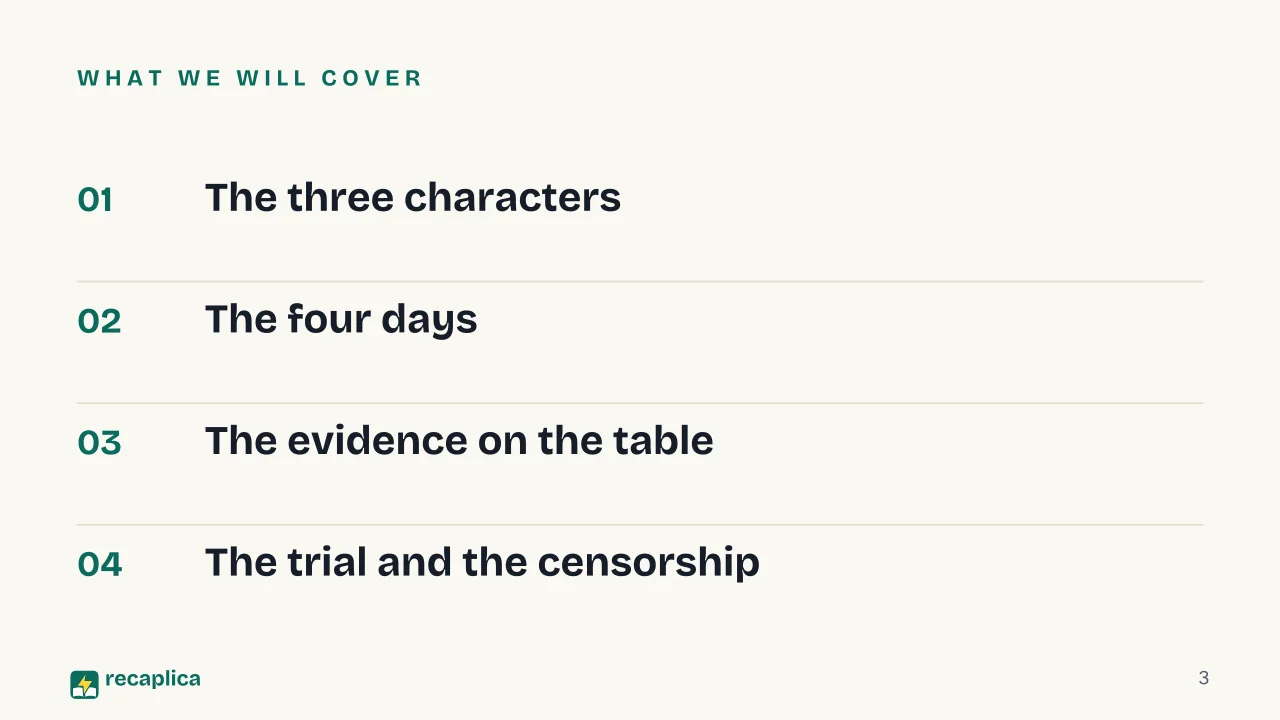  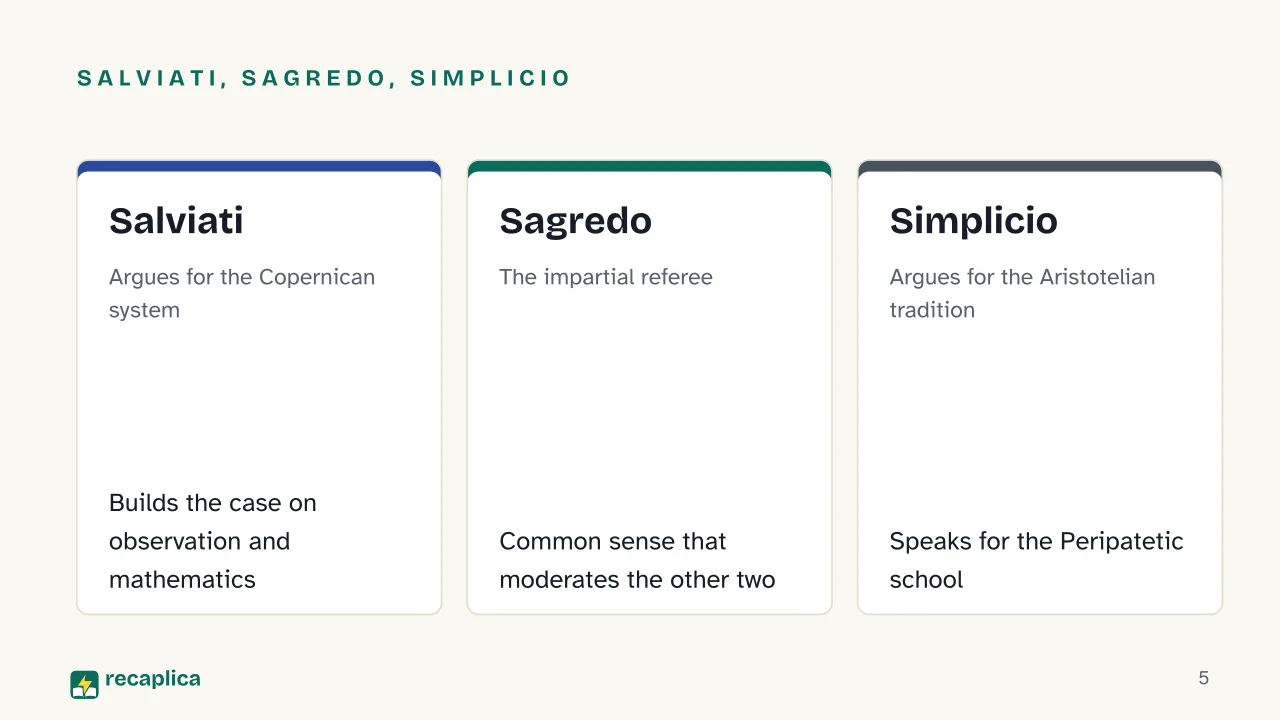  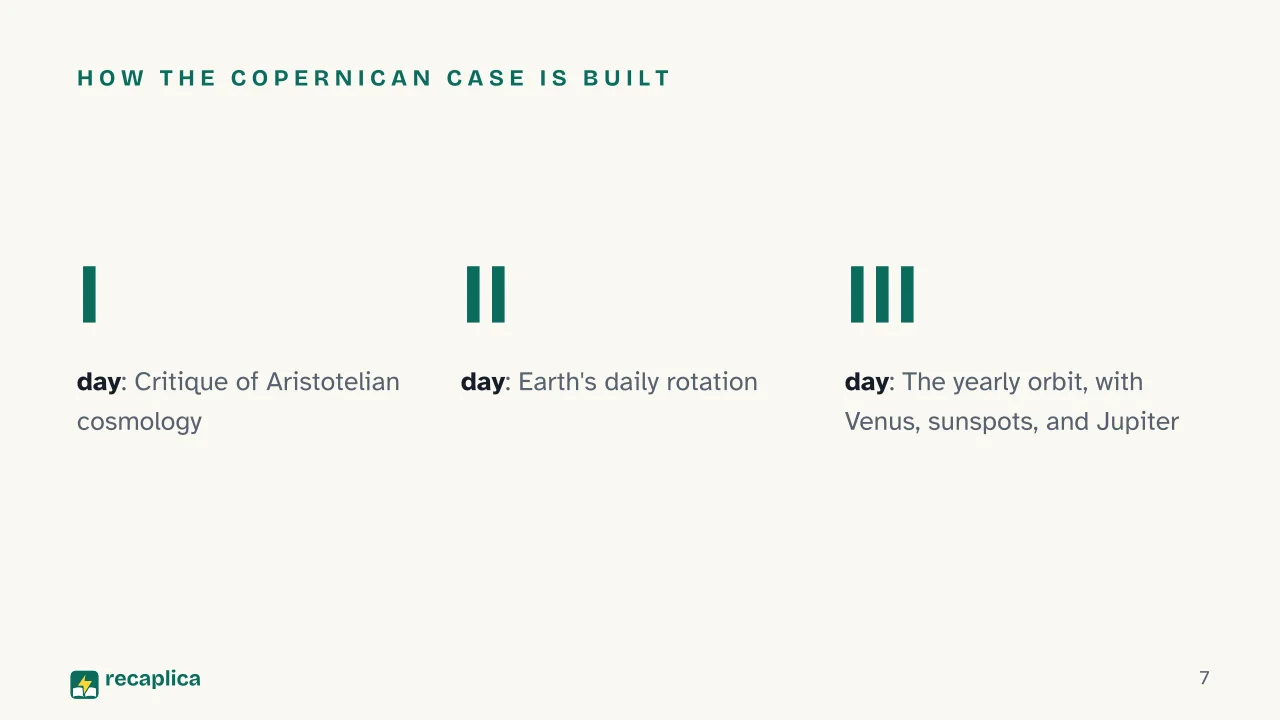 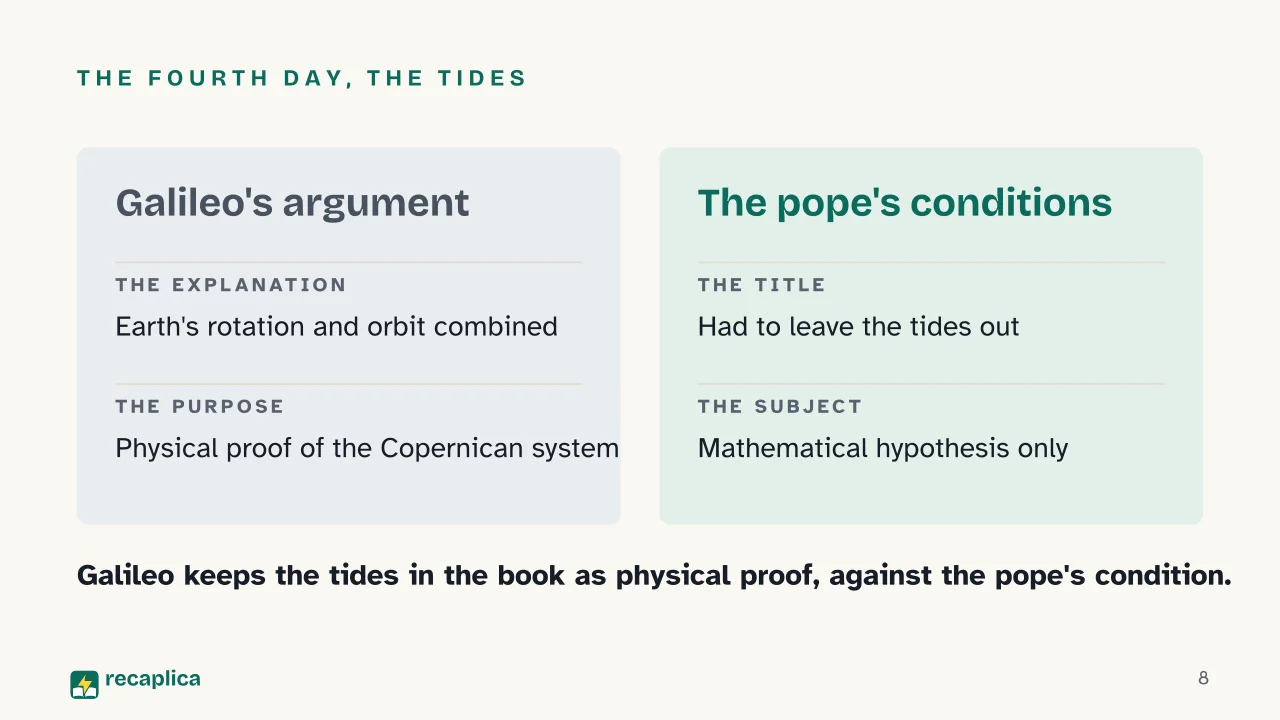  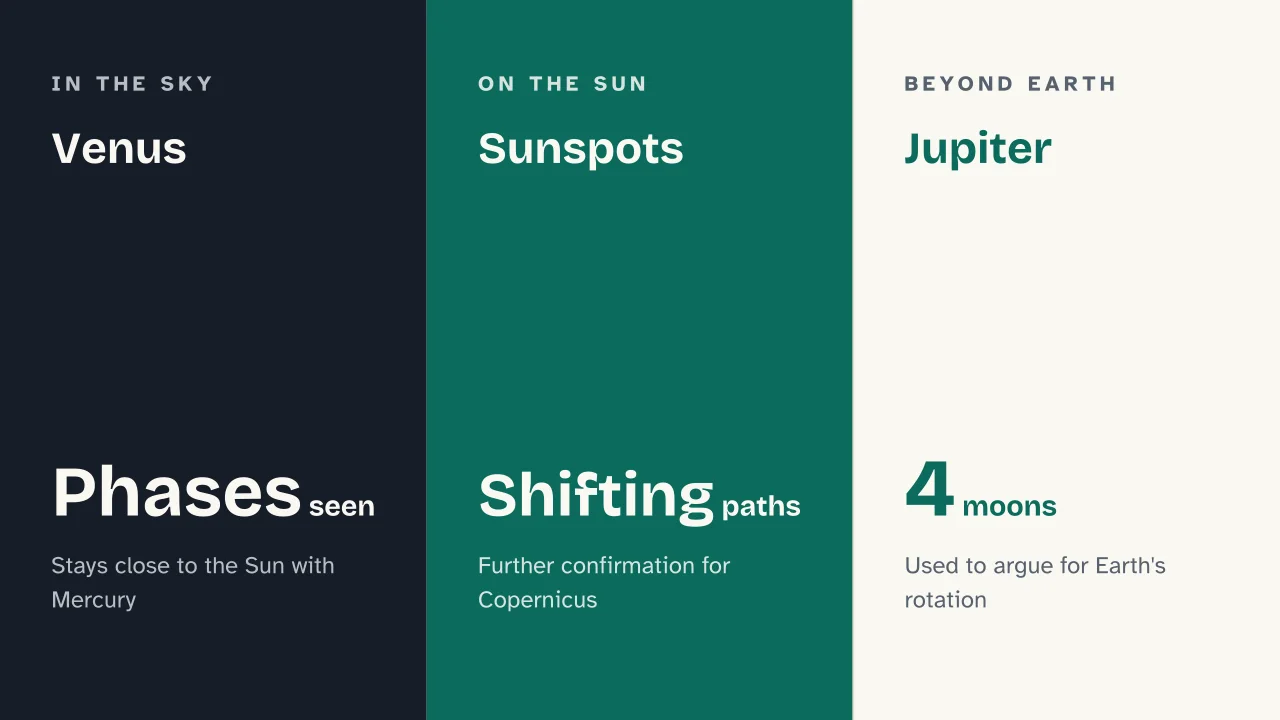  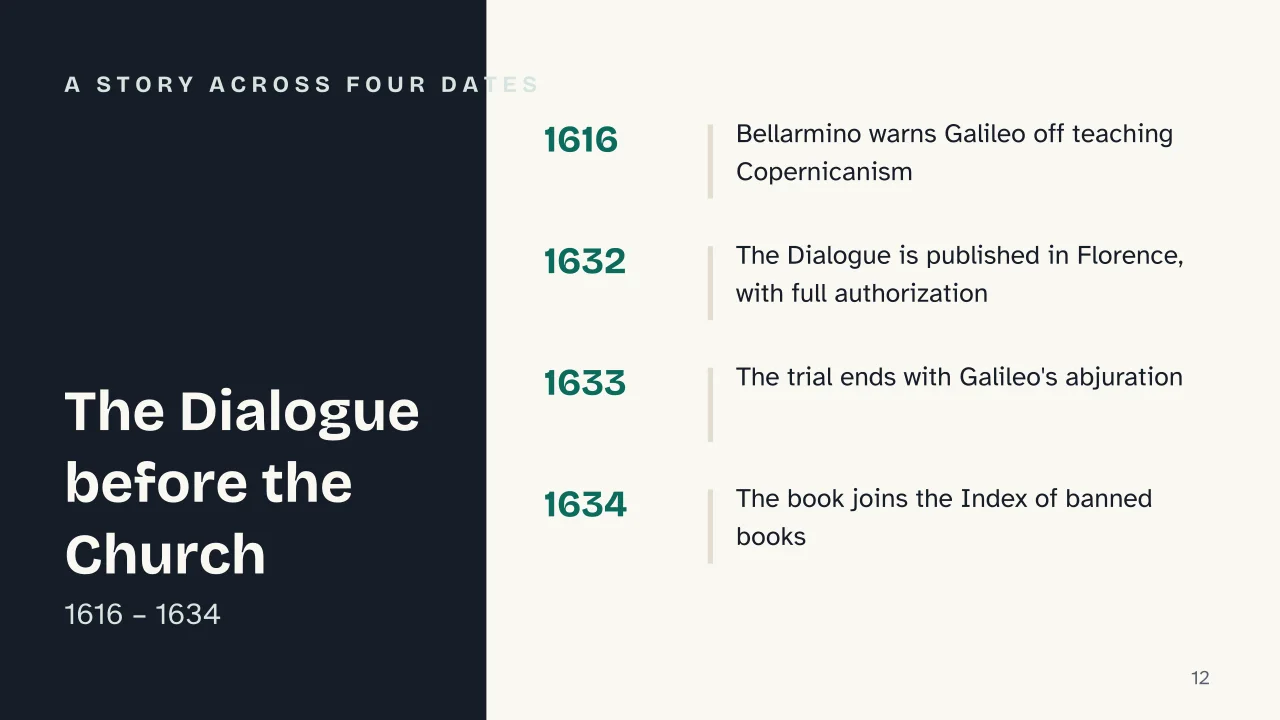 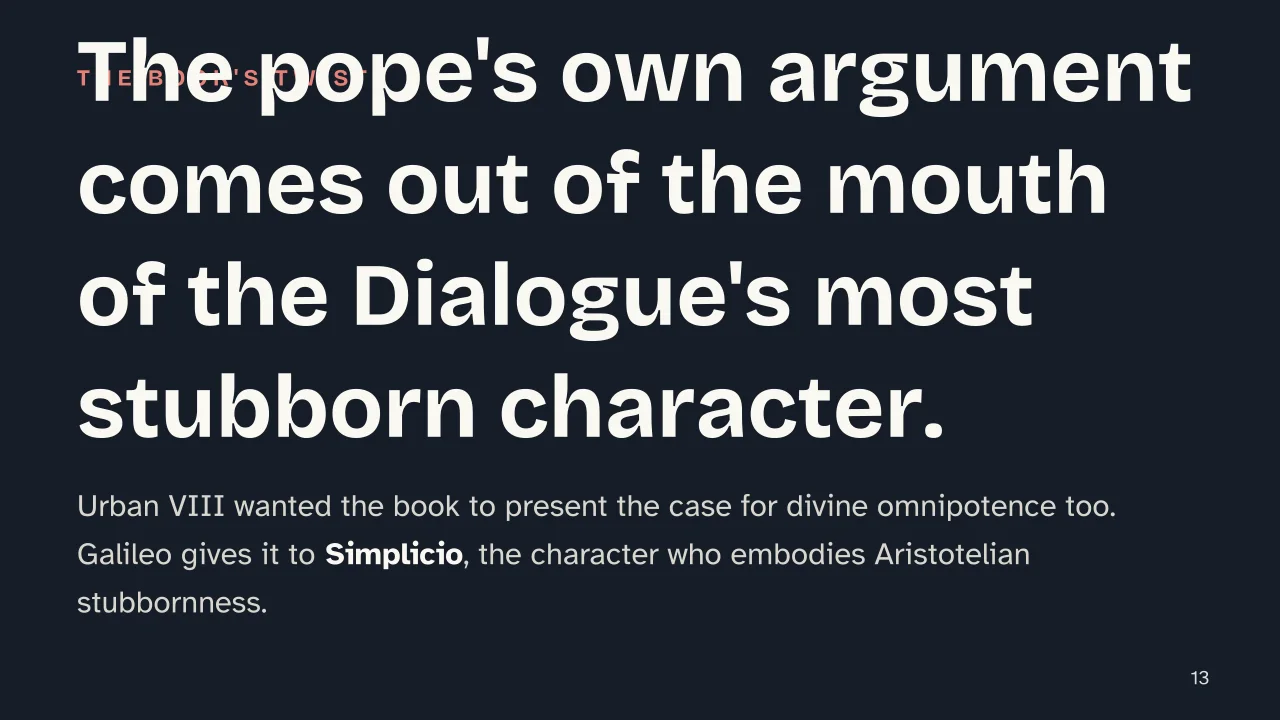 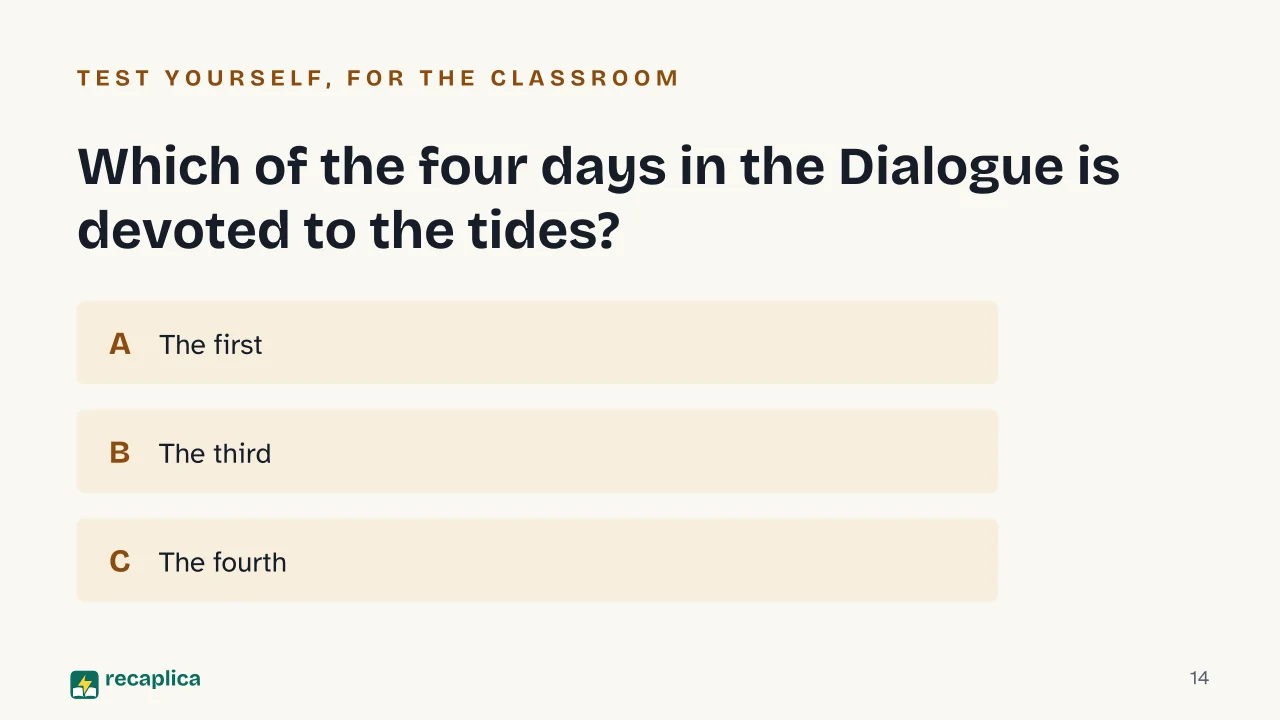  Common myths
Mind mapDrag the background to move around and the nodes to reposition them; use − and + to collapse and expand branches. 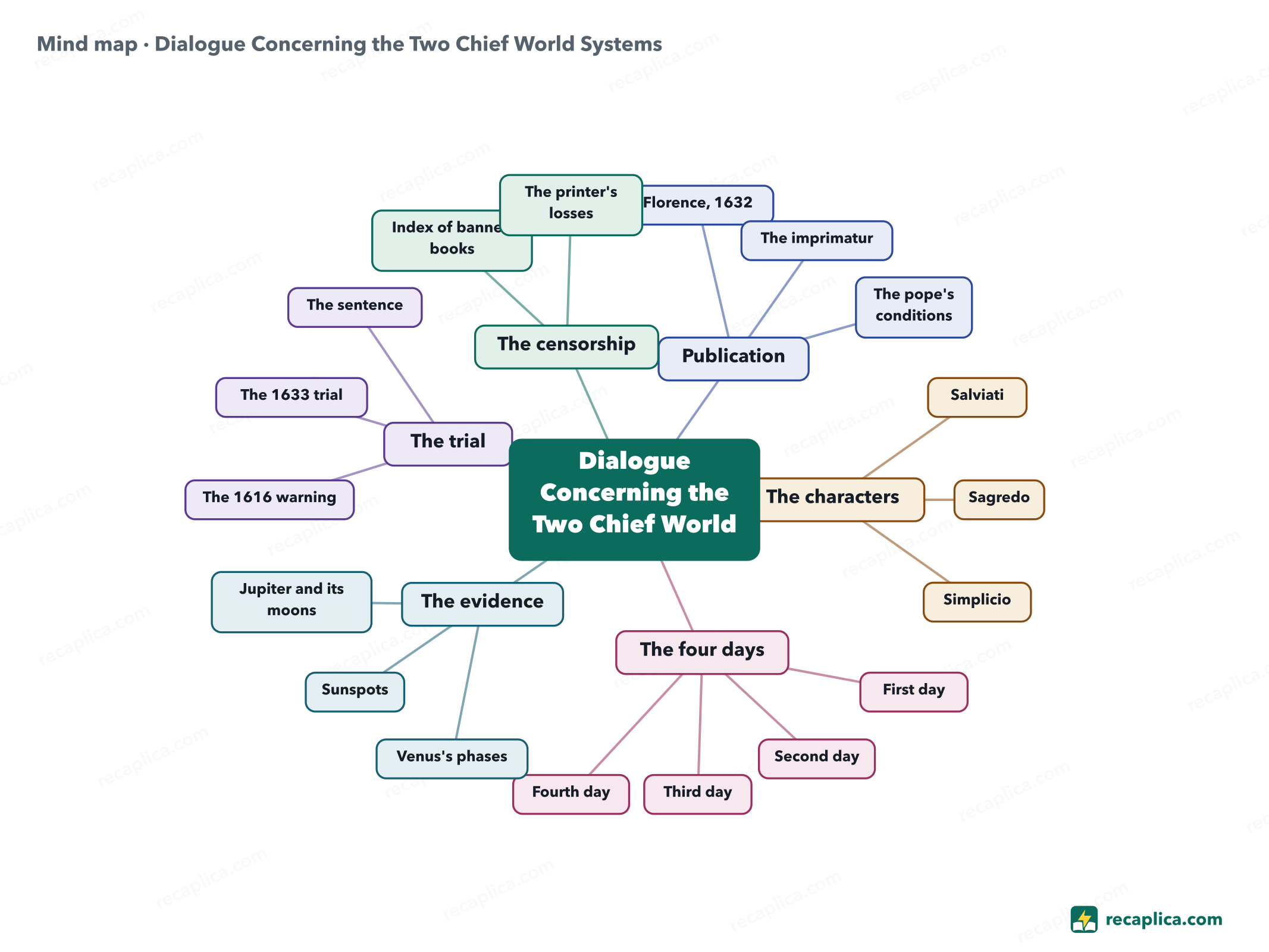
Quiz: test yourselfAnswer the questions to check what you have learned: you get instant feedback and a short explanation. Grade 0/10 0/5
FlashcardsTap the card to flip it and check whether you remember the answer, then move to the next one. 1 / 7 Explain it in your own wordsThe ultimate test: if you can explain it in simple words, you've truly understood it. Write your explanation, then compare it with the Recap. Your explanation is saved only on this device.
Frequently asked questionsWhat is Dialogue Concerning the Two Chief World Systems about?It weighs the Copernican system, with Earth moving around the Sun, against the Aristotelian-Ptolemaic one, with Earth motionless at the center of the universe. According to Treccani, Galileo's goal is to show that the Copernican account holds up physically, not just on paper, resting his case on concrete observation and rigorous mathematical reasoning. Who are Salviati, Sagredo, and Simplicio?The three speakers of the Dialogue. Salviati carries the Copernican argument; Simplicio, according to Treccani, speaks for the supporters of Aristotelian doctrine; Sagredo moderates between them, playing the part of the educated bystander with no side to defend. Why did the Dialogue lead to Galileo's 1633 trial?Galileo had already been warned in 1616 by Cardinal Roberto Bellarmino not to teach or defend Copernicanism, after the Church had condemned the heliocentric view. Pope Urban VIII's condition for publication was that the book present the Copernican system only as a mathematical hypothesis, and the published book went beyond that limit: according to Treccani, the work became the direct cause of a heresy trial, which closed in 1633 with his abjuration; the prison sentence was later reduced to house arrest. What evidence does Galileo use in the Dialogue to support Copernicus?The phases of Venus and its closeness to the Sun alongside Mercury, the shifting paths of sunspots (presented as further confirmation of the Copernican view), and the behavior of Jupiter with its four moons. Galileo also brings in the tides, explained through the combination of Earth's daily rotation and yearly orbit, an idea his contemporaries viewed with suspicion, since the Stanford Encyclopedia of Philosophy notes that it fits poorly with the actual behavior of the tides. What did Pope Urban VIII require for the book's publication?According to Museo Galileo, the pope asked that the tides stay out of the title and the declared subject of the book, leaving room only for the mathematical treatment of the Copernican position on Earth's motion, paired with the argument of divine omnipotence. Galileo placed that same papal argument in the mouth of Simplicio, the character who embodies Aristotelian stubbornness in the Dialogue. Every Recap goes through an independent review before publication. |