|
recaplica
The Renaissance: What It Was, When It Began, and Why It Changed Europe | |||||||||||||||
| © 2026 Recaplica · recaplica.com — All rights reserved | |||||||||||||||
The Renaissance: What It Was, When It Began, and Why It Changed EuropeWhat to print Page numbers appear when printing with default margins. SlidesChoose a cut Flash10 slidesThe essential thread, to present in classFull16 slidesEvery chapter and the deeper detailBoth come with speaker notes. In 30 seconds quick readThe Renaissance is the period of European history in which, starting from Florence and the other Italian city-states, scholars rediscovered the texts and ideals of ancient Greece and Rome and developed new approaches to art, science and politics. It begins around the middle of the fourteenth century and runs through the fifteenth and sixteenth, with exact boundaries still debated among historians. It grew out of the work of chancellors, philosophers and artists in Italian courts and republics, then spread across Europe helped along by the printing press. Its most lasting legacy is the method of observation and verification that would feed into the scientific revolution. Key Points
Key figures
Deep DiveThe Renaissance begins in the Italian city-states, not on a single date. Treccani describes a period that had already taken on fairly precise features around the middle of the fourteenth century, but notes that historians don’t agree on one range: some start it in 1400 and close it in 1550, others frame it between 1492 and 1600. The roots go back further still. What scholars call pre-humanism, based on the research of Remigio Sabbadini, reaches to the early fourteenth century and is centered on northern Italy, well before Florence becomes the movement’s main workshop. Humanism and the Renaissance: two words, one common mix-upHumanism, in Treccani’s definition, is the specifically philological side of the Renaissance: a literary period peaking in the fifteenth century, focused on recovering and critically studying ancient texts. The Renaissance is the broader container, which also includes painting, sculpture, architecture and science, and which in the most common historical usage runs from the late fifteenth century through the end of the sixteenth.
Treccani calls Petrarch the true starting point of humanist literature: the movement, in the encyclopedia’s own phrasing, converges in his work. Coluccio Salutati, chancellor of the Florentine republic, brought classical eloquence into the city’s politics; Leonardo Bruni, his successor at the chancellery, became its Latin historian. Lorenzo Valla applied the philological method to theology and law, and his critical approach later passed to Erasmus of Rotterdam, who carried it beyond Italy in the sixteenth century. The cities that served as a workshopThe movement develops mainly in the republics of Florence and Venice, where cultural inquiry was tied to the work of chancelleries and courts. In Florence, under Lorenzo de’ Medici, the Florentine Platonism of Marsilio Ficino, author of the Theologia platonica, held an appeal that Treccani says lasted across Europe until the end of the seventeenth century. Recovering the classical texts involved concrete searches through monastery libraries: Poggio Bracciolini searched the Swiss monasteries of St. Gall, Reichenau and Einsiedeln, while Ambrogio Traversari carried out his own search through central and northern Italian monasteries between 1432 and 1434; Giovanni Aurispa, on a trip to Greece in 1421, gathered 238 volumes of ancient works.
In Venice, the key figure is Aldus Manutius, whose press fulfilled what Treccani describes as Cardinal Bessarion’s wish: to hand the message of Greek learning down to humanity intact. Official teaching of Greek in Florence began in 1396, with Manuel Chrysoloras; in 1439 the ecumenical council relocated to the city, bringing with it Georgius Gemistus Pletho and other Byzantine scholars. After the fall of Constantinople in 1453, further Greek scholars fled the collapsing Byzantine Empire, carrying ancient manuscripts with them into Italy. The arts and the method of observationOn the artistic side, Donatello, Masaccio and Filippo Brunelleschi shape the Florentine scene in the first half of the fifteenth century. Brunelleschi develops the study of perspective as a tool for representing reality, later formalized by Leon Battista Alberti, whose De re aedificatoria lays out the model of a rationally planned city. Archaeological finds in Rome, such as the Laocoön between the late fifteenth and early sixteenth centuries, feed a growing interest in classical art. The High Renaissance, the best-known stretch even outside specialist circles, actually occupies a narrow window: Leonardo finishes the Vitruvian Man around 1492 and The Last Supper around 1498; Michelangelo works on the Pietà between 1497 and 1500, completes the David in 1504, and paints the ceiling of the Sistine Chapel between 1508 and 1512; Raphael finishes the frescoes in the Vatican Stanze, including The School of Athens, in 1511. Readers wanting the medieval backdrop the Renaissance broke away from can turn to our Middle Ages summary; to see what humanists were actually looking for in ancient texts, our Recaps on Ancient Greece and the Roman Empire cover the two civilizations they studied. How printing carried the Renaissance beyond ItalyJohannes Gutenberg began his printing experiments in the 1440s and set up his press in Mainz in 1450; his printed Latin Bible of 1456 is the first major work to come off the press. The earliest presses outside Germany opened in Subiaco in 1465 (the first in Italy), then in Rome in 1467 and Venice in 1469; by the start of the sixteenth century, even smaller towns had their own press. The effect on the circulation of ideas was enormous. Before printing, according to World History Encyclopedia, at most one person in ten could read extended texts; printed books, in addition, cost around an eighth of a handwritten copy, making them far more accessible. European book production went from around 2 million copies in the first decade of the 1500s to around 20 million by 1550, and to around 150 million by 1600. That, together with the movement of scholars and merchants, is one of the forces that carried humanist ideas and new artistic techniques beyond Italy’s borders. Scientifically, the Renaissance broke with the Aristotelian empiricism that had dominated for centuries, opening the way to the modern scientific revolution, of which Galileo Galilei would become a leading figure; Copernicus published his heliocentric theory in 1543. The same method of direct observation that painters developed through perspective, looking at reality with fresh eyes instead of simply repeating ancient authority, carried over from artists’ workshops into scientific laboratories. Slide deckSlides ready to download and make your own in PowerPoint or Google Slides, with speaker notes. Pick the Flash cut or the Full one.     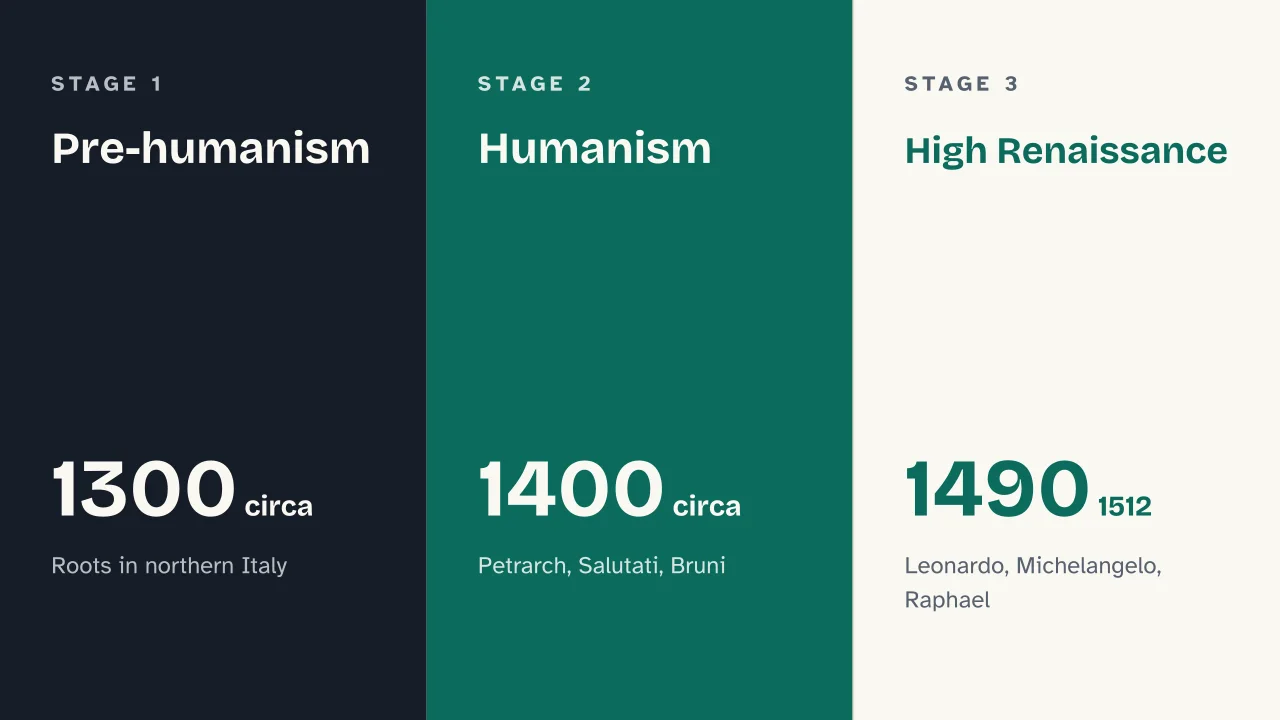  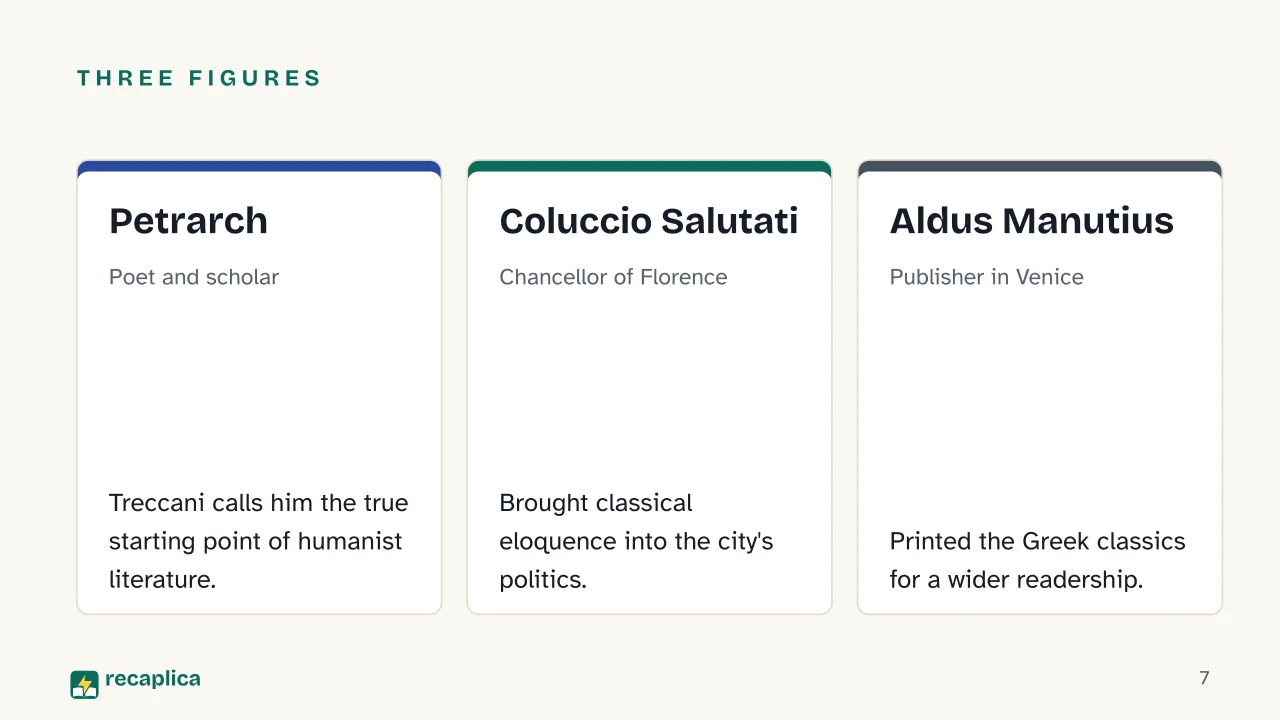 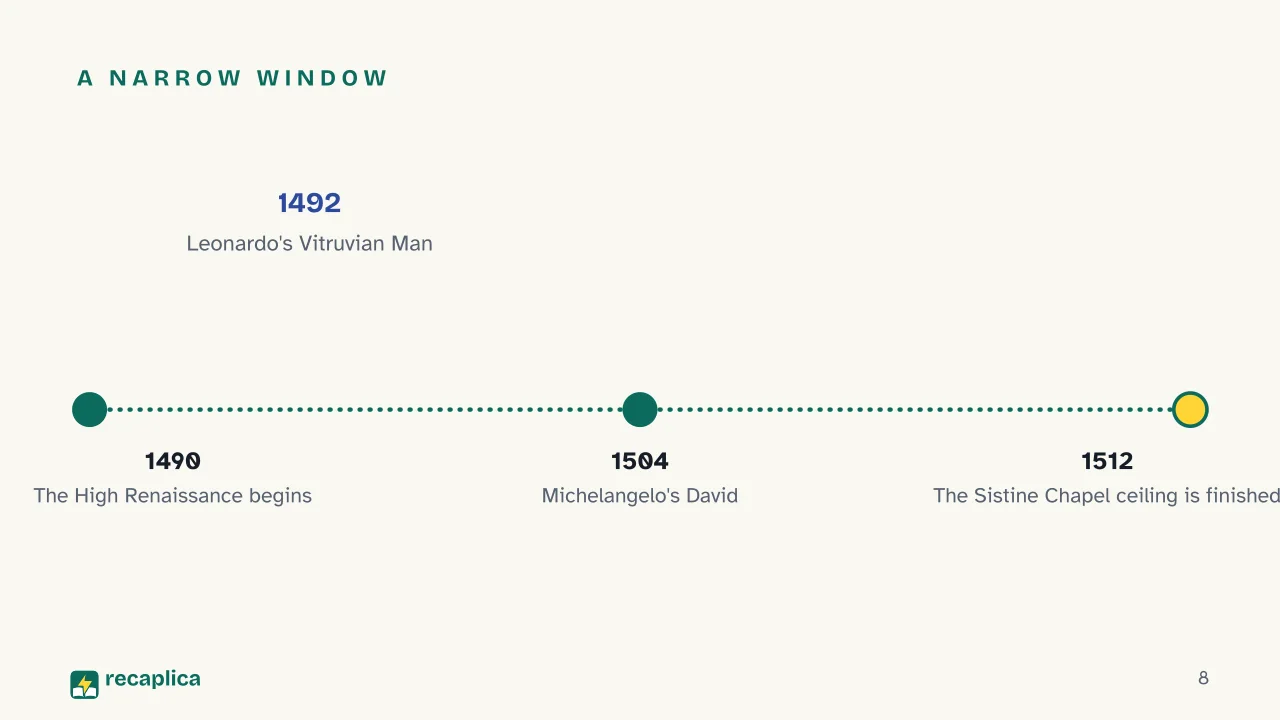  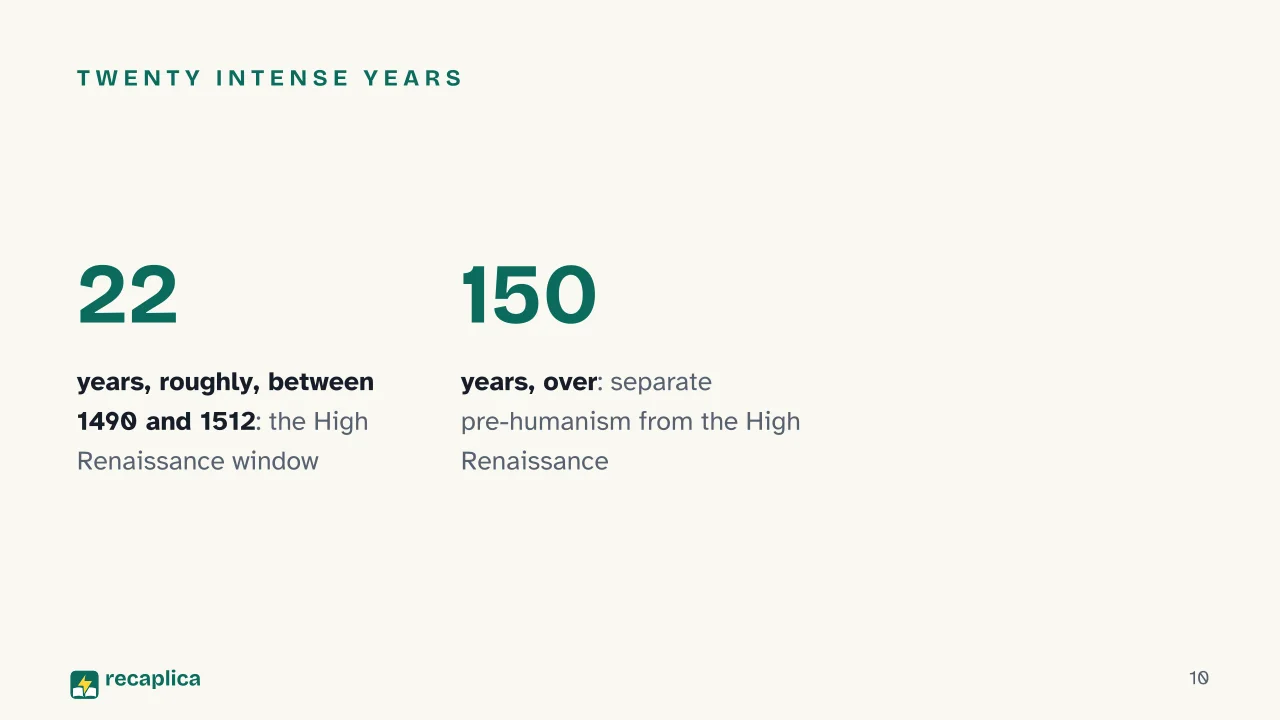 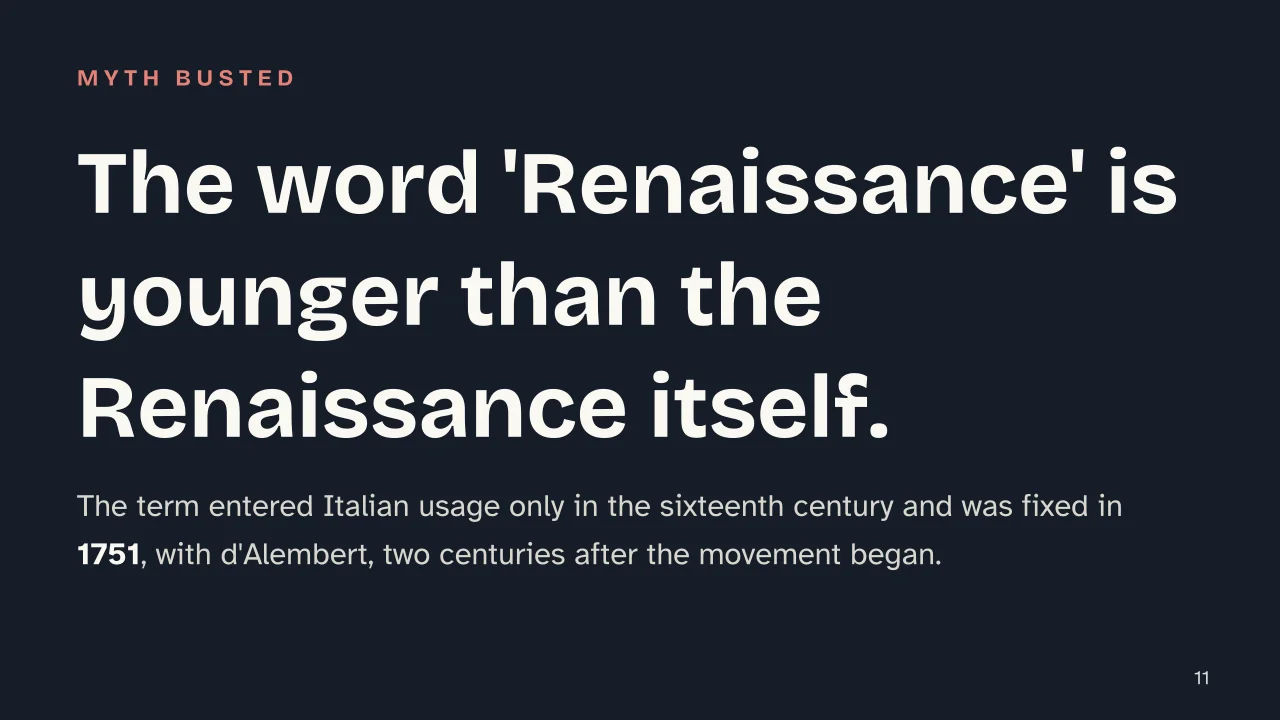  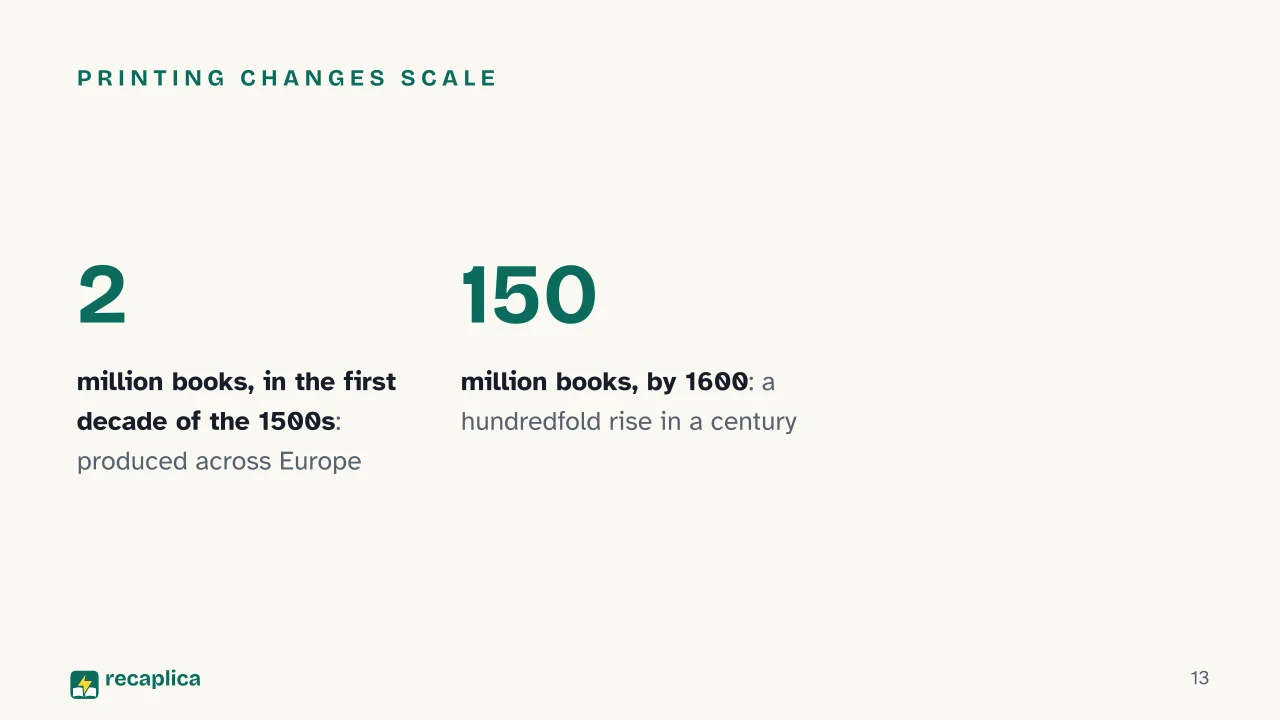 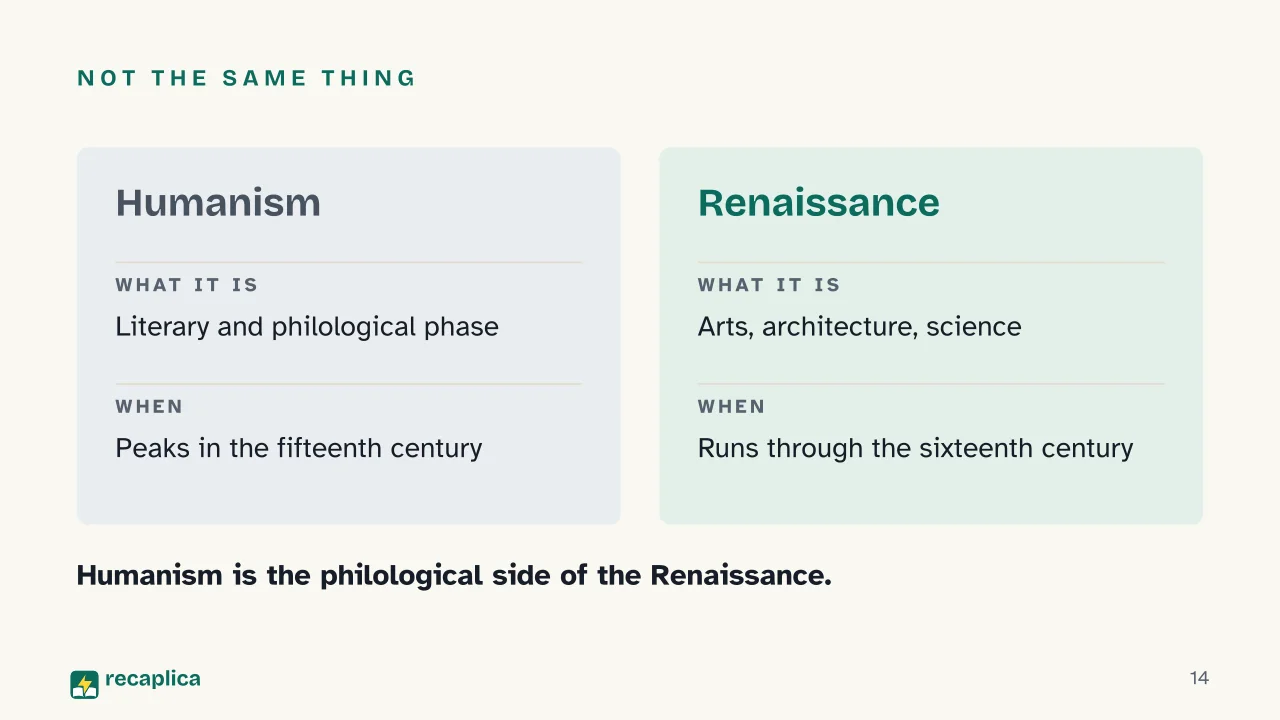 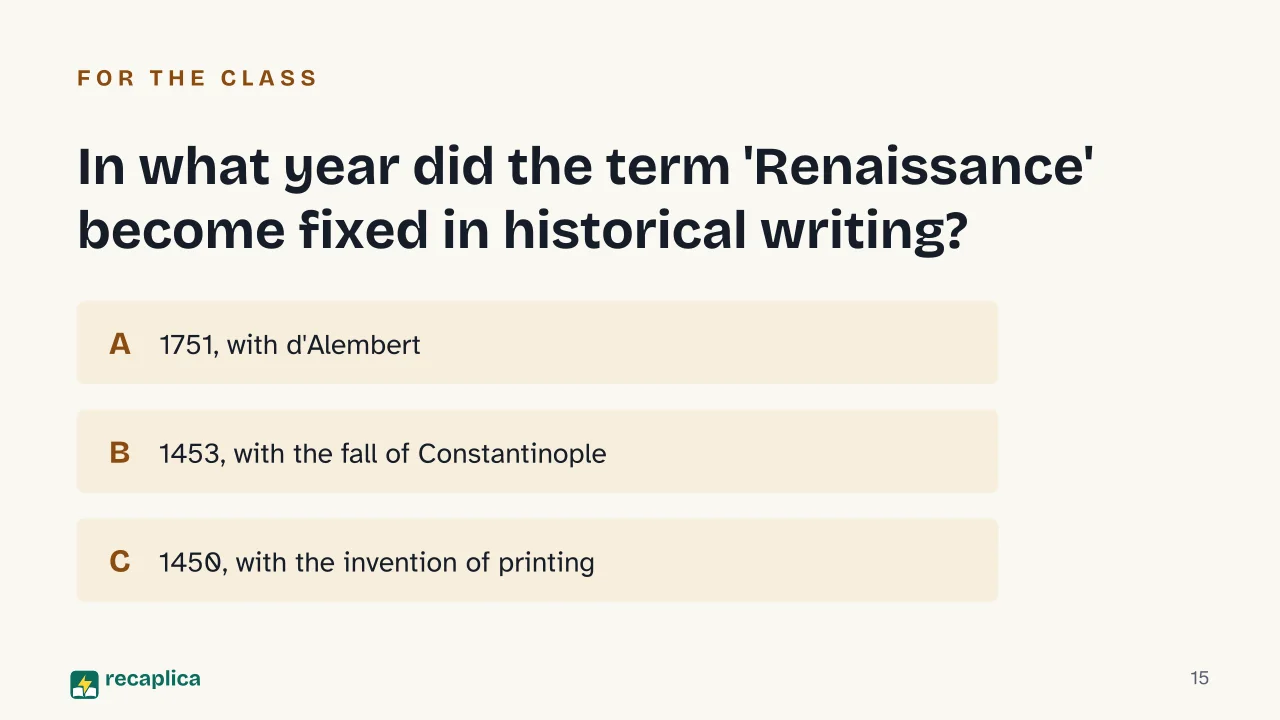  Common myths
Mind mapDrag the background to move around and the nodes to reposition them; use − and + to collapse and expand branches. 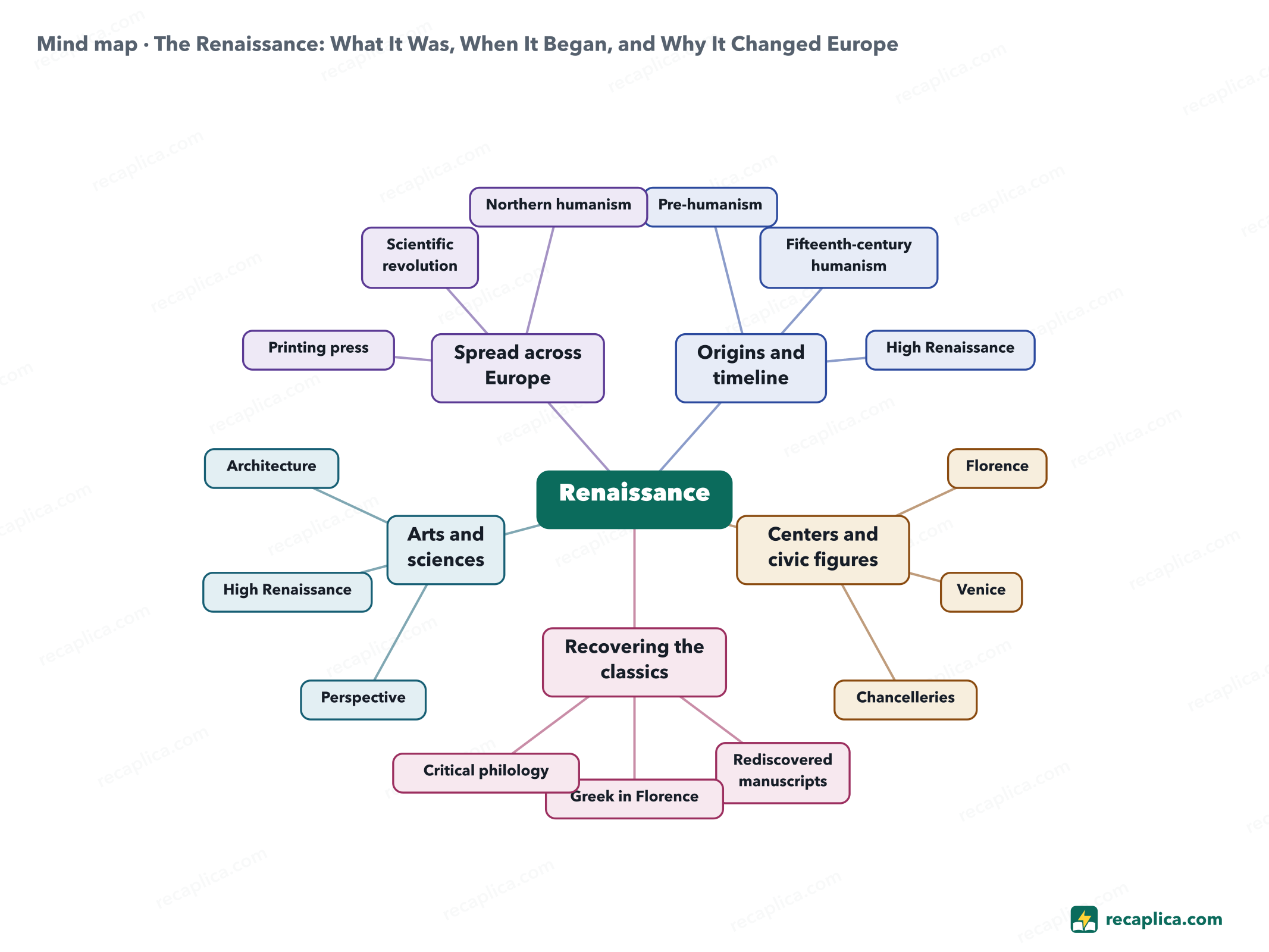
Quiz: test yourselfAnswer the questions to check what you have learned: you get instant feedback and a short explanation. Grade 0/10 0/5
FlashcardsTap the card to flip it and check whether you remember the answer, then move to the next one. 1 / 7 Explain it in your own wordsThe ultimate test: if you can explain it in simple words, you've truly understood it. Write your explanation, then compare it with the Recap. Your explanation is saved only on this device.
Frequently asked questionsWhen did the Renaissance begin?According to Treccani, the movement took on fairly precise features around the middle of the fourteenth century, in Italy. Historians propose different ranges, though: some place it between the mid-1300s and the end of the 1500s, others between 1400 and 1550, others between 1492 and 1600. What is the difference between humanism and the Renaissance?Humanism is the literary and philological phase of the Renaissance, peaking in the fifteenth century: it focuses on recovering and studying classical texts. The Renaissance is the wider movement, which also includes the arts, architecture and science, and runs through the end of the sixteenth century. Why is it called the Renaissance?The name points to a rebirth of classical culture after centuries in which it was thought to have faded from view. The word only entered Italian usage in the sixteenth century, modeled on the French Renaissance, and became a recognized historical term only in 1751. Who are the leading figures of the Renaissance?Key figures include Petrarch, the starting point of humanist literature; the Florentine chancellors Coluccio Salutati and Leonardo Bruni; the philosopher Marsilio Ficino; the artists Donatello, Masaccio and Brunelleschi; and, in the High Renaissance, Leonardo da Vinci, Michelangelo and Raphael. How did the Renaissance change Europe?The movement, born in Italy, soon crossed the country's borders and spread across the rest of Europe, helped by the printing press, which multiplied the circulation of books. It also drove a break with traditional Aristotelian thought that opened the way to the modern scientific revolution. Every Recap goes through an independent review before publication. |