Skip to content
recaplica

    One moment: security check

    Cloudflare wants to make sure you're not a robot. Tick the box below and your search will continue on its own.

    IT
    recaplica The German Ideology: A Summary of Marx and Engels' Critique
    © 2026 Recaplica · recaplica.com — All rights reserved
    Home › History

    The German Ideology: A Summary of Marx and Engels' Critique

    By Recaplica Newsroom · Updated on October 15, 2026

    What to print

    Page numbers appear when printing with default margins.

    Slides

    Choose a cut

    Flash10 slidesThe essential thread, to present in classFull10 slidesEvery chapter and the deeper detail

    Both come with speaker notes.

    Telegram channel
    recaplica Clear in 30 seconds, yours in 10 minutes.
    In 30 seconds Key points Figures Deep dive Slides Myths Mind map Quiz Flashcards FAQ

    In 30 seconds quick read

    Between the autumn of 1845 and mid-1846, Karl Marx and Friedrich Engels write a long manuscript they call The German Ideology. The text is a sustained attack on Ludwig Feuerbach, Bruno Bauer and Max Stirner, the leading figures of the Young Hegelians, and at the same time the first attempt by Marx and Engels to explain history starting from humans' material activity. No publisher prints it in full, and the manuscript stays unpublished until 1932. It is one of the main sources for reconstructing Marx's early thought.

    Key Points

    • Marx and Engels write The German Ideology between the autumn of 1845 and mid-1846.
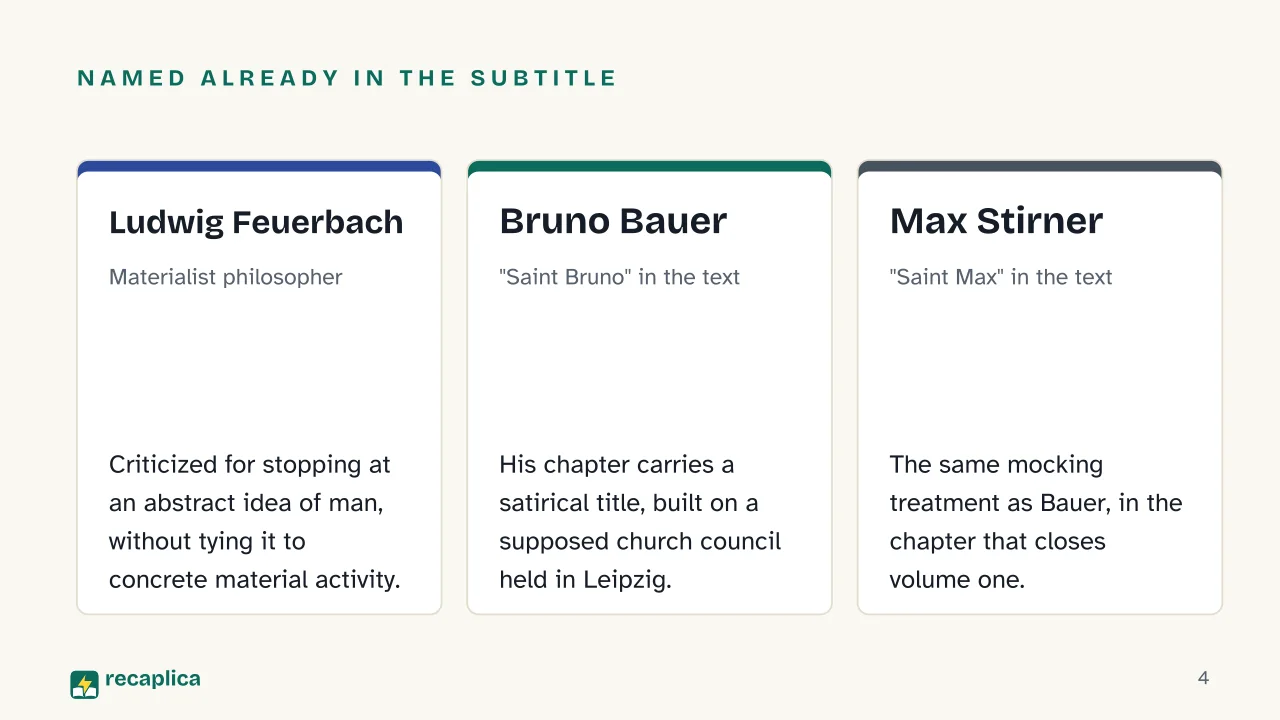
    • The subtitle names the targets of the critique: Ludwig Feuerbach, Bruno Bauer and Max Stirner.
    • The chapters on Bauer and Stirner are titled, mockingly, "Saint Bruno" and "Saint Max".
    • The text traces the line between humans and animals to the moment people start producing their own means of subsistence.
    • The work is split into two volumes: the first on the three philosophers, the second on German "true socialism".
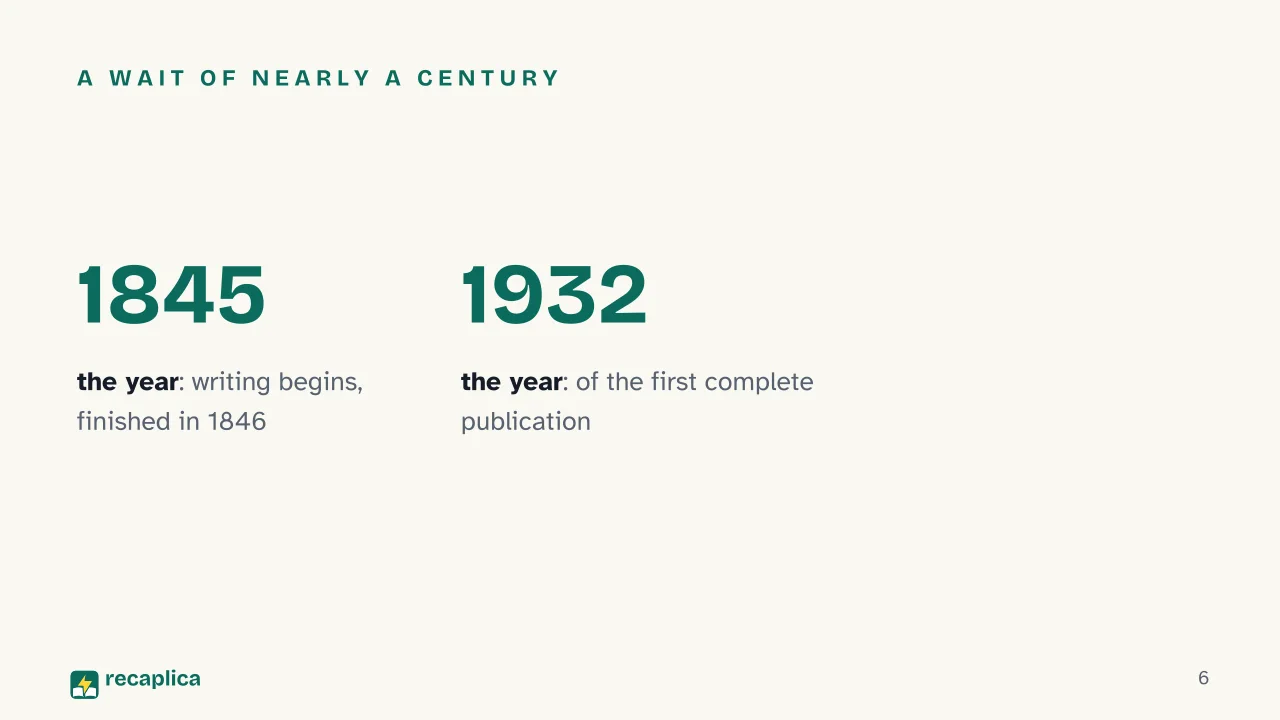
    • It stays unpublished until a complete edition appears in 1932, roughly 86 years after it was written.

    Key figures

    • 1845-1846 Period in which Marx and Engels write the manuscript. Source: Marxists Internet Archive
    • 1932 Year of the first complete publication. Source: Marxists Internet Archive; Encyclopedia.com

    Deep Dive

    Marx and Engels write The German Ideology between the autumn of 1845 and mid-1846, in the middle of their decades-long partnership, told in full in the Recap on Marx and Engels: the partnership that lasted almost forty years. The subtitle already names the targets: Ludwig Feuerbach, Bruno Bauer and Max Stirner, the leading figures of the Young Hegelian left.

    The chapter against Bauer plays on the name of a supposed church council held in Leipzig and is titled Saint Bruno; the one against Stirner repeats the joke as Saint Max. The choice signals how firmly Marx and Engels think the Young Hegelians remain locked inside religious language.

    The reversal: from earth to heaven

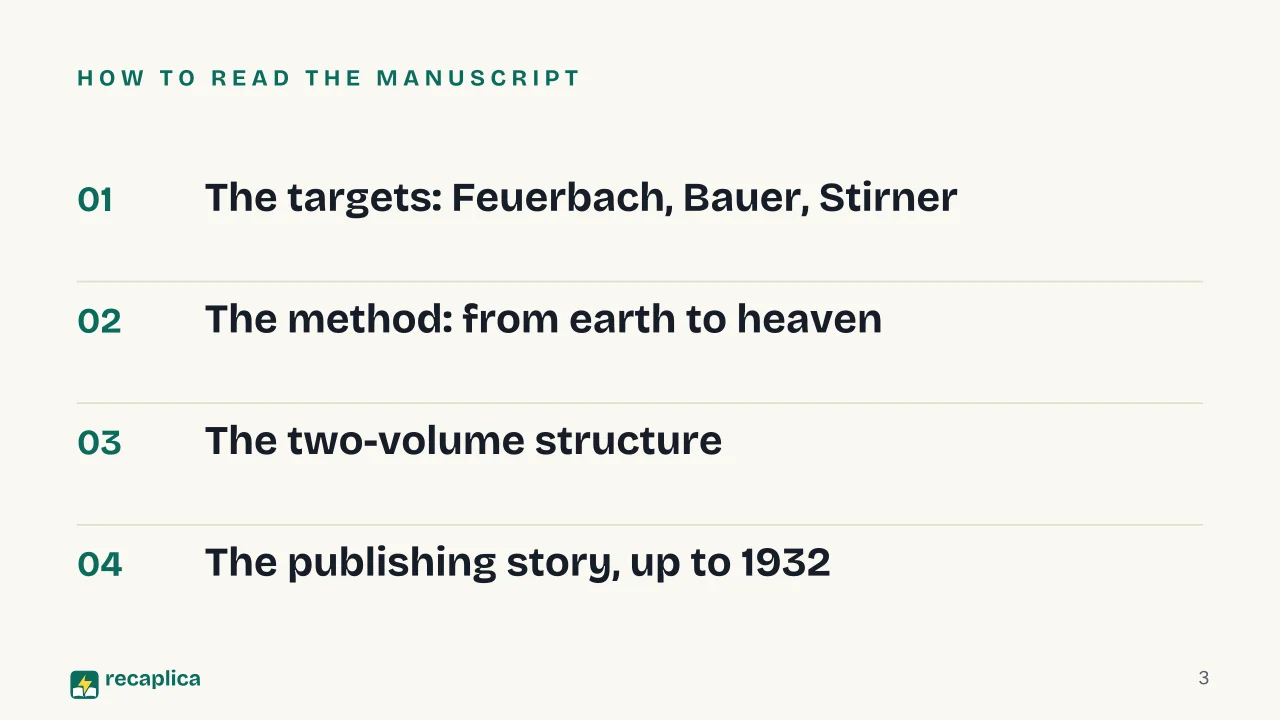
    The philosophical core of the text sits in Part I, on Feuerbach. Here Marx and Engels move the starting point: the line between humans and animals begins when people start producing what they need to live, a material act before it is anything else.

    From this follows the text’s central claim: material life determines consciousness, not the other way around.

    The text describes its own method through an image of direction: the old German philosophy moves from ideas down to facts, from heaven to earth; Marx and Engels climb from earth to heaven instead, starting from real individuals and their concrete activity. Seen this way, consciousness is a social product from the start, tied to the material relations among people: morality, religion and metaphysics are reflections of those material relations. The text applies the same lens when it connects the successive stages of the division of labor to their matching forms of property, as a way of explaining why a given society organizes ownership the way it does.

    Practical example: to see why two different eras assign property in different ways, the text’s method points to how each one organizes labor: that is where the shape of property gets explained, according to the text.

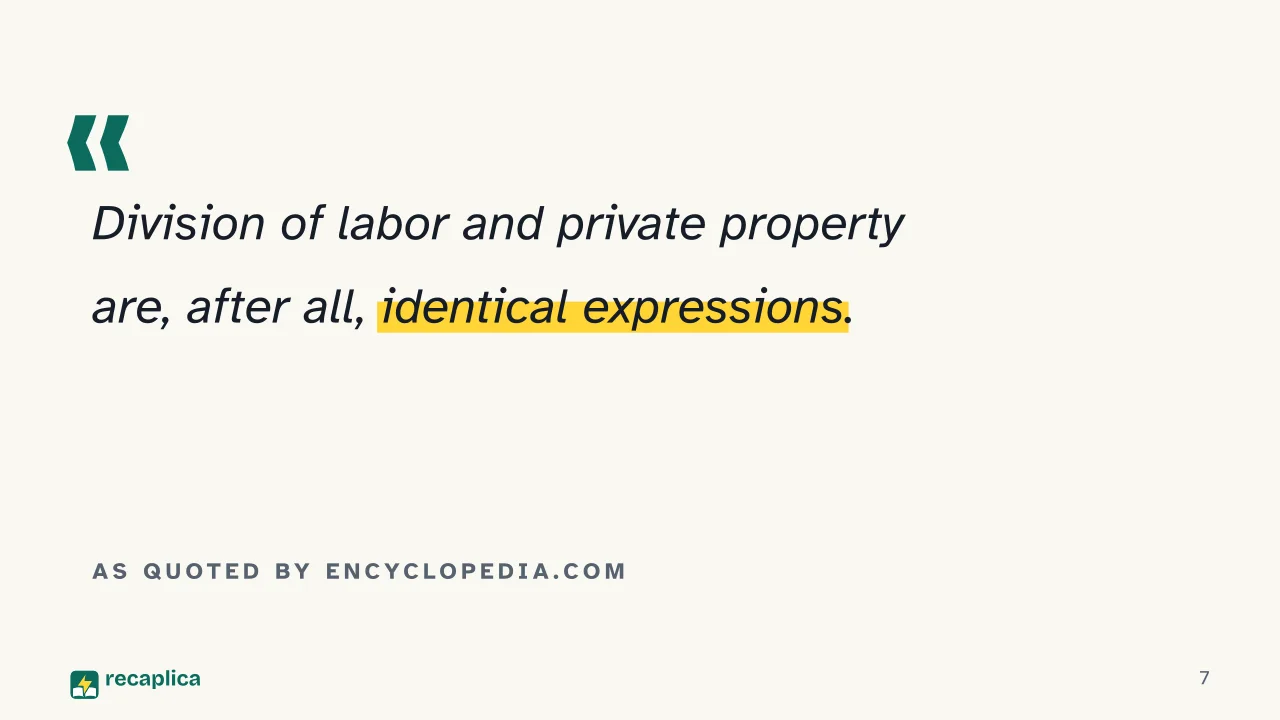
    The same logic shows up when the text ties the division of labor, also discussed in the Recap on the labor market, to the form property takes. Encyclopedia.com quotes the text as putting it this way: “division of labor and private property are, after all, identical expressions.” The two phenomena share the same root in how society organizes material life, a root the Industrial Revolution later pushes to a different scale. The text also treats property rights as a historical category, meaning one that changes over time.

    Two volumes, two different fronts

    The work is split into two volumes. The first gathers the three chapters against Feuerbach, Bauer and Stirner. The second turns to a different front, the so-called German “true socialism,” a current Marx and Engels accuse of translating French socialist ideas into an abstract philosophical language, stripping them of their practical edge in the process.

    A rejected manuscript, published eighty-six years later

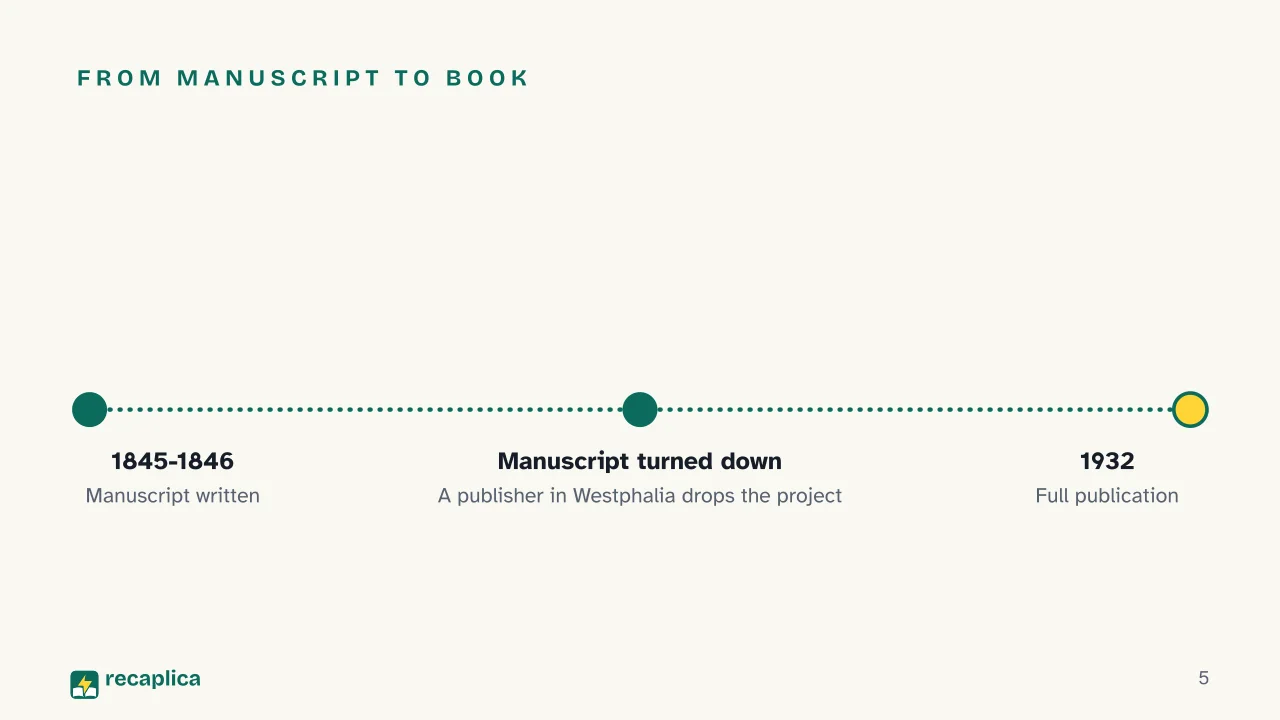
    The text’s publishing history is almost better known than its philosophical content. In the 1859 Preface to A Contribution to the Critique of Political Economy, Marx recalls that the manuscript, two thick octavo volumes, had already reached a publisher in Westphalia when he and Engels learned that the plan no longer held: circumstances on the publisher’s side had shifted, and printing was off the table.

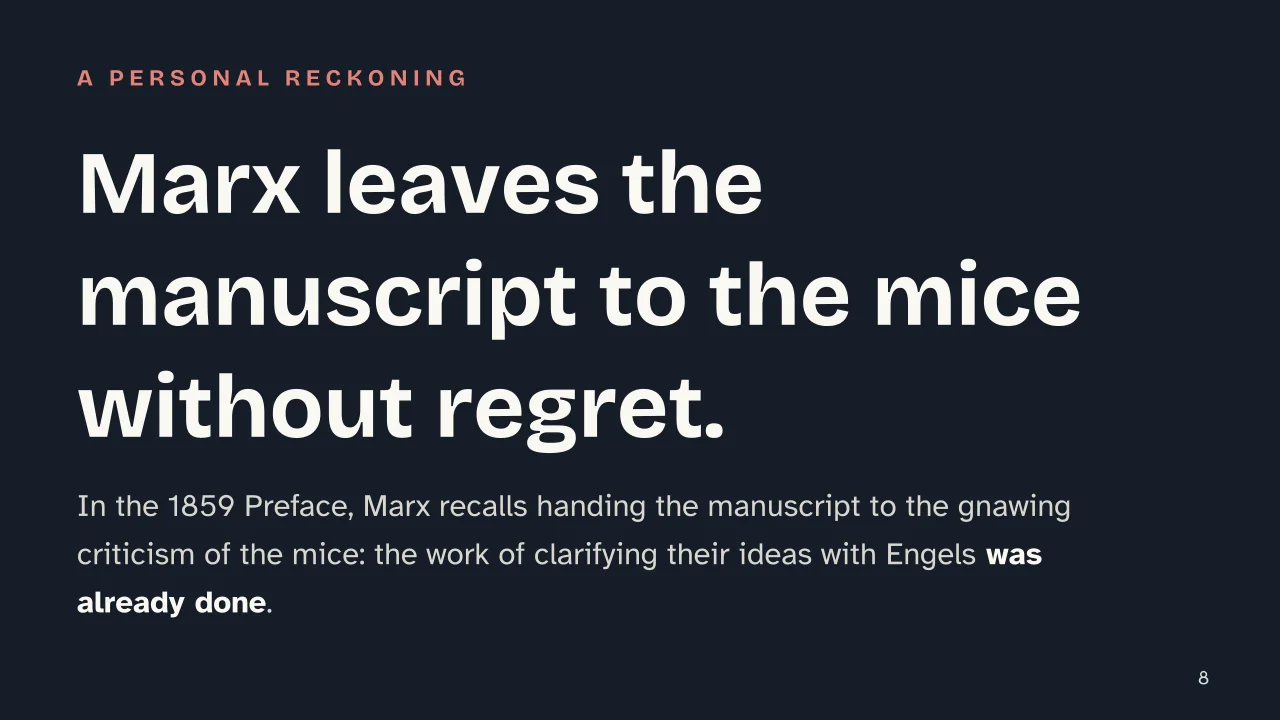
    Marx says he abandoned the manuscript willingly to the “gnawing criticism of the mice.” The line sounds like a surrender. Marx’s own account describes something closer to a positive reckoning instead: the goal he and Engels had set for themselves, putting their own convictions in order, had already been reached, and publication had lost its priority. The manuscript still stays unpublished in full for nearly a century: only in 1932 does a complete edition appear, roughly 86 years after it was written, a date on which independent sources agree.

    The Stanford Encyclopedia of Philosophy’s entry on Marx treats these manuscripts as one of the most used sources for reconstructing the author’s early thought: the place where the new materialist method takes shape in contrast with the German idealism that came before it, starting from “real individuals” and from the fact that a human being is, first of all, a producing being.

    Slide deck

    Slides ready to download and make your own in PowerPoint or Google Slides, with speaker notes. Pick the Flash cut or the Full one.
    Slide 1 of the presentation on The German Ideology: The German IdeologySlide 2 of the presentation on The German Ideology: Why does a manuscript sit unpublished for roughly 86 years?Slide 3 of the presentation on The German Ideology: How to read the manuscriptSlide 4 of the presentation on The German Ideology: Named already in the subtitle: Ludwig Feuerbach, Bruno Bauer, Max StirnerSlide 5 of the presentation on The German Ideology: From manuscript to bookSlide 6 of the presentation on The German Ideology: A wait of nearly a centurySlide 7 of the presentation on The German Ideology: As quoted by Encyclopedia.comSlide 8 of the presentation on The German Ideology: Marx leaves the manuscript to the mice without regret.Slide 9 of the presentation on The German Ideology: Why do Marx and Engels say they move "from earth to heaven"?Slide 10 of the presentation on The German Ideology: One manuscript, two centuries
    Flash10 slidesThe essential thread, to present in classFull10 slidesEvery chapter and the deeper detail

    Common myths

    • ✗ Myth Many assume The German Ideology is the text where Marx and Engels talk about "base and superstructure".

      ✓ Reality That specific vocabulary appears in the 1859 Preface to A Contribution to the Critique of Political Economy, a different and later work. The German Ideology, written in 1845-1846, uses other terms: division of labor, material relations, forms of property.

    • ✗ Myth Many assume that, with the phrase "the gnawing criticism of the mice", Marx was dismissing the manuscript as worthless.

      ✓ Reality In the 1859 Preface, Marx takes stock of the work he and Engels had done on that manuscript: the point is not the text's value, but an intellectual path the two considered already closed.

    • ✗ Myth Many assume the line "from each according to his ability, to each according to his needs" comes from The German Ideology.

      ✓ Reality That formula belongs to the Critique of the Gotha Programme, a text Marx writes in 1875. It does not appear in The German Ideology, written three decades earlier.

    Mind map

    Drag the background to move around and the nodes to reposition them; use − and + to collapse and expand branches.
    Customize
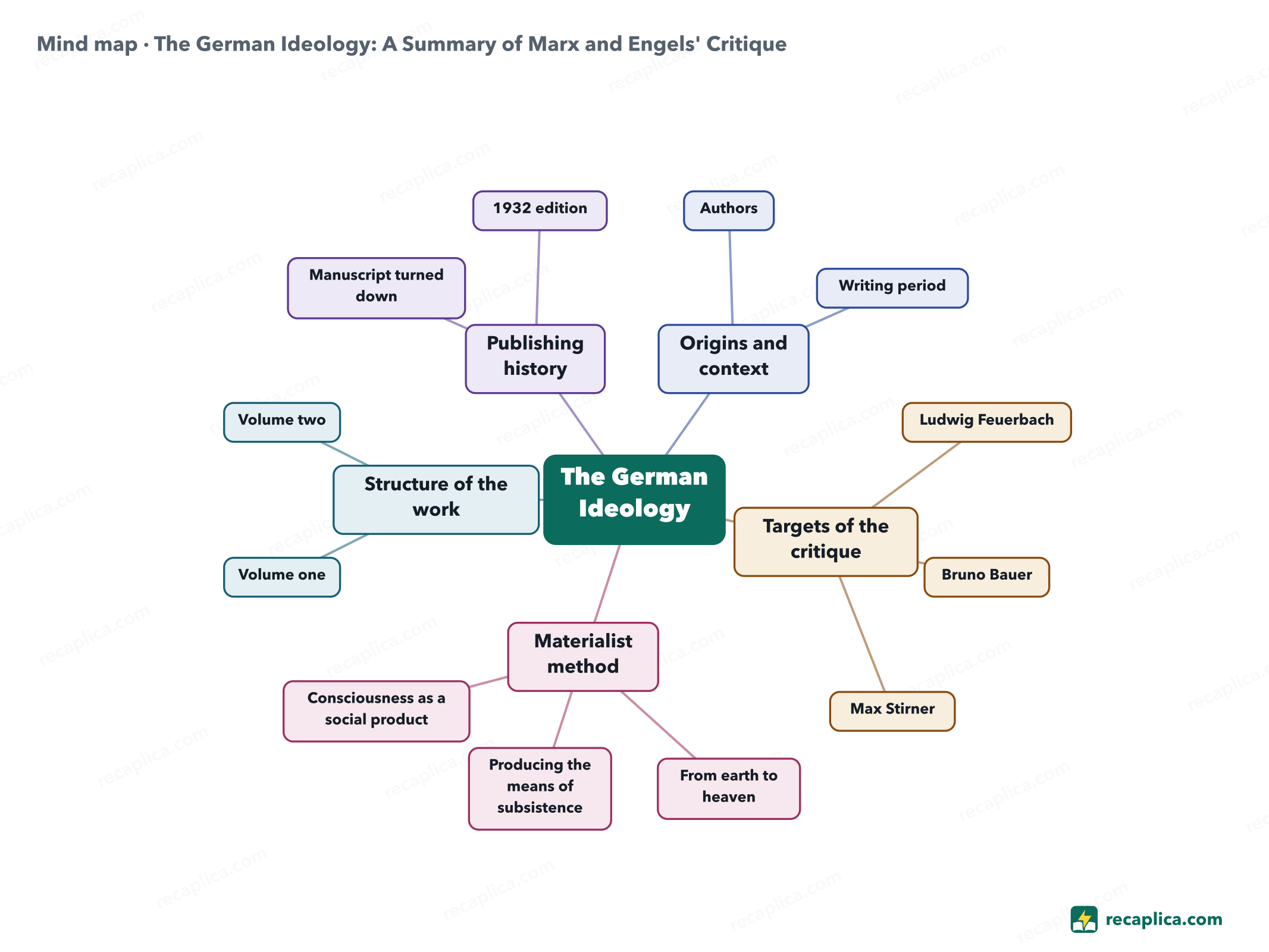
    Mind map: The German Ideology: A Summary of Marx and Engels' Critique
    • The German Ideology
      • Origins and context Written between 1845 and 1846
        • Authors Marx and Engels, working together
        • Writing period Autumn 1845 to mid-1846
      • Targets of the critique
        • Ludwig Feuerbach
        • Bruno Bauer chapter "Saint Bruno"
        • Max Stirner chapter "Saint Max"
      • Materialist method
        • From earth to heaven starting from real, living individuals
        • Producing the means of subsistence
        • Consciousness as a social product
      • Structure of the work
        • Volume one three chapters, on Feuerbach, Bauer, Stirner
        • Volume two German "true socialism"
      • Publishing history
        • Manuscript turned down a publisher in Westphalia drops the project
        • 1932 edition published in full, about 86 years later

    Quiz: test yourself

    Answer the questions to check what you have learned: you get instant feedback and a short explanation.

    Grade 0/10 0/5
    1 When do Marx and Engels write The German Ideology?

    According to the Marxists Internet Archive, the manuscript is written between the autumn of 1845 and mid-1846.

    2 Which philosophers does the work's subtitle name as its targets?

    The subtitle names exactly these three figures of the Young Hegelian left.

    3 What kind of title does the chapter on Bruno Bauer carry?

    The title plays on religious language, matching the companion chapter "Saint Max" on Stirner.

    4 How does the text describe the shift from the old German philosophy to its own method?

    This is the image the text uses to reverse the Hegelian relation between thought and reality.

    5 When is The German Ideology first published in full?

    Turned down by a publisher in Westphalia, the manuscript stays unpublished until 1932, as confirmed by both the Marxists Internet Archive and Encyclopedia.com.

    Answers: 1-A · 2-A · 3-A · 4-A · 5-A

    Flashcards

    Tap the card to flip it and check whether you remember the answer, then move to the next one.

    1 / 8

    Explain it in your own words

    The ultimate test: if you can explain it in simple words, you've truly understood it. Write your explanation, then compare it with the Recap.

    Your explanation is saved only on this device.

    Between the autumn of 1845 and mid-1846, Karl Marx and Friedrich Engels write a long manuscript they call The German Ideology. The text is a sustained attack on Ludwig Feuerbach, Bruno Bauer and Max Stirner, the leading figures of the Young Hegelians, and at the same time the first attempt by Marx and Engels to explain history starting from humans' material activity. No publisher prints it in full, and the manuscript stays unpublished until 1932. It is one of the main sources for reconstructing Marx's early thought.

    Frequently asked questions

    What is The German Ideology by Marx and Engels?

    It is a long manuscript written in 1845-1846, a critique of Feuerbach, Bauer and Stirner that lays the ground for reading history starting from labor and material production.

    Why wasn't The German Ideology published right away?

    The manuscript had already reached a publisher in Westphalia, but the project fell through once things on that end shifted and printing became impossible; it stayed unpublished in full until 1932.

    What is Part I of The German Ideology about?

    Part I is the chapter on Feuerbach, and it carries the core of the method: it shifts the starting point of philosophy from abstract ideas to real individuals and their material activity, arguing that consciousness follows from how people produce their means of subsistence.

    What does Marx mean by the "gnawing criticism of the mice"?

    He uses the phrase in the 1859 Preface to recount the manuscript's fate: by then he and Engels had already sorted out their own ideas between themselves, so leaving it to the mice cost them little.

    Does The German Ideology already talk about "base and superstructure"?

    No. That specific vocabulary belongs to the 1859 Preface to A Contribution to the Critique of Political Economy. The German Ideology, written in 1845-1846, speaks instead of divided labor, material ties among people, and property taking different shapes over time.

    What are the two volumes of the work?

    The first holds three chapters on Feuerbach, Bauer and Stirner; the second is devoted to the so-called German "true socialism".

    Sources

    • Marxists Internet Archive — The German Ideology
    • Encyclopedia.com — German Ideology, The
    • Stanford Encyclopedia of Philosophy — Karl Marx

    Every Recap goes through an independent review before publication.

    Every evening, the day's new Recaps on our Telegram channel. Join the channel →

    Keep learning

    • History What Is Existentialism? Heidegger, Being and Time, and Dasein Existentialism is a current of twentieth-century philosophy centered on human existence, freedom and the search for meaning. According to the Stanford Encyclopedia of Philosophy, the German philosopher Martin Heidegger (1889-1976) shaped that current more than almost anyone else, even though he never accepted the label. In 1927 he published Being and Time, his major work, where he introduced the concept of Dasein: the human being as the one entity that questions its own existence. That book influenced Jean-Paul Sartre's existentialism, but in 1946, in the Letter on Humanism, Heidegger openly broke with Sartre and refused to be called an existentialist. In 1933 he was elected rector of the University of Freiburg and became a Nazi party member, keeping that membership until the regime fell - an episode Heidegger himself later denied or played down more than once. Read the Recap →
    • History What Is Phenomenology? Husserl's Philosophy Explained Edmund Husserl founded phenomenology as a philosophical discipline around 1900-1901, with his Logical Investigations. His method starts from the epoché, a suspension of our everyday, unquestioning stance toward the world, and moves toward phenomenological reduction: studying how things appear to consciousness rather than what they are in themselves. At the center sits intentionality, the idea that every experience is always an experience of something specific, whether hoping, perceiving, or desiring. The method Husserl built carried into the 20th century through Heidegger, Sartre, and Merleau-Ponty, moving from German philosophy into French philosophy along the way. Read the Recap →
    • History Legal Positivism: What It Is, from Austin to Kelsen and Hart According to the Stanford Encyclopedia of Philosophy, legal positivism measures legal validity against observable social facts, keeping moral judgment on a separate track. Its roots lie in Hobbes and Hume. Jeremy Bentham produced the theory's first full account, which John Austin later took up and spread: for Austin, a rule is law only when a sovereign commands it under threat of punishment. In the twentieth century, Hans Kelsen grounded legal validity in a hierarchy that traces back to a presupposed basic norm, while Herbert Hart located it instead in a rule of recognition actually followed by judges and officials. Natural law theory takes the opposite view: an unjust law is not really a law. Legal positivism disagrees — a law stays valid even when it is morally unjust, as long as it was made the way the system requires. Read the Recap →

    recaplica

    Clear in 30 seconds, yours in 10 minutes.

    Recaps Mind maps Request a Recap Telegram channel Mind map maker Our method About Privacy & cookies Legal notes & terms of use

    © 2026 Recaplica · A project by Curi S.r.l. — VAT IT05472000750

    Statistics, only if you say so

    To learn which Recaps help most we would use Google Analytics, with aggregate, anonymous data. It starts only with your OK, and you can change your mind anytime. Privacy policy