Skip to content
recaplica

    One moment: security check

    Cloudflare wants to make sure you're not a robot. Tick the box below and your search will continue on its own.

    IT
    recaplica Wage Labour and Capital: Karl Marx on Wages and Surplus Value
    © 2026 Recaplica · recaplica.com — All rights reserved
    Home › History

    Wage Labour and Capital: Karl Marx on Wages and Surplus Value

    By Recaplica Newsroom · Updated on October 15, 2026

    What to print

    Page numbers appear when printing with default margins.

    Slides

    Choose a cut

    Flash10 slidesThe essential thread, to present in classFull15 slidesEvery chapter and the deeper detail

    Both come with speaker notes.

    Telegram channel
    recaplica Clear in 30 seconds, yours in 10 minutes.
    In 30 seconds Key points Figures Deep dive Slides Myths Mind map Quiz Flashcards FAQ

    In 30 seconds quick read

    Wage Labour and Capital is a pamphlet by Karl Marx, drawn from lectures he gave in Brussels in December 1847 and first published in 1849 as a series of articles in the Neue Rheinische Zeitung. In it Marx describes wages as the price of labour-power, defines capital as accumulated labour put back to work in production, and uses a numerical example to introduce surplus value: the value a worker's labour creates above the wage that worker is paid. Written for readers with no background in political economy, the pamphlet sketches, in simple terms, arguments Marx would expand two decades later in Capital.

    Key Points

    • The pamphlet grew out of lectures Marx gave in Brussels in December 1847 and first appeared in 1849 in the Neue Rheinische Zeitung; Friedrich Engels only edited it into a standalone booklet in 1891.
    • Marx treats the wage as the price paid for labour-power, the capacity to work that a labourer sells to a capitalist by the hour.
    • Marx cites the standard list — materials, tools, means of subsistence — only to argue it misses the point: for him, those goods count as capital only once they start to command the labour of living workers, and only under specific historical conditions.
    • A numerical example — one shilling in wages against two shillings of value produced — shows where the surplus value going to the capitalist comes from.
    • Marx states a law by which profit and wages rise and fall in inverse proportion, each at the other's expense.
    • The text is distinct both from Capital (1867), Marx's academic treatise, and from The Communist Manifesto (1848), a political programme written with Engels.

    Key figures

    • 1849 Year of first publication: the text ran in instalments in the Neue Rheinische Zeitung between April 5 and 11, across five issues of the paper. Source: Wikipedia, Wage Labour and Capital entry
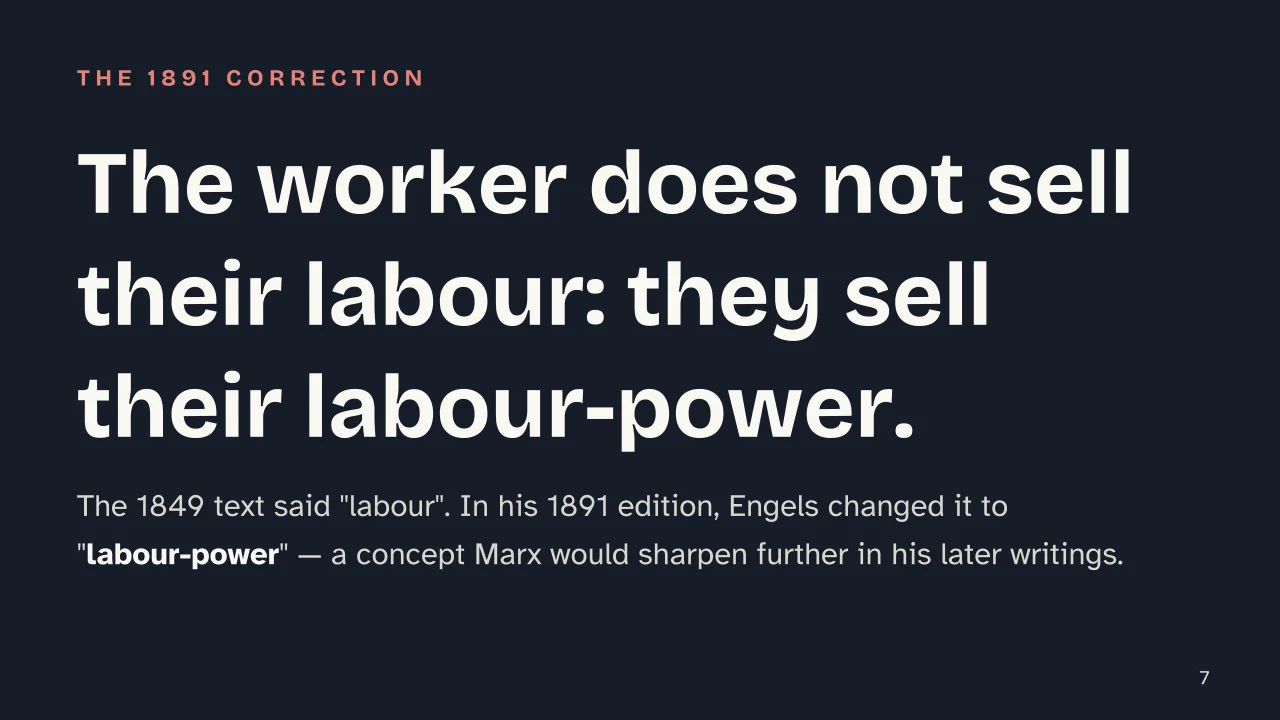
    • 1891 Year Friedrich Engels edited the pamphlet for print, correcting the term "labour" to "labour-power". Source: Wikipedia, Wage Labour and Capital entry

    Deep Dive

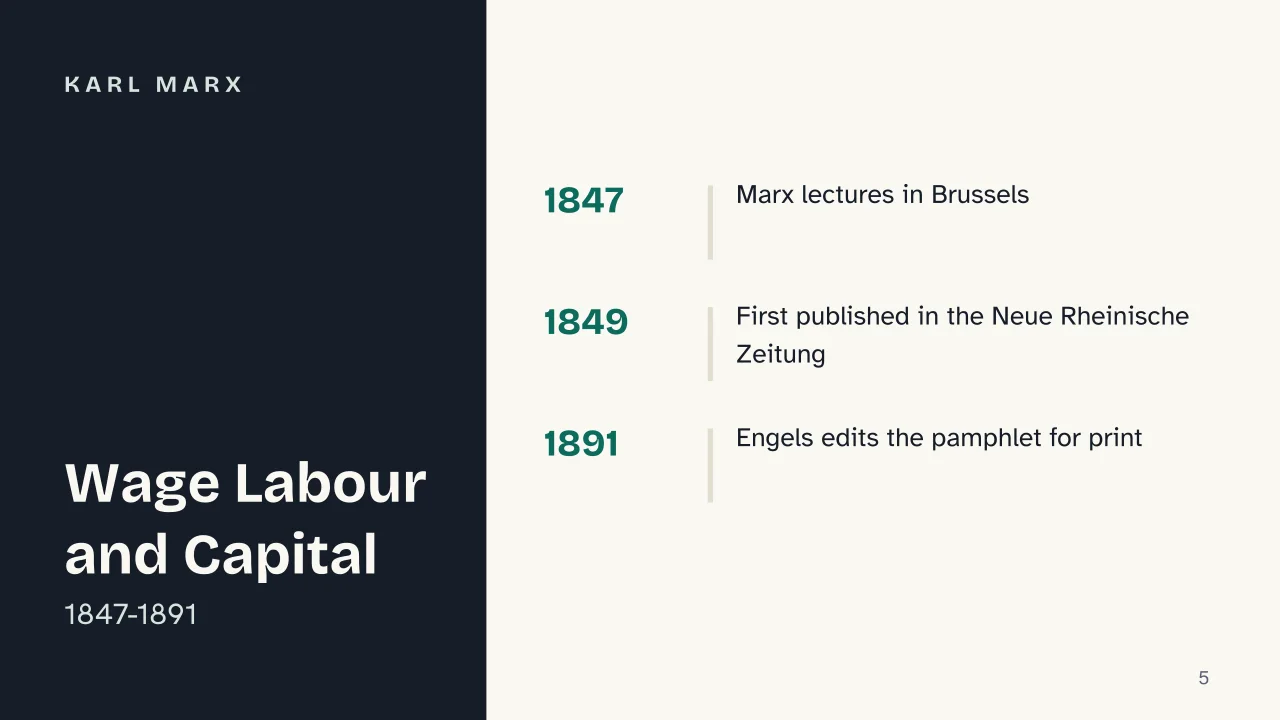
    Marx gave the lectures behind this text in Brussels in December 1847. The pamphlet first appeared in German only in April 1849, printed across five consecutive issues of the Neue Rheinische Zeitung; another four decades passed before Friedrich Engels edited it into a printed booklet, in 1891. In his preface Marx frames it as the next step: after dealing with the political events of 1848, he turns to an analysis of the economic conditions the capitalist class depends on.

    Marx wrote the text for working-class readers, in plain language that assumes no background in political economy; Capital, the treatise Marx would publish two decades later, does assume that background.

    Wages as the price of labour-power

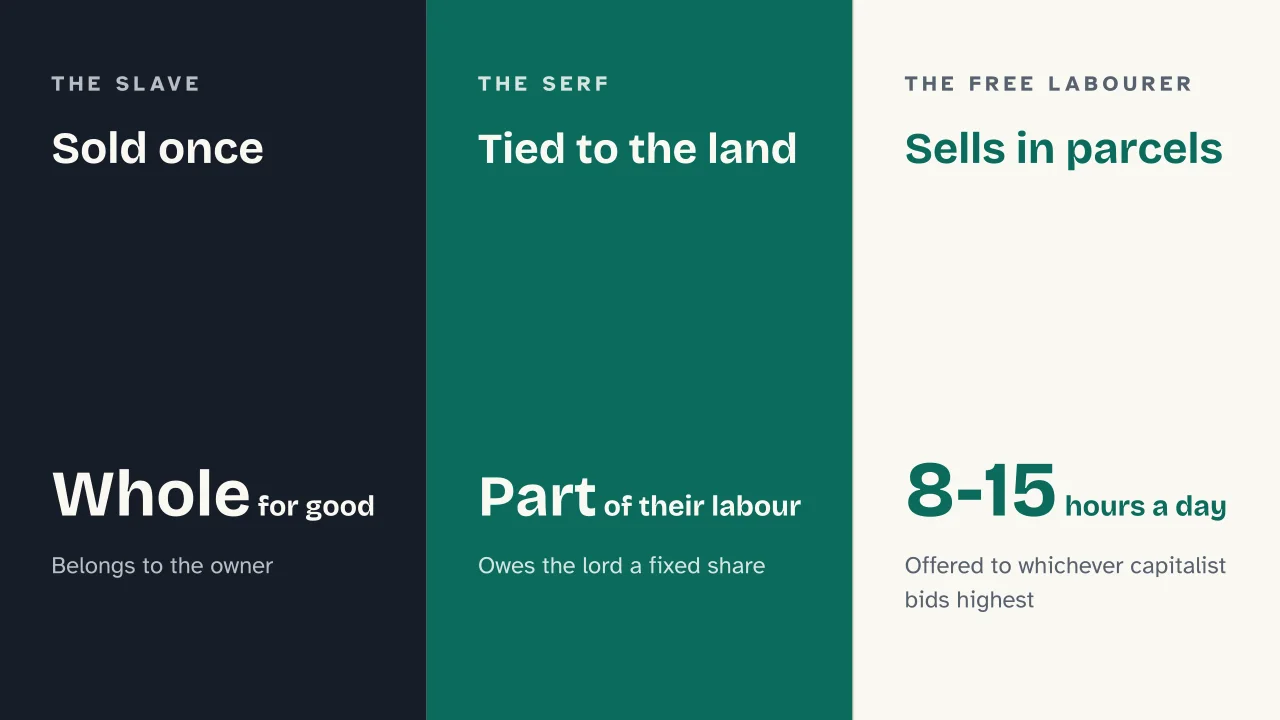
    Marx calls “wages” the price paid for a particular commodity: labour-power, what a labourer hands over to a capitalist in return for pay, the way any other good changes hands on the market. He sets this exchange apart from that of the slave and the serf — the slave is sold once and for good, the serf owes the lord a fixed share of labour tied to the land, while the free labourer sells only portions of themselves, auctioning off parts of the working day, 8, 10, 12 or 15 hours, to whichever capitalist bids highest. That price, for Marx, tends toward a precise floor: the cost of producing labour-power, meaning what it takes to keep the labourer alive and, for labour-power to go on existing over time, to let the labourer’s family reproduce as well. The same mechanism touches anyone who sells their hours on the labor market, well beyond the nineteenth-century factory Marx describes.

    Competition, in Marx’s account, runs on both sides of the exchange. Every capitalist undercuts rivals to attract buyers for their goods, and that race among sellers is, for Marx, one of the forces that pushes commodity prices down across the market.

    Capital as accumulated labour

    Marx takes up the standard definition of capital — materials, equipment and provisions used to produce more of the same — only to show its limit: those goods are not capital by themselves; they become capital only under specific historical conditions, once the past labour they represent gains power over the living labour of the worker. For Marx it is a social relation, not a sum of things; and as that power grows, in his account, so does the hold of the capitalist class over the working class.

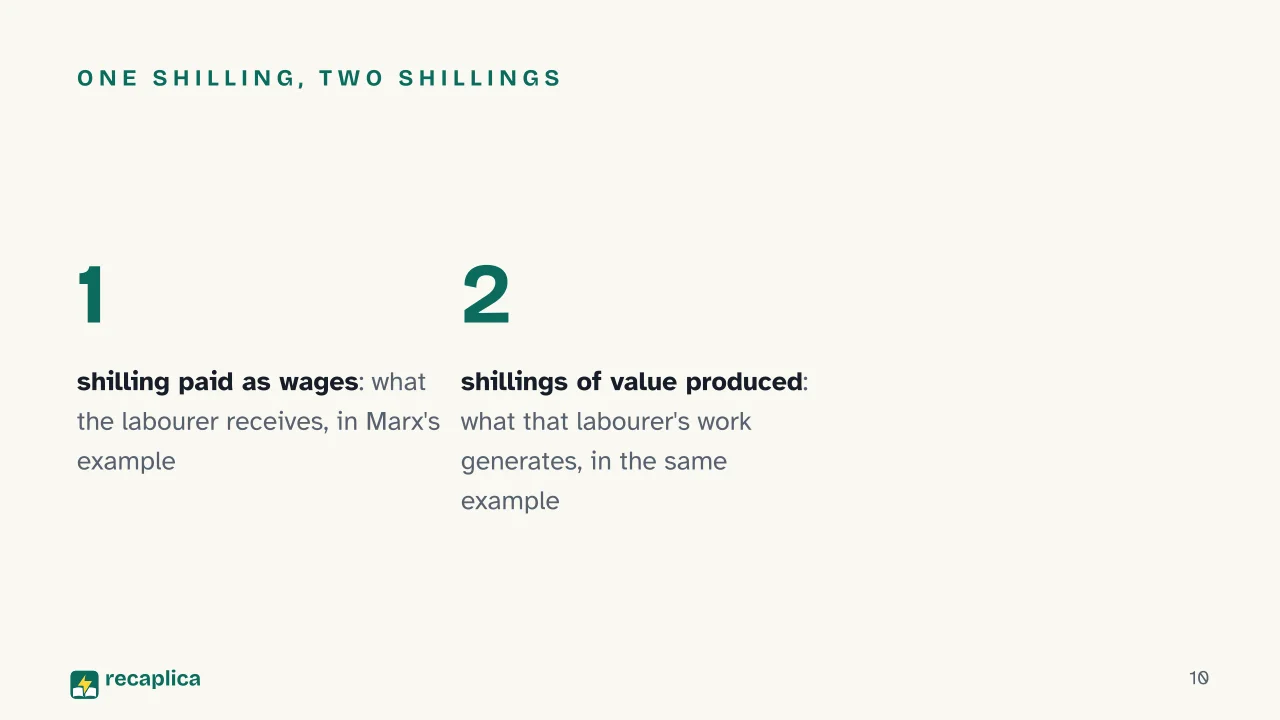
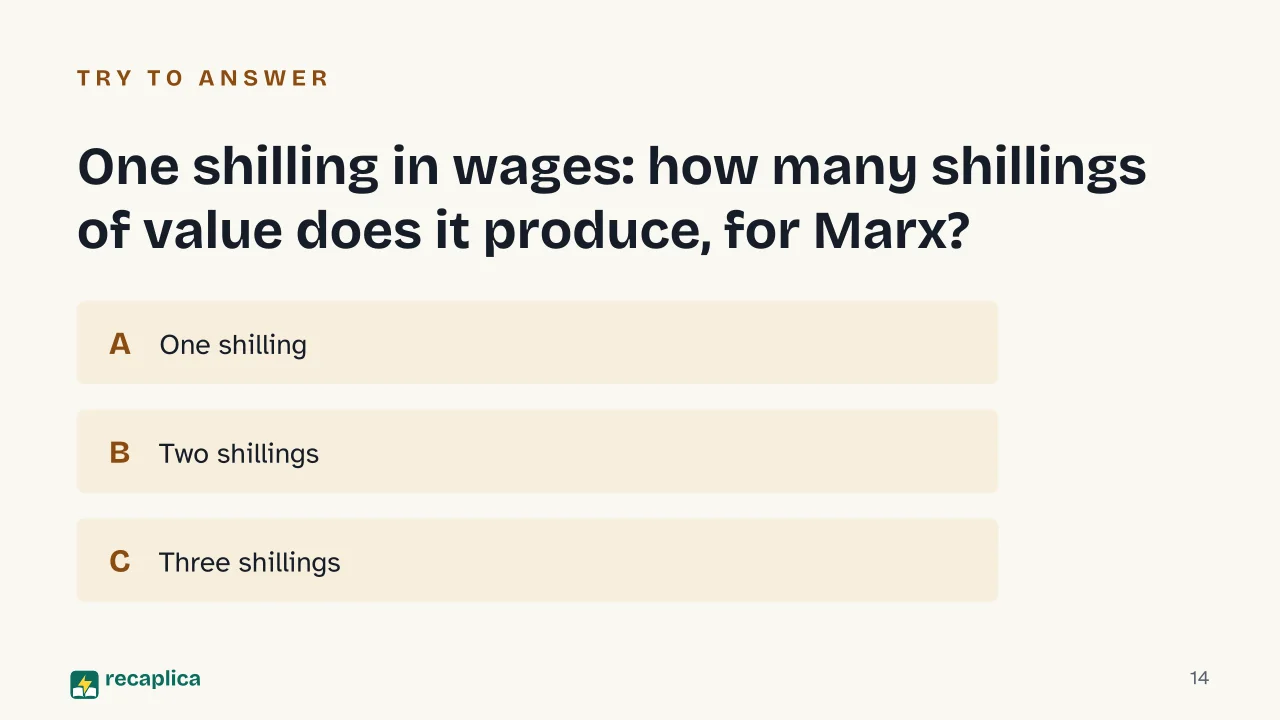
    Worked example: Marx illustrates the mechanism with a numerical case. The capitalist pays the labourer a wage of one shilling; that labourer’s work, in the same working day, produces a value of two shillings. The gap between what the capitalist pays and what the capitalist receives is the surplus value: by working, Marx argues, the labourer produces new capital, value that will again be used to set that labourer’s work in motion and to create still more value.

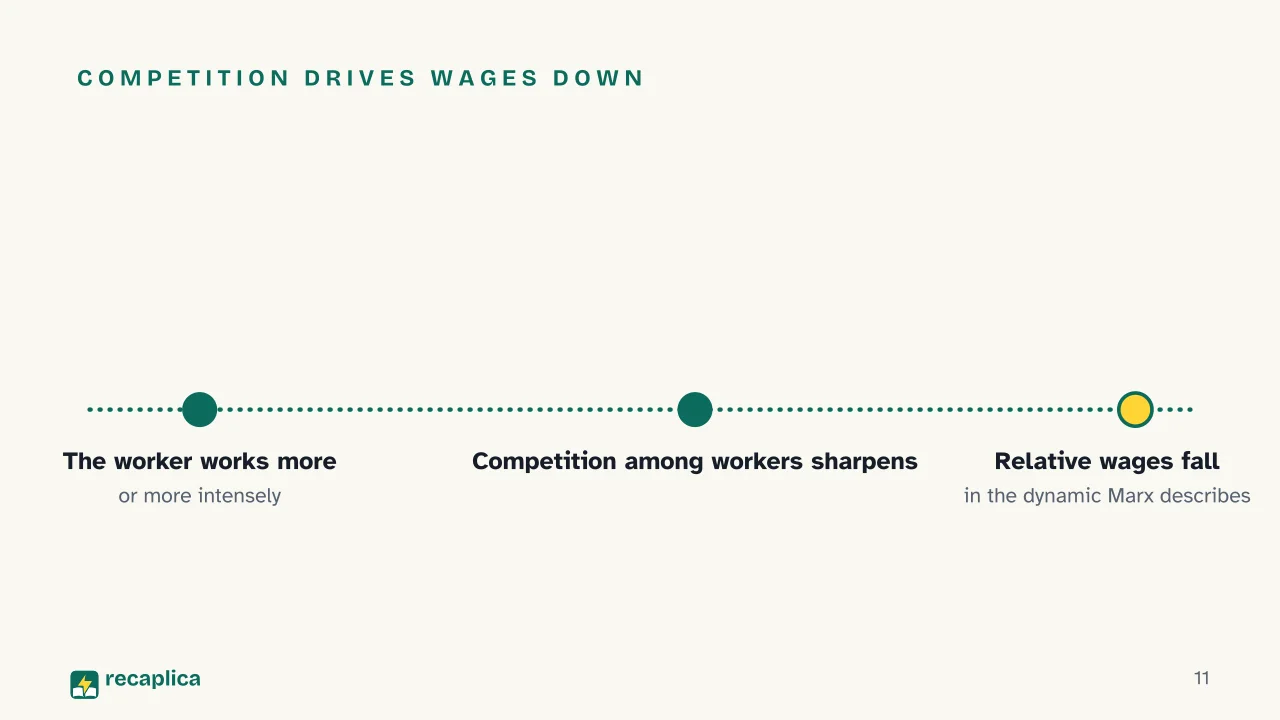
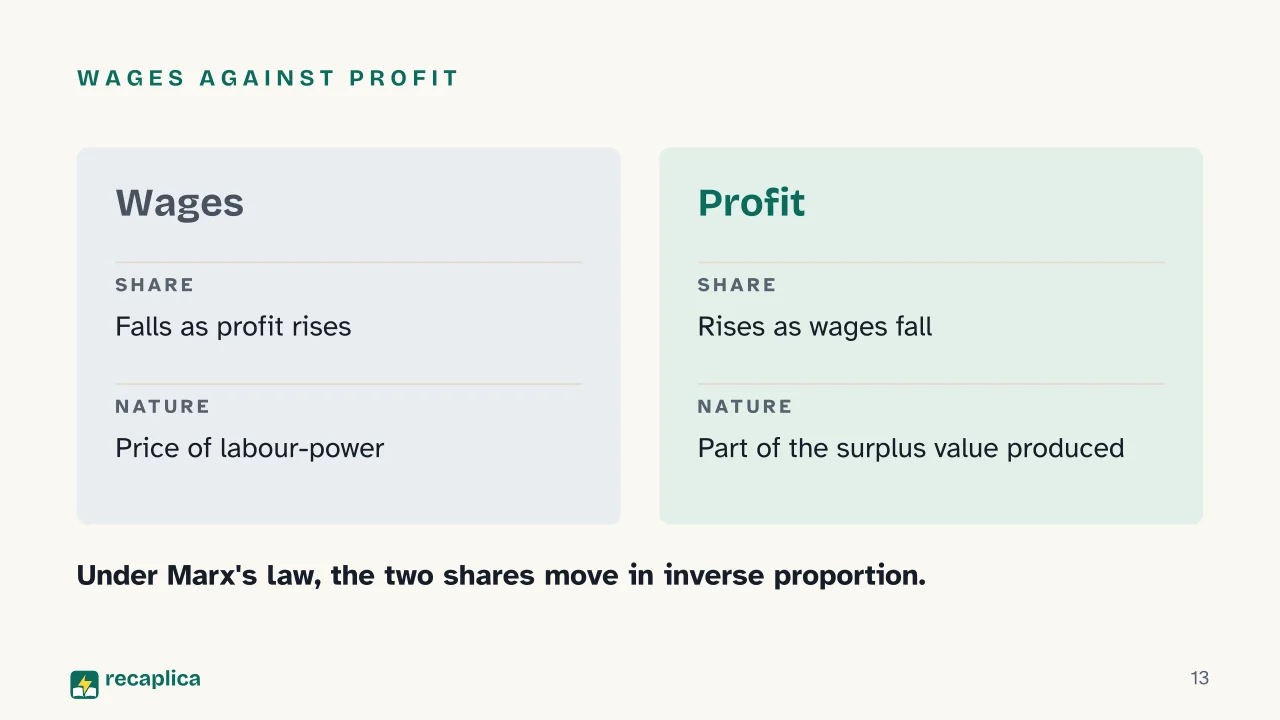
    This scheme yields a general law: the shares going to profit and to wages rise and fall at each other’s expense, never together. Marx also flags what he calls a paradoxical effect: in the competitive dynamic he describes, the more a worker works, or works more intensely, the more that worker’s relative wage tends to fall, because the same competition plays out among labourers too. It is an argument that anticipates, in accessible form, themes the Industrial Revolution had made central across Europe at the time, and that other schools of thought — from neoclassical economics to the Keynesian ideas that emerged a century later — would go on to address with different tools and different conclusions.

    The text itself, in Marx’s own framing, remains a preparatory step: eight short chapters that take the reader from wages, to the price of commodities, to capital, to the law of wages and profits and the effects of competition on social classes. The theory of surplus value that appears here in embryonic form is the same argument Marx would develop two decades later in a far larger work — published in German as Das Kapital, known in English as Capital.

    Slide deck

    Slides ready to download and make your own in PowerPoint or Google Slides, with speaker notes. Pick the Flash cut or the Full one.
    Slide 1 of the presentation on Wage Labour and Capital: Wage Labour and CapitalSlide 2 of the presentation on Wage Labour and Capital: Why doesn't working more mean earning more?Slide 3 of the presentation on Wage Labour and Capital: From wages to profitSlide 4 of the presentation on Wage Labour and Capital: Chapter 01: The text and its historySlide 5 of the presentation on Wage Labour and Capital: Karl MarxSlide 6 of the presentation on Wage Labour and Capital: Chapter 02: Wages and labour-powerSlide 7 of the presentation on Wage Labour and Capital: The worker does not sell their labour: they sell their labour-power.Slide 8 of the presentation on Wage Labour and Capital: Sold once · Tied to the land · Sells in parcelsSlide 9 of the presentation on Wage Labour and Capital: Chapter 03: Capital and surplus valueSlide 10 of the presentation on Wage Labour and Capital: One shilling, two shillingsSlide 11 of the presentation on Wage Labour and Capital: Competition drives wages downSlide 12 of the presentation on Wage Labour and Capital: Chapter 04: The law of wages and profitSlide 13 of the presentation on Wage Labour and Capital: Wages against profitSlide 14 of the presentation on Wage Labour and Capital: One shilling in wages: how many shillings of value does it produce, for Marx?Slide 15 of the presentation on Wage Labour and Capital: Now for the recap
    Flash10 slidesThe essential thread, to present in classFull15 slidesEvery chapter and the deeper detail

    Common myths

    • ✗ Myth Wage Labour and Capital is a summary or a chapter drawn from Capital.

      ✓ Reality It is a separate, earlier text: it comes from 1847 lectures and was published in 1849, while Capital appeared in 1867. Marx pitched it at a working-class audience and assumed no background in political economy, unlike the academic treatise he would write two decades later.

    • ✗ Myth In the text, the worker sells the capitalist their labour.

      ✓ Reality The original 1849 edition did say that, but Engels corrected the wording to "labour-power" when he edited the pamphlet in 1891: according to the Wikipedia entry consulted, it is a conceptual distinction Marx only sharpened in the years after 1849.

    • ✗ Myth Wage Labour and Capital and The Communist Manifesto are the same work.

      ✓ Reality They are two different texts: the Manifesto, written with Engels in 1848, is a political programme; this pamphlet lays out, for a general readership, the economic conditions Marx argued the capitalist class rests on.

    Mind map

    Drag the background to move around and the nodes to reposition them; use − and + to collapse and expand branches.
    Customize
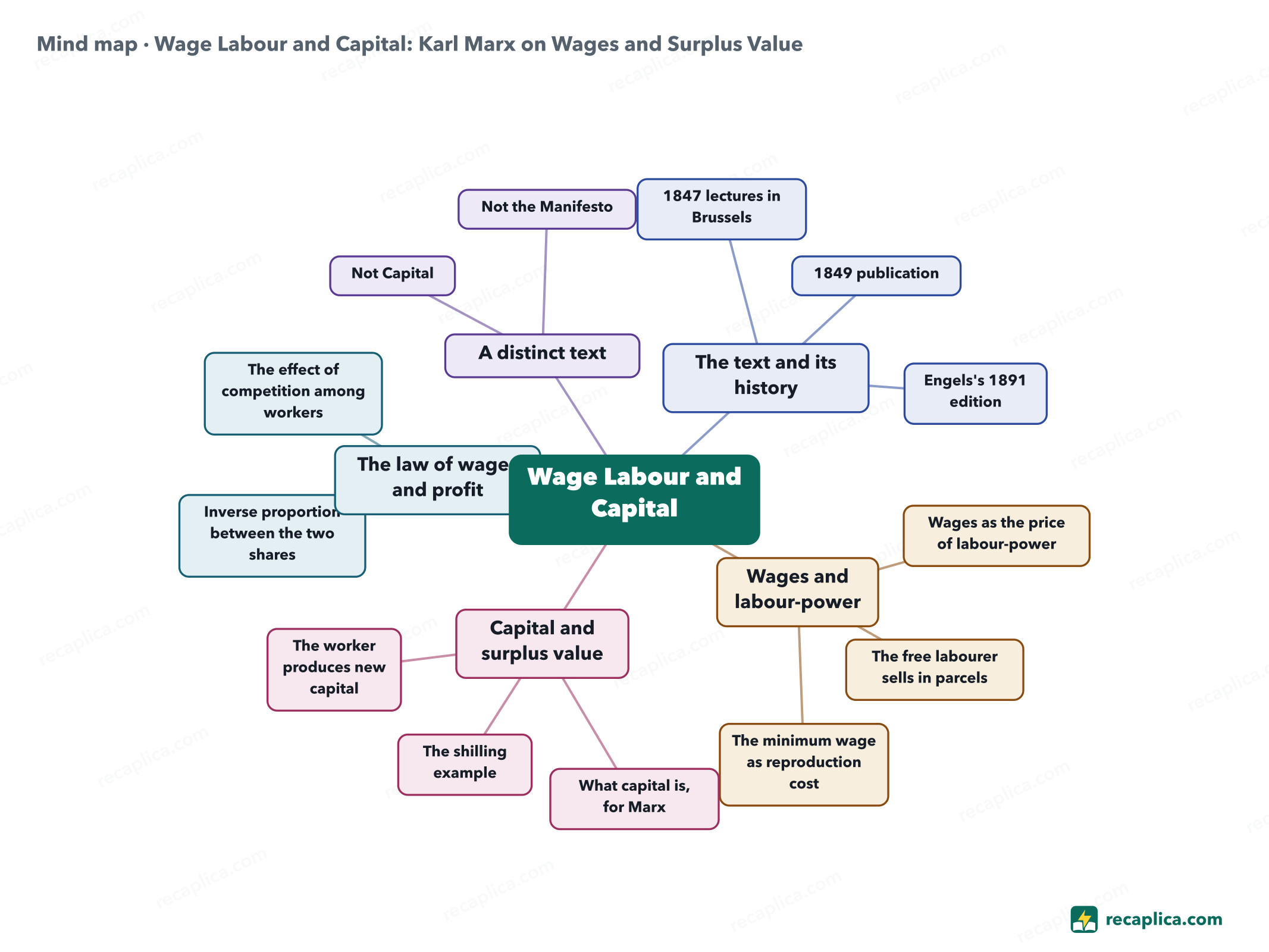
    Mind map: Wage Labour and Capital: Karl Marx on Wages and Surplus Value
    • Wage Labour and Capital
      • The text and its history
        • 1847 lectures in Brussels Marx gave them in December
        • 1849 publication Five articles in the Neue Rheinische Zeitung
        • Engels's 1891 edition Edited into a printed pamphlet
      • Wages and labour-power
        • Wages as the price of labour-power
        • The free labourer sells in parcels Unlike the slave or the serf
        • The minimum wage as reproduction cost
      • Capital and surplus value
        • What capital is, for Marx Accumulated labour put back to work
        • The shilling example One wage, two shillings of value
        • The worker produces new capital
      • The law of wages and profit
        • Inverse proportion between the two shares
        • The effect of competition among workers
      • A distinct text
        • Not Capital The 1867 academic treatise
        • Not the Manifesto The 1848 political programme

    Quiz: test yourself

    Answer the questions to check what you have learned: you get instant feedback and a short explanation.

    Grade 0/10 0/5
    1 In what year did Marx give the lectures behind the text?

    Marx lectured in Brussels in December 1847; the text itself was published as newspaper articles only in April 1849.

    2 What did Engels correct in the 1891 edition, compared with the 1849 original?

    Engels replaced "labour" with "labour-power" in the 1891 edition, picking up a distinction that would only be made explicit in Marx's later theory.

    3 How does Marx define the minimum wage in the text?

    For Marx, the minimum wage tends to coincide with the cost needed to keep the worker, and the worker's family, alive and able to work.

    4 In Marx's numerical example, the capitalist pays one shilling in wages and gets from the labourer's work a value of:

    The gap between the wage paid (one shilling) and the value produced (two shillings) is, in Marx's analysis, the surplus value.

    5 Under the general law Marx states in the text, when the share going to profit rises:

    Marx states an inverse relationship between profit and wages: one share rises exactly as much as the other falls, and vice versa.

    Answers: 1-A · 2-A · 3-A · 4-B · 5-B

    Flashcards

    Tap the card to flip it and check whether you remember the answer, then move to the next one.

    1 / 8

    Explain it in your own words

    The ultimate test: if you can explain it in simple words, you've truly understood it. Write your explanation, then compare it with the Recap.

    Your explanation is saved only on this device.

    Wage Labour and Capital is a pamphlet by Karl Marx, drawn from lectures he gave in Brussels in December 1847 and first published in 1849 as a series of articles in the Neue Rheinische Zeitung. In it Marx describes wages as the price of labour-power, defines capital as accumulated labour put back to work in production, and uses a numerical example to introduce surplus value: the value a worker's labour creates above the wage that worker is paid. Written for readers with no background in political economy, the pamphlet sketches, in simple terms, arguments Marx would expand two decades later in Capital.

    Frequently asked questions

    Is Wage Labour and Capital the same text as Capital?

    No. It is a much shorter pamphlet, drawn from 1847 lectures and published in 1849, written for a working-class readership; Capital, published in 1867, gathers the same arguments two decades later in a treatise aimed at specialists.

    What does Marx mean by surplus value in this text?

    In Marx's account, the extra value a labourer's work produces beyond the wage paid for it: in his example, a labourer paid one shilling produces a value of two shillings, and the difference goes to the capitalist.

    Who first published Wage Labour and Capital, and when?

    The text first appeared in German as a series of five articles in the Neue Rheinische Zeitung, between April 5 and 11, 1849; only in 1891 did Friedrich Engels edit it into a printed pamphlet, also introducing some corrections to the text.

    What is the difference between Wage Labour and Capital and The Communist Manifesto?

    They are two distinct works: the Manifesto, written with Engels in 1848, is a political programme; this pamphlet, from 1847-1849, explains in accessible terms the economic conditions Marx argued the capitalist class depends on.

    Why does Marx define the minimum wage as the cost of producing labour-power?

    Because, in his analysis, a wage cannot fall below what a household needs to get by and to raise the next generation of workers.

    Sources

    • Wage Labour and Capital, Karl Marx (Marxists Internet Archive)
    • Wage Labour and Capital (Wikipedia)
    • Karl Marx (Stanford Encyclopedia of Philosophy)

    Every Recap goes through an independent review before publication.

    Every evening, the day's new Recaps on our Telegram channel. Join the channel →

    Keep learning

    • History What Is Existentialism? Heidegger, Being and Time, and Dasein Existentialism is a current of twentieth-century philosophy centered on human existence, freedom and the search for meaning. According to the Stanford Encyclopedia of Philosophy, the German philosopher Martin Heidegger (1889-1976) shaped that current more than almost anyone else, even though he never accepted the label. In 1927 he published Being and Time, his major work, where he introduced the concept of Dasein: the human being as the one entity that questions its own existence. That book influenced Jean-Paul Sartre's existentialism, but in 1946, in the Letter on Humanism, Heidegger openly broke with Sartre and refused to be called an existentialist. In 1933 he was elected rector of the University of Freiburg and became a Nazi party member, keeping that membership until the regime fell - an episode Heidegger himself later denied or played down more than once. Read the Recap →
    • History What Is Phenomenology? Husserl's Philosophy Explained Edmund Husserl founded phenomenology as a philosophical discipline around 1900-1901, with his Logical Investigations. His method starts from the epoché, a suspension of our everyday, unquestioning stance toward the world, and moves toward phenomenological reduction: studying how things appear to consciousness rather than what they are in themselves. At the center sits intentionality, the idea that every experience is always an experience of something specific, whether hoping, perceiving, or desiring. The method Husserl built carried into the 20th century through Heidegger, Sartre, and Merleau-Ponty, moving from German philosophy into French philosophy along the way. Read the Recap →
    • History Legal Positivism: What It Is, from Austin to Kelsen and Hart According to the Stanford Encyclopedia of Philosophy, legal positivism measures legal validity against observable social facts, keeping moral judgment on a separate track. Its roots lie in Hobbes and Hume. Jeremy Bentham produced the theory's first full account, which John Austin later took up and spread: for Austin, a rule is law only when a sovereign commands it under threat of punishment. In the twentieth century, Hans Kelsen grounded legal validity in a hierarchy that traces back to a presupposed basic norm, while Herbert Hart located it instead in a rule of recognition actually followed by judges and officials. Natural law theory takes the opposite view: an unjust law is not really a law. Legal positivism disagrees — a law stays valid even when it is morally unjust, as long as it was made the way the system requires. Read the Recap →

    recaplica

    Clear in 30 seconds, yours in 10 minutes.

    Recaps Mind maps Request a Recap Telegram channel Mind map maker Our method About Privacy & cookies Legal notes & terms of use

    © 2026 Recaplica · A project by Curi S.r.l. — VAT IT05472000750

    Statistics, only if you say so

    To learn which Recaps help most we would use Google Analytics, with aggregate, anonymous data. It starts only with your OK, and you can change your mind anytime. Privacy policy