Skip to content
recaplica

    One moment: security check

    Cloudflare wants to make sure you're not a robot. Tick the box below and your search will continue on its own.

    IT
    recaplica Blaise Pascal: Life, Science, and Faith in His Philosophy
    © 2026 Recaplica · recaplica.com — All rights reserved
    Home › History

    Blaise Pascal: Life, Science, and Faith in His Philosophy

    By Recaplica Newsroom · Updated on October 13, 2026

    What to print

    Page numbers appear when printing with default margins.

    Slides

    Choose a cut

    Flash10 slidesThe essential thread, to present in classFull16 slidesEvery chapter and the deeper detail

    Both come with speaker notes.

    Telegram channel
    recaplica Clear in 30 seconds, yours in 10 minutes.
    In 30 seconds Key points Figures Deep dive Slides Myths Mind map Quiz Flashcards FAQ

    In 30 seconds quick read

    Blaise Pascal was born in Clermont, in the Auvergne region of France, on 19 June 1623 and died in Paris on 19 August 1662, at age 39. He was a mathematician and physicist, known for his work on the arithmetical triangle and, together with Pierre de Fermat, for laying the early foundations of probability theory; he also built one of the first mechanical calculators in history, the Pascaline. On the night of 23 November 1654 he went through an experience he interpreted as a religious conversion, after which his work turned increasingly toward theology. His notebook of reflections, published after his death as the Pensées, remains the best-known record of how he held reason and faith together.

    Key Points

    • Born on 19 June 1623 in Clermont (present-day Clermont-Ferrand) and died on 19 August 1662 in Paris, at age 39.
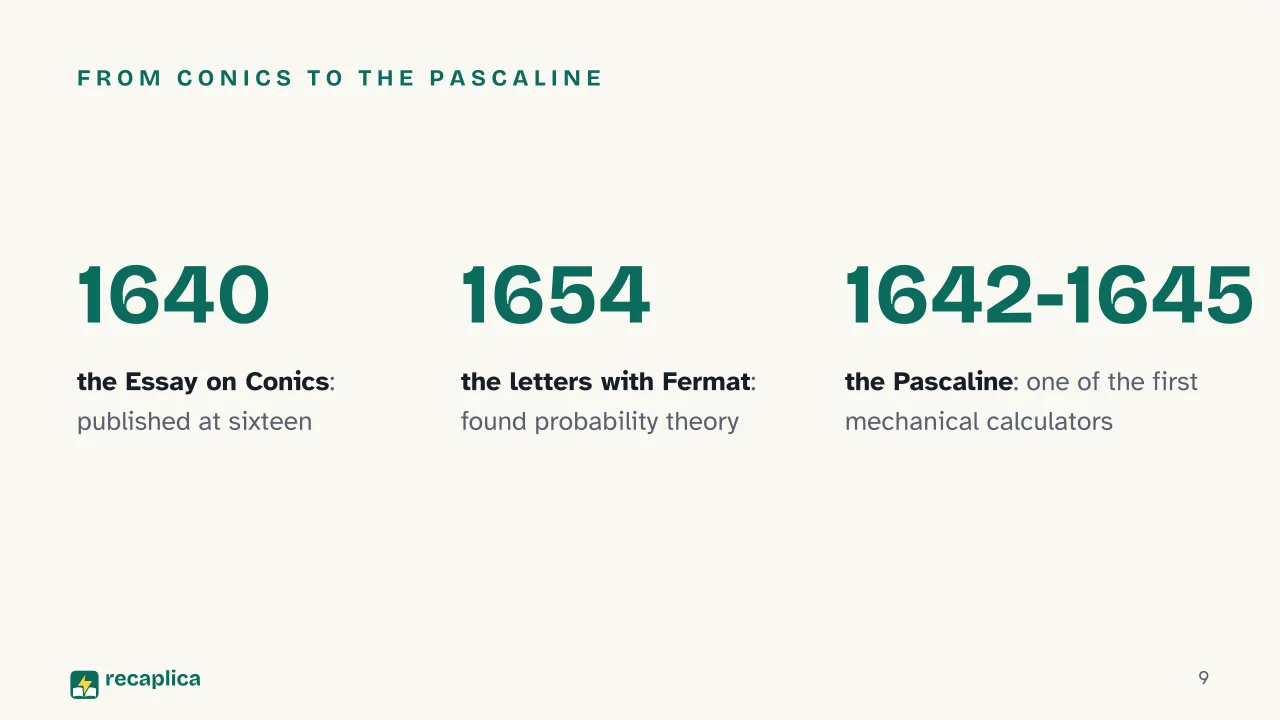
    • In 1640, at sixteen, he published the Essay on Conic Sections; according to the Internet Encyclopedia of Philosophy he had already joined Mersenne's Parisian scientific circle at thirteen.
    • In 1654 he exchanged letters with Pierre de Fermat that laid the groundwork for probability theory.
    • Between 1642 and 1645 he built the Pascaline, one of the first mechanical calculators, to help his father, a tax collector.
    • The night of 23 November 1654 marked his religious conversion, recorded in the Memorial he carried sewn into his coat until his death.
    • The Pensées, published after his death, gather his unfinished notes, including the fragment known as Pascal's Wager.

    Key figures

    • 19 June 1623 Blaise Pascal's date of birth, in Clermont, Auvergne. Source: Internet Encyclopedia of Philosophy
    • 1654 Year in which the exchange of letters with Pierre de Fermat laid the foundations of probability theory, and in which Pascal had the religious experience of the night of 23 November. Source: MacTutor History of Mathematics
    • 1642-1645 Period in which Pascal built the mechanical calculator known as the Pascaline, for his father, a tax collector. Source: MacTutor History of Mathematics

    Deep Dive

    A childhood among the mathematicians of Paris

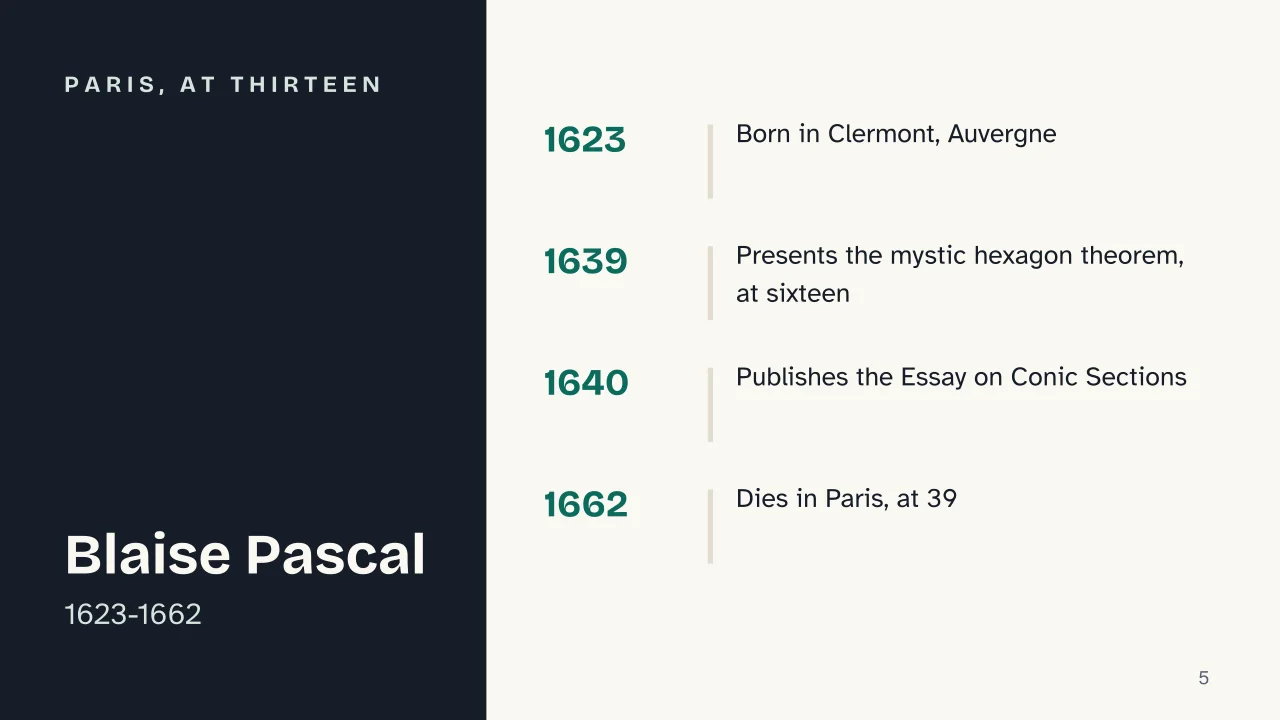
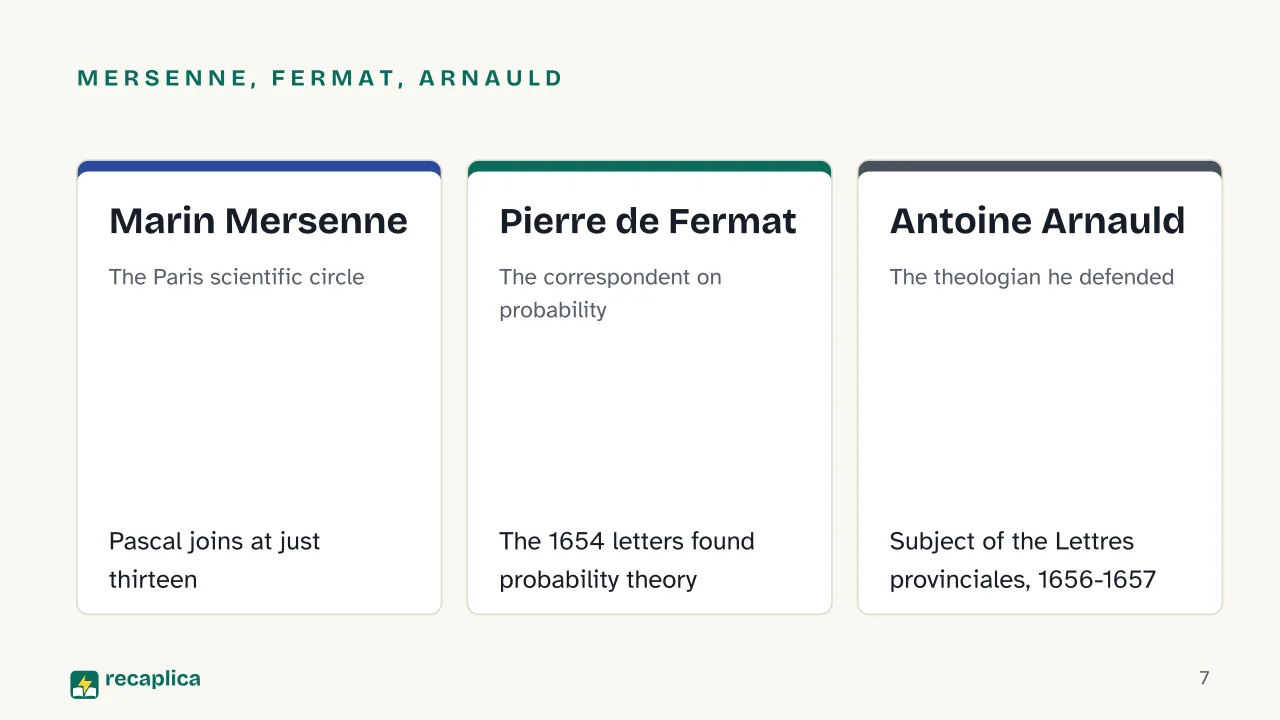
    Blaise Pascal was born on 19 June 1623 in Clermont, Auvergne, present-day Clermont-Ferrand. According to the Internet Encyclopedia of Philosophy, he received no traditional schooling: it was his father, himself a mathematician, who taught him everything he knew. That same father took him to Paris, where Pascal joined, at just thirteen, the scientific circle of Marin Mersenne, a gathering of the most active mathematicians of the time.

    In that circle Pascal soon showed an unusual gift. In June 1639, at sixteen, he presented a set of theorems in projective geometry that included the property now known as Pascal’s mystic hexagon, and the following year he published the Essay on Conic Sections. These early works apply the scientific method with precocious rigor to a geometric problem, closer to Aristotle in its method than in its subject matter.

    The years of science: triangles, probability, and a machine that counts

    Between 1642 and 1645 Pascal built the Pascaline, to help his father in his work as a tax collector. According to MacTutor History of Mathematics it took three years to build; according to the Internet Encyclopedia of Philosophy it was the first fully functional mechanical calculator in the world. In 1649 Pascal obtained a royal patent for it, but by 1652 only about fifty prototype units had been made: few sold, and production stopped.

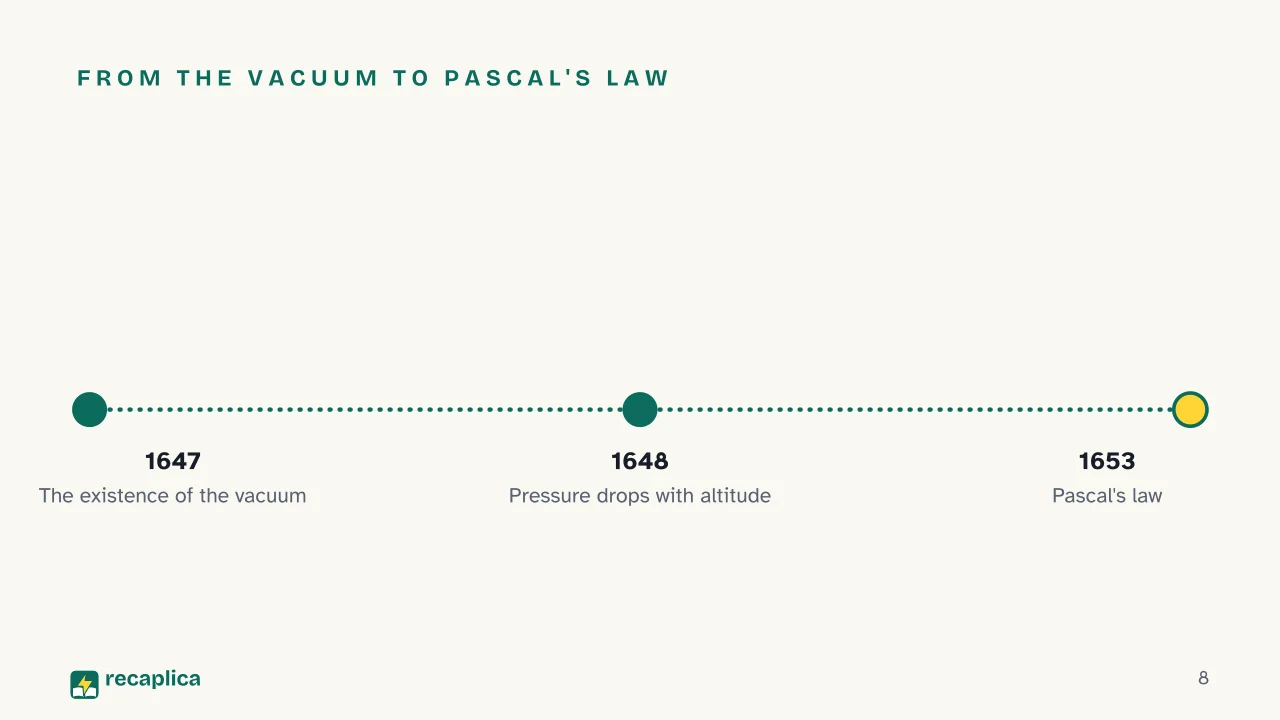
    The summer of 1654 brought his most lasting contribution. Through an exchange of five letters with Pierre de Fermat, on two gambling problems known as the problem of points and the problem of dice, Pascal and Fermat together laid the foundations of probability and statistics. In the same years he also worked in physics: by 1647 he believed he had proven the existence of the vacuum, in 1648 he observed that atmospheric pressure decreases with altitude, and in 1653 he wrote the Treatise on the Equilibrium of Liquids, setting out the physical principle now known as Pascal’s law of pressure in liquids. To these works is added the Treatise on the Arithmetical Triangle: Pascal was not the first to study that figure, but MacTutor calls his the most important work ever written on the subject.

    Illness and the night of the conversion

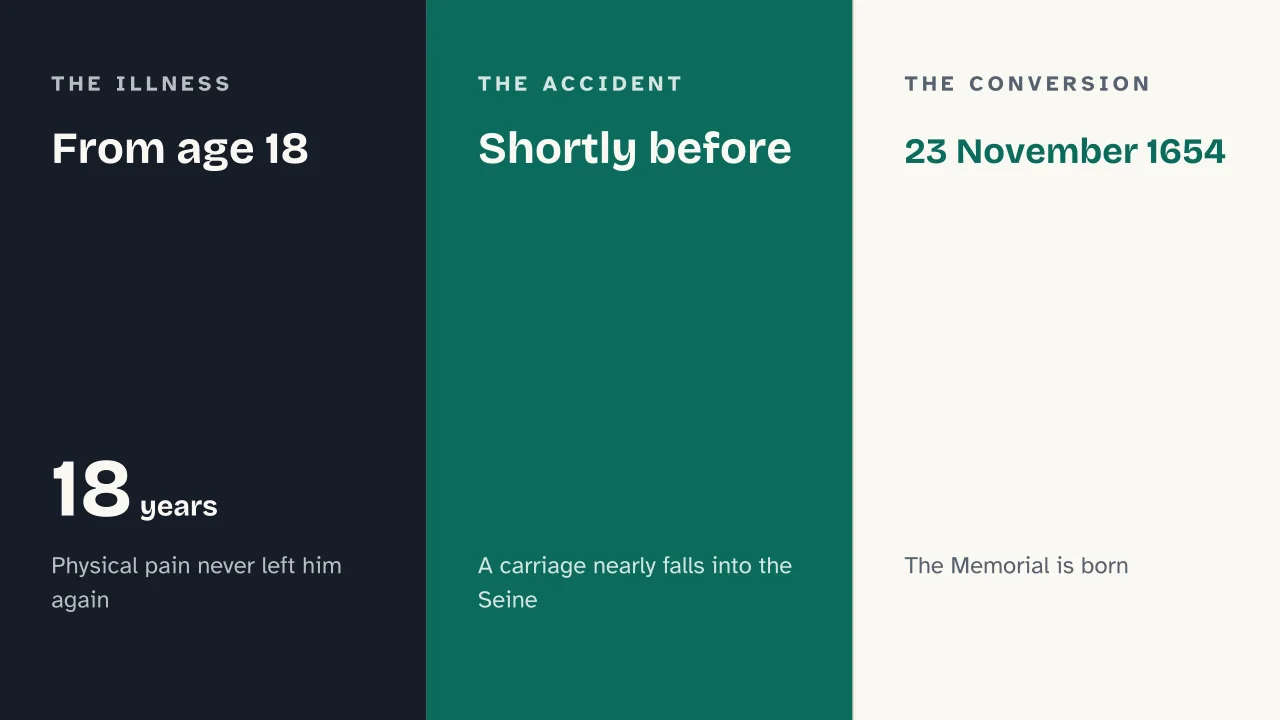
    According to the Internet Encyclopedia of Philosophy, which reports the testimony of Pascal’s sister, Gilberte, after age eighteen Pascal never had a day free from pain or some form of illness. By age twenty-four his condition had reached the point where he could tolerate only liquid food.

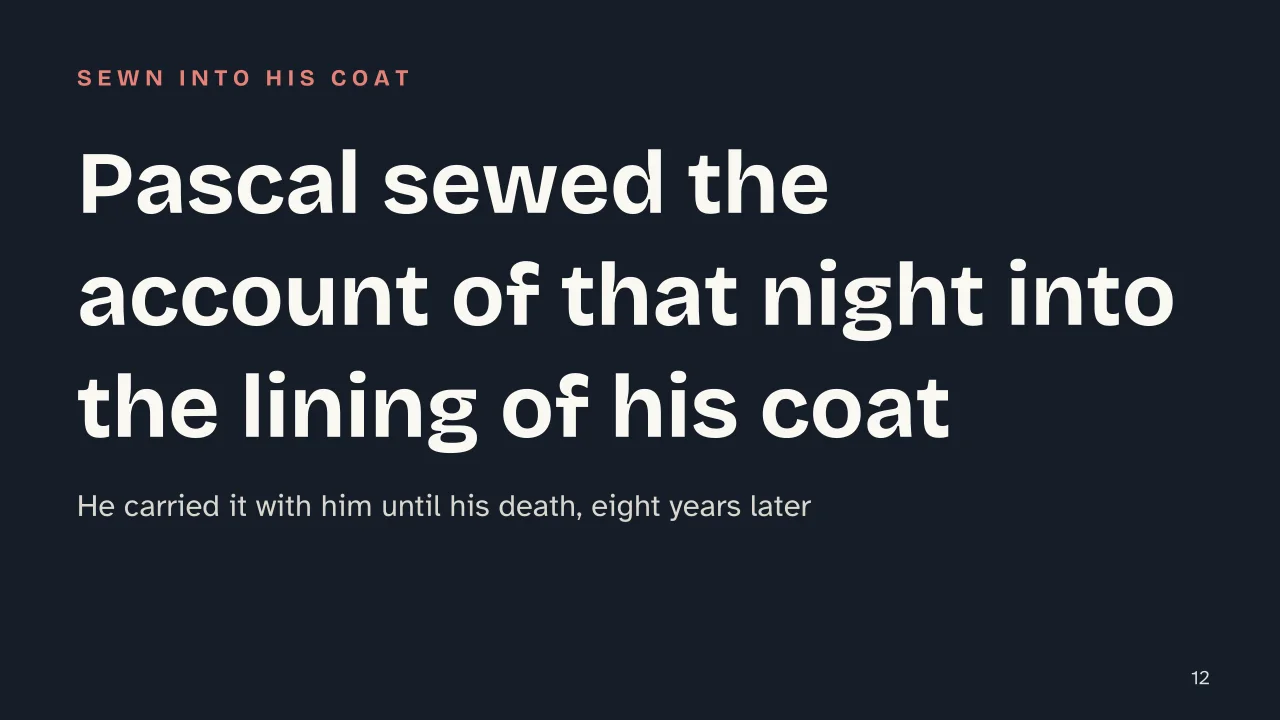
    Shortly before his religious experience, according to MacTutor, Pascal came close to dying in a carriage mishap: his startled horses took off on their own, and the carriage ended up hanging over a bridge on the Seine. Not long after, on the night of 23-24 November 1654, between 10:30 p.m. and 12:30 a.m. according to the Internet Encyclopedia of Philosophy, Pascal went through an experience he himself described as dreamlike or ecstatic, and which he interpreted as a religious conversion. He wrote an account of that night in a document known as the Memorial and sewed it into the lining of his coat.

    He kept it with him until his death: he died in Paris on 19 August 1662, at age 39, eight years after that night.

    According to the Stanford Encyclopedia of Philosophy, the intensity of that experience produced a lasting change in Pascal’s way of life, his intellectual interests, and his personal ambitions. The same source, citing the testimony of Pascal’s brother-in-law, adds that after his conversion Pascal grew detached from scientific pursuits.

    Even before then, taught by his father, Pascal had worked out a distinction between knowledge of facts, natural reason, and faith. Between January 1656 and March 1657, under the pseudonym Louis de Montalte, Pascal published eighteen letters, the Lettres provinciales, to defend the Jansenist theologian Antoine Arnauld, who had been accused of heresy. According to the Internet Encyclopedia of Philosophy, their tone ranges from light irony to outright mockery of the Jesuits, and the letters were banned by order of Louis XIV in 1660, placed on the Index, and burned by the Inquisition.

    The Pensées: what the work is and what it contains

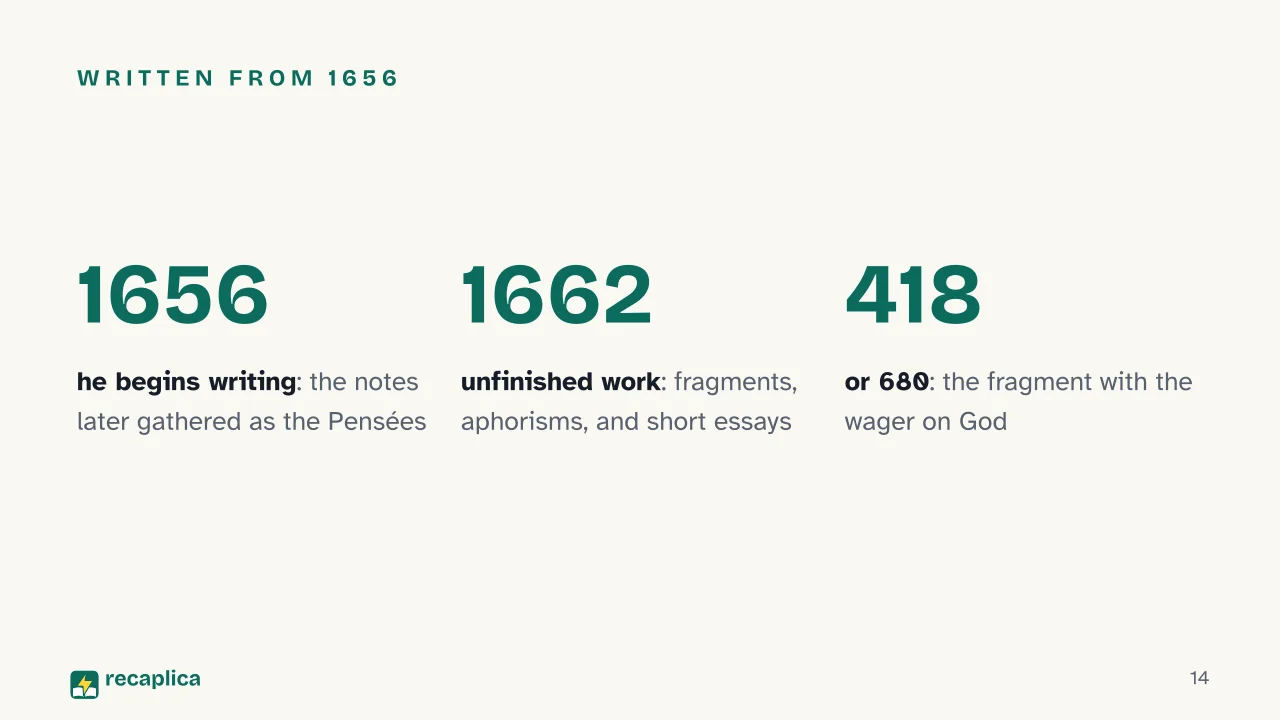
    Pascal published no philosophical work during his lifetime. According to the Stanford Encyclopedia of Philosophy, he began writing, in late 1656, a notebook of reflections that remained unfinished at his death in 1662: it was published only afterward, and became known as the Pensées. The Internet Encyclopedia of Philosophy describes the work, in the form it has reached us, as a collection of fragments, aphorisms, homilies, and short essays, conceived as a defense of the Christian faith addressed to non-believers.

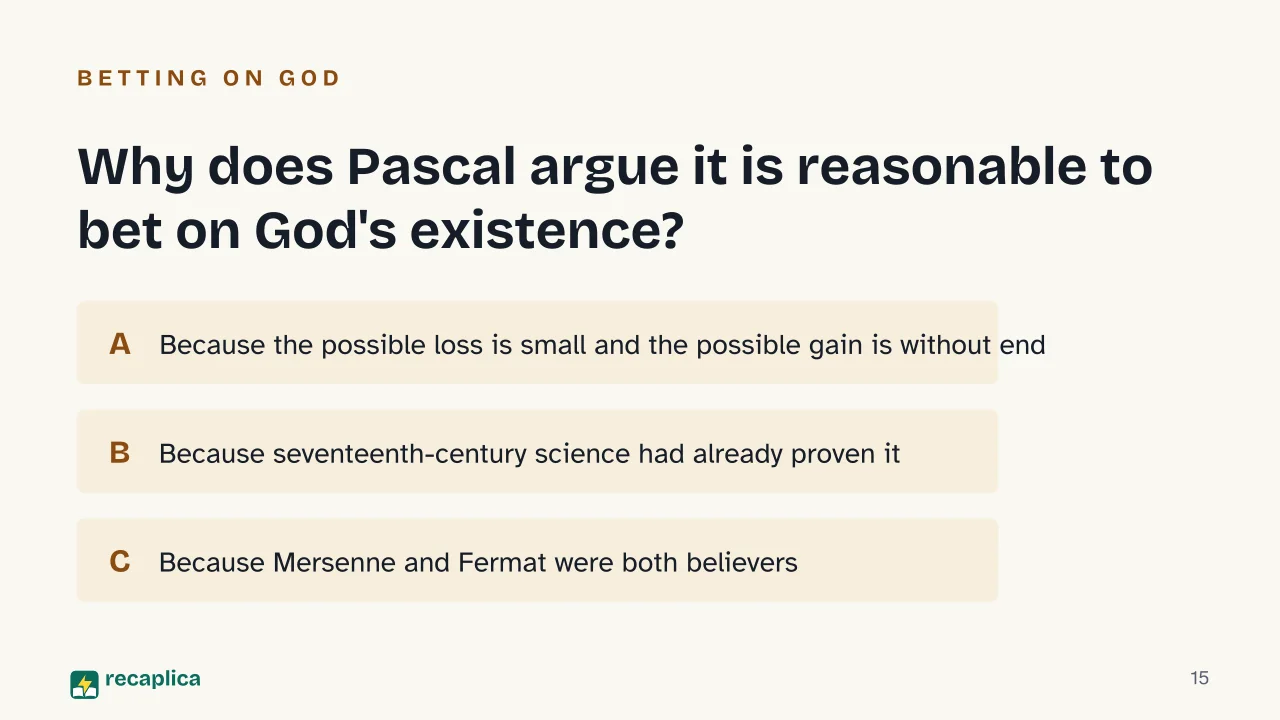
    One of the central themes of the Pensées, according to the Internet Encyclopedia of Philosophy, is the dual nature of the human condition: part misery, part greatness. In the work’s most discussed fragment, numbered 418 or 680 depending on the edition scholars use, Pascal compares the choice to believe to a wager: betting on God costs little if one loses, and may be worth an endless gain if one wins, while not betting exposes one to the opposite risk. Elsewhere in the same notebook, Pascal writes that it is the heart that experiences God, describing faith as something felt before it is proven.

    Worked example: Pascal’s Wager is widely regarded as an early instance of reasoning about a decision under uncertainty, the same kind of calculation that probability theory, born from his letters with Fermat, had formalized only a few years earlier.

    Pascal’s distinction between faith and reason touches on a question already raised, in different terms, by Plato and in his contrast with Aristotle over the relationship between knowledge and reality. A later parallel can be drawn with Kant and his categorical imperative: a method of reasoning far from Pascal’s wager, built on pure reason, yet born of the same underlying question — how far reason alone can go in grounding a choice.

    Slide deck

    Slides ready to download and make your own in PowerPoint or Google Slides, with speaker notes. Pick the Flash cut or the Full one.
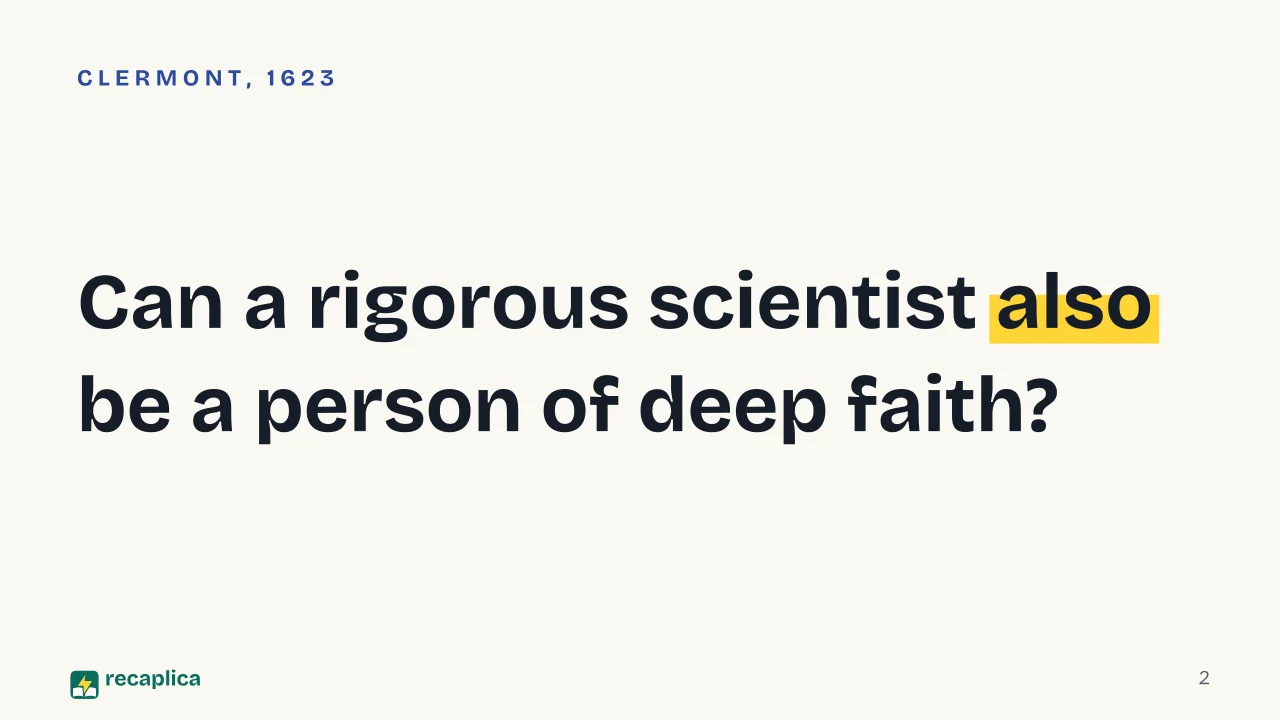
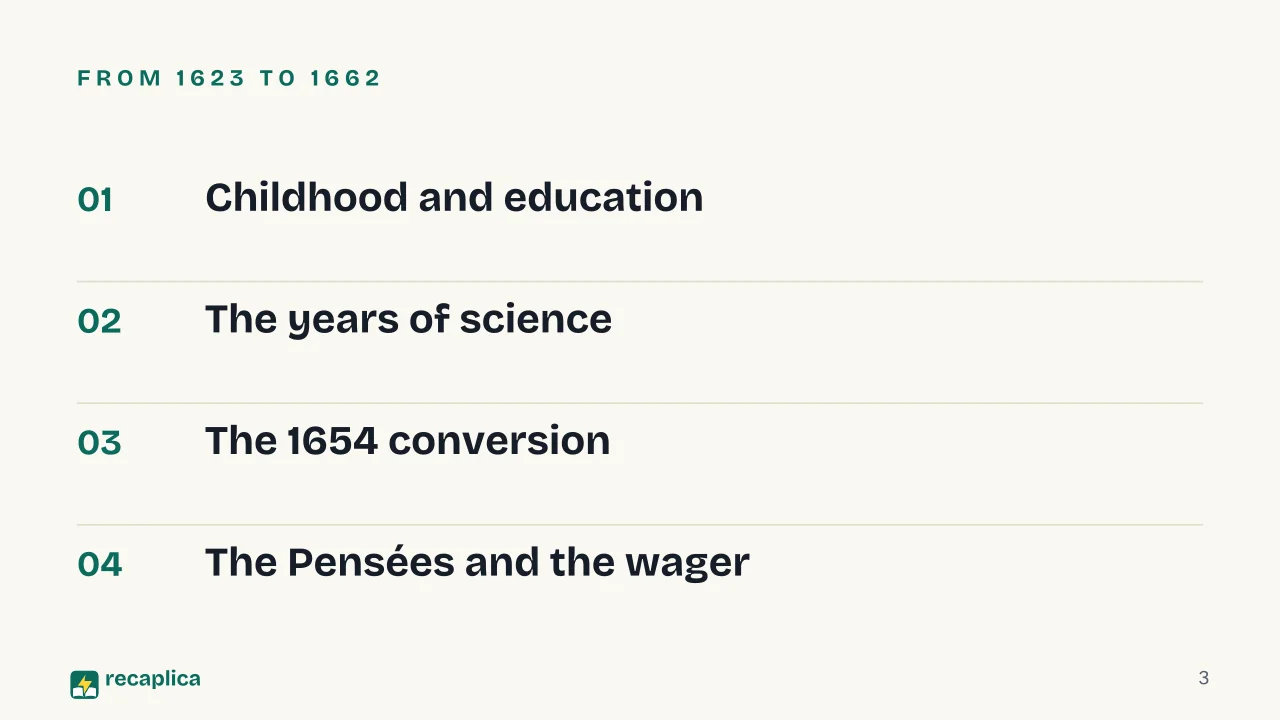
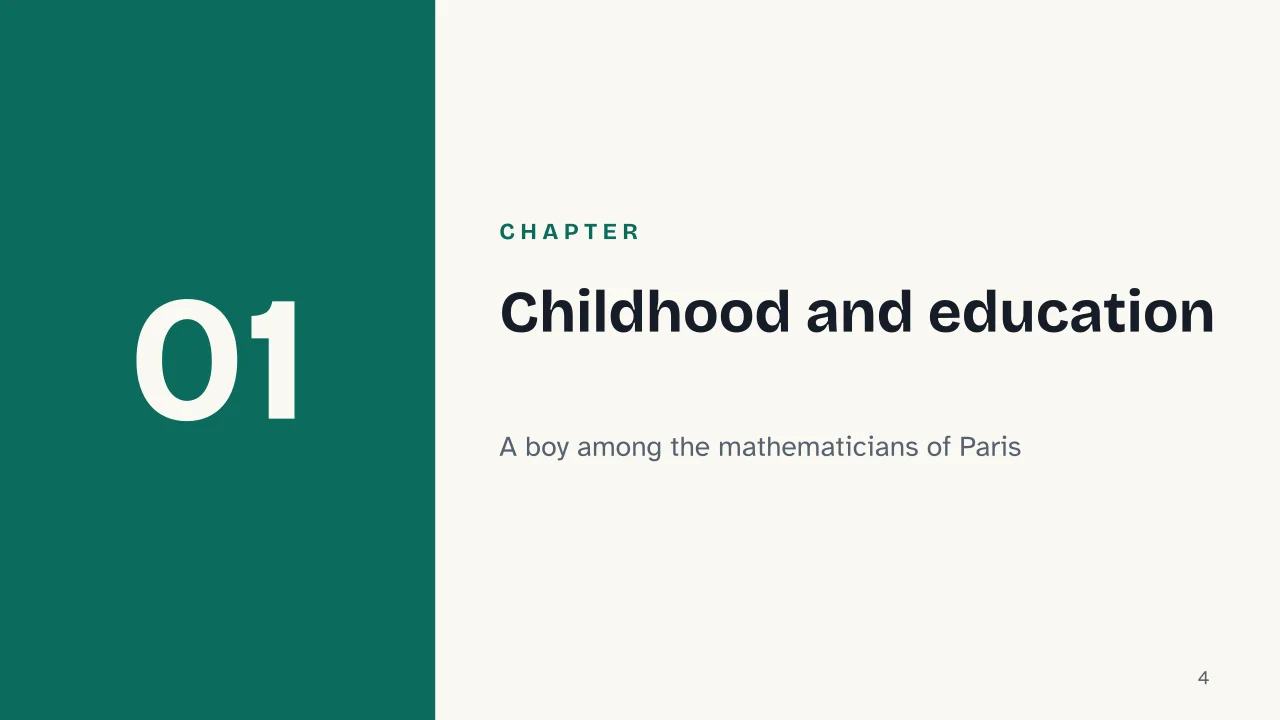
    Slide 1 of the presentation on Blaise Pascal: Blaise PascalSlide 2 of the presentation on Blaise Pascal: Can a rigorous scientist also be a person of deep faith?Slide 3 of the presentation on Blaise Pascal: From 1623 to 1662Slide 4 of the presentation on Blaise Pascal: Chapter 01: Childhood and educationSlide 5 of the presentation on Blaise Pascal: Paris, at thirteenSlide 6 of the presentation on Blaise Pascal: Chapter 02: The years of scienceSlide 7 of the presentation on Blaise Pascal: Mersenne, Fermat, Arnauld: Marin Mersenne, Pierre de Fermat, Antoine ArnauldSlide 8 of the presentation on Blaise Pascal: From the vacuum to Pascal's lawSlide 9 of the presentation on Blaise Pascal: From conics to the PascalineSlide 10 of the presentation on Blaise Pascal: Chapter 03: The 1654 conversionSlide 11 of the presentation on Blaise Pascal: From age 18 · Shortly before · 23 November 1654Slide 12 of the presentation on Blaise Pascal: Pascal sewed the account of that night into the lining of his coatSlide 13 of the presentation on Blaise Pascal: Chapter 04: The Pensées and the wagerSlide 14 of the presentation on Blaise Pascal: Written from 1656Slide 15 of the presentation on Blaise Pascal: Why does Pascal argue it is reasonable to bet on God's existence?Slide 16 of the presentation on Blaise Pascal: Now, time to review
    Flash10 slidesThe essential thread, to present in classFull16 slidesEvery chapter and the deeper detail

    Common myths

    • ✗ Myth Blaise Pascal was only a mathematician.

      ✓ Reality He was also a physicist and inventor: in 1653 he wrote the Treatise on the Equilibrium of Liquids, the source of what physicists now call Pascal's law, and between 1642 and 1645 he completed the Pascaline, a mechanical calculator that ranks among the first in history.

    • ✗ Myth Pascal's Wager proves that God exists.

      ✓ Reality The argument, found in the Pensées in the fragment numbered 418 or 680 depending on the edition, compares the cost of believing against the cost of not believing: according to the Internet Encyclopedia of Philosophy, it is not a proof of God's existence but a case for why betting on it is reasonable.

    • ✗ Myth The Pensées is a book Pascal wrote and published himself.

      ✓ Reality According to the Stanford Encyclopedia of Philosophy, Pascal published no philosophical work during his lifetime: the Pensées is a collection of unfinished notes and fragments, found and published only after his death in 1662.

    Mind map

    Drag the background to move around and the nodes to reposition them; use − and + to collapse and expand branches.
    Customize
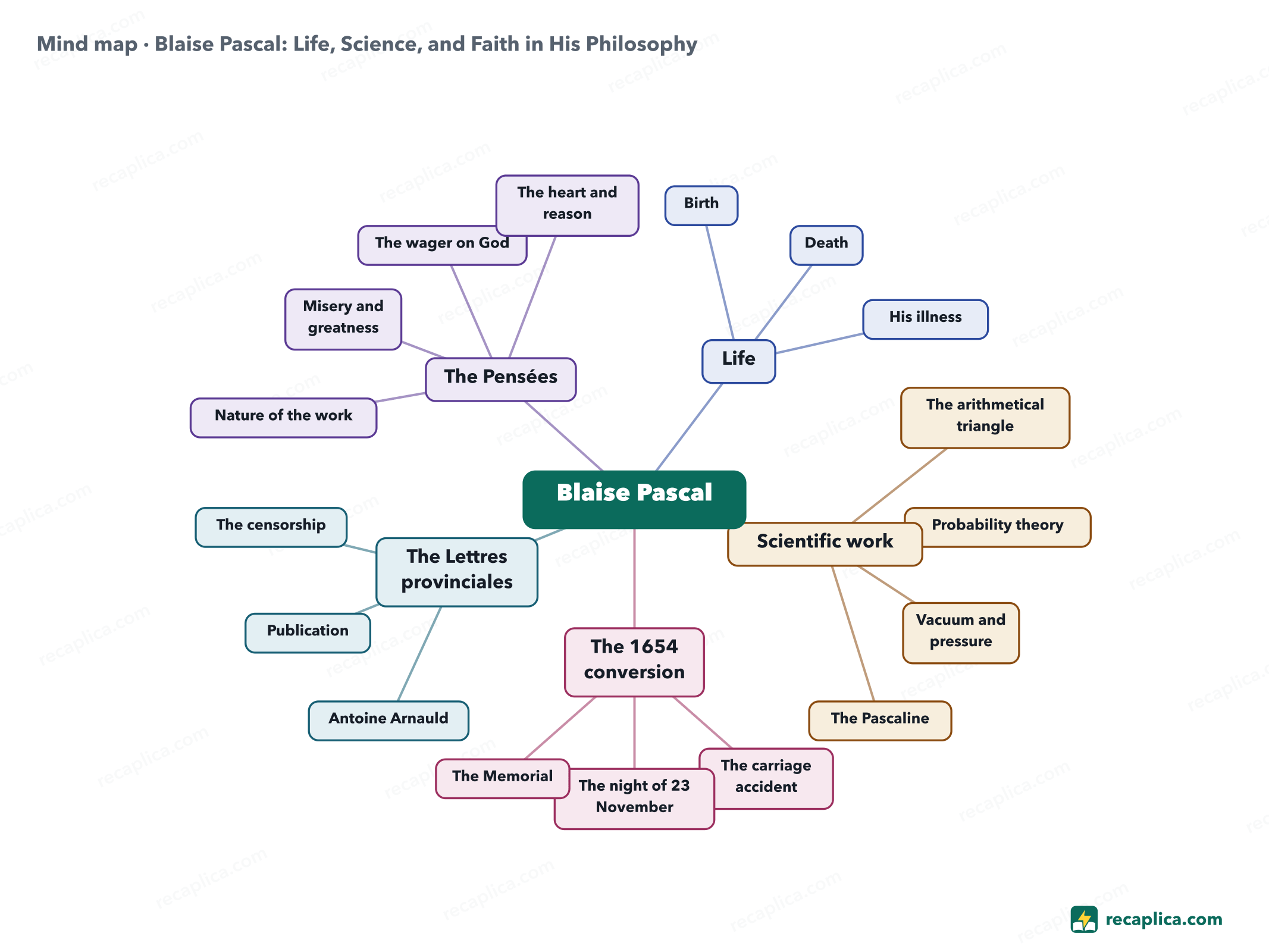
    Mind map: Blaise Pascal: Life, Science, and Faith in His Philosophy
    • Blaise Pascal
      • Life Birth, death, and health
        • Birth 19 June 1623, in Clermont, Auvergne
        • Death 19 August 1662 in Paris, at age 39
        • His illness Near-daily pain from age 18 onward
      • Scientific work Mathematics, probability, and physics
        • The arithmetical triangle Subject of his Treatise on the Arithmetical Triangle
        • Probability theory Letters with Pierre de Fermat, summer 1654
        • Vacuum and pressure Studies from 1647-1648, then Pascal's law in 1653
        • The Pascaline Mechanical calculator built between 1642 and 1645
      • The 1654 conversion The experience of the night of 23 November
        • The carriage accident Occurred shortly before, according to MacTutor
        • The night of 23 November The experience, between 10:30 p.m. and 12:30 a.m.
        • The Memorial The account sewn into the lining of his coat
      • The Lettres provinciales The defense of Jansenism
        • Antoine Arnauld Jansenist theologian accused of heresy
        • Publication 18 letters, January 1656-March 1657, signed Louis de Montalte
        • The censorship Banned by Louis XIV in 1660
      • The Pensées The unfinished work on faith
        • Nature of the work An unfinished collection of notes, fragments, and short essays
        • Misery and greatness The dual nature of the human condition
        • The wager on God Fragment 418 or 680, depending on the numbering
        • The heart and reason God felt by the heart, not only proven by reason

    Quiz: test yourself

    Answer the questions to check what you have learned: you get instant feedback and a short explanation.

    Grade 0/10 0/5
    1 When and where was Blaise Pascal born?

    According to the Stanford Encyclopedia of Philosophy and MacTutor History of Mathematics, Pascal was born on 19 June 1623 in Clermont, present-day Clermont-Ferrand, in Auvergne.

    2 Who did Pascal exchange letters with in 1654 that laid the foundations of probability theory?

    According to MacTutor History of Mathematics, in the summer of 1654 Pascal and Pierre de Fermat exchanged five letters on two gambling problems, laying the foundations of probability theory.

    3 What is the Pascaline?

    According to MacTutor History of Mathematics, Pascal built the Pascaline over three years of work, between 1642 and 1645, to ease his father's tax calculations; the Internet Encyclopedia of Philosophy ranks it as the first machine of its kind to actually work.

    4 According to the sources, what happened on the night of 23 November 1654?

    According to the Stanford Encyclopedia of Philosophy and the Internet Encyclopedia of Philosophy, that night Pascal had an intense experience he interpreted as a conversion, and he wrote an account of it in the Memorial.

    5 True or false: Pascal completed and published the Pensées himself.

    False: according to the Stanford Encyclopedia of Philosophy and the Internet Encyclopedia of Philosophy, the Pensées is an incomplete collection of notes and fragments, published only after Pascal's death in 1662.

    Answers: 1-A · 2-A · 3-A · 4-A · 5-B

    Flashcards

    Tap the card to flip it and check whether you remember the answer, then move to the next one.

    1 / 8

    Explain it in your own words

    The ultimate test: if you can explain it in simple words, you've truly understood it. Write your explanation, then compare it with the Recap.

    Your explanation is saved only on this device.

    Blaise Pascal was born in Clermont, in the Auvergne region of France, on 19 June 1623 and died in Paris on 19 August 1662, at age 39. He was a mathematician and physicist, known for his work on the arithmetical triangle and, together with Pierre de Fermat, for laying the early foundations of probability theory; he also built one of the first mechanical calculators in history, the Pascaline. On the night of 23 November 1654 he went through an experience he interpreted as a religious conversion, after which his work turned increasingly toward theology. His notebook of reflections, published after his death as the Pensées, remains the best-known record of how he held reason and faith together.

    Frequently asked questions

    Was Blaise Pascal a scientist or a man of faith?

    Both: he was a recognized mathematician and physicist in his younger years, and after the religious experience of 23 November 1654 he devoted much of his work to defending the Christian faith, leaving the Pensées as the clearest record of that shift.

    What does Pascal's Wager say?

    It is the argument set out in fragment 418, or 680 depending on the numbering, of the Pensées: Pascal treats belief in God as a choice to be weighed through the logic of a wager, not as something to be proven by reason.

    Is the Pensées a finished work?

    No: it is an incomplete collection of notes, fragments, aphorisms, and short essays that Pascal left at his death in 1662, conceived as a defense of the Christian faith and published only afterward.

    What is Pascal's best-known scientific contribution?

    Besides his work on the arithmetical triangle, the most cited contribution is the 1654 exchange of letters with Pierre de Fermat, which laid the foundations of probability theory.

    Sources

    • Stanford Encyclopedia of Philosophy — Blaise Pascal
    • MacTutor History of Mathematics — Blaise Pascal
    • Internet Encyclopedia of Philosophy — Blaise Pascal (1623—1662)

    Every Recap goes through an independent review before publication.

    Every evening, the day's new Recaps on our Telegram channel. Join the channel →

    Keep learning

    • History What Is Existentialism? Heidegger, Being and Time, and Dasein Existentialism is a current of twentieth-century philosophy centered on human existence, freedom and the search for meaning. According to the Stanford Encyclopedia of Philosophy, the German philosopher Martin Heidegger (1889-1976) shaped that current more than almost anyone else, even though he never accepted the label. In 1927 he published Being and Time, his major work, where he introduced the concept of Dasein: the human being as the one entity that questions its own existence. That book influenced Jean-Paul Sartre's existentialism, but in 1946, in the Letter on Humanism, Heidegger openly broke with Sartre and refused to be called an existentialist. In 1933 he was elected rector of the University of Freiburg and became a Nazi party member, keeping that membership until the regime fell - an episode Heidegger himself later denied or played down more than once. Read the Recap →
    • History What Is Phenomenology? Husserl's Philosophy Explained Edmund Husserl founded phenomenology as a philosophical discipline around 1900-1901, with his Logical Investigations. His method starts from the epoché, a suspension of our everyday, unquestioning stance toward the world, and moves toward phenomenological reduction: studying how things appear to consciousness rather than what they are in themselves. At the center sits intentionality, the idea that every experience is always an experience of something specific, whether hoping, perceiving, or desiring. The method Husserl built carried into the 20th century through Heidegger, Sartre, and Merleau-Ponty, moving from German philosophy into French philosophy along the way. Read the Recap →
    • History Legal Positivism: What It Is, from Austin to Kelsen and Hart According to the Stanford Encyclopedia of Philosophy, legal positivism measures legal validity against observable social facts, keeping moral judgment on a separate track. Its roots lie in Hobbes and Hume. Jeremy Bentham produced the theory's first full account, which John Austin later took up and spread: for Austin, a rule is law only when a sovereign commands it under threat of punishment. In the twentieth century, Hans Kelsen grounded legal validity in a hierarchy that traces back to a presupposed basic norm, while Herbert Hart located it instead in a rule of recognition actually followed by judges and officials. Natural law theory takes the opposite view: an unjust law is not really a law. Legal positivism disagrees — a law stays valid even when it is morally unjust, as long as it was made the way the system requires. Read the Recap →

    recaplica

    Clear in 30 seconds, yours in 10 minutes.

    Recaps Mind maps Request a Recap Telegram channel Mind map maker Our method About Privacy & cookies Legal notes & terms of use

    © 2026 Recaplica · A project by Curi S.r.l. — VAT IT05472000750

    Statistics, only if you say so

    To learn which Recaps help most we would use Google Analytics, with aggregate, anonymous data. It starts only with your OK, and you can change your mind anytime. Privacy policy