Skip to content
recaplica

    One moment: security check

    Cloudflare wants to make sure you're not a robot. Tick the box below and your search will continue on its own.

    IT
    recaplica Sophists: Who They Were and What They Taught in Fifth-Century Athens
    © 2026 Recaplica · recaplica.com — All rights reserved
    Home › History

    Sophists: Who They Were and What They Taught in Fifth-Century Athens

    By Recaplica Newsroom · Updated on October 7, 2026

    What to print

    Page numbers appear when printing with default margins.

    Slides

    Choose a cut

    Flash10 slidesThe essential thread, to present in classFull16 slidesEvery chapter and the deeper detail

    Both come with speaker notes.

    Telegram channel
    recaplica Clear in 30 seconds, yours in 10 minutes.
    In 30 seconds Key points Deep dive Slides Myths Mind map Quiz Flashcards FAQ

    In 30 seconds quick read

    The sophists were professional teachers who travelled around Athens and other Greek cities in the second half of the fifth century BC, selling lessons to young men from wealthy families. Most of their teaching was rhetoric, the skill of speaking in public, because in the Athenian democracy anyone who could win over an assembly or a jury gained power. The arguments around them turned on whether justice comes from nature or from human agreement. Plato portrayed them as teachers selling a skill, and his portrait accounts for much of the negative charge "sophistry" carries in modern usage.

    Key Points

    • They were travelling professionals who charged a fee for their lessons, not members of a school with shared doctrines.
    • The names the sources return to are Protagoras of Abdera, Gorgias of Leontini, Hippias of Elis, Prodicus of Ceos, Antiphon and Thrasymachus.
    • Rhetoric sat at the centre of the curriculum, alongside the other subjects almost all of them claimed to teach.
    • The growth of Athenian democracy raised the demand for capable speakers, and that skill was exactly what the sophists sold.
    • The argument over physis (nature) and nomos (custom, law, convention) runs through the positions the sources attribute to them.
    • The modern sense of "sophistry" as crooked reasoning comes mainly from the influence of Plato and Aristotle.

    Deep Dive

    Who the sophists were

    In the second half of the fifth century BC, in Athens and in other Greek cities, a figure appeared who had not existed before: the teacher who asked to be paid. The Internet Encyclopedia of Philosophy describes the sophists as itinerant professionals who, in exchange for a fee, gave wealthy young Greeks an education in aretē, virtue understood as excellence. The trade brought many of them money and fame, and the money brought a good deal of social resentment with it.

    The name comes from sophia, wisdom. Early on, a “sophist” was simply someone who practised a body of knowledge or a doctrine. Over the course of the fifth century BC the label shifted onto a new kind of intellectual: professional educators who moved between Greek cities teaching a wide range of subjects, with particular attention to skill in public speaking.

    They did not form a school. The Stanford Encyclopedia of Philosophy presents them as independent practitioners with no organisation and no common body of doctrine, one reason why the views we read under a single label sometimes contradict each other.

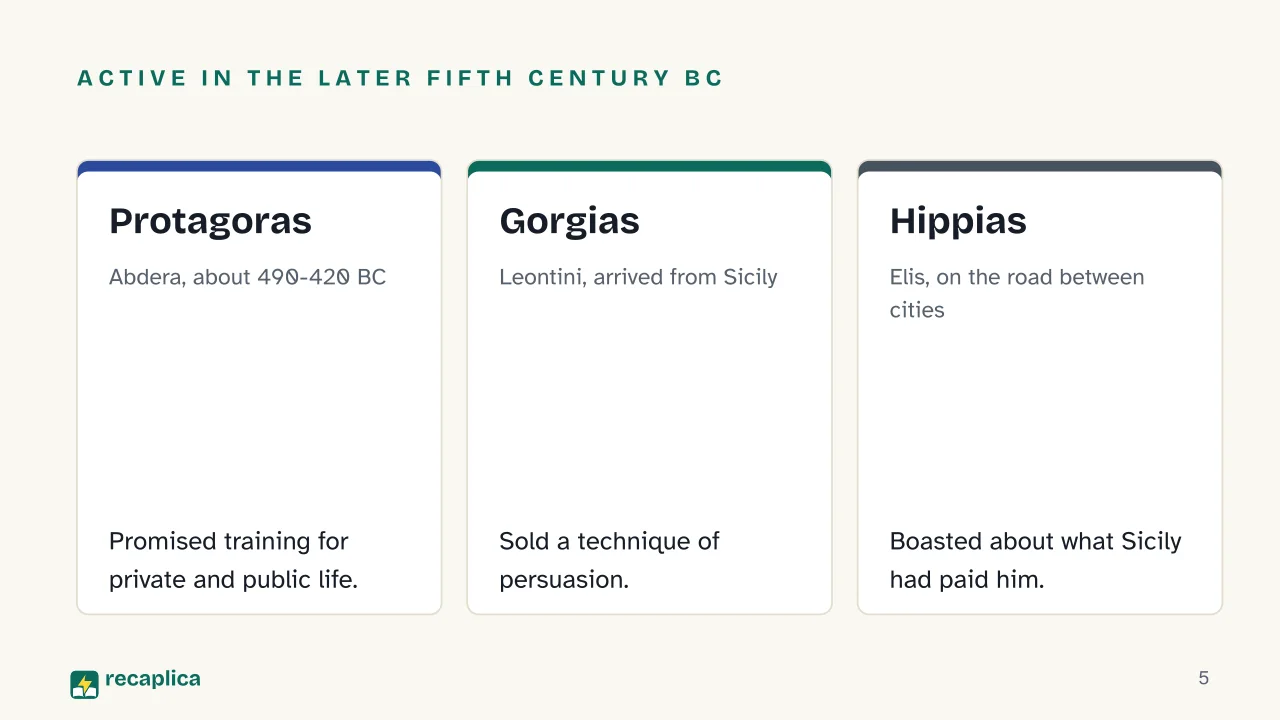
    The names both encyclopedias return to are Protagoras of Abdera (about 490-420 BC), Gorgias of Leontini (about 485-380 BC, who came over from Sicily), Hippias of Elis, Prodicus of Ceos, a contemporary of Socrates, Antiphon and Thrasymachus. For Hippias and Thrasymachus the sources record activity in the last third of the century.

    Why Athens wanted speakers

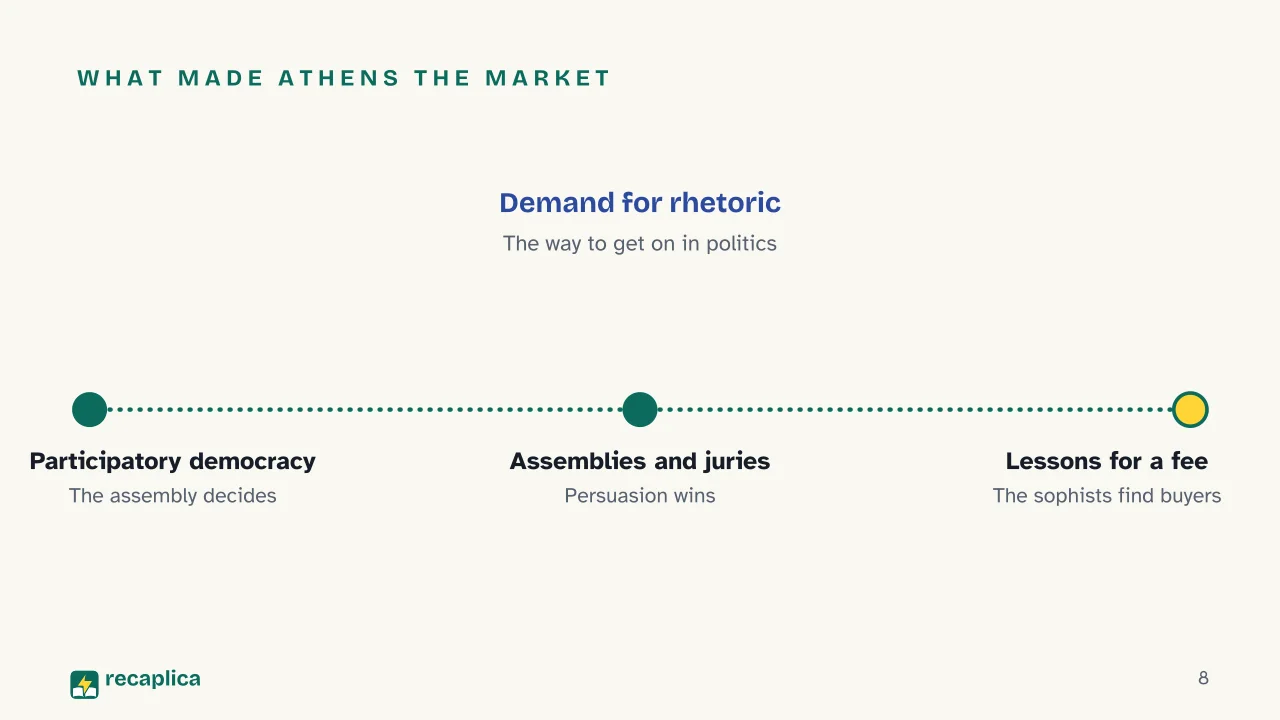
    Participatory democracy grew faster in Athens than elsewhere, and it raised the demand for rhetorical skill: anyone who wanted to get on in politics, or to defend himself before a popular jury, had to be able to address a large crowd. The paid teachers moved into that gap, and each of them pitched the service in his own way. Protagoras described his teaching as a complete training in managing one’s private affairs and the city’s business well, in word and in action. Gorgias, in Plato’s account of him, claimed to teach a technique of persuasion that was neutral about values and belonged to no ethical system; in the same dialogue he ends up conceding that a speaker active in politics does have to know what is just and what is not. The Stanford Encyclopedia of Philosophy flags that concession as a tension inside his own position.

    What they taught

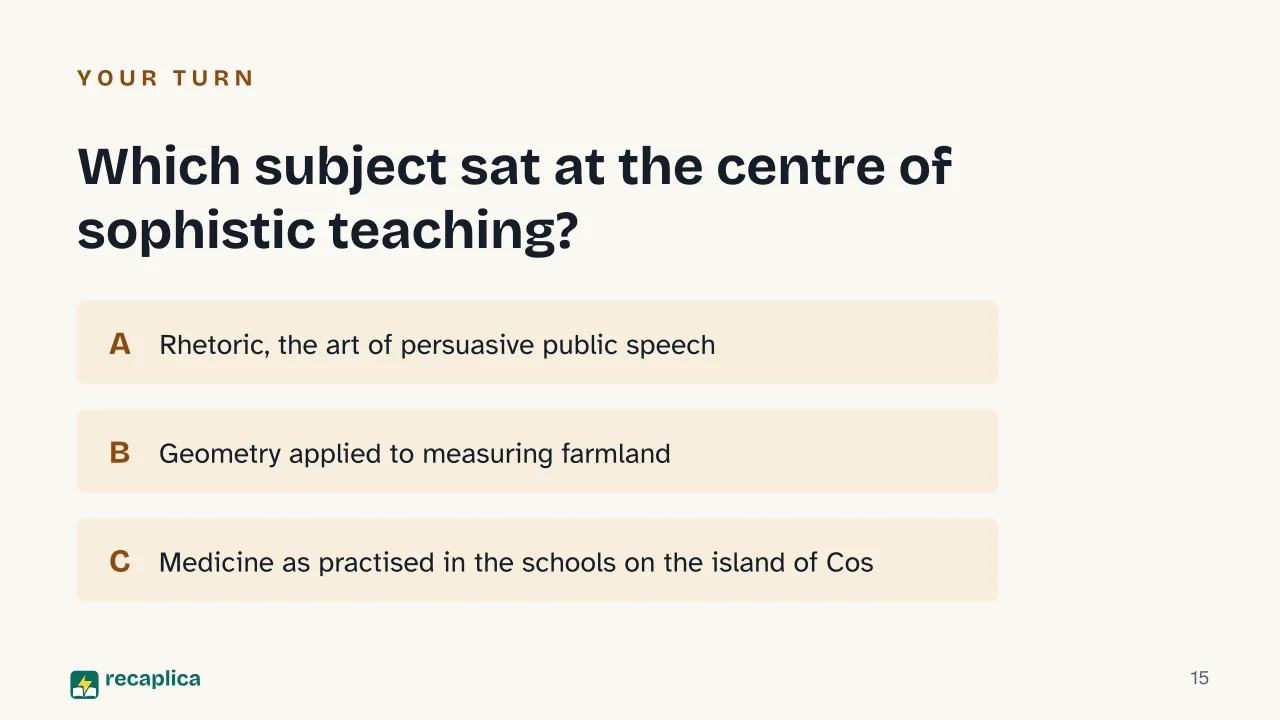
    The Internet Encyclopedia of Philosophy offers a definition it admits is rough: the sophists were paid teachers of aretē, where aretē means the capacity to reach political power and to exercise it through persuasive speech. Rhetoric sat at the centre of the curriculum, even though most of them said they taught other subjects as well.

    Practical example: according to Aristotle, one of the most criticised claims attributed to Protagoras was that he could make the weaker argument the stronger one in a speech. The natural ground for this was the courtroom, where cases are argued over what seems likely: a speaker could lean on how improbable it was that a weak man had attacked a strong one.

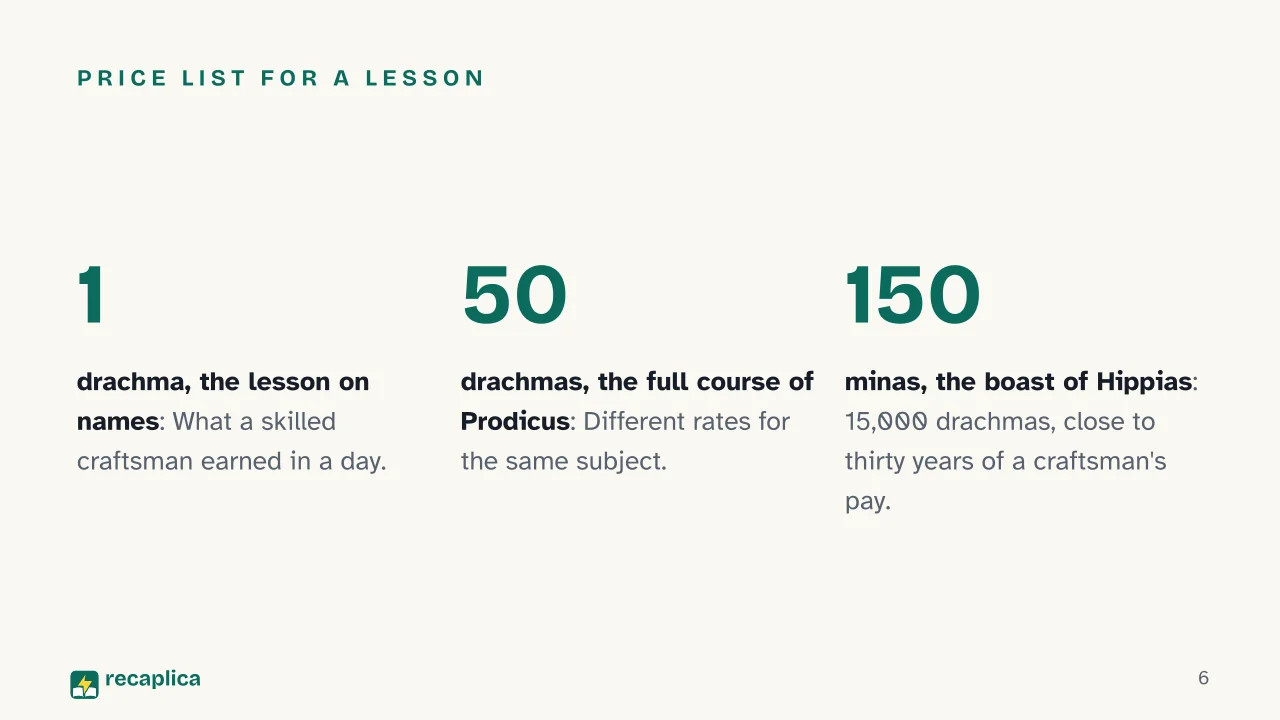
    The fees show how much the service was wanted. The Stanford Encyclopedia of Philosophy reports that Hippias boasted of earning more than 150 minas on a single visit to Sicily, that is 15,000 drachmas, a sum estimated at around thirty years of a skilled craftsman’s wages; in Plato’s Meno (91d) Socrates says Protagoras took in more than ten sculptors put together, Phidias included. Prodicus charged by course: one drachma for the lesson on names, which matched a skilled craftsman’s daily pay, and fifty drachmas for the full programme.

    Physis and nomos, the argument about justice

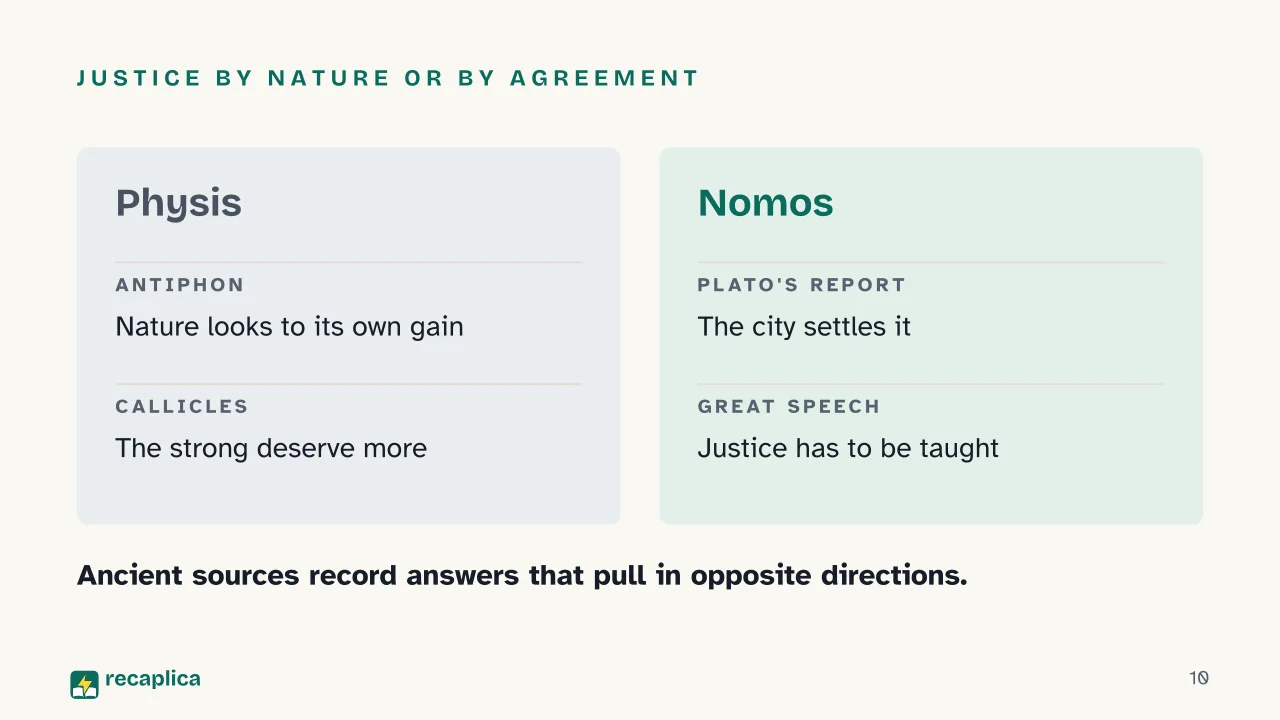
    In the later fifth century BC Greek thought was working on the distinction between physis, nature, and nomos, a word that covers custom, law and convention at once. What hung on it was the basis of the rules: are moral and social norms rooted in the nature of things, or are they only the product of habit and agreement between people? The same distinction comes up in working out what a legal norm is and where it gets its force.

    Antiphon took the distinction into the problem of justice and argued that much of what convention counts as just runs against nature, and therefore is not just by nature. A papyrus attributed to him holds a similar line: nature would drive each person to do only what serves him, while conventional morality usually limits that advantage. In Plato’s Gorgias the character Callicles pushes the claim further and describes current morality as an invention of the weaker sort to keep the stronger in check, where nature would grant the strong the right to exploit their inferiors.

    Protagoras, in the Great Speech that Plato puts in his mouth, goes the other way: justice and self-control would be natural to human beings, because the survival of the species depends on their being drilled into everyone. The sources trace his relativism back to his famous claim that the human being is the measure of all things; on Plato’s account it follows that whatever a city regards as just and admirable really is so for that city, for as long as the convention stays in force.

    PositionWho holds it in the sourcesWhat it claims
    Nature against conventionAntiphonMuch of conventional justice conflicts with nature
    The right of the strongerCallicles, a character in the GorgiasCurrent morality curbs the strong to the benefit of the weak
    Justice as naturalThe Protagoras of the Great SpeechWithout justice and self-control the species does not survive

    Why Socrates and Plato criticised them

    Most of what we know about the sophists comes through Plato, and Plato wrote with a definite aim: to mark off philosophers, Socrates first among them, from teachers who worked for a fee, because Athenians were inclined to put Socrates in that group too. In his writings the sophists almost always arrive with a dismissive aside about the mercenary side of the job.

    Their financial success had already provoked a reaction in conservative circles in Athens, where they were seen as a danger to inherited religion and moral standards, and as the wrong company for the city’s sons. The Stanford Encyclopedia of Philosophy notes that the charge was partly unfair, and adds a heavy consequence: according to Plato’s Apology, that climate of opinion, staged most memorably in Aristophanes’ Clouds, led to the conviction of Socrates for impiety and corrupting the young.

    The democracy that created the market for rhetoric lessons is the same one that condemned Socrates soon afterwards. To make sense of that assembly and those courts, start from how the Greek polis worked.

    From “sophist” to “sophism”

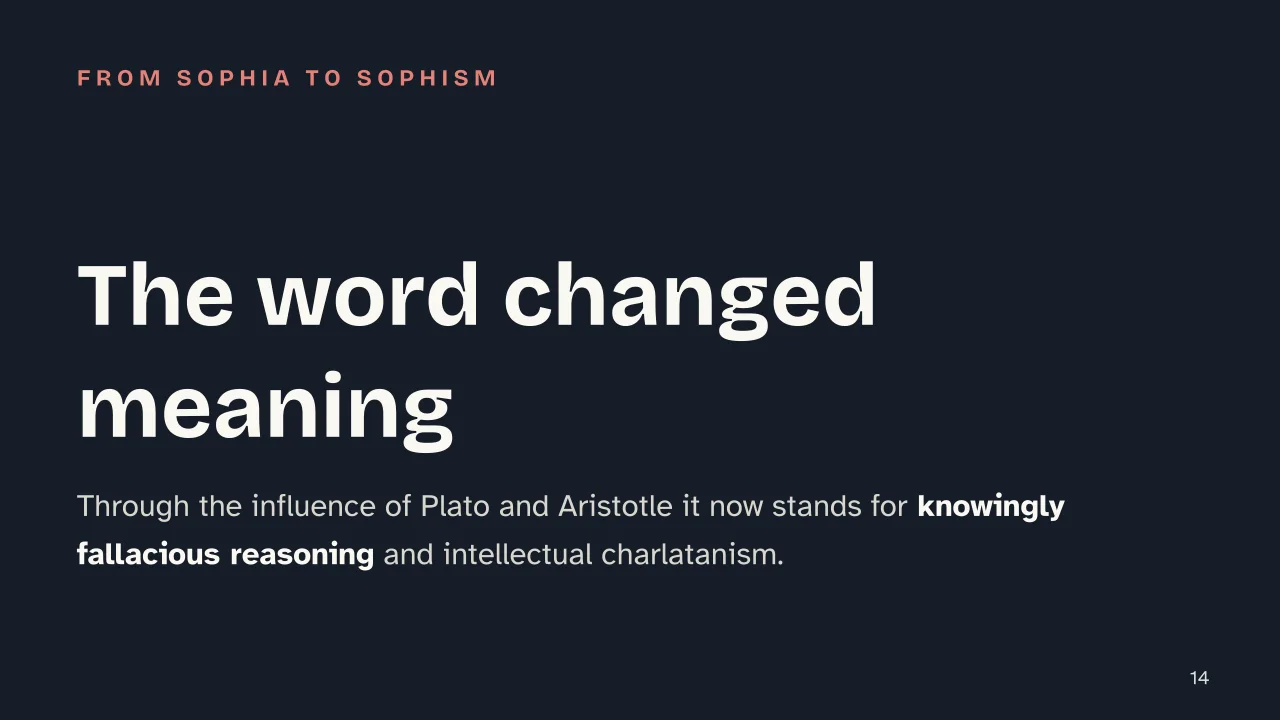
    It is mainly through the influence of Plato and Aristotle that “sophistry” means, in modern usage, reasoning built to be fallacious on purpose, intellectual charlatanism, a loose grip on moral scruple: the word lost its link with the wisdom it grew out of. Anyone who wants practice at taking apart an argument built to persuade can start with how to spot fake news.

    This is why the Stanford Encyclopedia of Philosophy warns that the current image of the sophist as an argumentative cheat significantly distorts the history that can be reconstructed. A school test usually turns on two distinctions: the one between physis and nomos, and the one between Plato’s sophist and the sophist of modern historical scholarship.

    Slide deck

    Slides ready to download and make your own in PowerPoint or Google Slides, with speaker notes. Pick the Flash cut or the Full one.
    Slide 1 of the presentation on Sophists: The sophistsSlide 2 of the presentation on Sophists: What is public speaking worth?Slide 3 of the presentation on Sophists: From rhetoric lessons to a bad nameSlide 4 of the presentation on Sophists: Chapter 01: A new trade for hireSlide 5 of the presentation on Sophists: Active in the later fifth century BC: Protagoras, Gorgias, HippiasSlide 6 of the presentation on Sophists: Price list for a lessonSlide 7 of the presentation on Sophists: Chapter 02: Athens wants speakersSlide 8 of the presentation on Sophists: What made Athens the marketSlide 9 of the presentation on Sophists: Chapter 03: Nature against conventionSlide 10 of the presentation on Sophists: Justice by nature or by agreementSlide 11 of the presentation on Sophists: There was no school of sophistsSlide 12 of the presentation on Sophists: Chapter 04: Plato strikes backSlide 13 of the presentation on Sophists: Why was Socrates taken for one of them?Slide 14 of the presentation on Sophists: The word changed meaningSlide 15 of the presentation on Sophists: Which subject sat at the centre of sophistic teaching?Slide 16 of the presentation on Sophists: Time to revise
    Flash10 slidesThe essential thread, to present in classFull16 slidesEvery chapter and the deeper detail

    Common myths

    • ✗ Myth The sophists were a philosophical school with a single doctrine.

      ✓ Reality The Stanford Encyclopedia of Philosophy describes freelance practitioners who each worked on their own, with no shared doctrines and no organisation of any kind. The disagreement about justice shows it: the papyrus attributed to Antiphon pushes towards personal advantage, while the Protagoras of the Great Speech holds that justice and self-control come naturally to human beings.

    • ✗ Myth A sophist was by definition a cheat with arguments.

      ✓ Reality That picture grew out of Plato's hostile portrait, which the Stanford Encyclopedia of Philosophy judges a significant distortion of the history that can be reconstructed. Most of what we know about the sophists reaches us through Plato's effort to keep philosophers apart from teachers who worked for money.

    • ✗ Myth Socrates counted as a sophist too, since he taught young men.

      ✓ Reality Athenians did tend to put him in that group; the Stanford Encyclopedia of Philosophy notes that Plato worked hard to argue they were wrong to do so. According to Plato's Apology, the hostile mood towards those teachers, staged in Aristophanes' Clouds, is what led to his conviction for impiety and corrupting the young.

    Mind map

    Drag the background to move around and the nodes to reposition them; use − and + to collapse and expand branches.
    Customize
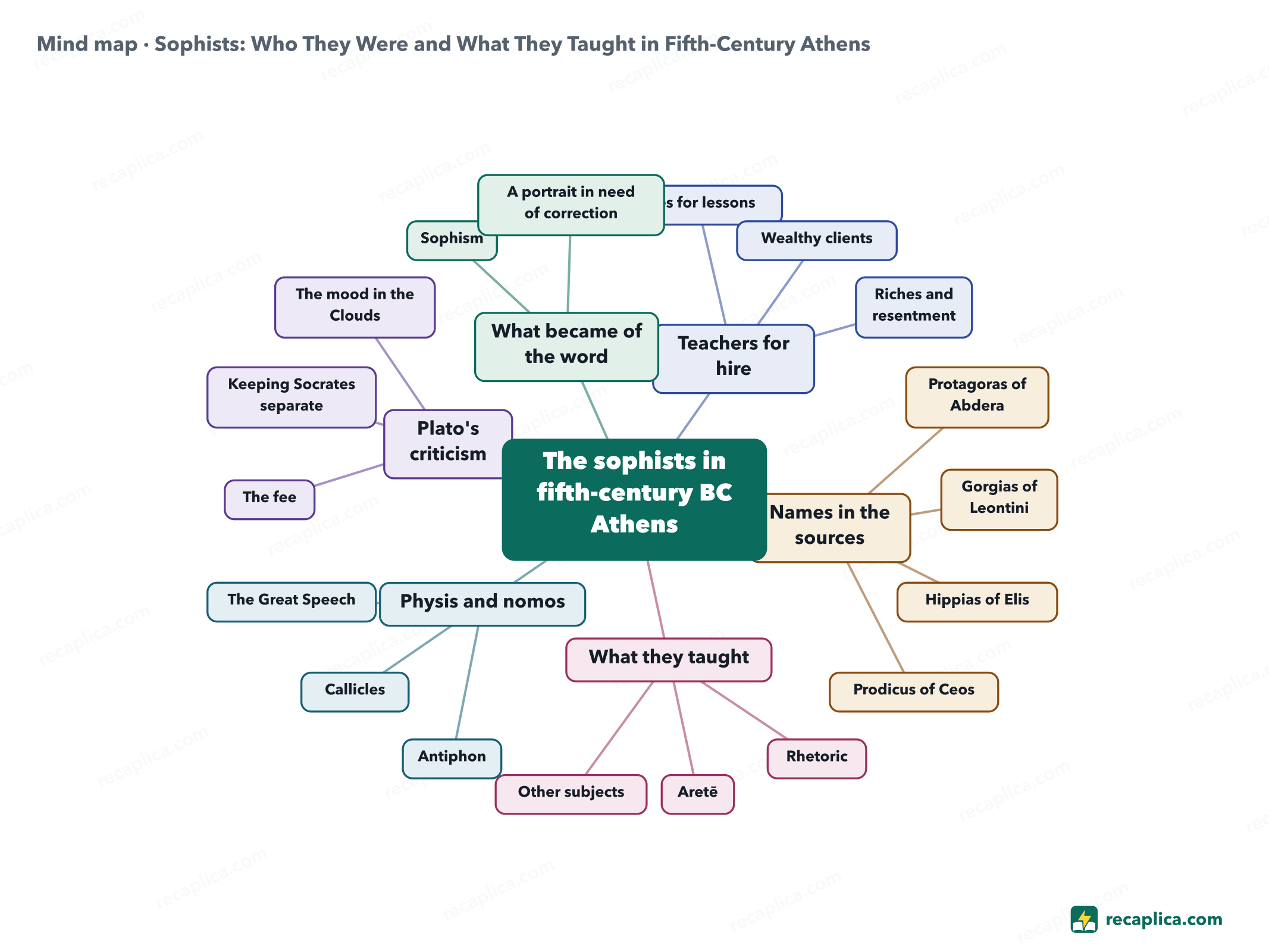
    Mind map: Sophists: Who They Were and What They Taught in Fifth-Century Athens
    • The sophists in fifth-century BC Athens
      • Teachers for hire A new trade, practised by travelling professionals
        • Fees for lessons
        • Wealthy clients
        • Riches and resentment
      • Names in the sources
        • Protagoras of Abdera About 490-420 BC
        • Gorgias of Leontini About 485-380 BC, from Sicily
        • Hippias of Elis
        • Prodicus of Ceos
      • What they taught
        • Rhetoric The core of the curriculum
        • Aretē Winning political power through speech
        • Other subjects
      • Physis and nomos Nature on one side, custom and law on the other
        • Antiphon Much of conventional justice clashes with nature
        • Callicles A Platonic character who defends the right of the strong
        • The Great Speech Protagoras calls justice natural
      • Plato's criticism
        • The fee Dismissive asides about the money
        • Keeping Socrates separate
        • The mood in the Clouds
      • What became of the word
        • Sophism
        • A portrait in need of correction

    Quiz: test yourself

    Answer the questions to check what you have learned: you get instant feedback and a short explanation.

    Grade 0/10 0/5
    1 Who were the sophists in Athens in the second half of the fifth century BC?

    The Internet Encyclopedia of Philosophy describes them as itinerant professionals who gave wealthy young Greeks an education in aretē in exchange for money.

    2 Which subject sat at the centre of sophistic teaching?

    Rhetoric carried the curriculum, even though most sophists said they taught other subjects as well. In Athenian courts and assemblies it was the skill most in demand.

    3 What separates physis from nomos in the Greek debate of the fifth century BC?

    The question was where moral and social rules come from. Do they rest on the nature of things, or do people simply settle them by habit and agreement? The sources record opposite answers.

    4 In the Great Speech reported by Plato, what does Protagoras hold about justice?

    In the Great Speech justice and self-control belong to human nature, since the species holds together only if they are taught to every member. The claim about the right of the strong belongs instead to the Platonic character Callicles.

    5 Why did the word "sophistry" take on a negative meaning?

    The Internet Encyclopedia of Philosophy gives Plato and Aristotle the larger share of the blame for the shift, which left the word meaning deliberately fallacious reasoning and intellectual charlatanism.

    Answers: 1-A · 2-A · 3-A · 4-A · 5-A

    Flashcards

    Tap the card to flip it and check whether you remember the answer, then move to the next one.

    1 / 7

    Explain it in your own words

    The ultimate test: if you can explain it in simple words, you've truly understood it. Write your explanation, then compare it with the Recap.

    Your explanation is saved only on this device.

    The sophists were professional teachers who travelled around Athens and other Greek cities in the second half of the fifth century BC, selling lessons to young men from wealthy families. Most of their teaching was rhetoric, the skill of speaking in public, because in the Athenian democracy anyone who could win over an assembly or a jury gained power. The arguments around them turned on whether justice comes from nature or from human agreement. Plato portrayed them as teachers selling a skill, and his portrait accounts for much of the negative charge "sophistry" carries in modern usage.

    Frequently asked questions

    What is a sophism?

    In modern usage it is an argument that looks sound and is not, built on purpose to carry a conclusion through. The sense comes from the drift of the word "sophistry", which thanks to Plato and Aristotle now means deliberately fallacious reasoning, intellectual charlatanism and a loose grip on moral scruple.

    What was the philosophy of the sophists?

    There is no single philosophy to report, because they were independent professionals. Two concerns do come back across the sources, the power of speech and the basis of social rules, and different teachers answered them in ways that sometimes clash head-on.

    Why did the sophists do so well in Athens in particular?

    Because Athenian participatory democracy made political careers and the outcome of trials depend on speaking in front of large numbers of people. Anyone selling that skill found clients willing to pay high prices.

    What did Plato hold against the sophists?

    Teaching for money. In the dialogues the fee comes up as a dismissive aside almost every time a sophist is named, and it serves to keep paid teachers at a distance from the figure of the philosopher.

    Were the sophists relativists?

    Some positions in the sources point that way, such as Plato's report that the just and the admirable hold good for the city that established them. Others do not, since the Great Speech attributed to Protagoras defends a justice natural to human beings.

    Sources

    • Stanford Encyclopedia of Philosophy, "The Sophists"
    • Internet Encyclopedia of Philosophy, "Sophists"

    Every Recap goes through an independent review before publication.

    Every evening, the day's new Recaps on our Telegram channel. Join the channel →

    Keep learning

    • History Roman Education: How Rome's Three-Tier School System Worked Roman education grew out of an idea the Romans called humanitas: the belief that a full human being is shaped by learning, not born complete. The word humanus originally meant simply being kind to others, but by the 1st century BC Cicero had stretched it to cover liberal education too, what the Greeks called paideia. That idea took a very concrete shape in Roman schools, split into three stages: the litterator taught children to read and write, the grammaticus added Greek and the natural sciences, and the rhetor trained young men in public speaking and law. Very few girls went past the first stage, since most married while still in their teens. Read the Recap →
    • History Saint Augustine of Hippo: Life, Conversion, and Philosophy Augustine of Hippo (354-430) was born in Thagaste, in Roman Numidia, to a Roman father and a mother, likely Berber, who was Christian. After a youth of rhetorical study and years following Manichaeism, he converted to Christianity in Milan in 386 and was baptized the following year. He became bishop of Hippo and wrote the Confessions and the City of God, two works that shaped Western philosophy. His thought blends the Neoplatonic tradition with Christianity, around the themes of free will, sin, and grace. Read the Recap →
    • History Hellenistic Judaism: What It Was and How Philo Read the Bible with Plato Hellenistic Judaism is the name given to Jewish thought as it grew up inside Greek culture, and the Internet Encyclopedia of Philosophy treats Philo of Alexandria as the most elaborate case of that encounter in Alexandria. Philo was born in Alexandria in Egypt around 20 BCE, into a wealthy and prominent Jewish family, and he trained in Greek philosophy at a high level. He read Scripture on the assumption that the text carries a literal sense and, underneath it, an allegorical one. Out of that reading came the idea he is best known for, the Logos, the part of God that a human mind can actually reach. Read the Recap →

    recaplica

    Clear in 30 seconds, yours in 10 minutes.

    Recaps Mind maps Request a Recap Telegram channel Mind map maker Our method About Privacy & cookies Legal notes & terms of use

    © 2026 Recaplica · A project by Curi S.r.l. — VAT IT05472000750

    Statistics, only if you say so

    To learn which Recaps help most we would use Google Analytics, with aggregate, anonymous data. It starts only with your OK, and you can change your mind anytime. Privacy policy