Skip to content
recaplica

    One moment: security check

    Cloudflare wants to make sure you're not a robot. Tick the box below and your search will continue on its own.

    IT
    recaplica Energy Sustainability: What It Means and How to Achieve It
    © 2026 Recaplica · recaplica.com — All rights reserved
    Home › Science

    Energy Sustainability: What It Means and How to Achieve It

    By Recaplica Newsroom · Updated on October 5, 2026

    What to print

    Page numbers appear when printing with default margins.

    Slides

    Choose a cut

    Flash10 slidesThe essential thread, to present in classFull16 slidesEvery chapter and the deeper detail

    Both come with speaker notes.

    Telegram channel
    recaplica Clear in 30 seconds, yours in 10 minutes.
    In 30 seconds Key points Figures Deep dive Slides Myths Mind map Quiz Flashcards FAQ

    In 30 seconds quick read

    Energy sustainability is the condition in which energy stays available, stays affordable and leaves a limited environmental footprint. The IEA, the international agency that studies energy systems, puts those three conditions in its stated mission, and the work runs along two lines, the sources energy is drawn from and the amount a given service requires. On the first, the IEA expects renewable capacity worldwide to grow by 4,600 GW between 2025 and 2030, with solar covering almost 80% of that. On the second, global energy efficiency should improve by 1.8% in 2025, while in the European Union Eurostat measured a renewable share of 26.2%, against a target of 42.5% by 2030.

    Key Points

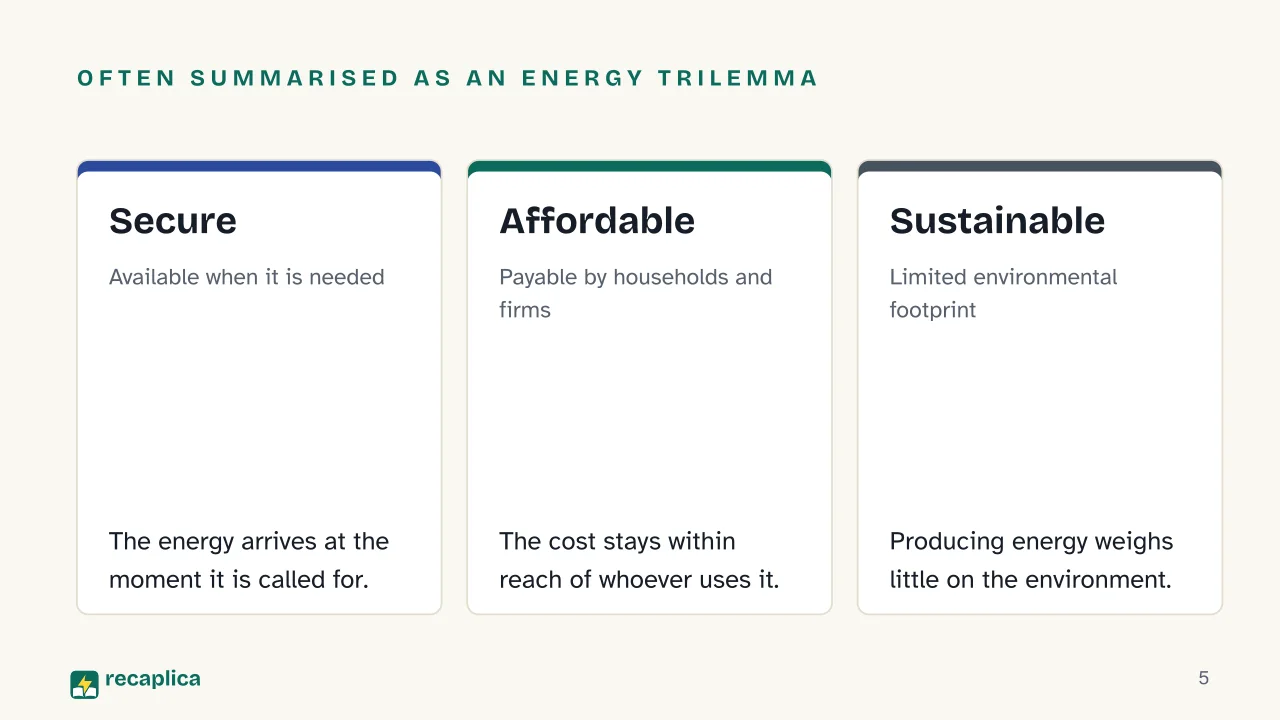
    • The mission the IEA states holds security, affordable cost and sustainability together, three conditions often summarised as an energy trilemma.
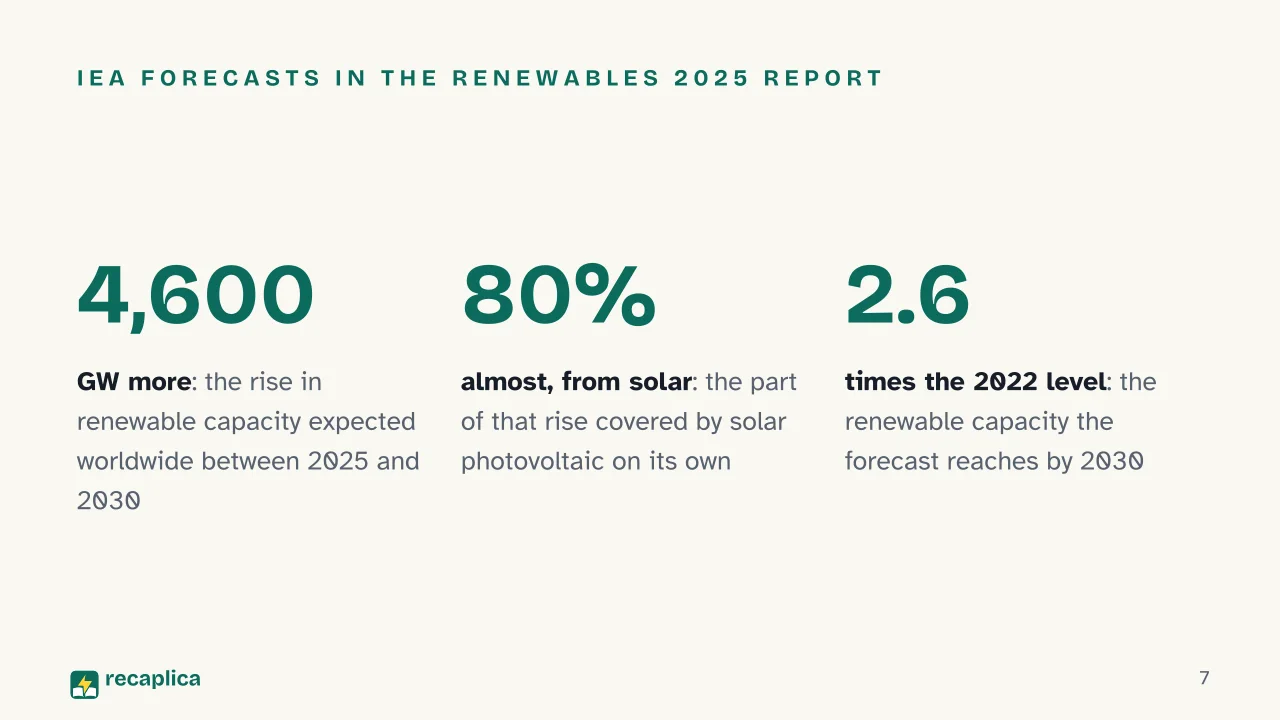
    • The IEA Renewables 2025 report expects installed renewable power worldwide to double between 2025 and 2030, which means 4,600 GW more.
    • Almost 80% of that growth would come from solar photovoltaic alone, with wind, hydropower, bioenergy and geothermal following at a distance.
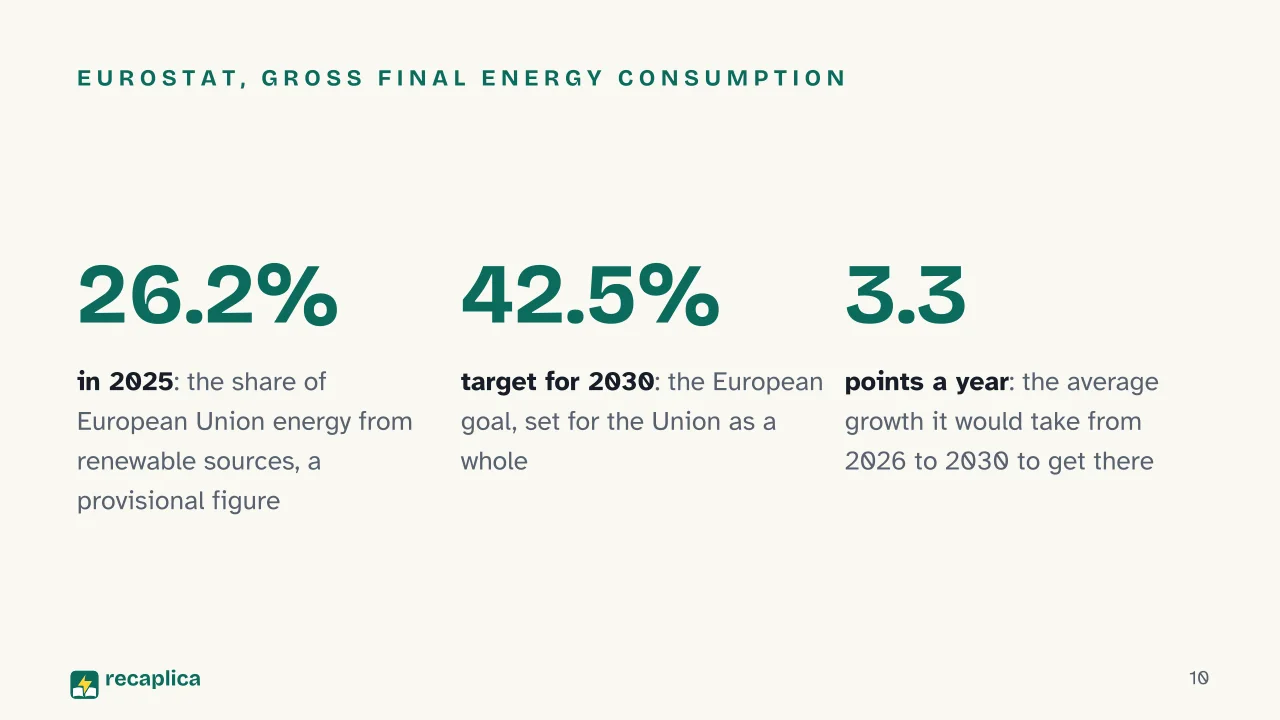
    • Eurostat measured a renewable share of 26.2% of the European Union's gross final energy consumption in 2025, a provisional figure up from 25.2% in 2024.
    • Reaching the 42.5% set for 2030 would take, in Eurostat's calculations, 3.3 percentage points of average growth a year from 2026 to 2030.
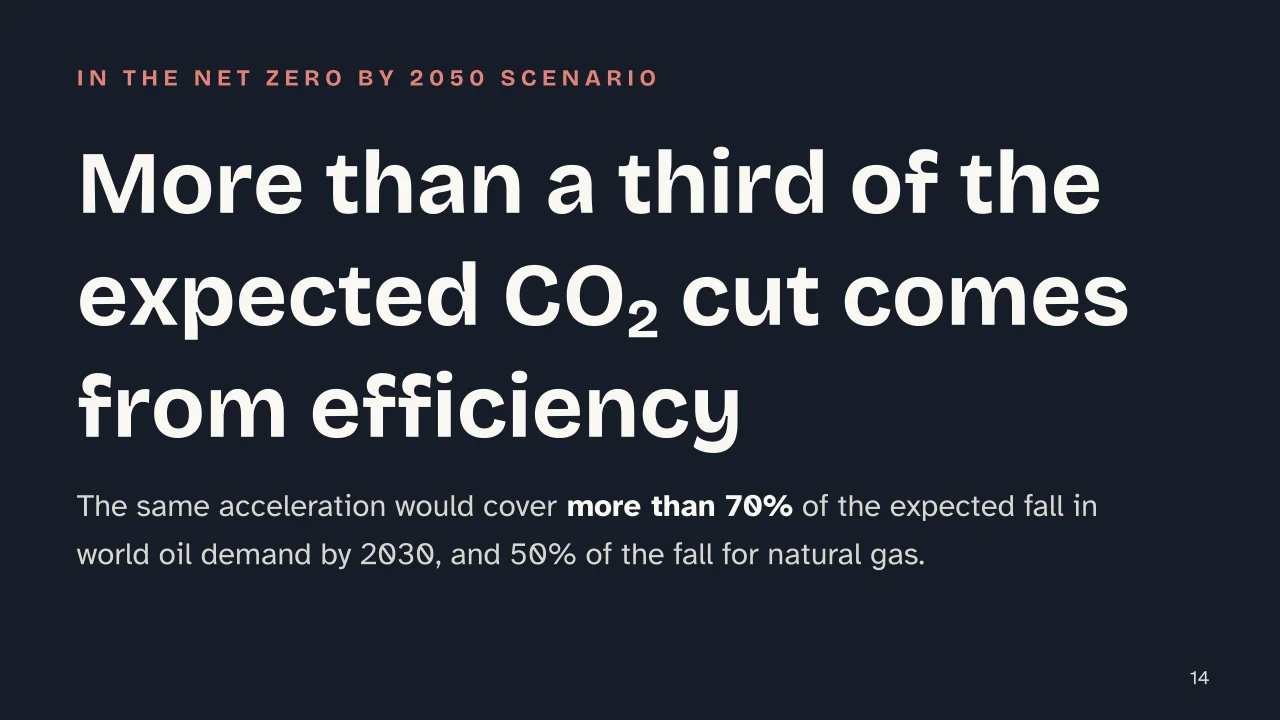
    • Inside the IEA scenario of net zero emissions by 2050, faster efficiency would deliver more than a third of the CO₂ reductions expected through 2030.

    Key figures

    • 26.2% the share of the European Union's gross final energy consumption covered by renewable sources in 2025, a provisional figure Source: Eurostat (2025 data, provisional)
    • 4,600 GW the rise in renewable capacity the IEA forecasts worldwide between 2025 and 2030, a doubling Source: IEA, Renewables 2025
    • 18 million people holding efficiency-related jobs around the world in 2024, almost, in an estimate the IEA revised upwards Source: IEA, Energy Efficiency 2025

    Deep Dive

    What we ask of energy

    The IEA, the International Energy Agency, states its mission as working with governments and industry to build an energy future that is secure, affordable and sustainable for all. That set of three is often summarised as an energy trilemma. It describes what energy sustainability asks for: energy has to be there when it is called for, it has to cost little enough for households and firms to afford it, and producing it must not leave an environmental bill to settle later. The same agency presents itself as a supplier of analysis and data that helps countries secure those conditions.

    Here the difference with sustainable development and its three pillars becomes visible, since that wider frame does not stop at the environment. Energy sustainability is the part that turns on two practical questions, where the energy comes from and how much of it is needed.

    Where the energy comes from

    According to the forecasts the IEA published in its Renewables 2025 report, world renewable capacity should double between 2025 and 2030, growing by 4,600 GW. Solar photovoltaic on its own stands for almost 80% of that, ahead of wind, hydropower, bioenergy and geothermal, and installed solar capacity should more than double over the five years to 2030. Panels and turbines feed electric current into the grid.

    Practical example: in the IEA forecasts, for every ten gigawatts of new renewable power installed through 2030, almost eight are photovoltaic.

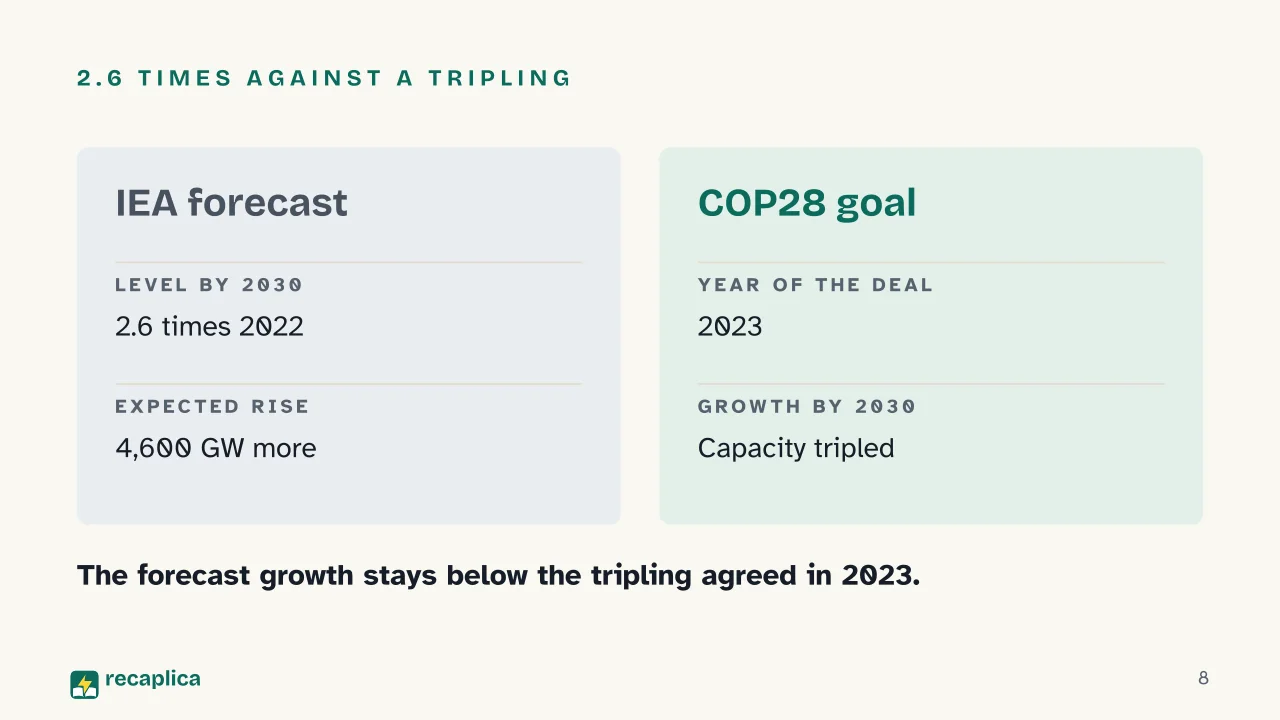
    The same forecast puts world renewable capacity at 2.6 times the 2022 level by 2030, less than the goal almost 200 countries agreed at COP28 in 2023, namely tripling world renewable capacity by the end of the decade.

    Europe at 26.2%

    According to provisional Eurostat data, 26.2% of the European Union’s gross final energy consumption came from renewable sources in 2025, climbing from 25.2% in 2024. The European target for 2030 is still 42.5%, and reaching it from the 2025 starting point would ask the share to rise by 3.3 percentage points a year on average between 2026 and 2030, Eurostat calculates.

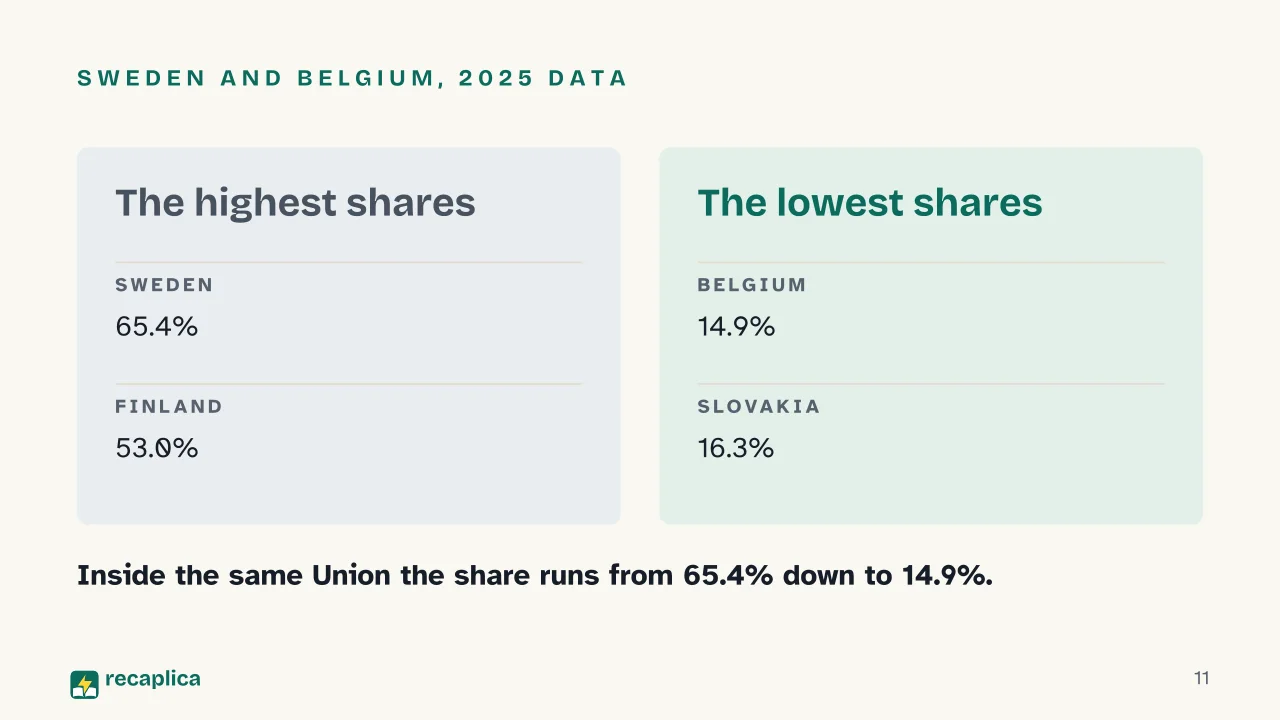
    The European figure is an average, and the distances inside it are wide.

    CountryRenewable share of gross final consumption, 2025
    Sweden65.4%
    Finland53.0%
    Denmark48.2%
    Ireland17.2%
    Slovakia16.3%
    Belgium14.9%

    How much energy a service needs

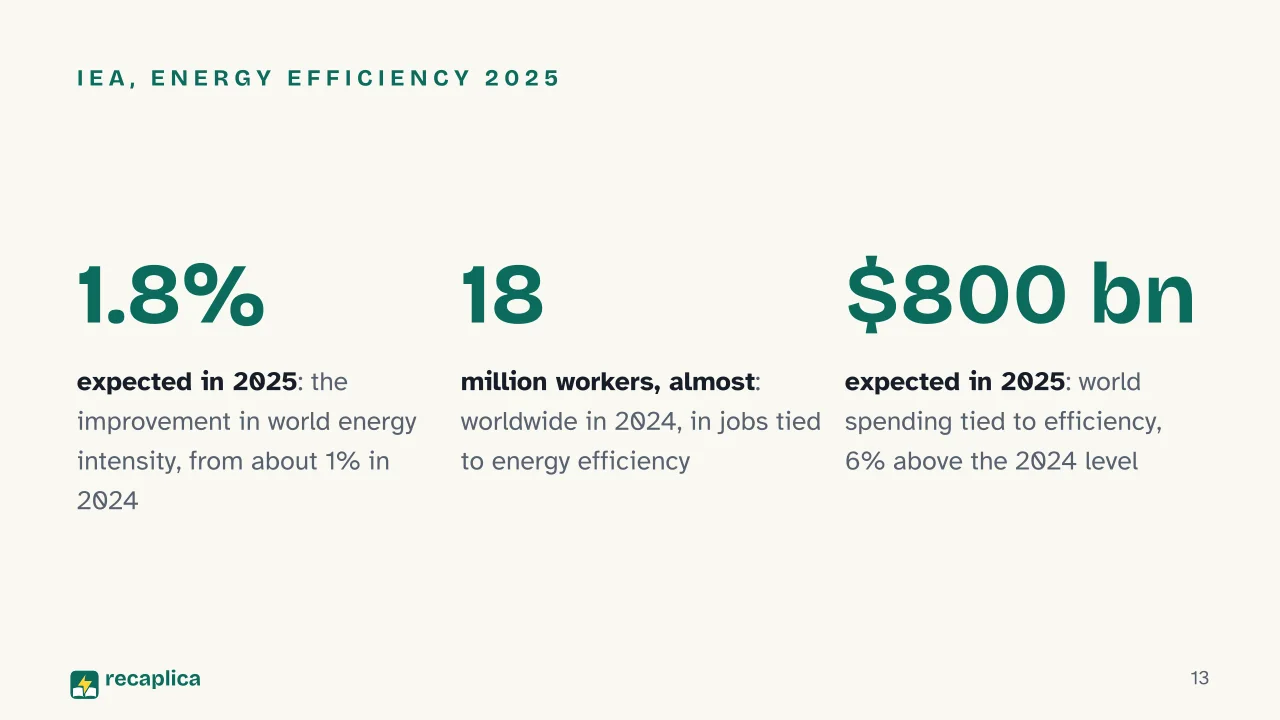
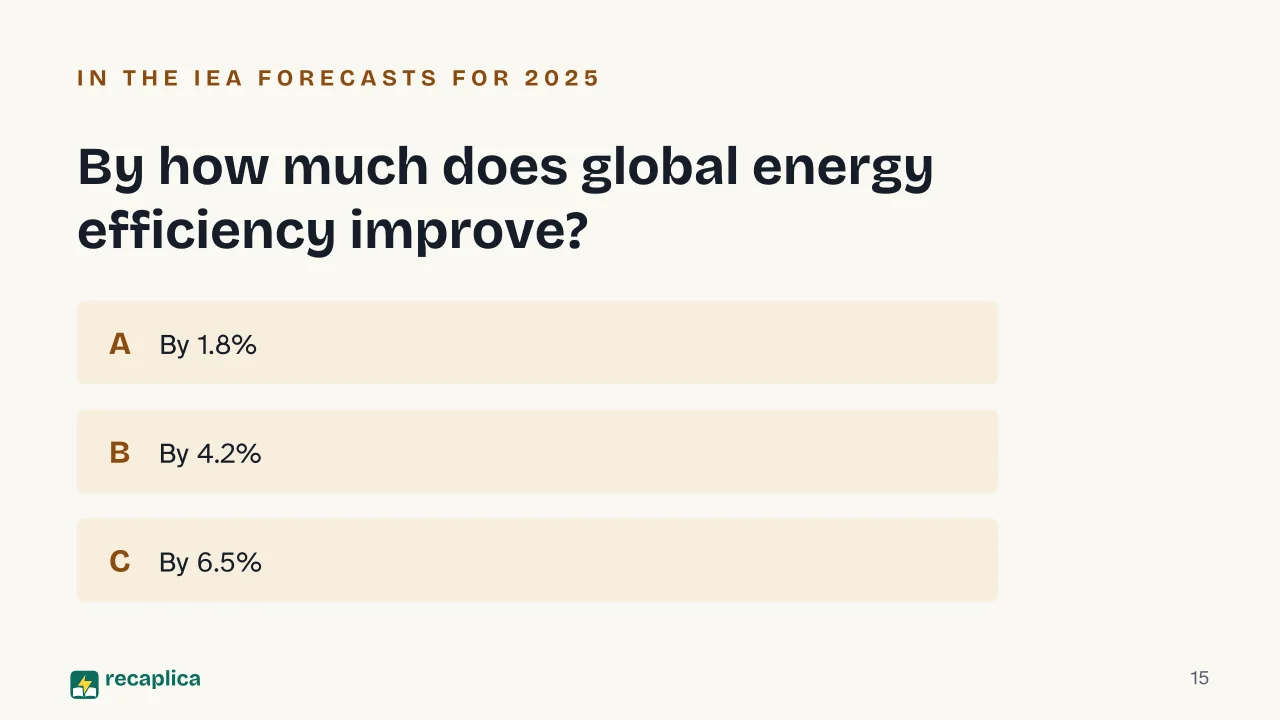
    The second lever is demand, meaning how much energy it takes to heat a building or keep a plant running. The indicator the IEA tracks it with is primary energy intensity: its improvement, stuck at roughly 1% in 2024, is expected to reach 1.8% in 2025. For that same year the agency puts world efficiency-related spending at almost 800 billion dollars, 6% above 2024 and more than 70% above 2015. The same edition of the report counts nearly 18 million people worldwide in jobs tied to energy efficiency in 2024, an estimate the IEA revised upwards from the year before.

    Further out the arithmetic changes scale. In a scenario of net zero emissions by 2050 the IEA places the spending needed on efficiency in buildings, transport and industry at around 1,900 billion dollars, three times the 660 billion that the previous edition of the report estimated on that item in 2024. In the same scenario, faster efficiency gains would cover more than 70% of the expected fall in oil demand by 2030 and 50% of the reduction expected for natural gas. Both levers end up measured against the same outcome, emissions of carbon dioxide, the greenhouse gas that human activity releases into the atmosphere and that the Recap on how the greenhouse effect works deals with. Still on the path to net zero by 2050, faster efficiency on its own would deliver more than a third of all the CO₂ emission reductions expected through 2030.

    Slide deck

    Slides ready to download and make your own in PowerPoint or Google Slides, with speaker notes. Pick the Flash cut or the Full one.
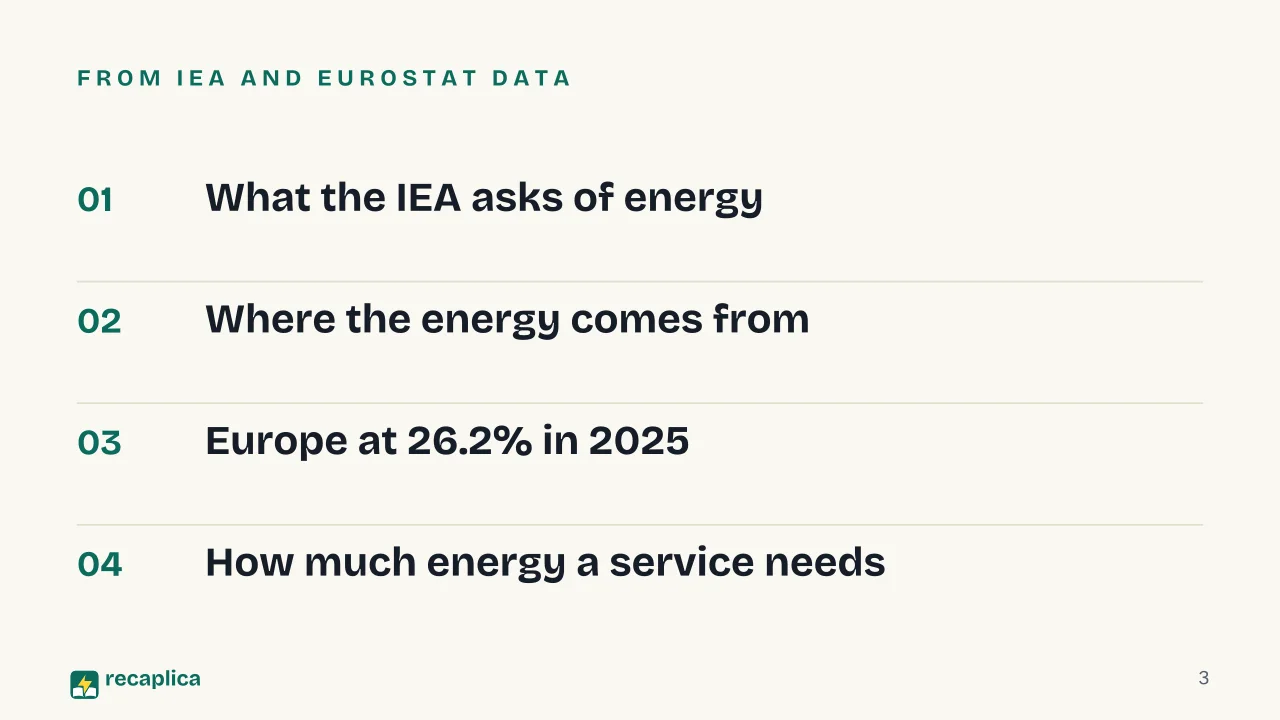
    Slide 1 of the presentation on Energy Sustainability: Energy sustainabilitySlide 2 of the presentation on Energy Sustainability: How much European energy comes from renewable sources?Slide 3 of the presentation on Energy Sustainability: From IEA and Eurostat dataSlide 4 of the presentation on Energy Sustainability: Chapter 01: What the IEA asks of energySlide 5 of the presentation on Energy Sustainability: Often summarised as an energy trilemma: Secure, Affordable, SustainableSlide 6 of the presentation on Energy Sustainability: Chapter 02: Where the energy comes fromSlide 7 of the presentation on Energy Sustainability: IEA forecasts in the Renewables 2025 reportSlide 8 of the presentation on Energy Sustainability: 2.6 times against a triplingSlide 9 of the presentation on Energy Sustainability: Chapter 03: Europe at 26.2% in 2025Slide 10 of the presentation on Energy Sustainability: Eurostat, gross final energy consumptionSlide 11 of the presentation on Energy Sustainability: Sweden and Belgium, 2025 dataSlide 12 of the presentation on Energy Sustainability: Chapter 04: How much energy a service needsSlide 13 of the presentation on Energy Sustainability: IEA, Energy Efficiency 2025Slide 14 of the presentation on Energy Sustainability: More than a third of the expected CO₂ cut comes from efficiencySlide 15 of the presentation on Energy Sustainability: By how much does global energy efficiency improve?Slide 16 of the presentation on Energy Sustainability: The full Recap
    Flash10 slidesThe essential thread, to present in classFull16 slidesEvery chapter and the deeper detail

    Common myths

    • ✗ Myth Energy sustainability means installing solar panels.

      ✓ Reality Panels sit on the supply side alone. The other side is how much energy a given service requires, and on a path to net zero emissions by 2050 the IEA credits faster efficiency with over a third of the carbon dioxide cuts the world expects by 2030.

    • ✗ Myth The European Union has already met its renewable energy target.

      ✓ Reality Eurostat measured a provisional share of 26.2% of gross final energy consumption for 2025, while the European target for 2030 is 42.5%. Covering the distance would take 3.3 percentage points of average growth a year from 2026 to 2030.

    • ✗ Myth The pledges governments have already made are enough to triple renewable capacity by 2030.

      ✓ Reality The IEA expects world renewable capacity to reach 2.6 times the 2022 level by 2030, therefore below the tripling that almost 200 countries agreed at COP28 in 2023.

    Mind map

    Drag the background to move around and the nodes to reposition them; use − and + to collapse and expand branches.
    Customize
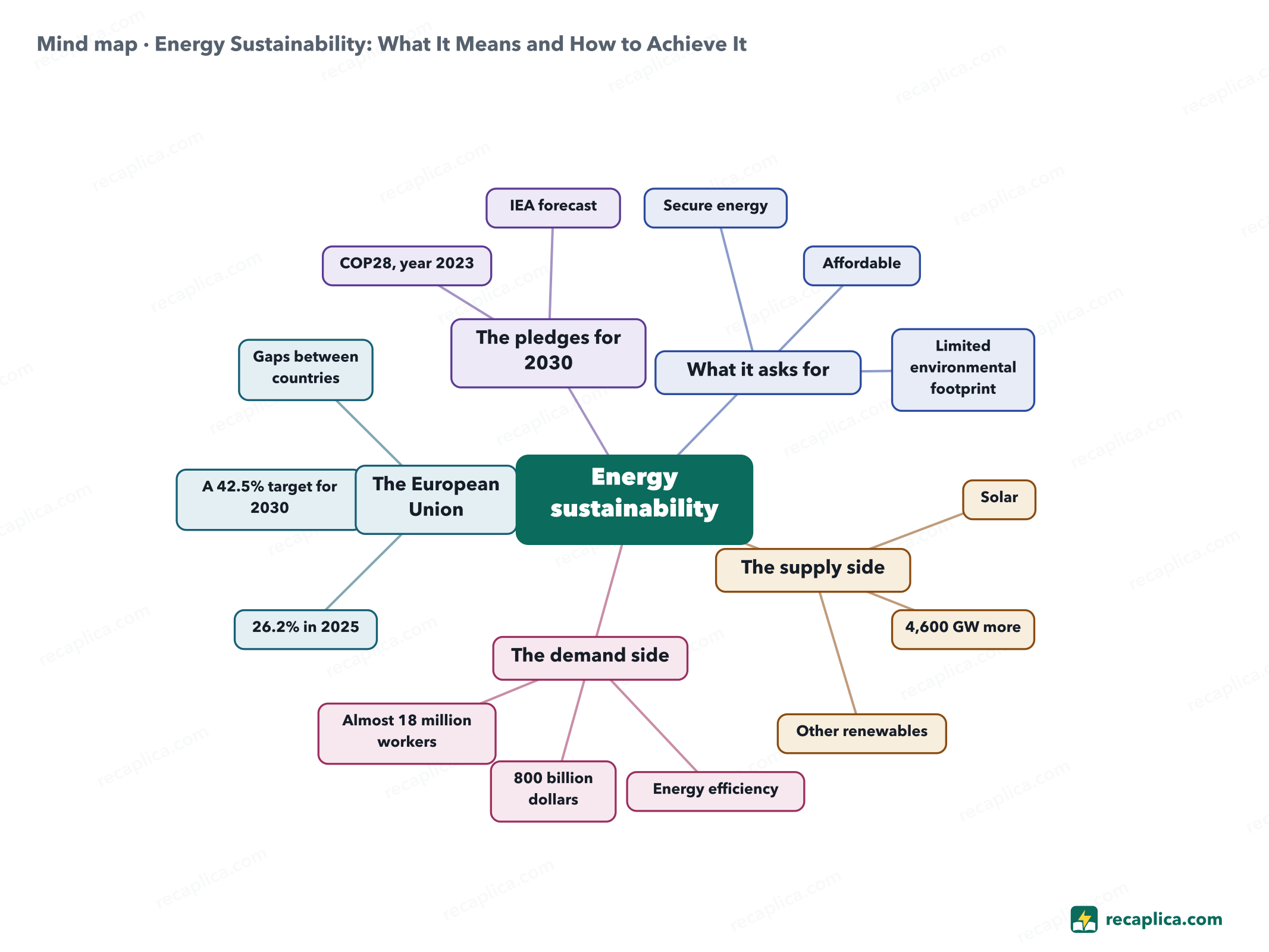
    Mind map: Energy Sustainability: What It Means and How to Achieve It
    • Energy sustainability
      • What it asks for The conditions of the IEA mission, read as a trilemma
        • Secure energy Available when it is needed
        • Affordable Payable by households and firms
        • Limited environmental footprint
      • The supply side
        • Solar Almost 80% of the rise expected through 2030
        • 4,600 GW more IEA forecast for 2025 to 2030
        • Other renewables Wind, hydropower, bioenergy, geothermal
      • The demand side
        • Energy efficiency An improvement of 1.8% expected in 2025
        • 800 billion dollars Efficiency-related spending expected in 2025
        • Almost 18 million workers Jobs tied to efficiency in 2024
      • The European Union
        • 26.2% in 2025 Provisional Eurostat figure on gross final consumption
        • A 42.5% target for 2030 It would take 3.3 points a year from 2026
        • Gaps between countries From 65.4% in Sweden to 14.9% in Belgium
      • The pledges for 2030
        • COP28, year 2023 Almost 200 countries, tripling capacity
        • IEA forecast 2.6 times the 2022 level

    Quiz: test yourself

    Answer the questions to check what you have learned: you get instant feedback and a short explanation.

    Grade 0/10 0/5
    1 According to provisional Eurostat data, what share of the European Union's gross final energy consumption came from renewable sources in 2025?

    Eurostat records 26.2% for 2025, up from 25.2% the year before. The 42.5% figure is the European target for 2030, and 65.4% was Sweden's share, the highest in the Union.

    2 In the IEA forecasts of the Renewables 2025 report, which technology covers almost 80% of the rise in renewable capacity through 2030 on its own?

    The forecast assigns solar almost 80% of the increase in renewable power over the period. Wind, hydropower, bioenergy and geothermal come next, with much smaller shares.

    3 How much is global energy efficiency forecast to improve in 2025, according to the IEA?

    The improvement, read on the indicator of primary energy intensity, is put at 1.8% for 2025, against roughly 1% recorded the year before.

    4 How many countries agreed at COP28 in 2023 to triple global renewable capacity by 2030?

    The pledge to triple renewable capacity by 2030 was set by almost two hundred countries at the COP28 climate summit. The IEA forecasts stop at 2.6 times the 2022 level.

    5 How does the IEA describe the energy future it works towards?

    The wording the IEA uses to present its mission holds three conditions together, security, affordability and sustainability, and declares them valid for everyone.

    Answers: 1-B · 2-A · 3-A · 4-C · 5-A

    Flashcards

    Tap the card to flip it and check whether you remember the answer, then move to the next one.

    1 / 7

    Explain it in your own words

    The ultimate test: if you can explain it in simple words, you've truly understood it. Write your explanation, then compare it with the Recap.

    Your explanation is saved only on this device.

    Energy sustainability is the condition in which energy stays available, stays affordable and leaves a limited environmental footprint. The IEA, the international agency that studies energy systems, puts those three conditions in its stated mission, and the work runs along two lines, the sources energy is drawn from and the amount a given service requires. On the first, the IEA expects renewable capacity worldwide to grow by 4,600 GW between 2025 and 2030, with solar covering almost 80% of that. On the second, global energy efficiency should improve by 1.8% in 2025, while in the European Union Eurostat measured a renewable share of 26.2%, against a target of 42.5% by 2030.

    Frequently asked questions

    What is energy sustainability?

    It is the condition in which energy is produced and used in a way that does not put future availability, affordability or the environment at risk. Those are the three requirements the IEA puts in its mission, and they are often summarised as an energy trilemma. In practice the work happens on two sides, how energy is produced and how efficiently it is used.

    Which renewable sources will grow the most by 2030?

    In the forecasts of the IEA report Renewables 2025, solar photovoltaic on its own covers almost 80% of the increase in renewable capacity through 2030, ahead of wind, hydropower, bioenergy and geothermal. These are projections built on the policies and projects known when the report was written, not figures already recorded.

    Is the European Union on track for its renewable energy target?

    In 2025 the renewable share of gross final energy consumption was 26.2% according to provisional Eurostat data, up from 25.2% in 2024. The goal for 2030 is 42.5%, and getting there from that starting point would take average growth of 3.3 percentage points a year from 2026 to 2030, much faster than the pace held so far.

    What is energy efficiency for, if renewables exist?

    It cuts the amount of energy a given service requires, and therefore the work supply has to cover. On a path aligned with net zero emissions by 2050, the IEA calculates that faster efficiency is worth more than 70% of the expected fall in oil demand by 2030, half of the reduction expected for natural gas, and more than a third of the planned CO₂ reductions.

    Sources

    • IEA — Our mission
    • IEA — Renewables 2025, Executive summary
    • IEA — Renewables 2024, Executive summary
    • Eurostat — Renewables make up 26% of EU energy use
    • IEA — Energy Efficiency 2025, Executive summary
    • IEA — Energy Efficiency 2024, Executive summary

    Every Recap goes through an independent review before publication.

    Every evening, the day's new Recaps on our Telegram channel. Join the channel →

    Keep learning

    • Science What Is Frost and How Does It Form? Frost is the layer of ice crystals that appears on grass, cars and roofs on cold mornings. It forms through deposition, when water vapor in the air turns directly into ice without passing through a liquid stage first. This requires the surface itself to drop below 0°C, a condition that develops most easily on clear nights with light wind and no fog. Some surfaces frost earlier than others because they lose heat at different rates: grass faster than asphalt, glass and metal faster than most other materials. Frost should not be confused with rime, which forms when supercooled fog droplets freeze on contact with a surface exposed to wind. Read the Recap →
    • Science Weather Forecasting: How It Works, From Data to Models to Forecasters A weather forecast starts with thousands of measurements collected every day by ground stations, radar, satellites and radiosondes carried aloft by balloons. A numerical model takes that data as a starting snapshot and uses the equations of physics to calculate how the atmosphere will change hour by hour. The further out the forecast reaches, the more a tiny error in the starting data grows, which is why detailed forecasts hold up for roughly a week, while beyond 15 days large models such as the ECMWF's work only in probabilities. In the end it's still a forecaster who settles on what to communicate to the public, uncertainty included. Read the Recap →
    • Science How Thunderstorms Form: From Warm Air to Lightning A thunderstorm forms when warm, moist air near the ground gets pushed upward, meets unstable air, and keeps rising until it builds a towering cloud, the cumulonimbus. It goes through three stages: developing, then mature, and finally dissipating. A single storm cell typically lasts 30 to 60 minutes, while the whole process takes about an hour. The mature stage is also the most dangerous: updrafts and downdrafts coexist and bring heavy rain, hail, strong wind, and lightning; if the updraft starts rotating because of winds that shift with height, a supercell forms, the longest-lived storm type, and the one most associated with the most violent tornadoes. Some storms, instead of fading away, keep regenerating over the same spot for hours, dumping persistent rain. Read the Recap →

    recaplica

    Clear in 30 seconds, yours in 10 minutes.

    Recaps Mind maps Request a Recap Telegram channel Mind map maker Our method About Privacy & cookies Legal notes & terms of use

    © 2026 Recaplica · A project by Curi S.r.l. — VAT IT05472000750

    Statistics, only if you say so

    To learn which Recaps help most we would use Google Analytics, with aggregate, anonymous data. It starts only with your OK, and you can change your mind anytime. Privacy policy